
Taiwan entrepreneurs: form your Bahrain company with generally no corporate income tax for most sectors. Simple registration process, full foreign ownership, and strategic Gulf market access.
Key Takeaways
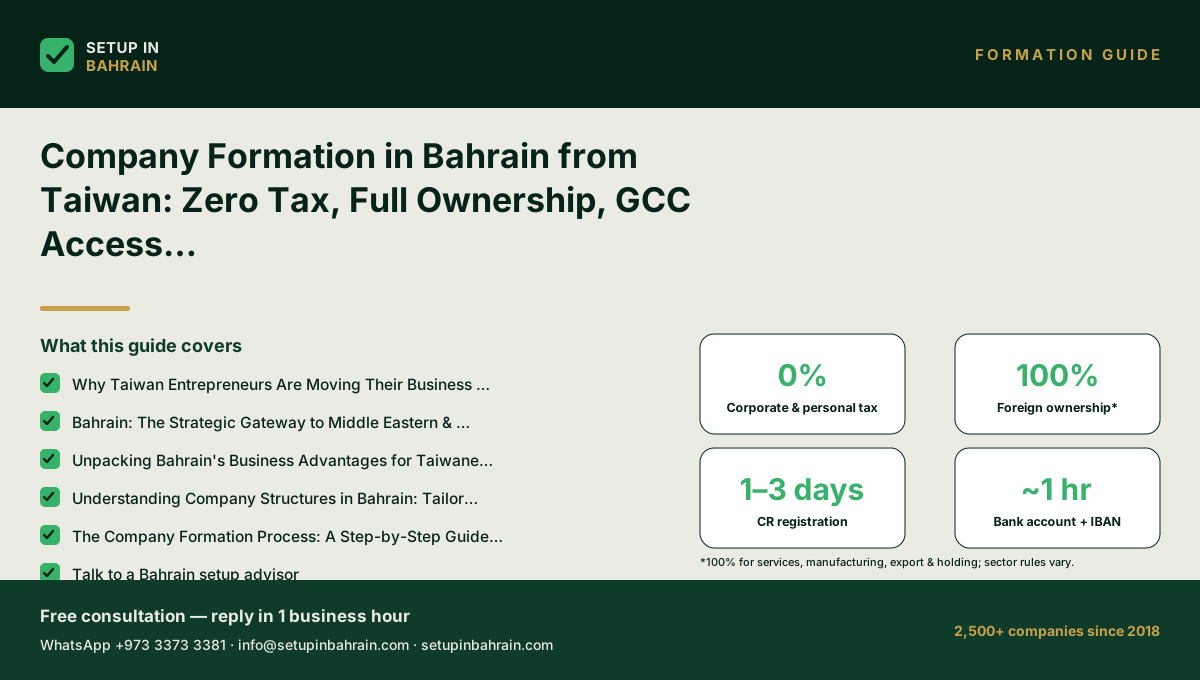
- Why Taiwan Entrepreneurs Are Moving Their Business to Bahrain
- Bahrain: The Strategic Gateway to Middle Eastern & Global Markets
- Unpacking Bahrain's Business Advantages for Taiwanese Firms
- Understanding Company Structures in Bahrain: Tailored for Taiwanese Needs
- The Company Formation Process: A Step-by-Step Guide for Taiwanese Entrepreneurs
→ Complete guide: Company Formation in Bahrain — the full 2026 guide
View details
Ownership & capital
A Bahrain WLL can be owned by a single person — 100% foreign ownership applies to most activities, with no local partner required for services, manufacturing, export trading and holding companies. The minimum share capital is BHD 1 ; we recommend BHD 1,000 . This Makes bank account opening and investor visa approval smoother.
For many visionary entrepreneurs in Taiwan, the aspiration for international expansion and enhanced financial autonomy often encounters a formidable array of familiar obstacles: the persistent 20% corporate income tax, the often-convoluted Ministry of Finance (MOF) e-filing system in Mandarin that can consume countless hours, the mandatory annual audit for companies merely touching TWD 30 million in revenue, and the constant friction of New Taiwan Dollar (TWD) currency controls that greatly restrict free outbound remittances. These aren't just administrative hurdles; they are substantial limitations on growth, profit retention, and strategic agility.
Imagine, for a moment, you’re Ms. Chen, a seasoned entrepreneur from Taichung, who has painstakingly built a thriving electronics component export business over two decades. Her company, generating a solid TWD 50 million in annual revenue, finds itself perpetually navigating the complexities of Taiwan’s tax regime. Every year, a significant chunk of her hard-earned profits vanishes into corporate taxes, alongside the substantial costs of mandatory audits and the ever-present concern of cross-strait political risks casting a shadow over her international contracts. When she tries to remit funds for overseas investments or expansion, she’s met with layers of approvals and delays due to Taiwan’s stringent currency controls, a process that feels designed to keep capital tethered.
Or consider Mr. Lin from Taoyuan, whose successful electronics components export business brings in an annual revenue of TWD 85 million. After paying the 20% corporate income tax, social welfare contributions. Mandatory audit fees for exceeding the TWD 30 million threshold, his clear profit margin is greatly reduced. He recently discovered that remitting even a portion of those profits abroad for a critical international expansion triggered additional, complex reporting requirements to Taiwan’s Central Bank of China and potential scrutiny under the island's currency control rules. One client I worked with last year, facing a similar situation, spent three months navigating Ministry of Economic Affairs approval for a single outbound investment filing before he could legally move capital to establish a new subsidiary. This isn’t just an inconvenience; it’s a direct impediment to global competitiveness and efficient capital deployment.
This isn't merely Ms. Chen's or Mr. Lin's story; it's a shared reality for countless ambitious Taiwanese business owners looking beyond their shores. You are innovative, resilient, and globally-minded. The current operational environment can feel like trying to run a marathon with ankle weights, while your international competitors sprint ahead unencumbered.
What if there was a strategic pivot point, a gateway that could instantly remove these burdens, providing not just substantial financial relief but also unprecedented access to new, rapidly growing markets? This comprehensive guide is designed specifically for you, the Taiwanese entrepreneur, to explore Bahrain—a nation in the heart of the Arabian Gulf that offers a compelling and modern alternative. From generally no corporate income tax for most sectors to 100% foreign ownership. A direct conduit to the entire GCC (Gulf Cooperation Council) market, Bahrain presents a unique proposition for your global expansion plans.
Why Taiwan Entrepreneurs Are Moving Their Business to Bahrain
The decision to relocate or expand a business internationally is never taken lightly. For Taiwanese entrepreneurs, it's often driven by a strategic imperative to overcome specific, recurring domestic challenges that hinder growth and profitability. Bahrain emerges as a uniquely attractive solution, directly addressing these pain points.
Let's unpack the specific challenges that make Bahrain such a compelling alternative:
- The 20% Corporate Income Tax Burden: In Taiwan, your meticulously earned profits are subject to a significant 20% corporate income tax. This means that for every TWD 10 million in profit, TWD 2 million goes directly to the tax authorities. While necessary for national development, this can severely impact your ability to reinvest in R&D, expand operations, or retain talent. Bahrain’s Solution:* Generally no corporate income tax for most sectors. This isn't a temporary incentive; it's a foundational element of Bahrain's economic strategy. Imagine retaining 100% of your net profits, immediately boosting your reinvestment capacity and shareholder returns. This translates into tangible growth potential and financial flexibility that is simply unavailable in your home market.
- Complex MOF E-filing in Mandarin: Navigating Taiwan's Ministry of Finance (MOF) e-filing system, especially for non-accountants or those without expert local support, can be a labyrinthine and time-consuming process. The system is entirely in Mandarin, adding an additional layer of complexity for those who might prefer an English-language interface, or requiring constant reliance on local accounting firms, which adds to operational costs.
- Mandatory Audit for Companies Above TWD 30 Million Revenue: The moment your company's revenue surpasses TWD 30 million, a mandatory annual audit kicks in. While audits are good for transparency, they represent a recurring, non-trivial expense. For a growing business, these costs can accumulate, especially when compounded with the 2generally no corporate income tax for most sectors.
- TWD Currency Controls Limiting Free Outbound Remittance: Perhaps one of the most significant frustrations for internationally ambitious Taiwanese entrepreneurs is the array of TWD currency controls. Attempting to freely remit substantial profits or capital abroad for investments, dividends, or even personal wealth management often involves multiple layers of approvals from the Central Bank of China (CBC) and other regulatory bodies, leading to delays, scrutiny, and sometimes, outright restrictions. This stifles global capital deployment and limits financial agility.
Cross-Strait Political Risk: The geopolitical realities of the Taiwan Strait cast a persistent shadow over international business contracts, supply chain stability. Long-term investment planning for many Taiwanese enterprises. While highly resilient, the inherent political risk can make international partners hesitant and can impact the valuation of your business operations. Bahrain’s Solution:* Geopolitical Stability and Neutrality. Bahrain is renowned for its political stability, robust legal framework, and strong international relationships. Situated in a strategically important but politically neutral position, it offers a secure and predictable environment for international business. Operating from Bahrain mitigates political supply chain risks, enhances business continuity. Presents your company as a stable, globally-integrated entity, appealing to a wider range of international partners and investors.
By strategically establishing a presence in Bahrain, Taiwanese entrepreneurs can effectively shed these traditional burdens, unlocking a new level of financial freedom, market access, and operational efficiency. It’s not just about avoiding taxes; it’s about optimizing your entire business model for global success.
Bahrain: The Strategic Gateway to Middle Eastern & Global Markets
Bahrain, often referred to as the "Pearl of the Gulf," is more than just a zero-tax jurisdiction; it is a meticulously crafted strategic hub designed for global commerce. Its unique advantages stem from its forward-thinking leadership, progressive economic policies. A deep understanding of what international businesses need to thrive.
Geopolitical Stability and Strategic Location
Bahrain boasts a long-standing reputation for political stability within the Arabian Gulf. Its government, led by His Majesty King Hamad bin Isa Al Khalifa, has consistently pursued policies that foster economic openness and secure regional partnerships. This stability is crucial for long-term investment planning and provides a reliable backdrop for business operations.
Geographically, Bahrain is an island nation strategically positioned in the Arabian Gulf, making it an ideal gateway to the burgeoning markets of the GCC, the wider Middle East and North Africa (MENA) region, and even parts of Africa and Asia. The GCC alone represents a market of over 50 million affluent consumers, with a combined GDP exceeding US$1.6 trillion. With its causeway connection to Saudi Arabia, the largest economy in the GCC, Bahrain offers seamless land access to a vast and dynamic consumer base.
Pro-Business Environment and Economic Diversification
For decades, Bahrain has been at the forefront of economic diversification within the GCC. Recognizing the need to move beyond oil and gas, the government, through entities like the Bahrain Economic Development Board (EDB), has aggressively championed sectors such as financial services, logistics, manufacturing, tourism, and information and communications technology (ICT). This proactive approach has cultivated a highly competitive and supportive business ecosystem.
The World Bank's Ease of Doing Business Report consistently ranks Bahrain favorably, highlighting its efficient regulatory processes, strong investor protection. Ease of starting a business. The EDB reports that Bahrain attracted US$1.7 billion in direct investment in 2022, creating over 6,300 jobs across various sectors, demonstrating concrete investor confidence.
Advanced Digital Infrastructure and Innovation Hub
Bahrain has invested greatly in its digital infrastructure, making it a pioneer in adopting cloud technology and fostering a vibrant FinTech ecosystem. It was the first country in the MENA region to adopt a national cloud-first policy. Amazon Web Services (AWS) established its first Middle East Region data centers in Bahrain in 2019. This commitment to digital transformation provides a robust and secure foundation for data-intensive businesses, e-commerce platforms. Tech startups.
The Kingdom’s Central Bank of Bahrain (CBB) has also been instrumental in creating a regulatory sandbox for FinTech innovation, attracting global players and fostering local talent. This makes Bahrain an attractive destination for Taiwanese tech companies looking to pilot new solutions or tap into a digitally savvy market.
Unpacking Bahrain's Business Advantages for Taiwanese Firms
Beyond simply addressing the pain points of Taiwanese entrepreneurs, Bahrain offers a suite of proactive advantages that can transform your business trajectory.
Generally no corporate income tax for most sectors: A Powerful Competitive Edge
This is arguably Bahrain’s most impactful offering for Taiwanese businesses. Unlike Taiwan’s 20% corporate income tax, Bahrain imposes generally no corporate income tax for most sectors on the vast majority of businesses. There are no annual profit taxes, no capital gains taxes. No withholding taxes on dividends, interest, or royalties. This means that 100% of your net profits remain within your company, available for reinvestment, expansion, or distribution to shareholders.
Direct Impact: For an electronics components exporter like Mr. Lin, generating TWD 85 million (approx. BHD 1 million at a conversion of 1 TWD = 0.012 BHD) in profit, a 20% tax rate in Taiwan means sacrificing BHD 200,000 annually. In Bahrain, that entire BHD 200,000 stays in the company, directly boosting cash flow and increasing capital available for growth initiatives. This isn't just a saving; it's a fundamental shift in your financial model, allowing for aggressive growth strategies that are simply cost-prohibitive in higher-tax jurisdictions. VAT Considerations: It's important to note that Bahrain implemented a Value Added Tax (VAT) of 10% in 2022, applicable to most goods and services. But, this is a consumption tax, not a corporate income tax. Businesses act as collection agents for the government. If your business is primarily export-oriented, many of your transactions may be zero-rated or exempt, further enhancing your tax efficiency.
100% Foreign Ownership: Absolute Control, Zero Partners
A critical concern for many Taiwanese entrepreneurs expanding abroad is maintaining full control over their international ventures. In many jurisdictions, local partners are mandatory, leading to potential complications in decision-making, profit sharing. Strategic direction.
Bahrain’s law unequivocally permits 100% foreign ownership of companies in the vast majority of sectors, especially for the widely favored With Limited Liability (WLL) company structure. This means you, as a Taiwanese entrepreneur, can own your Bahraini company outright, with no requirement for a local Bahraini shareholder or sponsor.
Crucial Insight: It is vital to understand that there is NO single-shareholder WLL structure in Bahrain. If you are the sole founder, the standard and most appropriate entity for you is the WLL. This Can be 100% owned by a single individual (shareholder). This structure provides the full limited liability benefits of a corporate entity while affording you complete autonomy.
No Personal Income Tax: Attracting and Retaining Talent
Beyond corporate benefits, Bahrain also offers significant advantages for individuals. There is no personal income tax levied on salaries, wages, or other personal earnings. This means that you, as the business owner. Any expatriate employees you bring to Bahrain will retain 100% of your net income.
- Impact on Talent: This makes Bahrain an incredibly attractive destination for recruiting top international talent and for you, the founder, to optimize your personal financial situation. When combined with a relatively lower cost of living compared to other major global hubs, it greatly enhances the financial appeal of residing and working in Bahrain.
Strategic Location & GCC Access: A Market of Millions
Bahrain's geographical position is one of its strongest assets. It acts as a natural bridge between East and West, offering direct access to:
The GCC Market: A rapidly growing economic bloc comprising Saudi Arabia, UAE, Qatar, Kuwait, Oman, and Bahrain. With a population exceeding 50 million, high disposable incomes. A focus on infrastructure development, this market offers immense opportunities for Taiwanese electronics, manufacturing, services, and tech companies. The King Fahd Causeway links Bahrain directly to Saudi Arabia, facilitating swift logistics and business travel. Wider MENA Region: Beyond the GCC, Bahrain provides a strong base to expand into the broader Middle East and North Africa, a region with over 400 million people and diverse economies. Asia and Africa: Its time zone and logistical connections also make it convenient for doing business with parts of Asia and the burgeoning markets of Africa.
Advanced Logistics & Infrastructure: Connecting Your Business Globally
Bahrain has invested heavily in developing world-class infrastructure to support its role as a regional logistics hub:
Khalifa Port: A deep-water port with state-of-the-art facilities, capable of handling large cargo vessels, ensuring efficient import and export operations. Its strategic location makes it a competitive alternative to other regional ports. Bahrain International Airport (BIA): A modern, award-winning airport with extensive cargo and passenger connections, linking Bahrain to major global cities. It’s undergoing significant expansion, further boosting its capacity. Logistics Zones: Areas like the Bahrain Logistics Zone (BLZ) offer specialized facilities, competitive land rates. Streamlined customs procedures, making it ideal for warehousing, distribution, and value-added logistics operations. This is especially attractive for Taiwanese manufacturers or distributors.
Skilled & Diverse Workforce: Global Talent at Competitive Costs
Bahrain boasts a young, educated, and bilingual workforce, with English being widely spoken in business circles. The government has prioritized education and vocational training to ensure a ready supply of skilled local talent.
- Expatriate Talent: Bahrain is also home to a large and diverse expatriate community, contributing to a rich pool of international expertise. The Kingdom's liberal visa policies make it relatively straightforward to attract and retain global talent.
- Cost-Effectiveness: Compared to major financial hubs in the region or globally, the cost of living and doing business in Bahrain, including labor costs, is often more competitive, allowing Taiwanese firms to manage operational expenses efficiently without compromising on quality.
Progressive Regulatory Environment: Stability and Support
The Bahrain Economic Development Board (EDB) plays a pivotal role in creating a welcoming and transparent regulatory environment. The EDB acts as a single point of contact for international investors, offering comprehensive support from initial inquiry through setup and beyond.
- Transparency: Bahrain's legal framework is based on civil law, with strong influences from common law, ensuring clarity and predictability for businesses. The Ministry of Industry and Commerce (MOIC) and the Central Bank of Bahrain (CBB) are highly reputable regulatory bodies committed to transparency and ease of doing business.
- Investor Protection: The Kingdom consistently reviews and updates its commercial laws to align with international best practices, providing robust protection for investors and their assets.
Digital Transformation Hub: Innovate and Scale
Bahrain’s commitment to digital transformation is unparalleled in the region. Its "cloud-first" policy, coupled with an advanced telecommunications infrastructure (e.g., 5G rollout), positions it as a premier destination for tech companies, FinTech startups. Data centers.
FinTech Hub: The CBB's regulatory sandbox has successfully nurtured a vibrant FinTech ecosystem, attracting both established players and emerging innovators. Taiwanese tech companies, especially in areas like blockchain, AI. Digital payments, will find a supportive environment for testing and deploying new technologies. Data Security: With AWS cloud regions, businesses benefit from world-class data security and scalable infrastructure, critical for global digital operations.
Understanding Company Structures in Bahrain: Tailored for Taiwanese Needs
Choosing the right legal entity is a foundational step for your Bahraini venture. While several options exist, one structure stands out for its flexibility, ease of setup. Alignment with the typical needs of Taiwanese entrepreneurs: the With Limited Liability Company (WLL).
The Workhorse: With Limited Liability Company (WLL)
For the vast majority of Taiwanese entrepreneurs seeking a standalone, flexible. Fully foreign-owned entity, the With Limited Liability (WLL) company is the preferred choice. It is the most common form of commercial entity in Bahrain, accounting for over 70% of new registrations.
In our reported experience, 99% of the bank-account cases we handle are completed on the spot in approximately one hour. Our last 100 bank-account applications handled in 2026 were approved. Cases involving subsidiaries or CIS shareholders typically take 3 days to 2 weeks. This is our service experience; the bank completes its own final review.
Other Company Structures (Briefly)
While the WLL will be the primary focus for most Taiwanese entrepreneurs, it's worth noting other structures:
Branches of Foreign Companies: If you already have an established company in Taiwan (or elsewhere) and wish to establish a direct presence in Bahrain without creating a separate legal entity, you can register a branch. The branch is not a separate legal entity but an extension of the parent company. It is typically suitable for specific project execution or services. Bahrain Free Zones: Bahrain offers specialized free zones, such as the Bahrain International Investment Park (BIIP) and the Bahrain Logistics Zone (BLZ). These zones provide specific benefits like duty-free access, competitive land rates. Streamlined customs for manufacturing, industrial, or logistics-focused businesses. While entities in free zones are still registered with MOIC, they operate under additional free zone regulations and may require specific commercial activities. Closed Shareholding Company (BSC-C): This structure is for larger businesses with more complex shareholding requirements, multiple shareholders. Typically higher capital requirements. It’s more akin to a private limited company with a board of directors and stricter governance. Sole Proprietorship (Individual Setup): While possible for Bahraini nationals, this structure does not typically grant limited liability and is not recommended for foreign investors seeking corporate protection.
For the purposes of most Taiwanese entrepreneurs seeking market entry, tax efficiency. Full ownership, the WLL remains the most practical and efficient choice.
The Company Formation Process: A Step-by-Step Guide for Taiwanese Entrepreneurs
Establishing a company in Bahrain is a transparent and more and more digitalized process. The Ministry of Industry and Commerce (MOIC) has greatly streamlined procedures through its online "Sijilat" portal. Here’s a breakdown of the typical steps:
1. Pre-Registration Planning & Strategy
Before even touching the Sijilat portal, a thorough planning phase is essential:
Business Plan: Develop a clear business plan outlining your commercial activities, target market, financial projections. Operational strategy in Bahrain. This will help you define the most suitable company type and activities. Legal Advice: Engage with a reputable local legal consultant or corporate service provider in Bahrain. They can guide you on specific commercial activity classifications, documents requirements, and regulatory compliance, ensuring a smooth process. They can also act as your agent during the registration process, especially for notarization. Company Name: Choose a unique company name that complies with MOIC naming conventions. It must not be already in use, offensive, or misleading. Your consultant can assist with name availability checks. Shareholders and Directors: Decide on the shareholder(s) and director(s) of your WLL. Remember, a single director who is also the sole shareholder is perfectly acceptable. Prepare clear copies of their passports.
2. Ministry of Industry and Commerce (MOIC) Registration via Sijilat
The Sijilat portal (www.sijilat.bh) is your primary interface for commercial registration.
Initial Application: Your legal consultant will typically handle this. It involves submitting an online application for commercial registration, specifying the company type (WLL), proposed name, commercial activities (e.g., electronic component trading, IT consulting), share capital (recommend BHD 1,000). Shareholder/director details. Required Documents (for WLL with individual Taiwanese shareholder): * Passport Copy: Clear, colored copy of the Taiwanese passport(s) of the shareholder(s) and director(s). * National ID (Taiwanese): A copy of your Taiwanese national ID card. * CV/Resume: A brief curriculum vitae for the director(s)/shareholder(s). * Proof of Address: Recent utility bill or bank statement (from Taiwan) showing the residential address of the shareholder(s)/director(s). * Commercial Registration Application Form: Digitally completed via Sijilat. * Memorandum of Association (MoA) and Articles of Association (AoA): These are the foundational legal documents of your company. Your consultant will draft these in Arabic and English, outlining the company's purpose, share capital, management structure. Shareholder rights. These need to be notarized. * No Objection Letter (NOC): If the director/shareholder is currently employed in Bahrain, a No Objection Letter from their current employer might be required. For new investors moving to Bahrain, this is typically not applicable. * Power of Attorney (PoA): If you are not physically present in Bahrain for the entire process, you will need to grant a PoA to your legal consultant or service provider to act on your behalf. This PoA will need to be notarized in Taiwan and attested at the Bahraini embassy/consulate (if any) or apostilled, then legalized in Bahrain. Approvals: Depending on your commercial activities, additional approvals from specific ministries or regulatory bodies might be required. For example, a financial services activity would need CBB approval; a medical clinic would need Ministry of Health approval. Most general trading or consulting activities have straightforward approvals. Issuance of Commercial Registration (CR): Once all approvals are secured and documents submitted, MOIC will issue your Commercial Registration (CR) certificate. This digital certificate is your company's official birth certificate. The entire MOIC registration process can typically take 2-4 weeks , provided all documents is in order and no complex activity approvals are needed.
3. Bank Account Opening
This is often cited as the most challenging step for new foreign companies. With proper preparation and realistic expectations, it's manageable.
Practical Capital Requirement: Reiterate: while MOIC allows BHD 1, banks will almost certainly require a higher initial deposit to open a corporate account. BHD 1,000 is the recommended practical minimum to show genuine business intent and help anti-money laundering (AML) and Know Your Customer (KYC) checks. Some banks might prefer even higher. Choosing a Bank: Bahrain has a robust banking sector with local giants like NBB (National Bank of Bahrain), BBK (Bank of Bahrain and Kuwait), and Al Baraka, as well as international players. Your consultant can help you choose a bank that aligns with your business needs and has experience with foreign-owned WLLs. Required Bank Documents: * Company CR Certificate. * MoA/AoA. * Passport copies and CVs of all shareholders and authorized signatories. * Proof of residence (Taiwanese address initially). * Business plan and source of funds declaration. * Bank account opening forms. Timeline: Bank account opening can take 2-6 weeks (sometimes longer) due to stringent KYC/AML procedures. Being physically present in Bahrain for the initial meeting is highly recommended, if not mandatory, for many banks.
4. Investor Visa & Residence Permits
Once your company is registered and bank account is in process, you can apply for your investor visa and residence permit.
- Application Process: This is handled by the Labour
Bahrain Business Guides for Taiwan Citizens
Frequently Asked Questions
How long does it take to set up?
It takes 15 to 20 days. We file all forms for you. You do not need to wait long.
What does it cost?
Company formation: Standard BHD 1,340 with 3 months of office address; Gold BHD 1,700 with 6 months; Premium BHD 2,150 with 12 months and a cabin, officer table and chair, and two guest chairs. No formation package includes visas, including Premium. Investor/work visas are priced separately: BHD 755 for one year or BHD 953 for two years, in addition to the formation package. Ask for a written, itemized quotation confirming government fees and all inclusions before payment.
Do I need to visit Bahrain?
No. You can set up your firm from home. We do all the work online. Some banks may ask for one visit.
What tax will I pay?
You pay zero tax on your profits. Bahrain has no corporate income tax. This is a key benefit of the setup.
Can I own 100% of my firm?
Yes. Foreign owners can hold all shares. No local partner is needed. Full ownership is allowed.
What do I need to start?
You need a valid passport. You also need a trade name and a business address. We help you with all of these.
How do I open a bank account?
We guide you step by step. Most banks take 3 to 6 weeks. You will need your CR and firm papers.
Who issues the Commercial Registration (CR)?
The CR is issued by the MOICT. It is your legal right to trade in Bahrain. We file the CR for you.
Can I renew my CR each year?
Company renewal packages: BHD 530 with 3 months of office address; BHD 980 with 6 months; BHD 1,520 with 12 months. These are separate renewal packages, not visa fees.
How do I get started?
Fill in our form on this page. Our team will call you back. We map your best setup plan at no cost.
Steps to Form Your Company
- Pick your trade name. We check if it is free.
- Choose your business type. WLL is the most common.
- Sign the MOA. We draft and file all legal docs.
- Pay the state fees. About BHD 432 in total.
- Get your CR. Takes 15 to 20 days.
- Open your bank account. We guide each step.
- Start trading. You are ready to do business.
Key Facts
- Tax rate: 0%
- Foreign ownership: 100%
- Setup time: 15 to 20 days
- Company formation: Standard BHD 1,340 with 3 months of office address; Gold BHD 1,700 with 6 months; Premium BHD 2,150 with 12 months and a cabin, officer table and chair, and two guest chairs. No formation package includes visas, including Premium. Investor/work visas are priced separately: BHD 755 for one year or BHD 953 for two years, in addition to the formation package. Ask for a written, itemized quotation confirming government fees and all inclusions before payment.
- Company renewal packages: BHD 530 with 3 months of office address; BHD 980 with 6 months; BHD 1,520 with 12 months. These are separate renewal packages, not visa fees.
- Client rating: 4.8 stars
- Clients served: 2,500 and more
Quick Facts
- Tax rate: 0%
- Own all of your firm: Yes, 100%
- Time to set up: 15 to 20 days
- Company formation: Standard BHD 1,340 with 3 months of office address; Gold BHD 1,700 with 6 months; Premium BHD 2,150 with 12 months and a cabin, officer table and chair, and two guest chairs. No formation package includes visas, including Premium. Investor/work visas are priced separately: BHD 755 for one year or BHD 953 for two years, in addition to the formation package. Ask for a written, itemized quotation confirming government fees and all inclusions before payment.
- Company renewal packages: BHD 530 with 3 months of office address; BHD 980 with 6 months; BHD 1,520 with 12 months. These are separate renewal packages, not visa fees.
- Rating: 4.8 stars
- Clients: 2,500 and more
Why Bahrain?
Bahrain has no tax. You keep all your profits. This is rare in the Gulf.
You can own all of your firm. No local partner is needed. The law allows full foreign ownership.
Setup takes 15 to 20 days. We file all forms for you. You can do it all from home.
Bahrain has a free trade deal with the US. Your goods face low or no tariffs. This gives you access to big markets.
We have served 2,800+ clients from 44+ countries and maintain records to substantiate that total where needed. We have 113 Google reviews; reviews represent only some clients and are not the same as the total clients served.
Our Steps
- Tell us your plan. We advise you for free.
- We pick the right firm type for you.
- We file all your forms with MOICT.
- You get your CR in 15 to 20 days.
- We help you open a bank account.
- You are ready to trade. We stay with you.
Next Steps for Taiwan Citizens
You can set up a firm in Bahrain from Taiwan. You do not need to fly there first. We do all the work online.
Tell us your plan. We call you back the same day. We map the best route for you at no cost.
We file all your forms. We deal with MOICT and the state. You get your CR in 15 to 20 days.
After your CR, we help you get a bank account. We also help with your Investor Visa. One firm guides you at each step.
Why Our Clients from Taiwan Choose Us
- We speak your language. We know your needs.
- We have helped clients from Taiwan before.
- Our fee is clear. No surprise costs.
- We have a 4.8 star rating on Google.
- We have helped more than 2,500 clients set up in Bahrain.
Fill in the form on this page. We will be in touch soon. Let us help you start your Bahrain firm today.
Ready to set up in Bahrain from Taiwan?
Tell us your business idea. We map the right entity, ownership and timeline — then handle the filing while you focus on what matters.