Swedish entrepreneurs can establish a company in Bahrain with generally no corporate income tax for most sectors. Enjoy strategic Middle East access, easy setup process, and significant tax savings from Sweden.
Key Takeaways
- Why Sweden Entrepreneurs Are Moving Their Business to Bahrain
- Understanding Bahrain's Business Environment
- Step-by-Step Company Formation Process
- Cost Comparison: Bahrain vs Sweden Company Operations
- Residence Visa and Immigration Options
→ Complete guide: Company Formation in Bahrain — the full 2026 guide
View details
Ownership & capital
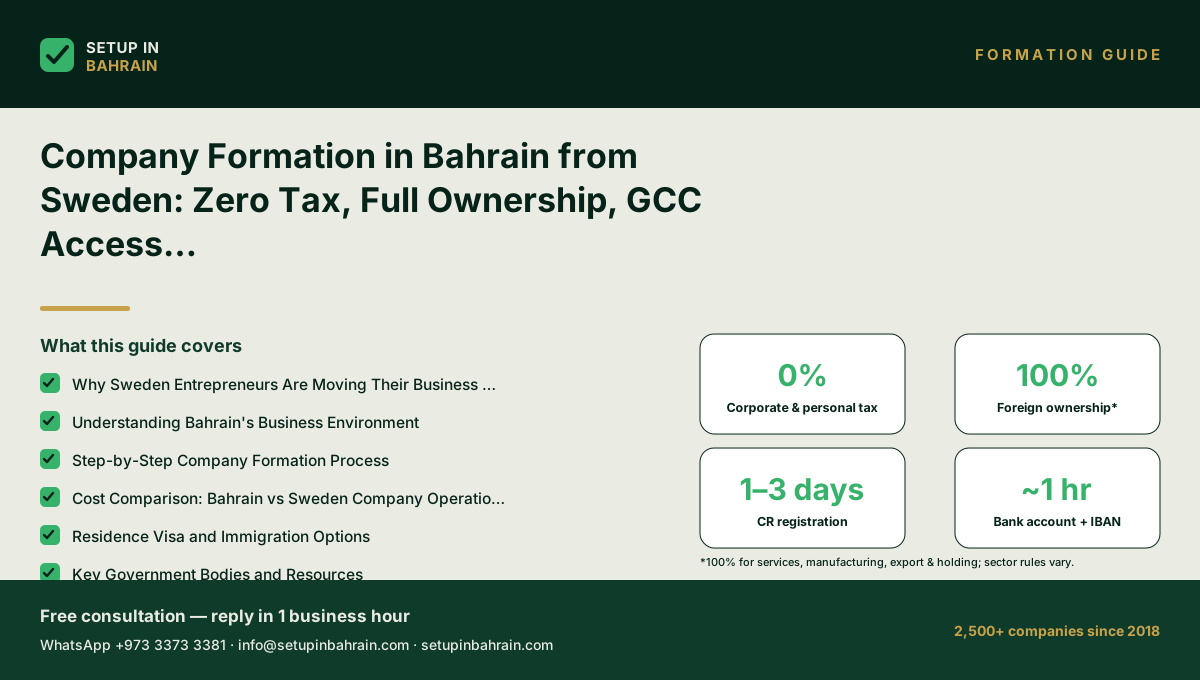
A Bahrain WLL can be owned by a single person — 100% foreign ownership applies to most activities, with no local partner required for services, manufacturing, export trading and holding companies. The minimum share capital is BHD 1 ; we recommend BHD 1,000 . This Makes bank account opening and investor visa approval smoother.
Last month, Erik Lindström sat across from his accountant in Malmö, staring at the numbers that had kept him awake for weeks. His SaaS company had just crossed SEK 8 million in annual revenue—a milestone that should have felt like victory. Instead, he was calculating how much of that growth would evaporate before it ever touched his bank account. Between the 20.6% bolagsskatt, the crushing 31.42% arbetsgivaravgifter on his four employees. His own marginal income tax pushing past 52%, Erik watched nearly SEK 4.2 million of his company's earnings disappear into the Swedish tax system.
Six weeks later, Erik was signing company formation documents in Manama. His new Bahrain entity pays exactly generally no corporate income tax for most sectors. He still serves the same European clients, employs Swedish developers remotely. Maintains full compliance with both jurisdictions—but the financial mathematics of his business have fundamentally transformed.
This isn't a story about tax evasion. It's about legitimate corporate restructuring in a jurisdiction that actively welcomes Swedish entrepreneurs. And it's happening far more frequently than most Swedish business owners realize.
If you're a Swedish founder running an aktiebolag, struggling with Skatteverket's complex income tax declarations, watching the SEK swing wildly against the dollar, and wondering whether there's a smarter way to structure your international operations—this guide was written specifically for you. Not generic advice recycled from offshore promoters. Practical, jurisdiction-specific intelligence based on real Swedish entrepreneurs who've made this transition successfully.
Why Sweden Entrepreneurs Are Moving Their Business to Bahrain
The Swedish business environment has reached a breaking point for growth-oriented entrepreneurs. What was once considered a reasonable trade-off—high taxes in exchange for social stability and infrastructure—has become mathematically unsustainable for companies competing in global markets.
Let me paint you a picture I've seen play out repeatedly this year alone.
Karl, a Stockholm-based SaaS founder, had been running his company for seven years. Revenue hit SEK 18 million. His corporate tax bill? SEK 3.7 million. His payroll costs with social contributions? Another SEK 5.2 million. Every time he looked at his profit and loss statement, he felt like he was working for Skatteverket, not himself. The mandatory annual report to Bolagsverket consumed three weeks of his time each year. The F-skatt filings for his foreign contracts added another layer of complexity he handled personally because Swedish accountants charged SEK 2,500 per hour for international tax advice.
Then he discovered Bahrain.
Today, Karl's company is registered in the Kingdom of Bahrain. Generally no corporate income tax for most sectors. Zero personal income tax on dividends. Zero currency volatility against his primary revenue currency—the Bahraini Dinar has been pegged to the US dollar at 0.376 BHD per USD since 1980, making it one of the world's most stable currencies. He still has clients in Sweden, still travels to Stockholm quarterly. The financial architecture of his business has been completely restructured.
The Real Cost of Running a Swedish Company in 2025
Consider the numbers that Swedish founders confront daily. A profitable aktiebolag generating SEK 5 million in annual profit surrenders SEK 1.03 million immediately to bolagsskatt. If the remaining profit gets distributed as salary to the owner, Sweden's progressive income tax system claims another 30-57% depending on the amount, plus the employer's social contribution of 31.42% applies before any salary reaches the owner's pocket.
Sweden's employer social contributions aren't just high—they're the highest in the world. At 31.42%, they exceed Germany's 21%, the UK's 13.8%. The United States' 7.65% by substantial margins. For a Swedish company paying SEK 3 million in total salaries, this translates to an additional SEK 942,600 in mandatory contributions before any employee receives a single krona.
The administrative burden compounds the financial pressure. Skatteverket's income tax declarations require meticulous documents of every deductible expense, every foreign transaction, every intercompany transfer. The mandatory annual report to Bolagsverket isn't simply a filing—it's a comprehensive document that must conform to Swedish Generally Accepted Accounting Principles, be submitted in Swedish, and include detailed notes on accounting policies, risk exposure, and related party transactions.
And then there's the currency problem. The Swedish krona has experienced significant volatility against major trading currencies. For Swedish companies earning revenue in USD, EUR, or GBP, this volatility introduces unpredictable margin compression that no amount of operational efficiency can offset. When your Saudi client pays in dollars and your costs are denominated in kronor, you're running a currency trading desk whether you intended to or not.
What Bahrain Offers That Sweden Cannot
Bahrain presents a fundamentally different proposition. The Kingdom levies generally no corporate income tax for most sectors on most business activities—not a reduced rate, not a temporary incentive. A permanent structural feature of the tax system. There's no personal income tax, no capital gains tax, no withholding tax on dividends or interest payments. The Bahraini Dinar's peg to the US dollar eliminates currency volatility for businesses earning in the world's primary reserve currency.
According to the World Bank's Doing Business rankings, Bahrain consistently outperforms regional competitors in ease of starting a business, dealing with construction permits, and trading across borders. The Economic Development Board of Bahrain reports that foreign direct investment reached USD 1.53 billion in 2023, with European companies representing an increasing share of new registrations.
But here's what matters most for Swedish entrepreneurs: Bahrain isn't a blacklisted jurisdiction. It's not on the EU's list of non-cooperative tax jurisdictions. It maintains tax information exchange agreements with Sweden and most other developed economies. The Central Bank of Bahrain operates under Basel III-compliant regulations that meet or exceed European standards. This is legitimate restructuring, not financial arbitrage through regulatory gaps.
Understanding Bahrain's Business Environment
Before diving into formation mechanics, Swedish entrepreneurs need to understand what makes Bahrain structurally different from other Middle Eastern jurisdictions—and why those differences matter for European business owners specifically.
A Brief Economic Context
Bahrain was the first Gulf state to discover oil, in 1932. It was also the first to recognize that petroleum reserves wouldn't last forever. This early awareness drove deliberate economic diversification that distinguishes Bahrain from its resource-rich neighbors. Today, the non-oil sector accounts for about 85% of GDP, with financial services, aluminum manufacturing, tourism. Professional services forming the economic backbone.
The Kingdom's population of about 1.5 million creates an intimate business environment where personal relationships matter and government accessibility remains remarkably high. The Bahrain Economic Development Board functions as both a promotional agency and a genuine facilitation service, assigning dedicated relationship managers to foreign investors and actively problem-solving regulatory obstacles.
Geographic positioning amplifies these structural advantages. The King Fahd Causeway connects Bahrain directly to Saudi Arabia—a market of 35 million consumers with a GDP exceeding USD 1 trillion. Bahrain serves as the de facto financial and services hub for the broader GCC region, with banks, insurance companies. Professional services firms using Bahrain as their regional headquarters to serve clients across the six-nation Gulf Cooperation Council.
The Regulatory Framework
Three government bodies oversee business formation and operation in Bahrain. Understanding their distinct roles will save you considerable confusion during the setup process.
The Ministry of Industry and Commerce (MOIC) handles commercial registrations for most business types. This is where your company receives its Commercial Registration (CR) number, the foundational document that establishes your legal existence in Bahrain. MOIC also manages trade name reservations, activity licensing, and the commercial registry itself.
The Central Bank of Bahrain (CBB) regulates all financial services activities, including banking, insurance, investment services. Cryptocurrency businesses. If your Swedish company operates in fintech, asset management, or any financial services vertical, CBB licensing becomes relevant—and the standards are rigorous, deliberately so. CBB has cultivated a reputation for regulatory quality that attracts institutional financial services firms seeking a reputable Middle Eastern base.
The Bahrain Economic Development Board (EDB) serves as the investment promotion and facilitation agency. While EDB doesn't technically issue licenses, it functions as a concierge service for foreign investors, coordinating between government ministries, expediting approvals. Providing practical support during the setup phase. Swedish entrepreneurs consistently report that engaging with EDB early in the process dramatically reduces friction and timeline.
The Bahrain Investors Center (BIC) operates as a one-stop-shop for company formation, bringing together representatives from MOIC, the Labour Market Regulatory Authority, the General Organization for Social Insurance, and other relevant bodies under one roof. For straightforward company formations, the entire process can be completed in a single visit.
Legal Structures Available to Swedish Entrepreneurs
Bahrain offers several corporate structures. Three are most relevant for Swedish business owners seeking to establish a presence:
The Limited Liability Company (WLL) remains the most common structure for foreign entrepreneurs. Since 2017, 100% foreign ownership is permitted in most sectors without requiring a local partner. Minimum capital requirements are modest—BHD 20,000 for certain licensed activities, though many service businesses can establish with no minimum capital requirement. The WLL provides limited liability protection similar to a Swedish aktiebolag, with profits flowing to shareholders after a simple annual audit.
The single-shareholder WLL allows a single individual or corporate shareholder to establish a limited liability entity. This structure works especially well for Swedish entrepreneurs who want sole control without the formality of multiple shareholders. WLLs require a minimum capital of BHD 1 (we recommend BHD 1,000) for certain activities, though service-based businesses often face no minimum.
The Branch Office permits a Swedish aktiebolag to establish a physical presence in Bahrain without creating a separate legal entity. The branch is legally considered an extension of the parent company. This Can simplify some administrative matters but also means the Swedish parent retains full liability for branch operations. Branch structures work well for companies seeking project-specific presence or those wanting to test the Bahraini market before committing to a separate entity.
For most Swedish entrepreneurs, the WLL structure offers the optimal combination of limited liability, operational flexibility. Tax efficiency. The WLL provides a simpler alternative for solo founders. Branch offices suit companies with specific project requirements or those maintaining substantial Swedish operations alongside Bahraini activities.
Step-by-Step Company Formation Process
The practical mechanics of establishing a Bahrain company follow a logical sequence, though the specific requirements vary based on your chosen structure and intended activities. Here's what the process looks like from a Swedish entrepreneur's perspective.
Phase 1: Pre-Formation Planning (Weeks 1-2)
Before engaging with Bahraini authorities, several decisions require attention.
Business Activity Selection : Bahrain uses a detailed activity classification system. Your commercial registration will specify exactly which activities your company may conduct. Swedish entrepreneurs often underestimate the importance of this step—selecting activities too narrowly limits future flexibility. Selecting too broadly may trigger additional licensing requirements. Work with a local corporate services provider to map your Swedish operations onto Bahrain's activity codes accurately.
Trade Name Reservation : Your proposed company name must be unique within Bahrain's commercial registry and conform to naming conventions. Arabic translation isn't strictly required for foreign-owned companies. Having an Arabic equivalent simplifies certain banking and government interactions. The name reservation process takes 1-2 business days through the Sijilat online portal.
Shareholder and Director Documents : You'll need notarized and apostilled copies of your Swedish passport, recent passport photographs. A no-objection certificate from any current employer if you're establishing the company while employed elsewhere. If your Swedish aktiebolag will be a shareholder in the Bahrain entity, you'll need apostilled copies of the Swedish company's registration certificate, memorandum of association, and board resolution authorizing the Bahrain investment.
Registered Office Address: Every Bahrain company requires a physical registered address. If you're not immediately establishing a full office, virtual office services provide registered addresses that satisfy legal requirements while you operate remotely during the initial phase.
Phase 2: Formation Documents and Submission (Weeks 2-3)
With preparatory documents assembled, the formation process proceeds through the Bahrain Investors Center or through a local corporate services provider handling submissions on your behalf.
Memorandum of Association: This foundational document establishes your company's purpose, capital structure, shareholder rights, and governance provisions. For WLLs, the MOA must be notarized before a Bahraini notary public. If you're not present in Bahrain, a power of attorney allows a local representative to execute documents on your behalf.
Commercial Registration Application : The CR application specifies your chosen activities, capital amount, shareholders, and directors. Processing typically takes 2-3 business days for straightforward applications. The CR certificate—your company's primary identity document—includes your unique CR number, activity codes. Company details.
Activity Licensing : Depending on your business activities, additional licenses may be required from sector-specific regulators. Professional services typically require no additional licensing beyond the CR. Technology companies operating in standard software development or IT services similarly proceed with just the CR. But, financial services, healthcare, education. Certain other sectors require separate regulatory approvals that add 2-8 weeks to the timeline.
Phase 3: Post-Formation Setup (Weeks 3-5)
With your company legally established, several practical steps follow.
Corporate Bank Account : Opening a Bahrain corporate bank account requires an in-person visit by at least one authorized signatory. The Central Bank of Bahrain's robust anti-money-laundering framework means banks conduct thorough due diligence—expect to provide detailed business plans, projected financials, CVs of key personnel, and proof of legitimate business relationships. For Swedish entrepreneurs, BNP Paribas, HSBC, Standard Chartered. Several well-regulated local banks offer corporate banking services with international transfer capabilities.
Banks typically require the CR certificate, company memorandum, shareholder and director identity documents, proof of registered address. A board resolution authorizing account opening. Processing takes 2-4 weeks depending on the bank and the complexity of your business model.
Labour Market Regulatory Authority Registration : If you'll employ staff in Bahrain—including yourself as a working shareholder—registration with LMRA is mandatory. This registration enables you to apply for work permits and ultimately get a Bahrain residence visa. This We'll discuss separately.
General Organization for Social Insurance : Bahraini employees require GOSI registration, with contributions split between employer and employee. Notably, foreign employees on work permits aren't subject to GOSI contributions. This Can provide cost advantages for companies employing primarily expatriate staff.
VAT Registration: Bahrain implemented a 10% value-added tax in 2019 on most goods and services. Companies with annual taxable supplies exceeding BHD 37,500 must register for VAT and file quarterly returns. The VAT system is straightforward by European standards—far simpler than Sweden's mervärdesskatt with its various exemption categories and special rules.
Timeline Summary
For a standard service-company formation without special licensing requirements, Swedish entrepreneurs should expect:
| Phase | Duration | Key Milestones |
| Pre-Formation Planning | 1-2 weeks | Activity selection, document preparation |
| Document Submission & CR | 1-2 weeks | Trade name, MOA notarization, CR issuance |
| Post-Formation Setup | 2-4 weeks | Bank account, LMRA registration |
| Total | 4-8 weeks | Fully operational company |
Cost Comparison: Bahrain vs Sweden Company Operations
The financial case for Bahrain becomes clearest when examining actual numbers side by side. Let's walk through a comparison using a realistic scenario: a professional services company generating SEK 5 million (about USD 480,000 or BHD 181,000) in annual revenue with three employees including the founder.
Annual Tax Burden Comparison
| Cost Category | Sweden (Aktiebolag) | Bahrain (WLL) |
| Corporate Tax | SEK 824,000 (20.6% on SEK 4M profit) | BHD 0 (0%) |
| Employer Social Contributions | SEK 754,080 (31.42% on SEK 2.4M salaries) | BHD 3,600 (3% employer GOSI on local staff only) |
| Personal Income Tax (Owner) | SEK 520,000 (avg ~45% on distributions) | BHD 0 (0%) |
| VAT Administration | Complex, quarterly | Simple, quarterly |
| Total Tax Burden | ~SEK 2,098,080 | ~BHD 3,600 (SEK 100,000 equivalent) |
Formation and Operating Costs
Bahrain formation isn't free, and operating costs deserve honest assessment.
Initial Formation Costs:
- MOIC registration fees: BHD 100-300
- Trade name reservation: BHD 30
- Notarization and document fees: BHD 200-500
- Corporate services provider (optional but recommended): BHD 2,000-5,000
- Virtual office (first year): BHD 1,500-3,000
- Total initial costs: BHD 3,830-8,830 (SEK 107,000-247,000)
Annual Operating Costs:
- CR renewal: BHD 100-300
- Virtual office: BHD 1,500-3,000
- Audit and accounting: BHD 1,500-4,000
- Corporate services retainer: BHD 1,000-3,000
- Bank charges: BHD 500-1,500
- Total annual operating: BHD 4,600-11,800 (SEK 128,000-330,000)
Even at the high end of operating costs, the Bahrain entity produces net savings exceeding SEK 1.7 million annually compared to Swedish operations. The formation investment typically recovers within the first quarter of operations.
Hidden Costs and Considerations
Honest analysis requires acknowledging costs that promotional materials often overlook.
Travel : Swedish entrepreneurs maintaining Bahrain entities typically visit 2-4 times annually for banking, regulatory. Relationship maintenance purposes. Direct flights from Stockholm to Bahrain via Gulf carriers cost SEK 8,000-15,000 per trip. Budget SEK 50,000-80,000 annually for travel.
Time Zone Management: Bahrain operates on Arabia Standard Time (AST), two hours ahead of Central European Time in winter, one hour ahead during Swedish summer time. This modest difference rarely creates operational problems for European-focused businesses but requires consideration for client-facing operations.
Banking Complexity: Maintaining corporate accounts in two jurisdictions requires careful cash management and transfer planning. International wire fees, while modest per transaction, accumulate. Some Swedish banks may ask questions about regular transfers to Middle Eastern accounts, requiring documents of legitimate business purposes.
Professional Advice: Swedish tax authorities have become more and more sophisticated in scrutinizing international structures. Budget for competent Swedish tax advice alongside Bahraini corporate services to ensure your structure achieves its intended purposes without triggering Swedish tax liabilities through technical missteps.
Residence Visa and Immigration Options
For Swedish entrepreneurs seeking not just corporate presence but personal residence in Bahrain, several pathways exist. The choice depends on your intended level of Bahrain engagement and personal circumstances.
Investor Residence Visa
The golden visa program for entrepreneurs who invest BHD 50,000 or more in a Bahrain business. This self-sponsored residence visa doesn't require local employment and provides a two-year renewable residence permit. Key features:
- No employer sponsorship required
- Ability to sponsor family members
- Multiple entry privileges
- Path to long-term residence
- No minimum physical presence requirements
For Swedish entrepreneurs maintaining their Bahrain company while spending significant time in Sweden or elsewhere, the investor visa provides flexibility that employment-based options don't match.
Employment-Based Residence
If you'll work actively in your Bahrain company, an employment visa provides straightforward residence rights. Your company sponsors your work permit application through LMRA. Processing takes 2-4 weeks after CR setup and requires:
- Valid passport with minimum 6-month validity
- Medical examination in Bahrain
- Employment contract
- Company CR certificate
- Processing fee (BHD 200-400)
Employment visas renew annually and permit sponsorship of immediate family members.
Bahrain's Tax Residence Implications
A critical consideration for Swedish entrepreneurs: Bahrain residence doesn't automatically eliminate Swedish tax obligations. Sweden taxes its tax residents on worldwide income regardless of where that income is earned or where the company generating it is registered.
Ceasing Swedish tax residence requires meeting specific criteria under Swedish domestic law and applicable tax treaties. Generally, this involves:
- Establishing genuine residence outside Sweden
- Demonstrating severed social and economic ties to Sweden
- Not spending more than specified time limits in Sweden
- Not maintaining a permanent dwelling available for use in Sweden
Swedish tax authorities scrutinize claims of ceased residency carefully, especially when the destination is a low-tax jurisdiction. The Sweden-Bahrain tax treaty exists but doesn't override Swedish domestic rules on tax residence.
For entrepreneurs maintaining Swedish residence while operating Bahrain companies, the Swedish Controlled Foreign Corporation rules may apply, potentially attributing Bahrain company profits to Swedish shareholders for Swedish tax purposes. Proper structuring and substance creation in Bahrain can address CFC concerns. This requires careful planning with qualified Swedish international tax advisors.
Key Government Bodies and Resources
Successfully navigating Bahrain's business environment requires understanding which authority handles what. Here's your reference guide:
Ministry of Industry and Commerce (MOIC)
Website: www.moic.gov.bh Sijilat Portal: www.sijilat.bh
MOIC handles commercial registrations, activity licensing, trade name reservations, and the commercial registry. The Sijilat online portal enables many transactions to be completed electronically, though certain matters still require in-person visits.
Central Bank of Bahrain (CBB)
Website: www.cbb.gov.bh
CBB regulates all financial services activities. If your business involves banking, insurance, investment management, crowdfunding, cryptocurrency, or payment services, CBB licensing is required. The regulatory framework aligns with international standards and provides market access credibility.
Economic Development Board (EDB)
Website: www.bahrainedb.com
EDB serves as the investment promotion agency and provides facilitation services for foreign investors. Engaging with EDB early in your planning can provide valuable guidance and government introductions. Their team includes specialists familiar with European business requirements.
Labour Market Regulatory Authority (LMRA)
Website: www.lmra.gov.bh
LMRA manages work permits, employment visas, and labor market compliance. Any company employing staff—including working shareholders—must register with LMRA.
Bahrain Investors Center (BIC)
Location: Bahrain Financial Harbour
BIC consolidates representatives from multiple government agencies in one location, streamlining company formation and related registrations. For straightforward formations, a single BIC visit can complete CR issuance and LMRA registration.
Bahrain Chamber of Commerce and Industry
Website: www.bahrainchamber.bh
Chamber membership provides networking opportunities, trade mission access, and commercial dispute resolution services. While not mandatory, chamber membership signals legitimacy and provides useful business development resources.
Banking and Financial Services in Bahrain
Opening corporate banking relationships in Bahrain deserves dedicated attention because it's often the most time-consuming element of setup for foreign entrepreneurs.
The Banking Landscape
Bahrain's financial services sector is the most developed in the Gulf region, with over 400 financial institutions regulated by the Central Bank of Bahrain. This includes global banks with regional headquarters, well-capitalized local banks. Specialized institutions serving everything from trade finance to Islamic banking.
For Swedish entrepreneurs, the relevant banking options include:
International Banks : HSBC, Standard Chartered, BNP Paribas, and Citibank all maintain Bahrain operations. These institutions offer familiarity for European entrepreneurs, established correspondent banking relationships for international transfers. Online banking platforms similar to Swedish standards.
Regional Banks : Gulf International Bank, Arab Banking Corporation. Ahli United Bank provide strong regional coverage and often more personalized service than global institutions.
Local Banks : Bank of Bahrain and Kuwait, National Bank of Bahrain. Bahrain Islamic Bank offer competitive pricing and local market expertise.
Account Opening Requirements
Regardless of which bank you choose, expect a thorough due diligence process. Post-2008 regulatory reforms and anti-money-laundering requirements mean banks conduct extensive reviews before accepting corporate clients.
Prepare the following:
- Commercial Registration certificate
- Memorandum and Articles of Association
- Board resolution authorizing account opening
- Passport copies of all shareholders and directors
- Proof of residential address for all beneficial owners
- Detailed business plan describing activities, customers, and projected volumes
- Source of funds documents for initial capitalization
- Reference letters from existing banks (if available)
Banks may also request:
- Client contracts demonstrating legitimate business relationships
- CVs of key personnel
- Organizational charts
- Website URLs and marketing materials
- Six months of bank statements from existing accounts
Timeline and Practical Tips
Allow 3-6 weeks for corporate account opening. The process typically involves:
- Initial document submission (can be done remotely)
- Bank compliance review (2-3 weeks)
- In-person meeting with bank relationship manager (required)
- Final approval and account activation (1-2 weeks)
Swedish entrepreneurs report the most success when they:
- Engage with the bank early, even before CR issuance, to understand specific requirements
- Provide comprehensive documents upfront rather than waiting for requests
- Prepare a clear, professional business plan that explains the business model simply
- Bring supporting evidence of legitimate business activities (contracts, invoices, client correspondence)
- Maintain a professional online presence that banks can verify
Avoid presenting complex multi-jurisdictional structures without clear commercial rationale—banks are trained to identify potential money laundering risks. Structures that appear designed primarily for opacity trigger extended scrutiny or rejection.
Tax Implications and International Compliance
The intersection of Bahrain's tax-free environment with Swedish tax residence and international reporting obligations creates complexity that rewards careful planning.
Bahrain's Tax Framework
Bahrain's domestic tax system remains remarkably straightforward:
- Corporate Tax: 0% for most sectors. Oil and gas companies pay higher rates, but this doesn't affect typical Swedish entrepreneurs.
- Personal Income Tax: 0% on employment income, dividends, and capital gains
- Withholding Tax: 0% on dividends, interest, and royalties paid abroad
- Value Added Tax: 10% on most goods and services, with registration threshold at BHD 37,500 annual taxable supplies
- Social Insurance: 4% employer contribution, 1% employee contribution for Bahraini nationals; foreign workers exempt
This simplicity extends to compliance obligations. Annual audited financial statements are required for companies above certain size thresholds. The reporting burden remains modest compared to Swedish standards.
Swedish CFC Rules and Substance Requirements
Swedish Controlled Foreign Corporation rules present the primary tax planning consideration for Swedish entrepreneurs establishing Bahrain entities.
Under Swedish CFC legislation, shareholders in low-tax foreign companies may be taxed in Sweden on their proportionate share of the foreign company's profits, regardless of whether those profits are distributed. A company is generally considered "low-taxed" if its effective tax rate falls below 55% of the Swedish corporate tax rate—currently, this means foreign effective rates below about 11.3%.
Bahrain's 0% rate clearly falls below this threshold, meaning CFC rules potentially apply to Swedish shareholders of Bahrain companies.
But, exemptions exist. The most relevant for Bahrain structures:
Real Economic Activity Exception: If the Bahrain company conducts genuine economic activity in Bahrain, CFC rules may not apply. This requires demonstrating:
- Physical office presence
- Local employees or engaged directors
- Management decisions made in Bahrain
- Real commercial activities conducted from Bahrain
Treaty Network Exception: Companies in jurisdictions with comprehensive tax treaties may receive exemption. Sweden and Bahrain have a tax information exchange agreement, though the specific application to CFC exemption requires analysis.
Proper structuring from the outset—ensuring genuine Bahrain substance rather than a letterbox company—provides the strongest protection against CFC attribution. This means:
- Holding board meetings in Bahrain
- Maintaining local bank accounts with active use
- Establishing credible office presence
- Employing or engaging local staff for appropriate functions
- Keeping books and records in Bahrain
International Reporting Obligations
Swedish participation in automatic exchange of information programs means financial account information flows between Bahrain and Sweden regularly. Bahrain participates in the Common Reporting Standard. Bahrain banks report account holder information to Bahraini tax authorities, who exchange it with treaty partners including Sweden.
This transparency isn't problematic for legitimately structured arrangements but eliminates any possibility of undisclosed offshore accounts. Swedish entrepreneurs should assume Skatteverket will receive information about their Bahrain corporate accounts and plan accordingly.
VAT Considerations
Bahrain's 10% VAT applies to most goods and services supplied within Bahrain. For Swedish entrepreneurs primarily serving clients outside Bahrain, exports of services are generally zero-rated, meaning VAT doesn't apply to revenue but input VAT credits remain available.
The practical implication: a Swedish entrepreneur operating a consultancy serving European clients from Bahrain likely owes minimal Bahrain VAT while benefiting from the Generally no corporate income tax for most sectors environment.
GCC Market Access and Regional Expansion
Beyond tax efficiency, Bahrain provides strategic positioning for Middle Eastern market expansion that Swedish entrepreneurs often underestimate.
The GCC Opportunity
The Gulf Cooperation Council comprises Bahrain, Kuwait, Oman, Qatar, Saudi Arabia, and the United Arab Emirates—collectively representing:
- Population: 60+ million
- Combined GDP: USD 2+ trillion
- Sovereign wealth assets: USD 4+ trillion
- Infrastructure investment pipeline: USD 1+ trillion through 2030
These economies are actively diversifying away from hydrocarbon dependence, creating enormous demand for the technology, professional services. Specialized expertise that Swedish companies excel at providing.
Saudi Arabia Access
The King Fahd Causeway connects Bahrain directly to Saudi Arabia's Eastern Province, the Kingdom's industrial and oil sector heartland. This 25-kilometer bridge carries over 70,000 vehicles daily, making Bahrain the de facto gateway to Saudi markets.
Saudi Arabia's Vision 2030 program is driving USD 3.3 trillion in planned investment across sectors including:
- Entertainment and tourism (USD 800 billion)
- Technology and digital infrastructure
- Healthcare modernization
- Renewable energy
- Urban development (NEOM, The Line, Red Sea Project)
Swedish companies are well-positioned for these opportunities. Swedish expertise in sustainability, clean technology, digital transformation, and healthcare aligns precisely with Saudi priorities. A Bahrain entity provides the regional credibility and operational base to compete effectively for Saudi contracts.
Regional Credibility
Middle Eastern business culture values relationships and local presence more than many Swedish entrepreneurs expect. A Bahrain corporate presence signals commitment to the region in ways that serving Middle Eastern clients from a Stockholm office cannot match.
This credibility translates into practical advantages:
- Ability to attend meetings, conferences, and networking events regularly
- Local phone numbers and business cards
- Time zone alignment for client communications
- Understanding of regional business practices and negotiation styles
- Reference customers and case studies from regional projects
Frequently Asked Questions
Can I form a Bahrain company while remaining a Swedish tax resident?
Yes, but with important caveats. Swedish tax residents are taxed on worldwide income. Swedish CFC rules may attribute Bahrain company profits to Swedish shareholders even if those profits aren't distributed. Proper structuring with genuine Bahrain substance can address CFC concerns. The structure must be planned carefully with qualified Swedish international tax advisors. Simply forming a Bahrain company while maintaining Swedish residence doesn't automatically produce tax savings.
How long does company formation take?
For a standard service-company WLL without special licensing, expect 4-8 weeks from document preparation through operational bank account. Companies requiring Central Bank of Bahrain licensing (financial services, crypto) add 4-12 weeks. The Commercial Registration itself typically issues within 3-5 business days once documents are properly submitted.
Do I need to visit Bahrain for company formation?
Not strictly for formation—power of attorney arrangements allow local representatives to execute formation documents on your behalf. But, opening a corporate bank account requires at least one authorized signatory to appear in person. Most Swedish entrepreneurs combine an initial visit for bank account opening with formation completion, setup of a local service provider relationship. Initial networking.
What's the minimum capital requirement?
It varies by activity. Many service-based businesses can form WLLs with no minimum capital requirement. Certain licensed activities require BHD 20,000-50,000 minimum capital. Financial services companies face greatly higher requirements depending on license category. Your corporate services provider can advise on requirements for your specific activities.
Can I hire Swedish employees to work remotely for my Bahrain company?
This arrangement requires careful structuring. Swedish employees working in Sweden are subject to Swedish employment law, social insurance contributions. Withholding requirements regardless of their employer's jurisdiction. The Bahrain company would likely need to register as a foreign employer in Sweden or engage the Swedish staff through compliant arrangements. Consultation with Swedish employment lawyers is essential before implementing such arrangements.
How does this affect my Swedish pension contributions?
If you're no longer employed in Sweden and cease Swedish tax residence, Swedish pension contributions would stop accruing. Bahrain has no mandatory pension system for foreign workers. Swedish entrepreneurs moving to Bahrain typically establish private pension arrangements or invest in alternative retirement planning vehicles. If you remain Swedish tax resident while operating through a Bahrain company, your personal pension situation depends on how you structure your own compensation.
Is Bahrain on any tax blacklists?
Bahrain is not on the EU list of non-cooperative jurisdictions for tax purposes. It has committed to
Bahrain Business Guides for Sweden Citizens
Frequently Asked Questions
How long does it take to set up?
It takes 15 to 20 days. We file all forms for you. You do not need to wait long.
What does it cost?
Company formation: Standard BHD 1,340 with 3 months of office address; Gold BHD 1,700 with 6 months; Premium BHD 2,150 with 12 months and a cabin, officer table and chair, and two guest chairs. No formation package includes visas, including Premium. Investor/work visas are priced separately: BHD 755 for one year or BHD 953 for two years, in addition to the formation package. Ask for a written, itemized quotation confirming government fees and all inclusions before payment.
Do I need to visit Bahrain?
No. You can set up your firm from home. We do all the work online. Some banks may ask for one visit.
What tax will I pay?
You pay zero tax on your profits. Bahrain has no corporate income tax. This is a key benefit of the setup.
Can I own 100% of my firm?
Yes. Foreign owners can hold all shares. No local partner is needed. Full ownership is allowed.
What do I need to start?
You need a valid passport. You also need a trade name and a business address. We help you with all of these.
How do I open a bank account?
We guide you step by step. Most banks take 3 to 6 weeks. You will need your CR and firm papers.
Who issues the Commercial Registration (CR)?
The CR is issued by the MOICT. It is your legal right to trade in Bahrain. We file the CR for you.
Can I renew my CR each year?
Company renewal packages: BHD 530 with 3 months of office address; BHD 980 with 6 months; BHD 1,520 with 12 months. These are separate renewal packages, not visa fees.
How do I get started?
Fill in our form on this page. Our team will call you back. We map your best setup plan at no cost.
Steps to Form Your Company
- Pick your trade name. We check if it is free.
- Choose your business type. WLL is the most common.
- Sign the MOA. We draft and file all legal docs.
- Pay the state fees. About BHD 432 in total.
- Get your CR. Takes 15 to 20 days.
- Open your bank account. We guide each step.
- Start trading. You are ready to do business.
Key Facts
- Tax rate: 0%
- Foreign ownership: 100%
- Setup time: 15 to 20 days
- Company formation: Standard BHD 1,340 with 3 months of office address; Gold BHD 1,700 with 6 months; Premium BHD 2,150 with 12 months and a cabin, officer table and chair, and two guest chairs. No formation package includes visas, including Premium. Investor/work visas are priced separately: BHD 755 for one year or BHD 953 for two years, in addition to the formation package. Ask for a written, itemized quotation confirming government fees and all inclusions before payment.
- Company renewal packages: BHD 530 with 3 months of office address; BHD 980 with 6 months; BHD 1,520 with 12 months. These are separate renewal packages, not visa fees.
- Client rating: 4.8 stars
- Clients served: 2,500 and more
Quick Facts
- Tax rate: 0%
- Own all of your firm: Yes, 100%
- Time to set up: 15 to 20 days
- Company formation: Standard BHD 1,340 with 3 months of office address; Gold BHD 1,700 with 6 months; Premium BHD 2,150 with 12 months and a cabin, officer table and chair, and two guest chairs. No formation package includes visas, including Premium. Investor/work visas are priced separately: BHD 755 for one year or BHD 953 for two years, in addition to the formation package. Ask for a written, itemized quotation confirming government fees and all inclusions before payment.
- Company renewal packages: BHD 530 with 3 months of office address; BHD 980 with 6 months; BHD 1,520 with 12 months. These are separate renewal packages, not visa fees.
- Rating: 4.8 stars
- Clients: 2,500 and more
Why Bahrain?
Bahrain has no tax. You keep all your profits. This is rare in the Gulf.
You can own all of your firm. No local partner is needed. The law allows full foreign ownership.
Setup takes 15 to 20 days. We file all forms for you. You can do it all from home.
Bahrain has a free trade deal with the US. Your goods face low or no tariffs. This gives you access to big markets.
We have served 2,800+ clients from 44+ countries and maintain records to substantiate that total where needed. We have 113 Google reviews; reviews represent only some clients and are not the same as the total clients served.
Our Steps
- Tell us your plan. We advise you for free.
- We pick the right firm type for you.
- We file all your forms with MOICT.
- You get your CR in 15 to 20 days.
- We help you open a bank account.
- You are ready to trade. We stay with you.
Why Set Up in Bahrain?
Bahrain is a great place to run a firm. It has no tax. You keep all your profits. This is rare in the Gulf.
You can own your firm 100%. No local partner is needed. The law is clear and fair.
It is fast to set up. You can have a CR in 15 to 20 days. We file all forms for you.
Bahrain has a free trade deal with the US. Your goods face low or no tariffs. This gives you access to big markets.
The banks are good. The roads are good. The schools are good. It is a well-run state.
We have served 2,800+ clients from 44+ countries and maintain records to substantiate that total where needed. We have 113 Google reviews; reviews represent only some clients and are not the same as the total clients served.
Our Services
- Company formation: Standard BHD 1,340 with 3 months of office address; Gold BHD 1,700 with 6 months; Premium BHD 2,150 with 12 months and a cabin, officer table and chair, and two guest chairs. No formation package includes visas, including Premium. Investor/work visas are priced separately: BHD 755 for one year or BHD 953 for two years, in addition to the formation package. Ask for a written, itemized quotation confirming government fees and all inclusions before payment.
- Company renewal packages: BHD 530 with 3 months of office address; BHD 980 with 6 months; BHD 1,520 with 12 months. These are separate renewal packages, not visa fees.
- Investor Visa — from BHD 755
- Work Visa — LMRA managed
- Virtual office — from BHD 600 per year
- Bank account opening — 3 to 6 weeks
- Family visa — for spouse and kids
- UBO filing — as required by law
Bahrain at a Glance
- Tax rate: 0%
- Foreign ownership: 100%
- Setup time: 15 to 20 days
- Free trade deal: Yes, with the US
- Language: Arabic and English
- Currency: Bahraini Dinar (BHD)
- Time zone: UTC+3
- GDP growth: Steady and strong
How to Start
- Fill in the form on this page. It takes 3 minutes.
- We call you back the same day.
- We map the best plan for your firm type and goals.
- We file all forms. We deal with MOICT for you.
- You get your CR in 15 to 20 days.
- We help you open a bank account and get your visa.
- You are ready to trade. We stay with you.
Common Questions
Do I need to visit Bahrain to set up?
No. You can do it all from home. We file online. You may need one visit to open a bank account.
Is Bahrain safe for business?
Yes. Bahrain is a stable state. It has a clear legal system. Your firm and funds are safe here.
Can I hire staff from any country?
Yes. You can hire from any country. Each hire needs a work permit from LMRA. We manage this for you.
What type of firm should I set up?
Most clients choose a WLL. This is a limited liability firm. It is flexible and well-known in Bahrain. We advise you on the best type for your case.
How do I get in touch?
Fill in our form. We call you back the same day. You can also email us or use the chat on this page.
Ready to set up in Bahrain from Sweden?
Tell us your business idea. We map the right entity, ownership and timeline — then handle the filing while you focus on what matters.