Complete guide for South Africa entrepreneurs: form a company in Bahrain with generally no corporate income tax for most sectors, 100% foreign ownership, and GCC market access. Costs, steps, visas, banking.
→ Complete guide: Company Formation in Bahrain — the full 2026 guide
View details
Ownership & capital
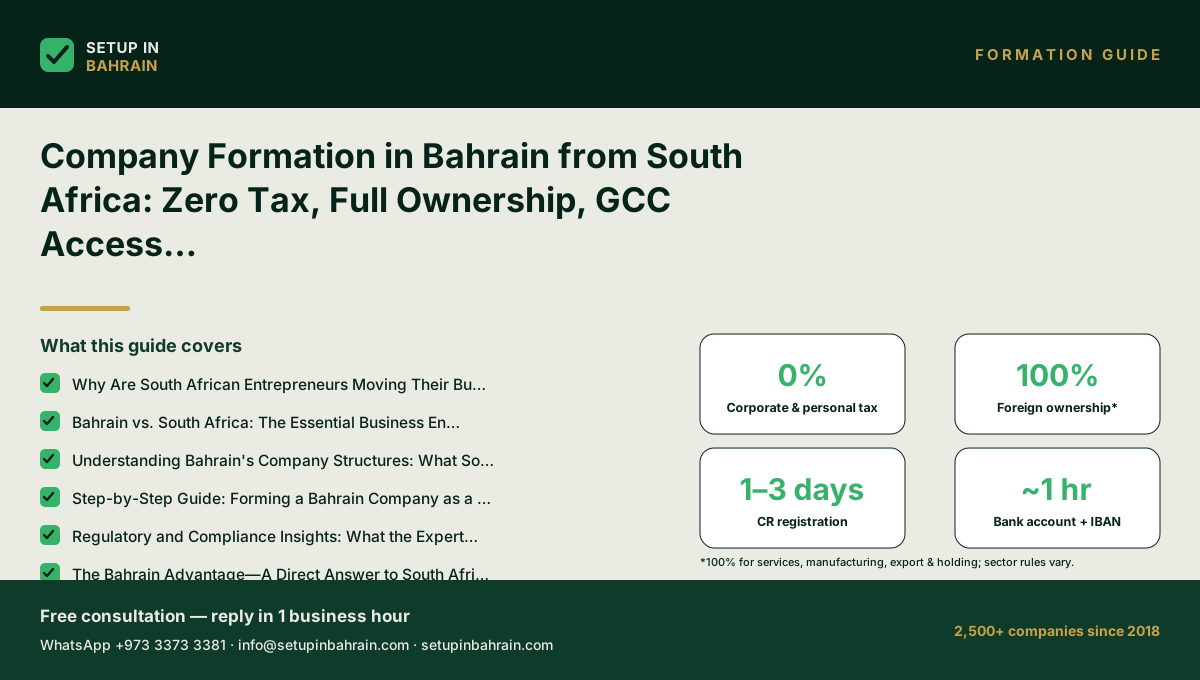
A Bahrain WLL can be owned by a single person — 100% foreign ownership applies to most activities, with no local partner required for services, manufacturing, export trading and holding companies. The minimum share capital is BHD 1; we recommend BHD 1,000, which makes bank account opening and investor visa approval smoother.
On a chilly winter evening in Sandton, as South Africa’s streets blink between generator-fueled islands of power, hundreds of entrepreneurs stare at spreadsheets—and at the harsh realities of South African company life. For business owners in Johannesburg, Cape Town, and Durban, 27% corporate tax is not just a cost line. It’s a growth cap. The CIPC’s update backlog stretches for weeks. Bi-annual SARS filings spring complex penalties. Payroll means a 12%+ add-on for UIF and PAYE, foreign exchange swings wreak havoc with global contracts, and that ever-present threat: the next multi-hour load-shedding blackout.
What if you could legally run your business from a jurisdiction with:
- 0% corporate income tax
- 0% personal income tax
- 100% foreign ownership — no local sponsors or partners required
- A currency pegged to the US Dollar, stable for 40+ years
- Fast, digital company registration (1–7 business days)
- Low-cost, digitally accessible compliance
That’s Bahrain. And for South African entrepreneurs—as 2026 dawns—the island nation is an overlooked, legitimate, and transformative destination for company formation.
This guide is meticulously crafted for South African founders, CEOs, and SME owners. Drawing on up-to-date data from the Bahrain Economic Development Board (EDB), Central Bank of Bahrain (CBB), Ministry of Industry & Commerce (MOIC), Bahrain Investors’ Centre (BIC), and the World Bank, you’ll find answers to your deepest strategic questions—and a step-by-step map for Bahrain company setup success.
Why Are South African Entrepreneurs Moving Their Businesses to Bahrain?
Let’s connect Bahrain’s benefits to your daily pain points.
1. Crushing 27% Corporate Tax vs. 0% in Bahrain In South Africa, a business clearing R5 million in pre-tax profit pays R1.35 million to SARS annually. In Bahrain, the exact same company keeps that full amount. Over five years, that's at least R6.75 million extra capital—enough to expand, enter new markets, or simply grow your reserves.
2. ZAR Currency Volatility vs. USD Stability Yearly ZAR/USD swings reach 30% or more (as in 2023 and early 2024). This means forward contracts and overseas deals become a gamble. Bahrain’s dinar (BHD) has been pegged to the US dollar at 0.376 BHD = 1 USD for over four decades (CBB, 2024). You lock in stability and can plan globally.
3. Load-Shedding & Productivity Losses South African SMEs self-report 18–31% productivity loss due to power cuts (SACCI Survey, 2024). Owners spend R400,000+ annually on backup power, maintenance, and lost opportunity. Bahrain’s uninterrupted power supply puts those funds back into your business, not your diesel bill.
4. Complicated Tax Regime vs. Simple Compliance Twice-yearly provisional tax estimates, PAYE, UIF, SDL, VAT and ever-tightening SARS audits—not to mention penalties for late or incorrect filings—mean hiring extra admin and compliance staff. In Bahrain, your company can submit a simple annual renewal and maintain digital records, with no personal or corporate tax bureaucracy and only VAT (10%) applying to qualifying onshore activities.
Real South African Founder Stories—A Snapshot
- Sipho, Cape Town tech CEO: “I moved my holding company to Manama, Bahrain, in 2023. My effective tax rate dropped to zero. I kept my South African operations as a branch and sent my international contracts through Bahrain. I reinvested R1.2 million I would have paid in tax into product development.”
- Leanne, Johannesburg digital agency: “Between the unpredictable currency and the growing payroll taxes, I was always behind on projections. Setting up a Bahrain WLL gave me a USD-based, globally accepted structure. My top client now wires directly to Bahrain—no delays, no exchange shock.”
Bahrain vs. South Africa: The Essential Business Environment Comparison
Here's a table comparing major business factors:
| Factor | Bahrain (2026) | South Africa (2026) |
| Corporate Income Tax | 0% (non-oil sectors) | 27% |
| Personal Income Tax | 0% | Up to 45% tiered |
| VAT | 10% (onshore sales) | 15% |
| Company Ownership | 100% foreign ownership (WLL) | 100% for SA residents, but with local complexities |
| Minimum Directors | 1 (any nationality, can be the owner) | 1 (South African resident) |
| Time to Incorporate | 1–7 business days (avg: 3) | 5–8 weeks (complex at CIPC) |
| Foreign Exchange Risk | None (BHD/USD stable since 1980) | >30% annual ZAR volatility |
| Payroll Social Charges | Approx. 12% social insurance (locals), 3% expatriate; only on Bahrain staff | 12%–20% across PAYE, UIF, SDL |
| Electricity Reliability | 99.99% uptime | Below 90% (frequent load-shedding) |
| Enforceability of Contracts | Strong (based on English/common law) | Often slow courts, variable outcomes |
| Access to GCC Markets | Yes, via free trade | No, outside African FTAs |
| Investor Visa | Yes, with share capital ≥ BHD 1,000 | No "automatic" improvement |
Understanding Bahrain's Company Structures: What South African Entrepreneurs Need to Know
What Types of Company Can You Register?
For South African business owners, the most common structure is the WLL (With Limited Liability) — similar to a South African (Pty) Ltd. Bahrain does not have a single-shareholder WLL as of 2026, but a WLL can be owned 100% by a single shareholder, who may also be the sole director. No Bahraini partners are required—a major contrast to the UAE system.
Key Features of a Bahrain WLL:
- Owners: 1–50 shareholders (can be individuals or companies, all foreign)
- Directors: Minimum 1, any nationality, can be owner
- Minimum Capital: BHD 1 (legal), but BHD 1,000 highly recommended for banking and visa approval
- Liability: Limited to invested capital
- Permitted Activities: Broad — trading, services, consulting, tech, holding, etc.
- Physical Presence: Virtual office possible for some businesses; physical office required for certain sectors (consult with the MOIC)
Holding, Operating, or Trading—What Works for SA Entrepreneurs?
Holding and IP Companies: Many South African groups are using a Bahrain WLL as their holding company for both African subsidiaries and new Middle East/GCC entities. Profits, dividends, and royalties can often be routed/aggregated in Bahrain, taking advantage of the 0% tax rate and stable currency.
Export and Service Businesses: If your business exports software, BPO, online services, or digital products, a Bahrain WLL can invoice global clients in USD, EUR, or GBP. Funds arrive free from ZAR conversion risk and SARS cross-border rules.
Trading/Distribution: For South African importers/exporters seeking GCC market access, Bahrain provides duty-free entry to Saudi Arabia, Kuwait, UAE, Qatar, and Oman—over 58 million consumers.
Step-by-Step Guide: Forming a Bahrain Company as a South African Entrepreneur
Step 1: Choose Business Activity & Get Initial Clearance
Start by identifying your business activity—consulting, tech/app development, trading, holding, etc.—using the Bahrain Commercial Registration (CR) system. Most consulting, trading, and tech categories are fully open to foreign ownership.
Tip: Use the Bahrain Business Activities List(https://www.moic.gov.bh) for current, approved activities.
Step 2: Reserve a Company Name
- Check names using the MOIC's online portal.
- Ensure your chosen name is not a registered South African trade mark to avoid IP conflicts.
Step 3: Prepare Incorporation Documents
Documents can be uploaded digitally or through your appointed PRO:
- Passport (notarised, all shareholders/directors)
- Proof of address
- CV or business profile (optional but strengthens high-risk cases)
- Draft Articles of Association (in Arabic & English)
- Shareholder/directed IDs
South African companies can also be the owner/shareholder of a Bahrain WLL (cross-border holding structure).
Step 4: Open a Bahrain Company Bank Account
This is often the most scrutinized step. While the legal share capital minimum is BHD 1, in practice, Bahraini banks require at least BHD 1,000 deposited to open the account and issue a letter of account opening, which is a prerequisite for the company to become fully operational and to qualify for investor visas.
- Most popular banks for foreign founders: Bank of Bahrain & Kuwait (BBK), National Bank of Bahrain (NBB), Al Salam Bank
- Account opening is digital-first but may require a physical visit for signature and compliance check
Pro Tip: Prepare KYC documents in advance: source of funds, group structure, and business plan. South African FNB or Standard Bank references help but are not mandatory.
Step 5: Final Registration and CR Issuance
Once your bank account confirmation letter and documents are lodged, the Bahrain MOIC issues your Commercial Registration (CR)—usually in 3–7 days. Your business is now a Bahrain-registered legal entity.
Step 6: Office Lease or Virtual Office
The WLL can operate with a physical or “virtual” office address, depending on your activity. For many digital consulting and tech businesses, a registered agent’s address suffices. For traders/importers, physical warehousing or an office may be required (check sector rules).
Step 7: Visa and Staff Arrangements
- Investor/Owner Visa: Direct shareholders can apply for an investor visa if the company is capitalized at ≥ BHD 1,000 and operational.
- Employee Visas: Straightforward quota for the first few hires (usually 5+), with streamlined Labour Market Regulatory Authority (LMRA) approval.
Step 8: Ongoing Compliance
- Annual renewal: Simple online process
- No annual audit for most SMEs under BHD 100,000 turnover
- No company tax returns or personal returns
- Simple VAT registration: Only for onshore sales/services > BHD 37,500/year
Making the Strategic Leap: FAQs for South African Founders
Is Bahrain “Black-Listed” or an Offshore Haven?
No. Bahrain is a fully compliant, onshore jurisdiction, regularly evaluated by the OECD, FATF, and BIPA. It is not a black-listed tax haven. Over 400 multinational companies and banks operate Bahrain entities, and the World Bank classifies Bahrain as having the #1 Most Improved Ease of Doing Business score in the MENA region, 2025–2026.
Can I Keep My South African Entity?
Yes. Most South African entrepreneurs retain a local (Pty) Ltd and register a Bahrain WLL either as a parent (holding) or parallel entity. Funds should move in accordance with South African Reserve Bank and SARS CFC (Controlled Foreign Company) rules. Speak to a tax consultant experienced in cross-border structuring.
What About Double Taxation?
Bahrain and South Africa do not have a specific DTA (Double Tax Agreement), but since Bahrain imposes generally no corporate income tax for most sectors on non-oil/industrial profits, any dividend/capital gain paid from Bahrain to SA is not subject to local (Bahrain) withholding tax. South African shareholders must properly declare offshore income under the CFC rules, but with good structuring, profit retention is highly efficient.
Will I Need to Visit Bahrain?
Not to incorporate, but yes for account opening at many banks and for obtaining your investor visa. Many founders schedule a 2–5 day Manama trip for signatures and site visits.
Can I Open a Bank Account Remotely?
Most banks require at least one in-person visit for final signatures due to CBB anti-money laundering (AML) standards. There are specialist providers who can pre-clear your case and schedule appointments for you.
What if I Hire Employees in Bahrain?
Local Bahrainis: 12% employer social insurance. Expat employees: ~3% employer insurance, plus health cover. Remote/non-resident employees (e.g., your SA-based team) are not taxable in Bahrain.
How Does Bahrain Compare to the UAE or Mauritius for South Africans?
| Feature | Bahrain WLL | UAE FZ-LLC | Mauritius GBC/Cat 1 |
| Corporate Tax | 0% (non-oil sectors) | 9% as of 2023 | 15% (GBC1 after partial credit: 3%) |
| 100% Foreign Ownership | Yes | Yes, in Free Zones | Yes |
| Required Capital | BHD 1 (min), BHD 1,000 (practical) | AED 10,000+ | USD 1 min (practical: USD 25,000) |
| Residency Visa | Yes, with BHD 1,000+ | Yes, with rent & license fees | Yes, but slow/complex |
| Currency Stability | USD-pegged | USD-pegged (AED) | ZAR/MUR fluctuation |
| Office Requirement | Virtual/physical | Must lease in zone | Registered agent only (often) |
| Banking Difficulty | Low–Medium | Medium–High | High post-EU blacklisting |
| Time to Set Up | 1–2 weeks | 3–8 weeks | 4–12 weeks |
Regulatory and Compliance Insights: What the Experts Say
- Central Bank of Bahrain (CBB): “Foreign founders are fully protected under Bahrain law, with bank account opening and digital payments standardized and regulated to international best practice.” — CBB Annual Report, 2025
- Economic Development Board (EDB): “Bahrain is the regional technology gateway for Africa-meets-GCC trade, with African investments doubling across 2023 and 2024 owing to zero-tax incentives.” — EDB White Paper on Africa, 2026
- Business in Bahrain Association (BIBA): “Over 400 South African-owned entities now operate from Bahrain, across tech, finance, trade, and logistics sectors.”
The Bahrain Advantage—A Direct Answer to South African Pain Points
| South African Challenge | Bahrain Solution |
| 27% corporate income tax | 0% company and personal tax |
| Bi-annual provisional tax | Simple annual company renewal; no routine filings |
| PAYE, UIF, SDL (12–20%) | Minimal social charges; only on Bahrain-based employees |
| Load-shedding cost | 99.99% power uptime; zero productivity loss |
| ZAR volatility | USD-pegged currency, stable for over 40 years |
| Sourcing global talent | Fast, digital visa for investors and professionals |
| CIPC/CSD delays | 1–7 day digital company setup; online renewals |
| Multi-currency banking hurdles | Open USD, GBP, EUR accounts; worldwide payments |
What South African Entrepreneurs Must Watch Out For (Risks & Best Practice)
- CFC & Tax Residency Risk: Always comply with South African CFC rules. If majority income is still SA-sourced, expect to report—structuring advice is essential.
- Banking KYC: Bahrain applies robust anti-money laundering laws. Transparent ownership and source of funds documents are non-negotiable.
- Substance Requirements: Increasingly, GCC jurisdictions require “real” business presence for licensing and tax residency—at minimum, basic office/rented address and a Bahraini director or signatory are recommended.
- Import/Export VAT: Imports to Bahrain from South Africa attract normal customs VAT; intra-GCC trade enjoys special free trade status.
The Roadmap to Bahrain: Your First 90 Days
Weeks 1–2: Research & choose business activity; reserve name; start document prep Weeks 2–4: Incorporate WLL (with an agent or online); prepare for bank KYC Weeks 4–6: Attend in-person bank appointment; inject BHD 1,000 starting capital Weeks 6–8: Apply for CR & open client/supplier accounts; set up basic compliance Weeks 8–12: Apply for owner/investor visa; hire remote or local staff as needed Month 3+: Globalize operations; invoice internationally in USD; enjoy 0% tax
Real Cost Scenario: SA vs. Bahrain WLL (Illustrative)
Scenario:
- Annual turnover: R12 million (approx. BHD 240,000)
- Net pre-tax profit: R3.9 million (BHD 78,000)
- 2 shareholders (SA residents)
- 6 remote staff (SA-based), 1 Bahrain-resident director
| Expense | South Africa (Pty) Ltd | Bahrain WLL |
| Corporate tax | R1,053,000 (27%) | R0 |
| Company annual renewal | R5,500 | BHD 350 (±R17,500) |
| PAYE/UIF/SDL (on staff) | R273,000 (7% avg) | Nil (on SA staff); BHD 1,000/year on Bahrain staff |
| Bank charges | R36,000 (multi-currency bounce, conversions) | BHD 300 (±R15,000) |
| CIPC, legal, and audit fees | R24,000 | BHD 1,200 (±R60,000 bank/audit, optional if low turnover) |
| Load-shedding costs | R220,000 | R0 |
| Net retained profit | R2,288,500 | ±R3,780,000 |
LSI Keywords to Know (and Use in Research)
- Bahrain business formation for Africans
- Form Bahrain WLL from South Africa
- Bahrain corporate bank account requirements
- Tax implications of Bahrain WLL for SA residents
- Cross-border company setup Bahrain-to-SA
- Bahrain trade gateway GCC Africa
- Bahrain company registration process for entrepreneurs
- Investor visa Bahrain Africa 2026
Frequently Asked Questions (PAA-Style)
How fast can I open a Bahrain company as a South African? Typical time is 3–7 business days, assuming all documents are in order. Fastest on record for South African tech companies: under 48 hours (EDB, 2024).
Do I need a Bahraini partner or sponsor? No. You may own a WLL 100% outright as a single shareholder; there is no WLL structure but a sole-owner WLL is the norm for SMEs.
Is there a catch—will I pay tax somewhere else? Provided you obey South African CFC rules and correctly structure IP holding vs. operating units, you have significant tax efficiency. Professional advice is indispensable.
Is this legal? Won't SARS object? SARS allows global structuring. Any South African resident or company holding equity in a foreign entity must follow CFC and reporting rules, but Bahrain entities are legal and fully recognized for international business under South African law.
Can a South African company be the shareholder? Yes, absolutely. Corporate WLL ownership is standard for holding setups. Cross-border structuring support is available through major Bahrain providers.
What's the minimum share capital for a WLL? Legally, BHD 1. Realistically, plan for BHD 1,000 to open a bank account and proceed with an investor visa. Don't trust suggestions for BHD 100 or similar—they will not pass compliance.
Do I need a local Bahrain office? Not for all activities. Tech, consulting, and holding companies may use virtual or hybrid offices. Trading/retail/industrial companies are likely to need a physical space.
Conclusion: Should You Move Your Business Base to Bahrain?
If you are a South African entrepreneur frustrated with eroding margins, currency chaos, compliance bureaucracy, and relentless load-shedding undermining your growth story, Bahrain offers a fact-based, legitimate alternative.
- Zero company and personal tax means higher retained profit.
- Full 100% foreign ownership with robust legal protections.
- Stable, USD-pegged currency and fast, global-friendly banking.
- Plug-and-play access to GCC and global markets.
- Relieve yourself of ZAR volatility and South Africa’s bi-annual provisional tax stress.
Your next step? Research a trusted Bahrain business setup specialist with real cross-border support, map your group structure, and plan your company migration or expansion in line with best global practice.
Recommended Reading:
- BIPA’s comprehensive Investor Guide to Bahrain(https://www.bipa.gov.bh)
- EDB Africa-GCC Investment Whitepaper(https://www.bahrainedb.com)
_This guide sources and references regulatory and business analysis from the Central Bank of Bahrain (CBB), Bahrain Economic Development Board (EDB), Ministry of Industry & Commerce (MOIC), World Bank “Doing Business 2026” reports, and Business in Bahrain Association (BIBA). For detailed, regulated tax advice, consult a cross-border structuring specialist or Bahrain-licensed provider._
Bahrain Business Guides for South Africa Citizens
Ready to set up in Bahrain from South Africa?
Tell us your business idea. We map the right entity, ownership and timeline — then handle the filing while you focus on what matters.