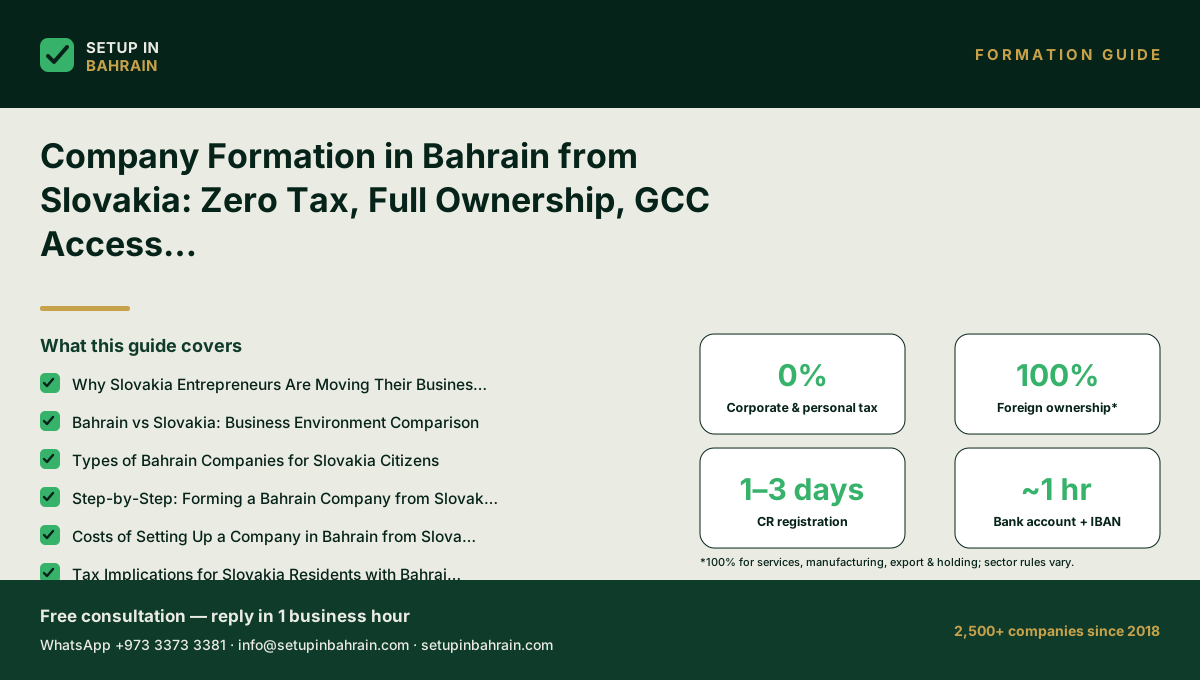
Register your Bahrain company from Slovakia with generally no corporate income tax for most sectors. Easy setup process, full foreign ownership, and strategic Gulf market access for Slovak entrepreneurs.
Key Takeaways
- Why Slovakia Entrepreneurs Are Moving Their Business to Bahrain
- Bahrain vs Slovakia: Business Environment Comparison
- Types of Bahrain Companies for Slovakia Citizens
- Step-by-Step: Forming a Bahrain Company from Slovakia
- Costs of Setting Up a Company in Bahrain from Slovakia
→ Complete guide: Company Formation in Bahrain — the full 2026 guide
View details
Ownership & capital
A Bahrain WLL can be owned by a single person — 100% foreign ownership applies to most activities, with no local partner required for services, manufacturing, export trading and holding companies. The minimum share capital is BHD 1 ; we recommend BHD 1,000 . This Makes bank account opening and investor visa approval smoother.
Martin Kováč sat across from me at a café in Bratislava's Old Town last September, laptop open, spreadsheets glowing. His software development company had just crossed €680,000 in annual revenue—mostly from German and Austrian enterprise clients. By any reasonable measure, Martin had built something successful.
But the numbers on his screen told a different story.
After Slovakia's 21% corporate tax claimed €142,800, after mandatory social contributions on salaries consumed another €47,000, after his accountant charged €8,400 for managing the labyrinthine FinStat publication requirements, and after the statutory auditor cost €6,200 (because Finančná správa had flagged him for the second audit in three years when his revenue crossed €500,000), Martin's actual retained profit sat at €311,000.
"I work fourteen-hour days building something valuable," Martin said, closing his laptop. "And nearly half of everything I create disappears before I can reinvest a single euro into growth. Meanwhile, my competitor in Dubai just hired three developers with money I sent to the Slovak treasury."
Martin's frustration represents a quiet exodus happening across Slovakia. Entrepreneurs who built successful businesses under the assumption that hard work equals proportional reward are discovering that Slovakia's tax and compliance architecture punishes scale. The more successful you become, the more the system extracts—not just in direct taxation, but in compliance costs, audit exposure. Opportunity cost.
This guide exists because Slovak entrepreneurs deserve specific, practical information about Bahrain as a business jurisdiction—not recycled advice written for Americans or generic "offshore company" marketing. I'll walk you through exactly why Bahrain makes strategic sense for Slovak businesses, what the formation process actually looks like, how to structure your operations legally and effectively, and the real costs and timelines involved.
No theoretical concepts. No sales pitches. Just the roadmap you need to make an informed decision about whether Bahrain belongs in your business strategy.
Why Slovakia Entrepreneurs Are Moving Their Business to Bahrain
The shift toward Bahrain isn't happening because Slovak entrepreneurs discovered some exotic loophole or developed a sudden interest in Middle Eastern culture. It's happening because the mathematics of running a business in Slovakia have become genuinely punishing for ambitious founders who want to scale beyond Central European borders.
Let me break down the specific pain points driving this migration.
The 21% Corporate Tax Reality
Slovakia's 21% corporate income tax rate positions it among the higher-taxed nations in Central Europe. For context, Hungary charges 9%, Bulgaria 10%. Ireland's effective rate for tech companies often lands below 12.5%. But the headline rate only tells part of the story.
When your Slovak s.r.o. generates profit, that 21% represents just the first extraction. If you want to actually use that money—pay yourself a dividend, reinvest in equipment, expand your team—additional layers of taxation activate. Dividend withholding adds 7%, bringing your effective rate to about 26.5% before the money reaches your personal account. Health insurance contributions on dividend income can push the effective burden even higher.
Compare this to Bahrain's generally no corporate income tax for most sectors. Zero. Not "effectively zero after deductions." Not "zero if you structure correctly." Simply zero. The Kingdom of Bahrain does not impose corporate income tax on most business activities. According to the Bahrain Economic Development Board (EDB), this policy has been consistent for decades and forms a cornerstone of Bahrain's economic strategy.
For Martin's €680,000 revenue business generating about €450,000 in gross profit, the difference between Slovakia and Bahrain isn't marginal—it's €94,500 annually. Over five years, that's nearly half a million euros retained for growth, hiring. Market expansion rather than transferred to government coffers.
FinStat Transparency That Hurts Competitive Position
Slovak entrepreneurs face a compliance requirement that business owners in most other countries find genuinely shocking: mandatory public disclosure of complete financial statements through the FinStat database.
Every s.r.o. in Slovakia must publish detailed financial information—revenue figures, cost structures, profit margins, asset values—in a publicly searchable format. This means your competitors can examine your financials. Your clients can see exactly how much profit you make from their contracts. Your suppliers can calculate precisely how much room you have for price negotiation.
Petra, who runs a SaaS company in Košice, described the competitive damage this creates: "My German competitors bid against me knowing exactly what margins I operate on. They've literally quoted my FinStat numbers back to me during negotiations. I'm competing with one hand tied behind my back."
The FinStat requirement consumes about 24-40 hours of accounting time annually for a typical small business, plus the accountant fees for ensuring statements meet statutory format requirements. For Petra's company, this translated to roughly €2,400 in direct costs and an opportunity cost she couldn't even quantify—the deals she lost because competitors could reverse-engineer her pricing strategy.
Bahrain companies face no such public disclosure requirements. Your financial information remains private. According to the Ministry of Industry and Commerce (MOIC), while companies must maintain proper accounting records and file with relevant authorities, there's no public database where competitors can access your commercial information.
Finančná správa Audit Triggers
Slovak entrepreneurs live with a constant, low-grade anxiety about audit exposure from Finančná správa, Slovakia's tax administration. Certain thresholds and patterns trigger heightened scrutiny:
- Revenue exceeding €500,000 annually
- Rapid revenue growth (especially above 30% year-over-year)
- International transactions, especially with "low-tax jurisdictions"
- Related-party transactions with foreign entities
- Unusual expense patterns or industry-atypical margins
Martin's company triggered audits twice in three years—not because he did anything improper. Because his success created the profile Finančná správa's algorithms flag. Each audit required:
- Hiring a statutory auditor (€4,000-8,000)
- Additional accounting preparation (40-60 hours)
- Management distraction (estimated 3-4 weeks of reduced productivity)
- Legal consultation (€1,500-3,000)
Even when audits conclude with no findings, the cost in time, money, and psychological burden accumulates. Slovak entrepreneurs describe feeling punished for growth—the more successful their businesses become, the more scrutiny they attract.
Bahrain's regulatory approach differs fundamentally. While the Central Bank of Bahrain (CBB) and MOIC maintain oversight appropriate to a well-regulated financial center, the audit culture focuses on compliance rather than extraction. Businesses meeting their licensing and reporting requirements operate without the constant anxiety of random audit triggers.
Mandatory Notarization for S.R.O. Changes
Every modification to a Slovak s.r.o.—changing share structure, updating registered address, adding directors, amending articles of association—requires notarization. This isn't optional convenience; it's mandatory legal process.
Each notarization costs €150-400 depending on complexity. More greatly, it requires physical presence at a Slovak notary office. For entrepreneurs who've relocated or travel frequently, this creates genuine operational friction.
Milan, running his agency from Bratislava while serving clients across the DACH region, described the frustration: "I needed to add a co-founder to my s.r.o. last year. The process required three separate notary visits, two weeks of waiting for document processing, and €1,100 in total fees. My friend with a company in Estonia did the equivalent change in forty-five minutes from his laptop."
Bahrain's company amendment processes operate primarily through the Sijilat online portal. While certain changes require physical document submission, the process emphasizes efficiency rather than ceremonial notarization. Most corporate modifications complete within 3-5 business days without requiring founder presence in Bahrain.
Limited English-Language Government Interface
Slovakia's government portals, tax systems, and official documents operate primarily in Slovak. For entrepreneurs building international businesses—especially those serving English-speaking markets or employing international staff—this creates persistent friction.
Try explaining Slovak tax regulations to a foreign investor. Attempt to onboard a remote employee who needs to understand their Slovak contract obligations. Navigate the social insurance portal with a team member who speaks German but not Slovak.
Bahrain conducts government business in both Arabic and English. The Sijilat business registration portal operates fully in English. MOIC communications arrive in English. Banking applications, license renewals, and regulatory correspondence function seamlessly in the global business language.
For Slovak entrepreneurs building international operations, this linguistic accessibility eliminates an entire category of friction and translation cost.
Market Size Ceiling
Slovakia's population of 5.5 million people represents a fundamental ceiling for domestic-focused businesses. The B2B market concentrates in Bratislava, with secondary clusters in Košice and a few regional centers. Competition for enterprise clients intensifies every year as more entrepreneurs chase the same limited pool of potential customers.
Bahrain's population of 1.5 million might seem smaller—until you recognize the strategic geography. Bahrain sits at the center of the Gulf Cooperation Council (GCC) market: Saudi Arabia (35 million), UAE (10 million), Kuwait (4.3 million), Qatar (2.9 million). Oman (5.1 million). The combined GCC market exceeds 58 million people with GDP surpassing $1.8 trillion.
More importantly, Bahrain connects to Saudi Arabia via the 25-kilometer King Fahd Causeway. Saudi Arabia's Vision 2030 economic transformation is creating opportunities at a scale Slovak entrepreneurs have never accessed domestically. According to the Saudi Ministry of Investment, the Kingdom is deploying over $3.2 trillion in development spending through 2030.
From a Bahrain base, Slovak entrepreneurs access this market directly—same time zone, easy physical access. Established business relationships between Bahraini and Saudi commercial sectors.
Bahrain vs Slovakia: Business Environment Comparison
Understanding the practical differences between Slovak and Bahraini business environments requires examining specific operational factors. The following comparison addresses the elements that most directly impact Slovak entrepreneurs considering this transition.
Corporate Taxation Structure
Slovakia:
- 21% corporate income tax (15% for companies with revenue under €49,790)
- 7% dividend withholding tax
- Effective combined rate: 26.5%+ for profit extraction
- Complex transfer pricing rules for international operations
- Controlled Foreign Corporation (CFC) rules affecting foreign subsidiaries
Bahrain:
- 0% corporate income tax (except oil/gas sector)
- 0% dividend withholding tax
- 0% capital gains tax
- No transfer pricing compliance burden for most businesses
- Full profit repatriation without restriction
We have served 2,800+ clients from 44+ countries and maintain records to substantiate that total where needed. We have 113 Google reviews; reviews represent only some clients and are not the same as the total clients served.
Company Formation Requirements
Slovakia (s.r.o. formation):
- Minimum share capital: €5,000 (must be deposited)
- Notarized formation documents required
- Trade license (živnostenské oprávnenie) application
- Commercial register entry (3-5 weeks processing)
- Bank account opening (2-3 weeks, often requires physical presence)
- Total timeline: 6-10 weeks realistic
- Total cost: €2,000-4,000 including all fees and professional services
Bahrain (WLL or Single Person Company formation):
- Minimum share capital: BHD 50 (about €120) for many license types
- 100% foreign ownership permitted in most sectors
- Online application through Sijilat portal
- CR (Commercial Registration) issuance: 1-3 business days
- Bank account opening: 2-4 weeks
- Total timeline: 2-4 weeks realistic
- Total cost: BHD 1,500-5,000 (€3,600-12,000) depending on license type and office requirements
Annual Compliance Burden
Slovakia:
- Mandatory financial statement publication on FinStat
- Annual tax returns with supporting documents
- Monthly/quarterly VAT returns if registered
- Social insurance reporting for employees
- Potential statutory audit requirement above thresholds
- Estimated annual compliance cost: €3,000-8,000 for a typical small business
Bahrain:
- Annual license renewal through MOIC
- Financial statements filed with regulators (not public)
- No VAT on most services (5% VAT exists but with high thresholds)
- Simplified labor reporting through LMRA
- Estimated annual compliance cost: BHD 800-2,500 (€1,900-6,000)
Banking and Financial Infrastructure
Slovakia:
- EU banking integration (SEPA, IBAN)
- Strong correspondent banking relationships
- Limited fintech innovation compared to Western Europe
- Account opening more and more difficult for international-facing businesses
- Euro-denominated accounts standard
Bahrain:
- Regional financial center with 80+ licensed banks
- Major international banks present (HSBC, Citi, Standard Chartered)
- Growing fintech ecosystem (Rain crypto exchange, multiple digital banks)
- Bahraini Dinar pegged to USD (BHD 1 = USD 2.65)
- Multi-currency account availability standard
- According to the Central Bank of Bahrain (CBB), the Kingdom maintains the region's most developed regulatory framework for digital banking and fintech
Business Culture and Operating Environment
Slovakia:
- Central European business culture
- Slovak language dominance in government/legal dealings
- Strong work ethic but bureaucratic friction
- EU regulatory framework
- Limited networking opportunities outside Bratislava
Bahrain:
- International business culture with Arab hospitality traditions
- English widely used in commercial settings
- Relationship-focused business development
- GCC regulatory framework with growing international alignment
- Active business community with regular networking events
- According to the Bahrain Economic Development Board, over 80% of professional communication occurs in English
Types of Bahrain Companies for Slovakia Citizens
Selecting the appropriate corporate structure in Bahrain requires understanding how each entity type aligns with specific business objectives. Slovak entrepreneurs typically consider four primary options, each with distinct advantages and requirements.
With Limited Liability (WLL) Company
The WLL represents Bahrain's equivalent to the Slovak s.r.o.—a limited liability company suitable for most commercial activities. Since Bahrain eliminated mandatory local partner requirements for most sectors, WLLs have become the default choice for foreign entrepreneurs seeking full operational control.
Structure Requirements:
- a single shareholder (one person can own 100%) (can be foreign individuals or companies)
- Minimum one director (can be shareholder)
- No minimum capital requirement for most activities (nominal BHD 50-250 sufficient)
- Registered office address in Bahrain required
Key Advantages for Slovak Entrepreneurs:
- 100% foreign ownership in most sectors
- Full operational flexibility
- Access to all commercial activities under appropriate license
- Ability to sponsor employee work permits
- No restrictions on profit repatriation
Practical Considerations: The two-shareholder minimum means solo Slovak entrepreneurs need either a business partner or must use a holding company structure. Many Slovak founders establish a simple EU holding company (often in Estonia or Malta) that then serves as one shareholder alongside themselves personally.
License costs vary greatly by activity type. A consultancy license might cost BHD 300 annually, while trading licenses range BHD 1,000-3,000. According to MOIC statistics, processing time averages 2-5 business days once documents is complete.
single-shareholder WLL
Bahrain introduced the Single Person Company structure specifically to accommodate solo entrepreneurs who don't want the complexity of multi-shareholder arrangements.
Structure Requirements:
- Single shareholder (individual or company)
- One director minimum
- BHD 50 minimum capital (about €120)
- Registered office address required
Key Advantages for Slovak Entrepreneurs:
- Perfect for solo founders and freelancers
- Simplified governance (no shareholder meetings)
- Full limited liability protection
- Same licensing options as WLL
Practical Considerations: The WLL functions nearly identically to a WLL for operational purposes. Banks and clients treat both structures equivalently. The primary difference lies in internal governance simplicity—no shareholder resolutions, no capital call mechanisms, no complex shareholder agreements.
For Slovak software developers, consultants. Service providers operating as individuals, the WLL offers the cleanest structure with minimal ongoing administration.
Branch Office
Foreign companies can establish Bahrain presence through a branch office—an extension of the parent company rather than a separate legal entity.
Structure Requirements:
- Parent company must be operational for minimum 2 years (requirement varies by sector)
- Branch operates under parent company's legal identity
- Local representative required
- Parent company bears unlimited liability for branch obligations
Key Advantages for Slovak Entrepreneurs:
- No separate capitalization requirement
- Direct integration with parent company operations
- Simplified profit consolidation
- May benefit from existing parent company banking relationships
Practical Considerations: Slovak s.r.o. companies can establish Bahrain branches, but this structure creates direct liability exposure for the Slovak entity. Any Bahrain branch obligations legally bind the Slovak parent. For tax optimization purposes, branches also offer fewer planning opportunities than subsidiary structures.
Branch registration typically requires 2-4 weeks and costs BHD 2,000-4,000 depending on licensing requirements.
Bahrain Free Zone Companies
Bahrain operates several free zones offering specific advantages for certain business types:
Bahrain International Investment Park (BIIP):
- Industrial and manufacturing focus
- Duty-free import of equipment and materials
- 100% foreign ownership guaranteed
- 10-year tax holiday (though Bahrain's 0% rate makes this largely symbolic)
Bahrain Logistics Zone: Logistics, warehousing. Distribution Direct access to Khalifa Bin Salman Port Streamlined customs procedures Ideal for e-commerce fulfillment serving GCC markets
Key Advantages for Slovak Entrepreneurs:
- Simplified licensing for specific activities
- Purpose-built facilities available
- Clustering benefits with similar businesses
- Often faster setup timelines
Practical Considerations: Free zones make sense primarily for businesses with physical operations—manufacturing, logistics, or laboratory facilities. For service companies, consultancies, and digital businesses, mainland WLL structures typically offer more flexibility without meaningful disadvantage.
According to the Bahrain Investment and Promotion Agency (BIPA), free zone companies can still conduct business throughout Bahrain and the GCC without restriction, though certain activities may require additional mainland licensing.
Choosing the Right Structure: Decision Framework
For Slovak entrepreneurs evaluating options, the decision typically flows from these questions:
Are you operating solo or with partners?
- Solo: WLL offers simplest structure
- Partners: WLL provides standard multi-shareholder governance
Do you have existing EU company structure?
- Yes: Consider using existing company as Bahrain shareholder
- No: Individual shareholding works fine for most purposes
What's your primary business activity?
- Services/consulting: Mainland WLL
- Trading/distribution: Mainland WLL or Logistics Zone
- Manufacturing: BIIP or mainland WLL
- Tech/software: Mainland WLL (maximum flexibility)
Do you need employee sponsorship capability?
- Yes: WLL with appropriate license
- No: Consider whether you even need Bahrain entity vs. alternative structures
The vast majority of Slovak entrepreneurs I've worked with end up choosing either WLL (solo founders) or WLL (partnerships or those wanting maximum flexibility). Free zones serve specific use cases but aren't the default choice for service-based businesses.
Step-by-Step: Forming a Bahrain Company from Slovakia
The practical process of establishing a Bahrain company from Slovakia involves distinct phases, each with specific requirements and typical timelines. Understanding this process in advance eliminates surprises and allows realistic planning.
Phase 1: Pre-Formation Planning (Week 1-2)
Before engaging with Bahrain authorities or formation agents, clarify these foundational decisions:
Business Activity Definition: Bahrain licenses are activity-specific. Your Commercial Registration (CR) will list permitted activities that define what your company can legally do. Choose carefully—changing activities later requires amendment fees and processing time.
Common activity categories for Slovak entrepreneurs:
- Management Consultancy Services
- Information Technology Consultancy
- Computer Programming and Software Development
- Marketing Services
- Business Support Services
- Trading (various categories)
- Professional Services
Shareholder and Director Structure: Decide who will hold shares and serve as directors. For WLLs, this is straightforward—you hold 100% and serve as director. For WLLs, determine:
- Shareholder percentages
- Director appointments (shareholders can be directors)
- Whether to use individual or corporate shareholders
Office Requirements: Every Bahrain company needs a registered office address. Options include:
- Virtual office packages (BHD 1,200-2,400 annually): Address only, mail handling, occasional meeting space
- Flexi-desk arrangements (BHD 2,400-4,800 annually): Dedicated workspace in shared environment
- Private office (BHD 6,000+ annually): Traditional office space
For most Slovak entrepreneurs initially, virtual office arrangements provide compliant registered address at minimal cost. Physical presence can scale up as business develops.
Budget Preparation: Realistic first-year budget for a Slovak entrepreneur establishing Bahrain presence:
| Item | Typical Cost (BHD) | EUR Equivalent |
| Formation agent fees | 800-1,500 | €1,900-3,600 |
| Government registration fees | 300-600 | €720-1,440 |
| License fees (first year) | 300-2,000 | €720-4,800 |
| Virtual office (annual) | 1,200-2,400 | €2,880-5,760 |
| Bank account setup | 100-500 | €240-1,200 |
| Miscellaneous/contingency | 300-500 | €720-1,200 |
| Total First Year | 3,000-7,500 | €7,200-18,000 |
Phase 2: Documents Preparation (Week 2-3)
Bahrain company formation requires specific documents from Slovak shareholders and directors:
For Individual Slovak Shareholders/Directors:
- Valid passport (scanned copy initially, certified copy later)
- Proof of address (utility bill or bank statement, less than 3 months old)
- CV/professional background summary
- Bank reference letter (some agents require this)
For Slovak Corporate Shareholders:
- Certificate of incorporation (výpis z obchodného registra)
- Articles of association (spoločenská zmluva)
- Certificate of good standing (recent extract showing company is active)
- Board resolution authorizing Bahrain investment
- Passport copies of authorized signatories
Document Authentication Requirements: Slovak documents destined for Bahrain require apostille authentication. Slovakia is party to the Hague Apostille Convention, so the process is straightforward:
- Get official documents from Slovak authorities
- Have documents apostilled at designated Slovak office (Ministry of Justice or regional court)
- Some documents may require notarized Slovak translation to English
- Apostilled documents valid for Bahrain submission
Apostille processing in Slovakia typically takes 3-5 business days and costs €10-20 per document.
Phase 3: Engagement with Formation Agent or Direct Application (Week 3-4)
Slovak entrepreneurs have two paths to Bahrain company formation:
Direct Application (DIY Approach): Technically possible through the Sijilat portal (www.sijilat.bh). Practically challenging for first-time foreign applicants. The portal operates in English, but navigating license category selection, document requirements. Fee calculations without local knowledge creates frustration and potential errors.
Direct application makes sense if you:
- Have previous Bahrain business experience
- Are forming a very simple structure with standard activities
- Want to minimize costs and can invest significant time learning the system
Formation Agent (Recommended for Most Slovak Entrepreneurs): Licensed Bahrain formation agents handle the entire process on your behalf:
- License category selection and optimization
- Document preparation and submission
- Communication with MOIC and other authorities
- Bank introduction letters
- Ongoing compliance support
Reputable formation agents charge BHD 800-1,500 for standard company formation. This investment typically saves weeks of frustration and reduces error risk greatly.
When selecting a formation agent, verify:
- MOIC licensing as corporate services provider
- Track record with foreign (especially European) clients
- Clear fee structure without hidden costs
- Responsiveness to initial inquiries (good indicator of ongoing service quality)
Phase 4: Application Submission and Processing (Week 4-5)
Once documents is complete, the formation agent (or you, if proceeding directly) submits the application through Sijilat:
Standard Application Components:
- Company name reservation (must be unique and appropriate)
- Shareholder and director information
- Registered office address confirmation
- Activity selection and license application
- Supporting documents (passports, apostilled corporate documents)
Processing Timeline: According to MOIC published standards, Commercial Registration issuance takes 1-3 business days after complete application submission. In practice, first-time foreign applicants often experience 3-7 business days due to document verification requirements.
Common Delays:
- Incomplete documents (most frequent cause)
- Company name conflicts with existing registrations
- Activity combinations requiring multiple license types
- Additional due diligence for certain nationalities (not typically an issue for Slovak citizens)
Phase 5: Commercial Registration and License Issuance (Week 5-6)
Upon successful application, MOIC issues:
Commercial Registration (CR): Your company's foundational legal document establishing its existence. The CR includes:
- Company name (English and Arabic)
- CR number (unique identifier)
- Registered address
- Share capital
- Shareholder details
- Licensed activities
License Certificate: Separate from the CR, the license authorizes specific business activities. License validity is typically one year, requiring annual renewal.
Both documents arrive electronically through Sijilat, with physical copies available upon request.
Phase 6: Bank Account Opening (Week 6-10)
Opening a Bahrain corporate bank account represents the most unpredictable element of company formation. While the company itself can be established remotely, most banks require physical presence for account opening.
Bank Selection for Slovak Entrepreneurs: Consider these factors when choosing a Bahrain bank:
International Banks (HSBC, Standard Chartered, Citi):
- Familiar processes for European entrepreneurs
- Strong correspondent banking networks
- Higher minimum balance requirements (often BHD 10,000+)
- More rigorous due diligence (longer processing)
- Typically require in-person account opening
Regional Banks (National Bank of Bahrain, BBK, Ahli United):
- Lower minimum balance requirements
- Faster processing for straightforward applications
- May accept video verification for account opening
- Good for GCC-focused businesses
Digital Banks (Tarabut, Rain for crypto):
- Fastest account opening
- Limited service range
- Lower balances accepted
- Good as secondary accounts
Required Documents for Bank Account:
- Commercial Registration
- License certificate
- Memorandum and Articles of Association
- Shareholder/director passports
- Proof of address for all parties
- Source of funds documents
- Business plan or description
- Bank reference letters (sometimes)
Timeline Expectations: Best case: 2 weeks (digital banks or straightforward applications) Typical case: 4-6 weeks (traditional banks with complete documents) Challenging case: 8-12 weeks (additional due diligence, complex structures)
Many Slovak entrepreneurs visit Bahrain during this phase—combining bank account opening with initial business development meetings and familiarizing themselves with the market.
Phase 7: Post-Formation Setup (Week 8-12)
With company registered and bank account operational, complete these remaining setup items:
LMRA Registration (If Hiring Employees): The Labour Market Regulatory Authority (LMRA) manages work permits and employment documents. Registration enables your company to sponsor employee visas.
Social Insurance Registration: Bahrain's Social Insurance Organization (SIO) requires employer registration before hiring staff.
Accounting Setup: Engage a Bahrain-based accountant or bookkeeper familiar with local requirements. While Bahrain's accounting standards aren't as onerous as Slovakia's, proper record-keeping remains essential for license renewals and any future due diligence.
Business Cards, Website Localization: Small details that matter for GCC market credibility—Arabic-language business cards, contact information with Bahrain presence. Local phone numbers all contribute to market acceptance.
Costs of Setting Up a Company in Bahrain from Slovakia
Understanding the true cost of Bahrain company formation requires looking beyond government fees to include all practical expenses. Slovak entrepreneurs should budget realistically to avoid surprises.
Initial Formation Costs
Government Fees:
| Fee Type | Amount (BHD) | EUR Equivalent |
| Commercial Registration | 100-250 | €240-600 |
| Trade License (basic) | 300-500 | €720-1,200 |
| Trade License (specialized) | 500-2,000 | €1,200-4,800 |
| Name Reservation | 20 | €48 |
| Certificate issuance | 10-30 | €24-72 |
| Service | Typical Range (BHD) | EUR Equivalent |
| Formation agent (full service) | 800-1,500 | €1,920-3,600 |
| Legal review (if desired) | 500-1,000 | €1,200-2,400 |
| Document apostille (Slovakia) | 50-100 | €50-100 |
| Document translation | 100-300 | €240-720 |
| Option | Annual Cost (BHD) | EUR Equivalent |
| Virtual office (basic) | 1,200-1,800 | €2,880-4,320 |
| Virtual office (premium) | 2,400-3,600 | €5,760-8,640 |
| Flexi-desk | 3,600-6,000 | €8,640-14,400 |
| Private office | 7,200+ | €17,280+ |
Realistic First-Year Budget Scenarios
Scenario 1: Solo Consultant (WLL, Virtual Office)
- Government fees: BHD 400
- Formation agent: BHD 900
- Virtual office: BHD 1,500
- Bank account setup: BHD 200
- Accounting (basic): BHD 600
- Contingency: BHD 400
- Total: BHD 4,000 (about €9,600)
Scenario 2: Tech Company with Employees (WLL, Physical Office)
- Government fees: BHD 800
- Formation agent: BHD 1,200
- Physical office: BHD 8,000
- Bank account setup: BHD 300
- Accounting: BHD 1,500
- LMRA/employee setup: BHD 2,000
- Contingency: BHD 700
- Total: BHD 14,500 (about €34,800)
Scenario 3: Trading Company (WLL, Warehouse)
- Government fees: BHD 1,500
- Formation agent: BHD 1,500
- Warehouse/office: BHD 15,000
- Bank account setup: BHD 500
- Accounting: BHD 2,000
- Import/export licensing: BHD 1,000
- Contingency: BHD 1,000
- Total: BHD 22,500 (about €54,000)
Ongoing Annual Costs
Mandatory Renewals:
| Item | Annual Cost (BHD) | EUR Equivalent |
| License renewal | 300-2,000 | €720-4,800 |
| CR renewal | 100 | €240 |
| Virtual office renewal | 1,200-2,400 | €2,880-5,760 |
| Item | Typical Range | Notes |
| Accounting/bookkeeping | BHD 600-3,000 | Depends on transaction volume |
| Legal retainer | BHD 1,000-3,000 | Optional but recommended |
| Bank fees | BHD 200-500 | Monthly maintenance fees |
| PRO services | BHD 600-1,200 | Government liaison |
Cost Comparison: Slovakia vs. Bahrain (5-Year Analysis)
For a software company generating €400,000 annual profit:
Slovakia (s.r.o.):
- Year 1 setup: €3,500
- Annual corporate tax: €84,000
- Annual compliance costs: €5,000
- 5-year total tax + compliance: €448,500
Bahrain (WLL):
- Year 1 setup: €15,000
- Annual corporate tax: €0
- Annual compliance costs: €8,000
- 5-year total tax + compliance: €55,000
Even accounting for higher initial setup costs and ongoing operating expenses in Bahrain, the tax differential creates substantial long-term savings for profitable businesses.
Tax Implications for Slovakia Residents with Bahrain Companies
The tax relationship between Slovakia and Bahrain requires careful navigation. Slovak entrepreneurs cannot simply form a Bahrain company and assume all tax obligations disappear—Slovakia's tax authority has mechanisms to capture income from foreign structures.
Slovakia's Controlled Foreign Corporation (CFC) Rules
Slovakia implemented CFC rules aligned with EU Anti-Tax Avoidance Directive (ATAD) requirements. These rules prevent Slovak tax residents from parking
Bahrain Business Guides for Slovakia Citizens
Frequently Asked Questions
How long does it take to set up?
It takes 15 to 20 days. We file all forms for you. You do not need to wait long.
What does it cost?
Company formation: Standard BHD 1,340 with 3 months of office address; Gold BHD 1,700 with 6 months; Premium BHD 2,150 with 12 months and a cabin, officer table and chair, and two guest chairs. No formation package includes visas, including Premium. Investor/work visas are priced separately: BHD 755 for one year or BHD 953 for two years, in addition to the formation package. Ask for a written, itemized quotation confirming government fees and all inclusions before payment.
Do I need to visit Bahrain?
No. You can set up your firm from home. We do all the work online. Some banks may ask for one visit.
What tax will I pay?
You pay zero tax on your profits. Bahrain has no corporate income tax. This is a key benefit of the setup.
Can I own 100% of my firm?
Yes. Foreign owners can hold all shares. No local partner is needed. Full ownership is allowed.
What do I need to start?
You need a valid passport. You also need a trade name and a business address. We help you with all of these.
How do I open a bank account?
We guide you step by step. Most banks take 3 to 6 weeks. You will need your CR and firm papers.
Who issues the Commercial Registration (CR)?
The CR is issued by the MOICT. It is your legal right to trade in Bahrain. We file the CR for you.
Can I renew my CR each year?
Company renewal packages: BHD 530 with 3 months of office address; BHD 980 with 6 months; BHD 1,520 with 12 months. These are separate renewal packages, not visa fees.
How do I get started?
Fill in our form on this page. Our team will call you back. We map your best setup plan at no cost.
Steps to Form Your Company
- Pick your trade name. We check if it is free.
- Choose your business type. WLL is the most common.
- Sign the MOA. We draft and file all legal docs.
- Pay the state fees. About BHD 432 in total.
- Get your CR. Takes 15 to 20 days.
- Open your bank account. We guide each step.
- Start trading. You are ready to do business.
Key Facts
- Tax rate: 0%
- Foreign ownership: 100%
- Setup time: 15 to 20 days
- Company formation: Standard BHD 1,340 with 3 months of office address; Gold BHD 1,700 with 6 months; Premium BHD 2,150 with 12 months and a cabin, officer table and chair, and two guest chairs. No formation package includes visas, including Premium. Investor/work visas are priced separately: BHD 755 for one year or BHD 953 for two years, in addition to the formation package. Ask for a written, itemized quotation confirming government fees and all inclusions before payment.
- Company renewal packages: BHD 530 with 3 months of office address; BHD 980 with 6 months; BHD 1,520 with 12 months. These are separate renewal packages, not visa fees.
- Client rating: 4.8 stars
- Clients served: 2,500 and more
Quick Facts
- Tax rate: 0%
- Own all of your firm: Yes, 100%
- Time to set up: 15 to 20 days
- Company formation: Standard BHD 1,340 with 3 months of office address; Gold BHD 1,700 with 6 months; Premium BHD 2,150 with 12 months and a cabin, officer table and chair, and two guest chairs. No formation package includes visas, including Premium. Investor/work visas are priced separately: BHD 755 for one year or BHD 953 for two years, in addition to the formation package. Ask for a written, itemized quotation confirming government fees and all inclusions before payment.
- Company renewal packages: BHD 530 with 3 months of office address; BHD 980 with 6 months; BHD 1,520 with 12 months. These are separate renewal packages, not visa fees.
- Rating: 4.8 stars
- Clients: 2,500 and more
Why Bahrain?
Bahrain has no tax. You keep all your profits. This is rare in the Gulf.
You can own all of your firm. No local partner is needed. The law allows full foreign ownership.
Setup takes 15 to 20 days. We file all forms for you. You can do it all from home.
Bahrain has a free trade deal with the US. Your goods face low or no tariffs. This gives you access to big markets.
We have served 2,800+ clients from 44+ countries and maintain records to substantiate that total where needed. We have 113 Google reviews; reviews represent only some clients and are not the same as the total clients served.
Our Steps
- Tell us your plan. We advise you for free.
- We pick the right firm type for you.
- We file all your forms with MOICT.
- You get your CR in 15 to 20 days.
- We help you open a bank account.
- You are ready to trade. We stay with you.
Why Set Up in Bahrain?
Bahrain is a great place to run a firm. It has no tax. You keep all your profits. This is rare in the Gulf.
You can own your firm 100%. No local partner is needed. The law is clear and fair.
It is fast to set up. You can have a CR in 15 to 20 days. We file all forms for you.
Bahrain has a free trade deal with the US. Your goods face low or no tariffs. This gives you access to big markets.
The banks are good. The roads are good. The schools are good. It is a well-run state.
We have served 2,800+ clients from 44+ countries and maintain records to substantiate that total where needed. We have 113 Google reviews; reviews represent only some clients and are not the same as the total clients served.
Our Services
- Company formation: Standard BHD 1,340 with 3 months of office address; Gold BHD 1,700 with 6 months; Premium BHD 2,150 with 12 months and a cabin, officer table and chair, and two guest chairs. No formation package includes visas, including Premium. Investor/work visas are priced separately: BHD 755 for one year or BHD 953 for two years, in addition to the formation package. Ask for a written, itemized quotation confirming government fees and all inclusions before payment.
- Company renewal packages: BHD 530 with 3 months of office address; BHD 980 with 6 months; BHD 1,520 with 12 months. These are separate renewal packages, not visa fees.
- Investor Visa — from BHD 755
- Work Visa — LMRA managed
- Virtual office — from BHD 600 per year
- Bank account opening — 3 to 6 weeks
- Family visa — for spouse and kids
- UBO filing — as required by law
Bahrain at a Glance
- Tax rate: 0%
- Foreign ownership: 100%
- Setup time: 15 to 20 days
- Free trade deal: Yes, with the US
- Language: Arabic and English
- Currency: Bahraini Dinar (BHD)
- Time zone: UTC+3
- GDP growth: Steady and strong
How to Start
- Fill in the form on this page. It takes 3 minutes.
- We call you back the same day.
- We map the best plan for your firm type and goals.
- We file all forms. We deal with MOICT for you.
- You get your CR in 15 to 20 days.
- We help you open a bank account and get your visa.
- You are ready to trade. We stay with you.
Common Questions
Do I need to visit Bahrain to set up?
No. You can do it all from home. We file online. You may need one visit to open a bank account.
Is Bahrain safe for business?
Yes. Bahrain is a stable state. It has a clear legal system. Your firm and funds are safe here.
Can I hire staff from any country?
Yes. You can hire from any country. Each hire needs a work permit from LMRA. We manage this for you.
What type of firm should I set up?
Most clients choose a WLL. This is a limited liability firm. It is flexible and well-known in Bahrain. We advise you on the best type for your case.
How do I get in touch?
Fill in our form. We call you back the same day. You can also email us or use the chat on this page.
Ready to set up in Bahrain from Slovakia?
Tell us your business idea. We map the right entity, ownership and timeline — then handle the filing while you focus on what matters.