
Register your Bahrain company from Singapore with generally no corporate income tax for most sectors. Fast setup, full support for Singaporean entrepreneurs expanding to the Gulf.
→ Complete guide: Company Formation in Bahrain — the full 2026 guide
View details
Ownership & capital
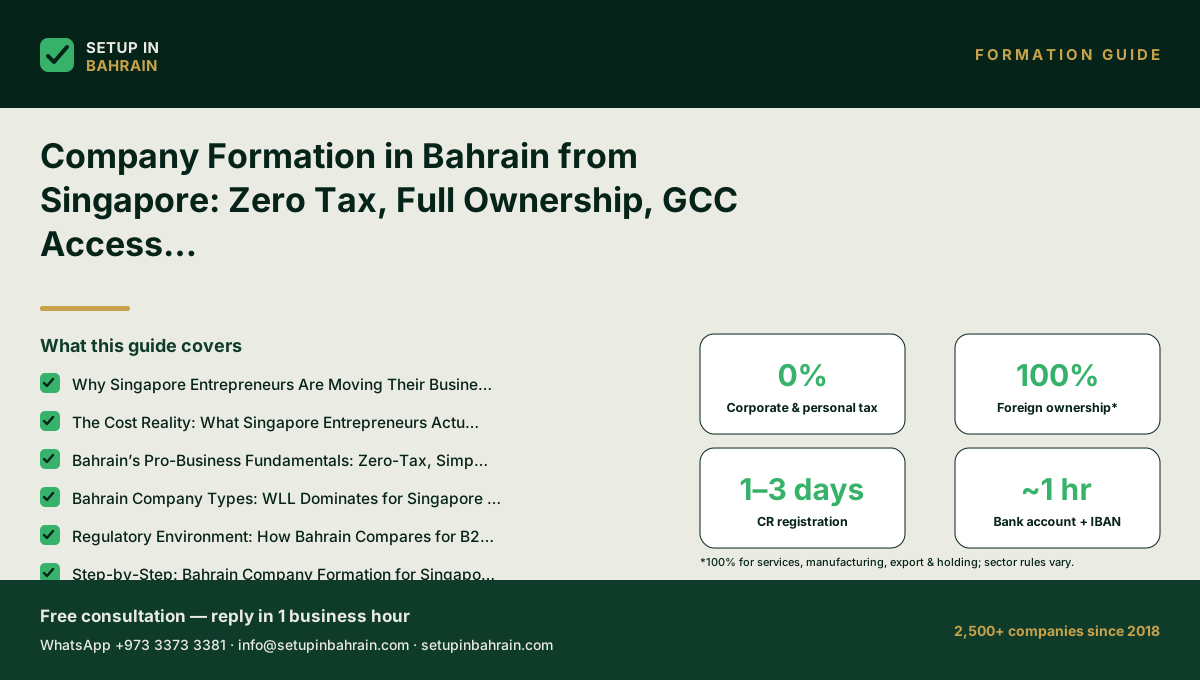
A Bahrain WLL can be owned by a single person — 100% foreign ownership applies to most activities, with no local partner required for services, manufacturing, export trading and holding companies. The minimum share capital is BHD 1; we recommend BHD 1,000, which makes bank account opening and investor visa approval smoother.
Why Singapore Entrepreneurs Are Moving Their Business to Bahrain
Picture this scenario: Michelle Tan, founder of a fast-scaling Singapore fintech SaaS, reviews her P&L. She’s staring down a 17% corporate tax bite on profits, another SGD 6,500 in compliance and audit overheads, and SGD 70,000 just for the privilege to apply for a Monetary Authority of Singapore (MAS) license — all before paying out any salary or CPF. Factoring in Central Business District (CBD) rents, mandatory employer contributions, and tightened substance rules, the reasons to stay home don’t look as compelling.
Michelle’s not alone. In 2023 and into 2026, a wave of Singapore-based entrepreneurs — from SaaS to professional services, e-commerce to fintech — quietly began moving all or part of their operations to Bahrain. Their motivations? Zero corporate, personal, or capital gains tax. 100% company ownership with no local partner. A practical minimum share capital for a WLL, and, critically, frictionless access to the $1.7 trillion GCC market from a country ranked by the World Bank among the region’s top performers for business startup ease.
This article is your definitive guide — deeply practical, data-driven, and built for entrepreneurs — to understanding:
- How Bahrain truly stacks up to Singapore
- Which structures support 100% foreign ownership
- What it actually costs to set up and run a Bahrain business, with a focus on financial services, tech, and B2B sectors
- How to fast-track bank account opening and regional expansion
Citations throughout come from the Central Bank of Bahrain (CBB), Bahrain Economic Development Board (EDB), Ministry of Industry & Commerce (MOIC), and Bahrain Investors’ Centre (BIPA), so you get real-time, actionable facts, not consultant marketing fluff.
The Cost Reality: What Singapore Entrepreneurs Actually Pay
Singapore often tops “business-friendly” rankings — and for good reason. But peel back the headlines and the real costs for SMEs and scaling firms, especially in regulated B2B or fintech sectors, quickly add up. Here’s a side-by-side comparison:
| Cost Factor | Singapore (2026) | Bahrain (2026) |
| Corporate Tax on Profits | 17% standard | 0% (no corporate, personal, or capital gains) |
| Annual Compliance & Audit | SGD 3,000–8,000 (ACRA filings, secretary, audit if >S$10M) | BHD 250–400 (annual renewal + basic audit) |
| Regulatory Licensing | MAS: SGD 50,000–80,000+ (application, legal, ongoing supervision) | CBB: BHD 1,000–12,000 (lower, scope-dependent) |
| Central District Office Rent (per sq. ft.) | SGD 14.00–18.00 | BHD 4.50–6.00 (Manama CBD – 65% lower) |
| Annual Wage-Related Levies | CPF (17% employer), SDF, skill levies | None (no payroll, social security for expats) |
| Foreign Ownership Restrictions | None (for most, but some MAS/sector limits, substance required) | None (100% foreign ownership for WLL, etc.) |
| Currency Controls | None | None |
| Immigration and Sponsorship | EP/SP needed; quotas & local hiring for passes | 1-person WLL can directly sponsor expat visas |
The Air-Conditioned Accountancy Pain Point
Most Singapore founders estimate their real annual compliance costs — including audit, tax prep and filings with ACRA and IRAS — at SGD 3,000 (bare minimum, for a small company) up to SGD 8,000 (for standard SMEs using outside accounting firms). This doesn’t include extra legal costs for MAS regulatory filings or any international structuring.
MAS Licensing: The Fintech Elephant in the Room
If your venture is in payments, fintech, crypto, or capital markets, MAS licensing is legendary for both its professionalism and its cost: expect SGD 50,000–80,000 just to apply, and 6–12 months before you can lawfully operate. Add mandatory local directors, substance (often including $10,000+/mo of local rent and payroll), and real-time reporting duties.
CBD Office Rents and Labor Levies
Singapore’s office rents, already on the high side in 2024, now average SGD 14–18 per square foot in the CBD. With even a modest team, overhead climbs fast. Employers pay CPF at 17% of all Singapore salaries (up to a $6,800 monthly cap per person as of 2026). There’s also the Skills Development Levy, Foreign Worker Levy, and various industry-specific permits.
Bottom line: The “easy to do business” reputation is true in spirit — but the cost of doing business, especially for innovative, regulated, or capital-light ventures, has reached historic highs.
Bahrain’s Pro-Business Fundamentals: Zero-Tax, Simple, and Fast
0% Corporate, Personal, and Capital Gains Tax
No headlines required: Bahrain levies zero corporate income tax for nearly all activities, with the only exception being oil and gas extraction. For professional services, fintech, SaaS, e-commerce, and investment holding? Zero. There is no personal income tax, no withholding tax, and no capital gains tax — neither for local nor foreign shareholders.
Source: Bahrain Economic Development Board (EDB), Tax Guide 2026
100% Foreign Ownership — No Local Partner Required
Bahrain abolished the need for GCC-national sponsors for almost all business activities back in 2018. Today, a WLL (With Limited Liability) is the most popular private company format for foreign entrepreneurs — and a single non-GCC national can own 100% of the shares with no local partner or director.
- No partnership/sponsor required (unlike the UAE mainland or Qatar LLC models)
- No WLL/Sole Proprietor Company: Bahrain does not offer a single-shareholder WLL structure — but the WLL is even more flexible and robust, accepted by all banks and regulators.
Minimal Share Capital — But What Works in Practice?
- Legal minimum: BHD 1 (Bahraini Dinar)
- Practical minimum: Most banks and the Bahrain Investors’ Centre (BIPA) recommend a starting capital of BHD 1,000 for fast bank account opening and investor visa eligibility (about SGD 3,550 as of June 2026).
Rapid, Transparent Company Formation
- Online reservation of company name: 1–2 working days (via Sijilat system, MOIC)
- Company setup approval: 3–7 working days for most standard businesses (by the Bahrain Investors’ Centre)
- CR (Commercial Registration) issuance: Typically 5–10 working days for WLLs with fully digital submission
No notary visits, no endless waiting: the entire process is digital-first and English-language compliant.
Zero Currency Controls and Full Profit Repatriation
Bahrain imposes no restrictions on currency flows, transfer pricing, or dividend repatriation. Profits can move between Bahrain, Singapore, and any global jurisdiction with standard reporting.
Bahrain Company Types: WLL Dominates for Singapore Entrepreneurs
Let’s clarify three things for Singapore founders:
- No WLL (“Single Person Company”): This structure is not available in Bahrain.
- The WLL (With Limited Liability) structure: This is the gold standard model, 100% foreign-owned, and is flexible for holding, operating, or group companies.
- Other options: Public Joint-Stock Companies (BSC), branches of foreign entities, and partnership types — typically only used if required for special listing or regulated activity.
WLL (With Limited Liability): Bahrain’s Answer for Global Entrepreneurs
- Single owner allowed: 1–50 shareholders; 100% can be a single foreign individual or corporation.
- No local partner required: Fully foreign-owned.
- Minimum capital: BHD 1 (legal), but BHD 1,000 is recommended for any banking/visa needs.
- Shareholder and director can be the same person: Total control.
- Regulatory approval: For sensitive regulated activities (banking, insurance, etc.), CBB pre-approval is needed — for most other sectors, standard BIPA/MOIC incorporation.
Comparison Table: Business Structures
| Feature | Bahrain WLL | Singapore Pte Ltd |
| Minimum owners/shareholders | 1 | 1 |
| Local sponsor required? | No | No |
| 100% foreign ownership? | Yes | Yes |
| Minimum capital | BHD 1 (practical: BHD 1,000) | SGD 1 (typical paid-up SGD 1,000) |
| Director nationality rules | Any; single person | At least one Singapore resident |
| Corporate tax rate | 0% | 17% |
| Withholding/capital gains tax | 0% | 0%/No |
| Payroll/citizen quotas | None | CPF, skill levy, quota for EPs |
| Annual renewal/compliance | BHD 250–400 | SGD 3,000–8,000 |
Regulatory Environment: How Bahrain Compares for B2B, Fintech, and SaaS
Financial Services: Bahrain’s CBB “Sandbox”
Bahrain’s Central Bank (CBB) was the first in the GCC to introduce a fintech regulatory sandbox, and its open stance has attracted blockchain, payment, and crypto asset players globally since 2017.
- CBB Sandbox: Fast-track for proof-of-concept and small-scale rollout
- Standard CBB licensing (PSP, EMI, investment): 3–5 months and a much lower total setup cost than Singapore (fees: BHD 1,000–12,000 vs. SGD 50,000+ for MAS)
- English documentation, digital submissions standard
Professional & Consultancy Services
Singapore leads in regional consulting, but competition and costs are intense. In Bahrain, licensing a consultancy (tech, management, marketing, digital) is straightforward — no “local content” requirement or GCC sponsorship, single-owner permitted.
Tech, SaaS, and Digital Commerce
- IP-friendly: No local hosting required, repatriation of IP income is permitted
- GCC access: Local Bahrain companies are treated as “GCC-local” for Saudi, UAE, and Qatar market access thanks to free-trade arrangements
- No sectoral headcount quotas: Zero requirements for local Bahraini hires unless you pursue government contracts
Step-by-Step: Bahrain Company Formation for Singapore Entrepreneurs
- Choose the Business Activity and Name
- Appoint Shareholder(s) and Director(s)
- Decide Share Capital
- Register Company via Sijilat or Bahrain Investors’ Centre (BIPA)
- Obtain Commercial Registration (CR) and MOIC Approval
- Open the Company Bank Account
- Apply for Residence and Investor Visas
- Launch Operations
Typical Timelines
| Step | Average Duration |
| Name reservation | 2 days |
| Company registration + CR | 3–7 days |
| Visa application | 2–4 weeks |
VAT & Ongoing Compliance: What’s Required
While Bahrain is a zero-tax jurisdiction for profit, it does have VAT.
- VAT rate: 10% (as of 2026), but only applies above a BHD 37,500 annual turnover threshold
- SMEs below threshold: No registration/VAT filing needed
- Annual renewal fee: BHD 250–400 for most WLLs
- Basic accounting records required: Can be managed from abroad, English-language documentation accepted
- Independent audit: Required only if WLL turnover or asset value exceeds more than BHD 500,000 — for most startups, not applicable
No sectoral “economic substance” obligations, and all filings are online via BIPA/Sijilat.
How to Open a Bahrain Company Remotely: Singaporean Founders’ Options
You don’t need to relocate or even visit Bahrain to complete incorporation and bank opening for most WLLs:
- Law and language: All key documents and company law are published in English
- e-Signatures and remote filings: Standard practice via the Sijilat portal
- Bank KYC interviews: Most banks will conduct video calls or allow Singapore-based founders to submit documents by courier, with a follow-up branch visit later
If your business is regulated (finance, crypto, payments, certain digital media): expect up to two extra months for CBB licensing, but most standard companies are up and running inside 3 weeks.
Risks, Realities, and Misconceptions: Addressing Singapore Entrepreneurs’ Top Questions
“Do I need a Bahraini partner?”
No. All non-restricted activities (over 95% of all commercial activities) are open to 100% foreign ownership via WLL.
“Is setting up in Bahrain a ‘tax haven’ risk for OECD compliance?”
Bahrain is fully FATF-compliant and collaborates on global tax transparency initiatives. The CBB, MOIC, and BIPA are seasoned in dealing with cross-border holding companies and international shareholding structures. All reporting is legal, clean, and standardized.
“Can I really run all admin and compliance from Singapore?”
Yes — Bahrain’s business and tax documentation is English-ready, and filings can be completed online or by proxy. Most SMEs appoint a Bahraini licensed accounting firm for BHD 30–90/month for VAT/bookkeeping.
“How hard is it to get a bank account?”
If you follow the BHD 1,000 share capital rule, present clean KYC, and operate in non-restricted sectors, all major banks will offer business accounts. For fintech or regulated businesses, CBB-licensed banks are well-versed in Singaporean holding structures.
“What about visas and hiring?”
Your company can directly sponsor investor (founder) and staff visas, with no local employee quota. Annual fees are moderate (BHD 172 per work permit, as of 2026) and no local labor quota for most sectors.
How Bahrain and Singapore Stack Up for Scaling Entrepreneurs
| Criteria | Singapore (2026) | Bahrain (2026) |
| Corporate tax rate | 17% | 0% |
| Total annual compliance cost | SGD 3,000–8,000 | BHD 250–400 |
| Regulatory licensing cost (fintech) | SGD 50,000–80,000 | BHD 1,000–12,000 |
| CBD office rent (per sq. ft.) | SGD 14.00–18.00 | BHD 4.50–6.00 |
| Payroll levies/obligations | CPF (17%), SDF, quotas | None |
| Company setup time | 2–3 weeks | 3–7 working days |
| Bank account opening | 2–6 weeks | Banking: approximately 1 hour in 99% of our reported cases; our last 100 applications handled in 2026 were approved; subsidiaries or CIS shareholders: 3 days to 2 weeks. Subject to the bank’s final review. |
| Founder visa issuance | 4–8 weeks | 2–4 weeks |
Bahrain for Singapore Entrepreneurs: The Real Benefits
- Radically lower fixed costs: Generally no corporate income tax for most sectors, 65% lower office rent, and negligible annual compliance — the savings directly boost your profit margin.
- Plug-and-play GCC access: Bahrain company is respected region-wide; full participation in Saudi, UAE, Qatar tenders and markets.
- Single-person control: Own 100% and act as sole director — no dependence on partners, local agents, or “sleeping” shareholders.
- Simple, transparent compliance: No language barriers, no legacy or surprise filings, and no “handshake” risks. Process designed for global business.
- Regulatory credibility: CBB and MOIC have robust fintech/tech-oriented licensing, and are world-ranked for anti-money laundering and transparency (FATF reports, 2025).
- Easy expansion or exit: No legal barriers to raising capital, selling shares, or relocating business functions between Bahrain, Singapore, UK, or US.
Frequently Asked Questions (Singapore Entrepreneur Edition)
Is it legal to operate a Singapore holding company with a Bahrain WLL subsidiary?
Yes. Most Bahrain WLLs are owned by Singapore holding companies, family offices, or trusts. There are no restrictions — and no withholding taxes — on dividends paid from Bahrain to Singapore.Are there restrictions on office location or type?
No — Bahrain allows full remote operations. Physical tenancy is not required unless your sector is regulated (banking, health), but modest virtual offices or flex desks can be arranged for as little as BHD 39/month.What are the main sectors where Bahrain is better than Singapore?
Fintech, professional consulting, SaaS, digital media, investment holding, e-commerce, digital assets, and web3 are all popular with Singapore founders relocating — especially those blocked by MAS, ACRA, or IRAS complexities or cost.Is there any “hidden” Bahrain cost to watch out for?
The 10% VAT kicks in over BHD 37,500/year in revenue — but most early-stage startups and holding companies fall below this. Otherwise, the fee landscape is straightforward and publicly listed.Can I open a multi-currency account in Bahrain?
Yes — Bahrain is a regional banking hub, with most banks offering USD, EUR, GBP, AED, and SAR accounts by default.E-E-A-T: Credibility Signals and Official Resources
- Central Bank of Bahrain (CBB): www.cbb.gov.bh(https://www.cbb.gov.bh/)
- Bahrain Economic Development Board (EDB): www.bahrainedb.com(https://www.bahrainedb.com/)
- Ministry of Industry and Commerce (MOIC): www.moic.gov.bh(https://www.moic.gov.bh/)
- Bahrain Investors’ Centre (BIPA): www.invest.bh(https://www.invest.bh/)
- World Bank – Bahrain Doing Business: www.doingbusiness.org(https://www.doingbusiness.org/)
Final Thoughts: What’s Next for Singapore Entrepreneurs?
Bahrain isn’t for everyone — but for founders feeling the double-pinch of Singapore’s “good, but costly” regulatory climate and the high bar of MAS/ACRA compliance, Manama is emerging as the new Middle Eastern base for the next decade of growth.
The real decision is strategic: Are you optimizing your top line or your net take-home? If you’re ready for radical cost reduction and want a platform for GCC expansion, Bahrain’s open, English-friendly system offers not just tax savings but a very real operating advantage.
Summary for Singapore SMEs:
- Save SGD 12,000–70,000+ per year in total operating costs
- Enjoy total corporate ownership and direct control, even as a single founder
- Direct GCC access, without hidden compliance traps
- No need to relocate or hire locally to operate or bank
- Transparent, FATF and OECD-compliant jurisdiction, with world-class regulatory support
Thinking Bahrain? The zero-tax, single-owner company model isn’t just possible — it’s already being used by hundreds of Singapore entrepreneurs. The only question is: How much are you ready to save?
Bahrain Business Guides for Singapore Citizens
Ready to set up in Bahrain from Singapore?
Tell us your business idea. We map the right entity, ownership and timeline — then handle the filing while you focus on what matters.