
Register your Bahrain company from Serbia with generally no corporate income tax for most sectors. Fast setup, full support for Serbian entrepreneurs expanding to the Gulf region.
Key Takeaways
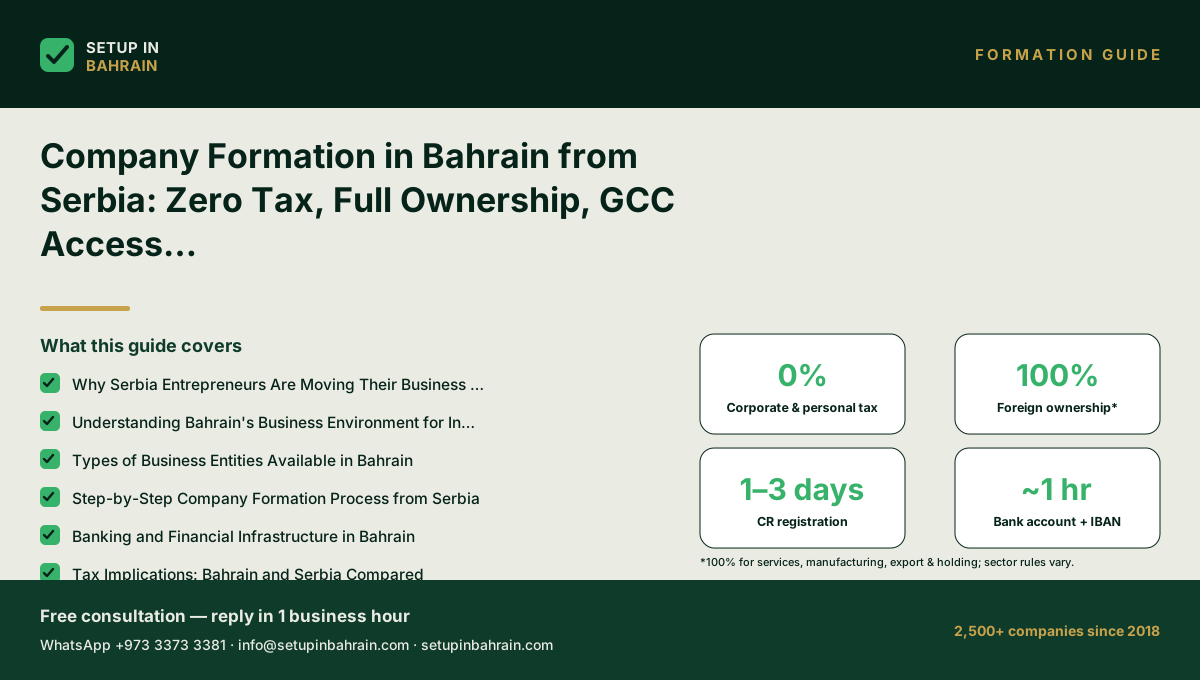
- Why Serbia Entrepreneurs Are Moving Their Business to Bahrain
- Understanding Bahrain's Business Environment for International Entrepreneurs
- Types of Business Entities Available in Bahrain
- Step-by-Step Company Formation Process from Serbia
- Banking and Financial Infrastructure in Bahrain
→ Complete guide: Company Formation in Bahrain — the full 2026 guide
View details
Ownership & capital
A Bahrain WLL can be owned by a single person — 100% foreign ownership applies to most activities, with no local partner required for services, manufacturing, export trading and holding companies. The minimum share capital is BHD 1 ; we recommend BHD 1,000 . This Makes bank account opening and investor visa approval smoother.
Marko runs a software development agency in Novi Sad. Last year, his company generated €340,000 in revenue—solid growth that should have felt like a victory. Instead, he spent three months wrestling with APR paperwork, watched his profit margins shrink by 11% due to RSD depreciation against the dollar, and handed over nearly €67,000 in combined corporate taxes, PIO contributions, and various regulatory fees.
"I'm building something real," he told me during a consultation last month. "But every time I try to scale internationally, Serbia's system pulls me backward. The 15% corporate tax sounds reasonable until you add everything else—the currency swings, the social contributions, the endless bureaucracy."
Marko isn't alone. Across Serbia, entrepreneurs running export-oriented businesses, SaaS companies, consulting firms. Trading operations are hitting the same wall. The numbers don't lie: Serbia's 15% headline corporate tax rate masks a much heavier actual burden. The RSD's persistent volatility against major currencies creates planning chaos that no spreadsheet can fully capture.
This guide exists because Serbian entrepreneurs deserve straight answers about Bahrain—not generic "offshore company" marketing fluff. Specific, actionable intelligence about how a Bahrain company structure actually works for someone running a business from Belgrade, Niš, or Subotica. We'll cover everything from the real costs involved to the step-by-step formation process, banking realities. The specific advantages that make Bahrain more and more attractive for Serbia-based founders looking to scale internationally.
Why Serbia Entrepreneurs Are Moving Their Business to Bahrain
The exodus isn't happening because Serbian business owners want to "escape" their country. Most love Serbia. They're leaving because the math simply doesn't work for internationally-oriented businesses anymore.
Consider what happened to Ana, who operates an e-commerce brand selling handcrafted Serbian products to customers across Europe and the Middle East. Her 2024 revenue hit €520,000—impressive for a five-person operation. But here's what her year actually looked like:
- Corporate tax (15%): €42,900
- PIO social insurance contributions for her team: €78,000
- Currency conversion losses (RSD depreciated 4.8% against EUR in 2024): about €18,700
- APR filing fees, accountant costs, compliance overhead: €12,400
Total effective burden: €152,000—nearly 30% of gross revenue, not the 15% the headline rate promised.
Ana's story repeats itself across Serbia's business landscape. The 15% corporate tax rate looks competitive on paper—lower than Germany's 30%, France's 25%, or even neighboring Croatia's 18%. But that number exists in isolation, divorced from the reality of actually running a business in Serbia.
The RSD Currency Problem Nobody Talks About
Serbia's dinar lost roughly 4.8% against the euro between January and October 2024 alone. For businesses invoicing in foreign currencies—which describes virtually every export-oriented Serbian company—this creates a compounding problem that no tax planning can solve.
Take a Serbian IT consultant who invoices €10,000 monthly to clients in Germany. At the start of 2024, that €10,000 converted to about 1,172,000 RSD. By October, the same €10,000 yielded only about 1,225,000 RSD—but his costs (office rent, utilities, local salaries) had already been budgeted in dinars. The math doesn't balance.
Worse, the volatility isn't predictable. The RSD doesn't decline smoothly; it lurches. In Q2 2024, it actually strengthened briefly against the euro before resuming its downward drift. This makes forward planning nearly impossible. How do you quote a six-month project when you genuinely don't know what your revenue will be worth when payment arrives?
Bahrain's Bahraini dinar (BHD), by contrast, has been pegged to the US dollar at a fixed rate of 0.376 BHD per USD since 1980. According to the Central Bank of Bahrain (CBB), this peg has never been adjusted. For Serbian entrepreneurs dealing primarily in dollars or with clients in dollar-denominated markets (the entire GCC, most of Africa, significant portions of Asia), this stability transforms financial planning from guesswork into actual planning.
PIO Contributions: The Silent Margin Killer
Serbia's mandatory social insurance contributions through the Pension and Disability Insurance Fund (PIO) represent another layer of cost that many entrepreneurs underestimate until they're deep into operations.
The combined employer and employee contribution rate for pension insurance alone sits at 24% of gross salary. Add health insurance (10.3%) and unemployment insurance (0.75%). You're looking at total social contributions of about 35% on top of salaries.
For a Serbian company with five employees earning an average of €1,500 gross monthly, that's an additional €31,500 annually in mandatory contributions—money that disappears into a system many entrepreneurs don't trust to actually pay out meaningful benefits when they retire.
In Bahrain, the Social Insurance Organization (SIO) contributions for expatriate employees total just 3% (1% employer, 2% employee). For a company structured primarily around foreign ownership and international operations, this difference alone can represent the margin between profitability and loss.
APR Bureaucracy and the Cost of Compliance
The Serbian Business Registers Agency (APR) serves essential functions, but anyone who's actually dealt with them knows the reality: delays, inconsistent requirements across different registrars, and documents requests that seem to multiply rather than resolve.
Registering a simple change of company address? Budget two to four weeks. Updating shareholding structure after a funding round? Possibly two months if any documents needs correction. These aren't exceptional cases—they're standard operating procedure.
For Serbian entrepreneurs accustomed to this environment, Bahrain's approach feels almost disorienting in its efficiency. The Bahrain Investors Center (BIC), operated by the Ministry of Industry and Commerce (MOIC), processes standard company formations in 24 to 48 hours. Not business days—actual hours. The Sijilat online platform allows most corporate maintenance tasks to be completed digitally without physical appointments.
EU Accession Uncertainty: The Planning Horizon Problem
Serbia has held EU candidate status since 2012. That's thirteen years of "pre-accession" status with no clear endpoint. The European Commission's 2024 enlargement report acknowledged Serbia's progress in some areas while highlighting ongoing concerns about rule of law, media freedom, and alignment with EU foreign policy positions.
For Serbian entrepreneurs, this uncertainty creates a strategic vacuum. Should they structure their business assuming eventual EU membership (with its VAT implications, GDPR requirements, and regulatory harmonization)? Or should they plan as if Serbia will remain outside the EU indefinitely?
Bahrain offers clarity. The regulatory environment is established, stable, and—critically—not subject to external negotiations with unpredictable timelines. The rules are the rules. They may evolve, but they won't suddenly transform because of geopolitical developments in Brussels or Belgrade.
Understanding Bahrain's Business Environment for International Entrepreneurs
Before diving into formation mechanics, Serbian entrepreneurs need to understand what makes Bahrain genuinely different from both Serbia and competing jurisdictions.
Generally no corporate income tax for most sectors: What It Actually Means
The Bahrain Economic Development Board (EDB) confirms what sounds almost too good to be true: Bahrain imposes 0% corporate income tax on most business activities. There's no municipal tax, no state tax, no accumulated earnings tax, no tax on capital gains.
The only exception involves oil and gas companies, which face a 46% tax rate. Since virtually no Serbian entrepreneur is entering Bahrain to drill for petroleum, this exception is functionally irrelevant.
What about the future? This question comes up constantly. Will Bahrain eventually introduce corporate taxation?
The honest answer: eventually, almost certainly. Bahrain has committed to implementing the OECD's Pillar Two minimum tax framework. This Would impose a 15% minimum effective tax rate on multinational enterprises with consolidated revenues exceeding €750 million annually. But, this threshold excludes the vast majority of SMEs, and implementation timelines remain subject to ongoing international negotiations.
For the foreseeable planning horizon—the next five to ten years—Bahrain's zero-tax environment for SMEs appears secure. The kingdom's economic diversification strategy explicitly depends on attracting international businesses. Eliminating its core competitive advantage would undermine two decades of policy development.
100% Foreign Ownership: The Real Deal
Until 2017, foreign investors in Bahrain generally required local partners holding at least 51% of company shares—a common restriction across the Gulf region. The Commercial Companies Law revision eliminated this requirement for most sectors.
Today, Serbian entrepreneurs can own 100% of their Bahrain company in virtually all permitted activities. According to MOIC guidelines, restricted sectors requiring local participation or licensing include:
- Petroleum and natural gas extraction
- Security services
- Fishing and pearl diving
- Certain media activities
- Hajj and Umrah travel services
- Real estate brokerage (though ownership of real estate companies is generally permitted)
For technology companies, professional services, trading, consulting, e-commerce. Most other activities Serbian entrepreneurs typically pursue, full foreign ownership is available without local sponsorship, silent partners, or complex workaround structures.
The GCC Market Access Advantage
Bahrain's location provides something no European jurisdiction can match: ground-floor access to the Gulf Cooperation Council market.
The six GCC nations (Bahrain, Kuwait, Oman, Qatar, Saudi Arabia. The United Arab Emirates) represent a combined GDP exceeding $2 trillion. More importantly, they represent a market of about 60 million consumers with the highest per-capita GDP concentration on Earth.
Through the GCC Customs Union, goods manufactured or greatly processed in Bahrain can move tariff-free throughout the Gulf. The King Fahd Causeway connects Bahrain directly to Saudi Arabia—a 25-kilometer drive to a market of 35 million consumers with massive government infrastructure spending and diversification initiatives.
For Serbian entrepreneurs currently selling to European markets, this might seem irrelevant. But consider the growth trajectory: European markets are mature, competitive, and more and more saturated. GCC markets are growing, underserved in many categories, and actively seeking international partnerships.
A Bahrain company positions Serbian entrepreneurs to serve both their existing European clients and expand into Gulf markets without establishing separate entities in each jurisdiction.
Types of Business Entities Available in Bahrain
Bahrain offers several corporate structures, each with distinct characteristics relevant to Serbian entrepreneurs considering international expansion.
Limited Liability Company (WLL)
The With Limited Liability (WLL) structure represents the most common choice for SMEs entering Bahrain. Key characteristics include:
- Minimum capital: 50 BHD (about €125) for most activities
- Shareholders: Minimum one, maximum fifty
- Foreign ownership: 100% permitted for most activities
- Director requirements: At least one director (can be foreign, non-resident)
- Annual requirements: Audited financial statements, license renewal
WLLs function similarly to Serbian DOO companies in terms of liability protection but with greatly lower capital requirements and simpler formation procedures. Most Serbian entrepreneurs entering Bahrain will find this structure appropriate for their needs.
single-shareholder WLL
Introduced to accommodate solo entrepreneurs and wholly-owned subsidiaries, the WLL structure features:
- Minimum capital: 50 BHD
- Shareholders: Exactly one (individual or corporate)
- Director requirements: At least one director
- Ideal for: Consulting firms, freelancers, holding structures
For Serbian consultants, developers, or professional service providers operating primarily as individuals, the WLL offers administrative simplicity while maintaining corporate separation.
Closed Joint Stock Company (BSC Closed)
Larger operations contemplating eventual public listing or requiring more sophisticated capital structures may consider the BSC Closed:
- Minimum capital: 250,000 BHD (about €625,000)
- Shareholders: Minimum two, maximum fifty
- Board: Required board of directors (minimum three members)
- Transferability: Share transfers require board approval
This structure is typically unnecessary for initial market entry but becomes relevant for established businesses seeking to raise significant capital or planning eventual IPO.
Branch Office
Serbian companies wishing to operate in Bahrain while maintaining their Serbian parent structure can establish a branch:
- Not a separate legal entity—extension of the parent company
- Requires local service agent (fee-based arrangement, not equity sharing)
- Useful for: Specific project contracts, testing market before full commitment
- Limitation: Parent company remains liable for branch obligations
Branches make sense for Serbian companies with existing reputations that want to leverage their established brand while accessing Bahrain's regulatory environment.
Comparison Table: Bahrain Business Structures for Serbian Entrepreneurs
| Feature | WLL | WLL | BSC Closed | Branch |
| Minimum Capital | 50 BHD | 50 BHD | 250,000 BHD | None specified |
| Shareholders | 1-50 | 1 only | 2-50 | N/A (parent) |
| Foreign Ownership | 100% | 100% | 100% | 100% |
| Separate Legal Entity | Yes | Yes | Yes | No |
| Local Partner Required | No | No | No | Service agent only |
| Formation Timeline | 2-5 days | 2-5 days | 2-4 weeks | 1-2 weeks |
| Annual Audit Required | Yes | Yes | Yes | Yes |
| Ideal For | Most SMEs | Solo founders | Large operations | Market testing |
Step-by-Step Company Formation Process from Serbia
The practical reality of forming a Bahrain company from Serbia involves several distinct phases. Here's exactly what to expect.
Phase 1: Pre-Formation Planning (1-2 Weeks)
Before touching any paperwork, Serbian entrepreneurs must resolve several foundational questions:
Business Activity Selection
Bahrain's Commercial Registration system requires specifying permitted activities using standardized codes. Unlike Serbia's relatively flexible APR system, Bahrain requires explicit licensing for each commercial activity your company will undertake.
The MOIC maintains the official activity list through the Sijilat platform. Common selections for Serbian entrepreneurs include:
- Computer programming and consultancy services
- Information technology services
- Business and management consultancy
- General trading (import/export)
- E-commerce services
- Professional services (engineering, architecture, etc.)
Choose carefully—adding activities later requires additional licensing and fees.
Company Name Reservation
Bahrain requires unique company names that don't conflict with existing registrations and comply with naming conventions. Names cannot:
- Duplicate existing registered names
- Use restricted terms (Bank, Insurance, Government, etc.) without special authorization
- Contain offensive language in any language
Name searches and reservations occur through Sijilat. Expect 24-48 hours for confirmation.
Corporate Structure Decision
Most Serbian entrepreneurs will choose between WLL and WLL structures. Key considerations:
- Will you have co-founders or investors? WLL accommodates multiple shareholders.
- Are you operating solo? WLL minimizes administrative overhead.
- Do you need to issue shares in the future? WLL provides more flexibility.
Phase 2: Document Preparation (1-2 Weeks)
Required documents varies slightly by company type but typically includes:
For Individual Shareholders (Serbian Citizens)
- Valid passport (minimum 6 months validity)
- Passport-sized photographs (white background)
- Proof of address (utility bill or bank statement, may require apostille)
- Professional CV/resume for director appointments
- No Objection Certificate if currently employed elsewhere
For Corporate Shareholders (Serbian Companies)
- Serbian company registration certificate (from APR)
- Articles of Association / Memorandum
- Board resolution authorizing Bahrain company formation
- Certificate of Good Standing (if available)
- Passport copies of authorized signatories
Apostille Requirements
Serbia is party to the Hague Apostille Convention, which simplifies document authentication. Documents requiring apostille include:
- Powers of attorney
- Corporate resolutions
- Certificates of incorporation for parent companies
Serbian apostilles are obtained through the Ministry of Justice or designated courts. Budget one to two weeks for processing.
Arabic Translation
While Bahrain's business environment operates greatly in English, certain documents require Arabic translation by certified translators. This typically applies to:
- Constitutional documents
- Powers of attorney
- Parent company documents
Translation services are readily available in Bahrain during the formation process, though arranging translations in Serbia beforehand can accelerate timelines.
Phase 3: Commercial Registration (2-5 Days)
This is where Bahrain's efficiency becomes apparent. The actual registration process through MOIC involves:
Step 1: Sijilat Application Submission
All applications submit electronically through Bahrain's Sijilat platform (www.sijilat.bh). Required information includes:
- Company name (previously reserved)
- Legal form (WLL, WLL, etc.)
- Proposed activities
- Share capital structure
- Director and shareholder details
- Registered office address
Step 2: Document Upload
Upload all prepared documents in PDF format. The system accepts English documents for most purposes, with Arabic translations required for specific items.
Step 3: Fee Payment
Registration fees vary by company type and activities. Typical costs:
- Commercial Registration: 10-100 BHD depending on activities
- Commercial License: 100-300 BHD annually
- Chamber of Commerce membership: 100-200 BHD annually
Total initial registration costs typically range from 300-700 BHD (€750-1,750), excluding professional service fees.
Step 4: Approval and Issuance
MOIC reviews applications within one to two business days for straightforward cases. Upon approval, the following are issued:
- Commercial Registration Certificate (CR)
- Commercial License
- Chamber of Commerce Certificate
Phase 4: Post-Formation Requirements (1-2 Weeks)
With registration complete, several operational requirements remain:
Bank Account Opening
Bahrain's banking sector is sophisticated and internationally connected. Major institutions serving business clients include:
- Ahli United Bank
- Bank of Bahrain and Kuwait (BBK)
- National Bank of Bahrain (NBB)
- Standard Chartered Bahrain
- HSBC Bahrain
Account opening typically requires:
- Commercial Registration certificate
- Commercial License
- Director/signatory passport copies
- Proof of business activity (contracts, invoices, business plan)
- Expected transaction volumes and sources of funds
Serbian entrepreneurs should anticipate detailed compliance questioning during account opening. Bahrain's banks take AML/KYC obligations seriously. Come prepared with clear documents of your business model, client base, and fund flows.
Virtual Office / Registered Address
Physical office space isn't mandatory for all activities, but a registered address is required. Options include:
- Traditional office lease (from about 200 BHD/month for small offices)
- Serviced offices and co-working spaces (from about 150 BHD/month)
- Virtual office services (from about 50-100 BHD/month)
For Serbian entrepreneurs managing operations remotely, virtual office arrangements provide compliant registered addresses without unnecessary overhead.
Labor Market Regulatory Authority (LMRA) Registration
If you plan to hire employees—including yourself as a working director—registration with LMRA is required. This enables:
- Work permit applications for foreign employees
- Visa sponsorship
- Labor law compliance
Banking and Financial Infrastructure in Bahrain
Serbian entrepreneurs often underestimate banking as a formation consideration—until they discover that their new company can't actually receive or send money efficiently. Bahrain's financial infrastructure deserves careful attention.
Why Bahrain's Banking System Matters
The Central Bank of Bahrain (CBB) regulates one of the most developed financial ecosystems in the Middle East. Key characteristics include:
International Connectivity
Bahrain banks maintain robust correspondent banking relationships with major global institutions. SWIFT transfers to and from European banks, US banks. Asian financial centers process smoothly—a contrast with some competing jurisdictions where correspondent banking has degraded.
For Serbian entrepreneurs accustomed to occasional payment delays and compliance holds in Serbian banking, Bahrain's connectivity feels remarkably smooth.
Currency Handling
Bahrain banks routinely handle multi-currency accounts. Maintaining balances in USD, EUR, GBP, and BHD at once is standard practice. For Serbian entrepreneurs dealing with clients across multiple markets, this eliminates the constant conversion friction experienced with Serbian banks.
Islamic Finance Options
As a major Islamic finance hub, Bahrain offers Sharia-compliant banking products alongside conventional options. While not relevant for all entrepreneurs, those serving Muslim-majority markets or seeking specific financing structures will find sophisticated options available.
Account Opening Realities
Let's be direct: opening a Bahrain bank account isn't as simple as walking into a branch with your passport. Post-2020 AML/KYC requirements have intensified globally, and Bahrain banks implement rigorous compliance procedures.
Expect to provide:
- Detailed business plan explaining your company's activities
- Projected financial statements (at least first-year projections)
- Evidence of existing business relationships (contracts, invoices from prior businesses)
- Personal background documents for all beneficial owners
- Source of funds documents for initial capital
For Serbian entrepreneurs, the challenge often involves explaining business models that may be unfamiliar to Bahrain-based compliance officers. A software developer in Novi Sad serving clients in Germany operates a perfectly legitimate business. The compliance team in Manama may need detailed documents to understand and approve the account.
Professional formation advisors typically include banking introduction services precisely because this stage can delay otherwise smooth formations. Budget two to four weeks for account opening, potentially longer for complex structures.
Alternative Financial Solutions
Traditional banking isn't the only option. Several fintech and payment solutions operate effectively from Bahrain:
EMI/Payment Institution Accounts
European electronic money institutions (EMIs) often accept Bahrain-registered companies, providing IBAN accounts, SEPA access. Multi-currency functionality. Options include:
- Wise Business
- Payoneer
- Mercury (US-focused)
These aren't replacements for traditional banking but provide useful supplementary accounts for specific payment flows.
Regional Payment Processors
For entrepreneurs focused on GCC markets, regional payment processors like PayTabs (headquartered in Bahrain) offer specialized solutions for Middle Eastern payment acceptance.
Tax Implications: Bahrain and Serbia Compared
Understanding tax treatment requires examining both jurisdictions, since Serbian tax residence and Bahrain company ownership intersect in specific ways.
Bahrain Tax Environment
Corporate Income Tax: 0%
As confirmed by MOIC and EDB, Bahrain does not impose corporate income tax on business profits. This applies regardless of:
- Nationality of shareholders
- Source of income (Bahrain or international)
- Industry sector (excluding petroleum)
Personal Income Tax: 0%
Bahrain imposes no personal income tax. Dividends, salaries, capital gains—all untaxed at the individual level.
Value Added Tax: 10%
Bahrain implemented VAT in January 2019 at 5%, increased to 10% in January 2022. VAT applies to:
- Domestic supplies of goods and services
- Imports of goods and services
Key exemptions include financial services, real estate transactions, and certain healthcare/education services.
For Serbian entrepreneurs operating B2B businesses primarily serving international clients, VAT often has minimal impact—exports are zero-rated.
Social Insurance: 3% Total for Expats
Contributions to Bahrain's Social Insurance Organization total 3% for non-Bahraini employees (1% employer, 2% employee). Compare this to Serbia's about 35% combined rate.
Serbia Tax Implications for Bahrain Company Owners
This is where Serbian entrepreneurs must pay careful attention. Owning a Bahrain company doesn't automatically eliminate Serbian tax obligations.
Controlled Foreign Corporation (CFC) Rules
Serbia's tax code includes CFC provisions that may attribute profits of foreign companies to Serbian resident shareholders. Key thresholds:
- Serbian residents holding >50% of a foreign company
- The foreign company is located in a jurisdiction with tax rates greatly below Serbia's
- The company earns primarily passive income (dividends, interest, royalties)
If CFC rules apply, Serbian shareholders may owe Serbian tax on their proportionate share of the foreign company's profits—even if no dividend is paid.
Practical Mitigation
CFC rules typically target passive holding structures, not active businesses. Serbian entrepreneurs operating genuine businesses through Bahrain companies—with real commercial activities, employees. Substance—generally fall outside CFC scope.
But, structures designed purely to accumulate profits offshore without genuine business purpose invite scrutiny. The key is operating real businesses, not paper companies.
Personal Tax Residence
Serbian tax residents remain liable for worldwide income. Simply owning a Bahrain company doesn't change personal tax residence.
For Serbian entrepreneurs spending significant time in Bahrain (or other jurisdictions), personal tax residence planning becomes relevant. Serbia generally considers individuals spending 183+ days annually in Serbia as tax residents. Strategic relocation can legitimately shift tax residence, though this requires genuine life changes—not merely claiming foreign residence while actually living in Belgrade.
Dividend Treatment
When profits are distributed from a Bahrain company to a Serbian individual shareholder, Serbia taxes that dividend as personal income. Current rates apply (progressive rates up to 20% on dividends for amounts above certain thresholds, though rates and thresholds adjust periodically).
This creates a key planning consideration: Bahrain companies offer powerful corporate-level tax savings. Profit extraction to Serbian residents triggers Serbian tax obligations. The optimal approach depends on individual circumstances, residency planning, and intended use of funds.
Tax Comparison Table: Serbia DOO vs. Bahrain WLL
| Tax Element | Serbia (DOO) | Bahrain (WLL) |
| Corporate Income Tax | 15% | 0% |
| Capital Gains Tax | 15% | 0% |
| VAT/Sales Tax | 20% | 10% |
| Dividend Withholding | 15% | 0% |
| Social Insurance (Employer) | ~17.9% | 1% |
| Social Insurance (Employee) | ~19.9% | 2% |
| Personal Income Tax | 10-20% | 0% |
| Currency | RSD (volatile) | BHD (USD peg) |
Legal and Regulatory Framework
Serbian entrepreneurs familiar with EU-influenced Serbian law will find Bahrain's legal system different but commercially sophisticated.
Commercial Law Foundations
Bahrain's Commercial Companies Law (Legislative Decree No. 21 of 2001, as amended) governs corporate formation and operation. Key features include:
- Clear shareholder rights and protections
- Minority shareholder protections
- Director duties and liabilities
- Merger and acquisition procedures
- Winding-up and liquidation protocols
For most commercial purposes, the law provides comparable protections to Serbian commercial law, with some differences in procedure and interpretation.
Dispute Resolution
Bahrain offers multiple dispute resolution options:
Bahrain Courts
The civil court system handles commercial disputes through specialized commercial chambers. Proceedings can be conducted in Arabic (official language) with translation available. Court enforcement of judgments is generally reliable.
Bahrain Chamber for Dispute Resolution (BCDR)
Established through partnership with the American Arbitration Association, the BCDR provides international-standard arbitration services. For disputes with international parties, BCDR arbitration offers neutral, professionally administered proceedings.
GCC Commercial Arbitration Centre
Located in Bahrain, this center handles disputes involving parties from GCC member states—useful for entrepreneurs doing business across the Gulf.
Intellectual Property Protection
The Bahrain Intellectual Property Office (BIPO) administers trademark, patent, and copyright registration. Bahrain is party to:
- Paris Convention for the Protection of Industrial Property
- Patent Cooperation Treaty (PCT)
- Berne Convention for the Protection of Literary and Artistic Works
- TRIPS Agreement (through WTO membership)
For Serbian tech entrepreneurs and creative professionals, IP protection in Bahrain meets international standards.
Foreign Investment Protection
The Bahrain Investment Promotion Agency (BIPA) oversees foreign investment protection measures, including:
- Bilateral Investment Treaties (BITs) with numerous countries
- Investment dispute settlement mechanisms
- Expropriation protections
While Serbia and Bahrain do not currently have a bilateral investment treaty, Bahrain's domestic legal framework provides substantial investor protections.
Industry-Specific Opportunities for Serbian Entrepreneurs
Bahrain's regulatory environment and market position create specific opportunities aligned with Serbian business strengths.
Information Technology and Software Development
Serbia's IT sector is globally recognized, and Bahrain actively courts tech companies. The EDB reports that technology accounts for a growing percentage of Bahrain's non-oil GDP, with government initiatives including:
- Startup Bahrain ecosystem development
- Fintech regulatory sandbox operated by CBB
- Tamkeen support for technology training and development
Serbian IT companies can leverage Bahrain as a regional headquarters for Middle Eastern operations while maintaining development teams in Serbia. This structure optimizes costs (Serbian developer salaries remain competitive) while positioning client-facing operations in a regional hub.
Professional Services
Consulting, engineering, architecture, and similar professional services find strong demand in the GCC. Bahrain's position as a professional services hub means:
- No restrictions on foreign professionals operating consultancies
- Access to major GCC infrastructure projects (Saudi Vision 2030 projects alone exceed $1 trillion in planned spending)
- English-language business environment
Serbian professionals with expertise in construction, engineering, or technical consulting can access these markets through a Bahrain base.
Trading and Distribution
Bahrain's free trade agreements and port infrastructure create opportunities for trading businesses:
- Bahrain-US Free Trade Agreement (2006) provides preferential access to US markets
- GCC Common Market enables free movement of goods
- Khalifa Bin Salman Port handles significant regional cargo
Serbian entrepreneurs with existing supplier relationships—whether in Serbian products or global sourcing—can operate trading businesses accessing both Middle Eastern and Western markets.
E-Commerce and Digital Services
Bahrain's supportive regulatory environment for digital businesses includes:
- No specific e-commerce licensing restrictions
- Modern electronic transaction laws
- Data protection legislation comparable to international standards
Serbian e-commerce operators serving global markets can benefit from Bahrain's zero-tax environment while maintaining operational teams anywhere with reliable internet.
Practical Considerations for Remote Management
Most Serbian entrepreneurs won't physically relocate to Bahrain—they'll manage their Bahrain companies remotely while maintaining Serbian residence (at least initially). This requires specific arrangements.
Corporate Governance from Distance
Bahrain law permits directors to fulfill duties remotely, with certain requirements:
- Maintain registered office address in Bahrain (through virtual office if not physically present)
- Ensure company records are accessible from Bahrain
- Appoint local representative for certain regulatory matters
Annual general meetings can typically be held virtually, though constitutional documents should explicitly permit this.
Local Representation Requirements
Certain regulatory interactions require physical presence or local representation:
- Bank account opening often requires at least one in-person meeting
- Some license renewals may require local interaction
- Government tender participation typically requires local presence
Most entrepreneurs address these requirements through:
- Brief visits to Bahrain for critical setup phases
- Appointment of local representatives or PRO (Public Relations Officer) services
- Engagement with professional service providers who handle regulatory interaction
Communication and Time Zones
Bahrain operates on Arabia Standard Time (GMT+3), placing it:
- 2 hours ahead of Central European Time (Serbia)
- 8 hours ahead of Eastern Standard Time (US)
- 5 hours behind Tokyo
For Serbian entrepreneurs, the time zone difference is minimal—comfortable for real-time communication with both Bahrain contacts and European clients.
Cost Analysis: Complete Formation Budget
Serbian entrepreneurs need realistic cost expectations. Here's a comprehensive breakdown:
Initial Formation Costs
| Cost Element | Amount (BHD) | Amount (EUR)* |
| Commercial Registration | 10-100 | 25-250 |
| Commercial License | 100-300 | 250-750 |
| Chamber of Commerce | 100-200 | 250-500 |
| Name Reservation | 10 | 25 |
| Document Attestation (Bahrain side) | 50-100 | 125-250 |
| Virtual Office (first year) | 600-1,200 | 1,500-3,000 |
| Professional Service Fees | 1,500-4,000 | 3,750-10,000 |
| Total Initial Costs | 2,370-5,910 | 5,925-14,775 |
Annual Maintenance Costs
| Cost Element | Amount (BHD) | Amount (EUR) |
| License Renewal | 100-300 | 250-750 |
| Chamber of Commerce | 100-200 | 250-500 |
| Registered Office | 600-1,200 | 1,500-3,000 |
| Annual Audit | 800-2,000 | 2,000-5,000 |
| Accounting Services | 1,200-3,600 | 3,000-9,000 |
| PRO/Administrative Support | 600-1,500 | 1,500-3,750 |
| Total Annual Costs | 3,400-8,800 | 8,500-22,000 |
Serbia-Side Costs
Don't forget Serbian document preparation costs:
| Cost Element | Amount (EUR) |
| Apostille services | 50-150 |
| Certified translations | 100-300 |
| Notarization | 50-100 |
| Serbian legal consultation | 200-500 |
| Total Serbia-Side Costs | 400-1,050 |
Break-Even Analysis
When does a Bahrain company make financial sense? Consider a Serbian entrepreneur with €200,000 annual profit:
Serbia Scenario:
- Corporate tax (15%): €30,000
- Additional compliance/admin costs: €3,000
- Currency volatility exposure: €8,
Bahrain Business Guides for Serbia Citizens
Frequently Asked Questions
How long does it take to set up?
It takes 15 to 20 days. We file all forms for you. You do not need to wait long.
What does it cost?
Company formation: Standard BHD 1,340 with 3 months of office address; Gold BHD 1,700 with 6 months; Premium BHD 2,150 with 12 months and a cabin, officer table and chair, and two guest chairs. No formation package includes visas, including Premium. Investor/work visas are priced separately: BHD 755 for one year or BHD 953 for two years, in addition to the formation package. Ask for a written, itemized quotation confirming government fees and all inclusions before payment.
Do I need to visit Bahrain?
No. You can set up your firm from home. We do all the work online. Some banks may ask for one visit.
What tax will I pay?
You pay zero tax on your profits. Bahrain has no corporate income tax. This is a key benefit of the setup.
Can I own 100% of my firm?
Yes. Foreign owners can hold all shares. No local partner is needed. Full ownership is allowed.
What do I need to start?
You need a valid passport. You also need a trade name and a business address. We help you with all of these.
How do I open a bank account?
We guide you step by step. Most banks take 3 to 6 weeks. You will need your CR and firm papers.
Who issues the Commercial Registration (CR)?
The CR is issued by the MOICT. It is your legal right to trade in Bahrain. We file the CR for you.
Can I renew my CR each year?
Company renewal packages: BHD 530 with 3 months of office address; BHD 980 with 6 months; BHD 1,520 with 12 months. These are separate renewal packages, not visa fees.
How do I get started?
Fill in our form on this page. Our team will call you back. We map your best setup plan at no cost.
Steps to Form Your Company
- Pick your trade name. We check if it is free.
- Choose your business type. WLL is the most common.
- Sign the MOA. We draft and file all legal docs.
- Pay the state fees. About BHD 432 in total.
- Get your CR. Takes 15 to 20 days.
- Open your bank account. We guide each step.
- Start trading. You are ready to do business.
Key Facts
- Tax rate: 0%
- Foreign ownership: 100%
- Setup time: 15 to 20 days
- Company formation: Standard BHD 1,340 with 3 months of office address; Gold BHD 1,700 with 6 months; Premium BHD 2,150 with 12 months and a cabin, officer table and chair, and two guest chairs. No formation package includes visas, including Premium. Investor/work visas are priced separately: BHD 755 for one year or BHD 953 for two years, in addition to the formation package. Ask for a written, itemized quotation confirming government fees and all inclusions before payment.
- Company renewal packages: BHD 530 with 3 months of office address; BHD 980 with 6 months; BHD 1,520 with 12 months. These are separate renewal packages, not visa fees.
- Client rating: 4.8 stars
- Clients served: 2,500 and more
Quick Facts
- Tax rate: 0%
- Own all of your firm: Yes, 100%
- Time to set up: 15 to 20 days
- Company formation: Standard BHD 1,340 with 3 months of office address; Gold BHD 1,700 with 6 months; Premium BHD 2,150 with 12 months and a cabin, officer table and chair, and two guest chairs. No formation package includes visas, including Premium. Investor/work visas are priced separately: BHD 755 for one year or BHD 953 for two years, in addition to the formation package. Ask for a written, itemized quotation confirming government fees and all inclusions before payment.
- Company renewal packages: BHD 530 with 3 months of office address; BHD 980 with 6 months; BHD 1,520 with 12 months. These are separate renewal packages, not visa fees.
- Rating: 4.8 stars
- Clients: 2,500 and more
Why Bahrain?
Bahrain has no tax. You keep all your profits. This is rare in the Gulf.
You can own all of your firm. No local partner is needed. The law allows full foreign ownership.
Setup takes 15 to 20 days. We file all forms for you. You can do it all from home.
Bahrain has a free trade deal with the US. Your goods face low or no tariffs. This gives you access to big markets.
We have served 2,800+ clients from 44+ countries and maintain records to substantiate that total where needed. We have 113 Google reviews; reviews represent only some clients and are not the same as the total clients served.
Our Steps
- Tell us your plan. We advise you for free.
- We pick the right firm type for you.
- We file all your forms with MOICT.
- You get your CR in 15 to 20 days.
- We help you open a bank account.
- You are ready to trade. We stay with you.
Why Set Up in Bahrain?
Bahrain is a great place to run a firm. It has no tax. You keep all your profits. This is rare in the Gulf.
You can own your firm 100%. No local partner is needed. The law is clear and fair.
It is fast to set up. You can have a CR in 15 to 20 days. We file all forms for you.
Bahrain has a free trade deal with the US. Your goods face low or no tariffs. This gives you access to big markets.
The banks are good. The roads are good. The schools are good. It is a well-run state.
We have served 2,800+ clients from 44+ countries and maintain records to substantiate that total where needed. We have 113 Google reviews; reviews represent only some clients and are not the same as the total clients served.
Our Services
- Company formation: Standard BHD 1,340 with 3 months of office address; Gold BHD 1,700 with 6 months; Premium BHD 2,150 with 12 months and a cabin, officer table and chair, and two guest chairs. No formation package includes visas, including Premium. Investor/work visas are priced separately: BHD 755 for one year or BHD 953 for two years, in addition to the formation package. Ask for a written, itemized quotation confirming government fees and all inclusions before payment.
- Company renewal packages: BHD 530 with 3 months of office address; BHD 980 with 6 months; BHD 1,520 with 12 months. These are separate renewal packages, not visa fees.
- Investor Visa — from BHD 755
- Work Visa — LMRA managed
- Virtual office — from BHD 600 per year
- Bank account opening — 3 to 6 weeks
- Family visa — for spouse and kids
- UBO filing — as required by law
Bahrain at a Glance
- Tax rate: 0%
- Foreign ownership: 100%
- Setup time: 15 to 20 days
- Free trade deal: Yes, with the US
- Language: Arabic and English
- Currency: Bahraini Dinar (BHD)
- Time zone: UTC+3
- GDP growth: Steady and strong
How to Start
- Fill in the form on this page. It takes 3 minutes.
- We call you back the same day.
- We map the best plan for your firm type and goals.
- We file all forms. We deal with MOICT for you.
- You get your CR in 15 to 20 days.
- We help you open a bank account and get your visa.
- You are ready to trade. We stay with you.
Common Questions
Do I need to visit Bahrain to set up?
No. You can do it all from home. We file online. You may need one visit to open a bank account.
Is Bahrain safe for business?
Yes. Bahrain is a stable state. It has a clear legal system. Your firm and funds are safe here.
Can I hire staff from any country?
Yes. You can hire from any country. Each hire needs a work permit from LMRA. We manage this for you.
What type of firm should I set up?
Most clients choose a WLL. This is a limited liability firm. It is flexible and well-known in Bahrain. We advise you on the best type for your case.
How do I get in touch?
Fill in our form. We call you back the same day. You can also email us or use the chat on this page.
Ready to set up in Bahrain from Serbia?
Tell us your business idea. We map the right entity, ownership and timeline — then handle the filing while you focus on what matters.