Complete guide for Sao Tome and Principe entrepreneurs: form a company in Bahrain with generally no corporate income tax for most sectors, 100% foreign ownership. GCC market access. Costs, steps, visas, banking.
Key Takeaways
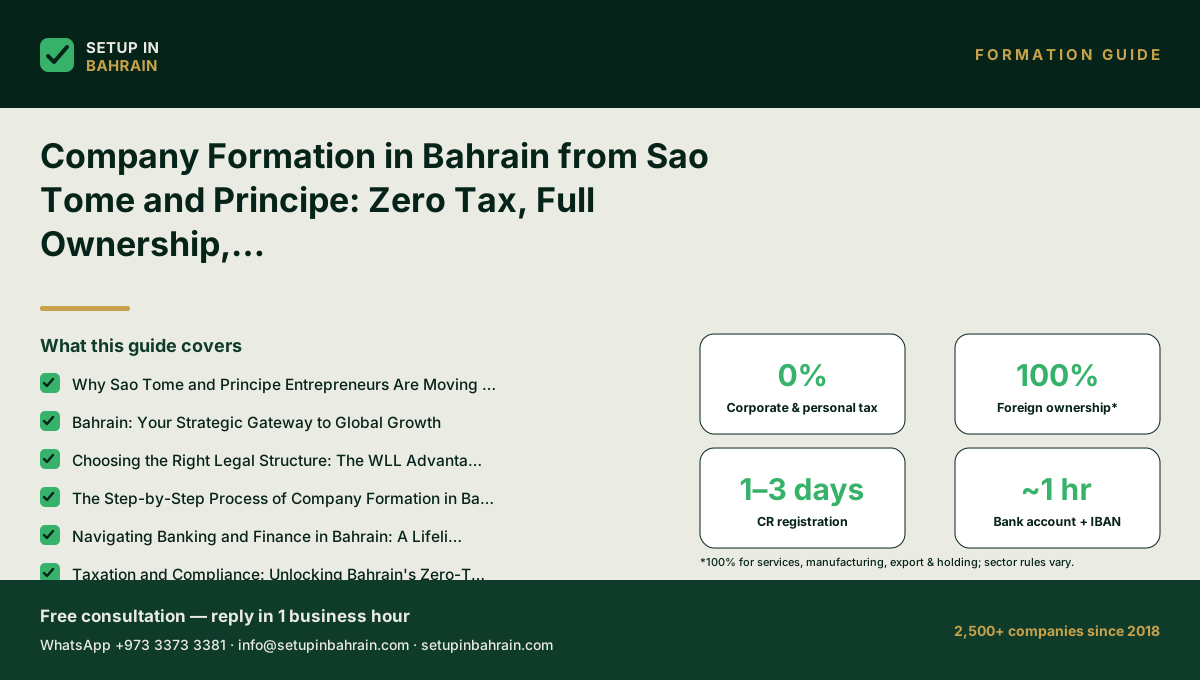
- Why Sao Tome and Principe Entrepreneurs Are Moving Their Business to Bahrain
- Bahrain: Your Strategic Gateway to Global Growth
- Choosing the Right Legal Structure: The WLL Advantage for Sao Tomean Founders
- The Step-by-Step Process of Company Formation in Bahrain
- Navigating Banking and Finance in Bahrain: A Lifeline for International Trade
→ Complete guide: Company Formation in Bahrain — the full 2026 guide
View details
Ownership & capital
A Bahrain WLL can be owned by a single person — 100% foreign ownership applies to most activities, with no local partner required for services, manufacturing, export trading and holding companies. The minimum share capital is BHD 1 ; we recommend BHD 1,000 . This Makes bank account opening and investor visa approval smoother.
As an entrepreneur from Sao Tome and Principe, you’re no stranger to navigating complex challenges. You've built your business, whether in cocoa export, boutique tourism, or local services, within an economy that demands resilience. You’ve mastered the art of doing more with less, of finding solutions where none seem to exist. But what if the very foundations of that economy – the tax structure, the market size, the banking infrastructure – are inadvertently holding you back from truly scaling your vision?
Many founders from Sao Tome and Principe share a common frustration. They look at their balance sheets, see 25% of their hard-earned corporate profits evaporating into tax. Wonder if there's a better way. They envision a future where their business can tap into a larger market, operate with financial agility. Retain more of its revenue to reinvest and grow. This isn't a pipe dream. It's the tangible reality Bahrain offers, just a few thousand kilometers away.
This comprehensive guide is written specifically for you, the Sao Tomean entrepreneur. We understand the nuances of the challenges you face daily, from the limited reach of the Banco Central de São Tomé e Príncipe (BCSTP) to the market constraints of a 220,000-person economy. We're here to show you how establishing a company in Bahrain can fundamentally transform your business trajectory, offering a gateway to Generally no corporate income tax for most sectors, full foreign ownership, and unparalleled access to the multi-trillion-dollar Gulf Cooperation Council (GCC) market. This isn't about mere expansion; it's about strategic liberation.
Why Sao Tome and Principe Entrepreneurs Are Moving Their Business to Bahrain
Let's talk about Carlos de Menezes. Carlos runs a cocoa export business out of São Tomé, a trade he’s meticulously built over a decade. Every year, when he tabulates his profits, he braces himself for the inevitable: 25% of that hard work goes directly to the Direção-Geral das Contribuições e Impostos (DGCI). That's BHD 12,500 on a BHD 50,000 profit (or about €31,000 on a €125,000 profit, given the STN-EUR peg). On top of that, he spends weeks each quarter buried in paper receipts and manual calculations because the DGCI’s digital infrastructure is minimal, making compliance a laborious, time-consuming affair.
His banking experience is equally frustrating. The BCSTP, while diligent, operates with very limited international correspondent banking relationships. This means his international wires are typically capped at BHD 15,000 per transaction unless he personally visits the branch and navigates a mountain of paperwork. And even then, cross-border payments, especially to emerging markets, often take five to seven days to clear, impacting cash flow and customer satisfaction.
Carlos wants to expand into the burgeoning markets of West Africa and perhaps even Europe. The São Tomé market of just 220,000 people simply cannot sustain the growth he envisions. He feels his ambition is constantly being throttled by the very system he operates within.
This scenario is far too common. It perfectly illustrates why discerning entrepreneurs from Sao Tome and Principe are more and more looking towards Bahrain.
STP Pain Point 1: The Weight of a 25% Corporate Tax
The 25% corporate income tax enforced by the DGCI is a significant drain on profitability. For many small and medium-sized enterprises (SMEs) in Sao Tome and Principe, this substantial chunk of revenue could otherwise be reinvested into expansion, technology upgrades, staff training, or simply retained as working capital to cushion against market fluctuations.
Imagine what that 25% could do for your business. In Bahrain, for most activities, that 25% stays in your pocket. This isn't a tax holiday; it's a fundamental aspect of Bahrain's economic strategy to attract and foster business growth. This difference isn't just impactful; it's transformative, allowing for greatly faster capital accumulation and reinvestment.
STP Pain Point 2: The Straitjacket of Limited Banking Infrastructure
The Banco Central de São Tomé e Príncipe (BCSTP) serves its national purpose. Its limited international correspondent banking network poses a severe bottleneck for businesses with global ambitions. For entrepreneurs like Carlos, or João, who runs a digital marketing agency targeting the Portuguese-speaking diaspora, efficient international money movement is non-negotiable.
Delayed Transactions: International SWIFT transfers often take five to seven business days to clear, impacting liquidity and trust with international partners. Transaction Limits: Stringent caps on international wires without extensive in-person authorization mean lost opportunities and operational friction. High Costs: Each transaction carries its own set of fees. This Accumulate rapidly when dealing with multiple international clients or suppliers. Currency Constraints: While the Sao Tomean Dobra (STN) is pegged to the Euro (EUR) through an agreement with Portugal, facilitating some stability, the actual conversion and transfer processes through BCSTP can still be cumbersome and costly compared to more globally integrated financial hubs.
In Bahrain, the Central Bank of Bahrain (CBB) oversees a robust, digitally advanced financial sector with strong ties to global banks. Transactions are faster, more secure. Generally more cost-effective, allowing businesses to operate with the agility required in today’s global economy.
STP Pain Point 3: A Market Too Small for Big Ambitions
With a population of about 220,000 people across its two main islands, the domestic market in Sao Tome and Principe offers limited scalability. For businesses aiming for significant growth, diversification, or economies of scale, expanding beyond these shores is not an option; it's a necessity.
Bahrain, on the other hand, is your direct gateway to the Gulf Cooperation Council (GCC) market – a dynamic economic bloc comprising Saudi Arabia, UAE, Qatar, Kuwait, Oman, and Bahrain itself. This market boasts:
- A combined GDP of over US$1.7 trillion.
- A population exceeding 58 million high-net-worth consumers.
- A region actively diversifying its economies, creating immense opportunities in technology, logistics, healthcare, education, and more.
From Bahrain, you're not just accessing the GCC; you're strategically positioned within a few hours' flight of other major markets in Africa, Asia, and Europe, offering a truly global reach that Sao Tome and Principe simply cannot provide.
STP Pain Point 4: Administrative Hurdles and Digital Deficits
The minimal digital infrastructure of the DGCI, as experienced by Carlos, is a prime example of the administrative challenges faced by businesses in Sao Tome and Principe. Time spent on paper-based filings, manual reconciliation. In-person visits to government offices is time not spent on growing your business.
Bahrain, committed to digitalization and ease of doing business, offers a stark contrast. The Ministry of Industry and Commerce (MOIC) and other government agencies have streamlined company registration and compliance processes, making much of it accessible online. This focus on digital efficiency means less administrative burden and more time for what truly matters: your business vision.
In essence, for a Sao Tomean entrepreneur looking to transcend local limitations, optimize tax efficiency, achieve financial agility. Tap into vast new markets, Bahrain isn't just an alternative; it's a strategic imperative.
Bahrain: Your Strategic Gateway to Global Growth
Bahrain isn't just a tax haven; it's a strategically located economic powerhouse designed for business efficiency and global connectivity. Its unique position and proactive government policies make it an ideal launchpad for entrepreneurs from Sao Tome and Principe looking to scale internationally.
Economic Resilience and Vision 2030
Bahrain has a long history as a trading hub, dating back millennia. Today, it’s building on that legacy, diversifying its economy away from oil dependence. The Kingdom’s Economic Vision 2030 , launched in 2008, outlines a clear roadmap towards a sustainable, competitive. Fair economy, underpinned by principles of economic liberalization, transparency, and innovation.
This vision is not just rhetoric; it’s backed by tangible efforts to create a business-friendly environment. The financial services sector, for instance, now contributes over 17% to Bahrain’s GDP, showcasing its strength beyond hydrocarbons. Also, Bahrain is a testbed for innovative technologies like FinTech, with the Central Bank of Bahrain (CBB) actively promoting regulatory sandboxes and supporting emerging ventures. This progressive approach ensures a dynamic and forward-thinking ecosystem for your business.
Ease of Doing Business: A World Bank Perspective
The World Bank consistently ranks Bahrain highly for its ease of doing business within the region. In the last "Doing Business" report, Bahrain outperformed many peers, especially in areas like starting a business, getting credit. Protecting minority investors. This isn’t accidental; it’s the result of concerted government efforts led by entities like the Economic Development Board (EDB) to cut red tape, simplify processes, and foster a transparent regulatory environment.
For you, an entrepreneur accustomed to administrative friction, this means:
- Faster Setup: Company registration can often be completed in a matter of days or weeks, not months.
- Clear Regulations: Transparent legal frameworks minimize uncertainty and provide a predictable operating environment.
- Accessible Support: Government bodies are generally responsive and geared towards assisting businesses.
Connectivity: Bridging Africa, Asia, and Europe
Geographically, Bahrain is a crucial nexus. Situated in the heart of the Arabian Gulf, it offers unparalleled air and sea connectivity.
- Logistics Hub: Its state-of-the-art Khalifa Port and Bahrain International Airport serve as efficient gateways for goods and people, making it ideal for trading, logistics, and distribution businesses.
- Market Access: Within a 3-hour flight radius, you can reach over 500 million people, including the entirety of the GCC, parts of North Africa, the Indian subcontinent, and Central Asia. This vast consumer base offers unprecedented opportunities for market penetration.
- Cultural Bridge: Bahrain's diverse expatriate population and historical ties with both East and West make it a multicultural melting pot, fostering an inclusive environment that supports international trade and collaboration.
This strategic positioning is a critical asset, transforming geographic proximity into economic opportunity – a stark contrast to the relative isolation of the Sao Tomean market.
Choosing the Right Legal Structure: The WLL Advantage for Sao Tomean Founders
Understanding the available legal structures is paramount for your business in Bahrain. The most common and recommended entity for most foreign investors, especially those from Sao Tome and Principe, is the With Limited Liability (WLL) company.
Understanding the With Limited Liability (WLL) Company
The WLL company in Bahrain is akin to a Private Limited Company (Pvt. Ltd.) in many jurisdictions. It's highly flexible and offers significant advantages:
- 100% Foreign Ownership: This is a crucial benefit. Unlike some other GCC nations, Bahrain allows 100% foreign ownership of a WLL company across almost all sectors (with a few exceptions like oil and gas exploration, which are generally not relevant for typical entrepreneurs). This means you, as a Sao Tomean entrepreneur, can own your Bahraini company outright, without needing a local partner or sponsor. This ensures full control over your business operations and profits.
- Limited Liability: As the name suggests, the liability of the shareholders is limited to the amount of their share capital contribution. Your personal assets are protected from the company’s debts and obligations.
- Flexibility in Shareholding: A WLL company can be owned by a single person. There is no requirement to have multiple partners. This is perfect for sole proprietors or small teams expanding their operations.
- Strong Reputation: The WLL is a well-understood and respected corporate structure, lending credibility to your operations when dealing with international clients, suppliers, and financial institutions.
- Relatively Simple Administration: While compliance is essential, the WLL structure is designed to be straightforward to manage in Bahrain’s business-friendly environment, especially with digital government services.
The Myth of the WLL: Why It Doesn't Exist in Bahrain
It's important to clarify a common misconception: there is no such entity as a "Single Person Company" (WLL) in Bahrain. While some countries offer distinct WLL structures, Bahrain achieves the benefits of single ownership through its WLL company.
Critical Bahrain Fact: A With Limited Liability (WLL) company in Bahrain can be fully owned by a single individual (100% ownership) and does not require any additional partners. This effectively provides the same advantages of a single-shareholder WLL within the WLL framework. Do not seek to register a single-shareholder WLL, as it does not exist in Bahraini corporate law.
Share Capital Requirements: Legal Minimum vs. Practical Reality
The share capital requirement for a WLL company in Bahrain is often a point of confusion for new investors:
Legal Minimum: The absolute legal minimum share capital for a WLL company in Bahrain is BHD 1 (one Bahraini Dinar). This is a testament to Bahrain’s commitment to making company formation accessible. Practical Recommendation: While BHD 1 is legally permissible, it is strongly recommended to register with a minimum share capital of BHD 1,000 . Why? * Bank Account Approval: Most reputable commercial banks in Bahrain will require a higher share capital for corporate bank account opening. BHD 1,000 is generally seen as a credible starting point, demonstrating serious intent and financial viability. Attempting to open an account with BHD 1 can lead to significant delays or outright refusal from banks. * Investor Visa Eligibility: To be eligible for an investor visa in Bahrain, a higher level of investment, often reflected in the company's share capital, is generally expected. BHD 1,000 is a practical threshold that supports your investor visa application. * Perception: A BHD 1 capital can be perceived negatively by potential partners, suppliers. Clients, suggesting a lack of serious commitment. BHD 1,000 provides a much more professional and credible image.
So, while BHD 1 is the letter of the law, aim for BHD 1,000 as your practical minimum share capital to ensure smooth bank account opening and investor visa processing.
Other Business Structures in Bahrain (Brief Overview)
While the WLL is most common, Bahrain offers other structures for specific needs:
- Bahrain Shareholding Company (B.S.C.) (Public or Closed): Suitable for larger enterprises planning to raise capital publicly or with a larger shareholder base. Less common for initial foreign investor setup.
- Partnership Company: For two or more individuals or entities engaging in commercial activity. Partners have unlimited liability.
- Branch of a Foreign Company: Allows an existing foreign company to establish a presence in Bahrain without forming a new legal entity. Its activities are limited to what its parent company conducts.
- Representative Office: Limited to marketing and promotional activities; cannot conduct commercial transactions directly.
- Sole Proprietorship: For individual professionals or traders. Not ideal for foreigners seeking investor visas or limited liability.
For the typical Sao Tomean entrepreneur looking for operational flexibility, full ownership. Limited liability, the WLL company remains the optimal choice.
The Step-by-Step Process of Company Formation in Bahrain
Registering a company in Bahrain is a relatively streamlined process, especially when compared to jurisdictions with more archaic systems like those in Sao Tome and Principe. The key is to understand the phases and the roles of the relevant government bodies, primarily the Ministry of Industry and Commerce (MOIC).
Phase 1: Pre-Registration & Name Reservation
- Select Your Business Activity: Define your primary and secondary commercial activities. Bahrain’s MOIC has a comprehensive list of activities, each with specific licensing requirements. Your consultant can help categorize these correctly.
- Choose Your Company Name: Propose a few unique company names in order of preference. The name must not be already in use, offensive, or infringing on trademarks. MOIC will verify availability.
- Appoint a Local Consultant (Recommended): While you can navigate the process yourself, engaging a local company formation specialist is highly recommended. They understand the nuances, requirements, and can greatly expedite the process, especially given your remote location. They will also act as a crucial communication channel.
Phase 2: Obtaining Approvals from MOIC and Other Authorities
This is the most crucial phase, involving several steps facilitated by the MOIC's "Sijilat" portal – Bahrain's integrated online commercial registration system.
Initial MOIC Application: Submit your company name reservation and details of your proposed activities through the Sijilat portal. This is where you specify the legal entity (WLL), shareholders, directors, and share capital. Mandatory Approvals: For general trading, service, or consulting companies, MOIC approval is usually the primary one. But, depending on your specific business activities (e.g., healthcare, education, financial services, food & beverage), you may require additional pre-approvals from other government ministries or regulatory bodies: * Central Bank of Bahrain (CBB): For financial services, FinTech, insurance, money exchange. * Ministry of Health: For medical clinics, pharmacies. * Ministry of Education: For schools, training centers. * Ministry of Tourism: For hotels, tour operators. * Ministry of Works, Municipalities Affairs, and Urban Planning: For construction, real estate. Your consultant will identify all necessary approvals based on your activities. This step is critical and can sometimes take the longest, ranging from a few days to several weeks depending on the complexity of the activity. Lease Agreement: Secure a physical office address. For most WLL companies, a virtual office or shared desk arrangement through a business center is acceptable initially, provided it meets MOIC standards. This lease agreement will be required for your Commercial Registration (CR).
Phase 3: Legal Documents and Notarization
Once all initial approvals are in place, you’ll proceed with drafting the legal documents:
- Memorandum of Association (MoA) & Articles of Association (AoA): These are the foundational documents of your company, outlining its purpose, share capital, management structure, and operational rules. Your consultant will draft these in Arabic and English, ensuring compliance with Bahraini law.
- Shareholder Resolution (if applicable): If there’s more than one shareholder, a resolution outlining their agreement will be needed.
- Notarization: All constitutional documents (MoA, AoA) must be notarized by a Public Notary in Bahrain. If you are not physically present, you will need to provide a Power of Attorney (PoA) to your consultant, authenticated by the Bahraini embassy in Portugal (as Sao Tome and Principe does not have a Bahraini embassy) or notarized and apostilled in Sao Tome and Principe.
Phase 4: Commercial Registration Certificate Issuance
- Final Application Submission: Submit the notarized documents and all required approvals through the Sijilat portal.
- Capital Deposit (Post-CR for WLL): Unlike some jurisdictions, for a WLL in Bahrain, the share capital does not need to be deposited before obtaining the Commercial Registration. It is typically deposited into the company’s bank account after the CR is issued and the bank account is opened.
- Issuance of Commercial Registration (CR): Once all requirements are met and fees paid, MOIC issues your Commercial Registration certificate. This is your official license to operate.
- Chamber of Commerce Membership: As per Bahraini law, all companies must become members of the Bahrain Chamber of Commerce and Industry (BCCI). This is usually processed concurrently with the CR issuance.
- MOIC Digital Signature: You will receive a digital signature key, allowing you to access and manage your company’s information and services on the Sijilat portal.
Timeline: The entire process, from initial application to CR issuance, typically takes 2 to 4 weeks for straightforward WLL companies with no complex approvals, assuming all documents are in order and promptly submitted. Companies requiring specific external approvals (e.g., CBB license) may take longer, from 6 weeks to several months.
Remember, the smooth execution of these steps heavily relies on the completeness and accuracy of your documents and, often, the expertise of your chosen local consultant.
Navigating Banking and Finance in Bahrain: A Lifeline for International Trade
For Sao Tomean entrepreneurs, the stark contrast in banking infrastructure between Bahrain and Sao Tome and Principe is often one of the most compelling reasons to establish a presence in the Gulf. Bahrain's financial sector is a global benchmark for efficiency, transparency, and innovation.
The Central Bank of Bahrain (CBB) and a Robust Financial Sector
The Central Bank of Bahrain (CBB) is the single regulatory authority for the entire financial sector in Bahrain. It maintains a meticulously regulated and highly stable environment, fostering confidence among local and international investors.
Key aspects of Bahrain's financial sector: Global Integration: Bahrain hosts over 350 financial institutions, including major international banks (e.g., HSBC, Standard Chartered, Citibank), investment firms. Insurance providers. This broad presence ensures diverse banking services and robust international connectivity. FinTech Hub: The CBB has been proactive in promoting FinTech innovation, establishing a regulatory sandbox and fostering a vibrant ecosystem for financial technology companies. This means access to cutting-edge banking solutions and payment gateways. Sharia-Compliant Finance: Bahrain is a leader in Islamic finance, offering a full range of Sharia-compliant banking and investment products. Digitalization: Bahraini banks are highly digitalized, offering advanced online banking platforms, mobile apps. Streamlined processes, dramatically reducing the need for physical branch visits.
Opening a Corporate Bank Account: Requirements and Best Practices
Opening a corporate bank account in Bahrain is a critical post-registration step. While generally straightforward, it requires careful preparation:
Typical Required Documents:
- Commercial Registration (CR) Certificate: Your company's official license from MOIC.
- Memorandum of Association (MoA) & Articles of Association (AoA): Notarized company constitutional documents.
- Board Resolution: Authorizing specific individuals to open and operate the bank account.
- Shareholders' & Directors' Passports and IDs: Copies for all signatories and beneficial owners.
- Proof of Address: For all signatories and beneficial owners (e.g., utility bills).
- Company Profile: A brief overview of your business activities, target market, and operational model.
- Business Plan (for new ventures): Especially if you require credit facilities or are a start-up.
- Source of Funds Declaration: Banks are diligent about KYC (Know Your Customer) and AML (Anti-Money Laundering) regulations. You will need to provide documents explaining the source of your initial capital.
- Practical Share Capital (BHD 1,000+): As highlighted earlier, having a share capital of at least BHD 1,000 will greatly ease the bank account opening process and improve your chances of approval.
Process: Bank Selection: Research and choose a bank that best suits your needs (e.g., international reach, FinTech integration, specific industry focus). Your consultant can provide recommendations. Appointment & Submission: Schedule an appointment with the bank. You (or your authorized signatory) will likely need to be physically present at least once for identity verification. Submit all required documents. Compliance Review: The bank's compliance team will conduct due diligence. This May involve interviews or requests for additional information. This is a standard and necessary process. Account Activation: Once approved, your account will be activated. You'll receive online banking credentials and debit cards.
Timeline: Account opening can take anywhere from 1 to 4 weeks after submission of all documents, depending on the bank and the complexity of your company's structure and activities.
International Transfers: A Stark Contrast to BCSTP's Limitations
This is where Bahrain truly shines for international entrepreneurs from Sao Tome and Principe.
Speed and Efficiency: International SWIFT transfers typically clear within 1-2 business days, often same-day for major currencies and destinations. This dramatically improves cash flow management and facilitates quicker transaction cycles. No Arbitrary Limits: Bahraini commercial banks do not impose the kind of restrictive transaction limits seen with BCSTP. Transfers are governed by your company's financial standing and regulatory compliance, not arbitrary caps. Competitive Fees: While fees exist, they are generally competitive and transparent, without hidden charges or excessive markups. Multi-Currency Accounts: Many Bahraini banks offer multi-currency accounts, allowing you to hold funds in various major currencies (USD, EUR, GBP, JPY, etc.), simplifying international trade and hedging against currency fluctuations. Advanced Digital Platforms: Online banking portals provide real-time tracking of international payments, beneficiary management. Bulk payment processing, making global operations greatly easier than the manual processes often required with BCSTP.
For an entrepreneur like Carlos, moving his cocoa trading operations to Bahrain means his international payments become a seamless, efficient part of his business, rather than a frustrating bottleneck. For João’s digital marketing agency, receiving payments from international clients and paying remote staff becomes instantaneous and cost-effective.
Taxation and Compliance: Unlocking Bahrain's Zero-Tax Environment
One of the most powerful draws of Bahrain for entrepreneurs is its exceptionally favorable tax regime. For those coming from a high-tax environment like Sao Tome and Principe, this can represent a monumental saving and a significant competitive advantage.
Zero Corporate and Personal Income Tax: A Game-Changer
Critical Bahrain Fact: Bahrain imposes zero corporate income tax on most business activities. This means that the 25% corporate tax you pay to the DGCI in Sao Tome and Principe simply doesn't exist for most companies operating in Bahrain.
Bahrain Business Guides for Sao Tome and Principe Citizens
Frequently Asked Questions
How long does it take to set up?
It takes 15 to 20 days. We file all forms for you. You do not need to wait long.
What does it cost?
Company formation: Standard BHD 1,340 with 3 months of office address; Gold BHD 1,700 with 6 months; Premium BHD 2,150 with 12 months and a cabin, officer table and chair, and two guest chairs. No formation package includes visas, including Premium. Investor/work visas are priced separately: BHD 755 for one year or BHD 953 for two years, in addition to the formation package. Ask for a written, itemized quotation confirming government fees and all inclusions before payment.
Do I need to visit Bahrain?
No. You can set up your firm from home. We do all the work online. Some banks may ask for one visit.
What tax will I pay?
You pay zero tax on your profits. Bahrain has no corporate income tax. This is a key benefit of the setup.
Can I own 100% of my firm?
Yes. Foreign owners can hold all shares. No local partner is needed. Full ownership is allowed.
What do I need to start?
You need a valid passport. You also need a trade name and a business address. We help you with all of these.
How do I open a bank account?
We guide you step by step. Most banks take 3 to 6 weeks. You will need your CR and firm papers.
Who issues the Commercial Registration (CR)?
The CR is issued by the MOICT. It is your legal right to trade in Bahrain. We file the CR for you.
Can I renew my CR each year?
Company renewal packages: BHD 530 with 3 months of office address; BHD 980 with 6 months; BHD 1,520 with 12 months. These are separate renewal packages, not visa fees.
How do I get started?
Fill in our form on this page. Our team will call you back. We map your best setup plan at no cost.
Steps to Form Your Company
- Pick your trade name. We check if it is free.
- Choose your business type. WLL is the most common.
- Sign the MOA. We draft and file all legal docs.
- Pay the state fees. About BHD 432 in total.
- Get your CR. Takes 15 to 20 days.
- Open your bank account. We guide each step.
- Start trading. You are ready to do business.
Key Facts
- Tax rate: 0%
- Foreign ownership: 100%
- Setup time: 15 to 20 days
- Company formation: Standard BHD 1,340 with 3 months of office address; Gold BHD 1,700 with 6 months; Premium BHD 2,150 with 12 months and a cabin, officer table and chair, and two guest chairs. No formation package includes visas, including Premium. Investor/work visas are priced separately: BHD 755 for one year or BHD 953 for two years, in addition to the formation package. Ask for a written, itemized quotation confirming government fees and all inclusions before payment.
- Company renewal packages: BHD 530 with 3 months of office address; BHD 980 with 6 months; BHD 1,520 with 12 months. These are separate renewal packages, not visa fees.
- Client rating: 4.8 stars
- Clients served: 2,500 and more
Quick Facts
- Tax rate: 0%
- Own all of your firm: Yes, 100%
- Time to set up: 15 to 20 days
- Company formation: Standard BHD 1,340 with 3 months of office address; Gold BHD 1,700 with 6 months; Premium BHD 2,150 with 12 months and a cabin, officer table and chair, and two guest chairs. No formation package includes visas, including Premium. Investor/work visas are priced separately: BHD 755 for one year or BHD 953 for two years, in addition to the formation package. Ask for a written, itemized quotation confirming government fees and all inclusions before payment.
- Company renewal packages: BHD 530 with 3 months of office address; BHD 980 with 6 months; BHD 1,520 with 12 months. These are separate renewal packages, not visa fees.
- Rating: 4.8 stars
- Clients: 2,500 and more
Why Bahrain?
Bahrain has no tax. You keep all your profits. This is rare in the Gulf.
You can own all of your firm. No local partner is needed. The law allows full foreign ownership.
Setup takes 15 to 20 days. We file all forms for you. You can do it all from home.
Bahrain has a free trade deal with the US. Your goods face low or no tariffs. This gives you access to big markets.
We have served 2,800+ clients from 44+ countries and maintain records to substantiate that total where needed. We have 113 Google reviews; reviews represent only some clients and are not the same as the total clients served.
Our Steps
- Tell us your plan. We advise you for free.
- We pick the right firm type for you.
- We file all your forms with MOICT.
- You get your CR in 15 to 20 days.
- We help you open a bank account.
- You are ready to trade. We stay with you.
Next Steps for Sao Tome And Principe Citizens
You can set up a firm in Bahrain from Sao Tome And Principe. You do not need to fly there first. We do all the work online.
Tell us your plan. We call you back the same day. We map the best route for you at no cost.
We file all your forms. We deal with MOICT and the state. You get your CR in 15 to 20 days.
After your CR, we help you get a bank account. We also help with your Investor Visa. One firm guides you at each step.
Why Our Clients from Sao Tome And Principe Choose Us
- We speak your language. We know your needs.
- We have helped clients from Sao Tome And Principe before.
- Our fee is clear. No surprise costs.
- We have a 4.8 star rating on Google.
- We have helped more than 2,500 clients set up in Bahrain.
Fill in the form on this page. We will be in touch soon. Let us help you start your Bahrain firm today.
Ready to set up in Bahrain from Sao Tome and Principe?
Tell us your business idea. We map the right entity, ownership and timeline — then handle the filing while you focus on what matters.