Register your Bahrain company from San Marino with generally no corporate income tax for most sectors. Fast setup, full foreign ownership, and strategic Gulf access for San Marino entrepreneurs.
Key Takeaways
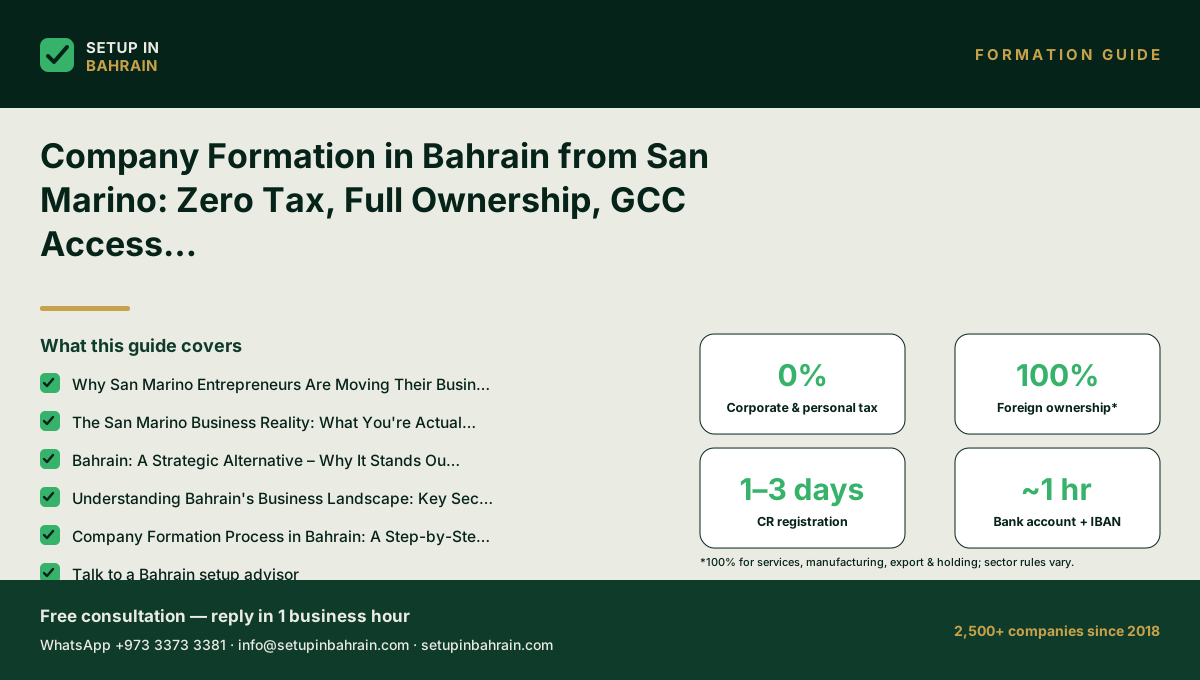
- Why San Marino Entrepreneurs Are Moving Their Business to Bahrain
- The San Marino Business Reality: What You're Actually Paying (and Losing)
- Bahrain: A Strategic Alternative – Why It Stands Out for Sammarinese Businesses
- Understanding Bahrain's Business Landscape: Key Sectors and Opportunities
- Company Formation Process in Bahrain: A Step-by-Step Guide for San Marino Investors
→ Complete guide: Company Formation in Bahrain — the full 2026 guide
View details
Ownership & capital
A Bahrain WLL can be owned by a single person — 100% foreign ownership applies to most activities, with no local partner required for services, manufacturing, export trading and holding companies. The minimum share capital is BHD 1 ; we recommend BHD 1,000 . This Makes bank account opening and investor visa approval smoother.
Marco runs a precision engineering consultancy from Serravalle. Last March, he sat across from his commercialista, staring at figures that made his stomach turn. Between the 17% IRES on his company profits, the mandatory quarterly VAT filings to the Tributario, the IGR contributions, and the endless documents requirements that mirror Italy's Agenzia delle Entrate systems, he calculated that nearly 42% of his gross revenue disappeared before he could reinvest a single euro into growth. His biggest challenge, but, wasn't just the tax burden; it was the suffocating constraint of scale. His client base was predominantly Saudi Arabian and UAE industrial firms. His market opportunity? Virtually unlimited across the Gulf. His ability to scale from a 35,000-person microstate wedged between two Italian regions? Practically zero.
Marco isn't alone.
Picture Alessandra, a tech startup founder in Borgo Maggiore. She spends her mornings designing apps and her afternoons wrestling with complex tax compliance forms, all while watching 17% of her company’s hard-won profits disappear to corporate tax (IRES) — and another 20–25% of revenue eaten by social contributions, VAT, and regulatory fees. Her business, constrained by San Marino’s minuscule 35,000-resident market, struggles to expand beyond a handful of local clients without tripping over EU customs snags or getting stonewalled by banks outside Cassa di Risparmio.
Or consider Mario, who built his specialized machinery import business from the ground up over two decades in Dogana. He frequently stares at another mountain of paperwork from the Agenzia delle Entrate. Just last week, he lost a significant export deal to a GCC client because the complexity and cost of navigating non-EU customs rules from San Marino made his offering uncompetitive. The market within San Marino, with its 35,000 inhabitants, feels more like a cozy village than a launchpad for growth. He knows he needs to expand, but every move feels like a fight against bureaucracy, high taxes. A limited domestic horizon.
Across San Marino's 61 square kilometers, business owners face an uncomfortable truth: the Republic's regulatory framework, designed to align with EU standards despite not being an EU member, creates compliance costs that strangle international ambitions. The banking sector revolves around Cassa di Risparmio and a handful of smaller institutions, limiting access to global correspondent networks. Court proceedings conducted exclusively in Italian create friction when disputes involve international partners. And the complete absence of bilateral investment treaties with any GCC nation means zero legal protection for investments in the world's fastest-growing economic bloc.
If Mario’s, Alessandra's, or Marco’s frustrations sound familiar, you’re not alone. Many San Marino entrepreneurs, resilient and innovative by nature, find themselves at a crossroads. They see the global marketplace. Their current operational base, for all its charm and stability, presents inherent limitations that stifle scaling and profit maximization. The question isn't if you should look beyond the Titano. Where and how to find a new operational hub that truly aligns with your ambitions for growth and profitability.
This guide exists because San Marino entrepreneurs deserve a clear path forward. It's written specifically for you , the San Marino entrepreneur. We understand the nuances of running a business in a micro-state, the specific tax landscape, the challenges of limited market access. The desire for a truly international footprint. Bahrain offers something remarkable: genuine generally no corporate income tax for most sectorsation, 100% foreign ownership, English-language governance. A geographic position that puts you 25 kilometers from Saudi Arabia's $1.1 trillion economy. More importantly, it offers an escape from the regulatory labyrinth that's holding your business hostage.
Think of this as your personal consultation, designed to provide the specific insights and actionable steps you need to make an informed decision for 2026 and beyond.
Why San Marino Entrepreneurs Are Moving Their Business to Bahrain
The motivations for San Marino entrepreneurs to consider a move to Bahrain are manifold, stemming directly from the pain points we've just discussed. It's not just about finding an alternative; it's about finding a superior operational environment that unlocks growth potential previously unattainable.
Here’s a direct comparison of why Bahrain is becoming the destination of choice:
Ask for a written, itemized quotation confirming government fees and all inclusions before payment.
By directly addressing these fundamental differences, Bahrain presents itself not merely as an escape route. As a strategic pivot point for San Marino entrepreneurs ready to unlock their full potential on the international stage.
The San Marino Business Reality: What You're Actually Paying (and Losing)
To truly appreciate the value proposition of Bahrain, it's essential to dissect the reality of doing business in San Marino, beyond the picturesque medieval towers. Many entrepreneurs, accustomed to the local framework, may not fully quantify the hidden costs and missed opportunities. Let’s break down the real costs and constraints – with concrete numbers and specific challenges.
1. Corporate Tax (IRES): The 17% Hit
- Flat Rate: As of 2026, the corporate income tax (Imposta Generale sul Reddito delle Società - IRES) stands at a flat 17%.
- Applied to Global Income: If your company is managed and controlled from San Marino, its worldwide income is generally subject to this 17% rate. This means profits generated from your Saudi or Emirati clients are taxed locally, regardless of where the revenue originates.
- Impact: For a business with €1,000,000 in annual profit, €170,000 immediately goes to tax, directly reducing funds available for reinvestment, R&D, or expanding your workforce. This is a significant drain compared to a generally no corporate income tax for most sectors jurisdiction.
2. The Agenzia delle Entrate-Style Compliance Labyrinth
San Marino’s tax and regulatory framework. Independent, often mirrors the complexity of Italy's Agenzia delle Entrate. This isn't just about paying tax; it's about the administrative burden.
Mandatory Filings: Entrepreneurs face mandatory quarterly VAT filings (Imposta sulle Merci e Servizi - IMS), annual IRES declarations. Various other contributions (e.g., IGR). The Modello Unico: The Modello Unico , San Marino's primary tax return form, is notoriously comprehensive, requiring meticulous record-keeping and often several weeks of your commercialista's* time (and your own oversight) to complete accurately. This isn't just an "annual check-the-box" exercise; it's an intricate process demanding significant administrative effort. Social Contributions: Beyond corporate tax, businesses are liable for social security contributions for employees and themselves, often ranging from 20-25% of gross revenue or salary, further eating into profitability. Hidden Costs: The time spent on compliance, the fees paid to commercialisti* for navigating these complexities. The risk of penalties for errors all constitute substantial hidden costs that reduce effective margins.
3. Minimal Domestic Market: The 35,000-Person Ceiling
- Population Constraint: With about 35,000 residents across 61 square kilometers, San Marino's domestic market is inherently tiny. This means businesses, especially those in manufacturing, tech, or specialized services, quickly hit a ceiling for local client acquisition.
- Limited Growth: For companies seeking significant scale, internationalization isn't an option; it's a necessity. But, San Marino's position often makes international expansion cumbersome.
- No Economies of Scale: A small domestic market often prevents businesses from achieving economies of scale in production or service delivery, making their unit costs higher than international competitors operating in larger markets.
4. EU Customs Union Exclusion: Import/Export Friction
Despite being surrounded by Italy, San Marino is not part of the EU proper. While it's in a customs union with the EU, this unique status introduces complexities:
Non-EU Customs Rules for International Trade: For exports and imports with non-EU countries (like the GCC), San Marino businesses must navigate full non-EU customs rules, which can be bureaucratic, time-consuming, and expensive. This includes completing customs declarations, complying with specific origin rules, and facing potential duties or tariffs. Additional Paperwork & Delays: Every shipment to a non-EU buyer involves additional paperwork, customs checks. Potential delays at ports (e.g., Ancona for sea freight). These frictions add to logistical costs and can make your products or services less competitive on the global stage, as Mario experienced with his specialized machinery. Impact on Supply Chains: Managing a global supply chain from San Marino, especially one involving multiple non-EU jurisdictions, can become an administrative nightmare, impacting efficiency and delivery times.
5. Legacy Banking Sector: Limited Global Reach
Concentrated Banking: San Marino's banking sector is dominated by a few key players, most notably Cassa di Risparmio della Repubblica di San Marino (Cassa di Risparmio). While stable, this concentration can limit choice and access to specialized international banking services. Global Correspondent Networks: Smaller domestic banks often have less extensive global correspondent banking networks compared to major international financial hubs. This can result in slower international transfers, higher fees. Potential difficulties in establishing relationships with banks in new markets. Compliance for Cross-Border Payments: Given its micro-state status, San Marino banks may face heightened scrutiny for international transactions, potentially leading to increased documents requirements and delays for legitimate cross-border payments.
6. Italian-Exclusive Legal System: Friction for International Disputes
- Language Barrier: All court proceedings and official legal documents in San Marino are exclusively in Italian. For businesses dealing with international clients or partners who operate in English or other languages, this creates an immediate language barrier, necessitating costly translations and potentially slowing down dispute resolution.
- Familiarity: While the legal system is robust, its specific nuances might be less familiar to international entities compared to widely adopted common law systems.
- Absence of Bilateral Investment Treaties (BITs): Crucially, San Marino has virtually no bilateral investment treaties (BITs) with any GCC nation. This means that if you invest in a GCC country from San Marino, your investment lacks specific legal protections that BITs typically provide, such as guarantees against expropriation, fair and equitable treatment, and access to international arbitration for dispute resolution. This exposes San Marino investors to significant risk in the world's fastest-growing economic bloc.
In essence, while San Marino offers stability and a unique quality of life, its current business framework is inadvertently throttling the international ambitions of its entrepreneurs. The move to Bahrain is not just about reducing costs; it's about unshackling your business from these systemic constraints and positioning it for exponential growth.
Bahrain: A Strategic Alternative – Why It Stands Out for Sammarinese Businesses
Having dissected the challenges facing San Marino entrepreneurs, let’s pivot to the compelling advantages Bahrain presents. It’s not simply a tax haven; it’s a strategically engineered ecosystem designed to foster international business growth and innovation, making it especially attractive for those looking beyond Europe.
1. Geographic Gateway to a Trillion-Dollar Market
Proximity to Saudi Arabia: Bahrain’s most significant strategic asset is its direct physical link to Saudi Arabia via the 25-kilometer King Fahd Causeway. Saudi Arabia, with its $1.1 trillion economy and ambitious Vision 2030 projects, represents an enormous procurement and consumer market. For San Marino businesses targeting the GCC, Bahrain offers unparalleled ease of access, allowing for daily commuting, efficient logistics. Rapid market entry. This is a game-changer for distribution, client meetings, and supply chain management. Central GCC Hub: Beyond Saudi Arabia, Bahrain is centrally located within the GCC, providing easy air and sea access to Qatar, UAE, Kuwait, and Oman. This makes it an ideal regional headquarters or distribution hub for businesses aiming for broader GCC penetration. Time Zone Advantage: Operating in the Gulf Standard Time (GST) zone, Bahrain offers a convenient bridge between European and Asian markets, facilitating real-time communication and operational efficiencies for globally oriented businesses.
2. Liberal, Open, and Diversified Economy
Economic Freedom: The World Bank consistently ranks Bahrain highly for ease of doing business. The Heritage Foundation's Index of Economic Freedom often places Bahrain as the freest economy in the Middle East and North Africa (MENA) region. This stems from its strong property rights, efficient regulatory framework, and open markets. Diversification Strategy: Unlike some of its oil-rich neighbors, Bahrain began its economic diversification journey decades ago. It has successfully positioned itself as a regional financial hub and is now actively fostering growth in ICT, logistics, manufacturing. Tourism. This creates a stable and dynamic environment less susceptible to oil price fluctuations. Pro-Business Government: The Bahrain Economic Development Board (EDB) acts as a primary facilitator, proactively attracting foreign investment and providing support services for businesses setting up. This dedicated government agency streamlines processes and offers tailored guidance, a stark contrast to navigating fragmented bureaucracies.
3. Skilled Workforce and Talent Pool
- Educated Local Population: Bahrain has invested heavily in education and skills development, resulting in a highly educated and bilingual (Arabic and English) local workforce. Bahraini nationals are known for their strong work ethic and adaptability.
- Expatriate Talent Magnet: As an attractive place to live and work, Bahrain draws a diverse expatriate talent pool from around the world, ensuring access to specialized skills and international expertise across various sectors.
- Competitive Labor Costs: Compared to major financial centers in Europe or North America, labor costs in Bahrain are relatively competitive, especially for skilled positions, offering a cost-effective base for operations.
4. Robust Digital Infrastructure and Connectivity
- Advanced ICT Infrastructure: Bahrain boasts one of the most advanced ICT infrastructures in the region, with high-speed internet penetration, widespread 5G coverage, and state-of-the-art data centers. This is crucial for tech-driven businesses, e-commerce, and any company reliant on digital operations.
- Digital Government Services: The government's commitment to digitalization is evident in platforms like "Sijilat," which allows for online company registration and various e-government services, greatly reducing administrative lead times.
- FinTech Hub: The Central Bank of Bahrain (CBB) has been a pioneer in fostering a FinTech ecosystem, establishing regulatory sandboxes and attracting FinTech startups. For financial services or tech companies, this provides a supportive and innovative environment.
5. Transparent and Predictable Regulatory Environment
English Common Law Influence: Bahrain's legal system is transparent and predictable, drawing heavily from English common law principles. This Provides comfort and familiarity for international investors. This clarity reduces legal risks and makes commercial transactions more straightforward than navigating an Italian-exclusive system. Independent Judiciary: The judicial system is independent, ensuring fair and impartial dispute resolution. Data Protection Laws: Bahrain has enacted comprehensive data protection laws (e.g., the Personal Data Protection Law) that align with international best practices, giving businesses confidence in handling sensitive information.
For a San Marino entrepreneur, Bahrain isn't merely an offshore locale; it's a strategically positioned, economically liberal, and digitally advanced hub that offers the infrastructure, market access, and regulatory clarity needed to transcend the limitations of a micro-state and truly thrive on a global scale.
Understanding Bahrain's Business Landscape: Key Sectors and Opportunities
While Bahrain offers a broad pro-business environment, certain sectors have been specifically targeted for growth and offer especially fertile ground for San Marino entrepreneurs looking to leverage their expertise. Understanding these areas helps in identifying how your existing business or new venture can best integrate into Bahrain's dynamic economy.
1. Financial Services and FinTech
Bahrain has historically been a regional leader in financial services, predating the oil boom. The Central Bank of Bahrain (CBB) has fostered a mature and diverse ecosystem, making it an ideal choice for financial institutions, consultancies. Innovative FinTech startups.
- Traditional Finance: Home to over 350 financial institutions, including conventional and Islamic banks, investment firms, and insurance companies. Opportunities exist for wealth management, corporate finance advisory, and asset management.
- Islamic Finance: Bahrain is a global hub for Islamic finance, offering a robust regulatory framework and a large pool of Sharia-compliant expertise.
- FinTech Innovation: The CBB's regulatory sandbox and supportive ecosystem have attracted numerous FinTech firms. Opportunities abound in areas like blockchain, payment solutions, InsurTech, RegTech, and AI in finance. San Marino entrepreneurs with expertise in niche financial advisory or digital payment solutions could find a welcoming and innovative environment.
2. Information and Communication Technology (ICT)
Bahrain's advanced digital infrastructure and commitment to a digital economy make it a prime location for ICT businesses.
Digital Transformation: As governments and businesses across the GCC undergo massive digital transformation, there's high demand for software development, cloud computing services, cybersecurity solutions, and IT consulting. Data Centers & Cloud Hosting: With strategic location and reliable infrastructure, Bahrain is becoming a regional data hub. Companies offering data center services, managed IT, or specialized cloud solutions can thrive. E-commerce & Digital Marketing: The growing online consumer market in the GCC presents significant opportunities for e-commerce platforms, digital marketing agencies. Logistics providers specializing in last-mile delivery.
3. Manufacturing and Logistics
Leveraging its strategic location and excellent connectivity, Bahrain is positioning itself as a manufacturing and logistics gateway to the GCC.
Value-Added Manufacturing: The Bahrain International Investment Park (BIIP) offers state-of-the-art facilities for light manufacturing, assembly. Processing industries. Focus areas include automotive components, food processing, packaging, and building materials. San Marino's precision engineering firms, like Marco's, could find an ideal base here to serve the Saudi automotive and industrial sectors directly. Logistics & Distribution: The Bahrain Logistics Zone (BLZ) provides multimodal logistics services, connecting Khalifa Bin Salman Port, Bahrain International Airport. The King Fahd Causeway. Opportunities exist for warehousing, freight forwarding, cold chain logistics, and supply chain optimization. Advanced Technologies in Manufacturing: There's a growing appetite for Industry 4.0 solutions, robotics. Automation in manufacturing, presenting opportunities for specialized tech firms.
4. Tourism and Hospitality
With its rich history, cultural attractions, and modern infrastructure, Bahrain is a growing tourist destination.
- Niche Tourism: Opportunities for specialized tour operators, boutique hotels, eco-tourism ventures, and event management companies.
- Hospitality Support Services: Demand for services supporting the hospitality sector, from F&B suppliers to technology solutions for hotels.
5. Education and Training
The demand for skilled labor and specialized education across the GCC is high.
Vocational Training: Opportunities for vocational training centers, professional development courses. Specialized certification programs aligned with industry needs (e.g., FinTech, cybersecurity, advanced manufacturing). Higher Education Partnerships: Potential for partnerships with existing Bahraini universities or establishing specialized educational institutes.
How San Marino Businesses Can Fit In:
Leverage Existing Expertise: If your San Marino business has specialized expertise in precision manufacturing, niche technology, or specific consulting services, Bahrain offers a larger, more accessible market and a supportive ecosystem to scale those services. Adapt to Regional Needs: Research the specific needs of the Bahraini and broader GCC markets. Can your product or service be localized or adapted to cater to regional preferences and regulations? Partnerships: Consider forming strategic partnerships with local Bahraini companies to gain market insight, help entry. Leverage local networks. Free Zones: Explore the benefits of Free Zones like BIIP or BLZ, which offer specific advantages for manufacturing, logistics. Export-oriented businesses, including duty exemptions and specialized infrastructure.
By aligning your business strategy with Bahrain's key growth sectors, you can not only mitigate the challenges faced in San Marino but also tap into unprecedented opportunities for expansion and profitability.
Company Formation Process in Bahrain: A Step-by-Step Guide for San Marino Investors
One of Bahrain's most compelling advantages is the streamlined, efficient process for company formation. Unlike the protracted, paper-heavy procedures familiar to San Marino entrepreneurs, Bahrain has greatly digitized and simplified its approach. The Economic Development Board (EDB) and the Ministry of Industry and Commerce (MOIC) are key facilitators in this journey.
Here’s a step-by-step guide for San Marino investors:
Step 1: Preliminary Planning and Due Diligence (1-2 Weeks)
Before initiating any formal steps, careful planning is crucial:
Business Activity Selection: Clearly define your business activities. Bahrain's Commercial Registration (CR) system requires specific activity codes. The MOIC provides a comprehensive list. This step is critical as it determines licensing requirements and eligible legal structures. Legal Structure Choice: Based on your business activity, ownership goals (100% foreign ownership is generally permissible). Future expansion plans, choose the appropriate legal entity. (More details on this below). Feasibility Study: Conduct a brief market assessment and financial projection to ensure viability in Bahrain. The EDB can assist with market insights and connections. Name Reservation: Propose several company names in order of preference. The MOIC will check for availability and approve one. This can often be done online via the Sijilat portal.
Step 2: Commercial Registration Application (CR) – Online via Sijilat (3-5 Business Days)
Bahrain's Sijilat portal is a single-window system for company registration, consolidating applications across various government entities.
Required Documents: * Proposed company name(s). * Passport copies for all shareholders, directors, and authorized signatories from San Marino. * CVs/Resumes of key personnel. * Address of the proposed office in Bahrain (physical or virtual office agreement). * Memorandum of Association (MoA) and Articles of Association (AoA) – specific templates are available for different legal structures. These outline the company's purpose, share capital, and governance. * Proof of initial capital deposit (if required for the legal entity). * For specific activities, additional approvals from relevant ministries (e.g., CBB for financial services, Ministry of Health for healthcare). Online Submission: All documents are uploaded digitally via the Sijilat portal. The system guides you through the process, consolidating applications for Commercial Registration (CR), municipal licenses. Other necessary permits. Initial Approval: Once submitted, the MOIC reviews the application for completeness and compliance. Initial approval typically takes a few business days.
Step 3: Obtaining Licenses and Permits (Varies by Activity, 1-4 Weeks)
After initial CR approval, specific operational licenses and permits are required depending on your business activity.
Sector-Specific Approvals: * Financial Services: Requires rigorous approval from the Central Bank of Bahrain (CBB). * Healthcare: Ministry of Health approvals. * Education: Ministry of Education approvals. * Manufacturing: Ministry of Industry and Commerce (and potentially specific environmental permits). Municipality License: This is required for your physical business premises. It ensures compliance with local zoning and safety regulations. Chamber of Commerce Membership: Mandatory for all registered companies. You will typically be required to register with the Bahrain Chamber of Commerce and Industry (BCCI). Step 4: Post-Registration Formalities (1-2 Weeks)
Once your CR and licenses are in
Bahrain Business Guides for San Marino Citizens
Frequently Asked Questions
How long does it take to set up?
It takes 15 to 20 days. We file all forms for you. You do not need to wait long.
What does it cost?
Company formation: Standard BHD 1,340 with 3 months of office address; Gold BHD 1,700 with 6 months; Premium BHD 2,150 with 12 months and a cabin, officer table and chair, and two guest chairs. No formation package includes visas, including Premium. Investor/work visas are priced separately: BHD 755 for one year or BHD 953 for two years, in addition to the formation package. Ask for a written, itemized quotation confirming government fees and all inclusions before payment.
Do I need to visit Bahrain?
No. You can set up your firm from home. We do all the work online. Some banks may ask for one visit.
What tax will I pay?
You pay zero tax on your profits. Bahrain has no corporate income tax. This is a key benefit of the setup.
Can I own 100% of my firm?
Yes. Foreign owners can hold all shares. No local partner is needed. Full ownership is allowed.
What do I need to start?
You need a valid passport. You also need a trade name and a business address. We help you with all of these.
How do I open a bank account?
We guide you step by step. Most banks take 3 to 6 weeks. You will need your CR and firm papers.
Who issues the Commercial Registration (CR)?
The CR is issued by the MOICT. It is your legal right to trade in Bahrain. We file the CR for you.
Can I renew my CR each year?
Company renewal packages: BHD 530 with 3 months of office address; BHD 980 with 6 months; BHD 1,520 with 12 months. These are separate renewal packages, not visa fees.
How do I get started?
Fill in our form on this page. Our team will call you back. We map your best setup plan at no cost.
Steps to Form Your Company
- Pick your trade name. We check if it is free.
- Choose your business type. WLL is the most common.
- Sign the MOA. We draft and file all legal docs.
- Pay the state fees. About BHD 432 in total.
- Get your CR. Takes 15 to 20 days.
- Open your bank account. We guide each step.
- Start trading. You are ready to do business.
Key Facts
- Tax rate: 0%
- Foreign ownership: 100%
- Setup time: 15 to 20 days
- Company formation: Standard BHD 1,340 with 3 months of office address; Gold BHD 1,700 with 6 months; Premium BHD 2,150 with 12 months and a cabin, officer table and chair, and two guest chairs. No formation package includes visas, including Premium. Investor/work visas are priced separately: BHD 755 for one year or BHD 953 for two years, in addition to the formation package. Ask for a written, itemized quotation confirming government fees and all inclusions before payment.
- Company renewal packages: BHD 530 with 3 months of office address; BHD 980 with 6 months; BHD 1,520 with 12 months. These are separate renewal packages, not visa fees.
- Client rating: 4.8 stars
- Clients served: 2,500 and more
Quick Facts
- Tax rate: 0%
- Own all of your firm: Yes, 100%
- Time to set up: 15 to 20 days
- Company formation: Standard BHD 1,340 with 3 months of office address; Gold BHD 1,700 with 6 months; Premium BHD 2,150 with 12 months and a cabin, officer table and chair, and two guest chairs. No formation package includes visas, including Premium. Investor/work visas are priced separately: BHD 755 for one year or BHD 953 for two years, in addition to the formation package. Ask for a written, itemized quotation confirming government fees and all inclusions before payment.
- Company renewal packages: BHD 530 with 3 months of office address; BHD 980 with 6 months; BHD 1,520 with 12 months. These are separate renewal packages, not visa fees.
- Rating: 4.8 stars
- Clients: 2,500 and more
Why Bahrain?
Bahrain has no tax. You keep all your profits. This is rare in the Gulf.
You can own all of your firm. No local partner is needed. The law allows full foreign ownership.
Setup takes 15 to 20 days. We file all forms for you. You can do it all from home.
Bahrain has a free trade deal with the US. Your goods face low or no tariffs. This gives you access to big markets.
We have served 2,800+ clients from 44+ countries and maintain records to substantiate that total where needed. We have 113 Google reviews; reviews represent only some clients and are not the same as the total clients served.
Our Steps
- Tell us your plan. We advise you for free.
- We pick the right firm type for you.
- We file all your forms with MOICT.
- You get your CR in 15 to 20 days.
- We help you open a bank account.
- You are ready to trade. We stay with you.
Next Steps for San Marino Citizens
You can set up a firm in Bahrain from San Marino. You do not need to fly there first. We do all the work online.
Tell us your plan. We call you back the same day. We map the best route for you at no cost.
We file all your forms. We deal with MOICT and the state. You get your CR in 15 to 20 days.
After your CR, we help you get a bank account. We also help with your Investor Visa. One firm guides you at each step.
Why Our Clients from San Marino Choose Us
- We speak your language. We know your needs.
- We have helped clients from San Marino before.
- Our fee is clear. No surprise costs.
- We have a 4.8 star rating on Google.
- We have helped more than 2,500 clients set up in Bahrain.
Fill in the form on this page. We will be in touch soon. Let us help you start your Bahrain firm today.
Ready to set up in Bahrain from San Marino?
Tell us your business idea. We map the right entity, ownership and timeline — then handle the filing while you focus on what matters.