
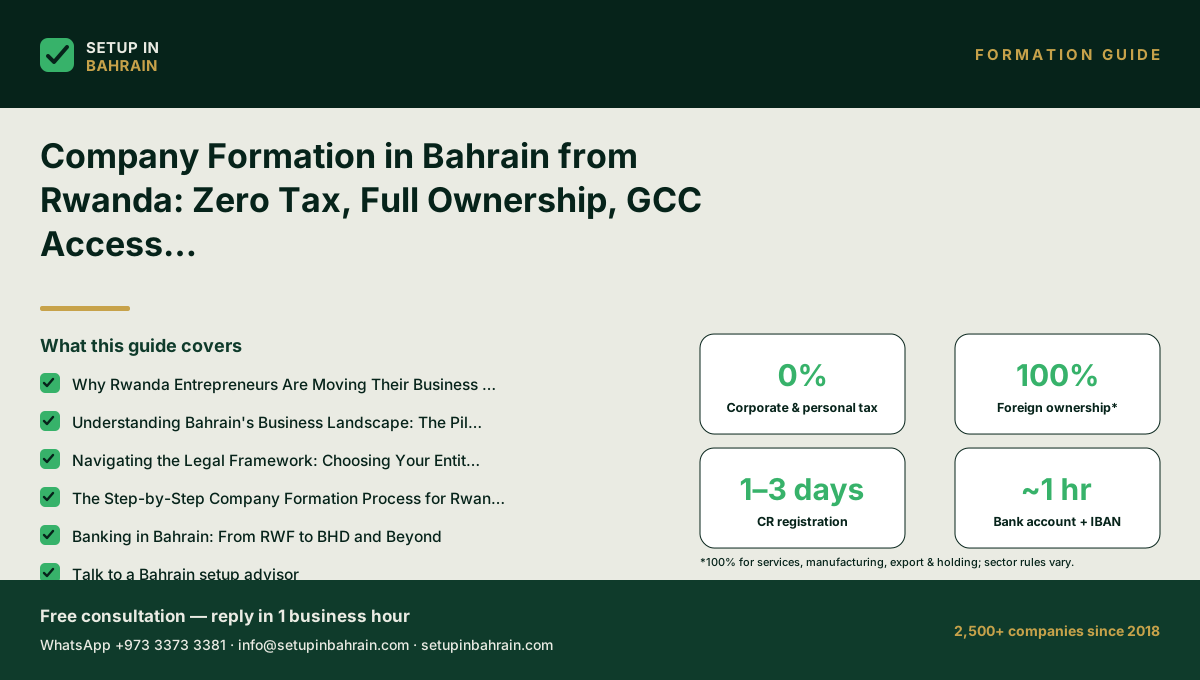
Complete guide for Rwanda entrepreneurs: form a company in Bahrain with generally no corporate income tax for most sectors, 100% foreign ownership. GCC market access. Costs, steps, visas, banking.
Key Takeaways
- Why Rwanda Entrepreneurs Are Moving Their Business to Bahrain
- Understanding Bahrain's Business Landscape: The Pillars of Opportunity
- Navigating the Legal Framework: Choosing Your Entity Type in Bahrain
- The Step-by-Step Company Formation Process for Rwandan Entrepreneurs
- Banking in Bahrain: From RWF to BHD and Beyond
→ Complete guide: Company Formation in Bahrain — the full 2026 guide
View details
Ownership & capital
A Bahrain WLL can be owned by a single person — 100% foreign ownership applies to most activities, with no local partner required for services, manufacturing, export trading and holding companies. The minimum share capital is BHD 1 ; we recommend BHD 1,000 . This Makes bank account opening and investor visa approval smoother.
Imagine this: Alice, a Kigali-based tech entrepreneur, logs into her business dashboard and sighs — another RWF 7,200,000 transferred to the Rwanda Revenue Authority, wiped right off her bottom line by the standard 30% corporate income tax. Even as a “preferred investor” with her rapidly expanding SaaS hub, she still pays 15% corporate tax, plus navigating complex compliance, managing payroll, and making mandatory contributions to the Rwanda Social Security Board (RSSB). Factor in the persistent currency depreciation of the Rwandan Franc (RWF), tight local banking options, and the persistent headaches of exporting services or goods to regional powerhouses like Saudi Arabia, and Rwanda starts to feel—at least from her boardroom window—a bit confining, a bit expensive.
Now imagine a different scenario. She registers her company in Bahrain:
- generally no corporate income tax for most sectors. Your hard-earned profits remain yours to reinvest and grow.
- 100% foreign ownership. No local partner, no nominee shareholder, no compromises on control.
- A stable, USD-pegged currency (the Bahraini Dinar, BHD) with no surprises, safeguarding your international purchasing power.
- Direct, unfettered access to a colossal $2.3 trillion GCC market—across a mere 25-kilometer causeway connecting Bahrain directly to Saudi Arabia.
This guide isn't about leaving Rwanda behind. It's about strategically repositioning your business, amplifying its growth potential, and unshackling your profits from heavy taxes. It's for the Rwandan entrepreneur who looks at their balance sheet and sees the 30% corporate income tax (or even 15% for preferred investors) as a significant drag. It’s for the founder frustrated by annual RWF depreciation eating into their international purchasing power, or the logistics manager struggling with the 20-30% additional shipping costs to reach the Gulf Cooperation Council (GCC) markets from Kigali.
In this definitive guide, crafted specifically for you, the ambitious Rwandan entrepreneur, you’ll get a Rwanda-specific breakdown—real numbers, concrete compliance realities, the immense opportunities, and the exact next steps to take if you want to future-proof your Rwanda business in 2026 and beyond with a strategic Bahrain company formation. We’ll peel back the layers of frustration you currently face and illuminate the tangible advantages Bahrain offers, providing a step-by-step process, crucial insights, and answering your most pressing questions.
Why Rwanda Entrepreneurs Are Moving Their Business to Bahrain
Let’s anchor this with a real scenario, building on the experiences many Rwandan entrepreneurs face daily.
Eric Uwimana owns a profitable Kigali-based cross-border logistics startup. His annual turnover for the last financial year was about RWF 400 million (around USD 315,000 at recent exchange rates). Despite solid year-on-year revenue growth, Eric realizes that, between taxes, compliance. Currency volatility, his effective margins are constantly eroding. At tax time, the numbers bite hard:
3generally no corporate income tax for most sectors: A staggering RWF 120 million (about USD 94,500) goes straight to the tax office from his net profit. Even if he qualified as a "preferred investor" for a specific sector, he’d still face a 15% rate. This Is substantial. This directly impacts his ability to reinvest, innovate, and expand. Mandatory RSSB Contributions: His payroll is burdened by non-negotiable contributions to the Rwanda Social Security Board (RSSB), typically 5% of gross salary split between employer and employee. This adds an administrative and financial layer that can be a drain, especially for a lean startup. Banking Fees, FX Costs. SWIFT Complications: Each international transaction can take days to clear and often incurs up to 1.5% in hidden intermediary charges due to limited SWIFT correspondent banking options from Rwanda. When dealing with international suppliers or clients, these costs accumulate rapidly. RWF Depreciation: Over the last five years, the Rwandan Franc has consistently lost value against major currencies, often depreciating by 10-15% annually. Simply holding cash or having receivables in RWF means his capital is shrinking before he even makes a strategic move. This erodes international purchasing power and makes imported goods or services more expensive, impacting his supply chain. RDB Investment Approval Process: While the Rwanda Development Board (RDB) aims to streamline processes, securing various investment approvals and operational licenses can still be a time-consuming and sometimes opaque hurdle, adding to the administrative load.
Eric’s story is not unique. Many Rwandan entrepreneurs, from software developers building logistics platforms for East African exporters to agri-tech innovators, find themselves in a similar predicament. They are innovative, resilient. Resourceful, but they operate within a framework that, while supportive in many ways, presents significant financial and logistical constraints for international scaling.
The allure of Bahrain for these entrepreneurs is not just a dream; it’s a strategic imperative for global competitiveness. Consider the immediate relief:
Generally no corporate income tax for most sectors: Imagine that RWF 120 million staying in Eric’s company, available for expansion, technology upgrades, or hiring more talent. Bahrain stands out globally for its 0% corporate income tax, making it an incredibly attractive jurisdiction for profit retention and reinvestment. Full Foreign Ownership: In Bahrain, a foreign entrepreneur can own 100% of their company, especially the popular With Limited Liability (WLL) structure, without requiring a local sponsor or partner. This means complete control and simpler decision-making processes, a stark contrast to scenarios where local partnership requirements might dilute ownership or complicate operations. Stable, USD-Pegged Currency: The Bahraini Dinar (BHD) is pegged to the US Dollar, providing unparalleled currency stability. This eliminates the uncertainty and risk associated with RWF depreciation, making international transactions predictable and protecting asset values. Unrestricted GCC Market Access: Bahrain is strategically positioned as a gateway to the Gulf Cooperation Council (GCC) market, a collective economic powerhouse boasting a GDP of over $2.3 trillion and a population exceeding 55 million high-spending consumers. With its direct 25km causeway to Saudi Arabia, Bahrain facilitates efficient trade and business expansion into the largest economy in the Arab world without the 20-30% additional shipping premiums and logistical complexities often faced from East Africa. Simplified Regulatory Environment: The Kingdom of Bahrain, through its Ministry of Industry and Commerce (MOIC) and the Economic Development Board (EDB), has cultivated an exceptionally business-friendly environment. Processes are streamlined, transparent. Digitally advanced, greatly reducing the time and administrative burden associated with company registration and ongoing compliance.
This isn't about abandoning Rwanda but about building a robust, international platform for growth. By leveraging Bahrain’s advantages, Rwandan entrepreneurs can overcome their existing pain points, access new markets. Future-proof their ventures for sustained success on a global scale.
Understanding Bahrain's Business Landscape: The Pillars of Opportunity
Bahrain, often called the "Pearl of the Gulf," is more than just a tax haven; it’s a sophisticated, OECD-compliant financial hub with a strategic vision for economic diversification and global integration. For Rwandan entrepreneurs, understanding this landscape is crucial to appreciating the depth of the opportunity.
Strategic Geographic Location: Bahrain's greatest physical asset is its location. Nestled in the heart of the Arabian Gulf, it offers unparalleled access to the entire GCC market. The King Fahd Causeway, a 25-kilometer land bridge, connects Bahrain directly to Saudi Arabia, facilitating swift logistical movements and direct business engagement. This proximity means that establishing a base in Bahrain effectively places your business within easy reach of the enormous Saudi market, alongside thriving economies like the UAE, Qatar, Kuwait, and Oman. For businesses currently grappling with high shipping costs and complex logistics to reach the Gulf from Rwanda, Bahrain offers a significant competitive edge.
A Pioneering & Diversified Economy: Bahrain was the first GCC nation to move beyond oil, proactively diversifying its economy decades ago. Today, its economy is robust and driven by non-oil sectors, especially financial services, logistics, ICT, manufacturing. Tourism. Financial Services: Home to the Central Bank of Bahrain (CBB), Bahrain boasts a mature and well-regulated financial sector. It's a regional leader in Islamic finance, fintech, and conventional banking. This provides a stable and advanced ecosystem for managing your business finances, accessing capital. Leveraging innovative financial technologies. Logistics & Trade: With Khalifa Bin Salman Port, a state-of-the-art facility. A highly efficient customs process, Bahrain is designed for international trade. Its free trade agreements and membership in the GCC customs union further simplify cross-border commerce. Information & Communication Technology (ICT): The government has invested heavily in digital infrastructure, fostering a vibrant tech ecosystem. This attracts global tech companies and provides a fertile ground for Rwandan tech startups looking to scale. Initiatives by the Economic Development Board (EDB) actively promote innovation and digital transformation.
Pro-Business & Progressive Regulatory Environment: Bahrain consistently ranks high in global ease-of-doing-business reports (e.g., World Bank Doing Business reports). This isn't accidental; it's a result of deliberate policy decisions by the Ministry of Industry and Commerce (MOIC) and the EDB to create an attractive investment climate. Streamlined Processes: From company registration to licensing, processes are more and more digital and efficient. The "Invest in Bahrain" portal and various online services greatly reduce bureaucratic hurdles. Investor-Friendly Policies: Policies like 100% foreign ownership, absence of corporate and personal income tax. Minimal customs duties on most goods show Bahrain's commitment to attracting foreign direct investment. Skilled Workforce: Bahrain has a well-educated, bilingual (Arabic and English) workforce, greatly reducing the need for extensive expatriate hiring for every role, though skilled expatriates are also welcomed. Cost-Effectiveness: Compared to some of its GCC neighbors, Bahrain offers a more competitive cost of living and doing business, especially concerning office rents and operational expenses, without compromising on quality of life or infrastructure.
A Hub for Innovation and Talent: Bahrain has positioned itself as a regional testbed for emerging technologies, especially in fintech. The CBB has established a regulatory sandbox, allowing startups to test innovative financial products and services in a controlled environment. This commitment to innovation, coupled with a growing startup ecosystem, makes Bahrain an exciting place for Rwandan entrepreneurs involved in technology, digital services, and knowledge-based industries.
For the Rwandan entrepreneur looking beyond domestic limitations, Bahrain offers not just relief from high taxes and currency woes. A strategic platform built on stability, connectivity, and a forward-thinking economic vision. It’s a place where your business can truly thrive and access global markets with unprecedented ease.
Navigating the Legal Framework: Choosing Your Entity Type in Bahrain
Selecting the right legal entity is a foundational step in establishing your business in Bahrain. For Rwandan entrepreneurs, understanding the options and their implications is paramount to ensuring compliance, operational efficiency. Future growth.
Crucially, let's address a common misconception: There is NO WLL (Single Person Company) in Bahrain. While some jurisdictions offer this, Bahrain does not. But, this does not mean a single individual cannot own a company entirely. Bahrain offers robust structures that allow for 100% foreign, single-person ownership.
The most suitable and frequently recommended legal entity for foreign entrepreneurs in Bahrain is the With Limited Liability (WLL) company.
The With Limited Liability (WLL) Company: Your Primary Choice
The WLL structure is the cornerstone for most foreign investors in Bahrain due offering the best balance of flexibility, protection. Straightforward compliance.
Key Features of a WLL:
100% Foreign Ownership: This is perhaps the most significant advantage for Rwandan entrepreneurs. A WLL company can be entirely owned by a single foreign individual or a single foreign corporate entity. There is absolutely no requirement for a local Bahraini partner or sponsor. This ensures complete control over your business, its assets. Its strategic direction, eliminating any concerns about equity dilution or shared decision-making. Limited Liability Protection: As the name suggests, the liability of the shareholder(s) is limited to the amount of their capital contribution to the company. This protects your personal assets from the company's debts and obligations, a crucial safeguard for any entrepreneur. Minimum Share Capital: Legally, the minimum share capital required for a WLL company in Bahrain is BHD 1 . This is an incredibly low threshold designed to promote ease of entry. * Practical Recommendation: While BHD 1 is the legal minimum, for practical purposes, especially when opening a corporate bank account and applying for an investor visa, it is strongly recommended to have a minimum paid-up capital of BHD 1,000 . Banks often require a higher capital to show financial stability. Immigration authorities consider this when assessing investor visa applications. This BHD 1,000 provides a much smoother path for initial operations. Number of Shareholders: A WLL can be formed with a minimum of one shareholder and a maximum of 50 shareholders. This means a single Rwandan entrepreneur can establish and fully own a WLL. Perpetual Existence: The company continues to exist regardless of changes in ownership or management, providing stability and continuity for your business operations. Versatile for Various Activities: A WLL can engage in a wide range of commercial activities, from trading and services to consulting, manufacturing. Technology, making it suitable for most Rwandan business ventures.
Other Company Structures (Less Common for New Foreign Entrants):
While WLL is dominant, it's worth briefly understanding other types, mainly to understand why they might be less suitable for most Rwandan entrepreneurs just starting in Bahrain:
Bahrain Shareholding Company (BSC): * Public BSC (B.S.C. (Public)): Suitable for large enterprises that intend to raise capital from the public through initial public offerings (IPOs). Requires a minimum of BHD 1,000,000 share capital and is subject to stringent regulations from the CBB and Bahrain Bourse. Not practical for small to medium-sized Rwandan businesses. * Closed BSC (B.S.C. (Closed)): A private shareholding company not open to public subscription. Requires a minimum of BHD 250,000 share capital. Also generally too capital-intensive for most Rwandan entrepreneurs. Partnership Company (General Partnership or Limited Partnership): These involve unlimited liability for at least one partner and are typically less attractive to foreign investors seeking liability protection. Branch of a Foreign Company: If you have an established company in Rwanda (or elsewhere) and simply want to set up an operational presence without creating a new legal entity, a branch might be an option. But, it operates as an extension of the parent company, meaning the parent company retains full liability. Often more complex for initial setup than a WLL. Sole Proprietorship (Individual Setup): This entity is generally reserved for Bahraini or GCC nationals. It means the owner and the business are legally one and the same, with unlimited personal liability. Not applicable to Rwandan entrepreneurs.
Why the WLL is the Best Fit:
For the vast majority of Rwandan entrepreneurs aiming to establish a commercial presence in Bahrain, the WLL company offers the most straightforward, cost-effective, and secure pathway. Its combination of 100% foreign ownership, limited liability. Manageable capital requirements makes it the ideal vehicle for international expansion and accessing the lucrative GCC market.
Before making a final decision, it's always advisable to consult with a local corporate services provider or a legal expert in Bahrain. They can help you align your specific business activities with the appropriate commercial registration (CR) codes and ensure your chosen structure perfectly fits your long-term strategic objectives. The Ministry of Industry and Commerce (MOIC) is the primary regulatory body overseeing company registration. Their portal is an excellent resource for commercial activities and requirements.
The Step-by-Step Company Formation Process for Rwandan Entrepreneurs
Establishing a company in Bahrain, especially a With Limited Liability (WLL) company, is a remarkably streamlined process, largely due to the digital initiatives championed by the Ministry of Industry and Commerce (MOIC) and support from entities like the Bahrain Economic Development Board (EDB) and Bahrain Investors Protection Agency (BIPA). For Rwandan entrepreneurs, the key is understanding each stage and preparing the necessary documents, keeping in mind specific requirements for foreign nationals.
Here’s a detailed, step-by-step roadmap:
Step 1: Business Activity and Name Reservation
Define Your Business Activities: * Clearly articulate the exact nature of your business operations. Bahrain's MOIC maintains a comprehensive list of commercial activities (CR codes). You must select the appropriate codes that match your intended services or products. Be specific; for example, "IT Consulting" is different from "Software Development." Rwandan Context:* If you’re a Rwandan tech firm, look for codes covering "ICT solutions," "software development," "data processing," etc. If you’re in logistics, focus on "freight forwarding," "customs clearance," etc. Choose Your Company Name: * Propose at least three unique company names, in order of preference. The name must not be already in use, offensive, or infringing on trademarks. It must also end with "W.L.L." (e.g., "Kigali Global Solutions W.L.L."). * Apply for Name Reservation: This is done online through the Sijilat portal, the MOIC's e-services platform. Approval is usually quick, often within a few hours to 1-2 business days.
Step 2: Document Preparation and Attestation
This is a critical stage, especially for documents originating from Rwanda.
Personal Documents of Shareholder(s) and Director(s): * Copy of valid passport (for all shareholders and directors). * Copy of National ID (if applicable, though passport is primary for foreigners). * Curriculum Vitae (CV) of the proposed director(s) and ultimate beneficial owner (UBO). * Proof of residence (e.g., utility bill). * Bank reference letter (from your personal bank in Rwanda or elsewhere). * Educational certificates (often required for specific licensed activities). Corporate Documents (if a Rwandan company is a shareholder): * Certificate of Incorporation of the Rwandan company. * Memorandum and Articles of Association (or equivalent founding documents). * Board Resolution from the Rwandan company authorizing the setup of a subsidiary in Bahrain and appointing a representative to act on its behalf. * Shareholder register. Attestation Requirements (CRITICAL for Rwandan Documents): * All documents originating from Rwanda (passports, certificates, corporate documents) must be attested. This usually involves a multi-step process: 1. Notarization in Rwanda (by a Public Notary). 2. Authentication by the Ministry of Foreign Affairs in Rwanda. 3. Legalization by the Bahraini Embassy or Consulate in Ethiopia (the closest accredited mission for Rwanda) or by the Rwandan Embassy in Saudi Arabia (if they have consular services for Bahrain). 4. Final attestation by the Ministry of Foreign Affairs in Bahrain upon arrival. This process can be time-consuming, so start early and factor in courier times and potential delays.* Professional corporate service providers in Bahrain can often assist with this final attestation step. Drafting Key Company Documents: * Memorandum of Association (MoA): This document outlines the company's objectives, share capital, shareholder details. Management structure. It must comply with Bahraini Company Law. * Articles of Association (AoA): These govern the internal management of the company. These documents are typically drafted by your corporate service provider or legal counsel in Bahrain.*
Step 3: Initial Application and Fee Payment
Submit Initial Application via Sijilat Portal: * Upload all prepared and attested documents (scanned copies initially). * Fill out the application forms online. * Pay the initial application fees, which include name reservation fees, commercial registration fees, and sometimes activity-specific fees. Estimated Fees:* Initial registration fees are relatively low, often a few hundred BHD.
Step 4: Obtaining Licenses and Approvals (if required)
Depending on your chosen business activities, you may need additional approvals from various government ministries or regulatory bodies:
- Central Bank of Bahrain (CBB): For financial services, fintech, insurance.
- Ministry of Health: For healthcare-related activities.
- Ministry of Education: For educational institutions.
- Telecommunications Regulatory Authority (TRA): For telecommunications services.
- Tourism & Exhibitions Authority: For tourism-related businesses.
Your corporate service provider will guide you on specific licensing requirements and assist with these applications.
Step 5: Commercial Registration (CR) Issuance
Once all documents are approved and any necessary licenses obtained, the MOIC will issue your Commercial Registration (CR) certificate. This is the legal document proving your company's existence and authorization to operate in Bahrain.
Step 6: Finding a Business Address (Virtual Office/Physical Office)
Before or immediately after obtaining your CR, you need a registered office address in Bahrain.
Virtual Office: Many startups and consulting firms opt for virtual office services. This Provide a registered address and mail handling. This is a cost-effective solution initially. Physical Office: For operations requiring a physical presence (e.g., retail, manufacturing, larger teams), you'll need to lease commercial property.
Your chosen service provider can assist in securing a suitable address.
Step 7: Corporate Bank Account Opening
This is a crucial step where the recommended BHD 1,000 capital comes into play.
Select a Bank: Bahrain has numerous reputable local and international banks (e.g., BBK, NBB, Ahli United Bank, HSBC, Citibank). Research their corporate banking services, fees, and requirements. Submit Application: You'll need your company's CR, Memorandum of Association, shareholder/director passports. Proof of address. Most banks will also require details of the ultimate beneficial owner (UBO) and a business plan. Deposit Share Capital: Once the account is conditionally approved, you will deposit the share capital (at least BHD 1,000 is highly recommended) into the corporate account. Tip for Rwandan entrepreneurs:* Be prepared for enhanced due diligence from banks due to international AML/CTF regulations, especially for funds originating from jurisdictions with different risk profiles. Have clear documents for the source of funds. Account Activation: After deposit and final checks, your corporate bank account will be fully activated.
Step 8: Investor Visa Application
Once your company is registered and bank account active, you, as the foreign investor and director, can apply for an investor visa and residency permit.
Documents Required: Company CR, MoA, passport copy, educational certificates, medical check-up report, good conduct certificate (from Rwanda, attested). Visa application forms. Submission: Applications are submitted to the Labour Market Regulatory Authority (LMRA) and then processed by the General Directorate of Nationality, Passports & Residence Affairs (GDNPR). Process: This typically involves an initial entry visa, followed by medical examinations and fingerprinting in Bahrain, leading to the issuance of the CPR (Central Population Registry) ID card and the residency permit stamp in your passport. The investor visa typically grants residency for 2-3 years, renewable.*
Step 9: Ongoing Compliance
Once operational, ensure you meet ongoing compliance obligations:
- Annual Renewals: Renew your Commercial Registration annually.
- VAT Registration: If your annual turnover exceeds BHD 37,500, you must register for VAT with the National Bureau for Revenue (NBR).
- Audited Financial Statements: All WLL companies are required to submit audited financial statements annually.
- Record Keeping: Maintain proper accounting records.
By systematically following these steps, Rwandan entrepreneurs can efficiently and successfully establish their business presence in Bahrain, opening doors to a world of new opportunities. Utilizing a reputable local corporate service provider can greatly simplify this journey, providing expert guidance and handling many administrative tasks on your behalf.
Banking in Bahrain: From RWF to BHD and Beyond
For Rwandan entrepreneurs, the transition to banking in Bahrain represents a significant upgrade in terms of stability, international connectivity. Operational efficiency. The challenges faced with limited SWIFT correspondent banking, high FX costs. The annual depreciation of the RWF are largely mitigated by the robust financial ecosystem in Bahrain.
The Stability of the Bahraini Dinar (BHD)
One of the most immediate and profound benefits is the stability of the local currency. The Bahraini Dinar (BHD) has been pegged to the US Dollar at a fixed rate of BHD 1 = USD 2.659 since 1986. This long-standing peg offers unparalleled currency stability, effectively insulating your Bahraini operations from volatile exchange rate fluctuations that often plague emerging market currencies like the RWF.
Protection Against Depreciation: For Rwandan entrepreneurs, this means your profits held in BHD are protected from the 10-15% annual depreciation often seen with the RWF. Your purchasing power for international goods, services, and investments remains stable and predictable. Simplified Financial Planning: Knowing your currency exchange rate is fixed greatly simplifies financial forecasting, budgeting. International transaction planning.
A Robust and Sophisticated Banking Sector
Bahrain is a well-established financial hub, home to over 30 retail banks and numerous wholesale banks, licensed and regulated by the Central Bank of Bahrain (CBB). This diverse banking landscape offers:
- Extensive Correspondent Banking Networks: Bahraini banks have strong relationships with major international banks globally. This translates to efficient and cost-effective international transfers (SWIFT transactions) with greatly fewer intermediary charges (compared to the 1.5% often faced from Rwanda) and faster processing times.
- Full Range of Services: You'll find comprehensive corporate banking services, including multi-currency accounts, trade finance, treasury services, online banking platforms, mobile banking, and access to various credit facilities and investment products.
- Fintech Innovation: Bahrain is actively promoting fintech. Many banks are integrating advanced digital solutions, making banking operations more seamless and user-friendly.
Opening a Corporate Bank Account: The Practicalities
As mentioned, opening a corporate bank account is a critical step after company registration.
Choosing Your Bank: * Local Banks: National Bank of Bahrain (NBB), Bahrain Commercial Bank (BBK), Ahli United Bank (AUB), Bank Al Habib. These often have strong local networks and competitive rates. * International Banks: HSBC, Citibank, Standard Chartered, Arab Bank. These can be advantageous if you already have existing relationships with them elsewhere or require specific international services. Consider factors like fees, online banking capabilities, customer service reputation. The bank’s experience with foreign-owned SMEs.* Required Documents: * Company Commercial Registration (CR) Certificate. * Memorandum and Articles of Association (MoA & AoA). * Board Resolution (authorizing account opening and signatory). * Passports of all directors, shareholders, and authorized signatories. * Proof of residence for all individuals (e.g., utility bill). * Curriculum Vitae (CV) of the Ultimate Beneficial Owner (UBO) and main signatories. * Detailed Business Plan: This is crucial. It should outline your business activities, target market, financial projections, and rationale for establishing in Bahrain. Banks use this for due diligence and to understand your operational needs. * Source of Funds Documents: Be prepared to provide clear evidence of the source of your initial capital. This is part of international Anti-Money Laundering (AML) and Counter-Terrorism Financing (CTF) regulations. The BHD 1,000 Capital Requirement (Practical): * While the legal minimum capital for a WLL is BHD 1, banks will almost universally require a higher initial deposit for a corporate account to show genuine business intent and financial viability. BHD 1,000 is the commonly accepted practical minimum for seamless account opening. This sum needs to be deposited into the corporate account once conditionally approved. Due Diligence and Process: * Banks conduct thorough Know Your Customer (KYC) and due diligence checks. This involves verifying identities, understanding the business model, and assessing risk. The process typically takes 2-4 weeks, sometimes longer depending on the complexity of the ownership structure and the promptness of document submission. Be patient and proactive in providing all requested information.*
Managing Funds: BHD, USD, and RWF
- Multi-Currency Accounts: Most Bahraini banks offer multi-currency accounts, allowing you to hold funds in BHD, USD, EUR, GBP
Bahrain Business Guides for Rwanda Citizens
Frequently Asked Questions
How long does it take to set up?
It takes 15 to 20 days. We file all forms for you. You do not need to wait long.
What does it cost?
Company formation: Standard BHD 1,340 with 3 months of office address; Gold BHD 1,700 with 6 months; Premium BHD 2,150 with 12 months and a cabin, officer table and chair, and two guest chairs. No formation package includes visas, including Premium. Investor/work visas are priced separately: BHD 755 for one year or BHD 953 for two years, in addition to the formation package. Ask for a written, itemized quotation confirming government fees and all inclusions before payment.
Do I need to visit Bahrain?
No. You can set up your firm from home. We do all the work online. Some banks may ask for one visit.
What tax will I pay?
You pay zero tax on your profits. Bahrain has no corporate income tax. This is a key benefit of the setup.
Can I own 100% of my firm?
Yes. Foreign owners can hold all shares. No local partner is needed. Full ownership is allowed.
What do I need to start?
You need a valid passport. You also need a trade name and a business address. We help you with all of these.
How do I open a bank account?
We guide you step by step. Most banks take 3 to 6 weeks. You will need your CR and firm papers.
Who issues the Commercial Registration (CR)?
The CR is issued by the MOICT. It is your legal right to trade in Bahrain. We file the CR for you.
Can I renew my CR each year?
Company renewal packages: BHD 530 with 3 months of office address; BHD 980 with 6 months; BHD 1,520 with 12 months. These are separate renewal packages, not visa fees.
How do I get started?
Fill in our form on this page. Our team will call you back. We map your best setup plan at no cost.
Steps to Form Your Company
- Pick your trade name. We check if it is free.
- Choose your business type. WLL is the most common.
- Sign the MOA. We draft and file all legal docs.
- Pay the state fees. About BHD 432 in total.
- Get your CR. Takes 15 to 20 days.
- Open your bank account. We guide each step.
- Start trading. You are ready to do business.
Key Facts
- Tax rate: 0%
- Foreign ownership: 100%
- Setup time: 15 to 20 days
- Company formation: Standard BHD 1,340 with 3 months of office address; Gold BHD 1,700 with 6 months; Premium BHD 2,150 with 12 months and a cabin, officer table and chair, and two guest chairs. No formation package includes visas, including Premium. Investor/work visas are priced separately: BHD 755 for one year or BHD 953 for two years, in addition to the formation package. Ask for a written, itemized quotation confirming government fees and all inclusions before payment.
- Company renewal packages: BHD 530 with 3 months of office address; BHD 980 with 6 months; BHD 1,520 with 12 months. These are separate renewal packages, not visa fees.
- Client rating: 4.8 stars
- Clients served: 2,500 and more
Quick Facts
- Tax rate: 0%
- Own all of your firm: Yes, 100%
- Time to set up: 15 to 20 days
- Company formation: Standard BHD 1,340 with 3 months of office address; Gold BHD 1,700 with 6 months; Premium BHD 2,150 with 12 months and a cabin, officer table and chair, and two guest chairs. No formation package includes visas, including Premium. Investor/work visas are priced separately: BHD 755 for one year or BHD 953 for two years, in addition to the formation package. Ask for a written, itemized quotation confirming government fees and all inclusions before payment.
- Company renewal packages: BHD 530 with 3 months of office address; BHD 980 with 6 months; BHD 1,520 with 12 months. These are separate renewal packages, not visa fees.
- Rating: 4.8 stars
- Clients: 2,500 and more
Why Bahrain?
Bahrain has no tax. You keep all your profits. This is rare in the Gulf.
You can own all of your firm. No local partner is needed. The law allows full foreign ownership.
Setup takes 15 to 20 days. We file all forms for you. You can do it all from home.
Bahrain has a free trade deal with the US. Your goods face low or no tariffs. This gives you access to big markets.
We have served 2,800+ clients from 44+ countries and maintain records to substantiate that total where needed. We have 113 Google reviews; reviews represent only some clients and are not the same as the total clients served.
Our Steps
- Tell us your plan. We advise you for free.
- We pick the right firm type for you.
- We file all your forms with MOICT.
- You get your CR in 15 to 20 days.
- We help you open a bank account.
- You are ready to trade. We stay with you.
Next Steps for Rwanda Citizens
You can set up a firm in Bahrain from Rwanda. You do not need to fly there first. We do all the work online.
Tell us your plan. We call you back the same day. We map the best route for you at no cost.
We file all your forms. We deal with MOICT and the state. You get your CR in 15 to 20 days.
After your CR, we help you get a bank account. We also help with your Investor Visa. One firm guides you at each step.
Why Our Clients from Rwanda Choose Us
- We speak your language. We know your needs.
- We have helped clients from Rwanda before.
- Our fee is clear. No surprise costs.
- We have a 4.8 star rating on Google.
- We have helped more than 2,500 clients set up in Bahrain.
Fill in the form on this page. We will be in touch soon. Let us help you start your Bahrain firm today.
Ready to set up in Bahrain from Rwanda?
Tell us your business idea. We map the right entity, ownership and timeline — then handle the filing while you focus on what matters.