Register your Bahrain company from Russia with generally no corporate income tax for most sectors. Fast setup, full support for Russian entrepreneurs. Start your tax-free business today.
→ Complete guide: Company Formation in Bahrain — the full 2026 guide
View details
Ownership & capital
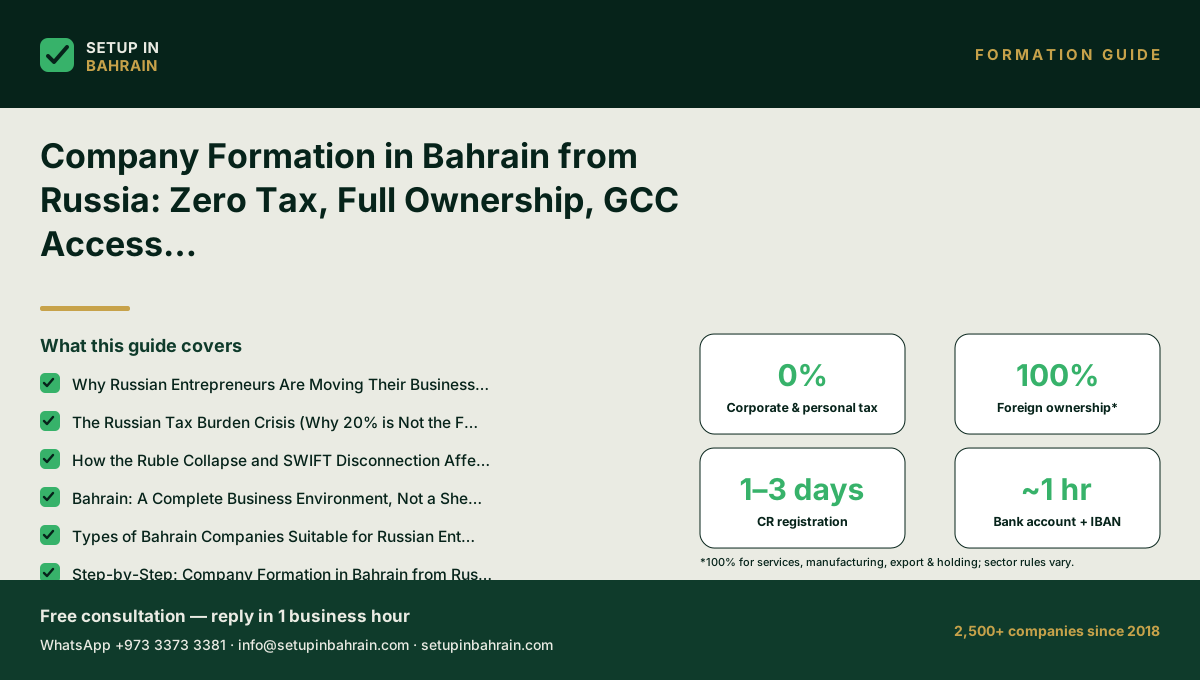
A Bahrain WLL can be owned by a single person — 100% foreign ownership applies to most activities, with no local partner required for services, manufacturing, export trading and holding companies. The minimum share capital is BHD 1; we recommend BHD 1,000, which makes bank account opening and investor visa approval smoother.
Dmitry had built a profitable software development agency in Moscow over eight years. Forty-two employees. Blue-chip clients across Europe. Revenue hitting 180 million rubles annually. Then came February 2022, and everything changed.
First, his Raiffeisen account froze outgoing SWIFT transfers for eleven days. Then his European clients couldn't pay him—their banks rejected transfers to Russian accounts entirely. His effective tax burden had already climbed to nearly 27% when you added the regional Moscow surcharge to the federal 20% corporate rate, plus all the ФНС compliance costs. But now he couldn't even receive the money he'd earned.
"I spent 340,000 rubles on lawyers in three months just trying to figure out how to legally receive payment for work we'd already completed," Dmitry told me. "Meanwhile, the ruble dropped from 75 to 120 against the dollar. My purchasing power evaporated while my tax obligations stayed the same—calculated on ruble amounts that meant nothing internationally."
Dmitry relocated his company structure to Bahrain in September 2023. Today, he generally pays no corporate income tax in most sectors. His clients wire USD directly to his Bahrain bank account. He invoices in dollars, pays his team through a proper international payroll system, and sleeps better knowing his business assets aren't subject to the next round of unexpected restrictions.
This guide exists because Dmitry's situation isn't unique. Thousands of Russian entrepreneurs face identical pressures—punishing domestic tax rates, currency instability, payment infrastructure collapse, and growing isolation from global markets. Bahrain offers a legitimate, tax-efficient, and operationally practical solution.
Why Russian Entrepreneurs Are Moving Their Business to Bahrain
The exodus isn't happening because Russian entrepreneurs suddenly discovered lower tax rates exist elsewhere. That's always been true. The migration is happening because the combination of tax burden, currency collapse, payment blockages, and regulatory pressure has made it functionally impossible to run an international business from Russia.
Take the case of Sergei, who ran a B2B software firm in Saint Petersburg. In 2023 his effective tax load hit 23.4% after the 20% federal corporate rate plus Leningrad region surcharge, plus another 30% in social contributions on payroll. When SWIFT access for his main bank was restricted, he lost three USD contracts worth $180,000 because clients could not wire funds. By mid-2024 he had moved the operating company to Bahrain while keeping a small Russian representative office for local clients.
The core pressures driving Russian entrepreneurs to Bahrain break down into four categories:
| Pressure | Russia Reality | Bahrain Solution |
| Corporate tax | 20% federal + regional surcharges (0-2%) | generally no corporate income tax for most sectors (no time limit, no cap) |
| Currency risk | Ruble down ~37% since 2022, volatile | Bahraini Dinar pegged to USD (stable) |
| Regulatory burden | Mandatory РСБУ filings, FNS scrutiny, complex VAT | Simplified compliance, transparent CBB oversight |
The Russian Tax Burden Crisis (Why 20% is Not the Full Story)
Let's be precise about what Russian entrepreneurs are actually paying.
The federal corporate profit tax rate is 20%. But that's just the headline number. Regional authorities can add their own surcharge of up to 2% (many do, especially in Moscow and Saint Petersburg). So the base rate quickly becomes 22% or higher.
Then you add:
- Social contributions: 30% on payroll for most employees (22% pension, 5.1% medical, 2.9% social insurance)
- Property tax: Up to 2.2% on fixed assets
- VAT: 20% on most goods and services (with complex reclaim rules for exporters)
- Dividend tax: 15% when distributing profits to foreign shareholders
And all of this is calculated in rubles—a currency that has lost nearly 40% of its purchasing power against the dollar since early 2022.
I received a call last month from Dmitry, a Moscow-based software exporter who had just received his tax bill for 2024. Twenty percent federal corporate tax. Then the regional surcharge for Moscow Oblast. Then the social contributions. Then the VAT reclaim nightmare. Then the letter from his bank: "We can no longer process USD payments to your UAE supplier."
He was paying 34% of his revenue to the Russian system in one form or another. His company had been blocked from receiving EUR payments for three months. His accountant spent 40 hours a month wrestling with FNS reporting in mandatory Russian-language РСБУ format. And now, his bank had just informed him that his USD account would be converted to rubles within 30 days.
For a business that earned 70% of its revenue from international clients, this was existential.
The question becomes: Why pay Russian corporate tax at all if your business is international? If your clients aren't in Russia, your revenue isn't in rubles, and your growth depends on global markets—what economic rationale exists for maintaining a Russian tax residency?
This is not about evading taxes. It's about aligning your tax residency with your actual business operations.
How the Ruble Collapse and SWIFT Disconnection Affect Your Business
Let's get specific about the numbers.
In January 2022, one US dollar bought approximately 75 Russian rubles. By March 2022, after the first wave of sanctions, the rate touched 150 before stabilizing. As of late 2025, the rate hovers around 90-100 RUB/USD.
But here's what the exchange rate doesn't capture: the operational cost.
If you invoice a German client for €50,000 in January, and the ruble drops 15% by the time payment clears in March, you've lost €7,500 in purchasing power for work you already completed. You can't hedge effectively from within Russia because currency controls limit your access to foreign exchange markets.
And that's assuming payment arrives at all.
Since March 2022, the SWIFT disconnection has created a cascading series of problems:
First, Russian banks connected to SWIFT (those not sanctioned) face intense scrutiny from correspondent banks. Transfers to Russia are delayed, rejected, or held for compliance review. The average processing time for a USD transfer to Russia went from 1-2 days to 7-14 days—if it clears at all.
Second, European and US banks have internal policies that go beyond legal requirements. Many simply refuse to process any transfer involving Russian entities, even if those entities aren't sanctioned. This is risk avoidance, not legal compliance.
Third, alternative payment channels (crypto, stablecoins, third-party processors) exist but introduce their own compliance, liquidity, and regulatory risks. The Russian Central Bank has repeatedly warned against using unregulated payment methods.
Pavel, founder of a successful SaaS company in Ekaterinburg, told me: "In 2021, 80% of my MRR came from clients abroad—mainly Western Europe and the Middle East, all paid in USD or EUR. Things changed overnight: Sanctions. SWIFT restrictions. Suddenly, DCB bank in Moscow froze inbound USD wires from Ireland for 'compliance review.' I tried third-party wallets like TransferWise and Payoneer, but new KYC blocks followed. I lost a $45,000 contract because my French client's bank simply refused to wire to Russia. That's when I started looking at Bahrain."
The solution isn't finding another payment processor inside Russia. The solution is moving the receiving entity to a jurisdiction where payment infrastructure works normally.
Bahrain: A Complete Business Environment, Not a Shell Jurisdiction
I want to be clear about what Bahrain offers because there's a lot of misinformation in the market.
Bahrain is not a zero-filing, zero-presence "offshore" jurisdiction. You can't register a company, disappear, and expect everything to work. The Central Bank of Bahrain (CBB) and the Ministry of Industry and Commerce (MOIC) require substance—a physical presence, active operations, proper accounting.
What Bahrain offers instead is far more valuable:
| Feature | What It Means for You |
| generally no corporate income tax for most sectors | No time limit, no cap. Not a holiday that expires. |
| 100% foreign ownership | No local sponsor required in most sectors |
| USD-pegged currency | Bahraini Dinar pegged at 0.376 BHD/USD (stable since 2001) |
| Full international banking | SWIFT-enabled accounts, USD/EUR/GBP multi-currency |
| GCC market access | No tariffs, free movement of goods/services within GCC |
| Simplified compliance | Annual audited financials, no monthly VAT (0% VAT rate on most exports) |
| OECD/EU compliant | Not on any blacklist. Recognized as cooperative jurisdiction. |
For Russian entrepreneurs specifically, Bahrain offers something no other jurisdiction does: full integration with the global financial system without the compliance burden of UAE or Singapore.
Types of Bahrain Companies Suitable for Russian Entrepreneurs
There are three company structures that matter for Russian founders:
1. Bahrain SPV (Single Purpose Vehicle) — W.L.L. (With Limited Liability)
Best for: Tech startups, consulting, software development, professional services. Minimum share capital: BHD 20,000 (~$53,000) for most W.L.L. structures. Ownership: 100% foreign ownership allowed. Licensing: Must obtain a Commercial Registration (CR) from MOIC. Substance: Need physical office space (can be serviced/flexible office).
This is Dmitry's structure and the most common for Russian entrepreneurs. It allows full operational control, direct invoicing, and access to Bahrain's banking system.
2. Bahrain S.P.C. (Single Person Company)
Best for: Solo founders, individual consultants, freelancers transitioning to international structure. Minimum share capital: BHD 20,000 (~$53,000). Ownership: Single shareholder, 100% foreign allowed. Management: One director required (can be the shareholder). Flexibility: Can convert to W.L.L. later.
3. Exempt Company
Best for: Holding structures, IP ownership, investment vehicles. Minimum share capital: Typically higher (BHD 1 (we recommend BHD 1,000)). Restrictions: Cannot conduct business within Bahrain's domestic market. Use case: Hold your intellectual property, patents, or investment portfolio in a zero-tax jurisdiction without local market restrictions.
Step-by-Step: Company Formation in Bahrain from Russia
Here's the practical process, based on what Dmitry, Sergei, and Pavel actually did:
Step 1: Initial Consultation and Business Case (Week 1-2)
Before you spend anything, you need clarity on:
- What exactly will the Bahrain entity do? (Operations, holding, IP, or all three)
- Where are your clients located? (GCC, Europe, US, other)
- What's your current revenue and projected growth?
- Will you need Bahrain residency for yourself?
The EDB can provide free initial consultations. Alternatively, work with a licensed corporate service provider (CSP) registered with MOIC.
Step 2: Company Name Reservation and Legal Structure Selection (Week 2-3)
Choose a unique company name. File a name reservation application with MOIC. Simultaneously, decide on W.L.L., S.P.C., or Exempt Company structure.
MOIC typically processes name reservations within 3-5 business days.
Step 3: Prepare and Notarize Foundational Documents (Week 3-5)
This is where Russian entrepreneurs need to pay close attention.
You'll need:
- Memorandum of Association (MOA) — drafted in English and Arabic
- Board resolution (or sole owner resolution) approving Bahrain company formation
- Proof of registered office address in Bahrain
- Shareholder and director identification — certified copies of passports, proof of address
- Bank reference letter from your current bank (if possible)
Critical for Russian founders: Documents that are in Russian must be translated into English by a certified translator, then notarized, then attested by the Russian Ministry of Justice and the Bahrain Embassy in Moscow (or a designated attestation service). Budget 2-3 weeks and approximately 50,000-80,000 rubles for this process.
Step 4: Submit to MOIC and Obtain CR (Week 5-7)
Submit all documents to the Ministry of Industry and Commerce. MOIC reviews for completeness, compliance, and substance. Expected turnaround: 10-15 business days for initial review.
Once approved, you receive your Commercial Registration (CR) number. This is your company's legal identity in Bahrain.
Step 5: Open a Corporate Bank Account (Week 6-10)
This is the most complex step for Russian nationals. Bahrain banks (such as Ahli United Bank, National Bank of Bahrain, or HSBC Bahrain) require:
- Original CR certificate
- MOA and company documents
- Passport copies of all shareholders and directors
- Bank reference letters (from your Russian bank, if possible)
- Proof of address (utility bill, bank statement)
- Business plan and projected cash flows
- Source of funds documentation
Practical note: Banks have become more cautious with Russian passport holders. Working with a registered CSP who has existing banking relationships significantly improves approval rates.
Step 6: Secure Physical Presence (Week 8-12)
You need a registered office address. Options include:
- Serviced office: BH 200-500/month (flexible, includes meeting rooms)
- Dedicated office: BH 500-2,000/month (depending on location and size)
- Virtual office: BH 50-150/month (less suitable for substance requirements)
Bahrain's EDB offers co-working spaces in partnership with Tenmou (Bahrain's startup incubator) and other providers.
Step 7: Apply for Business Licenses and Permits (Week 8-12)
Depending on your activity, you may need additional licenses:
- Professional license for consulting, tech, or services
- Trade license for import/export activities
- Central Bank of Bahrain (CBB) approval for financial services
MOIC typically coordinates this process; expect 2-4 weeks.
Step 8: Set Up Accounting and Compliance (Month 3)
Bahrain requires annual audited financial statements. For W.L.L. companies, the audit must be conducted by a Bahrain-licensed auditor. Monthly VAT returns may apply (standard VAT rate is 10%, but 0% for exports).
Engage a local accounting firm (many service Russian-speaking clients). Budget approximately BH 2,000-5,000 annually for full compliance.
Banking Solutions: Opening Accounts for Russian Nationals
Let's be honest about the challenge. Not every bank in Bahrain will readily open accounts for Russian passport holders. But several have built specific capabilities:
| Bank | Russian-Friendly? | Notes |
| Ahli United Bank | Yes | Established relationships with CSPs |
| National Bank of Bahrain | Moderate | Requires strong reference/recommendation |
| HSBC Bahrain | Yes | Premium banking, higher minimum balances |
| Bank ABC (Arab Banking Corporation) | Moderate | More rigorous KYC |
| Al Salam Bank | Moderate | Growing Russian client base |
- Source of funds documentation (tax returns, contracts, invoices)
- Business purpose (legitimate international trade/services)
- Physical presence (meetings conducted in Bahrain)
- No sanctions exposure (direct or indirect)
What to avoid: Don't attempt to transfer large sums from Russia without proper documentation. Banks will freeze accounts pending source-of-funds verification, which can take weeks.
Taxation in Bahrain: What Russian Entrepreneurs Actually Pay
This is the headline benefit, and it's worth understanding precisely.
Corporate income tax: 0%. No time limit. No cap. No minimum. This is not a tax holiday; it's permanent legislation.
Withholding tax: 0% on dividends, interest, royalties paid to non-residents.
VAT: 10% standard rate, but 0% on exports of goods and services. If your Bahrain company services non-Bahrain clients, VAT is effectively zero.
Social contributions: None for expatriate employees (only Bahraini nationals require GOSI contributions).
Property tax: None on commercial property rental income.
What you do pay:
- Annual CR renewal fee: BH 180 (~$480)
- Audit and compliance costs: BH 2,000-5,000
- Office rent: BH 2,400-24,000/year depending on type
- Bank charges: BH 300-1,000/year depending on transactions
Total annual overhead for a fully compliant Bahrain company: approximately $7,000-$15,000, depending on office and compliance choices.
Compare this to Russia, where Dmitry was paying approximately 15 million rubles in total taxes plus 4 million rubles in compliance costs—before currency losses.
Living and Working in Bahrain: The Residency Pathway
Most Russian entrepreneurs who form a company in Bahrain also want residency. The primary pathway is the Bahrain Work Visa (Flexi Permit) or the Investor Visa.
Work Visa Pathway
- Sponsor: Your own Bahrain company
- Valid for 2 years, renewable
- Allows you to live and work in Bahrain full-time
- Processing time: 4-8 weeks
- Cost: Approximately BH 1,500-2,500
Investor Visa (Business Visitor Visa)
- For entrepreneurs who want flexible residency
- Valid for 1 year, renewable
- Allows 180+ days in Bahrain per year
- Lower cost but less stability
Bahrain's Golden Residency Visa was introduced in 2024 for high-net-worth individuals meeting specific criteria (minimum real estate investment of BH 200,000, or BH 50,000 annual income). However, this is primarily for property investors rather than business owners.
Cost of living in Bahrain:
- One-bedroom apartment in Manama: BH 250-500/month
- International school fees: BH 4,000-8,000/year
- Utilities (electricity, water, internet): BH 80-150/month
- Healthcare (mandatory health insurance): BH 200-500/year
Bahrain offers a high quality of life at roughly 30-40% lower cost than Dubai. The community is English-speaking, there are numerous Russian-speaking professionals through expat networks, and the culture is liberal compared to other GCC states.
Comparison: Bahrain vs UAE vs Other Jurisdictions
| Criterion | Bahrain | UAE (Dubai) | Singapore | Cyprus |
| Corporate tax | 0% | 9% (above AED 375K profit) | 17% | 12.5% |
| Foreign ownership | 100% | 100% (free zones) | 100% | 100% |
| Minimum capital | BH 20K ($53K) | AED 50K ($13.6K) | SGD 1 ($0.75) | €0 |
| Banking for Russians | Moderate | Moderate-Difficult | Difficult | Moderate |
| Residency pathway | Work visa | Investor visa | EP/EntrePass | Cyprus investor |
| Substance cost (annual) | $7-15K | $10-20K | $15-25K | $8-15K |
| Currency stability | USD-pegged (BHD) | USD-pegged (AED) | SGD (floating) | EUR (floating) |
| OECD compliance | Compliant | Compliant | Compliant | Compliant (some scrutiny) |
| GCC market access | Full | Full | None | None (EU) |
Common Pitfalls for Russian Entrepreneurs (And How to Avoid Them)
Mistake 1: Assuming "Zero Tax" Means "No Compliance"
This is the biggest error. Bahrain requires annual audited financials, proper bookkeeping, and CR renewal. Failure to comply results in fines, license suspension, or worse.Fix: Engage a local accounting firm from day one. Budget for annual compliance.
Mistake 2: Trying to Transfer Large Sums Without Documentation
Multiple Russian entrepreneurs have had accounts frozen for "source of funds" inquiries after transferring $100K+ with only a vague explanation.Fix: Maintain documentation for every wire: contracts, invoices, bank statements, tax returns. Use a CSP or bank with Russian-language support.
Mistake 3: Ignoring Dual Residency Risks
Bahrain doesn't automatically change your Russian tax residency. If you spend more than 183 days in Russia, the Russian tax authorities may consider you tax-resident regardless of your Bahrain company.Fix: Obtain Bahrain residency (work permit or investor visa). Track your days spent in each country. Consult with a cross-border tax specialist.
Mistake 4: Using Bahrain as a Mailbox
Without physical office, employees, or operational substance, Bahrain authorities may deny CR renewal or audit approval.Fix: Secure a genuine office (serviced or dedicated). At minimum, have a meeting room, registered address, and bank statements showing active business.
Case Study: How a Russian SaaS Founder Relocated to Bahrain
Let me share the full story of Dmitry from the introduction.
Dmitry's agency had 42 employees in Moscow. Revenue: 180 million rubles (~$2.4 million at the time). Eighty percent from European clients. He incorporated a Bahrain W.L.L. in September 2023.
Timeline:
- Month 1-2: Legal consultation, document preparation, MOIC submission
- Month 3: Bank account opening (Ahli United Bank)
- Month 4: Registered office (serviced, BH 400/month)
- Month 5: Transferred key contracts to Bahrain entity
- Month 6: Obtained Bahrain residency (work visa)
Financial outcome after 12 months:
- Revenue: $3.2 million (growth from easier international payments)
- Tax paid in Bahrain: $0
- Compliance cost: $8,500
- Total overhead for Bahrain entity: $14,200
- Remaining in Russia: Representative office for 5 local staff
What changed:
- Clients wire USD directly without delays
- Dmitry invoices in dollars, pays himself in dollars
- His Russian rep office handles only legacy Russian clients
- He sleeps better knowing his IP is held in Bahrain, not subject to potential seizure
Dmitry's advice to other Russian entrepreneurs: "Don't wait until you lose another contract. The process takes two to three months. Start it now, even if you're not sure you'll fully relocate. A Bahrain company gives you options—options you don't have in Russia."
Frequently Asked Questions (FAQs)
Can I form a company in Bahrain without visiting? Yes. Most CSPs handle the entire process remotely. However, you'll need to visit for bank account opening (usually in person for initial accounts). Some banks now accept video verification for Russian nationals, but in-person visit is safer.
How long does the entire process take? Approximately 8-12 weeks for company formation, bank account opening, and residency application. Faster (6-8 weeks) if you use an established CSP with banking relationships.
What is the minimum investment required? For a W.L.L. company: BHD 20,000 (~$53,000) declared share capital (not necessarily paid in full immediately, but declared). Plus legal, registration, and office costs: approximately $10,000-15,000.
Do I need a local partner? No. Bahrain allows 100% foreign ownership in most sectors. Certain regulated industries (financial services, some retail) may require local sponsorship, but tech, consulting, and professional services do not.
Will the Russian tax authorities pursue me? They can, if you remain Russian tax resident. The key is proper exit: formal resignation from Russian tax residency, minimal days in Russia, no active management from Russia. Consult with a Russian tax attorney before moving.
Is Bahrain safe for Russian nationals? Yes. Bahrain has diplomatic relations with Russia, no freezing of assets or restrictions on Russian nationals, and a significant expat community including Russians. There's no "capital controls" on foreign investment.
Can I use crypto and stablecoins in Bahrain? Bahrain's Central Bank (CBB) has a progressive stance on digital assets. Crypto businesses require CBB licensing, but individuals can hold and transact in crypto. However, for mainstream banking, expect traditional fiat currency accounts.
What happens to my existing Russian company? You don't need to liquidate it immediately. Many entrepreneurs maintain a small Russian company for local clients while moving international operations to Bahrain. This is lawful as long as both entities are properly managed and taxed.
How does Bahrain handle double taxation? Bahrain doesn't have a double taxation treaty with Russia (as of 2025 negotiations are ongoing but not finalized). However, given Bahrain's 0% tax, there's no double tax to apply. The Russian entity pays Russian tax on Russian-source income; the Bahrain entity pays 0% on Bahrain-source income. The key is proper transfer pricing.
Final Thoughts: Is Bahrain Right for Your Russian Business?
Bahrain is not for everyone. If your entire business is domestic within Russia, there's no benefit to Bahrain incorporation. If you're trying to avoid legitimate Russian tax on Russian operations, that's tax evasion, not tax optimization.
Bahrain is right for you if:
- You earn significant revenue from outside Russia
- You want to protect your assets from currency risk and regulatory unpredictability
- You need reliable international banking and payment infrastructure
- You're willing to invest in proper compliance and substance
- You see long-term potential in GCC and international markets
Bahrain is wrong for you if:
- Your business is 100% domestic in Russia
- You're not ready for the minimum $10K-15K annual overhead
- You can't maintain physical presence in Bahrain
- You're looking for a zero-filing, zero-compliance "offshore"
Dmitry, Sergei, and Pavel made their moves. They're paying Generally no corporate income tax for most sectors, receiving payments normally, and building their businesses without the Russian tax and regulatory anchor. Their advice is consistent: don't wait.
The process takes three months. Your next contract could be lost in three weeks.
How to Get Started
Step 1: Determine your business structure and revenue profile. Step 2: Consult with a licensed Bahrain CSP (I can recommend several who speak Russian). Step 3: Prepare your documentation (passports, articles, bank references). Step 4: Submit to MOIC and open your bank account. Step 5: Secure your office and residency. Step 6: Transfer your international contracts to the new entity.
The cost of inaction is higher than the cost of action. Every month you wait is another month of currency risk, payment blockages, and missed opportunities.
Ready to explore whether Bahrain works for your specific situation? The CBB and EDB websites provide official guidance. For personalized advice tailored to your business type and revenue profile, work with a CSP who has experience with Russian clients.
Your business deserves a home that doesn't punish you for success. Bahrain offers exactly that.
Bahrain Business Guides for Russia Citizens
Ready to set up in Bahrain from Russia?
Tell us your business idea. We map the right entity, ownership and timeline — then handle the filing while you focus on what matters.