
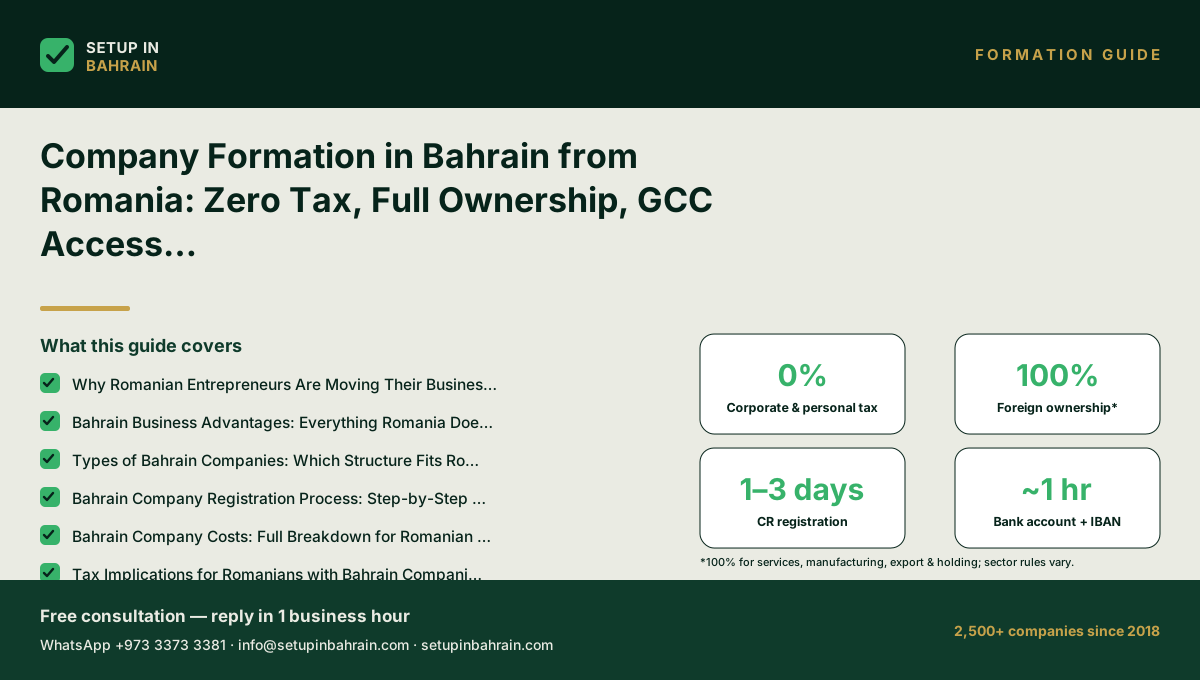
Register your Bahrain company from Romania with generally no corporate income tax for most sectors. Expert guidance for Romanian entrepreneurs seeking tax-efficient business setup in Bahrain.
Key Takeaways
- Why Romanian Entrepreneurs Are Moving Their Business to Bahrain
- Bahrain Business Advantages: Everything Romania Doesn't Offer
- Types of Bahrain Companies: Which Structure Fits Romanian Entrepreneurs
- Bahrain Company Registration Process: Step-by-Step for Romanian Citizens
- Bahrain Company Costs: Full Breakdown for Romanian Business Owners
→ Complete guide: Company Formation in Bahrain — the full 2026 guide
View details
Ownership & capital
A Bahrain WLL can be owned by a single person — 100% foreign ownership applies to most activities, with no local partner required for services, manufacturing, export trading and holding companies. The minimum share capital is BHD 1 ; we recommend BHD 1,000 . This Makes bank account opening and investor visa approval smoother.
Last month, I spoke with Andrei, a software development agency owner from Cluj-Napoca who had just received his quarterly ANAF statement. Between his 16% corporate tax, the mandatory CAS and CASS contributions, the endless D112 declarations, and the newly implemented e-Factura requirements, he calculated that nearly 47% of his gross revenue disappeared before he could reinvest a single leu into his business.
"I'm competing against developers in Dubai and Singapore who keep almost everything they earn," he told me over coffee in the city center. "Meanwhile, I'm spending three days every month just dealing with Romanian bureaucracy instead of writing code for clients who actually pay me."
Andrei's frustration isn't unique. Across București, Timișoara, Iași, and Brașov, thousands of Romanian entrepreneurs—especially those in IT, consulting, e-commerce, and export services—are discovering that their home country's tax framework actively punishes growth rather than rewarding it. And many are finding an unexpected solution just six hours away by plane: the Kingdom of Bahrain.
This guide is specifically written for Romanian business owners who are tired of watching their profits evaporate into a system that seems designed to complicate rather than help business success. What follows is everything you need to know about establishing a Bahrain company while maintaining compliance with Romanian regulations—no generic offshore advice, no recycled tax haven propaganda, just practical steps from someone who understands exactly what you're dealing with back home in Romania.
Why Romanian Entrepreneurs Are Moving Their Business to Bahrain
The Romanian business spirit is genuinely remarkable. Despite bureaucratic obstacles that would make most Western European business owners abandon ship entirely, Romanian founders have built successful companies across technology, manufacturing, agricultural exports, and professional services. But there's a growing realization spreading through business communities from the capital to Transylvania: working harder simply won't overcome a system that takes nearly half your earnings before you can grow.
The Real Tax Picture in Romania (Beyond the Headlines)
Romania's corporate tax sounds straightforward at first glance: 16% if you're a standard company, 1–3% if you qualify as a micro-enterprise. But that headline figure obscures a much more painful reality that every Romanian entrepreneur knows intimately.
Let me break down what actually happens to a typical Romanian IT consultancy earning €400,000 annually:
The Micro-Enterprise Trap: Starting January 2024, the micro-enterprise regime underwent significant changes. The turnover threshold sits at €500,000, but the moment you exceed it—or employ staff in ways that trigger different classifications—you're pushed into the standard corporate tax bracket with little warning. The 1% rate only applies if you have at least one employee; otherwise, you're looking at 3% on total turnover regardless of actual profitability.
Mandatory Social Contributions: Here's where Romanian taxation becomes genuinely brutal. As a director or shareholder extracting any income, you face:
- 25% CAS (pension contribution) on declared salary
- 10% CASS (health insurance contribution) on dividends and salary
- 8% dividend tax on distributed profits
The Hidden Compliance Costs: ANAF's electronic filing system—including the dreaded e-Factura and S.A.F.T. requirements—is repeatedly cited by the World Bank as one of the most time-consuming and error-prone in the European Union. The average Romanian SME owner spends 163 hours annually on tax compliance alone, according to PwC's Paying Taxes 2024 report. That's over four full working weeks lost to paperwork instead of business development.
For Andrei's Cluj agency with €480,000 in revenue and €320,000 in actual profit, the breakdown looked like this:
| Tax/Contribution | Amount (€) | Percentage |
| Corporate Tax (16%) | 51,200 | 16.0% |
| CAS on Director Salary | 15,000 | 4.7% |
| CASS on Salary + Dividends | 12,800 | 4.0% |
| Dividend Tax (8%) | 19,200 | 6.0% |
| Accountant Fees | 4,800 | 1.5% |
| Total Effective Burden | 103,000 | 32.2% |
The RON Currency Problem Nobody Discusses
Romanian entrepreneurs earning in EUR or USD face an additional challenge that domestic-focused businesses don't fully appreciate: currency volatility. The Romanian Leu has experienced fluctuations of 3-7% annually against major currencies over the past decade. For a software company billing €500,000 to international clients, even a 4% adverse movement represents €20,000 in potential losses—money that simply evaporates due to exchange rate timing.
Bahrain's currency, the Bahraini Dinar (BHD), has been pegged to the US Dollar at a fixed rate of 1 BHD = 2.659 USD since 1980. This isn't a soft peg that central banks occasionally adjust; it's backed by substantial foreign reserves managed by the Central Bank of Bahrain (CBB) and has remained stable through multiple global financial crises. For Romanian entrepreneurs billing international clients in USD or EUR, this stability eliminates an entire category of business risk.
Limited Market Access from Romania
Romania's position within the EU provides certain advantages for intra-European trade. It creates significant barriers for accessing high-growth markets in the Middle East, Africa, and Asia. The Gulf Cooperation Council (GCC) represents a $2 trillion combined economy growing at 4-6% annually—greatly faster than the EU average of 1-2%.
Bahrain sits at the geographic and commercial heart of this market. The 25-kilometer King Fahd Causeway connects Bahrain directly to Saudi Arabia, the largest economy in the Middle East. Bahrain maintains free trade agreements with the United States, Singapore. Preferential access arrangements throughout the GCC that simply aren't available to Romanian-registered companies.
Bahrain Business Advantages: Everything Romania Doesn't Offer
When I explain Bahrain's business environment to Romanian entrepreneurs, they often assume I'm exaggerating or omitting hidden costs. I'm not. The contrast with Romania is genuinely that stark.
Zero Percent Corporate Tax (Actually Zero)
Bahrain imposes 0% corporate income tax on all businesses except oil and gas companies. This isn't a temporary incentive, a special economic zone benefit, or a regime with sunset clauses—it's the standard tax treatment for every commercial entity operating in the kingdom.
There's no turnover threshold that triggers higher rates. No micro-enterprise versus standard company classifications. No surprise legislative changes every January that restructure your entire tax position. A software company earning BHD 500,000 in profit pays exactly the same tax rate as a startup earning BHD 50,000: zero.
The only exception involves hydrocarbon extraction, where a 46% tax applies to oil and gas production companies. Unless you're planning to drill for petroleum, this doesn't affect you.
One Hundred Percent Foreign Ownership
Until relatively recently, establishing a business in most GCC countries required a local sponsor or partner who would hold majority ownership of your company—regardless of who actually built the business, brought the clients, or did the work.
Bahrain eliminated this requirement entirely. As a Romanian citizen, you can own 100% of your Bahrain company across virtually all business activities. The Ministry of Industry and Commerce (MOIC) explicitly permits full foreign ownership for:
- IT services and software development
- Consulting and professional services
- E-commerce and digital businesses
- Import/export trading
- Manufacturing and light industry
- Marketing and creative agencies
- Educational services and training
A limited number of activities—primarily those involving national security, certain healthcare services. Specific real estate categories—still require Bahraini partnership. But for the vast majority of service businesses that Romanian entrepreneurs operate, full ownership is standard.
Stable Currency Pegged to USD
I mentioned this earlier, but it bears repeating because currency stability is something Romanian entrepreneurs rarely experience. The Bahraini Dinar's peg to the US Dollar at 1 BHD = 2.659 USD has held firm since 1980. The Central Bank of Bahrain maintains foreign currency reserves exceeding 140% of the monetary base, providing genuine backing for this peg rather than just stated policy intentions.
For context: Romania's foreign reserves cover about 5-6 months of imports. Bahrain's reserve position is among the strongest in the world relative to economic size.
What does this mean practically? When you invoice a client in USD and receive payment into your Bahrain business account, you know exactly what that money is worth today and what it will be worth next month. The mental overhead of currency hedging, timing conversions. Hoping the RON doesn't move against you simply disappears.
World-Class Banking Infrastructure
Romania's banking sector has improved greatly over the past decade. Opening business accounts for internationally-oriented companies remains challenging. Several Romanian entrepreneurs have told me stories of banks rejecting applications for accounts simply because their client base was primarily foreign, or requiring months of documents to process straightforward requests.
Bahrain hosts the regional headquarters of over 400 financial institutions, including major international banks like HSBC, Citibank, Standard Chartered. BNP Paribas. The Central Bank of Bahrain (CBB) has developed a regulatory framework specifically designed to help international business banking while maintaining strong AML/KYC standards.
Opening a business account for a properly formed Bahrain company typically takes 2-4 weeks with complete documents. Multi-currency accounts are standard. International wire transfers process same-day or next-day. And critically, banks are accustomed to working with foreign-owned companies serving international client bases—it's the norm rather than the exception.
Strategic Geographic Position
Bahrain's location provides practical advantages that aren't immediately obvious from a map:
Time Zone: GMT+3 allows comfortable overlap with European business hours (your morning) and Asian markets (your afternoon). Romanian entrepreneurs can conduct meetings with London at 10 AM local time and Singapore at 4 PM local time on the same day.
Flight Connectivity: Bahrain International Airport offers direct connections to most major global business destinations. London is about 6.5 hours. Singapore is 8 hours; Dubai is a 45-minute hop across the Gulf.
Regional Access: The GCC countries (Saudi Arabia, UAE, Kuwait, Qatar, Oman) represent a combined market of over 60 million people with GDP per capita among the highest globally. Bahrain's position and trade agreements provide preferential access to this entire bloc.
Types of Bahrain Companies: Which Structure Fits Romanian Entrepreneurs
Bahrain offers several business structures, each suited to different operational models. For most Romanian entrepreneurs, three options deserve serious consideration.
WLL (With Limited Liability) Company
The WLL structure is Bahrain's equivalent of a private limited company and represents the most common choice for foreign entrepreneurs establishing substantive operations.
Key Characteristics:
- a single shareholder (one person can own 100%) required (can be individuals or corporate entities)
- Minimum capital requirement of BHD 1 (we recommend BHD 1,000) (about €123,000) for foreign-owned companies
- Full limited liability protection for shareholders
- Can employ staff, lease premises, and conduct all normal business activities
- Requires at least one director who need not be Bahraini
Best For: Romanian entrepreneurs planning to build a genuine operational presence in Bahrain—hiring local staff, leasing office space. Serving regional clients directly.
Capital Consideration: The BHD 1 minimum capital (we recommend BHD 1,000) sounds substantial. It doesn't need to be fully paid up front. Bahrain allows partial payment of share capital, with the remainder payable over time as the business develops. Also, this capital remains in the business and can be used for operational purposes—it's not a government fee or sunk cost.
single-shareholder WLL
Introduced to provide flexibility for solo entrepreneurs, the WLL allows one individual to establish a limited liability company without requiring additional shareholders.
Key Characteristics:
- Single shareholder permitted
- Minimum capital of BHD 1 (we recommend BHD 1,000) for foreign owners
- Full limited liability protection
- Shareholder serves as both owner and director
- Simpler governance requirements than WLL
Best For: Romanian consultants, freelance developers. Individual service providers who want corporate structure without the complexity of multiple-shareholder governance.
Branch Office
A branch office represents an extension of your existing Romanian company rather than a separate Bahrain entity.
Key Characteristics:
- No separate share capital required
- Parent company bears full liability for branch activities
- Activities must fall within scope of parent company's business
- Requires local representative
- Profits flow back to parent company
Best For: Romanian companies wanting to test the Bahrain market or establish a commercial presence while maintaining their primary corporate structure in Romania. Note that branch profits ultimately become subject to Romanian taxation when repatriated, limiting the tax efficiency compared to establishing an independent Bahrain entity.
Comparison Table: Bahrain Company Structures for Romanian Entrepreneurs
| Feature | WLL | WLL | Branch Office |
| Minimum Shareholders | 2 | 1 | N/A (extension of parent) |
| Minimum Capital (Foreign) | BHD 1 (we recommend BHD 1,000) | BHD 1 (we recommend BHD 1,000) | None |
| Limited Liability | Yes | Yes | Parent company liable |
| Tax Treatment | 0% Bahrain tax | 0% Bahrain tax | 0% local, but profits taxed in Romania |
| Setup Complexity | Medium | Low-Medium | Medium |
| Annual Compliance | Moderate | Low | Low-Moderate |
| Best Application | Operational presence | Solo practitioners | Market testing |
Bahrain Company Registration Process: Step-by-Step for Romanian Citizens
The actual process of forming a Bahrain company from Romania involves several distinct phases. What follows is the practical sequence rather than the theoretical overview you'll find on government websites.
Phase 1: Pre-Application Planning (1-2 Weeks)
Before submitting any applications, you need to resolve several foundational questions:
Company Name Reservation: Bahrain requires unique company names that don't conflict with existing registrations or protected terms. You can search the MOIC database online and reserve your preferred name as part of the application process. Names must include appropriate suffixes (WLL, WLL, etc.) and cannot imply government affiliation or use restricted terms without authorization.
Activity Selection: Bahrain uses a standardized Commercial Registration (CR) system with specific activity codes. You'll need to identify which activities your company will conduct and ensure they're permitted for 100% foreign ownership. For IT services, consulting, e-commerce, and most professional services, this is straightforward. For activities involving healthcare, education, or real estate, additional permits may be required.
Registered Office: Every Bahrain company requires a physical registered address. This can be a leased office, a serviced office arrangement, or a registered agent address. Costs range from about BHD 200-500 monthly for basic virtual office services to BHD 1,000+ for dedicated office space in premium locations.
Document Preparation: As a Romanian citizen, you'll need to prepare several documents for authentication:
- Passport copies (notarized)
- Proof of address (utility bills, bank statements)
- Bank reference letters
- CV/resume for directors
- For corporate shareholders: certificate of incorporation, memorandum of association, board resolution authorizing the investment
Phase 2: Document Authentication (1-2 Weeks)
Documents issued in Romania must be authenticated for use in Bahrain. Romania is party to the Hague Apostille Convention, which simplifies this process considerably.
Steps:
- Get original or certified copies of required documents
- Have documents notarized by a Romanian notary public (notar public)
- Get apostille from the Romanian Ministry of Justice or designated courts
- Translate documents into Arabic by a certified translator
- Some documents may require additional authentication by the Bahrain Embassy in Bucharest
Cost Estimate: Notarization, apostille, and translation typically costs €300-600 depending on document volume and translation requirements.
Time-Saving Tip: Begin this process while finalizing your business plan and company structure decisions. Document authentication represents the longest bureaucratic delay in the formation process, and starting early prevents bottlenecks.
Phase 3: Bahrain Economic Development Board Engagement (Optional but Recommended)
The Bahrain Economic Development Board (EDB) serves as the kingdom's investment promotion agency and offers substantial support for foreign entrepreneurs establishing businesses. Unlike similar agencies in many countries that exist primarily for PR purposes, the EDB provides genuinely useful services:
Investor Services:
- Guidance on optimal company structure
- Facilitation of government agency approvals
- Introduction to banking partners
- Visa and immigration support
- Ongoing business support after setup
Why This Matters for Romanians: EDB staff understand that entrepreneurs from EU countries like Romania operate differently than those from neighboring GCC states. They can help navigate requirements that might not be intuitive for European business owners and often accelerate approval timelines through their relationships with regulatory agencies.
Engaging with the EDB is free and doesn't create any obligation. For Romanian entrepreneurs unfamiliar with Gulf business culture, this support can prevent costly mistakes during the setup process.
Phase 4: Application Submission to Sijilat (1-2 Weeks)
Bahrain's company registration system, Sijilat, operates as a centralized online platform managed by the Ministry of Industry and Commerce. The process is notably more efficient than ANAF's equivalent systems—most Romanian entrepreneurs find it refreshingly straightforward.
Application Components:
- Company formation application form
- Memorandum and Articles of Association
- Shareholder and director particulars
- Authenticated documents from Phase 2
- Proposed registered office address
- Activity code selections
- Application fees (about BHD 100-300 depending on structure)
Processing Timeline: Standard applications typically receive approval within 5-10 business days. Complex applications involving restricted activities or additional permits may take 2-4 weeks.
Pro Tip: The MOIC occasionally requests clarifications or additional documents during review. Designating a local representative or corporate service provider to receive these communications ensures prompt responses and prevents delays.
Phase 5: Post-Registration Formalities (2-3 Weeks)
Once your Commercial Registration (CR) certificate is issued, several additional steps complete the company setup:
GOSI Registration: Companies with employees must register with Bahrain's Social Insurance Organization within 14 days of commencing employment. This applies to both Bahraini and foreign employees.
Municipality Registration: Depending on your business location and activities, municipal licenses may be required.
Bank Account Opening: With your CR certificate, you can approach banks to open business accounts. Prepare:
- CR certificate and Memorandum of Association
- Passport copies of all shareholders and directors
- Proof of address for shareholders
- Business plan or description of intended activities
- Expected transaction volumes and source of funds information
Office Setup: If you've used a virtual office address for registration, you may need to establish physical premises for certain activities or visa applications.
Complete Timeline and Budget Summary
| Phase | Duration | Estimated Cost |
| Pre-Application Planning | 1-2 weeks | €500-1,500 (professional advice) |
| Document Authentication | 1-2 weeks | €300-600 |
| Application Submission | 1-2 weeks | €400-800 (fees + translation) |
| Post-Registration | 2-3 weeks | €1,000-3,000 (bank, office, licenses) |
| Total | 6-10 weeks | €2,200-5,900 |
Bahrain Company Costs: Full Breakdown for Romanian Business Owners
Understanding the complete cost structure helps Romanian entrepreneurs budget accurately and avoid surprises. I'll break this down into formation costs, annual maintenance, and operational expenses.
Formation Costs (One-Time)
| Expense Category | Budget Range (EUR) | Notes |
| Government registration fees | €250-400 | Varies by company type and activities |
| Document authentication | €300-600 | Notarization, apostille, translation |
| Memorandum drafting | €400-800 | Legal fees for constitutional documents |
| Registered office (first year) | €2,400-6,000 | Ranges from virtual to physical office |
| Bank account setup | €0-500 | Some banks charge setup fees |
| Corporate service provider | €800-2,000 | If using professional formation service |
| Total Formation | €4,150-10,300 | Depending on complexity and support level |
Annual Maintenance Costs
| Expense Category | Annual Cost (EUR) | Notes |
| Commercial Registration renewal | €200-400 | Annual renewal fee |
| Registered office | €2,400-6,000 | Ongoing rent/service charges |
| Accounting services | €1,500-4,000 | Greatly simpler than Romanian requirements |
| Audit (if required) | €2,000-5,000 | Required above certain thresholds |
| Corporate service provider | €1,000-2,500 | Ongoing compliance support |
| Bank fees | €300-600 | Account maintenance and transaction fees |
| Total Annual | €7,400-18,500 | Varies greatly by business size |
Cost Comparison: Bahrain WLL vs Romanian SRL
For a direct comparison, consider a software consultancy earning €300,000 annually with €200,000 in profit:
| Factor | Romanian SRL | Bahrain WLL |
| Corporate Tax | €32,000 (16%) | €0 |
| Dividend Tax | €13,440 (8% on distributed) | €0 |
| Social Contributions | €15,000 (estimated) | €0 for foreign owner |
| Accounting/Compliance | €5,000 | €3,000 |
| Office/Registered Address | €4,000 | €4,000 |
| Annual Total Cost | €69,440 | €7,000 |
| Net Savings | — | €62,440 |
Tax Implications for Romanians with Bahrain Companies
This section requires careful attention because it's where Romanian entrepreneurs most commonly make costly errors. The tax benefits of a Bahrain company are real, but accessing them legitimately requires proper structuring and compliance.
Understanding Tax Residency
Romania taxes its tax residents on worldwide income. If you remain Romanian tax resident while owning a Bahrain company, the company's profits may be attributed to you personally under Controlled Foreign Company (CFC) rules, or dividend distributions may be taxed in Romania regardless of where the company is registered.
Key Principle: To fully benefit from Bahrain's generally no corporate income tax for most sectors regime, you typically need to either:
- Relocate your personal tax residency to Bahrain or another suitable jurisdiction, OR
- Structure the Bahrain company such that it has genuine economic substance and its profits aren't simply attributed to your Romanian tax position
Romanian CFC Rules
Romania implemented CFC legislation aligned with EU Anti-Tax Avoidance Directives. Under these rules, if you (as a Romanian tax resident) control a foreign company in a low-tax jurisdiction, the undistributed profits of that company may be taxed in Romania as if they were your personal income.
CFC Applies When:
- Romanian residents hold more than 50% of the foreign entity
- The foreign company's effective tax rate is less than half the Romanian rate (i.e., less than 8%)
- More than 30% of the company's income derives from passive sources (dividends, interest, royalties, etc.)
Critical Exception: CFC rules don't apply if the foreign company carries on genuine economic activity supported by staff, equipment, assets. Premises proportionate to its income. A Bahrain company with real operations, actual employees. Legitimate business activities is not merely a "letterbox" entity subject to CFC attribution.
The Substance Solution
For Romanian entrepreneurs who maintain Romanian tax residency while operating a Bahrain company, the key is ensuring genuine economic substance in Bahrain:
Substance Indicators:
- Physical office presence (not just registered address)
- Employees or contractors based in Bahrain
- Management decisions made in Bahrain
- Board meetings held in Bahrain
- Banking and administrative activities conducted locally
Practical Application: If your Bahrain company employs a local operations manager, maintains an actual office, and conducts its core business activities from Bahrain, it's not a shell company for CFC purposes—it's a legitimate foreign subsidiary with real economic presence.
The Relocation Solution
The more straightforward approach involves relocating your personal tax residency to Bahrain. Bahrain imposes no personal income tax on residents, meaning:
- Salary you pay yourself from your Bahrain company: 0% tax
- Dividends you distribute to yourself: 0% tax
- Capital gains if you sell the company: 0% tax
Romanian Tax Residency Departure: Under Romanian law, you cease being Romanian tax resident when you:
- Establish domicile in another country, AND
- Spend fewer than 183 days in Romania during the calendar year
Notification Requirements: You should notify ANAF of your departure and change of tax residence. This isn't merely administrative—it protects you from Romania continuing to claim taxing rights over your worldwide income.
Practical Structuring for Romanian Entrepreneurs
Based on working with dozens of Romanian entrepreneurs, three common structures emerge:
Structure 1: Full Relocation You move to Bahrain, establish tax residency there, and operate your business locally. All income flows through the Bahrain company, and you pay no income tax anywhere.
Structure 2: Dual Presence with Substance You maintain some presence in Romania but establish a Bahrain company with genuine operations, local staff. Real economic activity. The Bahrain company's active business income is not CFC-attributed because it has substance. You pay Romanian tax only on income directly sourced from Romania.
Structure 3: Branch Office (Limited Tax Benefit) Your Romanian company opens a Bahrain branch for regional operations. Profits are taxed in Romania when repatriated. This provides market access but limited tax advantages.
Recommendation: Structure 1 provides maximum benefit for entrepreneurs able to relocate. Structure 2 works for those needing ongoing Romanian presence but should be implemented with professional tax advice to ensure CFC compliance.
Bahrain Golden Visa and Residency Options
Establishing a company in Bahrain opens pathways to legal residency. This In turn supports the tax planning structures discussed above.
Investor Residency Visa
Foreign investors establishing businesses in Bahrain qualify for investor residency visas tied to their company ownership.
Requirements:
- Valid Commercial Registration
- Investment meeting minimum thresholds (typically satisfied by company capital)
- Clear criminal background
- Medical examination
- Proof of accommodation in Bahrain
Benefits:
- Multi-year renewable residency
- Ability to sponsor dependent family members
- Path to permanent residency after qualifying period
- No requirement to be physically present continuously
Self-Sponsored Visa
Bahrain offers a self-sponsored visa category for individuals who can show independent financial means without traditional employment.
Requirements:
- Minimum monthly income of BHD 2,000 (about €4,900) from foreign sources
- Proof of accommodation
- Medical insurance coverage
- Background checks
Best For: Romanian entrepreneurs whose Bahrain company may take time to generate local revenue but who have existing income streams from international clients.
Permanent Residency Pathway
After maintaining legal residency for a qualifying period (typically 5+ years), foreign nationals may apply for Bahrain permanent residency. This Provides long-term stability and additional rights.
Comparison: Bahrain Residency vs UAE/Qatar
| Factor | Bahrain | UAE | Qatar |
| Investor Visa Availability | Yes | Yes | Limited |
| Minimum Investment | Lower | Higher | Higher |
| Processing Time | 2-4 weeks | 2-6 weeks | 4-8 weeks |
| Family Sponsorship | Yes | Yes | Yes |
| Physical Presence Requirement | Minimal | Varies by emirate | Moderate |
| Path to Permanent Residency | Yes | Introduced 2019 | Very limited |
| Renewal Complexity | Low | Moderate | Moderate |
Banking in Bahrain: Opening Accounts as a Romanian Business Owner
Bahrain's position as the Gulf's traditional financial center translates directly into practical banking advantages for foreign business owners.
Banking Landscape Overview
The Central Bank of Bahrain (CBB) supervises over 400 financial institutions, including:
- Major international banks (HSBC, Citibank, Standard Chartered, BNP Paribas)
- Regional Islamic banks (Al Baraka, Kuwait Finance House)
- Local commercial banks (Bank of Bahrain and Kuwait, National Bank of Bahrain)
- Specialized trade finance institutions
- Digital-first banks and payment processors
This diversity means you can select a banking partner suited to your specific needs—whether that's international wire transfer efficiency, Islamic finance compliance, or integration with specific payment platforms.
Account Opening Requirements
Banks in Bahrain maintain strong compliance standards aligned with international AML/KYC frameworks. For a newly formed company owned by Romanian nationals, expect to provide:
Corporate Documents:
- Commercial Registration certificate
- Memorandum and Articles of Association
- Board resolution authorizing account opening
- Company ownership structure chart
Personal Documents (for all shareholders and directors):
- Passport copies
- Proof of residential address (utility bills, bank statements)
- Bank reference letters from existing banks
- CV/professional background summary
Business Information:
- Description of business activities
- Anticipated transaction volumes (monthly inflows/outflows)
- Principal countries for transactions
- Major clients/suppliers (if known)
- Source of initial capital
Timeline and Tips
Realistic Timeline: 2-4 weeks for straightforward applications; 4-8 weeks if banks request additional documents or clarification.
Success Factors:
- Prepare comprehensive documents before applying
- Provide clear, detailed description of business model
- Be transparent about Romania connection and international nature of business
- Consider applying to 2-3 banks at once to compare offers and ensure backup options
Common Obstacles for Romanian Entrepreneurs:
- Insufficient explanation of business model (banks want to understand how you make money)
- Incomplete address documents (Romanian utility bills in Romanian may need certified translation)
- Missing bank references (if your Romanian bank won't provide references, this signals issues to Bahraini banks)
Multi-Currency and International Transfer Capabilities
Bahrain banks routinely offer multi-currency accounts supporting USD, EUR, GBP, and BHD. International wire transfers process efficiently—typically same-day for outgoing transfers and 1-2 days for incoming international payments.
Cost Comparison: Wire transfer fees typically range from BHD 5-15 (€12-37) for international transfers, compared to €15-45 at most Romanian banks for similar transactions. Monthly account maintenance fees average BHD 10-25 (€25-61).
Digital Banking Options
Bahrain has emerged as a fintech hub in the region, with the CBB operating a regulatory sandbox that has attracted numerous innovative financial technology companies. Romanian entrepreneurs comfortable with digital banking may find options like:
- Rain (cryptocurrency exchange with fiat integration)
- Tap Payments (payment processing)
- Various neo-banks operating under CBB supervision
These complement traditional banking relationships rather than replacing them for most business purposes.
How to Run a Bahrain Company Remotely from Romania
Many Romanian entrepreneurs initially operate their Bahrain companies remotely while testing the market or building toward eventual relocation. This is entirely feasible with proper planning.
Essential Remote Operations Infrastructure
Virtual Office Services: Bahrain offers numerous virtual office providers who can supply:
- Registered business address
- Mail handling and forwarding
- Local phone number with call forwarding
- Meeting room access when visiting
- Company secretary services
Costs range from BHD 100-300 monthly (€245-735) depending on service level and address prestige.
Cloud-Based Business Management:
- Accounting software: Xero, QuickBooks, Zoho Books all support Bahrain
- Banking: Most Bahrain banks offer comprehensive online banking platforms
- Document management: Standard cloud storage solutions work seamlessly
- Communication: VoIP systems can route calls through Bahrain numbers
Local Representation: Some activities require in-person presence for government interactions, bank visits, or license renewals. Options include:
- Corporate service providers who act as your local point of contact
- Part-time local administrative support
- Periodic trips to Bahrain (the 6-hour flight from Bucharest via major hubs makes this practical)
Compliance Considerations for Remote Operations
Annual Filing Requirements: Bahrain companies must file annual returns with MOIC and maintain current registered address information. Most corporate service providers handle these filings as part of ongoing engagement.
Accounting Standards: Bahrain companies must maintain accounting records in accordance with International Financial Reporting Standards (IFRS) or IFRS for SMEs. If you're accustomed to Romanian accounting standards, the transition is relatively straightforward—many concepts are similar.
Audit Requirements: Companies exceeding certain size thresholds require annual audit by a Bahrain-licensed auditor. Thresholds vary by
Bahrain Business Guides for Romania Citizens
Frequently Asked Questions
How long does it take to set up?
It takes 15 to 20 days. We file all forms for you. You do not need to wait long.
What does it cost?
Company formation: Standard BHD 1,340 with 3 months of office address; Gold BHD 1,700 with 6 months; Premium BHD 2,150 with 12 months and a cabin, officer table and chair, and two guest chairs. No formation package includes visas, including Premium. Investor/work visas are priced separately: BHD 755 for one year or BHD 953 for two years, in addition to the formation package. Ask for a written, itemized quotation confirming government fees and all inclusions before payment.
Do I need to visit Bahrain?
No. You can set up your firm from home. We do all the work online. Some banks may ask for one visit.
What tax will I pay?
You pay zero tax on your profits. Bahrain has no corporate income tax. This is a key benefit of the setup.
Can I own 100% of my firm?
Yes. Foreign owners can hold all shares. No local partner is needed. Full ownership is allowed.
What do I need to start?
You need a valid passport. You also need a trade name and a business address. We help you with all of these.
How do I open a bank account?
We guide you step by step. Most banks take 3 to 6 weeks. You will need your CR and firm papers.
Who issues the Commercial Registration (CR)?
The CR is issued by the MOICT. It is your legal right to trade in Bahrain. We file the CR for you.
Can I renew my CR each year?
Company renewal packages: BHD 530 with 3 months of office address; BHD 980 with 6 months; BHD 1,520 with 12 months. These are separate renewal packages, not visa fees.
How do I get started?
Fill in our form on this page. Our team will call you back. We map your best setup plan at no cost.
Steps to Form Your Company
- Pick your trade name. We check if it is free.
- Choose your business type. WLL is the most common.
- Sign the MOA. We draft and file all legal docs.
- Pay the state fees. About BHD 432 in total.
- Get your CR. Takes 15 to 20 days.
- Open your bank account. We guide each step.
- Start trading. You are ready to do business.
Key Facts
- Tax rate: 0%
- Foreign ownership: 100%
- Setup time: 15 to 20 days
- Company formation: Standard BHD 1,340 with 3 months of office address; Gold BHD 1,700 with 6 months; Premium BHD 2,150 with 12 months and a cabin, officer table and chair, and two guest chairs. No formation package includes visas, including Premium. Investor/work visas are priced separately: BHD 755 for one year or BHD 953 for two years, in addition to the formation package. Ask for a written, itemized quotation confirming government fees and all inclusions before payment.
- Company renewal packages: BHD 530 with 3 months of office address; BHD 980 with 6 months; BHD 1,520 with 12 months. These are separate renewal packages, not visa fees.
- Client rating: 4.8 stars
- Clients served: 2,500 and more
Quick Facts
- Tax rate: 0%
- Own all of your firm: Yes, 100%
- Time to set up: 15 to 20 days
- Company formation: Standard BHD 1,340 with 3 months of office address; Gold BHD 1,700 with 6 months; Premium BHD 2,150 with 12 months and a cabin, officer table and chair, and two guest chairs. No formation package includes visas, including Premium. Investor/work visas are priced separately: BHD 755 for one year or BHD 953 for two years, in addition to the formation package. Ask for a written, itemized quotation confirming government fees and all inclusions before payment.
- Company renewal packages: BHD 530 with 3 months of office address; BHD 980 with 6 months; BHD 1,520 with 12 months. These are separate renewal packages, not visa fees.
- Rating: 4.8 stars
- Clients: 2,500 and more
Why Bahrain?
Bahrain has no tax. You keep all your profits. This is rare in the Gulf.
You can own all of your firm. No local partner is needed. The law allows full foreign ownership.
Setup takes 15 to 20 days. We file all forms for you. You can do it all from home.
Bahrain has a free trade deal with the US. Your goods face low or no tariffs. This gives you access to big markets.
We have served 2,800+ clients from 44+ countries and maintain records to substantiate that total where needed. We have 113 Google reviews; reviews represent only some clients and are not the same as the total clients served.
Our Steps
- Tell us your plan. We advise you for free.
- We pick the right firm type for you.
- We file all your forms with MOICT.
- You get your CR in 15 to 20 days.
- We help you open a bank account.
- You are ready to trade. We stay with you.
Why Set Up in Bahrain?
Bahrain is a great place to run a firm. It has no tax. You keep all your profits. This is rare in the Gulf.
You can own your firm 100%. No local partner is needed. The law is clear and fair.
It is fast to set up. You can have a CR in 15 to 20 days. We file all forms for you.
Bahrain has a free trade deal with the US. Your goods face low or no tariffs. This gives you access to big markets.
The banks are good. The roads are good. The schools are good. It is a well-run state.
We have served 2,800+ clients from 44+ countries and maintain records to substantiate that total where needed. We have 113 Google reviews; reviews represent only some clients and are not the same as the total clients served.
Our Services
- Company formation: Standard BHD 1,340 with 3 months of office address; Gold BHD 1,700 with 6 months; Premium BHD 2,150 with 12 months and a cabin, officer table and chair, and two guest chairs. No formation package includes visas, including Premium. Investor/work visas are priced separately: BHD 755 for one year or BHD 953 for two years, in addition to the formation package. Ask for a written, itemized quotation confirming government fees and all inclusions before payment.
- Company renewal packages: BHD 530 with 3 months of office address; BHD 980 with 6 months; BHD 1,520 with 12 months. These are separate renewal packages, not visa fees.
- Investor Visa — from BHD 755
- Work Visa — LMRA managed
- Virtual office — from BHD 600 per year
- Bank account opening — 3 to 6 weeks
- Family visa — for spouse and kids
- UBO filing — as required by law
Bahrain at a Glance
- Tax rate: 0%
- Foreign ownership: 100%
- Setup time: 15 to 20 days
- Free trade deal: Yes, with the US
- Language: Arabic and English
- Currency: Bahraini Dinar (BHD)
- Time zone: UTC+3
- GDP growth: Steady and strong
How to Start
- Fill in the form on this page. It takes 3 minutes.
- We call you back the same day.
- We map the best plan for your firm type and goals.
- We file all forms. We deal with MOICT for you.
- You get your CR in 15 to 20 days.
- We help you open a bank account and get your visa.
- You are ready to trade. We stay with you.
Common Questions
Do I need to visit Bahrain to set up?
No. You can do it all from home. We file online. You may need one visit to open a bank account.
Is Bahrain safe for business?
Yes. Bahrain is a stable state. It has a clear legal system. Your firm and funds are safe here.
Can I hire staff from any country?
Yes. You can hire from any country. Each hire needs a work permit from LMRA. We manage this for you.
What type of firm should I set up?
Most clients choose a WLL. This is a limited liability firm. It is flexible and well-known in Bahrain. We advise you on the best type for your case.
How do I get in touch?
Fill in our form. We call you back the same day. You can also email us or use the chat on this page.
Ready to set up in Bahrain from Romania?
Tell us your business idea. We map the right entity, ownership and timeline — then handle the filing while you focus on what matters.