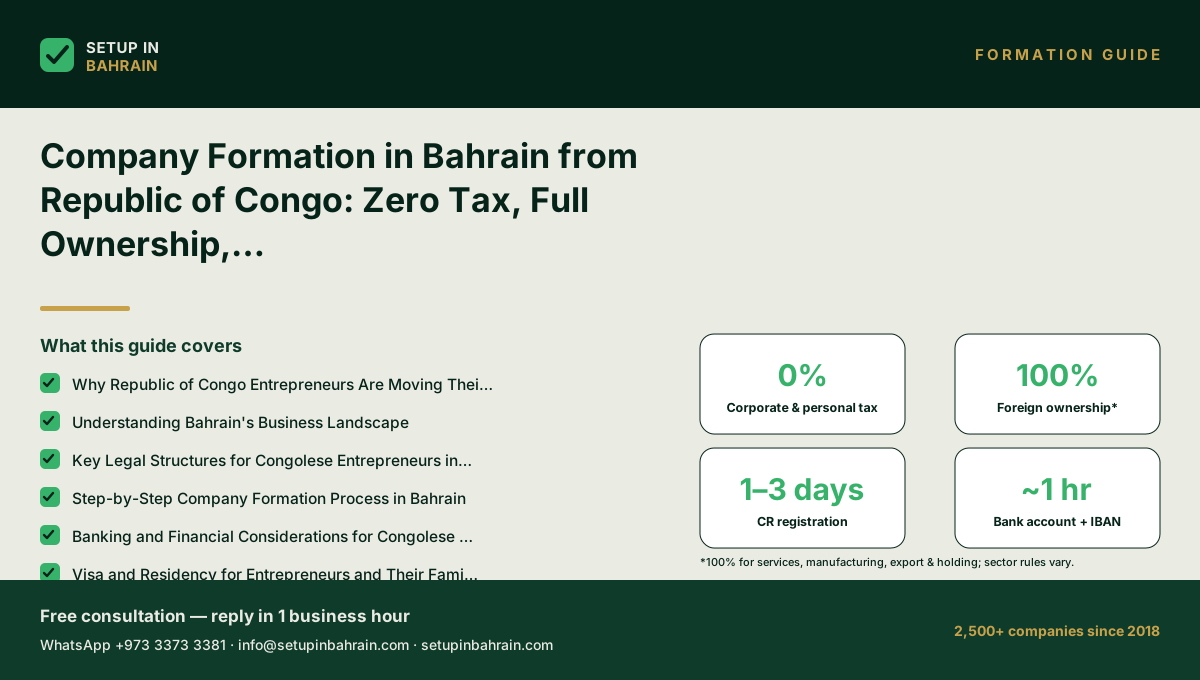
Complete guide for Republic of Congo entrepreneurs: form a company in Bahrain with generally no corporate income tax for most sectors, 100% foreign ownership. GCC market access. Costs, steps, visas, banking.
Key Takeaways
- Why Republic of Congo Entrepreneurs Are Moving Their Business to Bahrain
- Understanding Bahrain's Business Landscape
- Key Legal Structures for Congolese Entrepreneurs in Bahrain
- Step-by-Step Company Formation Process in Bahrain
- Banking and Financial Considerations for Congolese Entrepreneurs
→ Complete guide: Company Formation in Bahrain — the full 2026 guide
View details
Ownership & capital
A Bahrain WLL can be owned by a single person — 100% foreign ownership applies to most activities, with no local partner required for services, manufacturing, export trading and holding companies. The minimum share capital is BHD 1 ; we recommend BHD 1,000 . This Makes bank account opening and investor visa approval smoother.
For the astute entrepreneur in Brazzaville or Pointe-Noire, the dream of expanding beyond the Republic of Congo’s dynamic but challenging borders often comes hand-in-hand with a mix of aspiration and apprehension. You’ve built your business through sheer grit, navigating complex regulations, currency fluctuations, and a demanding tax landscape. Now, you’re eyeing horizons where your hard-earned profits aren't immediately carved away by steep taxes, where your currency anxieties cease to dictate your international ambitions, and where access to a booming regional market is literally just a bridge away.
Consider Jean-Pierre Okemba, who runs a mid-sized oil services firm in Pointe-Noire. Last year, his company posted XAF 420 million in revenue. After the obligatory 28% corporate income tax, substantial CNSS contributions. The labyrinthine DGI quarterly filings, he retained roughly XAF 260 million. The remaining cash, vital for reinvestment, often sat in local banks that struggled with efficient, cost-effective conversion into USD or EUR for crucial equipment purchases from Europe. When he tried to expand into Saudi Arabia, the CEMAC foreign-exchange approval process through the BEAC central bank took eleven agonizing weeks, only to ultimately fail, stalling his market entry.
That single quarter, filled with bureaucratic delays and profit erosion, convinced him to explore alternatives. Within six weeks, by establishing a presence in Bahrain, Jean-Pierre had registered a WLL (With Limited Liability) company, opened a corporate bank account, and gained direct, unfettered access to the Gulf Cooperation Council (GCC) market. His profits are no longer subject to corporate tax, his currency conversions are swift and transparent. His operational freedom is dramatically enhanced.
This isn’t about abandoning your Republic of Congo roots; it’s about establishing a strategic, highly efficient international base that amplifies your potential, secures your future, and provides an unparalleled launchpad to a market worth trillions. This comprehensive guide is built specifically for you, the visionary Republic of Congo entrepreneur, addressing the unique challenges you face and illuminating the path to unparalleled opportunity in the Kingdom of Bahrain.
Why Republic of Congo Entrepreneurs Are Moving Their Business to Bahrain
Let's speak plainly. For Congolese business owners, the current operational environment. Offering local opportunities, also presents significant chokepoints on international growth and profit retention. These aren't merely annoyances; they are fundamental limitations that impact your ability to scale, innovate. Compete globally.
The Republic of Congo Reality: Specific Pain Points for Entrepreneurs
- Crippling Corporate Income Tax: The 28% corporate income tax rate in Republic of Congo is a substantial slice of your hard-earned profits. For many businesses, especially those with tight margins or significant reinvestment needs, this tax burden directly hinders growth, reduces capital available for expansion, and makes international competitiveness a constant uphill battle. This isn't just a number; it's the difference between expanding to Abidjan or staying stuck servicing Brazzaville.
- Complex DGI Quarterly Filings: Navigating the Directorate General of Taxes (DGI) for quarterly advance payments and intricate filings is a time-consuming and often confusing process. It diverts valuable managerial time and resources away from core business activities, demanding dedicated accounting teams and consistent vigilance to avoid penalties. The administrative overhead can be as debilitating as the tax itself.
XAF (CFA Franc) Conversion Headaches & BEAC Control: This is perhaps one of the most significant yet often overlooked pain points for Republic of Congo entrepreneurs eyeing international trade, especially with the GCC. * Currency Conversion Costs: The CFA franc (XAF) is pegged to the Euro. While this offers some stability against the Euro, any transaction with other major currencies like the USD (which is prevalent in the GCC) requires a double conversion (XAF to EUR, then EUR to USD), incurring multiple conversion fees and exposing your business to two layers of exchange rate fluctuations. This erodes margins on international deals. * BEAC Monetary Policy & Controls: The Bank of Central African States (BEAC) exerts significant control over foreign exchange transactions for CEMAC member states, including the Republic of Congo. Strict regulations, lengthy approval processes, and capital controls can severely restrict your ability to transfer funds for international payments, investments, or even receiving payments from abroad without significant delays. Jean-Pierre Okemba's eleven-week ordeal attempting to send funds to Saudi Arabia is a stark, real-world example of this constraint. This makes agile international trade and investment incredibly challenging.
Mandatory CNSS Contributions: The National Social Security Fund (CNSS) contributions. This Can amount to up to 20% of your payroll for employer contributions, greatly increase your operational costs. While essential for employee welfare, these contributions add a substantial burden to an already tight budget, making it harder to manage cash flow and grow your workforce efficiently.
Bahrain: Your Strategic Counter-Move
Now, imagine operating your international enterprise in a jurisdiction that not only addresses these pain points but transforms them into distinct competitive advantages.
- 0% Corporate Income Tax: This isn't a temporary incentive; it's a foundational pillar of Bahrain's economic policy. For most business activities, your company will pay zero corporate income tax. This means 100% of your profits remain within your business, available for reinvestment, expansion, or distribution to shareholders. No DGI filings, no quarterly advances. This provides unparalleled capital efficiency and greatly boosts your bottom line.
- 100% Foreign Ownership: Unlike many jurisdictions where local partners are mandatory, Bahrain permits 100% foreign ownership of most business entities, including the highly popular With Limited Liability (WLL) company. This means complete control over your operations, strategy, and profits. No navigating complex partnership agreements or sacrificing equity.
- Gateway to the $2.3 Trillion GCC Market: Bahrain is strategically located at the heart of the GCC, connected by a 25-kilometer causeway to Saudi Arabia, the region's largest economy. From Bahrain, you gain immediate, unfettered access to a market of over 50 million affluent consumers and businesses across Saudi Arabia, UAE, Qatar, Kuwait, and Oman. This proximity slashes logistics costs, simplifies market entry, and positions you optimally for regional expansion.
- Operational Freedom and Currency Stability: Bahrain's Central Bank (CBB) maintains a transparent, stable financial environment. The Bahraini Dinar (BHD) is pegged to the US Dollar, providing predictable exchange rates and eliminating the multi-layered conversion costs and uncertainties associated with the XAF. International transfers are swift, efficient, and free from capital controls.
- Business-Friendly Regulatory Environment: The Economic Development Board (EDB) and the Ministry of Industry and Commerce (MOIC) actively promote foreign investment through streamlined processes, digital services, and clear regulations. The World Bank consistently ranks Bahrain highly for its ease of doing business, a stark contrast to the administrative hurdles faced in many other regions.
- Cost-Effective Operations: While offering world-class infrastructure, Bahrain provides a highly competitive cost of living and doing business compared to other GCC hubs. This means your operational budget goes further, allowing you to invest more in growth and talent.
In essence, Bahrain offers a direct, powerful solution to the growth limitations faced by Republic of Congo entrepreneurs. It's not just a place to save on taxes; it's a platform to genuinely globalize your business with confidence and control.
Understanding Bahrain's Business Landscape
Before diving into the nuts and bolts of company formation, it's crucial to appreciate the environment you'll be stepping into. Bahrain has consciously cultivated an open, progressive. Diversified economy, moving beyond its oil-rich neighbors to become a regional leader in financial services, technology, logistics, and tourism.
Bahrain's Economic Diversification and Vision 2030
Bahrain was one of the first Gulf states to recognize the need to diversify its economy away from oil. Its Vision 2030 framework outlines a strategic plan to create a sustainable, competitive, and fair economy. This vision has led to significant investments in:
Financial Services: Home to the Central Bank of Bahrain (CBB) and numerous international banks, Bahrain is a seasoned financial hub, especially strong in Islamic finance. This provides robust banking infrastructure for your business. Information & Communication Technology (ICT): Bahrain is rapidly emerging as a data hub, with significant cloud computing infrastructure and a vibrant startup ecosystem. Logistics: With world-class ports, a modern airport. Its direct causeway link to Saudi Arabia, Bahrain is an ideal logistics and distribution center for the wider GCC market. Manufacturing: Targeted incentives and free zones encourage light manufacturing and assembly, offering duty-free access to GCC markets under certain conditions.
This diversified economic base means a broader range of opportunities for Congolese entrepreneurs, whether you are in trading, services, tech, or light manufacturing.
Legal Framework and Regulatory Bodies
Bahrain operates under a civil law system, with laws meticulously designed to protect investors and help business. The key regulatory bodies you'll interact with include:
Ministry of Industry and Commerce (MOIC): This is your primary point of contact for company registration, licensing. Commercial regulations. They are responsible for issuing your Commercial Registration (CR). Economic Development Board (EDB): The EDB acts as a strategic partner and facilitator for foreign investors. They provide invaluable support, from initial inquiries and market insights to connecting you with relevant government agencies and local partners. They are an excellent first point of contact. Central Bank of Bahrain (CBB): Oversees the financial sector, ensuring stability and regulating banks, insurance companies. Investment firms. Your corporate bank account will be under their regulatory umbrella.
This clear, well-defined legal and regulatory structure provides transparency and predictability, crucial for international investors.
Taxation and Incentives
While the 0% corporate income tax is the headline, it's important to understand the broader tax environment:
No Personal Income Tax: You, as an individual, will not pay income tax on earnings in Bahrain. No Withholding Tax: No tax is typically withheld on dividends, interest, or royalties paid to non-residents. VAT (Value Added Tax): A standard 10% VAT applies to most goods and services, consistent with GCC-wide implementation since January 2022. Businesses exceeding a certain turnover threshold (BHD 37,500 annually) are required to register for VAT, file quarterly returns. Collect/remit VAT. This is a consumption tax, not a profit tax. Customs Duties: Generally, a 5% customs duty applies to most imported goods, though exemptions exist for goods imported for re-export or manufacturing within free zones, and for goods from other GCC countries. Specific Sector Incentives: The EDB offers targeted incentives for businesses in priority sectors like ICT, manufacturing, logistics. Tourism, which can include grants, training support, and subsidized land.
The overall fiscal policy is designed to attract and retain foreign direct investment, making Bahrain a highly tax-efficient jurisdiction for your international operations.
Key Legal Structures for Congolese Entrepreneurs in Bahrain
Choosing the right legal entity is a foundational decision that impacts liability, operational flexibility, and future expansion. For Republic of Congo entrepreneurs, the With Limited Liability Company (WLL) is overwhelmingly the most suitable and popular choice.
The With Limited Liability (WLL) Company: Your Best Fit
The WLL is the workhorse of Bahraini corporate structures for international investors, offering a robust balance of limited liability and operational flexibility.
Critical Features of a Bahraini WLL:
100% Foreign Ownership: This is a major advantage for Congolese entrepreneurs. You can own 100% of your WLL without requiring any Bahraini partner or shareholder. This ensures complete control over your business decisions and profits. Single Shareholder Permitted: Crucially, a WLL can be owned by a single person. There is no requirement for multiple partners, making it ideal for sole entrepreneurs or small business owners from Republic of Congo. Limited Liability: As the name suggests, the liability of shareholders is limited to the amount of their capital contribution. Your personal assets are protected from business debts and obligations. Minimum Share Capital: Legally, the minimum share capital for a WLL is BHD 1 (one Bahraini Dinar). But, for practical purposes, we strongly recommend a starting share capital of BHD 1,000. This higher, yet still modest, capital greatly eases the process of opening a corporate bank account and is often a prerequisite for obtaining an investor visa. Banks require a certain level of commitment to consider a business viable. BHD 1,000 shows this commitment. Suitable Activities: A WLL can undertake a wide range of commercial, industrial. Service activities, making it versatile for diverse business models from trading to consultancy to tech. No Restriction on Repatriation of Profits: Profits and capital can be freely repatriated from Bahrain without any taxes or controls. This is a significant relief from the XAF/BEAC restrictions.
Key Point to Remember: There is NO single-shareholder WLL legal structure in Bahrain. The WLL, with its ability to be 100% owned by a single individual, effectively serves the purpose of what might be called an "WLL" in other jurisdictions. Do not search for or ask for a single-shareholder WLL; focus on the WLL.
Other Structures (Less Common for Congolese Entrepreneurs):
While less common for direct international expansion from Republic of Congo, it's good to be aware of other options:
Bahraini Shareholding Company (BSC): For larger enterprises seeking public listing or requiring significant capital, often with a single shareholder (one person can own 100%). Public BSC:* Minimum capital BHD 1,000,000. Closed BSC:* Minimum capital BHD 250,000. Partnership Company: Requires at least two partners and includes various types (General Partnership, Limited Partnership). Generally offers unlimited liability for at least one partner, making it less attractive for risk-averse foreign investors. Branch of a Foreign Company: Suitable if you already have a well-established company in Republic of Congo and wish to operate under its existing name, though it entails unlimited liability for the parent company. Representative Office: Primarily for marketing, promotion, and gathering market intelligence; cannot conduct commercial transactions directly. Sole Proprietorship: Only available to Bahraini or GCC nationals, so not an option for Republic of Congo entrepreneurs.
For the vast majority of Republic of Congo entrepreneurs looking to leverage Bahrain for tax efficiency, GCC market access. Operational freedom, the WLL is the clear winner.
Step-by-Step Company Formation Process in Bahrain
The process of establishing a WLL in Bahrain is notably streamlined, thanks to the government's commitment to ease of doing business. Here's a practical roadmap:
Phase 1: Planning and Preparation
Define Your Business Activity: Clearly articulate what your company will do. Bahrain has a defined list of commercial activities. Ensure your proposed activities are permissible and accurately categorized. This determines your licensing requirements. Choose Your Company Name: Select a unique name that complies with MOIC guidelines (e.g., no offensive terms, not identical to existing companies). You'll typically provide a few options in order of preference. Identify Shareholder(s) and Director(s): For a single-owner WLL, you will be both the sole shareholder and director. You will need copies of passports, proof of address, and potentially a CV. Determine Share Capital: As discussed. BHD 1 is the legal minimum, commit to BHD 1,000 as your starting share capital. This makes banking and visa applications greatly smoother. Secure a Registered Office Address: Every company in Bahrain requires a physical address. This can be a serviced office, a co-working space, or a traditional office lease. Virtual offices are sometimes permissible for certain activities but a physical presence adds credibility for banking and visa purposes.
Phase 2: Application and Registration
This phase is primarily managed through the Sijilat Portal, Bahrain's integrated online commercial registration system.
Submit Initial Application (Commercial Registration - CR): * Through Sijilat, you'll submit details of your company name, activities, shareholders, directors. Proposed share capital. * Required documents typically include: * Passport copies of all shareholders and directors (notarized and attested if required). * Proof of residential address for shareholders/directors (e.g., utility bill). * CV/Resumé for directors/managers. * Draft Memorandum and Articles of Association (MOA/AOA). This legal document outlines the company's purpose, structure, and operational rules. It will be drafted to comply with Bahraini law and reflect your 100% ownership. * Proof of registered office address (e.g., lease agreement). * The MOIC will review your application and issue initial approval for the company name and activities.
- MOA/AOA Notarization: Once approved, the MOA/AOA needs to be formally signed and notarized by a public notary in Bahrain. If you are not physically present, you can grant a Power of Attorney (POA) to a local representative or legal firm to sign on your behalf. This POA must be attested in Republic of Congo and then legalized by the Bahraini Embassy in Congo, or attested in a country with a Bahraini embassy and then legalized by the Bahraini Ministry of Foreign Affairs. This is a critical step for remote formation.
- Capital Deposit (Post-Approval): While legally your capital doesn't need to be deposited until after the MOIC approval for most WLLs, having a bank account ready to receive it immediately post-approval speeds up subsequent steps. Your BHD 1,000 will be deposited into the company's new bank account.
- Final CR Issuance: Upon successful review of all documents, including the notarized MOA/AOA and confirmation of registered address, the MOIC will issue your Commercial Registration (CR). This is your official license to operate in Bahrain.
Phase 3: Post-Registration and Operational Setup
Open Corporate Bank Account: This is a crucial step. * You will need your newly issued CR, MOA/AOA, and shareholder/director identification documents. * Banks will conduct thorough Know Your Customer (KYC) and Anti-Money Laundering (AML) checks. * Original Insight: Many banks will require the signatory (you, as the director/shareholder) to be physically present in Bahrain to open the account, especially for first-time applicants. Plan for a short trip to Bahrain for this specific purpose if you are not already residing there. The BHD 1,000 recommended capital becomes critical here. * The Central Bank of Bahrain (CBB) regulates all financial institutions, ensuring transparency and stability.
- Get Business Licenses (if applicable): Depending on your specific business activities (e.g., healthcare, education, financial services), you might require additional approvals or licenses from relevant sector-specific ministries or regulatory bodies after your CR is issued. For most general trading or consulting WLLs, the CR is sufficient.
- Register for VAT (if applicable): If your projected annual turnover exceeds BHD 37,500 (about USD 99,500), you must register for VAT with the National Bureau for Revenue (NBR).
Visa and Residency (for Investor/Manager): * As a foreign owner and director, you will typically apply for an investor visa and residency permit. * This requires sponsorship by your new Bahraini company. * Documents include passport, educational certificates, medical check-up. Proof of sufficient funds (the BHD 1,000 share capital helps here). * The processing is handled by the Labour Market Regulatory Authority (LMRA) and the Nationality, Passports. Residence Affairs (NPRA).
Timeline for Company Formation:
- Registration (MOIC): Can be as quick as 3-5 working days if all documents are in order and submitted online.
- Bank Account Opening: 2-4 weeks, highly dependent on the bank's KYC process and your ability to be physically present.
- Visa/Residency: 2-4 weeks after company and bank account are established.
Overall, from initial application to having your company registered, bank account open. Investor visa in hand, a realistic timeline is 6-10 weeks. This assumes proactive engagement and having all documents ready.
Banking and Financial Considerations for Congolese Entrepreneurs
Establishing robust banking relationships in Bahrain is paramount for your international business. It directly addresses the currency conversion and foreign exchange challenges you face in Republic of Congo.
Opening a Corporate Bank Account in Bahrain
Choice of Banks: Bahrain hosts a wide array of local and international banks, including HSBC, Standard Chartered, Arab Bank. Local powerhouses like National Bank of Bahrain (NBB) and Al Baraka Bank (for Islamic finance). Research which bank best suits your transaction volumes, international transfer needs, and digital banking preferences. Requirements: Beyond your company's CR and MOA/AOA, expect banks to ask for: * Detailed business plan and projected financials. * KYC documents for all beneficial owners and directors (passport, visa, utility bills, bank statements from your country of origin). * Proof of source of funds for the initial capital deposit. * Crucial Point: Physical Presence: As mentioned, many banks will insist on the primary signatory (often the sole shareholder/director) being physically present in Bahrain for the initial account opening meeting. This is a non-negotiable step for many institutions due to stringent compliance requirements. Plan for this trip. Benefits of a Bahraini Account: * USD Peg: Your Bahraini Dinar (BHD) account offers stable, direct conversion to USD, eliminating the XAF-EUR-USD double conversion problem. * Efficient International Transfers: Seamless SWIFT transfers worldwide, free from the capital controls and delays of the BEAC. * Multi-currency Accounts: Many banks offer multi-currency accounts, allowing you to hold funds in USD, EUR, GBP, etc., directly, further optimizing your international transactions. * Online Banking & Digital Services: Sophisticated digital platforms for managing accounts, making payments, and accessing trade finance facilities.
Financial Management and Compliance
Accounting and Auditing: While many small WLLs might not require annual audits by law, maintaining accurate financial records is essential for VAT compliance and good governance. Consider engaging a local accounting firm. VAT Filings: If registered, quarterly VAT returns must be filed with the NBR, detailing your sales, purchases. VAT collected/paid. Customs Declarations: For import/export businesses, accurate customs declarations are necessary for all goods moving in and out of Bahrain. Payroll: If you hire staff, you'll need a payroll system, adhering to Bahrain's labor laws and social insurance regulations (though these are separate from CNSS and typically less onerous for foreign companies).
Strategic Financial Planning for Congolese Entrepreneurs
Capital Allocation: With generally no corporate income tax for most sectors, you have maximum flexibility to allocate profits towards expansion, research and development, or talent acquisition. Investment Opportunities: Bahrain's mature financial sector offers various investment avenues, from fixed deposits to wealth management services, allowing your retained earnings to grow within a stable environment. Trade Finance: Bahraini banks are experienced in trade finance, offering Letters of Credit (LCs), guarantees. Other facilities vital for international trading companies dealing with GCC partners. This streamlines your export operations, providing security and liquidity.
By establishing your financial base in Bahrain, you are not just opening a bank account; you are gaining access to a sophisticated, stable financial ecosystem that directly supports and accelerates your international business ambitions, freeing you from the XAF and BEAC constraints.
Visa and Residency for Entrepreneurs and Their Families
Relocating or even just managing an international business requires addressing personal residency. Bahrain offers clear pathways for entrepreneurs and their families.
The Investor Visa and Residency Permit
As the owner/director of your Bahraini WLL, you will typically apply for an investor visa. This Leads to a renewable residency permit.
Sponsorship: Your new Bahraini company will act as your sponsor. Key Requirements: * Valid passport (with at least six months validity). * Completed application form. * Passport-sized photographs. * Medical examination results (conducted in Bahrain). * Fingerprinting (also in Bahrain). * Copy of your company's Commercial Registration (CR). * Proof of sufficient funds or company capital (the recommended BHD 1,000 for WLL is beneficial here). * Educational certificates (sometimes required). * No objection certificates from relevant authorities. Process: 1. Your company submits the visa application to the Labour Market Regulatory Authority (LMRA). 2. Once approved, an entry visa is issued, allowing you to travel to Bahrain. 3. Upon arrival, you'll complete medical checks and fingerprinting. 4. The final residency permit (often valid for 1-2 years initially, then renewable) is issued by the Nationality, Passports. Residence Affairs (NPRA). Family Sponsorship: Once you have your own residency permit, you can sponsor your immediate family members (spouse and children) to join you in Bahrain. This requires additional documents for each family member, including marriage and birth certificates (often requiring attestation).
Benefits of Bahrain Residency
- Freedom of Movement: With a residency permit, you can enter and exit Bahrain freely.
- Access to Services: Access to local banking, utilities, schools, and healthcare.
- Long-Term Stay: A stable basis for living and working in the region.
- Tax Residency: While Bahrain has no personal income tax, being a tax resident can have implications for your global tax planning, especially concerning any remaining assets or income in Republic of Congo. Consult with an international tax advisor.
Other Visa Options (Less Common for Entrepreneurs):
- Self-Sponsorship Visa: Bahrain recently introduced a 'Golden Residency Visa' for highly skilled individuals or significant investors, offering long-term residency (10 years) without requiring a local sponsor. This is a premium option for those making substantial investments or meeting specific high-income criteria.
- GCC Visa: If you already hold a valid residency permit in another GCC country, you might be eligible for easier entry to Bahrain, but this doesn't automatically grant you work or long-term residency rights for your business.
For most Republic of Congo entrepreneurs, the investor visa through their WLL company is the most direct and practical route to establishing personal residency in Bahrain.
Life and Business in Bahrain: Beyond the Setup
Establishing your company is just the first step. Understanding the quality of life and the broader business ecosystem will help you thrive.
Quality of Life: A Blend of Modernity and Culture
Bahrain offers a high standard of living at a relatively affordable cost compared to other major Gulf cities.
Cosmopolitan Environment: A diverse expatriate community means you’ll find people from all over the world, contributing to a rich cultural tapestry. Safety and Stability: Bahrain is known for its low crime rate and political stability, providing a secure environment for families. Education: A wide choice of international schools offering British, American. Other curricula, ensuring quality education for your children. Healthcare: Excellent public and private healthcare facilities. Leisure and Recreation: From pristine beaches and watersports to world-class dining, shopping malls. Cultural attractions, there’s plenty to do. The annual Formula 1 Grand Prix is a major highlight. Cultural Experience: While modern, Bahrain retains its rich Arab heritage, offering opportunities to explore traditional souqs, historical forts. Local customs.
Connectivity and Logistics Hub
Bahrain’s strategic location and infrastructure make it an ideal base for regional and international trade.
Khalifa Bin Salman Port: A deep-water port capable of handling large cargo vessels, offering efficient container handling and customs clearance. Bahrain International Airport (BIA): A modern, expanded airport with excellent connectivity to major cities in the Middle East, Asia, Europe. Africa. Direct flights connect easily to key global markets. King Fahd Causeway: The land link to Saudi Arabia allows for seamless overland movement of goods and people, crucial for accessing the largest GCC market. Free Trade Agreements: As a GCC member, Bahrain benefits from free trade agreements with key markets, including the US, Singapore. The European Free Trade Association (EFTA), providing preferential access for your products. For an entrepreneur from Republic
Bahrain Business Guides for Republic Of Congo Citizens
Frequently Asked Questions
How long does it take to set up?
It takes 15 to 20 days. We file all forms for you. You do not need to wait long.
What does it cost?
Company formation: Standard BHD 1,340 with 3 months of office address; Gold BHD 1,700 with 6 months; Premium BHD 2,150 with 12 months and a cabin, officer table and chair, and two guest chairs. No formation package includes visas, including Premium. Investor/work visas are priced separately: BHD 755 for one year or BHD 953 for two years, in addition to the formation package. Ask for a written, itemized quotation confirming government fees and all inclusions before payment.
Do I need to visit Bahrain?
No. You can set up your firm from home. We do all the work online. Some banks may ask for one visit.
What tax will I pay?
You pay zero tax on your profits. Bahrain has no corporate income tax. This is a key benefit of the setup.
Can I own 100% of my firm?
Yes. Foreign owners can hold all shares. No local partner is needed. Full ownership is allowed.
What do I need to start?
You need a valid passport. You also need a trade name and a business address. We help you with all of these.
How do I open a bank account?
We guide you step by step. Most banks take 3 to 6 weeks. You will need your CR and firm papers.
Who issues the Commercial Registration (CR)?
The CR is issued by the MOICT. It is your legal right to trade in Bahrain. We file the CR for you.
Can I renew my CR each year?
Company renewal packages: BHD 530 with 3 months of office address; BHD 980 with 6 months; BHD 1,520 with 12 months. These are separate renewal packages, not visa fees.
How do I get started?
Fill in our form on this page. Our team will call you back. We map your best setup plan at no cost.
Steps to Form Your Company
- Pick your trade name. We check if it is free.
- Choose your business type. WLL is the most common.
- Sign the MOA. We draft and file all legal docs.
- Pay the state fees. About BHD 432 in total.
- Get your CR. Takes 15 to 20 days.
- Open your bank account. We guide each step.
- Start trading. You are ready to do business.
Key Facts
- Tax rate: 0%
- Foreign ownership: 100%
- Setup time: 15 to 20 days
- Company formation: Standard BHD 1,340 with 3 months of office address; Gold BHD 1,700 with 6 months; Premium BHD 2,150 with 12 months and a cabin, officer table and chair, and two guest chairs. No formation package includes visas, including Premium. Investor/work visas are priced separately: BHD 755 for one year or BHD 953 for two years, in addition to the formation package. Ask for a written, itemized quotation confirming government fees and all inclusions before payment.
- Company renewal packages: BHD 530 with 3 months of office address; BHD 980 with 6 months; BHD 1,520 with 12 months. These are separate renewal packages, not visa fees.
- Client rating: 4.8 stars
- Clients served: 2,500 and more
Quick Facts
- Tax rate: 0%
- Own all of your firm: Yes, 100%
- Time to set up: 15 to 20 days
- Company formation: Standard BHD 1,340 with 3 months of office address; Gold BHD 1,700 with 6 months; Premium BHD 2,150 with 12 months and a cabin, officer table and chair, and two guest chairs. No formation package includes visas, including Premium. Investor/work visas are priced separately: BHD 755 for one year or BHD 953 for two years, in addition to the formation package. Ask for a written, itemized quotation confirming government fees and all inclusions before payment.
- Company renewal packages: BHD 530 with 3 months of office address; BHD 980 with 6 months; BHD 1,520 with 12 months. These are separate renewal packages, not visa fees.
- Rating: 4.8 stars
- Clients: 2,500 and more
Why Bahrain?
Bahrain has no tax. You keep all your profits. This is rare in the Gulf.
You can own all of your firm. No local partner is needed. The law allows full foreign ownership.
Setup takes 15 to 20 days. We file all forms for you. You can do it all from home.
Bahrain has a free trade deal with the US. Your goods face low or no tariffs. This gives you access to big markets.
We have served 2,800+ clients from 44+ countries and maintain records to substantiate that total where needed. We have 113 Google reviews; reviews represent only some clients and are not the same as the total clients served.
Our Steps
- Tell us your plan. We advise you for free.
- We pick the right firm type for you.
- We file all your forms with MOICT.
- You get your CR in 15 to 20 days.
- We help you open a bank account.
- You are ready to trade. We stay with you.
Next Steps for Republic Of Congo Citizens
You can set up a firm in Bahrain from Republic Of Congo. You do not need to fly there first. We do all the work online.
Tell us your plan. We call you back the same day. We map the best route for you at no cost.
We file all your forms. We deal with MOICT and the state. You get your CR in 15 to 20 days.
After your CR, we help you get a bank account. We also help with your Investor Visa. One firm guides you at each step.
Why Our Clients from Republic Of Congo Choose Us
- We speak your language. We know your needs.
- We have helped clients from Republic Of Congo before.
- Our fee is clear. No surprise costs.
- We have a 4.8 star rating on Google.
- We have helped more than 2,500 clients set up in Bahrain.
Fill in the form on this page. We will be in touch soon. Let us help you start your Bahrain firm today.
Ready to set up in Bahrain from Republic of Congo?
Tell us your business idea. We map the right entity, ownership and timeline — then handle the filing while you focus on what matters.