Start your Bahrain company from Poland with generally no corporate income tax for most sectors. Fast registration, full support for Polish entrepreneurs. Maximize profits today.
Key Takeaways
- Why Poland Entrepreneurs Are Moving Their Business to Bahrain
- Bahrain Business Environment and Economic Advantages
- Types of Company Structures Available in Bahrain
- Bahrain Company Formation Process from Poland
- Banking and Financial Infrastructure in Bahrain
→ Complete guide: Company Formation in Bahrain — the full 2026 guide
View details
Ownership & capital
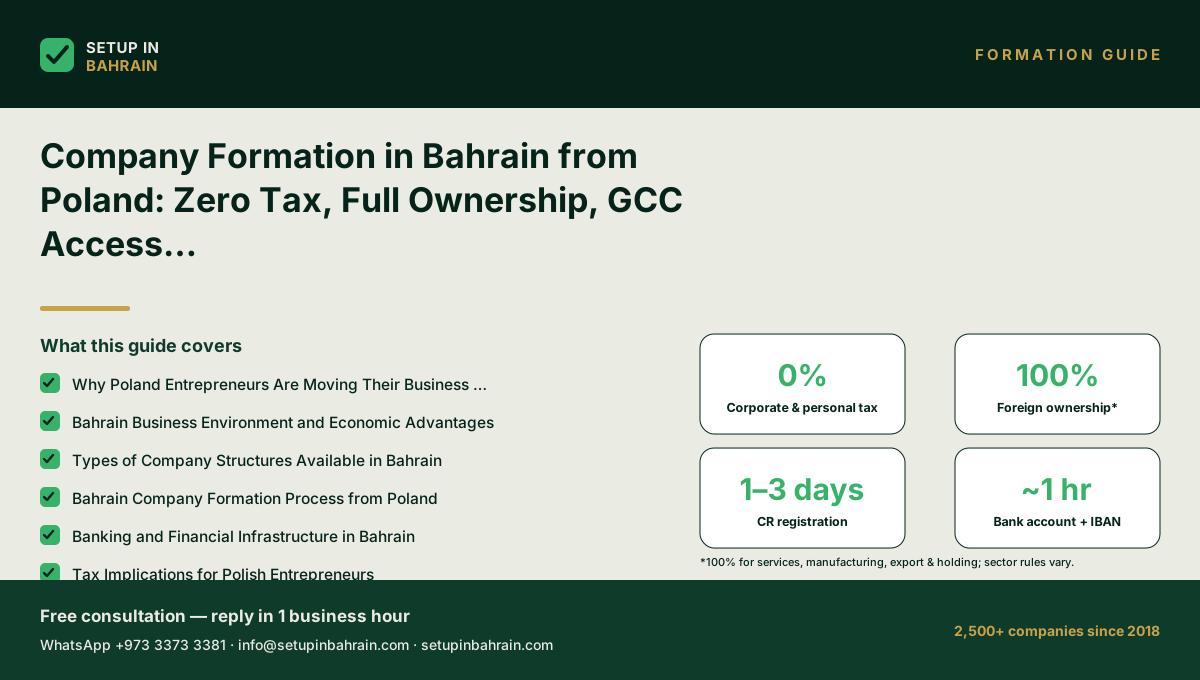
A Bahrain WLL can be owned by a single person — 100% foreign ownership applies to most activities, with no local partner required for services, manufacturing, export trading and holding companies. The minimum share capital is BHD 1 ; we recommend BHD 1,000 . This Makes bank account opening and investor visa approval smoother.
Michał stared at his accountant's email for ten minutes before responding.
His Wrocław-based IT outsourcing company had just closed another profitable year—€1.2 million in revenue, mostly from clients scattered across Germany, the UAE. Saudi Arabia. The numbers looked healthy until his księgowy delivered the comprehensive tax breakdown: 19% CIT amounting to PLN 998,000, ZUS contributions for his team of eight developers totaling PLN 384,000 annually, and the 9% health insurance levy on his planned dividend distribution. When he factored in the accounting fees for mandatory e-JPK_VAT monthly submissions and the annual CIT-8 filing complexity, his effective tax burden climbed to 43.7% of gross profit.
"I'm essentially working for the Polish tax system from January through late May," Michał told me during our first video consultation. "My clients don't care where my company is registered. They care that the software works and arrives on time. So why am I hemorrhaging nearly half my earnings to serve customers who have never set foot in Poland?"
That conversation happened in February 2024. By August, Michał's Bahrain-registered WLL served those same clients from a small office in Manama's Seef District. His corporate tax obligation? Zero. His annual compliance burden? A straightforward audit and renewal process he handles in under six hours. The JPK nightmares, the notarized deeds, the apostille stamps for every international document—all replaced by a fully digital system he navigated primarily from his apartment in Wrocław.
I share Michał's story because it represents a pattern I've witnessed dozens of times since 2022. Forty-three Polish entrepreneurs have walked through my consultation process, each carrying the same exhausted expression, the same spreadsheets showing money flowing out faster than it flows in, the same fundamental question: "There has to be a better way, right?"
There is. And for the right Polish business owner, Bahrain represents perhaps the most significant wealth-preservation opportunity available in 2026.
But let me be clear from the outset: this isn't a blanket recommendation. Bahrain restructuring doesn't suit every business model. I'll explain exactly which Polish companies should pursue this path—and which should stay home. What follows is the complete operational guide I wish someone had handed me when I first explored this jurisdiction, covering everything from the genuine tax arbitrage to the CFC rules that could undermine your entire strategy if ignored.
Let's examine why the math has become impossible for Polish entrepreneurs to ignore.
Why Poland Entrepreneurs Are Moving Their Business to Bahrain
The exodus isn't happening because Polish entrepreneurs stumbled upon a clever loophole. It's happening because the cumulative weight of Poland's tax and compliance environment has reached a breaking point for internationally-oriented businesses.
The 19% CIT Reality Is Actually Much Worse
On paper, Poland's corporate income tax rate appears reasonable by European standards. The standard 19% CIT rate sits below France's 25%, Germany's combined 29.9%. Portugal's 21%. Polish lawmakers even created a preferential 9% rate for companies with annual revenues below PLN 2 million—a threshold that sounds generous until you realize it excludes most businesses with genuine growth trajectories.
But the headline rate tells only part of the story.
When Agnieszka, a Kraków-based technology entrepreneur, asked her accountant to calculate her true tax burden, the number that came back was 41.3%. Here's how that breaks down for a typical Polish spółka z o.o. generating PLN 1.5 million in annual profit:
- Corporate Income Tax (CIT): PLN 285,000 (19% standard rate)
- ZUS Contributions: PLN 192,000 annually for a team of five (about PLN 3,200 per employee per month for full contributions)
- Health Insurance Levy on Dividends: 9% of distributed profits, adding PLN 109,350 if the full after-tax amount is withdrawn
- Effective PIT on Dividend Income: 19% flat rate on distributions after the health levy
The compounding effect is brutal. A zloty earned by a Polish company faces corporate taxation, then social contribution obligations, then personal taxation upon distribution—with each layer reducing what actually reaches the entrepreneur's personal account.
The Compliance Burden Nobody Talks About
Polish business owners spend an average of 334 hours annually on tax compliance activities, according to World Bank Doing Business methodology. That figure places Poland among the most administratively burdensome jurisdictions in the European Union.
The culprits are familiar to anyone running a Polish company:
CIT-8 Annual Filing : This isn't a simple tax return. Polish CIT-8 declarations require detailed reconciliation of accounting profit to taxable income, including adjustments for non-deductible expenses, transfer pricing documents. Controlled foreign company disclosures. The deadline falls nine months after the fiscal year-end, but preparation typically begins three months earlier.
E-JPK_VAT Monthly Reporting: Since October 2020, Polish companies must submit Standard Audit Files (SAF-T) containing detailed transaction-level VAT data. The JPK_VAT file format requires precise coding of every invoice, with penalties of PLN 500 per error for mistakes in submitted data. For companies processing hundreds of monthly transactions, maintaining JPK compliance consumes 8-15 hours monthly.
ZUS Declarations: Social insurance contributions require separate monthly declarations for each employee, with different calculation bases for health insurance, pension contributions, disability insurance, and the Labour Fund. The ZUS DRA monthly declaration alone involves reconciling data across multiple sub-forms.
Polish entrepreneurs serving international clients find themselves in an absurd position: they're spending more time satisfying Polish compliance requirements than actually serving the customers who generate their revenue.
PLN Currency Volatility Creates Invisible Losses
For Polish companies earning in euros, dollars, or Gulf currencies, the złoty's volatility represents a constant drain on profitability.
Between January 2022 and December 2024, the EUR/PLN exchange rate fluctuated between 4.48 and 4.93—a 10% range that translated directly into unpredictable revenue recognition for euro-denominated contracts. The USD/PLN pair showed even greater volatility, swinging from 3.92 to 4.58 during the same period.
Consider the practical impact: A Polish software house signs a €500,000 annual contract with a German client. If the EUR/PLN rate moves from 4.50 to 4.30 over the contract period, that €500,000 translates to PLN 2,150,000 instead of PLN 2,250,000—a PLN 100,000 loss that never appears on any profit statement but directly reduces purchasing power.
Bahrain's dinar, by contrast, has maintained a fixed peg to the US dollar at BHD 0.376 since 1980. For Polish entrepreneurs serving dollar-denominated markets—especially the Gulf region—this currency stability alone justifies serious consideration of relocation.
The Ukrainian Border Administrative Reality
Since February 2022, Polish businesses have faced unprecedented administrative complexity related to the refugee crisis. While humanitarian considerations rightly take priority, the practical burden on Polish employers has been substantial.
Companies hiring Ukrainian nationals navigate a complex web of simplified employment procedures (notification-based rather than permit-based), but these simplified rules create their own compliance requirements: 14-day notification deadlines to the powiat employment office, documents of legal stay status, and integration with standard ZUS registration within 7 days of employment commencement.
For Polish tech companies that pivoted to hiring displaced Ukrainian developers—a common strategy given the talent pool—the administrative overhead often exceeded expectations. Marek's Kraków software house reported spending 11 hours weekly on refugee-related paperwork during 2023, administrative time that produced no billable output.
Why Bahrain Specifically?
Polish entrepreneurs researching tax-efficient jurisdictions inevitably encounter the usual suspects: Dubai, Singapore, Malta, Cyprus, Ireland. Each has merit for specific situations. But Bahrain offers a combination of factors that make it unusually attractive for Polish business owners targeting the Gulf market:
Generally no corporate income tax for most sectors: Not reduced. Not deferred. Zero. Bahrain does not impose corporate income tax on most business activities, with narrow exceptions for oil and gas companies.
100% Foreign Ownership: Unlike Saudi Arabia's historical restrictions or the UAE's former mainland requirements, Bahrain has permitted full foreign ownership of onshore companies since 2017 for most activities.
Geographic Position: Bahrain sits 25 kilometers from Saudi Arabia's eastern coast, connected by the King Fahd Causeway. For Polish companies targeting the GCC's largest market (Saudi's $1.1 trillion GDP), Bahrain provides a compliant base without the operational complexity of Saudi incorporation.
Digital Infrastructure: Bahrain's company formation process operates primarily online through the Sijilat portal, with most registration steps completable remotely. This matters enormously for Polish entrepreneurs who can't spend weeks in Manama during the setup phase.
Time Zone Alignment: Bahrain operates on GMT+3, creating a 2-hour overlap with Poland's afternoon business hours (during Central European Time) and substantial overlap with Gulf client working days. For Polish tech companies serving Saudi or UAE clients, this alignment supports real-time collaboration.
Bahrain Business Environment and Economic Advantages
Understanding why Bahrain works requires examining the structural factors that make the Kingdom's business environment genuinely different from European norms.
The GCC Gateway Effect
Bahrain's 1.5 million population and 785 square kilometer territory make it the smallest Gulf state by far. Saudi Arabia's landmass exceeds Bahrain's by a factor of 2,700. Yet this apparent limitation conceals Bahrain's actual economic function: it operates as the financial and services hub for a GCC market exceeding $1.6 trillion in combined GDP.
The Kingdom's position crystallized during the 1970s oil boom, when regional wealth sought sophisticated financial services that conservative domestic policies in Saudi Arabia and Kuwait couldn't readily provide. International banks, professional services firms. Trading companies established Bahrain operations to serve Gulf clients while operating under more liberal commercial regulations.
This legacy persists. Bahrain hosts 371 financial institutions licensed by the Central Bank of Bahrain (CBB), including the regional headquarters of HSBC, Standard Chartered, Citibank. BNP Paribas. For Polish fintech companies or financial services providers, Bahrain offers regulatory infrastructure and correspondent banking relationships unavailable in newer Gulf financial centers.
Economic Diversification Beyond Oil
Unlike Kuwait (where hydrocarbons contribute 90% of government revenue) or Qatar (85%), Bahrain has pursued genuine economic diversification since the 1990s. The oil and gas sector now accounts for about 18% of GDP, with financial services, manufacturing. Logistics comprising the balance.
This diversification matters for Polish entrepreneurs because it indicates policy stability. Bahrain cannot afford the economic whiplash that oil-dependent states experience during commodity cycles. The Kingdom's commitment to foreign investment, liberal company formation rules. Zero-tax regimes reflects structural necessity rather than temporary inducement.
The Economic Development Board (EDB), Bahrain's investment promotion agency, reports that foreign direct investment inflows reached $1.8 billion in 2024, with technology and financial services comprising the fastest-growing sectors. Polish companies entering this market join established European, American, and Asian businesses rather than pioneering uncertain territory.
Regulatory Credibility and International Standards
Skeptical Polish entrepreneurs—and healthy skepticism serves you well in this process—often ask whether Bahrain's favorable tax treatment comes with hidden regulatory risks. The question is legitimate. Tax havens with opaque ownership structures and minimal compliance requirements create exposure to reputation damage, banking difficulties. Potential EU sanctions.
Bahrain's regulatory framework addresses these concerns directly:
FATF Compliance: Bahrain satisfies Financial Action Task Force requirements for anti-money laundering and counter-terrorist financing standards. The Kingdom underwent mutual evaluation in 2018 and has implemented recommended improvements, maintaining its position off the FATF grey list.
Automatic Exchange of Information: Bahrain participates in the OECD's Common Reporting Standard (CRS), automatically exchanging financial account information with participating jurisdictions including Poland. This transparency eliminates the secrecy-based tax planning that characterized previous generations of offshore structures.
EU Cooperative Jurisdiction: Bahrain does not appear on the European Union's list of non-cooperative tax jurisdictions. Polish companies incorporating in Bahrain face no automatic presumption of aggressive tax planning from Polish or EU authorities.
BIPA Protection: Poland and Bahrain maintain a bilateral investment protection agreement (BIPA) that provides legal recourse in disputes between Polish investors and the Bahraini state. This treaty protection exceeds what's available in many alternative jurisdictions.
The Zero-Tax Reality: What It Actually Means
When I tell Polish entrepreneurs that Bahrain charges Generally no corporate income tax for most sectors, the immediate response is usually: "Where's the catch?"
The honest answer: there isn't one—for corporate taxation. But understanding the complete picture requires examining what Bahrain does and doesn't tax:
Corporate Income Tax: 0% for companies not engaged in oil and gas extraction. This applies regardless of whether profits derive from Bahrain-based activities, GCC clients, or international operations.
Personal Income Tax: 0% on individual earnings, including salary, dividends, and capital gains. Polish entrepreneurs who establish genuine Bahrain residence (distinct from simply incorporating a company) eliminate personal income taxation as well.
Withholding Tax on Dividends: 0%. Profits can be repatriated to Poland or any other jurisdiction without Bahrain-side deduction.
Capital Gains Tax: 0% on the sale of shares, real estate, or other assets.
Value Added Tax: 10% as of January 2022, applicable to domestic sales of goods and services. This VAT applies only to Bahrain-based transactions—services exported to clients outside Bahrain are zero-rated.
The VAT implementation represents Bahrain's primary domestic consumption tax, introduced as part of the GCC-wide VAT framework. For Polish service companies whose clients sit primarily in Saudi Arabia, UAE, or Europe, Bahrain VAT rarely applies because exported services fall outside the taxable scope.
Types of Company Structures Available in Bahrain
Polish entrepreneurs evaluating Bahrain incorporation must choose among several distinct entity types, each with different ownership rules, capital requirements. Operational implications.
With Limited Liability Company (WLL)
The WLL represents the standard vehicle for foreign-owned businesses operating in Bahrain. Since the 2017 legislative changes eliminating mandatory local partnership requirements, Polish entrepreneurs can hold 100% of WLL shares directly.
Key Characteristics:
- a single shareholder (one person can own 100%) (can be the same individual holding shares through different capacities, or one individual plus a corporate shareholder)
- Minimum capital requirement of BHD 1 (we recommend BHD 1,000) (about €125,000) for most activities, though some sectors require BHD 20,000
- Limited liability protection—shareholders not personally liable for company debts beyond their capital contribution
- No restrictions on profit repatriation
- Requires physical office address in Bahrain (virtual office arrangements available for certain activity types)
For most Polish technology, consulting, or trading businesses, the WLL provides optimal flexibility. The capital requirement. Higher than Poland's PLN 5,000 minimum for a spółka z o.o., remains modest compared to the tax savings achievable in the first operating year.
single-shareholder WLL
Bahrain permits wholly-owned single shareholder companies, addressing the WLL's minimum two-shareholder requirement.
Key Characteristics:
- Single shareholder permitted (individual or corporate)
- Same limited liability protection as WLL
- Capital requirements equivalent to WLL for comparable activities
- Simplified governance—no separate board of directors required
- Suitable for holding company structures or professional services
Polish entrepreneurs operating solo consultancies or holding passive investments often prefer the WLL structure for its administrative simplicity. But, the WLL classification limits certain banking relationships, as some institutions prefer the governance structures inherent in multi-shareholder entities.
Bahrain Branch of Foreign Company
Rather than incorporating a new Bahraini entity, Polish companies can register a branch office representing the parent spółka z o.o. directly.
Key Characteristics:
- No separate legal personality—branch operates as extension of Polish parent
- Polish parent company liable for branch obligations
- No minimum capital requirement, but parent company must show adequate capitalization
- Profits attributed to branch subject to Bahrain's 0% rate
- Simplified registration process (typically 5-7 working days)
The branch structure appeals to Polish companies seeking Bahrain presence without creating separate corporate entities. But, this approach carries a significant drawback: because the branch isn't a separate legal person, Polish CFC rules may apply differently. Profits might be attributed directly to the Polish parent for Polish tax purposes.
Holding Company
Bahrain's holding company regime permits entities whose primary function involves owning shares in subsidiary companies.
Key Characteristics:
- 0% tax on dividend income received from subsidiaries
- 0% tax on capital gains from disposal of subsidiary shares
- Minimum capital requirement of BHD 1 (we recommend BHD 1,000)
- Restrictions on conducting trading or operational activities directly
For Polish entrepreneurs building multi-entity structures—perhaps a Bahrain operating company alongside Saudi or UAE subsidiaries—the Bahrain holding company provides tax-efficient consolidation. Dividends flow upward to the holding company without Bahrain taxation. The holding company can reinvest or distribute those funds without withholding.
Free Zone Companies
Bahrain's free zones—primarily the Bahrain Logistics Zone and the Bahrain International Investment Park—offer alternatives to mainland company formation.
Key Characteristics:
- 100% foreign ownership guaranteed
- 0% customs duties on imports
- 10-year tax holidays (though the generally no corporate income tax for most sectors makes this largely symbolic)
- Restrictions on selling directly into the Bahrain domestic market
- Specialized facilities for manufacturing, logistics, or warehousing
Polish manufacturing companies seeking GCC market access sometimes prefer free zone structures for the customs benefits and purpose-built facilities. But, for service businesses—the majority of Polish entrepreneurs I advise—mainland WLL structures provide greater operational flexibility.
Bahrain Company Formation Process from Poland
The practical formation process differs greatly from Polish company registration. Polish entrepreneurs accustomed to notarized deeds, court registry filings. Multi-week waiting periods find Bahrain's digital-first approach refreshingly direct.
Step-by-Step Formation Timeline
Week 1: Preparation and Name Reservation
Before initiating formal registration, Polish entrepreneurs must:
- Select company name: Bahrain requires Arabic company names, though English trade names operate in parallel. The Sijilat system (Bahrain's online business registration portal) provides real-time name availability checking.
- Reserve the name: Online reservation through Sijilat costs BHD 10 and holds the name for 60 days.
- Determine activity codes: Bahrain uses a Commercial Registration (CR) system requiring specific activity code designation. Each activity code may carry different licensing requirements or capital thresholds.
- Prepare incorporation documents:
Week 2: Submission and Ministry Approval
Submit application via Sijilat : The online portal accepts document uploads, fee payments. Application submission without physical presence in Bahrain.
- Ministry of Industry and Commerce (MOIC) review: Standard applications receive approval within 3-5 working days. Complex activities requiring additional ministry clearances (healthcare, education, financial services) may extend this timeline.
- Commercial Registration issuance: Upon approval, MOIC issues the CR certificate electronically through Sijilat.
Week 3: Post-Formation Requirements
- Municipal registration: Companies must register with the relevant municipality for their office location.
- Social insurance registration: Registration with Bahrain's Social Insurance Organization (SIO) required if employing staff.
- Bank account opening: Corporate banking applications submitted with CR documents.
Document Requirements for Polish Citizens
Polish passport holders face no unusual documents requirements for Bahrain company formation. Standard documents include:
- Valid passport with minimum 6 months remaining validity
- Proof of residential address (Polish utility bill or bank statement acceptable)
- Bank reference letter from Polish bank (some Bahraini banks require this; others don't)
- Educational certificates if applying for professional licenses
- No criminal record certificate (not required for standard company formation, but needed for certain licensed activities)
All documents require English translation if originally in Polish. Apostille certification through Polish courts satisfies Bahrain's legalization requirements under the Hague Convention.
Formation Costs Breakdown
Realistic budgeting for Bahrain company formation from Poland:
| Cost Category | Amount (BHD) | Amount (PLN Equivalent) |
| Name reservation | 10 | 110 |
| CR registration fee | 100-300 | 1,100-3,300 |
| Ministry fees (varies by activity) | 50-500 | 550-5,500 |
| Legal/formation agent fees | 500-1,500 | 5,500-16,500 |
| Memorandum/Articles drafting | 200-400 | 2,200-4,400 |
| Virtual office (annual) | 1,200-3,000 | 13,200-33,000 |
| Bank account opening assistance | 200-500 | 2,200-5,500 |
| Total Formation Cost | 2,260-6,210 | 24,860-68,310 |
Remote Formation: What You Can and Cannot Do from Poland
Polish entrepreneurs can complete about 80% of the formation process without traveling to Bahrain:
Completable Remotely:
- Name reservation and CR application
- Document preparation and submission
- MOIC approval process
- CR certificate issuance
- Municipal registration
- SIO registration
Typically Requires Bahrain Presence:
- Bank account opening (most Bahraini banks require in-person meeting for corporate accounts)
- Certain licensed activity approvals
- Physical office inspection for activities requiring dedicated premises
The bank account requirement represents the primary obstacle to fully remote formation. Polish entrepreneurs typically plan a 3-5 day visit to Bahrain for account opening, using the trip to also establish initial supplier relationships and assess office options.
Some banks—especially digital-focused institutions like Tarabut Gateway partner banks—have begun accepting video verification for corporate account opening, though this remains less common than in-person requirements.
Banking and Financial Infrastructure in Bahrain
Banking relationships represent the operational foundation of any Bahrain company. For Polish entrepreneurs, establishing appropriate accounts requires understanding Bahrain's financial landscape and the specific requirements international businesses face.
The Banking Ecosystem
Bahrain hosts 371 financial institutions licensed by the Central Bank of Bahrain (CBB), creating one of the most developed banking sectors in the Middle East. This density reflects the Kingdom's historical role as the Gulf's financial services hub.
Retail and Commercial Banks : Traditional banks like Bank of Bahrain and Kuwait (BBK), Ahli United Bank. National Bank of Bahrain serve most corporate banking needs. International banks including HSBC, Standard Chartered, and Citibank maintain full-service Bahrain operations.
Islamic Banks: Bahrain hosts leading Islamic financial institutions including Al Baraka Banking Group and Bahrain Islamic Bank. For Polish entrepreneurs serving clients who prefer Sharia-compliant financial arrangements, these institutions provide appropriate structures.
Digital and Fintech Banks: Bahrain's regulatory sandbox has attracted fintech-focused institutions, though most Polish companies will work with traditional commercial banks for primary operating accounts.
Account Opening Requirements
Corporate bank account opening in Bahrain requires:
Documents:
- Commercial Registration certificate
- Memorandum and Articles of Association
- Board resolution authorizing account opening and designating signatories
- Passport copies and proof of address for all signatories
- Company business plan or description of activities
- Projected turnover estimates
- Source of funds documents (especially important for initial capital deposits)
Compliance Verification:
- KYC (Know Your Customer) verification for all beneficial owners
- Source of wealth questionnaire for significant shareholders
- Reference letters from existing banks (Polish bank references accepted)
- Company website or marketing materials demonstrating legitimate business activities
Polish entrepreneurs sometimes encounter questions about their business model, especially if the company's clients sit primarily outside Bahrain. Banks want to understand why a Polish-owned company is operating from Bahrain rather than from the entrepreneur's home country. Having a clear explanation—GCC market access, client preferences, regional presence—resolves these inquiries.
Multi-Currency Capabilities
Bahrain banks routinely maintain accounts in multiple currencies, addressing Polish entrepreneurs' exposure to different trading currencies:
- BHD (Bahraini Dinar): Local expenses, salary payments, government fees
- USD (US Dollar): GCC client invoicing (most Gulf contracts denominate in USD)
- EUR (Euro): European client relationships, Polish expense reimbursements
- SAR (Saudi Riyal): Saudi client payments (SAR maintains fixed peg to USD)
The ability to hold funds in transactional currencies—without conversion to złoty—eliminates the currency volatility losses that plague Polish companies operating from Poland.
Practical Banking Considerations
Timeline: Corporate account opening typically requires 2-4 weeks from document submission to active account, assuming no compliance complications.
Minimum Balances: Most commercial banks require minimum balances between BHD 1,000 and BHD 5,000 for corporate accounts. Islamic banks sometimes set higher thresholds.
Transaction Costs: SWIFT transfers to Poland typically cost BHD 15-25 per transaction. SEPA transfers (for EUR movements to Polish euro accounts) may be available through banks with European correspondent relationships.
Online Banking: All major Bahraini banks provide corporate online banking platforms with English interfaces. Mobile banking availability varies by institution.
Tax Implications for Polish Entrepreneurs
The tax arbitrage between Poland and Bahrain creates the primary financial motivation for restructuring. But capturing that arbitrage legally requires understanding how Polish tax law treats foreign income and foreign-controlled companies.
Poland's CFC (Controlled Foreign Corporation) Rules
Polish CFC legislation, implemented to prevent profit shifting to low-tax jurisdictions, requires Polish tax residents who control foreign companies to include those companies' passive income in their Polish tax base.
When CFC Rules Apply:
A foreign company qualifies as a CFC for Polish tax purposes when:
- A Polish tax resident (individual or company) holds directly or indirectly more than 50% of the foreign company's shares, voting rights, or profit participation; AND
- At least 33% of the foreign company's income comprises "passive" income (dividends, interest, royalties, capital gains from financial instruments, income from intellectual property); AND
- The foreign company pays less than 14.25% effective tax on its income (the threshold equals 75% of Poland's 19% CIT rate)
Bahrain companies obviously satisfy condition 3 (0% < 14.25%). Whether conditions 1 and 2 apply depends on ownership structure and income composition.
Practical Implications for Polish Entrepreneurs:
For Polish entrepreneurs earning primarily active income—fees for consulting services, software development revenue, trading profits from physical goods—CFC rules typically don't apply because passive income remains below the 33% threshold.
For holding companies or investment vehicles earning primarily dividends, interest, or royalty income, CFC rules will likely attribute income to the Polish beneficial owner for Polish taxation. In these cases, the Bahrain structure provides deferral rather than elimination of Polish tax.
Exit Tax Considerations
Polish entrepreneurs contemplating physical relocation to Bahrain must consider Poland's exit tax provisions. When a Polish tax resident transfers assets (including company shares) out of Polish tax jurisdiction, an exit tax equal to 19% of unrealized capital gains may apply.
Mitigation Strategies:
- Staged relocation: Establishing Bahrain residence while maintaining some Polish ties can extend the exit tax calculation period
- Asset restructuring: Transferring shares to a holding entity before relocation may affect exit tax calculation basis
- Treaty benefits: Poland-Bahrain tax treaty provisions may provide relief, though specific application requires professional analysis
Polish entrepreneurs should consult qualified Polish tax advisors before physical relocation. The exit tax exposure can exceed the value of several years' tax savings if not properly managed.
Transfer Pricing Requirements
When a Polish company and a Bahrain company under common control engage in transactions, Polish transfer pricing rules require those transactions to occur at arm's length prices.
Documents Requirements:
- Local file: Required for Polish companies in controlled transactions exceeding PLN 10 million annually (goods) or PLN 2 million (services)
- Master file: Required for groups exceeding PLN 200 million consolidated revenue
- Benchmark studies: Required to show that intercompany pricing reflects market rates
Polish companies maintaining relationships with related Bahrain entities should document transfer pricing compliance proactively. The Polish tax authorities have increased scrutiny of intercompany transactions involving low-tax jurisdictions.
Double Taxation Treaty Benefits
Poland and Bahrain have signed a double taxation agreement that provides:
- Dividend withholding tax reduction: Treaty caps withholding at 5% (Bahrain's domestic rate is already 0%, so this provision primarily affects Polish-source dividends paid to Bahrain companies)
- Interest withholding relief: Treaty caps withholding at 5%
- Royalty provisions: Treaty addresses intellectual property payments between the countries
- Permanent setup definitions: Treaty clarifies when activities in one country create taxable presence
The treaty provides valuable certainty for cross-border transactions, though Bahrain's zero-tax regime means Polish entrepreneurs primarily benefit from clarity rather than rate reductions.
Poland vs. Bahrain Business Structure Comparison
Understanding the structural differences between Polish and Bahraini business entities clarifies the operational changes entrepreneurs experience after relocation.
Corporate Comparison Table
| Feature | Poland (Spółka z o.o.) | Bahrain (WLL) |
| Corporate Tax Rate | 19% (9% for small taxpayers) | 0% |
| Minimum Capital | PLN 5,000 | BHD 1 (we recommend BHD 1,000) |
| Foreign Ownership Limit | 100% permitted | 100% permitted |
| Formation Time | 2-4 weeks (S24 online: 24 hours) | 5-10 working days |
| Notarization Required | Yes (deed or qualified electronic signature) | No |
| Annual Filing Complexity | High (CIT-8, JPK_VAT, financial statements) | Low (annual audit, CR renewal) |
| Dividend Withholding | 19% PIT + 9% health levy | 0% |
| VAT Rate | 23% standard | 10% |
| Currency | PLN (volatile) | BHD (USD-pegged) |
| Time Zone | GMT+1/+2 | GMT+3 |
Employment Cost Comparison
The ZUS burden represents one of the most significant cost differences between jurisdictions.
Poland Employment Costs (Monthly, for employee earning PLN 10,000 gross):
- Employee gross salary: PLN 10,000
- Employer ZUS contributions: PLN 2,048 (20.48% of gross)
- Employee ZUS contributions: PLN 1,371 (13.71% of gross)
- Employee PIT: PLN 1,200 (approximate, after deductions)
- Employee net salary: PLN 7,429
- Total employer cost: PLN 12,048
- Effective employment overhead: 20.48%
Bahrain Employment Costs (Monthly, for employee earning equivalent salary):
- Employee gross salary: BHD 900 (about PLN 10,000)
- Employer SIO contribution: BHD 135 (15% for Bahraini employees; lower for expatriates)
- Employee SIO contribution: BHD 63 (7% for Bahraini employees)
- Employee income tax: BHD 0
- Total employer cost: BHD 1,035
- Effective employment overhead: 15%
For companies employing primarily expatriate staff (common for Polish entrepreneurs hiring international talent), Bahrain's social insurance obligations are greatly lower than the rates applicable to Bahraini nationals.
Compliance Burden Comparison
Annual Compliance - Polish Spółka z o.o.:
- Monthly JPK_VAT submissions (12 per year)
- Monthly ZUS declarations (12 per year)
- Quarterly CIT advance payments
- Annual CIT-8 return
- Annual financial statements (KRS filing)
- Transfer pricing documents (if applicable)
- Estimated annual compliance hours: 250-400
Annual Compliance - Bahrain WLL:
- Annual financial statements (audit required above certain thresholds)
- Annual CR renewal (online, BHD 100-300)
- VAT returns (quarterly or monthly depending on turnover)
- No corporate tax return (because there's no corporate tax)
- Estimated annual compliance hours: 40-80
The compliance time savings—potentially 200+ hours annually—represent real value for entrepreneurs whose time creates billable output.
Industry-Specific Opportunities in Bahrain
Certain Polish business categories find particular advantages in Bahrain structuring. Understanding sector-specific dynamics helps entrepreneurs evaluate whether their business model aligns with the opportunity.
Technology and Software Development
Polish tech companies represent the largest category of Bahrain incorporations I've facilitated. The reasons align with the sector's characteristics:
- Remote delivery model: Software development requires no physical proximity to clients
- Active income classification: Development fees and SaaS revenue qualify as active income, avoiding CFC issues
- GCC market demand: Saudi Arabia's Vision 2030
Bahrain Business Guides for Poland Citizens
Frequently Asked Questions
How long does it take to set up?
It takes 15 to 20 days. We file all forms for you. You do not need to wait long.
What does it cost?
Company formation: Standard BHD 1,340 with 3 months of office address; Gold BHD 1,700 with 6 months; Premium BHD 2,150 with 12 months and a cabin, officer table and chair, and two guest chairs. No formation package includes visas, including Premium. Investor/work visas are priced separately: BHD 755 for one year or BHD 953 for two years, in addition to the formation package. Ask for a written, itemized quotation confirming government fees and all inclusions before payment.
Do I need to visit Bahrain?
No. You can set up your firm from home. We do all the work online. Some banks may ask for one visit.
What tax will I pay?
You pay zero tax on your profits. Bahrain has no corporate income tax. This is a key benefit of the setup.
Can I own 100% of my firm?
Yes. Foreign owners can hold all shares. No local partner is needed. Full ownership is allowed.
What do I need to start?
You need a valid passport. You also need a trade name and a business address. We help you with all of these.
How do I open a bank account?
We guide you step by step. Most banks take 3 to 6 weeks. You will need your CR and firm papers.
Who issues the Commercial Registration (CR)?
The CR is issued by the MOICT. It is your legal right to trade in Bahrain. We file the CR for you.
Can I renew my CR each year?
Company renewal packages: BHD 530 with 3 months of office address; BHD 980 with 6 months; BHD 1,520 with 12 months. These are separate renewal packages, not visa fees.
How do I get started?
Fill in our form on this page. Our team will call you back. We map your best setup plan at no cost.
Steps to Form Your Company
- Pick your trade name. We check if it is free.
- Choose your business type. WLL is the most common.
- Sign the MOA. We draft and file all legal docs.
- Pay the state fees. About BHD 432 in total.
- Get your CR. Takes 15 to 20 days.
- Open your bank account. We guide each step.
- Start trading. You are ready to do business.
Key Facts
- Tax rate: 0%
- Foreign ownership: 100%
- Setup time: 15 to 20 days
- Company formation: Standard BHD 1,340 with 3 months of office address; Gold BHD 1,700 with 6 months; Premium BHD 2,150 with 12 months and a cabin, officer table and chair, and two guest chairs. No formation package includes visas, including Premium. Investor/work visas are priced separately: BHD 755 for one year or BHD 953 for two years, in addition to the formation package. Ask for a written, itemized quotation confirming government fees and all inclusions before payment.
- Company renewal packages: BHD 530 with 3 months of office address; BHD 980 with 6 months; BHD 1,520 with 12 months. These are separate renewal packages, not visa fees.
- Client rating: 4.8 stars
- Clients served: 2,500 and more
Quick Facts
- Tax rate: 0%
- Own all of your firm: Yes, 100%
- Time to set up: 15 to 20 days
- Company formation: Standard BHD 1,340 with 3 months of office address; Gold BHD 1,700 with 6 months; Premium BHD 2,150 with 12 months and a cabin, officer table and chair, and two guest chairs. No formation package includes visas, including Premium. Investor/work visas are priced separately: BHD 755 for one year or BHD 953 for two years, in addition to the formation package. Ask for a written, itemized quotation confirming government fees and all inclusions before payment.
- Company renewal packages: BHD 530 with 3 months of office address; BHD 980 with 6 months; BHD 1,520 with 12 months. These are separate renewal packages, not visa fees.
- Rating: 4.8 stars
- Clients: 2,500 and more
Why Bahrain?
Bahrain has no tax. You keep all your profits. This is rare in the Gulf.
You can own all of your firm. No local partner is needed. The law allows full foreign ownership.
Setup takes 15 to 20 days. We file all forms for you. You can do it all from home.
Bahrain has a free trade deal with the US. Your goods face low or no tariffs. This gives you access to big markets.
We have served 2,800+ clients from 44+ countries and maintain records to substantiate that total where needed. We have 113 Google reviews; reviews represent only some clients and are not the same as the total clients served.
Our Steps
- Tell us your plan. We advise you for free.
- We pick the right firm type for you.
- We file all your forms with MOICT.
- You get your CR in 15 to 20 days.
- We help you open a bank account.
- You are ready to trade. We stay with you.
Why Set Up in Bahrain?
Bahrain is a great place to run a firm. It has no tax. You keep all your profits. This is rare in the Gulf.
You can own your firm 100%. No local partner is needed. The law is clear and fair.
It is fast to set up. You can have a CR in 15 to 20 days. We file all forms for you.
Bahrain has a free trade deal with the US. Your goods face low or no tariffs. This gives you access to big markets.
The banks are good. The roads are good. The schools are good. It is a well-run state.
We have served 2,800+ clients from 44+ countries and maintain records to substantiate that total where needed. We have 113 Google reviews; reviews represent only some clients and are not the same as the total clients served.
Our Services
- Company formation: Standard BHD 1,340 with 3 months of office address; Gold BHD 1,700 with 6 months; Premium BHD 2,150 with 12 months and a cabin, officer table and chair, and two guest chairs. No formation package includes visas, including Premium. Investor/work visas are priced separately: BHD 755 for one year or BHD 953 for two years, in addition to the formation package. Ask for a written, itemized quotation confirming government fees and all inclusions before payment.
- Company renewal packages: BHD 530 with 3 months of office address; BHD 980 with 6 months; BHD 1,520 with 12 months. These are separate renewal packages, not visa fees.
- Investor Visa — from BHD 755
- Work Visa — LMRA managed
- Virtual office — from BHD 600 per year
- Bank account opening — 3 to 6 weeks
- Family visa — for spouse and kids
- UBO filing — as required by law
Bahrain at a Glance
- Tax rate: 0%
- Foreign ownership: 100%
- Setup time: 15 to 20 days
- Free trade deal: Yes, with the US
- Language: Arabic and English
- Currency: Bahraini Dinar (BHD)
- Time zone: UTC+3
- GDP growth: Steady and strong
How to Start
- Fill in the form on this page. It takes 3 minutes.
- We call you back the same day.
- We map the best plan for your firm type and goals.
- We file all forms. We deal with MOICT for you.
- You get your CR in 15 to 20 days.
- We help you open a bank account and get your visa.
- You are ready to trade. We stay with you.
Common Questions
Do I need to visit Bahrain to set up?
No. You can do it all from home. We file online. You may need one visit to open a bank account.
Is Bahrain safe for business?
Yes. Bahrain is a stable state. It has a clear legal system. Your firm and funds are safe here.
Can I hire staff from any country?
Yes. You can hire from any country. Each hire needs a work permit from LMRA. We manage this for you.
What type of firm should I set up?
Most clients choose a WLL. This is a limited liability firm. It is flexible and well-known in Bahrain. We advise you on the best type for your case.
How do I get in touch?
Fill in our form. We call you back the same day. You can also email us or use the chat on this page.
Ready to set up in Bahrain from Poland?
Tell us your business idea. We map the right entity, ownership and timeline — then handle the filing while you focus on what matters.