
Start your Bahrain company from the Philippines with generally no corporate income tax for most sectors. Easy registration, full foreign ownership & strategic Gulf market access for Filipino entrepreneurs.
→ Complete guide: Company Formation in Bahrain — the full 2026 guide
View details
Ownership & capital
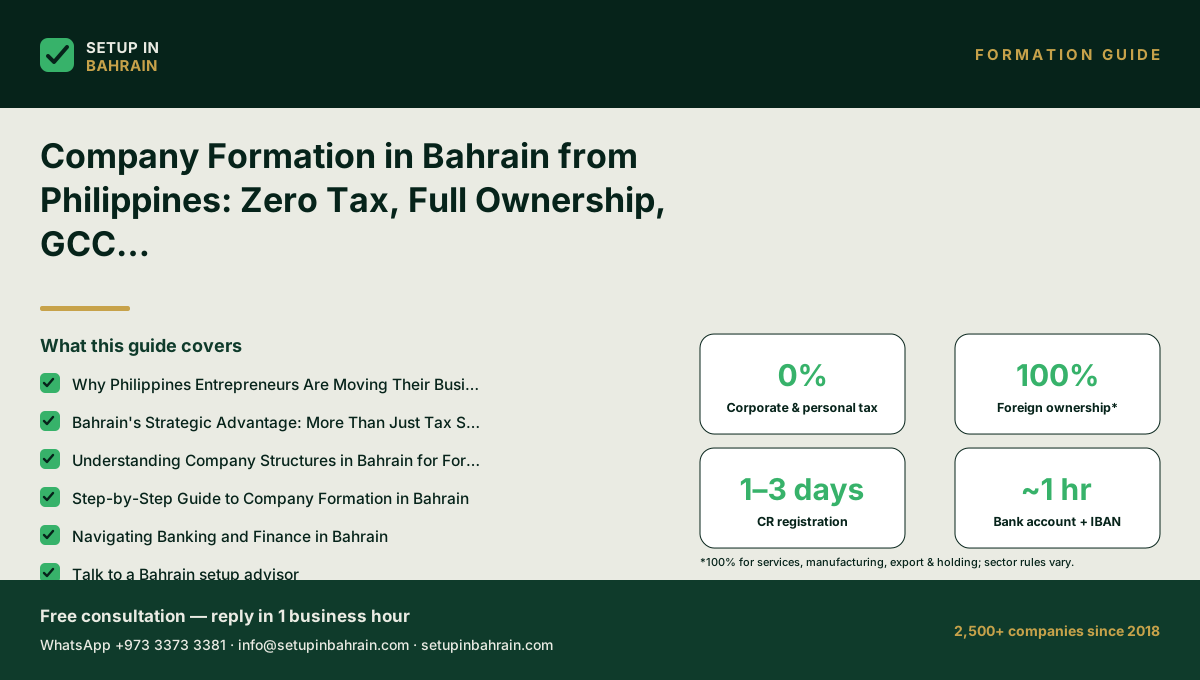
A Bahrain WLL can be owned by a single person — 100% foreign ownership applies to most activities, with no local partner required for services, manufacturing, export trading and holding companies. The minimum share capital is BHD 1; we recommend BHD 1,000, which makes bank account opening and investor visa approval smoother.
When Anna, founder of a thriving digital marketing agency in Makati, finally crossed three million pesos in revenue, her initial elation quickly gave way to a familiar dread: the marching columns of tax returns, the impending Bureau of Internal Revenue (BIR) deadlines, and a substantial 25% corporate tax rate (or 20% for registered small and medium enterprises) hammering each peso of her hard-won income. Finding skilled staff meant navigating the Department of Labor and Employment’s (DOLE) meticulous labor requirements, while expanding to lucrative markets like Singapore or the UAE seemed out of reach with the Bangko Sentral ng Pilipinas (BSP) capital controls on dollar transfers and the ever-shifting sands of the PHP-USD exchange rate. Her story is not unique—if you’re a Philippines entrepreneur, you likely share Anna’s frustrations.
Imagine for a moment a different reality: What if there was a way to keep every earned dollar, escape regulatory bottlenecks, and launch your business directly into the trillion-dollar GCC marketplace in just days? A place where your company could be 100% foreign-owned, with zero corporate income tax, and your profits truly yours to keep and repatriate without restrictions. This isn't a pipe dream; it's the tangible reality of doing business in Bahrain, a dynamic island nation and the GCC’s best-kept secret for growth-minded Philippines founders.
This comprehensive 2026 guide is crafted specifically for you, the ambitious Filipino entrepreneur. We understand your challenges: the complex BIR filing with its monthly, quarterly, and annual returns; the mandatory 12% VAT once your annual sales hit PHP 3 million; SEC registration delays averaging 3 to 4 months; and the constant worry about BSP restrictions on foreign currency outward remittances. Bahrain offers a stark, refreshing contrast, and we’re here to show you exactly how to make the move, painlessly and profitably. From step-by-step setup to unlocking GCC expansion, we cover every detail with real figures and answers to questions only a Philippines business owner would ask.
Why Philippines Entrepreneurs Are Moving Their Business to Bahrain
Let's be candid about the realities of running a successful business in the Philippines. You’ve poured your heart, soul, and capital into building something meaningful. But then, year after year, the government stakes its claim.
Take the case of a Manila-based software development firm that closed 2024 with PHP 18 million in revenue. The owner paid the standard 25% corporate income tax on most profits, diligently filed monthly and quarterly BIR returns plus the annual Income Tax Return (ITR), crossed the PHP 3 million VAT threshold, adding a mandatory 12% output tax to his services, then spent another PHP 420,000 annually on a full-time bookkeeper and external auditor just to stay compliant and avoid penalties. When he tried to move USD 85,000 to a new Singapore client account for an urgent project, BSP documentation requirements stretched the transfer across three weeks and cost an extra 1.8% in bank fees due to processing charges and unfavorable exchange rates. This currency fluctuation between the peso and the dollar could erase a significant chunk of profit on its own.
Consider Kuya Ben, another successful entrepreneur who runs a content creation agency in Cebu. His clients are mostly international, paying him in USD. But when those dollars hit his Philippines bank account, they're immediately subjected to peso volatility, eroding their value even before taxes are calculated. The mandatory 12% VAT on sales above PHP 3 million further complicates his pricing for international clients, making him less competitive. The constant battle with BIR deadlines – from monthly percentage taxes to quarterly income tax returns and the annual audited financial statements – feels like a never-ending administrative burden.
These aren't isolated incidents; they are systemic challenges faced by countless Filipino entrepreneurs:
- High Corporate Income Tax: The Philippines' corporate income tax rate of 25% (or 20% for SMEs with taxable income not exceeding PHP 100 million and total assets not exceeding PHP 100 million) is among the highest in Southeast Asia. This directly reduces your net profits and reinvestment capacity.
- Complex and Frequent Tax Filings: The BIR system demands an arduous schedule of filings. Beyond the standard annual ITR and Audited Financial Statements (AFS), businesses face monthly percentage taxes (if not VAT-registered), quarterly income tax returns, and monthly/quarterly VAT returns if applicable. This constant cycle of compliance requires dedicated resources, often a full-time accountant or outsourced services, adding significant operational costs.
- Mandatory 12% VAT Threshold: Once your gross annual sales or receipts exceed PHP 3 million, you are automatically subject to 12% Value Added Tax (VAT). While input VAT can be offset, managing VAT compliance, calculating output and input taxes, and filing remittances is an additional layer of complexity and cost.
- SEC Registration Delays: Setting up a new corporation or making significant changes can be a bureaucratic marathon. SEC registration can often drag on for 3 to 4 months, delaying your business launch and market entry. Time, as you know, is money.
- BSP Capital Controls and Peso Volatility: The Bangko Sentral ng Pilipinas (BSP) imposes controls on foreign currency outward remittances, particularly for large amounts. Transferring significant capital abroad for investments, international suppliers, or personal reasons often involves extensive documentation, lengthy approval processes, and can incur substantial bank fees and unfavorable exchange rates. The inherent volatility of the Philippine Peso against major currencies like the USD can also significantly erode your international earnings and complicate financial planning.
- DOLE Labor Compliance: While protecting workers is essential, the Philippines' labor laws, as enforced by DOLE, are extensive and can be a labyrinth for employers. Mandatory contributions to Social Security System (SSS), PhilHealth, and Pag-IBIG Fund, along with the 13th-month pay requirement and other benefits, add substantial overheads to payroll. Managing these deductions, remittances, and compliance is a constant administrative task.
Now, let's contrast this with Bahrain:
- Generally no corporate income tax for most sectors: Yes, you read that correctly. Bahrain boasts a 0% corporate income tax rate for most business activities. This means every peso (or rather, every Dinar or dollar) your company earns stays with your company, maximizing your profits and reinvestment potential.
- 100% Foreign Ownership: Forget the need for local partners or nominee shareholders. In Bahrain, a With Limited Liability (WLL) company can be 100% owned by a single foreign individual or entity, giving you complete control over your enterprise.
- Rapid Setup: The Ministry of Industry and Commerce (MOIC) and the Economic Development Board (EDB) have streamlined company formation. You can typically register a business and receive your commercial registration (CR) in a matter of days or weeks, not months.
- Strategic Gateway to a Trillion-Dollar Market: Bahrain is not just an offshore haven; it's a vibrant economy strategically located at the heart of the Gulf Cooperation Council (GCC). With a causeway connecting it directly to Saudi Arabia (the largest economy in the GCC), Bahrain offers unparalleled access to a market of over 50 million affluent consumers and a regional GDP exceeding USD 2.1 trillion.
- Stable Currency and Easy Repatriation: The Bahraini Dinar (BHD) is pegged to the US Dollar at a stable rate of 1 BHD = 2.65 USD. This stability protects your international earnings from currency fluctuations. Moreover, the Central Bank of Bahrain (CBB) maintains an open financial system with no restrictions on capital repatriation, allowing you to freely move your profits and capital globally.
- Minimal Regulatory Burden: While Bahrain is a well-regulated jurisdiction, its approach is generally lighter and more business-friendly compared to the Philippines. Annual compliance requirements are straightforward, allowing you to focus on growth rather than bureaucracy.
For Philippines entrepreneurs like Anna and Kuya Ben, Bahrain isn't just an alternative; it's a strategic upgrade that empowers them to retain more profit, simplify operations, and truly scale internationally.
Bahrain's Strategic Advantage: More Than Just Tax Savings
While the allure of Generally no corporate income tax for most sectors and 100% foreign ownership is undeniably powerful, Bahrain offers a far deeper strategic advantage that resonates particularly with forward-thinking Filipino entrepreneurs. It's not merely an offshore haven; it's a well-connected, dynamic economy designed for growth and international reach.
Gateway to the GCC and Beyond
Think of Bahrain as your launchpad. Positioned centrally in the Arabian Gulf, it offers immediate and efficient access to the entire GCC market – Saudi Arabia, UAE, Qatar, Kuwait, and Oman. This market, with its high disposable income and significant development projects, represents an enormous opportunity for businesses ranging from IT and digital services to e-commerce, consulting, and logistics.
- Saudi Arabian Connection: The King Fahd Causeway links Bahrain directly to the Eastern Province of Saudi Arabia, a major industrial and economic hub. This physical connection facilitates trade, logistics, and personnel movement, making Bahrain an ideal operational base for businesses targeting Saudi Arabia, the region's largest economy.
- Logistics Hub: Bahrain’s modern Khalifa Bin Salman Port, alongside its efficient customs procedures and competitive logistics costs, makes it an attractive hub for distributing goods and services across the GCC and wider MENA (Middle East and North Africa) region. The Bahrain International Airport is also undergoing significant expansion, further enhancing its connectivity.
- Open Trade Policies: Bahrain maintains an open economy with free trade agreements with key global partners, including the United States, Singapore, and a pan-Arab free trade agreement. This fosters an environment conducive to international business and reduces barriers to market entry.
Economic Stability and Pro-Business Environment
The Kingdom of Bahrain has consistently ranked high in global indices for ease of doing business. The World Bank's Ease of Doing Business report has frequently highlighted Bahrain's reforms in areas like starting a business, getting electricity, and enforcing contracts.
- Diversified Economy: While historically reliant on oil, Bahrain has made significant strides in diversifying its economy, with strong growth in financial services, ICT, logistics, manufacturing, and tourism. This diversification creates a resilient economic landscape and a broader base of potential clients and partners.
- Regulatory Framework: The Central Bank of Bahrain (CBB) is a highly respected and robust regulator, particularly for the financial sector. This instills confidence in investors and ensures a stable, transparent operating environment. For non-financial companies, the Ministry of Industry and Commerce (MOIC) oversees commercial registrations and ensures fair business practices.
- Government Support: The Economic Development Board (EDB) of Bahrain acts as a single point of contact for foreign investors, offering extensive support from initial inquiry to setup and beyond. They provide insights into market opportunities, connect businesses with local partners, and assist with navigating regulatory requirements. This level of personalized support is invaluable for foreign entrepreneurs.
Modern Infrastructure and Digital Readiness
Bahrain has invested heavily in developing world-class infrastructure, particularly in its digital capabilities.
- Advanced ICT Infrastructure: The country boasts high internet penetration rates, robust broadband connectivity, and a growing ecosystem of digital services. This makes it an ideal location for technology-driven businesses, remote teams, and those reliant on seamless global communication.
- Smart City Initiatives: Bahrain is actively pursuing smart city initiatives, leveraging technology to enhance urban living and business efficiency. This forward-thinking approach creates a fertile ground for innovation and provides a modern, comfortable environment for residents and businesses alike.
- Educated and Diverse Workforce: While a small nation, Bahrain has a highly educated local workforce complemented by a significant expatriate talent pool. The government prioritizes education and vocational training, ensuring a skilled labor force that is adaptable to the needs of modern businesses. This can be particularly beneficial for Filipino entrepreneurs looking to tap into diverse skill sets or even relocate key staff.
For Filipino entrepreneurs, Bahrain represents not just an escape from local challenges but a proactive step towards scaling their operations globally, securing their assets in a stable economy, and tapping into opportunities far beyond what the Philippine market alone can offer. It’s an investment in a future of lower overheads, higher profits, and unparalleled market access.
Understanding Company Structures in Bahrain for Foreign Investors
Choosing the right legal structure is foundational to your success in Bahrain. For most Filipino entrepreneurs, the With Limited Liability (WLL) company will be the optimal choice. It offers the perfect blend of flexibility, control, and protection for foreign investors.
The With Limited Liability (WLL) Company: Your Primary Option
The WLL company is Bahrain's equivalent of a Private Limited Company and is the most common and versatile entity chosen by foreign investors. Here's why it's ideal for Filipino entrepreneurs:
- 100% Foreign Ownership: This is a crucial distinction. Unlike some other GCC nations or even certain setups in the Philippines that might require local partners or complex joint ventures, a WLL in Bahrain can be 100% owned by a single foreign individual or a foreign corporate entity. You maintain full control over your business decisions, operations, and profits. No nominee shareholders, no mandatory local partners – just your vision, directly implemented.
- Minimum Share Capital: Legally, the minimum share capital for a WLL company in Bahrain is a symbolic BHD 1. This is an incredibly low barrier to entry, demonstrating Bahrain's commitment to attracting diverse businesses.
- Limited Liability: As the name suggests, your personal liability as a shareholder is limited to the amount of your capital contribution. Your personal assets are protected from business debts and obligations.
- Flexibility in Operations: WLLs can engage in a wide range of commercial activities, from trading and consulting to services, technology, and manufacturing, provided the relevant licenses are obtained.
- Number of Shareholders: A WLL can be formed by a single individual (who can be the 100% foreign owner) up to a maximum of 50 shareholders. This flexibility accommodates solo entrepreneurs, partnerships, and larger ventures.
- Management Structure: A WLL is managed by one or more managers (who can be shareholders or third parties). There is no requirement for a board of directors, simplifying the governance structure for smaller operations.
Critical Clarification: No single-shareholder WLL in Bahrain
This is an absolutely vital point that often causes confusion for entrepreneurs accustomed to other jurisdictions. There is NO specific legal entity known as a single-shareholder WLL in Bahrain.
If you are a single entrepreneur from the Philippines intending to own your company 100% in Bahrain, you will establish a With Limited Liability (WLL) company. The Bahraini Commercial Companies Law permits a WLL to be formed and wholly owned by a single shareholder. This effectively serves the purpose of what might be called an "WLL" in other countries, but the correct legal designation in Bahrain is a WLL. Do not search for or ask for an "WLL" as it does not exist under Bahraini law. The WLL is your direct route to solo ownership.
Other Company Types (Less Common for Initial Foreign Investment)
While the WLL is most suitable for most Filipino entrepreneurs, it's worth briefly understanding other structures:
- Bahraini Shareholding Company (BSC) – Public/Closed: These are larger corporate structures, akin to public or private limited companies in the Philippines, typically reserved for larger ventures, listed entities (Public BSC), or substantial private equity investments (Closed BSC). They have higher capital requirements and more stringent governance rules (e.g., mandatory board of directors).
- Partnership Companies: These include General Partnerships, Limited Partnerships, and Partnerships Limited by Shares. They involve unlimited liability for at least one partner and are less common for foreign investors seeking limited liability protection.
- Foreign Branch Office: A foreign company can establish a branch office in Bahrain. This is suitable if you already have an existing, operational company in the Philippines (or elsewhere) and wish to expand its direct presence into Bahrain without creating a separate legal entity. The branch office is not a separate legal entity; its liabilities extend to the parent company. This might be considered if your existing Philippine entity wants to directly enter Bahrain, but for a new, independent venture, a WLL is usually preferred.
- Representative Office: Similar to a branch, but with strictly limited activities (e.g., market research, marketing). It cannot engage in commercial transactions or generate revenue.
For almost all initial company formation scenarios for a Filipino entrepreneur, the WLL company is the most practical, cost-effective, and strategically advantageous choice due to its 100% foreign ownership, limited liability, minimal setup capital (practically BHD 1,000 recommended), and administrative simplicity.
Step-by-Step Guide to Company Formation in Bahrain
Establishing your company in Bahrain is a streamlined process, thanks to the government’s pro-business initiatives, primarily driven by the Ministry of Industry and Commerce (MOIC) and supported by the Economic Development Board (EDB). While specific timelines can vary based on your activity and responsiveness, the process is considerably faster and less cumbersome than what you might experience with the SEC in the Philippines.
Here's a detailed roadmap:
Step 1: Preliminary Research and Activity Definition (Pre-Application)
Before you even touch a form, clear definition is key.
- Define Your Business Activity: What exactly will your company do? Be precise. Bahrain's MOIC has a comprehensive list of commercial activities, each with specific codes. Your chosen activity will dictate the licenses required. For instance, a "digital marketing agency" will have different requirements than a "software development company" or a "trading enterprise."
- Due Diligence: Understand the market, your target audience in the GCC, and any specific regulatory requirements for your industry. The EDB can be an invaluable resource here, providing market intelligence and guidance.
- Choose Your Company Name: Select a few potential names, ensuring they are unique, not offensive, and not already registered in Bahrain. MOIC will verify availability.
Step 2: MOIC Commercial Registration (CR) Application
This is the core of your company setup.
- Name Reservation:
- Initial Approval (Pre-Approval):
- Capital Deposit (Optional at this stage, but often required by banks):
- Final Approval and Issuance of Commercial Registration (CR):
Step 3: Obtaining Activity-Specific Licenses (Post-CR)
While the CR allows your company to exist, certain regulated activities require additional permits.
- Regulated Activities: If your business falls into sectors like financial services (regulated by CBB), healthcare (NHRA), education (MOE), or certain types of trading, you'll need to obtain specific licenses from the relevant ministries or regulatory bodies.
- EDB Support: The EDB (Economic Development Board) is excellent at guiding you through this. They act as a facilitator, helping you identify and apply for these licenses. For instance, a financial technology (fintech) company would need direct approval from the CBB.
- Timeline: This step’s duration varies widely depending on the complexity of your activity and the specific regulatory body. It could be a few days for minor approvals or several weeks for highly regulated sectors.
Step 4: Securing an Office Space
You need a registered address for your company in Bahrain.
- Physical Office: Many companies opt for a traditional physical office. This can range from a small serviced office to a larger leased space in one of Bahrain's business districts (e.g., Manama, Seef).
- Virtual Office (for specific activities): For certain types of businesses (e.g., consulting, IT services, e-commerce) where a physical presence isn't strictly necessary for daily operations, virtual office providers are available. They offer a registered address, mail handling, and sometimes access to meeting rooms. This can be a very cost-effective solution initially.
- EDB Incubation Programs: For startups and tech companies, the EDB sometimes offers incubation programs or access to co-working spaces with reduced rents, which can be an excellent starting point.
- Lease Agreement: Once you choose your space, you'll sign a lease agreement, which needs to be registered with relevant authorities.
Step 5: Opening a Corporate Bank Account
This is a critical practical step, often taking longer than the CR itself.
- Central Bank of Bahrain (CBB) Regulation: The CBB supervises all financial institutions, ensuring stability and compliance.
- Documentation: Banks will require a certified copy of your Commercial Registration (CR), your company’s Memorandum and Articles of Association, passport copies of all shareholders and authorized signatories, proof of your residential address, and often a comprehensive business plan detailing your operations, revenue projections, and source of funds.
- In-Person Visit: While some preliminary steps can be done remotely, expect to make an in-person visit to Bahrain to finalize the bank account opening. Due to stringent AML (Anti-Money Laundering) and KYC (Know Your Customer) regulations, banks almost always require the authorized signatory to be physically present.
- Practical Tip for Philippines Entrepreneurs: Be prepared to explain your source of funds and the nature of your business thoroughly. Banks are increasingly cautious about international transactions and financial crime. Having a well-prepared business plan and clear documentation of your financial background will expedite the process.
- Timeline: This can take anywhere from 2-4 weeks after all documents are submitted and the in-person visit is completed. Patience and thorough preparation are key here.
Step 6: Obtaining Your Investor Visa and CPR (Optional, but highly recommended)
If you plan to reside in Bahrain and manage your business directly.
- Investor Visa Application: As the owner of a Bahraini company, you are eligible to apply for an investor visa. This typically requires your company’s CR, bank statements (showing sufficient funds to support yourself and your business), a medical examination, and good conduct certificates.
- Central Population Registry (CPR) Card: Upon approval of your visa, you will be issued a CPR card, which is Bahrain’s national ID card. This card is essential for virtually all aspects of daily life, from signing leases to utility hook-ups.
- Sponsorship for Dependents: Once you have your investor visa and CPR, you can sponsor your immediate family members (spouse, children) to reside in Bahrain.
- Timeline: The visa process can take 2-4 weeks once all documentation is submitted.
Step 7: Post-Formation Compliance
Once your company is registered and operational:
- Labor Registration (if hiring): If you plan to hire employees (local or expatriate), you'll need to register with the Labour Market Regulatory Authority (LMRA). This involves obtaining a labor registration for your company and then applying for work permits for your employees.
- Social Insurance (if hiring): Register with the Social Insurance Organization (SIO) for local employees.
- Annual Renewals: Your Commercial Registration and any activity-specific licenses will need to be renewed annually. This is a straightforward process typically done through the MOIC's Sijilat portal.
By following these steps, you can efficiently establish your presence in Bahrain, paving the way for a tax-efficient and globally connected business operation. The key is to be meticulous with documentation and leverage the expertise of local consultants or the EDB when needed.
Navigating Banking and Finance in Bahrain
For any entrepreneur, especially those seeking to escape the capital controls and volatility of their home country, the banking system of a new jurisdiction is paramount. Bahrain, under the vigilant eye of the Central Bank of Bahrain (CBB), offers a robust, stable, and highly liquid financial environment that provides significant advantages for Filipino entrepreneurs.
The Central Bank of Bahrain (CBB): A Pillar of Stability
The CBB is one of the most respected regulatory bodies in the Middle East. It maintains a sophisticated and transparent regulatory framework that governs all financial institutions, from conventional retail banks to Islamic banks, investment firms, and insurance companies. This strong regulatory oversight ensures:
- Financial Stability: A secure and well-capitalized banking sector.
- Transparency: Clear rules and guidelines for banking operations.
- Investor Protection: Measures to safeguard deposits and investments.
For you, this translates into peace of mind. Your funds are held in a secure environment, far removed from the unpredictability of less regulated markets.
Ease of International Transactions and Fund Repatriation
This is a game-changer for Filipino entrepreneurs. One of the major pain points in the Philippines is the restriction and complexity surrounding outward remittances and foreign currency transfers. In Bahrain:
- No Capital Controls: The CBB operates an open financial system. There are virtually no restrictions on the inward or outward movement of capital. You can freely repatriate your profits, dividends, and capital from Bahrain to any country in the world without bureaucratic hurdles or lengthy approval processes (
Bahrain Business Guides for Philippines Citizens
Ready to set up in Bahrain from Philippines?
Tell us your business idea. We map the right entity, ownership and timeline — then handle the filing while you focus on what matters.