Complete guide for Papua New Guinea entrepreneurs: form a company in Bahrain with generally no corporate income tax for most sectors, 100% foreign ownership. GCC market access. Costs, steps, visas, banking.
Key Takeaways
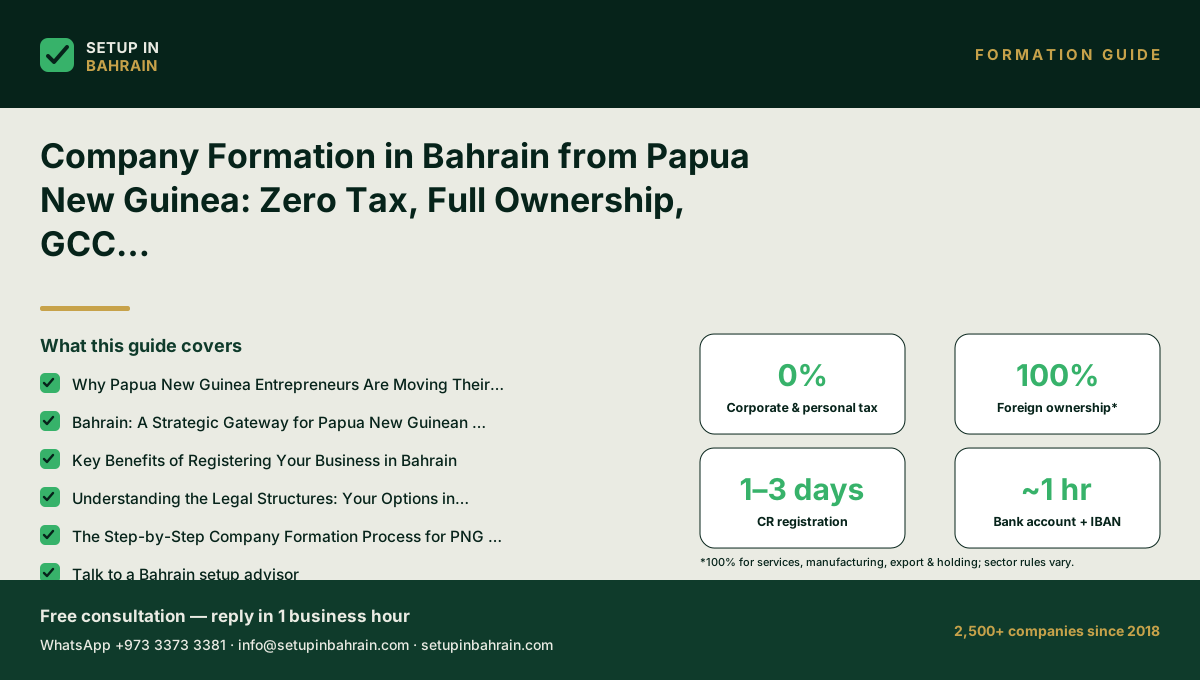
- Why Papua New Guinea Entrepreneurs Are Moving Their Business to Bahrain
- Bahrain: A Strategic Gateway for Papua New Guinean Visionaries
- Key Benefits of Registering Your Business in Bahrain
- Understanding the Legal Structures: Your Options in Bahrain
- The Step-by-Step Company Formation Process for PNG Entrepreneurs
→ Complete guide: Company Formation in Bahrain — the full 2026 guide
View details
Ownership & capital
A Bahrain WLL can be owned by a single person — 100% foreign ownership applies to most activities, with no local partner required for services, manufacturing, export trading and holding companies. The minimum share capital is BHD 1 ; we recommend BHD 1,000 . This Makes bank account opening and investor visa approval smoother.
Imagine this: Sampson, a Port Moresby-based logistics entrepreneur, sits in his office after a productive year. He’s proud of his team and the growth they’ve achieved. A familiar dread creeps in as he prepares for the annual corporate tax payment to the Internal Revenue Commission (IRC). A substantial 30% of his hard-won profits will disappear overnight. His accountant, always diligent, frowns – not just at the final number, but at the sheer time and energy spent wrestling with limited online tax filing infrastructure, the Bank of Papua New Guinea’s (BPNG) tight currency controls, and the constant reality that all his expansion dreams feel boxed in by the country’s rigid rules for outbound investment and business ownership.
Now imagine Sampson discovering that, just 10 hours by air from PNG, Bahrain offers him a radically different business future: zero income tax on corporate profits, complete 100% foreign ownership of his venture, a stable US dollar-pegged currency, an incredibly easy and efficient online company setup process, and a direct, unfettered bridge to the lucrative $2 trillion Gulf Cooperation Council (GCC) market. For entrepreneurs like Sampson, who dream of scaling their business beyond the immediate shores of the Pacific, this isn't just an opportunity; it's a profound paradigm shift.
If this sounds like the kind of leap that could transform your business, offering a clear path to global expansion and greatly greater profitability, then this comprehensive guide is written specifically for you. We’re going to navigate the specific challenges you face in Papua New Guinea and unveil how Bahrain stands as a beacon of opportunity, designed to empower visionaries like yourself.
Why Papua New Guinea Entrepreneurs Are Moving Their Business to Bahrain
For decades, Papua New Guinean entrepreneurs have often found themselves operating within borders drawn tighter by regulatory friction, currency inconvertibility. Infrastructure constraints. While local industries – such as shipping, fisheries, agri-processing, extractives. Professional services – are rich in potential, ambitious growth often slams into a few hard walls that stifle international competitiveness and wealth accumulation.
Let's unpack these critical pain points you face in PNG. Why they make Bahrain such an appealing alternative:
- The Weight of 30% Corporate Income Tax: The IRC’s corporate income tax rate of 30% is not just high; it's one of the highest effective rates in the ASEAN-Pacific region. Unlike many other nations, PNG offers minimal preferential tax regimes for specific sectors that might otherwise spur diversified growth. For a business clearing PGK 4.8 million (about USD 1.25 million at current rates) in annual profit, that’s PGK 1.44 million – nearly half a million US dollars – going directly to tax. This greatly reduces retained earnings available for re-investment, innovation, or expansion. In Bahrain, that entire sum, for most business activities, remains within your company.
- Limited Digital Filing Infrastructure for Tax and Compliance: While progress is being made, the IRC’s digital filing infrastructure is often described by entrepreneurs as cumbersome and prone to delays. What should be a straightforward process often becomes a paper-heavy, time-consuming ordeal, diverting valuable operational hours away from core business activities. This isn't just an inconvenience; it's a hidden cost of doing business, demanding more administrative overhead and reducing efficiency. Bahrain, in stark contrast, offers a largely digitized government services ecosystem, exemplified by its Sijilat portal.
The PGK's Managed Float and Limited Convertibility: The Papua New Guinean Kina (PGK) operates under a managed float. This Means its value is actively influenced by the Bank of Papua New Guinea (BPNG). This can lead to periods of unpredictable exchange rate volatility, making long-term financial planning for international transactions extremely challenging. When you’re importing critical equipment or raw materials, or needing to pay international suppliers, the constantly shifting value of the PGK adds a layer of risk and uncertainty to your cost base.
- BPNG Restrictions on Foreign Currency Outflows: This is perhaps one of the most significant impediments to international expansion for PNG entrepreneurs. The BPNG maintains tight controls and approval processes for foreign currency outflows. Moving capital abroad, paying international service providers, or repatriating profits from a foreign venture back to PNG can involve bureaucratic hurdles and approval delays that routinely stretch from six to nine weeks. This administrative friction makes it incredibly difficult to operate agilely in the global marketplace, where swift financial transactions are often the norm. Imagine needing to pay a crucial software vendor or an overseas consultant, only to be held up for months.
Mandatory Majority Local Ownership Rules: Many sectors in PNG, especially in services, retail. Various small to medium-sized enterprises (SMEs), still require majority local ownership. This means if you, as a Papua New Guinean citizen, seek to establish an international partnership or create a group structure where you have full control, you might find your options severely limited within PNG. This can stifle innovation, deter foreign direct investment, and prevent local entrepreneurs from fully controlling their global ventures. Bahrain, as we will explore, offers a completely different model: 100% foreign ownership in most sectors.
- Geographic Isolation and Logistics Premiums: Expanding into new markets, especially the lucrative Middle East, Africa, or Europe, often comes with a significant logistical premium due to PNG's geographic isolation. Shipping costs can add anywhere from 30% to 40% to the landed cost of goods, making your products less competitive. Bahrain, strategically positioned at the heart of key trade routes, dramatically reduces these costs and complexities, acting as an ideal distribution hub.
Consider a practical scenario: a Port Moresby-based logistics and procurement company serving the mining sector clears PGK 4.8 million in annual profit. After the 30% corporate income tax, plus additional compliance and audit fees that routinely add another PGK 180,000, the owner is left with roughly PGK 3.18 million. The business then faces BPNG foreign-exchange approval delays of six to nine weeks for every outward payment. The kina’s managed float creates constant uncertainty on imported equipment costs. When the owner explored expanding into Saudi Arabia, the 30–40% logistics premium from geographic isolation made the venture economically unviable.
Now, picture that same entrepreneur in Bahrain. Their business operates without corporate income tax, enjoys full control, experiences seamless foreign exchange, and is perfectly positioned to serve not only Saudi Arabia (just a 25-minute drive via the King Fahd Causeway) but the entire GCC region. This isn't just an incremental improvement; it's a foundational redesign of their business trajectory.
Bahrain: A Strategic Gateway for Papua New Guinean Visionaries
Bahrain, an island nation nestled in the Arabian Gulf, has meticulously carved out a niche for itself as a leading financial hub, a tech-forward economy, and a truly open and welcoming destination for international business. For entrepreneurs from Papua New Guinea, it presents not just an escape from domestic constraints but a strategic launchpad into new, expansive markets.
Why Bahrain Stands Out:
Prime Geographic Location: Bahrain sits at the geographic and economic heart of the GCC, offering unparalleled access to a market of over 58 million high-net-worth consumers and a collective GDP exceeding $2 trillion. Crucially, it's directly connected to Saudi Arabia, the largest economy in the Middle East, by the King Fahd Causeway. This means your Bahraini company can physically serve customers in Saudi Arabia with ease, making it a critical entry point. Economic Stability and Diversification: For over 50 years, Bahrain has focused on diversifying its economy away from oil, building robust sectors in financial services, logistics, manufacturing, tourism, and information and communication technology (ICT). This foresight has resulted in a resilient, stable economy, as evidenced by consistent growth rates and a commitment to business-friendly policies. A Liberal and Progressive Business Environment: The Kingdom of Bahrain prides itself on its open-door policy for foreign investment. This isn't just rhetoric; it’s enshrined in law and actively promoted by entities like the Bahrain Economic Development Board (EDB) and the Ministry of Industry, Commerce and Tourism (MOIC). They understand that attracting global talent and capital is key to future prosperity. World-Class Infrastructure: From state-of-the-art airports and seaports (like Khalifa Bin Salman Port, which is highly efficient for cargo transit) to high-speed digital connectivity and modern logistics parks, Bahrain's infrastructure is designed to support international trade and advanced business operations. A Global Financial Hub: With the Central Bank of Bahrain (CBB) overseeing a sophisticated and well-regulated financial sector, Bahrain offers access to a diverse range of local and international banks, investment funds, and fintech innovators. This makes capital raising, treasury management. International banking exceptionally smooth – a stark contrast to the currency control challenges in PNG. Gateway to a Wider Market: Beyond the GCC, Bahrain's strategic location and network of Free Trade Agreements (FTAs) provide a bridge to markets in North Africa, the Levant, Europe, and even parts of Asia.
Specific Sectors Attracting PNG Entrepreneurs:
Given PNG's economic strengths and the ambitions of its entrepreneurs, certain sectors in Bahrain align perfectly:
- Logistics & Distribution: For PNG companies in shipping, import/export, or those looking to distribute products internationally, Bahrain offers a superior hub. Its efficient ports, free zones, and connectivity to Saudi Arabia make it ideal.
- e-Commerce & Digital Services: With a young, tech-savvy population and high digital penetration in the GCC, an e-commerce platform or digital services company based in Bahrain can tap into a massive online market without the logistical headaches faced when operating from PNG.
- Manufacturing & Assembly: For value-added processing, even of PNG-origin materials (e.g., specific agricultural products, specialized components), Bahrain's industrial zones and skilled workforce offer competitive advantages and easy access to export markets.
- Financial Services & Fintech: For those in financial advisory, payment solutions, or tech-driven finance, Bahrain's robust regulatory sandbox and established financial ecosystem are highly attractive.
- Consulting & Professional Services: Setting up a consultancy in Bahrain allows you to serve regional clients, leveraging the zero-tax environment and professional reputation.
By establishing a presence in Bahrain, you're not just moving your business; you're elevating it onto a global stage, de-risking your operations, and unlocking opportunities that are simply unattainable from your home country.
Key Benefits of Registering Your Business in Bahrain
The shift from operating in Papua New Guinea to establishing a base in Bahrain offers a multitude of tangible advantages that directly address and overcome the limitations you currently face. Let's delve into these core benefits:
1. Zero Corporate Income Tax
This is often the most compelling advantage for entrepreneurs from PNG. Unlike the 30% corporate income tax levied by the IRC in Papua New Guinea, Bahrain imposes zero corporate income tax on most business activities. There are generally no personal income taxes, wealth taxes, or capital gains taxes either. The only significant tax is Value Added Tax (VAT), introduced in 2019 at a standard rate of 10%. This Applies to businesses with an annual turnover exceeding BHD 37,500 (about USD 99,500). But, VAT is a consumption tax, meaning it's ultimately paid by the end-consumer. Businesses typically act as collection agents, not taxpayers on their profits.
- Impact for PNG Entrepreneurs: Imagine retaining an additional 30% of your net profits. This capital can be reinvested into your business, used for innovation, expansion, marketing, or simply provide a higher return to shareholders. This isn't just a saving; it's a fundamental shift in your business's financial potential and growth trajectory. For a business generating PGK 5 million in annual profits, moving to Bahrain could mean retaining an additional PGK 1.5 million (over USD 400,000) each year.
2. 100% Foreign Ownership
For many sectors in Papua New Guinea, foreign entrepreneurs or even PNG citizens seeking international collaboration often encounter mandatory majority local ownership rules, limiting their control and flexibility. Bahrain offers a starkly different reality:
- Complete Control: In Bahrain, you can own 100% of your company in most sectors, especially for the widely used With Limited Liability (WLL) company structure. There is no requirement for a local partner or sponsor. This empowers you with full operational and strategic control over your venture, a level of autonomy rarely found in many developing economies.
- Streamlined Decision-Making: Without the need to negotiate with local partners on shareholding, profit distribution, or strategic direction, decision-making processes are greatly streamlined, allowing for greater agility and faster execution of your business plans.
3. Stable, US Dollar-Pegged Currency (BHD)
The Bahraini Dinar (BHD) has been officially pegged to the US Dollar at a fixed rate of 1 BHD = 2.6596 USD since 1986. This long-standing peg provides an extraordinary level of currency stability and predictability.
Contrast with PGK: For PNG entrepreneurs accustomed to the managed float of the PGK and the associated unpredictability and BPNG foreign exchange outflow restrictions, the BHD's stability is a game-changer. Benefits for International Trade: This peg eliminates foreign exchange risk when dealing with USD-denominated transactions, simplifying financial planning, budgeting. International trade. Importing goods, paying international suppliers, or repatriating profits become predictable processes, free from the currency fluctuations that can erode margins.
4. World-Class Infrastructure and Connectivity
Bahrain has invested heavily in creating an infrastructure that supports a modern, globally connected economy:
- Logistics & Ports: The Khalifa Bin Salman Port is a highly efficient deep-water port, facilitating smooth cargo movement. Bahrain International Airport is a modern, well-connected air cargo and passenger hub.
- Digital Infrastructure: High-speed internet, 5G networks, and robust data centers ensure that digital businesses can operate seamlessly. The government’s e-services portal, Sijilat, is a testament to this digital commitment.
- Physical Infrastructure: Modern office spaces, well-maintained roads, and efficient utilities contribute to a smooth operating environment.
5. Simplified Business Setup & Regulatory Environment
The Bahrain Economic Development Board (EDB) and the Ministry of Industry, Commerce and Tourism (MOIC) are actively committed to making Bahrain one of the easiest places in the world to start and run a business.
Online Sijilat Portal: The MOIC's Sijilat portal allows for most company registration processes to be completed online, reducing bureaucracy and processing times. Pro-Business Regulations: Bahrain consistently ranks high in global ease of doing business indices (e.g., World Bank's Doing Business Report), reflecting its continuous efforts to streamline regulations and cut red tape. Support from EDB: The EDB acts as a single point of contact for foreign investors, offering extensive support, guidance. Facilitation throughout the setup process.
6. Access to a $2 Trillion GCC Market
Bahrain is not just a destination; it's a gateway.
Direct Access: Its strategic location, especially the King Fahd Causeway to Saudi Arabia, provides direct and immediate access to the largest economy in the Middle East. This means your Bahraini-registered company can efficiently serve customers across the entire GCC region. This Boasts a combined GDP exceeding $2 trillion and a youthful, affluent population of over 58 million. Consumer Power: The GCC market is characterized by high disposable incomes and a strong demand for quality goods and services, offering immense growth potential for businesses willing to cater to its needs.
7. Highly Skilled and Cost-Effective Workforce
Bahrain boasts a diverse and well-educated workforce, comprising both Bahraini nationals and expatriates from around the globe.
Skilled Talent Pool: The government has heavily invested in education and vocational training, producing a skilled national workforce, especially in finance, technology. Services. Competitive Labor Costs: Compared to other major international hubs, labor costs in Bahrain are relatively competitive, offering excellent value for skilled personnel. Multicultural Environment: The expatriate population brings a wealth of international experience and linguistic diversity, making it easy to build a team that understands global markets.
8. Extensive Free Trade Agreements (FTAs)
Bahrain has cultivated a robust network of FTAs with key global economies, enhancing its appeal as a trade hub.
US-Bahrain FTA: This was the first FTA between the US and a GCC member and offers significant advantages for companies looking to export to the United States. Singapore-Bahrain FTA: Provides preferential access to the Southeast Asian market. Pan-Arab Free Trade Area (PAFTA) & GCC Common Market: Ensures free movement of goods, services. Capital within the wider Arab and GCC regions.
These benefits collectively create an environment where your business, free from the burdens of high taxation, ownership restrictions. Currency volatility, can truly flourish and achieve its global potential.
Understanding the Legal Structures: Your Options in Bahrain
When forming a company in Bahrain, selecting the right legal structure is paramount. It determines your liability, ownership structure, capital requirements, and administrative obligations. For most Papua New Guinean entrepreneurs, especially those starting an SME, the With Limited Liability (WLL) company will be the most suitable and recommended option.
1. With Limited Liability Company (WLL)
The WLL is the most popular and flexible company type in Bahrain for foreign investors. It offers significant advantages that directly address the pain points faced by PNG entrepreneurs.
CRITICAL: 100% Foreign Ownership: This is a key differentiator. A WLL in Bahrain can be owned 100% by a single person with zero partners required. This means you, as a Papua New Guinean entrepreneur, can have complete, undisputed control over your Bahraini entity. There is no need for local partners or sponsors to hold shares, giving you absolute autonomy. CRITICAL: Minimum Share Capital: Legally, the minimum share capital for a WLL is BHD 1 . This is the absolute statutory minimum set by law. But, for practical purposes, especially when you need to open a corporate bank account and apply for an investor's visa, banks and immigration authorities typically prefer to see a more substantial capital commitment. So, the strong practical recommendation is to budget for and initially deposit BHD 1,000 as the starting capital. This greatly improves your chances of smooth bank account approval and visa processing, making your operational setup much faster and less problematic. Limited Liability: As the name suggests, the liability of the shareholders is limited to the amount of their share capital. Your personal assets are protected from the company's debts and obligations, provided you adhere to legal and ethical business practices. Flexibility: WLLs are suitable for a wide range of commercial activities, from trading and services to consulting and logistics. Management: A WLL is managed by one or more directors. They do not need to be Bahraini residents initially. For an investor visa application, at least one director will typically need to become a resident. No single-shareholder WLL in Bahrain: It is crucial to understand that there is NO single-shareholder WLL legal structure in Bahrain . Any mention of WLL in other jurisdictions does not apply here. The WLL structure, allowing 100% single ownership, effectively serves the purpose of a single-shareholder WLL, making it the go-to choice for solo entrepreneurs.
2. Bahrain Shareholding Company (BSC - Closed or Public)
These structures are generally for larger enterprises, often with multiple shareholders, or those looking to raise public capital.
- BSC Closed: Suitable for a limited number of shareholders, typically for family businesses or private equity ventures. Minimum share capital is BHD 1 (we recommend BHD 1,000).
- BSC Public: Designed for companies planning to list on a stock exchange and raise capital from the public. This has higher regulatory requirements and a minimum share capital of BHD 250,000.
- Relevance for PNG Entrepreneurs: While these options exist, they are less likely to be the initial choice for most PNG entrepreneurs who are establishing their first international entity. The WLL offers sufficient flexibility and benefits for most SME needs.
3. Branch of a Foreign Company
If you already have an established and operational company in Papua New Guinea, you can register a branch of that foreign company in Bahrain.
Legal Continuity: The branch is an extension of the parent company, not a separate legal entity. Its liabilities extend back to the parent company. Activities: The branch can only conduct activities identical to those of the parent company. Capital: There is no specific minimum capital requirement for a branch. The parent company must show financial solvency. Relevance for PNG Entrepreneurs: This option is ideal for established PNG businesses looking to expand their existing operations directly into the GCC market, maintaining a single corporate identity.
4. Holding Company Structure
While not a standalone legal structure, a WLL or BSC can be formed as a holding company. This is a strategic choice for entrepreneurs who plan to:
- Consolidate Assets: Hold shares in other operating companies (both in Bahrain and internationally).
- Intellectual Property Management: Own and license intellectual property.
- Asset Protection: Centralize and protect group assets.
- Tax Efficiency: Help tax-efficient structuring for international operations, leveraging Bahrain's zero-tax environment.
Choosing Your Structure:
For most Papua New Guinean entrepreneurs venturing into Bahrain, the With Limited Liability (WLL) company will be the most practical and advantageous choice. Its combination of 100% foreign ownership, limited liability, and realistic capital requirements makes it accessible and powerful. Always seek professional advice from a Bahraini legal expert or corporate service provider to ensure your chosen structure perfectly aligns with your specific business goals and long-term vision.
The Step-by-Step Company Formation Process for PNG Entrepreneurs
Setting up a company in Bahrain has been greatly streamlined by the Ministry of Industry, Commerce and Tourism (MOIC) and the Bahrain Economic Development Board (EDB). The process is largely digitized through the Sijilat portal, making it remarkably efficient compared to many jurisdictions. Especially so when contrasted with the administrative burdens in Papua New Guinea.
Here’s a detailed, step-by-step guide for PNG entrepreneurs:
Phase 1: Pre-Registration & Planning
Develop Your Business Plan: Before anything else, clearly define your business activities, target market in Bahrain/GCC, revenue model. Operational strategy. This will guide your legal structure and licensing requirements. Seek Professional Guidance: Engaging a local corporate service provider or legal consultant in Bahrain from the outset is highly recommended. They can navigate the nuances, ensure compliance, and expedite the process. The EDB can also connect you with reputable service providers. Choose Your Company Name: Select a unique name for your company. You can check availability and reserve it via the Sijilat portal. The name must comply with MOIC regulations (e.g., not offensive, not misleading, relevant to your activities). Define Business Activities (CR Activities): Clearly specify all the commercial activities your company will undertake. These are categorized by MOIC and dictate the type of licenses you'll need. Your service provider can help classify these correctly. Identify Shareholding Structure & Management: For a WLL, confirm whether you will be the sole 100% owner or if you have other shareholders. Identify who will be the director(s) and authorized signatory(ies).
Phase 2: Document Preparation
This phase involves gathering and preparing the necessary legal and personal documents. All documents from PNG typically need to be notarized and attested by the Ministry of Foreign Affairs in PNG, and then legalized by the Bahraini Embassy or Consulate (if one exists, otherwise by a neighboring embassy or a country with shared diplomatic relations, or by the Bahraini Ministry of Foreign Affairs upon arrival). Your service provider can advise on the exact attestation requirements.
Shareholders/Directors (for individuals): * Passport copies (valid for at least 6 months) * Proof of residential address (e.g., utility bill from PNG, bank statement) * Bank reference letter (sometimes required by banks for account opening) * CV/Resume (often requested by banks for KYC) Shareholders (for corporate entities - if your PNG company is investing): * Certificate of Incorporation of the parent PNG company * Memorandum and Articles of Association (M&AA) of the parent company * Board Resolution from the parent company authorizing the setup of the Bahraini entity and appointing representatives. * Passport copies of the directors/authorized signatories of the parent company. Memorandum of Association (MOA) & Articles of Association (AOA): These are the foundational legal documents for your Bahraini company. Your corporate service provider will draft these according to Bahraini law, outlining the company's purpose, share capital, management. Shareholder rights. Initial Capital Deposit Proof: While the legal minimum for a WLL is BHD 1, banks will require proof of deposit for a higher amount, typically BHD 1,000 , to open the corporate bank account. This deposit usually happens after* initial MOIC approval but before the final Commercial Registration (CR) is issued.
Phase 3: MOIC Application via Sijilat Portal
This is the core of the registration process, handled primarily through the user-friendly Sijilat portal (www.sijilat.bh).
Online Application Submission: Your service provider will upload all prepared documents and the drafted MOA/AOA to the Sijilat portal. Initial Approval: MOIC reviews the application, proposed name, and activities. This typically takes a few days. Once approved, you receive an initial approval certificate. Finalization & Signature: The MOA/AOA will need to be signed by the shareholders/authorized signatories. This can sometimes be done remotely via power of attorney. For certain stages, physical presence in Bahrain might be preferred or required, especially for bank account opening. Commercial Registration (CR) Issuance: Once all requirements are met and the MOIC is satisfied, your Commercial Registration (CR) Certificate is issued. This is the official document confirming your company's legal existence in Bahrain. This usually takes 3-5 working days after all documents are approved.
Phase 4: Corporate Bank Account Opening
This is a crucial step, and often where entrepreneurs face unexpected delays if not properly prepared.
Bank Selection: Bahrain has a robust banking sector with numerous local and international banks (e.g., BBK, NBB, Ahli United Bank, HSBC, Standard Chartered). Choose a bank that best suits your needs. KYC & Due Diligence: Banks in Bahrain, like globally, have stringent Know Your Customer (KYC) and Anti-Money Laundering (AML) requirements. This is where your personal CV, bank reference, and detailed business plan become important. Initial Deposit: You will need to make the initial capital deposit (recommended BHD 1,000 ) into the corporate account to activate it. The bank will then issue a letter confirming the capital deposit. This Is submitted back to MOIC for final CR issuance if it hasn't been issued yet. Process Time: Bank account opening can take anywhere from 1-4 weeks, depending on the bank and the complexity of your profile. Having an authorized signatory physically present in Bahrain for the initial meeting is often highly beneficial, if not mandatory, for certain banks.
Phase 5: Licensing & Visa Application
Once your CR is issued and bank account is active, you can move to operational setup.
- Activity-Specific Licenses: Depending on your business activities (e.g., financial services, healthcare, education), you may require additional permits or licenses from specific regulatory bodies (e.g., CBB for financial services, Ministry of Health for medical clinics). Your service provider will identify and help secure these.
- Investor Visa Application: As a 100% owner of a Bahraini WLL, you are eligible to apply for an investor visa. This allows you to reside and work in Bahrain.
Bahrain Business Guides for Papua New Guinea Citizens
Frequently Asked Questions
How long does it take to set up?
It takes 15 to 20 days. We file all forms for you. You do not need to wait long.
What does it cost?
Company formation: Standard BHD 1,340 with 3 months of office address; Gold BHD 1,700 with 6 months; Premium BHD 2,150 with 12 months and a cabin, officer table and chair, and two guest chairs. No formation package includes visas, including Premium. Investor/work visas are priced separately: BHD 755 for one year or BHD 953 for two years, in addition to the formation package. Ask for a written, itemized quotation confirming government fees and all inclusions before payment.
Do I need to visit Bahrain?
No. You can set up your firm from home. We do all the work online. Some banks may ask for one visit.
What tax will I pay?
You pay zero tax on your profits. Bahrain has no corporate income tax. This is a key benefit of the setup.
Can I own 100% of my firm?
Yes. Foreign owners can hold all shares. No local partner is needed. Full ownership is allowed.
What do I need to start?
You need a valid passport. You also need a trade name and a business address. We help you with all of these.
How do I open a bank account?
We guide you step by step. Most banks take 3 to 6 weeks. You will need your CR and firm papers.
Who issues the Commercial Registration (CR)?
The CR is issued by the MOICT. It is your legal right to trade in Bahrain. We file the CR for you.
Can I renew my CR each year?
Company renewal packages: BHD 530 with 3 months of office address; BHD 980 with 6 months; BHD 1,520 with 12 months. These are separate renewal packages, not visa fees.
How do I get started?
Fill in our form on this page. Our team will call you back. We map your best setup plan at no cost.
Steps to Form Your Company
- Pick your trade name. We check if it is free.
- Choose your business type. WLL is the most common.
- Sign the MOA. We draft and file all legal docs.
- Pay the state fees. About BHD 432 in total.
- Get your CR. Takes 15 to 20 days.
- Open your bank account. We guide each step.
- Start trading. You are ready to do business.
Key Facts
- Tax rate: 0%
- Foreign ownership: 100%
- Setup time: 15 to 20 days
- Company formation: Standard BHD 1,340 with 3 months of office address; Gold BHD 1,700 with 6 months; Premium BHD 2,150 with 12 months and a cabin, officer table and chair, and two guest chairs. No formation package includes visas, including Premium. Investor/work visas are priced separately: BHD 755 for one year or BHD 953 for two years, in addition to the formation package. Ask for a written, itemized quotation confirming government fees and all inclusions before payment.
- Company renewal packages: BHD 530 with 3 months of office address; BHD 980 with 6 months; BHD 1,520 with 12 months. These are separate renewal packages, not visa fees.
- Client rating: 4.8 stars
- Clients served: 2,500 and more
Quick Facts
- Tax rate: 0%
- Own all of your firm: Yes, 100%
- Time to set up: 15 to 20 days
- Company formation: Standard BHD 1,340 with 3 months of office address; Gold BHD 1,700 with 6 months; Premium BHD 2,150 with 12 months and a cabin, officer table and chair, and two guest chairs. No formation package includes visas, including Premium. Investor/work visas are priced separately: BHD 755 for one year or BHD 953 for two years, in addition to the formation package. Ask for a written, itemized quotation confirming government fees and all inclusions before payment.
- Company renewal packages: BHD 530 with 3 months of office address; BHD 980 with 6 months; BHD 1,520 with 12 months. These are separate renewal packages, not visa fees.
- Rating: 4.8 stars
- Clients: 2,500 and more
Why Bahrain?
Bahrain has no tax. You keep all your profits. This is rare in the Gulf.
You can own all of your firm. No local partner is needed. The law allows full foreign ownership.
Setup takes 15 to 20 days. We file all forms for you. You can do it all from home.
Bahrain has a free trade deal with the US. Your goods face low or no tariffs. This gives you access to big markets.
We have served 2,800+ clients from 44+ countries and maintain records to substantiate that total where needed. We have 113 Google reviews; reviews represent only some clients and are not the same as the total clients served.
Our Steps
- Tell us your plan. We advise you for free.
- We pick the right firm type for you.
- We file all your forms with MOICT.
- You get your CR in 15 to 20 days.
- We help you open a bank account.
- You are ready to trade. We stay with you.
Next Steps for Papua New Guinea Citizens
You can set up a firm in Bahrain from Papua New Guinea. You do not need to fly there first. We do all the work online.
Tell us your plan. We call you back the same day. We map the best route for you at no cost.
We file all your forms. We deal with MOICT and the state. You get your CR in 15 to 20 days.
After your CR, we help you get a bank account. We also help with your Investor Visa. One firm guides you at each step.
Why Our Clients from Papua New Guinea Choose Us
- We speak your language. We know your needs.
- We have helped clients from Papua New Guinea before.
- Our fee is clear. No surprise costs.
- We have a 4.8 star rating on Google.
- We have helped more than 2,500 clients set up in Bahrain.
Fill in the form on this page. We will be in touch soon. Let us help you start your Bahrain firm today.
Ready to set up in Bahrain from Papua New Guinea?
Tell us your business idea. We map the right entity, ownership and timeline — then handle the filing while you focus on what matters.