
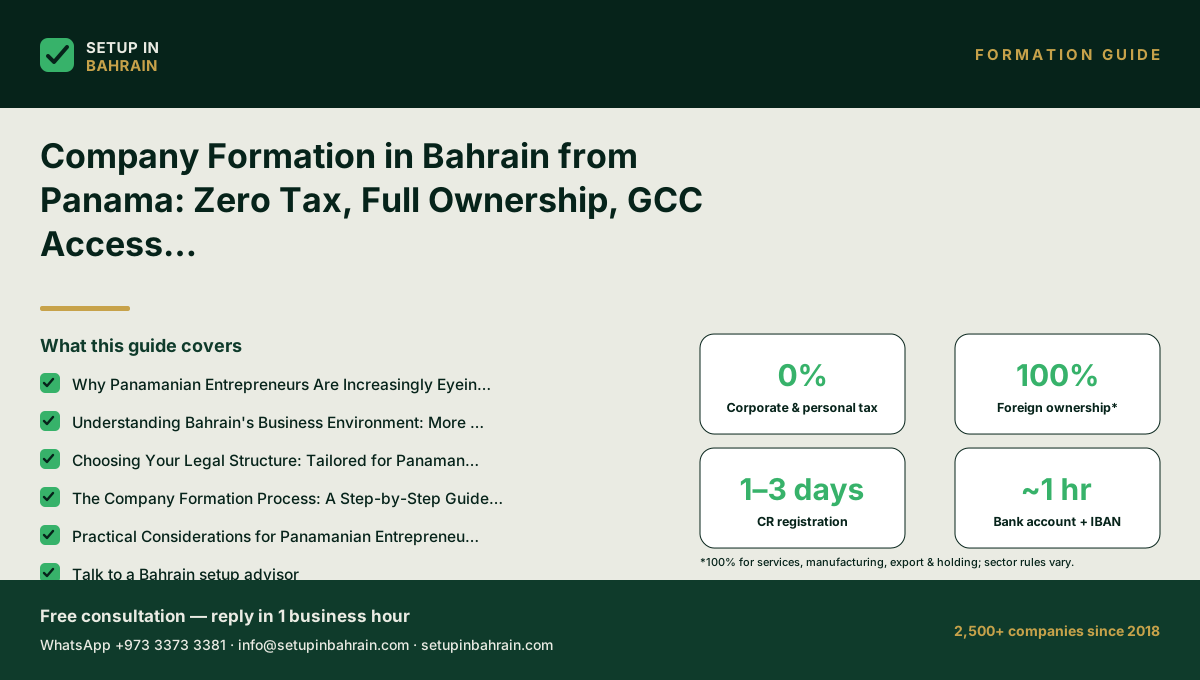
Complete guide for Panama entrepreneurs: form a company in Bahrain with generally no corporate income tax for most sectors, 100% foreign ownership. GCC market access. Costs, steps, visas, banking.
Key Takeaways
- Why Panamanian Entrepreneurs Are Increasingly Eyeing Bahrain
- Understanding Bahrain's Business Environment: More Than Just Tax
- Choosing Your Legal Structure: Tailored for Panamanian Needs
- The Company Formation Process: A Step-by-Step Guide for Panamanians
- Practical Considerations for Panamanian Entrepreneurs in Bahrain
→ Complete guide: Company Formation in Bahrain — the full 2026 guide
View details
Ownership & capital
A Bahrain WLL can be owned by a single person — 100% foreign ownership applies to most activities, with no local partner required for services, manufacturing, export trading and holding companies. The minimum share capital is BHD 1 ; we recommend BHD 1,000 . This Makes bank account opening and investor visa approval smoother.
Imagine this: You’re a successful Panamanian entrepreneur, perhaps running a logistics company that leverages the Canal’s global reach, a digital marketing agency serving clients across the Americas, or a thriving e-commerce platform with regional ambitions. You’ve built your business with grit and ingenuity, navigating the complexities and opportunities of your home market.
But lately, a nagging frustration persists: the 25% corporate tax rate that eats into your hard-earned profits, the ever-increasing employer contributions to the CSS Caja de Seguro Social (currently at 12.25%) which inflate your operational costs, and the endless DGI mandatory e-filing requirements that demand constant administrative attention. You appreciate the stability of a USD-pegged economy. The tax burden and compliance overhead often feel disproportionate to the effort you invest.
You’re also acutely aware of the intense beneficial ownership scrutiny that has become standard practice for all company structures in Panama, a direct consequence of past reputational challenges. The days of "offshore" implying minimal oversight are long gone, especially when dealing with international banking or seeking acceptance in sophisticated global markets.
Despite Panama's removal from the FATF grey-list in 2023, the reputational damage from the Panama Papers and years of scrutiny persists, often making international transactions and supplier onboarding a more arduous process than it should be. The world demands demonstrated economic substance, transparency. Robust compliance – and for businesses targeting lucrative global markets, especially the rapidly expanding Gulf Cooperation Council (GCC), this is non-negotiable.
What if there was a strategic alternative? A jurisdiction that offered a true generally no corporate income tax for most sectors, allowed 100% foreign ownership without the need for local sponsors, provided a stable USD-pegged currency, and acted as a direct, compliant gateway to a multi-trillion-dollar market – all while maintaining a gold standard for regulatory oversight? This isn’t a pipe dream or another convoluted "offshore" scheme that will land you in more compliance headaches.
This is Bahrain, and it’s rapidly becoming the preferred hub for forward-thinking Panamanian entrepreneurs ready to scale globally and operate with unparalleled fiscal efficiency and transparency.
This complete 2026 guide is designed exclusively for you. We’ll dissect the true costs and challenges of your current operating environment in Panama and unveil Bahrain’s compelling advantages. We’ll walk you through the precise steps of company formation, detail the optimal legal structures. Provide practical insights only an expert consultant would share. By the end, you’ll have a clear roadmap to leveraging Bahrain’s strategic position for your international business growth.
Why Panamanian Entrepreneurs Are Increasingly Eyeing Bahrain
Consider the case of Carlos Mendoza, who runs a successful import-export operation moving electronics and construction materials through the Colón Free Zone. In 2024, his company cleared roughly USD 1.8 million in taxable profit. After the 25% corporate tax and the CSS employer contributions of 12.25% on local salaries, his effective burden exceeded 32% of his profits. The DGI’s mandatory e-filing system flagged nearly every large transaction for review, adding layers of administrative work and uncertainty.
Also, the lingering reputational shadow from the Panama Papers made it harder to open accounts with European and Asian suppliers, who often requested extensive due diligence that felt disproportionate to the transaction size. Carlos began exploring Bahrain after a Saudi buyer asked whether his firm could establish a more direct presence in the GCC, citing concerns about transacting through a Panamanian entity.
His story is not unique; it reflects the growing strategic imperative for Panamanian entrepreneurs to seek out more globally competitive and compliant jurisdictions.
The Panamanian Business Landscape: Navigating Success and Specific Headwinds
Panama offers many advantages, from its strategic geographical location and the Canal to its robust financial services sector and a thriving service-based economy. But, for entrepreneurs looking to scale internationally, specific elements of the Panamanian business environment can present significant headwinds.
The 25% Corporate Tax: A Substantial Erosion of Profits
While Panama’s tax system is territorial, meaning only income derived from sources within Panama is taxable, the reality for many active businesses is that a significant portion of their global revenue is captured within the 25% corporate tax rate. For a company like Carlos's, generating USD 1.8 million in profit, this translates to USD 450,000 lost to corporate tax alone. This directly impacts reinvestment capabilities, dividend payouts, and overall competitiveness.
When compared to jurisdictions offering generally no corporate income tax for most sectors, this difference becomes a critical factor in long-term financial planning and growth potential.
CSS Caja de Seguro Social: Employer Contributions of 12.25%
Beyond corporate tax, the social security contributions in Panama add another layer of significant cost. Employers are mandated to contribute 12.25% of their employees' salaries to the Caja de Seguro Social (CSS). While these contributions support local social welfare programs, from a global business perspective, they represent a non-negotiable operational cost that adds to the overall burden of hiring and maintaining a workforce.
For businesses with even a moderate number of employees, these contributions can quickly accumulate into a substantial overhead, impacting profit margins and scalability.
DGI Mandatory E-filing Requirements: Administrative Burden and Scrutiny
The Directorate General of Revenue (DGI) in Panama has implemented mandatory e-filing systems that. Intended to improve transparency and efficiency, often create a significant administrative burden for businesses. Every transaction, every financial statement, and every compliance report must be meticulously prepared and submitted digitally. This requires dedicated resources, time, and often, the engagement of external accountants, adding to operational costs.
For entrepreneurs looking for streamlined, efficient compliance processes, the DGI's intensive e-filing can feel like an unnecessary drag on productivity.
Beneficial Ownership Scrutiny & Reputational Legacy: The Shadow of the Panama Papers
Perhaps one of the most pressing challenges for Panamanian businesses operating internationally is the lingering reputational shadow cast by the Panama Papers and the country's historical association with offshore finance. Despite significant efforts by the Panamanian government to enhance transparency and comply with international anti-money laundering (AML) and counter-terrorist financing (CTF) standards – leading to its removal from the FATF grey-list in October 2023 – the perception can take years to fully shift.
Banks, international partners, and regulatory bodies worldwide now subject Panamanian entities to heightened beneficial ownership scrutiny. This means more rigorous KYC (Know Your Customer) checks, extended due diligence processes. A general skepticism that can delay transactions, complicate banking relationships, and even deter potential investors or clients. For a serious entrepreneur, this translates into lost time, missed opportunities. The constant need to prove your legitimacy – a fundamental waste of valuable resources.
The global standard now demands not just legal compliance, but demonstrable "economic substance" – real operations, real offices, real employees. Real decision-making within the jurisdiction of incorporation.
Bahrain's Strategic Proposition: A Beacon of Opportunity
Against this backdrop, Bahrain emerges as a compelling and more and more strategic alternative for Panamanian entrepreneurs. It offers a unique blend of fiscal efficiency, regulatory transparency. Unparalleled market access, positioning itself as a modern, compliant gateway to global markets.
generally no corporate income tax for most sectors: A Direct Impact on Your Bottom Line
One of Bahrain's most significant draws is its commitment to a generally no corporate income tax for most sectors for most businesses. Unlike many jurisdictions that offer tax incentives only within specific free zones or for particular industries, Bahrain applies this to virtually all onshore companies, with the exception of specific oil and gas companies and certain foreign bank branches.
This means that a company generating USD 1.8 million in profit would retain the entire sum, allowing for greater reinvestment, faster growth. Enhanced shareholder value. This is a monumental shift from Panama’s 25% rate and represents a direct, substantial increase in profitability.
100% Foreign Ownership: Dispelling Partnership Myths
A common misconception among entrepreneurs exploring the Middle East is the requirement for a local sponsor or partner. Bahrain definitively breaks from this stereotype. For most commercial activities, the Kingdom allows 100% foreign ownership of companies without any local partnership requirement. This includes the popular With Limited Liability (WLL) company structure. This Can be owned entirely by a single person, whether that’s an individual or a corporate entity.
This offers complete control and operational independence, a crucial factor for entrepreneurs who value autonomy.
GCC Gateway: Accessing a Multi-Trillion-Dollar Market
Bahrain's strategic geographical location, nestled in the heart of the GCC, makes it an ideal launchpad into a market of over 50 million affluent consumers with a combined GDP exceeding USD 2 trillion. It offers direct access to Saudi Arabia, the largest economy in the Middle East, via the King Fahd Causeway.
For Panamanian logistics companies, e-commerce platforms, or service providers, establishing a base in Bahrain means you are literally at the doorstep of a rapidly growing, digitally savvy, and highly interconnected market that is actively diversifying its economies away from oil. This isn't just a regional market; it's a critical hub for East-West trade.
Regulatory Excellence & Ease of Doing Business
Bahrain is not just about tax efficiency; it’s about regulatory clarity and a business-friendly environment. The Kingdom consistently ranks highly in the World Bank's Ease of Doing Business reports, a testament to its streamlined processes, digital government services, and commitment to transparency. Its regulatory framework, overseen by bodies like the Ministry of Industry and Commerce (MOIC) and the Central Bank of Bahrain (CBB), is robust, internationally aligned, and designed to foster legitimate business growth.
For entrepreneurs tired of bureaucratic hurdles, Bahrain offers a refreshing efficiency.
Stable Economy: USD-Pegged Currency and Financial Hub Status
For Panamanian entrepreneurs accustomed to a USD-pegged economy, Bahrain offers familiar stability. The Bahraini Dinar (BHD) is pegged to the US Dollar at a fixed exchange rate (BHD 1 = USD 2.65), eliminating currency fluctuation risks and providing predictability for international transactions and financial planning. Also, Bahrain has a long-standing history as a sophisticated financial hub, especially in Islamic finance, with a well-developed banking sector that facilitates international trade and investment.
Understanding Bahrain's Business Environment: More Than Just Tax
While the generally no corporate income tax for most sectors is a significant draw, understanding Bahrain’s broader economic vision and regulatory landscape is crucial for long-term success. The Kingdom is not merely offering a tax haven; it is building a sustainable, diversified economy anchored in innovation, technology. Transparent governance.
The Kingdom's Vision: Economic Development Board (EDB) and Vision 2030
Bahrain’s economic transformation is driven by its Vision 2030, an ambitious plan to shift from an oil-dependent economy to a diversified, sustainable, and knowledge-based powerhouse. At the forefront of this transformation is the Economic Development Board (EDB), a dynamic public agency responsible for attracting foreign direct investment (FDI) and driving economic growth.
The EDB acts as a strategic partner for international businesses, providing support and guidance throughout the setup process. They are actively seeking companies in sectors like financial services, ICT, manufacturing, logistics. Tourism, offering tailored incentives and a supportive ecosystem. Their proactive approach ensures that foreign investors find a welcoming and efficient environment, making them an invaluable resource for Panamanian entrepreneurs.
The EDB's commitment to cutting red tape and facilitating market entry shows Bahrain's genuine desire to be a global business hub.
Regulatory Framework: MOIC, CBB, and Anti-Money Laundering (AML) Standards
Bahrain’s regulatory environment is characterized by clarity, robustness. Adherence to international best practices, a stark contrast to some historical perceptions of offshore jurisdictions.
Ministry of Industry and Commerce (MOIC): The primary regulatory body for company registration and commercial activities. MOIC oversees trade name registration, commercial registrations (CRs), and ensures businesses operate within defined legal frameworks. Their online portal, Sijilat, is a testament to the government's digital-first approach to business services, simplifying many administrative tasks. Central Bank of Bahrain (CBB): For financial services companies, including fintech, banking, insurance. Money exchange businesses, the CBB is the key regulator.
The CBB is renowned for its progressive yet stringent regulatory framework, making Bahrain a leader in financial innovation while maintaining stability and trust. Anti-Money Laundering (AML) and Counter-Terrorist Financing (CTF) Standards: Critically, Bahrain maintains stringent AML/CTF standards, fully compliant with FATF recommendations. This is a significant advantage for entrepreneurs from Panama, as it means your Bahraini entity will operate within a highly respected and transparent financial system.
This commitment to compliance helps counter any lingering reputational issues from other jurisdictions and facilitates smoother dealings with international banks and partners who prioritize robust AML frameworks. For serious global businesses, operating in a jurisdiction with high compliance standards is not a burden. A strategic asset.
Choosing Your Legal Structure: Tailored for Panamanian Needs
Selecting the right legal entity is a foundational decision for your Bahraini venture. While several options exist, one structure stands out for its flexibility, ownership benefits. Suitability for the vast majority of international entrepreneurs: the With Limited Liability (WLL) company.
The Workhorse: With Limited Liability Company (WLL)
The WLL is the most common and versatile legal structure for foreign investors in Bahrain. For good reason. It offers a balance of ownership control, liability protection. Operational flexibility that aligns perfectly with the needs of Panamanian entrepreneurs.
100% Foreign Ownership, Single Shareholder Permitted: This is a crucial point. Unlike some other GCC nations that historically required local partners, Bahrain's WLL structure allows for 100% foreign ownership. Also, a WLL can be entirely owned by a single individual or a single corporate entity. There is absolutely no requirement for a local Bahraini partner or shareholder, providing you with complete control over your business operations and profits.
This directly addresses the pain point of finding and managing local partners, often a requirement in other regions. Minimum Share Capital: Legally, the minimum share capital for a WLL in Bahrain is a symbolic BHD 1 (about USD 2.65). But, this legal minimum is rarely practical for actual business operations. For serious entrepreneurs looking to open a corporate bank account and secure an investor visa, we strongly recommend* a practical starting capital of BHD 1,000 (about USD 2,650).
This amount shows sufficient substance to banks for KYC purposes and provides a more solid foundation for visa applications, showing serious intent to invest in the Kingdom. Limited Liability Protection: As the name suggests, a WLL provides limited liability protection to its shareholders. This means that the personal assets of the owners are protected from the company's debts and obligations, limiting their financial risk to the amount of capital invested in the company.
Flexibility in Activities: A WLL can undertake a wide range of commercial, industrial. Service activities, making it suitable for diverse business models from e-commerce and logistics to consulting, tech development, and holding company functions. No WLL (Single Person Company): It is critical to note that Bahrain does not have a specific legal entity designated as a single-shareholder WLL*. The WLL structure effectively serves this purpose by allowing a single shareholder to own and operate the company with limited liability.
Be wary of any advice suggesting a single-shareholder WLL in Bahrain; it simply doesn't exist as a separate legal form.
Branch of a Foreign Company: Extending Your Panamanian Operations
For established Panamanian businesses that wish to have a direct, legally recognized extension of their existing entity in Bahrain without creating a separate legal personality, a branch office is an option.
No Separate Legal Identity: A branch office is not a distinct legal entity but an extension of the parent company. This means the parent company in Panama is fully liable for the branch's activities in Bahrain. Limited Scope: Generally, a branch office is restricted to carrying out activities similar to those of its parent company.
Administrative Overhead: While seemingly simpler, maintaining a branch can sometimes involve more administrative complexity as it directly links to the foreign parent company's financials and legal standing. When it Makes Sense: This structure is usually preferred by larger corporations that already have a significant international presence and primarily seek to establish a local sales presence, service center, or regional representation office, rather than a fully independent operational entity.
For most Panamanian SMEs seeking full operational independence and limited liability, a WLL is almost always the superior choice.
Other Structures (Briefly Mentioned)
While less common for direct foreign investment from entrepreneurs, other structures exist:
- Partnership Companies: Require two or more partners and typically offer unlimited liability, making them less attractive for foreign investors seeking risk mitigation.
- Sole Proprietorship: Primarily intended for Bahraini nationals and offers unlimited liability.
- Public Shareholding Company (B.S.C.): Reserved for larger ventures seeking public funding, with stringent regulatory requirements.
For the vast majority of Panamanian entrepreneurs, the With Limited Liability (WLL) company structure offers the optimal blend of ownership, liability protection. Operational flexibility within Bahrain's welcoming business environment.
The Company Formation Process: A Step-by-Step Guide for Panamanians
Establishing your company in Bahrain is a streamlined process, largely facilitated by the MOIC’s digital Sijilat portal. But, understanding each phase and preparing thoroughly is key to a smooth incorporation.
Phase 1: Planning and Preparation
The foundation of a successful company setup lies in meticulous planning and document preparation.
Business Activity Classification (MOIC): The first step is to accurately identify your proposed business activities. Bahrain has a comprehensive classification system (NACE codes). Your chosen activities will determine any specific licenses or approvals required from relevant ministries (e.g., CBB for financial services, Ministry of Health for medical activities). It's crucial to be precise here, as your CR will only permit activities you've registered. Trade Name Reservation: You'll need to propose several unique trade names for your company.
The MOIC’s Sijilat portal allows for online name availability checks and reservation. The name must be unique, not offensive, and reflect the nature of your business. Document Gathering: This is where preparation pays off. You'll need: * Passport Copies: For all shareholders and directors. * Proof of Address: Utility bills or bank statements (dated within 3 months) for all individuals. * Curriculum Vitae (CV): For all shareholders and directors, especially for MOIC and CBB approvals to assess experience.
* Business Plan: A concise but comprehensive outline of your business, including objectives, market analysis, operational plan. Financial projections. This is especially important for attracting bank accounts and for CBB-regulated activities. * Memorandum and Articles of Association (MOA/AOA): Drafted in Arabic and English, outlining the company's purpose, share capital, governance. Shareholder rights. Professional assistance is highly recommended for this. * Bank Reference Letters: For individual shareholders/directors (sometimes required by banks or regulators for enhanced due diligence).
* Certified Copies of Corporate Documents: If a corporate entity is a shareholder, certified copies of its Certificate of Incorporation, MOA/AOA. A board resolution authorizing the Bahraini company formation will be required (apostilled/legalized).
Phase 2: Application and Approval
Once your documents is ready, you proceed with the official application.
MOIC Application (Sijilat Online Portal): The entire application process is initiated through the Sijilat portal. You will create an account and upload all your prepared documents. This digital platform greatly speeds up processing times compared to traditional paper-based systems. Initial Approvals (Pre-Licensing): Depending on your business activities, you might require initial approvals from specific government bodies before* final MOIC registration. For instance: * Financial services, fintech, investment firms: CBB approval. * Educational institutions: Ministry of Education approval.
* Healthcare facilities: Ministry of Health approval. * These initial approvals can be the longest part of the process and often involve interviews or detailed presentations of your business plan. Memorandum and Articles of Association (MOA/AOA) Submission: Once initial approvals are in place (if required) and your trade name is reserved, you'll submit the drafted MOA/AOA to MOIC for review and approval.
Capital Deposit (Practical Step): While the BHD 1,000 capital isn’t legally required at this exact moment for MOIC, it’s a critical practical step you’ll want to have ready. Most banks will require the capital to be deposited before* activating your account. A live bank account is necessary for the final CR issuance and visa applications.
Phase 3: Registration and Post-Incorporation
With approvals secured, you can finalize your company’s registration and begin operations.
Commercial Registration (CR) Issuance: Upon MOIC’s final review and approval of all documents (including the MOA/AOA and proof of capital deposit, often via a bank letter), your Commercial Registration (CR) certificate will be issued. This is your company's official birth certificate, allowing you to operate legally in Bahrain. The CR will list your company name, activities, shareholders, and directors. Bank Account Opening: This is a critical post-incorporation step. While Bahrain’s banking sector is robust, international banks maintain strict KYC/AML procedures.
* Recommendation for BHD 1,000 Capital: This is where the recommended BHD 1,000 share capital becomes crucial. Banks are far more likely to approve and expedite account opening for companies demonstrating a tangible investment, rather than those with the bare BHD 1 legal minimum. * Due Diligence: Expect thorough due diligence, including personal interviews with shareholders/directors (which can sometimes be conducted remotely), extensive documents. Background checks.
Be prepared for questions about the source of funds, business model, and operational substance. Visa Application (Investor/Work Permit): Once your company is registered and your bank account is active, you can apply for an investor visa for yourself (as a shareholder) and potentially work permits for employees. * Investor Visa: As a foreign investor/shareholder, you are eligible to apply for an investor visa. This Can be renewable for up to two years initially.
This visa often depends on the level of investment and the nature of your business. * Family Sponsorship: Once you have your investor visa, you can sponsor your immediate family members (spouse and children) for residency visas, allowing them to join you in Bahrain. Office Space (Virtual, Serviced, Physical): You will need a registered office address in Bahrain. * Virtual Office: For certain activities and initial stages, a virtual office can suffice, providing a registered address and mail handling.
But, for demonstrating "economic substance," this might not be enough long-term. * Serviced Office: A popular choice, offering a physical address, meeting rooms. Administrative support without the overhead of a full-scale office setup. * Physical Office: For larger operations requiring dedicated space and staff, leasing a physical office is the natural progression.
Practical Considerations for Panamanian Entrepreneurs in Bahrain
Beyond the legal steps, several practical aspects warrant your attention to ensure a smooth transition and sustainable operation in Bahrain.
Banking and Financial Infrastructure: CBB and International Connectivity
Bahrain boasts a mature and sophisticated financial sector, regulated by the Central Bank of Bahrain (CBB). It's home to numerous international banks, a thriving fintech ecosystem, and is a hub for Islamic finance. This means excellent international connectivity for transactions, trade finance, and various financial products.
Robustness: The CBB's stringent oversight ensures the stability and integrity of the banking system. This Is a significant asset compared to jurisdictions with less rigorous controls. Challenges for New Foreign Companies: Despite the robust infrastructure, new foreign companies, especially those without an immediate large-scale physical presence, can still face challenges in opening corporate bank accounts. Banks are highly focused on KYC and AML compliance.
This often requires: * Physical Presence: Directors/shareholders may need to visit Bahrain for initial account opening interviews. * Clear Business Model: A well-articulated business plan demonstrating legitimate commercial activity. Sufficient Capital: Reiterating the recommendation for BHD 1,000 capital* as a practical starting point, signaling serious intent and operational readiness. * Economic Substance: Banks will more and more look for evidence of real operations – a registered office, initial contracts. A clear rationale for banking in Bahrain.
Multi-Currency Accounts: Most Bahraini banks offer multi-currency accounts. This Is highly beneficial for businesses dealing with international clients and suppliers.
Taxation and Compliance: The Zero-Tax Advantage and Local Requirements
Understanding the specifics of Bahrain's tax regime is crucial for maximizing your fiscal efficiency.
generally no corporate income tax for most sectors Explained: As mentioned, Bahrain does not levy corporate income tax on most businesses. This is not a temporary incentive but a fundamental aspect of its economic policy, aimed at attracting investment and fostering growth. There are exceptions for oil and gas companies and certain foreign bank branches. For the vast majority of active businesses, the 0% rate applies. Value Added Tax (VAT): Bahrain implemented a 5% VAT in 2019, which increased to 10% in January 2022.
Businesses exceeding a specific annual turnover threshold (BHD 37,50
Bahrain Business Guides for Panama Citizens
Frequently Asked Questions
How long does it take to set up?
It takes 15 to 20 days. We file all forms for you. You do not need to wait long.
What does it cost?
Company formation: Standard BHD 1,340 with 3 months of office address; Gold BHD 1,700 with 6 months; Premium BHD 2,150 with 12 months and a cabin, officer table and chair, and two guest chairs. No formation package includes visas, including Premium. Investor/work visas are priced separately: BHD 755 for one year or BHD 953 for two years, in addition to the formation package. Ask for a written, itemized quotation confirming government fees and all inclusions before payment.
Do I need to visit Bahrain?
No. You can set up your firm from home. We do all the work online. Some banks may ask for one visit.
What tax will I pay?
You pay zero tax on your profits. Bahrain has no corporate income tax. This is a key benefit of the setup.
Can I own 100% of my firm?
Yes. Foreign owners can hold all shares. No local partner is needed. Full ownership is allowed.
What do I need to start?
You need a valid passport. You also need a trade name and a business address. We help you with all of these.
How do I open a bank account?
We guide you step by step. Most banks take 3 to 6 weeks. You will need your CR and firm papers.
Who issues the Commercial Registration (CR)?
The CR is issued by the MOICT. It is your legal right to trade in Bahrain. We file the CR for you.
Can I renew my CR each year?
Company renewal packages: BHD 530 with 3 months of office address; BHD 980 with 6 months; BHD 1,520 with 12 months. These are separate renewal packages, not visa fees.
How do I get started?
Fill in our form on this page. Our team will call you back. We map your best setup plan at no cost.
Steps to Form Your Company
- Pick your trade name. We check if it is free.
- Choose your business type. WLL is the most common.
- Sign the MOA. We draft and file all legal docs.
- Pay the state fees. About BHD 432 in total.
- Get your CR. Takes 15 to 20 days.
- Open your bank account. We guide each step.
- Start trading. You are ready to do business.
Key Facts
- Tax rate: 0%
- Foreign ownership: 100%
- Setup time: 15 to 20 days
- Company formation: Standard BHD 1,340 with 3 months of office address; Gold BHD 1,700 with 6 months; Premium BHD 2,150 with 12 months and a cabin, officer table and chair, and two guest chairs. No formation package includes visas, including Premium. Investor/work visas are priced separately: BHD 755 for one year or BHD 953 for two years, in addition to the formation package. Ask for a written, itemized quotation confirming government fees and all inclusions before payment.
- Company renewal packages: BHD 530 with 3 months of office address; BHD 980 with 6 months; BHD 1,520 with 12 months. These are separate renewal packages, not visa fees.
- Client rating: 4.8 stars
- Clients served: 2,500 and more
Quick Facts
- Tax rate: 0%
- Own all of your firm: Yes, 100%
- Time to set up: 15 to 20 days
- Company formation: Standard BHD 1,340 with 3 months of office address; Gold BHD 1,700 with 6 months; Premium BHD 2,150 with 12 months and a cabin, officer table and chair, and two guest chairs. No formation package includes visas, including Premium. Investor/work visas are priced separately: BHD 755 for one year or BHD 953 for two years, in addition to the formation package. Ask for a written, itemized quotation confirming government fees and all inclusions before payment.
- Company renewal packages: BHD 530 with 3 months of office address; BHD 980 with 6 months; BHD 1,520 with 12 months. These are separate renewal packages, not visa fees.
- Rating: 4.8 stars
- Clients: 2,500 and more
Why Bahrain?
Bahrain has no tax. You keep all your profits. This is rare in the Gulf.
You can own all of your firm. No local partner is needed. The law allows full foreign ownership.
Setup takes 15 to 20 days. We file all forms for you. You can do it all from home.
Bahrain has a free trade deal with the US. Your goods face low or no tariffs. This gives you access to big markets.
We have served 2,800+ clients from 44+ countries and maintain records to substantiate that total where needed. We have 113 Google reviews; reviews represent only some clients and are not the same as the total clients served.
Our Steps
- Tell us your plan. We advise you for free.
- We pick the right firm type for you.
- We file all your forms with MOICT.
- You get your CR in 15 to 20 days.
- We help you open a bank account.
- You are ready to trade. We stay with you.
Next Steps for Panama Citizens
You can set up a firm in Bahrain from Panama. You do not need to fly there first. We do all the work online.
Tell us your plan. We call you back the same day. We map the best route for you at no cost.
We file all your forms. We deal with MOICT and the state. You get your CR in 15 to 20 days.
After your CR, we help you get a bank account. We also help with your Investor Visa. One firm guides you at each step.
Why Our Clients from Panama Choose Us
- We speak your language. We know your needs.
- We have helped clients from Panama before.
- Our fee is clear. No surprise costs.
- We have a 4.8 star rating on Google.
- We have helped more than 2,500 clients set up in Bahrain.
Fill in the form on this page. We will be in touch soon. Let us help you start your Bahrain firm today.
Ready to set up in Bahrain from Panama?
Tell us your business idea. We map the right entity, ownership and timeline — then handle the filing while you focus on what matters.