Complete guide for Palestine entrepreneurs: form a company in Bahrain with generally no corporate income tax for most sectors, 100% foreign ownership. GCC market access. Costs, steps, visas, banking.
Key Takeaways
- Why Palestinian Entrepreneurs Are Moving Their Business to Bahrain
- Bahrain's Unrivaled Advantages for International Business
- Understanding Company Structures in Bahrain: WLL, Branch, and More
- The Step-by-Step Company Formation Process for Palestinian Entrepreneurs
- Navigating Specific Challenges for Palestinian Applicants
→ Complete guide: Company Formation in Bahrain — the full 2026 guide
View details
Ownership & capital
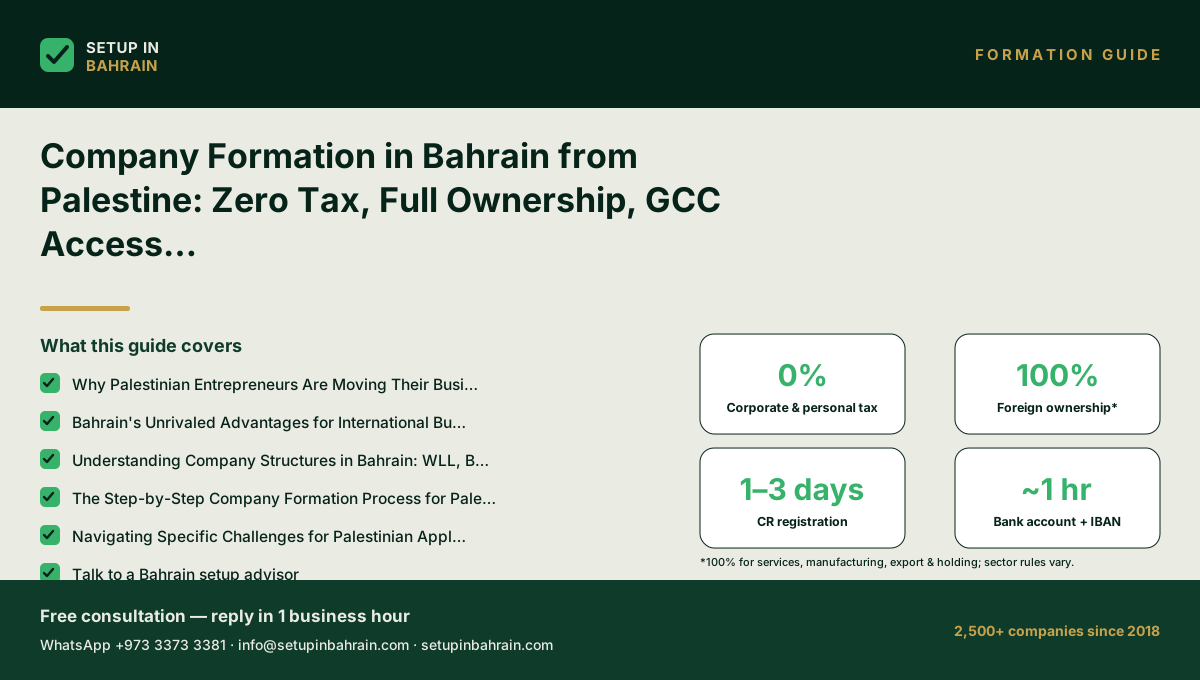
A Bahrain WLL can be owned by a single person — 100% foreign ownership applies to most activities, with no local partner required for services, manufacturing, export trading and holding companies. The minimum share capital is BHD 1 ; we recommend BHD 1,000 . This Makes bank account opening and investor visa approval smoother.
Entrepreneurship in Palestine is a testament to resilience, innovation, and an unwavering spirit. Yet, if you're reading this, it's likely you’ve encountered the invisible walls that restrict your business growth – not just physical barriers, but systemic ones, like the 15% corporate income tax, compounded by the realities of operating under the Israeli fiscal arrangements (Paris Protocol) that limit independent monetary policy and financial sovereignty. You've navigated movement restrictions affecting everything from supply chains to market access across the West Bank and Gaza. You’ve felt the pinch of limited international banking access, making global expansion a daunting, if not impossible, task.
Perhaps you’re a Palestinian entrepreneur in the diaspora – whether in Jordan, Chile, the UAE, or the US – looking for a stable, growth-oriented base for your international ventures. You seek a place where your hard work isn't immediately clipped by high taxes or bureaucratic hurdles, a clear path to scale, to access global markets, and to build something truly enduring, free from the unique complexities of your home country.
This guide is for you.
We understand these pain points intimately. We’ve seen countless Palestinian businesses reach a ceiling, not because of a lack of vision or effort. Because the foundational environment makes exponential scaling incredibly difficult. But what if there was a direct, strategic route to establishing a company that offered generally no corporate income tax for most sectors, 100% foreign ownership. A direct gateway to the USD 1.6 trillion GCC market, all within days?
Bahrain, a strategically located island nation at the heart of the Gulf, offers exactly that. This guide isn't just about setting up a company; it’s about unlocking a new future for your business, a future where your profits stay in your pocket, where international banking is seamless, and where your reach knows no geopolitical boundaries.
Why Palestinian Entrepreneurs Are Moving Their Business to Bahrain
Let's be candid about the realities faced by Palestinian entrepreneurs. Ahmed, who runs a small export trading firm in Ramallah supplying agricultural products to Gulf markets, spent three months last year trying to open a second corporate account for his growing international invoices. His local bank cited compliance rules tied to the Paris Protocol. This Locks the Palestinian Authority into Israeli fiscal and monetary arrangements with no independent currency or central bank of its own. He pays 15% corporate income tax on profits, faces movement restrictions that delay shipments between the West Bank and Gaza. Watches his cash flow swing with every ILS-to-USD fluctuation. After a costly experience trying to expand his banking relationships, he's now exploring options outside Palestine.
Ahmed's story is not unique. It reflects a systemic environment that, while fostering incredible innovation and resilience, ultimately constrains growth and global competitiveness.
The Palestinian Economic Reality: Navigating Restrictions and Seeking Sovereignty
For entrepreneurs operating within the West Bank and Gaza, the challenges are multi-layered and deeply impactful:
Limited Monetary Sovereignty and Fiscal Arrangements: The Paris Protocol (part of the Oslo Accords) dictates that the Palestinian Authority (PA) operates under Israeli fiscal arrangements. This means the PA cannot issue its own currency, controls its own borders for customs, or freely set its own independent monetary policy. Businesses are largely reliant on the Israeli New Shekel (ILS), Jordanian Dinar (JOD). US Dollar (USD), leading to currency fluctuation risks and a lack of independent financial tools for economic stability. This also often creates complex compliance hurdles for international banking. High Corporate Income Tax: With a corporate income tax rate of 15% in Palestine, a significant portion of your hard-earned profits is diverted before you can reinvest or expand. This directly impacts cash flow and the ability to scale. Movement Restrictions and Logistics: Physical barriers and restrictions on the movement of goods and people between and within the West Bank and Gaza create immense logistical headaches. Supply chains are unpredictable, market access is fragmented. Reaching international clients or suppliers can be an administrative nightmare, adding costs and delays. Challenges with International Banking: Due to the political context and associated compliance complexities, Palestinian businesses often struggle to secure robust international banking relationships. This makes cross-border transactions, access to trade finance, and global payment processing greatly more difficult and expensive. Banks globally often perceive higher risk, leading to slower processes and stricter scrutiny. Limited Access to Capital Markets: Developing a thriving startup or SME ecosystem requires access to diverse capital markets. In Palestine, these avenues are often nascent or constrained, making it harder to secure growth capital from international investors who might be deterred by the geopolitical and financial environment.
The Diaspora Dilemma: Finding a Stable Base for Global Reach
Palestinian entrepreneurs living in the diaspora also face unique challenges and opportunities. While they might escape some of the direct movement restrictions, they often carry the weight of their national identity into international business, sometimes facing heightened scrutiny from financial institutions or navigating complex dual-nationality considerations. Many seek:
A neutral, stable hub: A place where their business can operate without the political or economic shadows of their homeland, allowing them to focus purely on growth and innovation. Ease of international expansion: A jurisdiction with robust financial infrastructure, a strong regulatory framework. Seamless access to global markets. Tax efficiency: An environment where their international profits are not eroded by high corporate taxes. Reputation and Credibility: A business base that offers undisputed international credibility and facilitates trust with global partners.
Why Bahrain Emerges as a Strategic Solution
Bahrain isn't just another offshore jurisdiction; it's a strategically positioned, forward-thinking economic hub that directly addresses the core pain points of Palestinian entrepreneurs. It offers a clear, legal, and efficient pathway to:
- Eliminate Corporate Income Tax: Zero percent corporate tax means 100% of your profits stay within your business, available for reinvestment, expansion, or distribution.
- Achieve 100% Foreign Ownership: Complete control over your company, without the need for local partners or sponsors.
- Gain Seamless International Banking: Access to a sophisticated financial services sector regulated by the Central Bank of Bahrain (CBB), offering robust and compliant international banking solutions.
- Unlock the GCC Market: Direct access to a USD 1.6 trillion regional market, serving as a launchpad for broader MENA and global expansion.
- Ensure Stability and Predictability: A mature legal framework, a stable government, and a business-friendly regulatory environment.
By choosing Bahrain, Palestinian entrepreneurs are not just relocating a company; they are fundamentally altering their business trajectory, empowering themselves with financial freedom, global access, and a stable platform for exponential growth.
Bahrain's Unrivaled Advantages for International Business
Bahrain has cultivated a reputation as the most liberal economy in the GCC, actively attracting foreign direct investment (FDI) and fostering a dynamic business environment. Its proactive approach to digital transformation and economic diversification, especially in sectors like FinTech, ICT. Logistics, makes it an appealing choice for modern businesses.
0% Corporate Income Tax: Keep Your Profits
This is arguably one of Bahrain's most compelling advantages. Unlike many jurisdictions, including Palestine's 15% corporate tax rate, Bahrain imposes 0% corporate income tax on most business activities. This means that every Dinar your company earns remains yours to reinvest, expand, or distribute as you see fit. This significant fiscal benefit directly translates into increased profitability and stronger cash flow for your business. For a growing Palestinian enterprise, this isn't just a saving; it's a fundamental shift in economic viability.
100% Foreign Ownership: Complete Control
Bahrain is one of the few countries in the GCC that allows 100% foreign ownership of companies in most sectors, with no requirement for a local partner or sponsor. This is a critical advantage for international entrepreneurs, ensuring complete control over your business operations, strategic decisions. Profits. This eliminates the complexities, potential conflicts. Profit-sharing arrangements often associated with local partnership requirements in other countries. You maintain full autonomy over your venture from day one.
Gateway to the USD 1.6 Trillion GCC Market
Bahrain's strategic location in the heart of the Arabian Gulf makes it an ideal gateway to the entire GCC market. This Boasts a combined GDP exceeding USD 1.6 trillion and a population of over 50 million affluent consumers. With its causeway connecting to Saudi Arabia and excellent air and sea links, Bahrain offers unparalleled logistical advantages for businesses looking to penetrate the region. Its liberal trade policies and membership in the GCC common market mean seamless access to a vast and growing consumer base, without the movement restrictions and fragmented access you might experience elsewhere.
Simplified Business Environment and Digital-First Approach
Bahrain consistently ranks high in global indices for ease of doing business. The World Bank's "Ease of Doing Business" report frequently highlights Bahrain's strengths in starting a business, getting electricity. Protecting minority investors. The Kingdom has embraced a digital-first approach to government services, exemplified by the "Sijilat" online commercial registration portal (managed by the Ministry of Industry and Commerce, MOIC). This portal allows entrepreneurs to register their businesses, apply for licenses. Manage their commercial records almost entirely online, streamlining bureaucratic processes and reducing setup times from weeks to just days in many cases. The Economic Development Board (EDB) actively supports investors throughout this journey.
World-Class Infrastructure and Connectivity
Investing in state-of-the-art infrastructure has been a cornerstone of Bahrain's economic strategy. The country boasts:
Advanced Telecommunications: High-speed internet connectivity, 5G networks. A robust digital backbone supporting cloud computing and data centers. Modern Logistics: Khalifa Bin Salman Port, Bahrain International Airport. An efficient road network help seamless import, export, and regional distribution. Financial Hub: A mature and well-regulated financial services sector, home to over 380 financial institutions, including conventional and Islamic banks, investment firms, and a rapidly expanding FinTech ecosystem, all overseen by the Central Bank of Bahrain (CBB). This provides unparalleled access to corporate banking, trade finance, and investment opportunities.
Liberal Repatriation of Capital and Profits
Bahrain maintains a liberal policy towards capital and profit repatriation. There are no restrictions on the transfer of capital, profits, or dividends in and out of the country. This provides entrepreneurs with complete financial flexibility and assurance that their earnings can be freely moved to their desired accounts globally, without exchange controls or administrative hurdles often found in more restrictive economies. For Palestinian entrepreneurs, this freedom is a direct antidote to the limitations imposed by the Paris Protocol and associated banking difficulties.
Understanding Company Structures in Bahrain: WLL, Branch, and More
Choosing the right legal structure is a foundational decision for your business. Bahrain offers several options, but one stands out as the most common and versatile for international entrepreneurs.
The Workhorse: Limited Liability Company (WLL) – Ideal for Most
The Limited Liability Company (WLL) is by far the most popular and recommended structure for foreign investors setting up a new business in Bahrain. It provides a balance of flexibility, protection, and international recognition.
In our reported experience, 99% of the bank-account cases we handle are completed on the spot in approximately one hour. Our last 100 bank-account applications handled in 2026 were approved. Cases involving subsidiaries or CIS shareholders typically take 3 days to 2 weeks. This is our service experience; the bank completes its own final review.
Who is a WLL ideal for? Most Palestinian entrepreneurs, whether establishing a trading company, a consultancy, an e-commerce venture, a tech startup, or a service provider, will find the WLL structure perfectly suited to their needs. It offers the right balance of operational freedom and legal protection.
Other Structures: Branch Office, Public Shareholding Company, Partnership
While the WLL is the most common, other structures exist for specific purposes:
- Branch of a Foreign Company: If you already have an established company outside Bahrain (e.g., in Europe or the UAE) and wish to expand its operations directly into Bahrain, a branch office might be suitable. It is not a separate legal entity but an extension of the parent company, with liability resting with the parent.
- Public Shareholding Company (BSC/B.S.C.): Reserved for larger enterprises seeking to raise capital from the public through shares listed on the Bahrain Bourse. This structure is complex and typically not relevant for SMEs or startups.
- Partnership Company (General Partnership, Limited Partnership): These structures involve unlimited liability for partners (General Partnership) or a mix of limited and unlimited (Limited Partnership). They are less common for foreign investors due to the higher personal risk involved.
- Holding Company: A WLL or Public Shareholding Company can function as a holding company, owning shares in other companies.
For the vast majority of Palestinian entrepreneurs looking to establish a new, independent business in Bahrain, the WLL is the clear and most efficient choice.
The Step-by-Step Company Formation Process for Palestinian Entrepreneurs
Setting up a company in Bahrain is a streamlined process, especially when compared to the bureaucratic hurdles in many other jurisdictions. The digital Sijilat portal is a game-changer. Here’s a detailed breakdown:
Step 1: Choosing Your Business Activity and Legal Structure
Before you do anything else, you need clarity on:
- Business Activities: What exactly will your company do? Bahrain's Ministry of Industry and Commerce (MOIC) has a comprehensive list of commercial activities. Ensure your chosen activities align with your business model. Some specialized activities (e.g., financial services, education, healthcare) require specific approvals from regulatory bodies like the CBB, Ministry of Health, or Ministry of Education.
- Legal Structure: As discussed, for most, a Limited Liability Company (WLL) is the preferred option due to 100% foreign ownership and limited liability benefits.
Insight: Consider the future scope of your business. It's often easier to register for a broader range of related activities upfront, even if you don't use them immediately, than to amend your commercial registration later.
Step 2: Name Reservation
Once your activities and structure are clear, you'll need to reserve your company name through the Sijilat portal.
- Process: Submit a few preferred names in order of priority. The MOIC will check for availability and adherence to naming conventions (e.g., no offensive terms, not identical to existing names).
- Approval Time: This step is usually quick, often within a few hours to a day if the name is unique and compliant.
Step 3: Required Documents and Approvals (MOIC, CBB, EDB)
This is the documents-heavy part, but with the right guidance, it's manageable.
Key Documents (for Individual Shareholder WLL): * Passport copy of all shareholders and proposed managers. * National ID (CPR equivalent) if resident in Bahrain. * CV/Resume of shareholders and proposed managers. * Proof of address (utility bill, bank statement) for shareholders and managers. * Proposed Articles and Memorandum of Association (AOA/MOA): These are the foundational legal documents outlining the company's purpose, share capital, management structure, and shareholder rights. Templates are often available, but customization is common. * Declaration form signed by shareholders and managers. * No Objection Certificate (NOC) from your current employer in Bahrain, if applicable (for Bahrain residents).
For Palestinian Nationals: * You will generally need to provide an authenticated copy of your Palestinian Passport and potentially a proof of current residency outside of Palestine, if applicable. * Some banks might request additional due diligence documents due to the specific geopolitical context, so being prepared with comprehensive personal and financial background information is crucial.
Pre-Approvals (if required): Depending on your business activity, you might need specific pre-approvals from relevant government ministries or agencies before* final commercial registration. Examples: * Central Bank of Bahrain (CBB): For financial services, FinTech, insurance, money exchange. * Ministry of Health: For medical, pharmaceutical, or healthcare services. * Ministry of Education: For educational institutions. * Bahrain Economic Development Board (EDB): While not a regulatory body for approvals, the EDB is an excellent resource for guidance, support. Facilitating connections with relevant authorities. They act as a strategic partner for investors. * Ministry of Justice and Islamic Affairs: For legal services.
Insight: Engage a local corporate service provider or legal firm early. They can help draft the AOA/MOA, ensure all documents are correctly prepared. Guide you through specific approval requirements, saving significant time and preventing errors.
Step 4: Share Capital Deposit (BHD 1,000 Recommendation)
Once your documents are submitted and initial approvals are in place, you'll need to deposit the initial share capital. The Practicality: While the legal minimum for a WLL is BHD 1, depositing BHD 1,000 is highly recommended. This amount is generally considered the practical minimum by Bahraini banks for opening a corporate bank account. It also serves as a reasonable threshold for demonstrating serious intent. This Is often a factor in investor visa applications. Process: The funds are deposited into a temporary bank account (or directly into your new company account once opened) and a bank certificate confirming the deposit is issued. This certificate is then submitted to the MOIC.
Step 5: Commercial Registration and Licensing
With all documents, approvals, and share capital in place, the MOIC will issue your Commercial Registration (CR).
- CR Issuance: This is the official document confirming your company's legal existence. It will list your company name, CR number, activities, and registered address.
- Trade Licenses: Along with the CR, specific trade licenses for your chosen activities will be issued. These authorize you to legally conduct your business operations.
Timeline: The entire process from name reservation to CR issuance can take as little as 3-5 working days if all documents are perfectly prepared and no special pre-approvals are required. Complex activities requiring multiple regulatory approvals can take longer, potentially weeks.
Step 6: Setting Up Your Corporate Bank Account (Crucial for Palestinians)
This step is critical, especially for Palestinian entrepreneurs, given the challenges often faced with international banking. Key Consideration: Bahrain’s banking sector is sophisticated and well-regulated by the CBB. Major international and local banks operate here, adhering to strict KYC (Know Your Customer) and AML (Anti-Money Laundering) regulations. Process: You will need to present your company's Commercial Registration, MOA/AOA. Shareholder/manager identification documents to your chosen bank. Due Diligence for Palestinian Nationals: Be prepared for enhanced due diligence. Banks in Bahrain are global players and must comply with international financial crime prevention standards. This might involve: * Providing detailed explanations of your source of funds. * Demonstrating the legitimate purpose and nature of your business. * Supplying bank statements or professional references from previous jurisdictions. * Transparency and clear communication are key. Choosing a bank with experience in international clients and strong compliance departments can smooth this process. Recommendation: Begin discussions with banks early* in the process, perhaps even before final CR, to understand their requirements and ensure a smooth onboarding once your company is registered.
Original Insight: For Palestinian entrepreneurs, Bahraini banks. Rigorous, operate within a clear, independent legal and financial framework that is distinct from the complexities of the Paris Protocol. This provides a level of certainty and a pathway to compliant international banking that is often elusive in Palestine.
Step 7: Employee Registration and Visas (CPR, LMRA)
Once your company is registered and bank accounts are open, you can begin hiring and securing visas. CPR (Central Population Registry) Card: This is Bahrain's national identity card, essential for residents. It's required for everything from opening personal bank accounts to renting property. LMRA (Labour Market Regulatory Authority): This authority manages work permits and immigration. Your company will need to register with LMRA and apply for work permits (visas) for yourself (as an investor/owner) and any employees. Investor Visa: As a company owner, you will typically apply for an investor's visa. This Grants residency and the ability to work in your company. This often requires demonstrating the BHD 1,000 share capital and a clear business plan. Family Visas: Once you have your investor visa, you can sponsor your family (spouse and children) for residency visas.
Insight: The LMRA portal is also largely digital. Professional PRO (Public Relations Officer) services or legal firms can manage this process efficiently on your behalf.
Navigating Specific Challenges for Palestinian Applicants
While Bahrain offers a welcoming environment, Palestinian entrepreneurs may encounter specific points of enhanced scrutiny. This Are entirely manageable with preparation.
Banking & Compliance: Beyond the Paris Protocol
As highlighted, international banking can be a significant hurdle for Palestinian businesses. In Bahrain, the scenario is different:
Independent Financial System: Bahrain has its own sovereign financial system, regulated by the CBB, independent of external fiscal arrangements like the Paris Protocol. This provides a clear, stable, and predictable regulatory environment. Robust AML/KYC: Bahraini banks adhere to international anti-money laundering (AML) and know-your-customer (KYC) standards. For Palestinian applicants, this means being prepared to provide thorough documents: * Source of Funds (SoF): Detailed explanation and documents of where your capital originated. * Source of Wealth (SoW): Broader documents of your accumulated wealth. * Business Plan: A clear, well-articulated business plan demonstrating the legitimacy and viability of your venture. * Personal References: Professional and financial references can be helpful. Proactive Engagement: We recommend engaging with prospective banks early to understand their specific requirements for Palestinian nationals. Transparency and proactive provision of information will greatly expedite the process.
Original Insight: The distinction is crucial: in Palestine, the challenges often stem from systemic geopolitical realities. In Bahrain, while due diligence is stringent, it operates within a clear, independent, and internationally recognized framework. This makes the path to compliant international banking achievable and sustainable.
Visa and Residency: A Clear Path
Obtaining visas and residency in Bahrain for Palestinian entrepreneurs and their families is a straightforward process once your company is registered.
Investor Visa: As a shareholder and/or manager of a Bahraini company, you are eligible for an investor's visa. This typically requires a minimum share capital (the BHD 1,000 recommendation helps here) and a clear business purpose. Family Sponsorship: With an investor visa, you can sponsor your immediate family (spouse and children) for residency visas. Requirements: Generally, these include passport copies, passport-sized photos, medical examination results from an authorized Bahraini clinic. Specific application forms submitted through the LMRA. Processing Time: Investor and family visas typically take a few weeks to process after all documents are submitted. Overcoming Distance: Remote Formation and Trusted Partners
If you are currently based in Palestine or the diaspora, the prospect of remote company formation might seem daunting. But, Bahrain's digital infrastructure and established professional services ecosystem make it highly feasible.
*
Bahrain Business Guides for Palestine Citizens
Frequently Asked Questions
How long does it take to set up?
It takes 15 to 20 days. We file all forms for you. You do not need to wait long.
What does it cost?
Company formation: Standard BHD 1,340 with 3 months of office address; Gold BHD 1,700 with 6 months; Premium BHD 2,150 with 12 months and a cabin, officer table and chair, and two guest chairs. No formation package includes visas, including Premium. Investor/work visas are priced separately: BHD 755 for one year or BHD 953 for two years, in addition to the formation package. Ask for a written, itemized quotation confirming government fees and all inclusions before payment.
Do I need to visit Bahrain?
No. You can set up your firm from home. We do all the work online. Some banks may ask for one visit.
What tax will I pay?
You pay zero tax on your profits. Bahrain has no corporate income tax. This is a key benefit of the setup.
Can I own 100% of my firm?
Yes. Foreign owners can hold all shares. No local partner is needed. Full ownership is allowed.
What do I need to start?
You need a valid passport. You also need a trade name and a business address. We help you with all of these.
How do I open a bank account?
We guide you step by step. Most banks take 3 to 6 weeks. You will need your CR and firm papers.
Who issues the Commercial Registration (CR)?
The CR is issued by the MOICT. It is your legal right to trade in Bahrain. We file the CR for you.
Can I renew my CR each year?
Company renewal packages: BHD 530 with 3 months of office address; BHD 980 with 6 months; BHD 1,520 with 12 months. These are separate renewal packages, not visa fees.
How do I get started?
Fill in our form on this page. Our team will call you back. We map your best setup plan at no cost.
Steps to Form Your Company
- Pick your trade name. We check if it is free.
- Choose your business type. WLL is the most common.
- Sign the MOA. We draft and file all legal docs.
- Pay the state fees. About BHD 432 in total.
- Get your CR. Takes 15 to 20 days.
- Open your bank account. We guide each step.
- Start trading. You are ready to do business.
Key Facts
- Tax rate: 0%
- Foreign ownership: 100%
- Setup time: 15 to 20 days
- Company formation: Standard BHD 1,340 with 3 months of office address; Gold BHD 1,700 with 6 months; Premium BHD 2,150 with 12 months and a cabin, officer table and chair, and two guest chairs. No formation package includes visas, including Premium. Investor/work visas are priced separately: BHD 755 for one year or BHD 953 for two years, in addition to the formation package. Ask for a written, itemized quotation confirming government fees and all inclusions before payment.
- Company renewal packages: BHD 530 with 3 months of office address; BHD 980 with 6 months; BHD 1,520 with 12 months. These are separate renewal packages, not visa fees.
- Client rating: 4.8 stars
- Clients served: 2,500 and more
Quick Facts
- Tax rate: 0%
- Own all of your firm: Yes, 100%
- Time to set up: 15 to 20 days
- Company formation: Standard BHD 1,340 with 3 months of office address; Gold BHD 1,700 with 6 months; Premium BHD 2,150 with 12 months and a cabin, officer table and chair, and two guest chairs. No formation package includes visas, including Premium. Investor/work visas are priced separately: BHD 755 for one year or BHD 953 for two years, in addition to the formation package. Ask for a written, itemized quotation confirming government fees and all inclusions before payment.
- Company renewal packages: BHD 530 with 3 months of office address; BHD 980 with 6 months; BHD 1,520 with 12 months. These are separate renewal packages, not visa fees.
- Rating: 4.8 stars
- Clients: 2,500 and more
Why Bahrain?
Bahrain has no tax. You keep all your profits. This is rare in the Gulf.
You can own all of your firm. No local partner is needed. The law allows full foreign ownership.
Setup takes 15 to 20 days. We file all forms for you. You can do it all from home.
Bahrain has a free trade deal with the US. Your goods face low or no tariffs. This gives you access to big markets.
We have served 2,800+ clients from 44+ countries and maintain records to substantiate that total where needed. We have 113 Google reviews; reviews represent only some clients and are not the same as the total clients served.
Our Steps
- Tell us your plan. We advise you for free.
- We pick the right firm type for you.
- We file all your forms with MOICT.
- You get your CR in 15 to 20 days.
- We help you open a bank account.
- You are ready to trade. We stay with you.
Next Steps for Palestine Citizens
You can set up a firm in Bahrain from Palestine. You do not need to fly there first. We do all the work online.
Tell us your plan. We call you back the same day. We map the best route for you at no cost.
We file all your forms. We deal with MOICT and the state. You get your CR in 15 to 20 days.
After your CR, we help you get a bank account. We also help with your Investor Visa. One firm guides you at each step.
Why Our Clients from Palestine Choose Us
- We speak your language. We know your needs.
- We have helped clients from Palestine before.
- Our fee is clear. No surprise costs.
- We have a 4.8 star rating on Google.
- We have helped more than 2,500 clients set up in Bahrain.
Fill in the form on this page. We will be in touch soon. Let us help you start your Bahrain firm today.
Ready to set up in Bahrain from Palestine?
Tell us your business idea. We map the right entity, ownership and timeline — then handle the filing while you focus on what matters.