Complete guide for Pakistan entrepreneurs: form a company in Bahrain with generally no corporate income tax for most sectors, 100% foreign ownership, and GCC market access. Costs, steps, visas, banking.
→ Complete guide: Company Formation in Bahrain — the full 2026 guide
View details
Ownership & capital
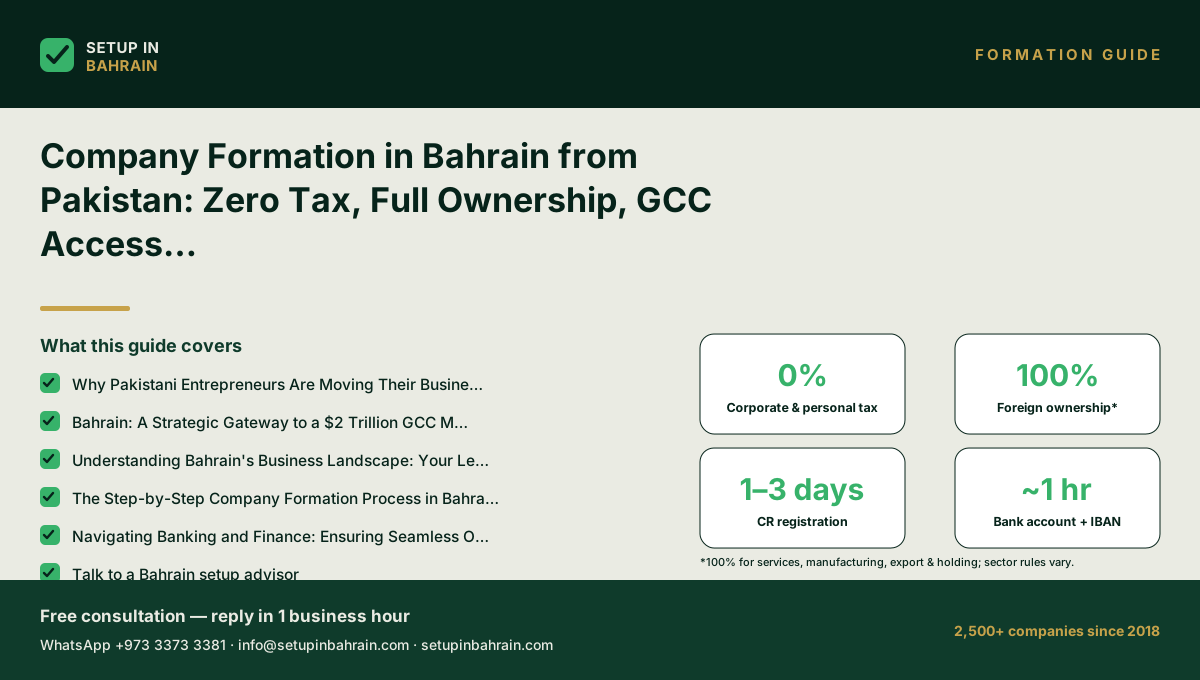
A Bahrain WLL can be owned by a single person — 100% foreign ownership applies to most activities, with no local partner required for services, manufacturing, export trading and holding companies. The minimum share capital is BHD 1; we recommend BHD 1,000, which makes bank account opening and investor visa approval smoother.
You're a Pakistani entrepreneur. You've poured your life, your passion, and countless hours into building your business. You've navigated the turbulent waters of a dynamic economy, constantly adapting, innovating, and pushing forward. But let's be frank: the current business climate in Pakistan often feels less like a supportive ecosystem and more like an uphill battle against an ever-shifting landscape of regulations, taxes, and economic uncertainties. You're not just running a business; you're perpetually strategizing against factors largely beyond your control.
Imagine a scenario where the corporate tax rate isn't a crippling 29%, where your profits aren't eroded by an unpredictable currency, and where international trade isn't a bureaucratic labyrinth of SBP foreign currency account restrictions. Imagine building a company where 100% of your ownership is guaranteed, with no local sponsor needed, and your access to a $2 trillion regional market like the GCC is just a 25-kilometer drive away. This isn't a fantasy; it's the reality Bahrain offers. This comprehensive 2026 guide is specifically for you, the resilient Pakistani entrepreneur, exploring how establishing your company in Bahrain can fundamentally transform your business trajectory, offering stability, growth, and unparalleled financial freedom.
We understand the pain points you face daily – the FBR e-filing complexity, the mandatory Super Tax, the persistent threat of IMF structural adjustment policies, and the delays at SECP that can halt your progress. This isn't just about finding an "offshore" solution; it's about strategically re-positioning your enterprise for sustainable growth and genuine wealth creation.
Why Pakistani Entrepreneurs Are Moving Their Business to Bahrain: A Stark Comparison
Last year, a Lahore-based software exporter told me his company cleared PKR 480 million in revenue. After FBR’s 29% corporate tax, the 10% Super Tax on income above PKR 400 million (which kicked in once he crossed the threshold), and the complexities of quarterly advance tax filings, he was left with roughly PKR 280 million. Then, the Pakistani Rupee (PKR) moved another 18% against the US Dollar in six months, and his effective take-home in real terms dropped further. He was not unique. Hundreds of Pakistani founders now run the same calculation every quarter and reach the same conclusion: the tax and currency arithmetic no longer supports staying onshore.
For far too long, Pakistani entrepreneurs have borne the brunt of an unpredictable economic environment. While the spirit of innovation and resilience remains strong, the structural impediments have become increasingly difficult to overcome.
The Erosion of Profits: Tax & Currency Woes in Pakistan
Let's dissect the numbers that keep you up at night:
- Crippling Corporate Taxation: Pakistan's corporate tax rate stands at a formidable 29% for most companies. This isn't just a deduction; it's a significant chunk of your hard-earned profits that never makes it back into your business for reinvestment or growth. When you factor in the additional "Super Tax," which became mandatory for higher-earning companies, the effective tax rate can climb even higher, placing an immense burden on profitability. For a business with an annual income exceeding PKR 400 million, the additional Super Tax adds another layer of financial pressure, making scaling even more challenging.
- FBR's Complexities and Quarterly Headaches: Beyond the rate, the process of compliance itself is a drain on resources. The FBR's e-filing system, while digitized, often presents its own set of complexities, demanding meticulous record-keeping and a deep understanding of tax laws. Quarterly advance tax payments require constant cash flow management and forecasting, diverting focus from core business activities.
- The Relentless Devaluation of the Rupee: Perhaps the most insidious threat to your wealth is the instability of the Pakistani Rupee. Since 2021, the PKR has lost more than 60% of its value against the US Dollar. This isn't just an abstract economic indicator; it directly erodes your purchasing power, reduces the real value of your savings, and makes international transactions painfully expensive. For businesses dealing with imports or targeting international markets, this volatility introduces an unacceptable level of risk. Your PKR 100 million in earnings today might be worth significantly less in USD terms just a few months down the line.
Navigating Trade Barriers: SBP Restrictions & International Ambitions
Pakistan's foreign exchange regulations, particularly those enforced by the State Bank of Pakistan (SBP), often act as a significant bottleneck for businesses with international aspirations.
- SBP Foreign Currency Account Restrictions: While businesses are allowed to maintain foreign currency accounts, the strict regulations around their use, withdrawal limits, and reporting requirements can complicate international trade and financial planning. Repatriating funds or making swift international payments can involve bureaucratic hurdles, leading to delays and missed opportunities. Many entrepreneurs find themselves in a constant battle with paperwork to simply move their own money across borders.
- Delays at SECP: Registering and making changes to companies in Pakistan can be a slow, cumbersome process. Delays at the Securities and Exchange Commission of Pakistan (SECP) are a common frustration, impacting everything from initial business setup to crucial structural changes or capital injections.
Bahrain's Unparalleled Business Climate: Stability, Growth, and Freedom
Now, let's contrast this with the proposition Bahrain offers:
Generally no corporate income tax for most sectors: Yes, you read that right. For most business activities, Bahrain imposes no corporate income tax*. Imagine the impact on your bottom line. That 29% (plus Super Tax) in Pakistan becomes 0% in Bahrain, allowing you to reinvest all your profits, accumulate capital faster, and truly grow your enterprise.
- 100% Foreign Ownership: A cornerstone of Bahrain's investor-friendly policy is the ability for foreign nationals to own 100% of their company in most sectors, without the need for a local partner or sponsor. This eliminates complex partnership agreements and gives you complete control over your business destiny.
- Stable Currency: The Bahraini Dinar (BHD) is pegged to the US Dollar at a fixed rate of BHD 1 = USD 2.65. This provides unparalleled currency stability, protecting your earnings from devaluation and offering predictability for international trade and financial planning. No more watching your profits shrink due to exchange rate fluctuations.
- Strategic Location and GCC Access: Bahrain is literally a bridge away from Saudi Arabia, the largest economy in the GCC. The King Fahd Causeway, a 25-kilometer stretch of road, connects Bahrain to Saudi Arabia, granting direct access to a $2 trillion regional market of over 50 million consumers. This is not merely geographical proximity; it's a direct commercial highway.
- Ease of Doing Business: Consistently ranked high by the World Bank for its ease of doing business, Bahrain offers a streamlined regulatory environment, digital government services, and pro-business policies designed to attract and support foreign investment. This translates to faster approvals, fewer bureaucratic hurdles, and a more efficient operational experience compared to many other jurisdictions.
For the Pakistani entrepreneur, Bahrain isn't just an alternative; it's a fundamental shift in how you operate, offering a pathway to significantly greater profitability, stability, and unhindered growth.
Bahrain: A Strategic Gateway to a $2 Trillion GCC Market
Bahrain's allure for Pakistani businesses isn't just about internal efficiencies; it's profoundly about external opportunities. The Kingdom's strategic location positions it as a natural springboard into the wider Gulf Cooperation Council (GCC) market, a powerhouse economy brimming with potential.
Geographic Proximity & Connectivity
While Pakistan and Bahrain are separated by a short flight of about two to three hours, the real magic happens within the GCC.
- The King Fahd Causeway: This engineering marvel links Bahrain directly to Saudi Arabia, providing unmatched logistical advantages. For businesses involved in goods and services, the ability to physically transport products or personnel across the border with relative ease is a game-changer. Imagine expanding your market reach from a local Pakistani city to Riyadh, Dammam, or Jeddah with the same ease you might move between Lahore and Islamabad. This 25-kilometer connection is your literal gateway to the largest economy in the GCC.
- Excellent Air and Sea Links: Bahrain International Airport (BIA) is a modern, efficient hub offering excellent connections to major cities across the Middle East, Asia, Europe, and Africa. Coupled with its advanced port facilities, Bahrain provides robust logistical infrastructure for global trade. For Pakistani exporters, establishing a base in Bahrain means reduced transit times and costs for reaching regional and international clients.
Economic Diversification & Vision 2030
Bahrain has long understood the imperative of looking beyond oil. Its "Economic Vision 2030," championed by the Bahrain Economic Development Board (EDB), outlines a clear path towards a diversified, knowledge-based economy.
- Focus on Non-Oil Sectors: The EDB actively promotes investment in sectors like financial services (including Islamic finance and fintech), manufacturing, logistics, tourism, and ICT. This focus aligns perfectly with the strengths of many Pakistani entrepreneurs, particularly those in the rapidly growing tech and services sectors. The Kingdom is actively building ecosystems to support these industries.
- Fintech Hub: Under the progressive guidance of the Central Bank of Bahrain (CBB), Bahrain has emerged as a leading fintech hub in the region. It offers a regulatory sandbox for innovative financial technologies, attracting startups and established players alike. For Pakistani fintech companies, this provides a fertile ground for piloting new products and gaining regional market access.
Ease of Doing Business & Regulatory Environment
Bahrain’s commitment to fostering a vibrant business environment is evident in its regulatory framework and institutional support.
- World Bank Rankings: Bahrain consistently ranks high in the World Bank's Ease of Doing Business reports, often outperforming many regional peers. This reflects its streamlined procedures, transparent regulations, and investor-friendly policies.
- Ministry of Industry and Commerce (MOIC): The MOIC is the primary body responsible for company registration and licensing. Their digitized services and clear guidelines significantly simplify the bureaucratic process compared to what many Pakistani entrepreneurs are accustomed to with the SECP.
- Central Bank of Bahrain (CBB): The CBB is a respected and forward-thinking regulator, particularly in the financial sector. Its clear guidelines ensure a stable and secure financial environment, vital for investor confidence. Their proactive approach to licensing and oversight ensures that financial entities operate within a robust framework.
- Bahrain Investment Primary Agency (BIPA): BIPA acts as a one-stop-shop for investors, providing guidance and support through the entire investment journey. While not a formal regulator, their advisory role is invaluable for new entrants.
In essence, Bahrain offers not just a place to set up a business, but a strategic partner in your journey to regional and international expansion, underpinned by a supportive government and a modern infrastructure.
Understanding Bahrain's Business Landscape: Your Legal Entity Options
When considering company formation in Bahrain, choosing the right legal structure is paramount. For Pakistani entrepreneurs seeking full ownership and limited liability, one particular entity stands out.
The WLL (With Limited Liability): The Preferred Choice for Pakistani Entrepreneurs
The With Limited Liability (WLL) company is by far the most popular and practical choice for foreign investors in Bahrain, and it is almost certainly the optimal structure for you.
100% Foreign Ownership: This is a critical advantage. Unlike some other jurisdictions or historical models, a WLL in Bahrain can be 100% owned by a foreign national or foreign entity. You do not* need a local Bahraini sponsor or partner to hold a majority stake. This ensures complete control over your business operations and profits. Single Shareholder: Another key benefit that directly addresses a common misconception: a WLL in Bahrain can be owned by a single person*. There is no requirement for multiple partners, making it ideal for individual entrepreneurs or sole founders who want to establish a legitimate, fully owned company. Do not confuse this with a "Single Person Company" (WLL) – which does not exist in Bahrain. The WLL structure provides all the benefits of limited liability and full ownership for an individual.
- Limited Liability Protection: As the name suggests, a WLL provides limited liability to its shareholders. This means your personal assets are protected from the company’s debts and obligations, limiting your risk to the amount of capital you've invested in the business. This separation of personal and business finances is crucial for risk management.
- Minimum Share Capital: Legally, the minimum share capital for a WLL in Bahrain is a symbolic BHD 1. However, and this is a critical practical distinction, we strongly recommend starting with a minimum share capital of BHD 1,000. While BHD 1 meets the legal requirement, most banks will require a higher capital amount (typically BHD 1,000 or more) to approve a corporate bank account, especially for non-resident directors. Furthermore, if you plan to apply for an investor visa for yourself, the immigration department often looks for a more substantial capital commitment, making BHD 1,000 a much more practical and advisable starting point.
- Scalability: A WLL is a highly flexible structure that can easily accommodate future growth. You can add shareholders, increase capital, and expand your business activities as your enterprise evolves, making it suitable for startups and growing SMEs alike.
- Broad Business Activities: A WLL can engage in a wide range of commercial, industrial, and service activities. The main restriction is that it generally cannot undertake banking, insurance, or investment fund management activities without specific additional licensing from the CBB, nor can it offer public subscriptions for shares or debentures.
Other Business Structures: A Brief Overview
While the WLL is the clear frontrunner, it's worth briefly knowing about other structures, though they are less common for direct foreign investment by individual entrepreneurs:
- Sole Proprietorship: This structure is generally reserved for Bahraini nationals or GCC citizens. It does not offer limited liability and is therefore less attractive for foreign investors seeking protection.
- Branch Office of a Foreign Company: If you already have an established company in Pakistan (or elsewhere) and want to operate a direct extension in Bahrain, a branch office might be considered. However, it is not a separate legal entity, and the parent company remains liable for all its operations in Bahrain. It requires significant commitment and typically higher setup costs.
- Public Shareholding Company (BSC Public): These are large corporations offering shares to the public and are subject to stringent regulatory requirements. Not suitable for SMEs or typical entrepreneurial ventures.
- Private Shareholding Company (BSC Closed): Similar to a WLL but with a higher capital requirement and different governance structure. Less common for initial foreign setups than a WLL.
Crucial Reminder: There is NO single-shareholder WLL as a distinct legal entity type in Bahrain. A WLL owned by a single person serves this purpose, offering all the benefits of limited liability and 100% ownership. Do not search for or ask for an "WLL" in Bahrain as it does not exist in its own category.
The Step-by-Step Company Formation Process in Bahrain: A Human-Centric Roadmap
Setting up a company in a new country can feel daunting, but Bahrain has significantly streamlined its process. Think of it less as a bureaucratic maze and more as a logical, phased journey with clear milestones. With the right guidance, it’s remarkably efficient.
Phase 1: Strategic Planning & Initial Approvals
This initial phase is about laying a solid foundation and getting the preliminary green lights.
- Define Your Business Activity & Legal Structure:
- Company Name Reservation:
- Initial MOIC Approval & Required Documents:
Phase 2: Registration & Licensing – Bringing Your Vision to Life
Once initial approval is granted, you move to the formal registration and licensing of your entity.
- Capital Deposit (Practical Step):
- Final MOIC Application & CR Issuance:
- Commercial Licenses & Other Registrations:
Phase 3: Post-Registration Essentials – Setting Up for Success
Your company is legally registered, but a few crucial steps remain to make it fully operational.
- Opening a Corporate Bank Account:
- Leasing Office Space (Virtual vs. Physical):
- Investor Visa & Residency Permit:
- Hiring Staff (If Applicable):
The entire process, from initial planning to fully operational, can typically take 3 to 6 weeks for a straightforward WLL with no complex licensing requirements, assuming all documents are in order and promptly submitted. Specialized activities might take longer.
Navigating Banking and Finance: Ensuring Seamless Operations
One of the primary drivers for Pakistani entrepreneurs to look beyond their borders is financial stability and ease of international transactions. Bahrain excels in both.
Opening a Corporate Bank Account in Bahrain
While the process is straightforward in theory, securing a corporate bank account for a newly registered foreign-owned company requires careful preparation.
- Documentation is Key: You'll need your Commercial Registration (CR), Memorandum and Articles of Association (M&AA), passports of all shareholders and directors, your company's physical or virtual office address proof, and sometimes a detailed business plan.
- Proof of Funds & Source of Wealth: Be prepared for banks to conduct stringent Know Your Customer (KYC) and Anti-Money Laundering (AML) checks. This includes providing documentation for the source of your initial capital deposit and potentially personal wealth. This is standard global practice but can be more meticulous for non-resident entities.
- The BHD 1,000 Capital Advantage: As reiterated, while BHD 1 is the legal minimum, banks almost universally prefer a higher initial deposit, with BHD 1,000 being a common practical threshold for account activation. Some banks might require even more, depending on your business activity and projected turnover.
- Choice of Banks: Bahrain hosts a robust financial sector with both conventional and Islamic banks. Local banks like National Bank of Bahrain (NBB
Bahrain Business Guides for Pakistan Citizens
Ready to set up in Bahrain from Pakistan?
Tell us your business idea. We map the right entity, ownership and timeline — then handle the filing while you focus on what matters.