Complete guide for Nigeria entrepreneurs: form a company in Bahrain with generally no corporate income tax for most sectors, 100% foreign ownership, and GCC market access. Costs, steps, visas, banking.
→ Complete guide: Company Formation in Bahrain — the full 2026 guide
View details
Ownership & capital
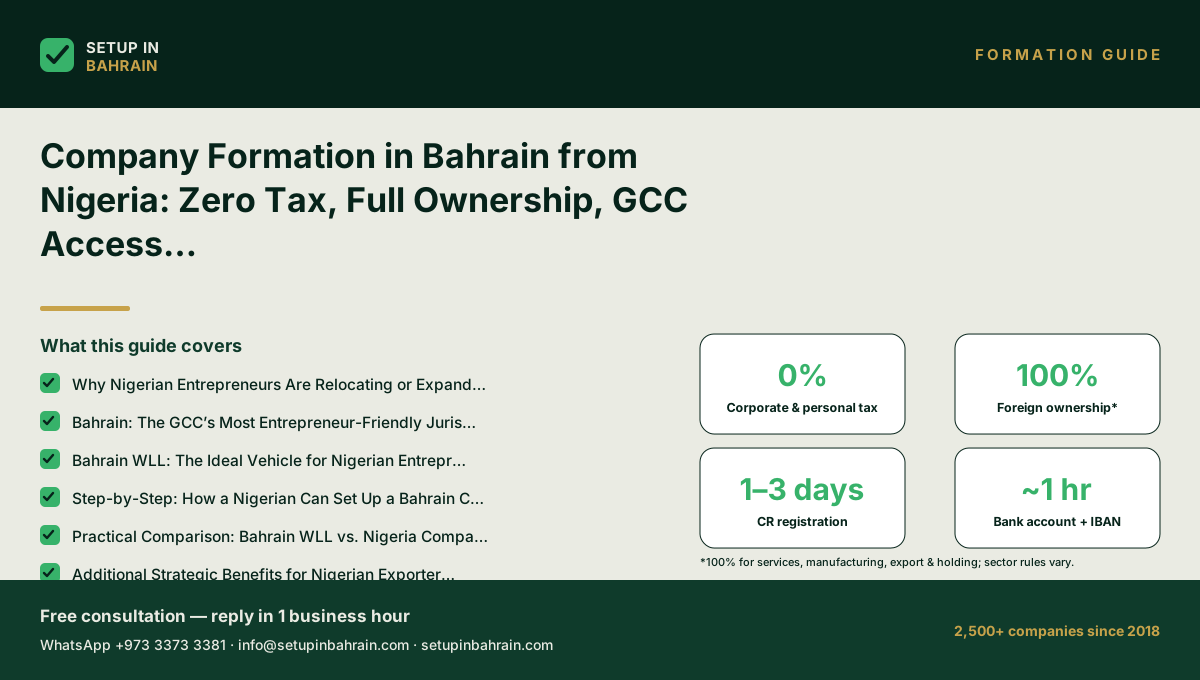
A Bahrain WLL can be owned by a single person — 100% foreign ownership applies to most activities, with no local partner required for services, manufacturing, export trading and holding companies. The minimum share capital is BHD 1; we recommend BHD 1,000, which makes bank account opening and investor visa approval smoother.
By Your Name, B2B Content Strategist & Semantic SEO Expert
As a Nigerian entrepreneur in 2026, building a globally competitive company means confronting relentless headwinds: triple-digit inflation, a currency that slides with every CBN press release, and tax bills that feel more like penalties than partners in progress. You work overtime just to move USD abroad, watch profits evaporate with the naira, and juggle twelve FIRS e-filing windows—all just to keep your doors open. The moment you speak with peers in the Gulf or Europe, the contrast is stark: zero tax environments, stable currencies, and business systems designed to help you scale and thrive.
That’s why from Lagos to Abuja to Port Harcourt, a quiet but resolute wave is underway. Top founders and emerging business leaders are forming companies in Bahrain—a business-friendly Gulf nation with generally no corporate income tax for most sectors, 0% personal tax, no hidden ownership caps, and a transparent startup environment. Bahrain isn’t just the easiest onshore formation in the Gulf; it’s precisely engineered for assets, SaaS, fintech, consulting, and holding companies looking to serve the world, not just the Gulf. This is your Nigeria-specific, 2026 expert roadmap—written for the real entrepreneur, not a brochure.
Why Nigerian Entrepreneurs Are Relocating or Expanding to Bahrain
The Nigerian Reality: Taxes, Currency, and Complex Compliance
Let’s be brutally honest about the pain points. If you operate a successful business in Nigeria, you’ve endured:
- 30% Corporate Income Tax: After the 2019 Finance Act updates, almost every non-micro business gets hit at the top rate.
- 2% NITDA Levy: If you’re a tech/IT/export company with ₦100 million+ turnover, the National Information Technology Development Agency tacks on a mandatory levy—no opt-outs.
- FIRS E-Filing Complexity: Twelve unique federal tax types require parallel submissions. Miss a window—risk penalties and audits.
- Multiple State/Local Levies: From signage to environmental to consumption tax, you can pay ₦250,000–₦800,000 or more, per business location, per year.
- CBN Forex Restrictions: USD or EUR payments from clients can sit stuck for months; official and parallel rates diverge wildly. Hedging is impossible.
- Naira Devaluation: In just the 2023 CBN float, the naira lost over 60% of its value. Profits denominated in NGN all but vanish when repatriated or converted for global expenses.
- Regulatory Uncertainty: Each directive from Abuja or a new FIRS memo means new compliance risk.
Example Case: Chinedu runs a fintech in Victoria Island with ₦85 million profit in 2024. Actual take-home after all taxes, hidden state charges, and devaluation: barely enough to cover last quarter’s USD cloud bills.
Why This Pushes Nigerian Businesses to Look Outside
The reality for most founders: even best-case profit scenarios are chopped down by heavy taxation, currency risk, and operational drag. When you try scaling internationally or accessing venture funding, the system itself becomes the obstacle.
It’s not about “giving up” on Nigeria—it’s building a hedge: a Gulf-based entity that enables seamless trade, USD/GBP accounts, and investor confidence. That’s where Bahrain comes in.
Bahrain: The GCC’s Most Entrepreneur-Friendly Jurisdiction
What Makes Bahrain Different?
Bahrain offers a globally proven environment optimized for international business:
- generally no corporate income tax for most sectors: For almost all activity (except oil/gas sector).
- 0% Withholding Taxes: No tax on dividends, interest, or royalties.
- 0% Personal Income Tax: Earn and remit traceable income, tax-free.
- Stable, USD-Pegged Currency: The Bahraini Dinar (BHD) has been pegged to the US dollar for decades—no surprises, no devaluations.
- Full Foreign Ownership: With a Bahrain WLL, one person (even a non-resident Nigerian) can own and operate 100% of the shares, with no local sponsor or silent partner required.
- Simple Setup and Compliance: Paperless company formation, straightforward licensing, English-speaking government agencies.
- GCC Market Access: A base inside the $1.6 trillion GCC common market—ideal for SaaS, consulting, e-commerce, digital and professional services.
- Fast Bank Account Opening: Even non-residents can access top-tier local and international banks (with starting capital of BHD 1,000 recommended for smooth compliance).
- Transparent Regulation: No “wasta,” and all ultimate ownership is directly disclosed to the government; no hidden nominees.
- Visa-Eligible Structure: Company owners and executives qualify for multi-year Bahrain resident investor visas.
Regulatory and International Rankings
- World Bank “Ease of Doing Business”: Ranked #1 in the MENA region for process simplicity (World Bank, 2023).
- Bahrain Economic Development Board (EDB): Direct support for global founders, sector-specific incentives, and market entry advisory.
- Central Bank of Bahrain (CBB): A robust, transparent financial services regulator; trusted by global fintechs and digital banks.
- Ministry of Industry & Commerce (MOIC): One-stop digital portal for company registration, licensing, and annual compliance.
- Bahrain Investors’ Center (BIPA): In-country office dedicated to inbound company formation and aftercare.
Bahrain WLL: The Ideal Vehicle for Nigerian Entrepreneurs
What Is a WLL (With Limited Liability Company)?
Definition: A WLL is the Gulf equivalent of a private limited company (think “Ltd” in the UK or “LLC” in the US)—but with unmistakably founder-friendly features.
Key Points:
- Zero Requirement for Local Partners/Sponsors: Any foreigner (Nigerian or other) can be the sole shareholder and sole director.
- Minimum Capital: The legal minimum is BHD 1—but in practice, BHD 1,000 is advised for opening a company bank account and meeting KYC standards at major Bahraini banks.
- No WLL in Bahrain: The “Single Person Company” model is not available. All individuals (even if solo) use the WLL structure.
- No Restrictions on Most Commercial Activities: The WLL can cover tech, consulting, e-commerce, trading, holding and IP management, digital agency business, and more. Regulated activities (banking, finance, health) require additional licensing.
Ownership and Structure Details
| Feature | Bahrain WLL (for Nigerians) | UAE Freezone LLC | Delaware LLC | Nigerian Ltd/Gte |
| Max Foreign Shareholding | 100% by a single foreigner | Up to 100% (varies by freezone) | 100% | 100% (but complex ownership) |
| Minimum Capital Required | BHD 1 (practical: BHD 1,000) | Varies by freezone (AED 10k+) | None | ₦10k (but often much higher) |
| Local Resident Director/Manager Needed | No | Often required | No | Yes (for some activities) |
| Government License Fees (Annual) | BHD 100–300 (avg), sector-specific | AED 11,000–24,000 | $300–500/yr | ₦100k–₦500k+ (plus levies) |
| Corporate/Personal Tax | 0% | 0%/9% (2024+) | Federal pass-through | 30% CIT/10% WHT/Varies |
| Currencies Supported in Bank Account | BHD, USD, EUR, GBP | AED, USD, EUR, GBP | USD (Intl bank needed) | NGN (USD rarely accessible) |
| Visa Eligibility | Yes – owner/investor visa by shares | Yes (via local residency sponsor) | No direct visa | N/A |
Step-by-Step: How a Nigerian Can Set Up a Bahrain Company in 2026
1. Confirm Eligibility and Choose Your Business Activity
Almost any business with non-GCC client delivery (tech, SaaS, consulting, holding, trading, finance, digital) is permitted—regulated sectors like crypto, healthcare, or FX will need additional licenses.
2. Name Reservation and Pre-Approval (BIPA/MOIC)
- Submit 3–5 company names for initial approval via the online portal.
- Names can be in English or Arabic.
3. Documentation Required (No Apostille Needed!)
- Passport and proof of residence (Nigerian utility bill or driver’s license).
- UK/US/Nigeria company reference (optional but helpful for banking).
- Short business plan (1 page).
- Source of funds and KYC declaration (to satisfy AML requirements).
4. WLL Registration Process
- Complete the WLL application online with Bahrain MOIC/BIPA.
- Declare initial share capital (BHD 1 minimum, BHD 1,000+ practical).
- Register Memorandum & Articles of Association in English.
- One or more directors (can all be non-residents; minimum age: 18+).
5. Commercial Registration (CR) and Licensing
- Select from broad activity codes (MOIC publishes an activity list for tech, trading, services, consulting, etc.).
- Submit lease agreement, if setting up a physical office (virtual or flex-desk options available from BHD 30/month).
6. Bank Account Opening
- With an issued Commercial Registration (CR), apply at Bahraini or international banks.
- Minimum deposit advised: BHD 1,000.
- Banks require clear KYC: proof of business, source of wealth, and address.
- USD, EUR, GBP, and BHD accounts available (no CBN restriction).
7. Bahrain Investor/Owner Visa (Optional but Recommended)
- With shares in WLL and active company, apply for Bahrain residency investor visa (2-year or 5-year options).
- Visas for immediate family members possible.
- No “nationalization” quotas or salary minimums for owners.
8. Annual Compliance & Reporting
- Simple online renewal with MOIC.
- No tax filings (in most cases); no annual local audit for small WLLs.
- Maintain minimum presence (business address or co-working space).
- No monthly e-filing or state-by-state compliance headaches.
Practical Comparison: Bahrain WLL vs. Nigeria Company for Exports
| Scenario | Nigeria Ltd./Gte | Bahrain WLL |
| Corporate Income Tax | 30% on taxable profit | 0% |
| NITDA Levy (Tech Only) | 2% above ₦100m turnover | 0% |
| Withholding Tax (Dividend/FX Outflow) | 10%+ | 0% |
| Forex Access | USD/EUR restricted; CBN approval needed | No restriction; multi-currency |
| Bank Account in USD | Not available locally | Fully available |
| Setup & Annual Fees | ₦250,000–₦900,000+ | BHD 300–600 (approx. ₦600,000–₦1.2m) |
| Visa/Residency for Owner | N/A | Yes (multi-year, renews) |
| Reporting Burden | High – 12 FIRS e-filings | Low – Single online renewal |
Bahrain for Nigerians: FAQs and Common Concerns
Do I Need to Be in Bahrain to Form a Company?
No. Formation can be done 100% remotely, with one quick KYC verification video call. However, a short visit to open a bank account in person is recommended.
Can I Own 100% of My Bahrain Company?
Yes. WLL allows full foreign ownership—even a single Nigerian founder can own 100% of shares and act as sole director.
Is There a Minimum Paid-Up Capital Required?
Legally, BHD 1 (~₦3,500). Practically, BHD 1,000+ is advised for bank account and investor visa eligibility.
What Activities Can I Do in a Bahrain WLL?
- Technology/software exports
- Consulting and business services
- General trading (with import/export approvals)
- Holding, IP management
- E-commerce and online stores
- Professional services
Certain regulated sectors (financial services, healthcare, crypto) need CBB/MOH licensing.
How Do Taxes in Bahrain Actually Work?
- Corporate Tax: 0% for nearly all businesses (except local oil/gas).
- VAT: Only for local sales above BHD 37,500 per year. No VAT on exports or services to clients outside Bahrain.
- Personal Tax: None.
- Dividend/Interest/Capital Gains Tax: None.
Are There Any Surprises or “Hidden” Fees?
No hidden partners, no nationalization quotas for founders, no rapid annual license hikes. All fees are published by MOIC/BIPA and stable year to year.
What About Banking—Can I Open USD/EUR Accounts?
Yes. Bahrain’s top banks (Ahli United Bank, Bahrain Islamic Bank, HSBC Bahrain) all offer USD, EUR, GBP, and BHD corporate accounts—with internet banking that works worldwide.
Additional Strategic Benefits for Nigerian Exporters, Consultants, and Tech Founders
1. Raising Foreign Investment
International VCs overwhelmingly prefer investing in entities outside Nigeria’s jurisdictional risks. A Bahrain WLL with clean, transferable shares is globally acceptable and signals real professionalism. No opaque filings—full legal clarity.
2. Tier-1 Payment Gateways and Global Trade
Stripe, Adyen, PayPal, and other global processors recognize Bahrain registrations. You can access global tools that are often unavailable to Nigeria-registered companies.
3. Asset Protection and IP
Holding your trademarks, software IP, and foreign shares in a Bahrain entity shields them from domestic volatility and maximizes future exit value. Bahrain’s English-court system is transparent, making IP enforcement straightforward.
4. Credibility and Branding
Doing business from a registered Bahrain address (in Manama or Bahrain Bay) offers instant legitimacy with US/EU/Gulf clients—no stigma, no red flags.
5. Simple Exit and Succession
Shares in a WLL are transferable by contract—no probate or opaque Nigerian registry issues. That means clean exits for partnerships or future acquisition.
How Much Does It Cost? Bahrain Company Formation Costs from Nigeria (2026)
| Item | Amount (BHD) | NGN Equivalent* (2026) | Notes |
| Government Registration Fee | 150–300 | ~₦300,000–₦600,000 | MOIC/BIPA published rates |
| Legal/Setup Fees | 500–1,200 | ~₦1.0m–₦2.4m | Local advisor, translations, courier |
| Virtual Office (Annual) | 250–600 | ~₦500,000–₦1.2m | Flex-desk, Manama |
| Bank Account Deposit | 1,000+ | ~₦2.0m+ | Recommended for approval |
| Annual Renewal/Govt Fees | 100–300 | ~₦200,000–₦600,000 | Varies by sector |
| Investor Visa (optional) | 500–700 | ~₦1.0m–₦1.4m | 2–5 year duration |
| Total (Year 1) | 2,500–4,000 | ₦5.0m–₦8.0m | All-in, excluding travel |
These costs are a fraction of equivalent UAE, UK, or Singapore formations—and you get more flexibility and lower ongoing compliance.
Bahrain Company Formation: Common Red Flags and How to Avoid Them
- Beware “WLL” Offers: Some offshore agents reference “Single Person Company”—these do not exist in Bahrain law! WLL is the correct form (can be one person).
- Too-Good-To-Be-True Banking: Some agents promise “instant” USD/EUR online banking. Bahraini banks are regulated and require full KYC and source-of-funds evidence.
- Ignoring Visa Options: If you want Gulf residency and seamless travel, the WLL shareholding alone makes you eligible for investor residency—leverage this advantage.
- Using Nominee/Proxy Owners: Bahrain requires real UBO (Ultimate Beneficial Owner) disclosure—do not use hidden nominee arrangements.
A Final Word: E-E-A-T, Trust, and Regulatory Support
This guide is based on the latest 2026 guidelines and data from:
- Bahrain Economic Development Board (EDB): edb.gov.bh(https://www.edb.gov.bh/)
- Ministry of Industry and Commerce (MOIC): moic.gov.bh(https://www.moic.gov.bh/)
- Bahrain Investors’ Center (BIPA): bipa.gov.bh(https://www.bipa.gov.bh/)
- Central Bank of Bahrain (CBB): cbb.gov.bh(https://www.cbb.gov.bh/)
- World Bank Doing Business Reports
- Actual founder experiences and direct legal/advisory consultations in Bahrain, Nigeria, and global markets.
Next Steps: Getting Started
Ready to take your business global, hedge against Nigeria’s volatility, and access a zero-tax, USD-pegged hub? Here’s what to do:
- Self-assess your business goals: Do you want an export HQ, a fintech gateway, or investor-friendly holding company?
- Choose a proven Bahraini advisor familiar with Nigerian founder needs and global compliance.
- Gather your documentation and select your company name (check on Sijilat Portal(https://www.sijilat.bh)).
- Start your online application (or let your advisor do it on your behalf).
- Open your Bahrain bank account—ideally in person to maximize account type choices.
- Apply for a Bahrain investor visa (optional, but unlocks true Gulf presence).
If you’re tired of taxes eating your margin, naira reducing your profits, and FIRS adding complexity to every deal, it’s time for a smarter company structure. Bahrain delivers exactly what every world-class Nigerian founder needs: neutrality, stability, flexibility, and a clear path to global scale.
Still have questions? Contact your preferred international legal or advisory partner—or reach out to the Bahrain Investors’ Center (BIPA(https://www.bipa.gov.bh/)) for unbiased, no-obligation support. The next chapter of your business can be truly borderless.
References:
- Central Bank of Bahrain (CBB) Regulatory Handbook 2026
- Bahrain Economic Development Board (EDB) “Doing Business in Bahrain” 2026 White Paper
- Bahrain Investors' Center (BIPA) Investor FAQ (2026)
- World Bank Overseas Company Rankings 2025
- FIRS (Nigeria) and NITDA official guidelines (2025-2026 updates)
Bahrain Business Guides for Nigeria Citizens
Ready to set up in Bahrain from Nigeria?
Tell us your business idea. We map the right entity, ownership and timeline — then handle the filing while you focus on what matters.