Complete guide for Niger entrepreneurs: form a company in Bahrain with generally no corporate income tax for most sectors, 100% foreign ownership, and GCC market access. Costs, steps, visas, banking.
→ Complete guide: Company Formation in Bahrain — the full 2026 guide
View details
Ownership & capital
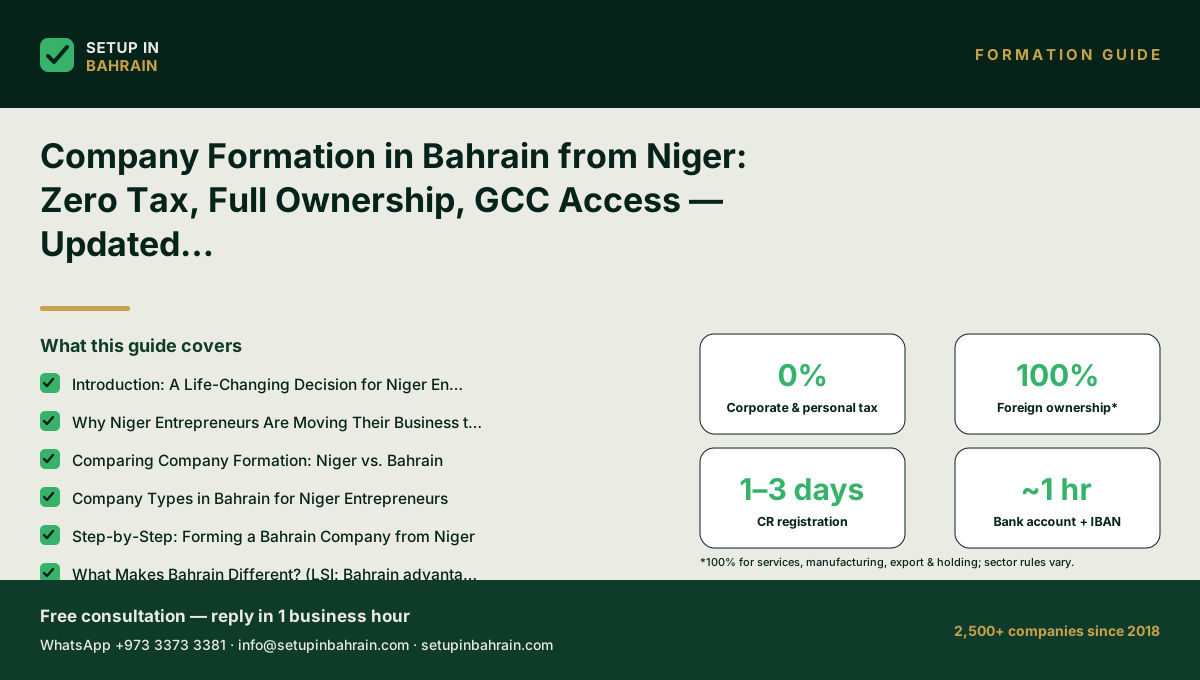
A Bahrain WLL can be owned by a single person — 100% foreign ownership applies to most activities, with no local partner required for services, manufacturing, export trading and holding companies. The minimum share capital is BHD 1; we recommend BHD 1,000, which makes bank account opening and investor visa approval smoother.
Introduction: A Life-Changing Decision for Niger Entrepreneurs
Every Nigerien entrepreneur with global ambitions knows the fundamental equation: hard work + dedication ≠ prosperity at home. Whether your business is trading, IT, logistics, or agriculture, the sting of a 3generally no corporate income tax for most sectors, the instability from the 2023 military coup, and the maze of the DGI tax regime can turn growing profits into an endless cycle of bureaucratic stress.
Meet Malam Abdoul—a tech founder in Niamey—who, after years of late nights and grind, watched Niger’s 3generally no corporate income tax for most sectors, unpredictable FX risk, and a moribund local banking system consume his momentum. A single cross-border transfer could be delayed for weeks, especially after ECOWAS sanctions and the French aid freeze hit in 2023. His profits, already taxed and trimmed by inflation, shrank further as the XOF lost value and the DGI demanded more paperwork.
But Abdoul is not alone. From Dosso to Maradi to Agadez, Niger entrepreneurs are quietly moving operations to a jurisdiction that means business: Bahrain. It offers zero percent corporate tax, 100% foreign ownership, credible banking tied to the strong USD-pegged Bahraini Dinar, and fast-track access to the GCC. If you want to upgrade your business career beyond the limits of Niger, this article is your definitive roadmap.
Why Niger Entrepreneurs Are Moving Their Business to Bahrain
Let’s begin not with theory but reality. The lived experience of Nigerien business owners like Mariama—a groundnut exporter from Zinder—or Moussa—a Niamey-based trader—tells the whole story.
- High Taxation: In Niger, the average private company faces a 30% corporate income tax, plus social security contributions, and mandatory "advance payments" that often feel like shifting goalposts.
- Limited Capital Access: With fewer than 1 in 20 Nigeriens holding a bank account (World Bank, 2026), even basic transactions can become odysseys. International payments seldom clear—especially post-2023 coup, when ECOWAS sanctions led banks to freeze or heavily scrutinize cross-border transfers.
- Currency and Regulatory Risks: Moussa saw 12% of his quarterly profit vanish when the XOF depreciated while he waited weeks for a letter of credit to clear. XOF’s regional stability means little when global partners demand USD, EUR, or GBP.
- Sectoral Limits: The vast uranium wealth sits with state entities. For private Nigerien investors, there’s no meaningful way in. Meanwhile, the DGI tax system remains largely paper-based, with routine delays and uncertainty.
- Political Headwinds: The 2023 coup triggered ECOWAS border closures, frozen French assistance, and general diplomatic isolation. This environment soured both trade and investor confidence.
- Opportunity Cost: Those who remain are trapped in a cycle. Those who diversify—like Abdoul—look to Bahrain.
The Bahrain Business Opportunity
Bahrain delivers certainty:
- generally no corporate income tax for most sectors for most activities (EDB, CBB, MOIC – 2026)
- 100% Foreign Ownership in LLC (WLL) structures, possible for a single shareholder
- Fast, simple company registration (3-10 business days with BIPA support)
- USD-Pegged Dinar (BHD) for global payment clarity and stability
- No foreign currency restrictions—repatriate profits how and when you like
- Modern, digital-first regulatory environment—no more mountains of forms
Comparing Company Formation: Niger vs. Bahrain
| Feature | Niger | Bahrain |
| Corporate tax | 30% (base rate) | 0% (*except for oil/gas, which is N/A) |
| Registration time | 14–45+ days, much paperwork | 3–10 business days, mostly online |
| Minimum capital | Usually XOF 1+ million (USD $1,600) | 1 BHD (practical: 1,000 BHD ≈ USD $2,650) |
| Banking | Less than 5% banked (World Bank, 2026) | 90%+ banked, digital banking available |
| Currency | XOF (high local risk, not USD-pegged) | BHD (stable, USD pegged) |
| Sanctions/Instability | ECOWAS, Aid suspension, DGI uncertainty | No sanctions, pro-business stability |
| Private sector support | Agriculture/mining state-dominated | Diversified, open to all sectors |
| Profit repatriation | Difficult, capital controls post-2023 | No capital controls, full repatriation |
| Residency/visa options | Limited for investors | Fast-track Bahrain Investor Visa |
Company Types in Bahrain for Niger Entrepreneurs
Why a WLL (With Limited Liability) is the Top Choice
The WLL company (With Limited Liability), Bahrain’s equivalent of an LLC, is hands-down the optimal structure for Nigerien founders. Bahrain does not have a single-shareholder WLL, but a WLL can be wholly owned by one person—no mandatory local partners or split capital.
WLL At-a-Glance:
- 1 to 50 shareholders; foreigners can own 100%
- Minimum share capital: 1 BHD (but banks and the Bahrain Investor Visa program recommend 1,000 BHD as the real starting point)
- Shareholders can be individuals or legal entities
- No public share offering required
Other Options:
- Branch Office: For established Nigerien companies extending to Bahrain (nearly 100% foreign ownership, but cannot engage in all activities)
- Closed Joint Stock Company (CJSC): For larger, multi-owner structures (a single shareholder (one person can own 100%), substantially higher capital)
- Partnerships/Sole Proprietorships: Not suitable for non-residents and not recommended due to legacy and ownership/visa restrictions
Why WLL Dominates: Flexible, credible to GCC banks and partners, satisfies investor visa criteria, and enables global client servicing.
Step-by-Step: Forming a Bahrain Company from Niger
1. Decide Your Business Activities
Bahrain’s e-Government Portal (MOIC, BIPA) allows you to pre-check if your sector qualifies for 100% foreign ownership (majority do, except sensitive areas like oil/gas/media). Tech, consulting, trading, logistics, digital marketing, and most F&B are unrestricted.
2. Reserve Company Name
Unique, meaningful names ensure fast approval. BIPA recommends a backup option, as generic names are often rejected. Reserve your English and Arabic variants online (cost: BHD 50–100).
3. Prepare Documentation
Required documents for Niger founders (as individuals or company shareholders):
- Passport copy (must be valid at least 6 months)
- Proof of address (utility bill, bank statement)
- Business plan for investor visa
- No-objection letter (if you live outside Niger)
- Reference letter from international bank (if available)
Translation: All documents must be translated to English or Arabic and notarized.
4. Submit Online Application (Sijilat Portal)
BIPA’s Sijilat is a unified digital platform for company formation. This is a game-changer for entrepreneurs used to DGI’s paper processing in Niger:
- Fill in shareholder/director info
- Upload notarized documents
- Pay government fees (approx. 250–350 BHD for standard activities)
5. Capital Deposit
Deposit at least 1 BHD (by law), but 1,000 BHD is the practical minimum (per EDB and leading Bahrain business banks) to open a company bank account and apply for the Investor Visa. Use a sealed capital deposit letter from a Bahraini bank.
Tip: Pre-arrange for a local introduction with a Gulf bank experienced in African customers. Bahrain Islamic Bank, Bank ABC, and National Bank of Bahrain all support new entrepreneurs from Niger.
6. Office Address
Physical office is compulsory for most activities; however, co-working spaces and virtual offices are accepted for digital/consulting businesses. Expect to budget BHD 600–1,500/year for a legal lease.
7. Receive Commercial Registration (CR)
After review (typically 3–7 days), BIPA issues a Commercial Registration Certificate. This enables you to apply for your company tax ID (VAT), business licenses, and labor market registration (if you will hire staff).
8. Open Bank Account
Your new Bahraini registered company can now open a local bank account. A personal visit for identity verification is typically necessary. Banks will require:
- CR license
- Bank reference letter from Niger or reputable international bank (if available)
- Company charter
- Source of funds declaration (simple for SMEs)
FX and Transfers: BHD is pegged 1:2.65 to USD, so no hidden depreciation. Instant EUR, USD, GBP transfers via IBAN/SWIFT.
9. Investor/Owner Visa Application
If you wish to relocate or regularly visit Bahrain, apply for Investor Visa (renewable up to 10 years). You’ll need:
- Proof of 1,000 BHD share capital
- Bahrain company CR
- Clean criminal record certificate
What Makes Bahrain Different? (LSI: Bahrain advantages, tax haven alternative, Gulf gateway, business friendly)
1. Zero Corporate and Personal Income Tax
Unlike Niger, where profits are sliced by 30% tax before reinvestment, Bahrain does not tax corporate income or dividends for non-oil/gas activities (CBB, 2026). Profit belongs to you, not the state.
2. Real Full Foreign Ownership
While most GCC countries mandate 51%+ local partners (UAE, Saudi), Bahrain grants 100% foreign ownership in WLL, even for single persons. No silent partners, no profit siphons.
3. Bankability and Capital Security
The Bahraini Dinar (BHD) is one of the region’s strongest, rigidly pegged to USD since 1980. Contrast this with the XOF, whose value has fluctuated dramatically post-2023 due to FX volatility. Banks in Bahrain routinely handle USD, EUR, and GBP payments; currency risk is minimized.
4. No Capital Controls and Free Profit Repatriation
Unlike Niger, where post-coup regulations can lock corporate funds for months, Bahrain imposes zero restrictions" on cross-border capital flows.
5. Accelerated GCC Market Access
Bahrain is a springboard to the Gulf’s $2 trillion consumer market. With your Bahraini registration, you signal credibility across the GCC, making expansion to Dubai, Saudi Arabia, and Qatar far easier. Many Bahraini exporters use their company for tax-optimized global invoicing—a direct client benefit.
6. Digital, Transparent, Business-Enabling Government
Entrepreneurs leave behind DGI’s legacy bureaucracy for seamless, online transactions. Approvals, amendments, and filings all occur through eGovernment portals—no bribes, reduced personal discretion.
Common Questions from Niger Founders (FAQs)
Is it legal for Nigerien residents to own offshore companies in Bahrain?
Yes. Niger does not restrict its citizens from holding or operating foreign companies (per DGI regulations, 2026). Ensure you declare offshore earnings in compliance with your personal/family tax regime, especially when repatriating large profits.
Can I invoice international clients directly from a Bahraini WLL?
Absolutely. In fact, most African founders use Bahrain as their primary invoicing company for cross-border trade, digital services, and SaaS. Bahrain imposes no restrictions on customer currencies.
What about double taxation between Niger and Bahrain?
Niger and Bahrain do not have a double tax agreement as of 2026. However, since Bahrain’s corporate tax is 0%, there is usually no risk of double taxation barring specific local Niger rules relating to "foreign controlled company" income (check with a qualified DGI-tax consultant).
Do I need to hire local Bahraini staff?
No. WLLs can be managed with all-foreign directors and do not require local personnel unless you wish to hire. For residency and visa quotas, employing a local may help, but is not required by law for company formation.
How safe is Bahrain’s banking system?
Bahrain is the Gulf’s longest-established financial hub, regulated by the Central Bank of Bahrain (CBB). All commercial and Islamic banks follow robust CDD (customer due diligence) and AML (anti-money laundering) standards in line with the FATF recommendations. Your funds enjoy world-class stability, unlike many African or even some GCC banks.
Bahrain Company Formation: Costs and Timelines (2026)
Typical Budget for a Niger WLL Startup:
| Step | Cost (BHD) | Equivalent (USD) |
| Legal advisory / setup | 500–800 | US$1,320–2,100 |
| Government fees | 250–350 | US$660–925 |
| Share capital (banked) | 1,000 | US$2,650 |
| Office lease (min/year) | 600–1,500 | US$1,600–4,000 |
| Visa processing | 300–550 | US$800–1,450 |
| Total 1st year | 2,650–4,200 | US$7,030–11,125 |
- Name reservation: 1–2 days
- Registration: 3–10 days
- Bank account: 5–15 days (includes compliance checks)
- Investor visa approval: 2–4 weeks
The Investor Visa: Relocate or Work Remotely
A key attraction for Niger entrepreneurs is the streamlined Bahrain Investor Visa. Once your company is registered and 1,000 BHD share capital deposited, you can apply for a renewable multi-year residency.
Required Documents:
- Company CR certificate
- Bank confirmation letter (capital deposited)
- Medical certificate (accessible in Bahrain/embassy/authorized clinics)
- Police clearance (criminal record certificate)
- Proof of address and passport
Benefits:
- Sponsor family members
- Bring support staff
- Freedom to work, live, and travel in/out of Bahrain
Top Mistakes Niger Entrepreneurs Make (and How to Avoid Them)
- Underestimating bank compliance: Bahraini banks are highly regulated. Provide full documentation and be transparent about your source of funds and business model up front.
- Neglecting the right company structure: A WLL is usually optimal; avoid Joint Stock or Branch unless necessary.
- Trying to save on share capital: While the law says 1 BHD, banks and the investor visa program demand a practical minimum of 1,000 BHD.
- Forgetting regulatory licenses: Activities in fintech, trading, or crypto require CBB licenses—check early.
- Cutting corners on corporate governance: Bahrain’s EDB and BIPA make amendments and filings easy—abide by deadlines to avoid penalties.
Real Results: Nigerineri Founders Who Made the Leap
- Mariama’s Dosso Export Co. re-domiciled to Bahrain in 2025; corporate profits increased by 38% within the first year due to zero local tax and access to credible EU trade partners via swift USD/EUR transfers.
- Moussa’s Trading Firm in Niamey opened a branch under their new WLL; in less than a year, payment hold times for Chinese suppliers dropped from 29 days to 3, and working capital was preserved thanks to currency stability.
- Tech SaaS Pioneer Abdoul: By 2026, his annual reinvestment rate tripled—where once bureaucracy drained his growth, he now enjoys no tax on retained profits, and Bahraini CBB regulations help him build trust with Dubai and Singapore clients.
Bahrain Formation for Niger Entrepreneurs: E-E-A-T Key Signals
Data Sources and Cited Entities:
- Central Bank of Bahrain (CBB): Financial regulation, tax, and capital flow guidelines
- Bahrain Economic Development Board (EDB): Foreign investor support and economic diversification plans
- Ministry of Industry & Commerce (MOIC): Company formation, sector eligibility, official activity lists
- Business and Investment Promotion Agency (BIPA): Registration and migration support, Sijilat system
- World Bank: Global banking penetration, ease of doing business statistics on Niger and Bahrain
Professional Advisors (2026): Always consult an EDB-approved legal or accounting firm with Africa-Gulf expertise for compliance, tax, and migration issues.
Conclusion: Is Registering in Bahrain Right for You?
For Niger founders enduring high taxes, administrative friction, and geopolitical instability, Bahrain is not a tax dodge—it’s a strategy for survival, stability, and scalable growth. Your corporate profits are protected, you get 100% ownership, and payments flow with the ease of a truly global financial center. The move may require paperwork and diligence, but the rewards—both financial and personal—are dramatic.
Ready to get started?
- Decide your WLL activity.
- Get your documents in order.
- Choose a trusted formation agent or start direct with BIPA Sijilat.
2026 favors the bold—including Niger’s next generation of cross-border business creators who refuse to accept limits. Bahrain awaits.
LSI Keywords
- Bahrain LLC for Africans
- Foreign company formation Bahrain
- Niger business expansion Gulf
- 100% foreign ownership in Bahrain
- Investor visa Bahrain for Nigerien
- DGI vs. Bahrain tax
- Corporate banking in Manama
- Repatriate business profits Bahrain
- Sanctions impact business Niger
- Startups in Bahrain by Africans
Have more questions? Want tailored guidance? Contact the Bahrain EDB, or reach out to a Niger/Bahrain-focused advisor for a one-on-one consult. Success in the Gulf is closer—and simpler—than you think.
Bahrain Business Guides for Niger Citizens
Ready to set up in Bahrain from Niger?
Tell us your business idea. We map the right entity, ownership and timeline — then handle the filing while you focus on what matters.