
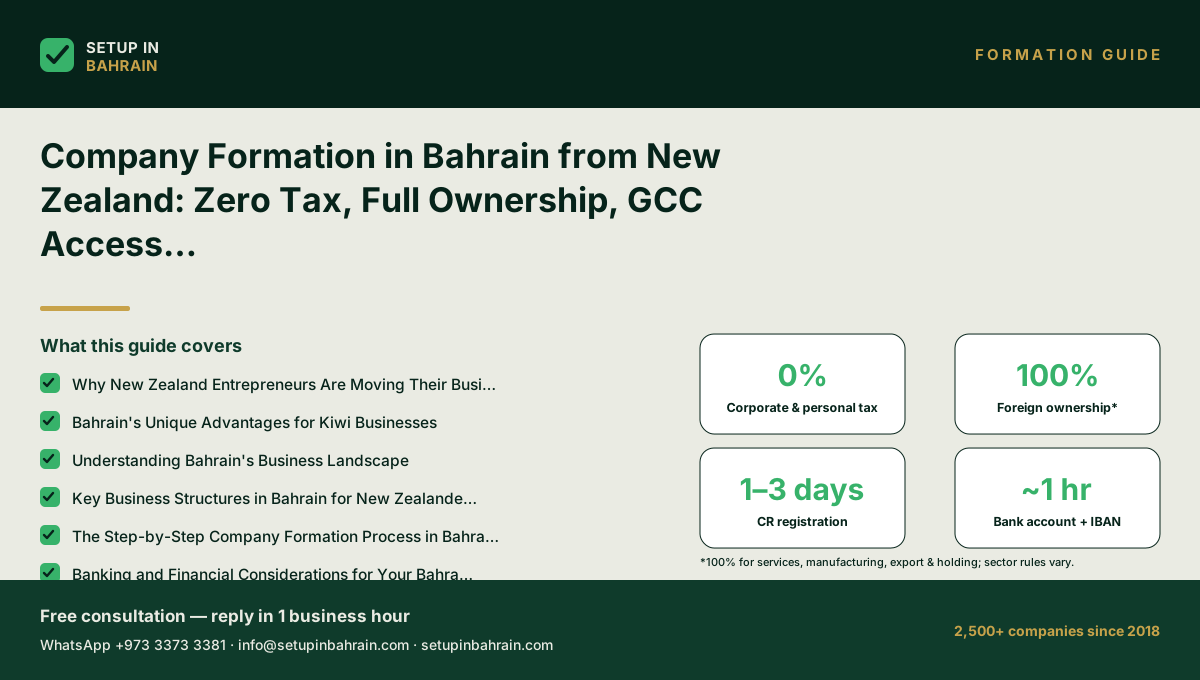
Complete guide for New Zealand entrepreneurs: form a company in Bahrain with generally no corporate income tax for most sectors, 100% foreign ownership. GCC market access. Costs, steps, visas, banking.
Key Takeaways
- Why New Zealand Entrepreneurs Are Moving Their Business to Bahrain
- Bahrain's Unique Advantages for Kiwi Businesses
- Understanding Bahrain's Business Landscape
- Key Business Structures in Bahrain for New Zealanders
- The Step-by-Step Company Formation Process in Bahrain
→ Complete guide: Company Formation in Bahrain — the full 2026 guide
View details
Ownership & capital
A Bahrain WLL can be owned by a single person — 100% foreign ownership applies to most activities, with no local partner required for services, manufacturing, export trading and holding companies. The minimum share capital is BHD 1 ; we recommend BHD 1,000 . This Makes bank account opening and investor visa approval smoother.
The pristine landscapes of Aotearoa, the vibrant business spirit that built a nation. The world-class innovation emerging from New Zealand's bustling cities are undeniably compelling. Yet, for many Kiwi business owners, the persistent headwinds of a high-tax environment, regulatory complexities. Geographic isolation from major global markets can feel like an anchor, holding back potential. Imagine, for a moment, being able to shed that anchor. To operate your business with zero corporate income tax, own 100% of your venture without local partners. Be positioned at the gateway to a USD 1.7 trillion market – all while maintaining a stable, USD-pegged currency that eliminates the headache of NZD volatility.
This isn't a distant fantasy; it's the reality of Bahrain. For New Zealand entrepreneurs, it represents a strategic pivot point that could redefine your business trajectory. In this comprehensive 2026 guide, we'll navigate the intricacies of establishing your company in Bahrain, speaking directly to the unique challenges and opportunities faced by Kiwis. From the jarring contrast with New Zealand's 28% corporate tax rate and mandatory KiwiSaver contributions to leveraging Bahrain's unparalleled access to the GCC, we’ll provide the deep, humanized insights you need to make an informed decision.
Why New Zealand Entrepreneurs Are Moving Their Business to Bahrain
Let's start with a scenario that’s probably all too familiar. You're a New Zealand entrepreneur, perhaps running a successful software consultancy from Parnell, an e-commerce platform shipping globally from Christchurch, or an innovative tech startup in Wellington. Your business is thriving, but every quarter, as you reconcile your accounts, you wince. That 28% corporate income tax rate, applied to your hard-earned profits, is a constant reminder of capital that could be reinvested, used for expansion, or simply enjoyed.
Picture this: a Christchurch-based agri-tech founder exporting sensor systems to Middle Eastern farms. Last year the company cleared NZD 1.2 million in profit. After the 28% corporate tax bill, ACC employer levies (which can add significant overhead, especially in higher-risk industries), quarterly GST returns above the NZD 60,000 threshold (a time-consuming administrative burden), and mandatory KiwiSaver contributions for employees, the founder took home roughly NZD 720,000 before personal income tax. The same revenue run through a Bahrain WLL (With Limited Liability) would have left the full amount available for reinvestment or distribution, with Generally no corporate income tax for most sectors and full repatriation rights. This difference isn't marginal; it's transformative.
New Zealand’s geographic isolation further compounds the issue. More than 14,000 kilometres separate Auckland from the heart of the Gulf Cooperation Council (GCC) market. This distance translates to extended shipping times, higher logistics costs, and a significant time zone difference that can complicate real-time collaboration with partners or clients in Europe, the Middle East, or even parts of Asia. While New Zealand boasts strong trade ties and robust digital infrastructure, the sheer physical distance from major global consumer and industrial hubs remains a tangible barrier for many businesses aiming for rapid international scaling. Bahrain, in contrast, offers a strategic geographical advantage, acting as a direct gateway to the USD 1.7 trillion GCC market and beyond into the wider Middle East and North Africa (MENA) region, home to over 500 million people.
Overcoming the Tax Burden: NZ's 28% vs. Bahrain's Zero
The most compelling incentive for many Kiwi entrepreneurs looking offshore is the stark contrast in corporate taxation. New Zealand's 28% corporate income tax rate. Stable, directly impacts a company's bottom line and limits capital available for growth. This is a significant drain on profitability, especially for businesses with high-profit margins or those in capital-intensive sectors.
In Bahrain, the landscape is entirely different. The Kingdom levies zero corporate income tax on most business activities. This means that 100% of your company's profits can be retained, reinvested, or distributed to shareholders without a corporate tax deduction. This isn't a temporary measure; it's a cornerstone of Bahrain's economic policy, designed to attract foreign direct investment and foster a thriving business ecosystem. For an entrepreneur accustomed to New Zealand's tax regime, this can feel like an almost unbelievable advantage, fundamentally altering financial projections and growth potential.
Escaping NZD Volatility with a USD-Pegged Currency
New Zealand's economy, while diversified, remains greatly influenced by commodity exports. This often leads to fluctuations in the New Zealand Dollar (NZD) against major currencies like the US Dollar, British Pound, or Euro. For businesses engaged in international trade, importing raw materials, or exporting finished goods, this currency volatility introduces an element of unpredictability to pricing, profit margins, and cash flow. Hedging strategies can mitigate some risks, but they also incur costs and add complexity.
Bahrain, on the other hand, pegs its national currency, the Bahraini Dinar (BHD), directly to the US Dollar at a fixed rate of BHD 1 = USD 2.65. This peg provides unparalleled currency stability, effectively eliminating exchange rate risk for transactions involving USD. For New Zealand entrepreneurs dealing with global supply chains or international clients, this stability simplifies financial planning, reduces administrative overhead. Provides a predictable operating environment. It allows you to focus on your core business strategy rather than constantly monitoring currency markets.
ACC Levies and KiwiSaver: Reduced Employer Costs
Beyond corporate tax, New Zealand businesses face other significant employer costs that chip away at profitability. ACC (Accident Compensation Corporation) levies are mandatory contributions employers must make to cover accident insurance for their employees. These levies vary by industry and can represent a substantial expense, especially for companies in sectors deemed higher risk. Similarly, mandatory KiwiSaver contributions for employees (currently a minimum of 3% of gross salary, matched by the employer) add another layer of overhead. While both are vital components of New Zealand's social welfare system, from a purely business cost perspective, they add to the financial burden of operating in the country.
In Bahrain. There are social insurance contributions for employees (Bahraini nationals primarily), the system is different and generally more flexible for foreign employers. There are no direct equivalents to ACC levies or mandatory employer-matched retirement schemes like KiwiSaver for expat employees. This translates to a leaner cost structure for businesses, allowing for more efficient allocation of human resource budgets and potentially higher net profits.
Simplified GST Filing vs. Bahrain's VAT (with nuances)
New Zealand's GST (Goods and Services Tax) regime requires quarterly filing for businesses with a turnover exceeding NZD 60,000. While the system is robust, preparing and filing these returns can be a time-consuming administrative task, especially for smaller businesses without dedicated accounting departments. Errors can lead to penalties, adding further stress.
Bahrain introduced VAT (Value Added Tax) in 2019 at a standard rate of 10%. While Bahrain does have VAT, the regulatory framework is relatively new and often seen as less complex than established VAT/GST systems in many developed nations. Moreover, for many international businesses primarily engaging in services or holding structures with no physical transactions within Bahrain, the direct implications of VAT might be minimal, or they may qualify for exemptions depending on their specific activities and customer base. It's important to note that if your Bahraini company generates revenue within Bahrain, VAT obligations will apply. For entities primarily serving international markets, the administrative burden can be greatly less compared to New Zealand's GST obligations.
Bahrain's Unique Advantages for Kiwi Businesses
Beyond the compelling financial and operational benefits of Generally no corporate income tax for most sectors, 100% foreign ownership. Currency stability, Bahrain offers a suite of strategic advantages that are especially appealing to New Zealand entrepreneurs looking to expand internationally.
Strategic Gateway to the GCC and MENA Market
Bahrain's geographical location is perhaps its most underrated asset. Situated in the heart of the Arabian Gulf, it is quite literally a bridge away from Saudi Arabia, the largest economy in the GCC, and within easy reach of the UAE, Qatar, Kuwait, and Oman. This central position makes it an ideal launchpad for businesses aiming to penetrate the entire GCC market. This Boasts a combined GDP of over USD 1.7 trillion and a young, affluent, and digitally-savvy population.
For a New Zealand business, this means moving from an isolated corner of the world to a pivotal nexus of trade and investment. Instead of distant exports, you gain proximate market access, enabling faster responses to market demands, reduced logistics costs. Stronger relationship building with regional clients and partners. The Economic Development Board (EDB) of Bahrain actively promotes the Kingdom as a regional hub, emphasizing its free trade agreements and open market policies.
A Pioneering Hub for Financial Services and FinTech
Bahrain has a long-standing reputation as a financial hub in the Middle East, predating many of its neighbours. The Central Bank of Bahrain (CBB) is a respected regulator, known for its progressive approach to financial innovation. This has positioned Bahrain as a leader in FinTech, with a regulatory sandbox and supportive ecosystem for blockchain, cryptocurrency. Other emerging financial technologies. For New Zealand entrepreneurs in FinTech, payment solutions, or digital banking, Bahrain offers a fertile ground for innovation and access to a sophisticated financial infrastructure. The presence of numerous international banks and financial institutions ensures robust banking services for businesses.
Ease of Doing Business: A Streamlined Process
The World Bank's Ease of Doing Business Report consistently ranks Bahrain highly, reflecting the government's commitment to creating a business-friendly environment. The Ministry of Industry, Commerce and Tourism (MOIC) and the Bahrain Investor Portal (BIPA) have worked diligently to streamline company registration processes, reduce bureaucratic hurdles, and enhance transparency. This means that setting up a company in Bahrain is often a greatly faster and more predictable process than in many other jurisdictions, including New Zealand, which, while efficient, still involves its own set of administrative steps and waiting periods.
Cost-Effective Operations and Living
Compared to regional peers like Dubai or Doha, Bahrain offers a greatly more cost-effective environment for both business operations and living. Office rents, operational costs, and even expatriate living expenses (housing, schooling, daily necessities) are generally lower. This allows businesses to stretch their capital further, providing a stronger runway for growth and profitability. This cost efficiency, combined with Generally no corporate income tax for most sectors, makes Bahrain an extremely attractive proposition for entrepreneurs mindful of their burn rate.
Highly Educated and Multilingual Workforce
Bahrain boasts a highly educated and skilled local workforce, augmented by a diverse and multilingual expatriate talent pool. English is widely spoken in business, making communication seamless for New Zealand entrepreneurs. The government heavily invests in education and vocational training, ensuring a continuous supply of qualified professionals. This makes it easier to recruit local talent or attract international professionals, reducing reliance on expensive overseas hires.
Modern Infrastructure and Connectivity
The Kingdom has invested heavily in state-of-the-art infrastructure, including advanced telecommunications networks, a modern international airport (Bahrain International Airport - BIA), and efficient logistics and port facilities. Bahrain's digital infrastructure is robust, offering reliable internet connectivity essential for modern businesses, especially those in tech or e-commerce.
Cultural Openness and Expat-Friendly Environment
Bahrain is known for its welcoming and tolerant culture. It's a progressive society that embraces diversity, making it a comfortable and safe place for expatriates and their families. There is a strong sense of community among the expat population. The country offers a high quality of life with excellent healthcare, international schools, and recreational activities. For Kiwis considering a move or establishing a presence, this aspect contributes greatly to a successful transition and long-term stay.
Understanding Bahrain's Business Landscape
Before diving into the specifics of company formation, it's crucial for New Zealand entrepreneurs to grasp the foundational elements of Bahrain's business environment. This understanding will help you tailor your strategy and navigate the regulatory framework effectively.
Regulatory Bodies and Legal Framework
The primary regulatory bodies overseeing company formation and business activities in Bahrain include:
- Ministry of Industry, Commerce and Tourism (MOIC): Responsible for commercial registrations, licensing, and regulating business activities.
- Central Bank of Bahrain (CBB): Regulates the financial services sector, including banking, insurance, and FinTech.
- Economic Development Board (EDB): A dynamic agency responsible for attracting foreign investment and promoting Bahrain's economic advantages globally. They are an invaluable resource for new investors.
- Bahrain Investor Portal (BIPA): A government initiative providing a unified platform for investors to access services and information.
Bahrain operates under a civil law system, influenced by Islamic Sharia law, especially in family matters and certain financial transactions, though its commercial laws are largely based on international best practices. The legal framework is clear, transparent, and geared towards protecting investor rights.
Economic Diversification and Vision 2030
Bahrain has been a pioneer in economic diversification among GCC states, recognizing early on the need to reduce reliance on oil and gas. Vision 2030 is the Kingdom's comprehensive economic blueprint, focusing on developing key non-oil sectors such as financial services, manufacturing, logistics, information and communication technology (ICT), tourism, and real estate. This strategic focus creates ample opportunities for New Zealand businesses that align with these growth sectors, such as agri-tech (supporting food security initiatives), FinTech, SaaS, and advanced manufacturing.
Free Zones vs. Mainland Companies
Bahrain offers options for both mainland company setup and free zone company setup. While many GCC countries heavily emphasize free zones for 100% foreign ownership, Bahrain uniquely allows 100% foreign ownership for most business activities on the mainland. This greatly simplifies strategic decisions for entrepreneurs, as they don't necessarily have to choose between full ownership and market access.
Mainland Company: Offers maximum flexibility, allowing you to operate anywhere in Bahrain, engage with both local and international clients. Lease any commercial premises. For most New Zealand entrepreneurs, a mainland setup is the preferred route due to its comprehensive market access. Free Zones: While mainland setup offers 100% foreign ownership, free zones like Bahrain International Investment Park (BIIP) or Bahrain Logistics Zone (BLZ) offer specific benefits for manufacturing, industrial, or logistics-focused businesses, including duty-free imports of raw materials and robust infrastructure tailored for these sectors. For a typical service-based or tech company, a mainland WLL often makes more sense due to direct market access and no inherent restrictions on engaging with local customers.
Key Business Structures in Bahrain for New Zealanders
Understanding the available legal structures is critical. For most New Zealand entrepreneurs, the With Limited Liability (WLL) Company will be the most suitable and commonly chosen option. It mirrors many advantages of a Private Limited Company in New Zealand. With significant enhancements about ownership and capital.
CRITICAL FACT: There is NO single-shareholder WLL structure in Bahrain. Please disregard any information suggesting otherwise. The WLL company structure fully accommodates a single shareholder.
With Limited Liability Company (WLL)
The WLL is the workhorse of company formation in Bahrain for foreign investors. It's the structure we highly recommend for New Zealand entrepreneurs. Here's why:
100% Foreign Ownership: This is a major draw. Unlike some neighbouring GCC countries that traditionally required a local partner or sponsor, Bahrain's WLL allows for 100% ownership by a single foreign individual or corporate entity . This gives you complete control over your business, its strategy. Its profits, without the complexities of navigating local partnerships. Single Shareholder Permitted: A WLL can be owned by a single person . You do not need multiple partners or shareholders. This is a crucial clarification, as it effectively serves the purpose that an "WLL" might in other jurisdictions. As a sole New Zealand entrepreneur, you can be the sole owner and director of your Bahraini WLL. Limited Liability: As the name suggests, the liability of the shareholders is limited to the amount of their share capital contribution. This protects your personal assets from the company's debts and obligations. Share Capital: Legally, the minimum share capital for a WLL is BHD 1 . But, for practical purposes, especially when opening a corporate bank account and securing an investor's visa, we strongly recommend a minimum paid-up capital of BHD 1,000 . While BHD 1 is technically permissible, banks are unlikely to open an account with such a nominal sum. Immigration authorities may view it as insufficient for a viable business warranting an investor visa. BHD 1,000 shows a genuine commitment to establishing a functioning enterprise. This capital can be used immediately for operational expenses after the company bank account is opened. Flexibility: WLLs are highly flexible and suitable for a wide range of business activities, including services, trading, consulting, technology. More.
Other Company Structures (Less Common for Initial Kiwi Setup)
While WLL is the most common, other structures exist for specific needs:
Bahraini Shareholding Company (BSC - Public or Closed): * BSC (Public): Requires a minimum of 7 shareholders and BHD 1,000,000 capital. Suitable for large public offerings. * BSC (Closed): a single shareholder (one person can own 100%) and BHD 250,000 capital. More suitable for larger, privately held corporations. * These are generally not the starting point for most New Zealand entrepreneurs due to higher capital requirements and complexity. Branch of a Foreign Company: * Allows an existing New Zealand company to establish a branch in Bahrain. The branch is legally an extension of the parent company. This might be suitable if you want to maintain your NZ company's legal identity while operating in Bahrain. * Requires a parent company presence and some additional registration steps. Representative Office: * Primarily for market research, promotional activities, and liaison work. It cannot engage in direct commercial activities or generate revenue in Bahrain. Useful for initial exploration.
For the vast majority of New Zealand entrepreneurs, the WLL provides the optimal balance of limited liability, 100% foreign ownership. Operational flexibility with a practical capital requirement.
The Step-by-Step Company Formation Process in Bahrain
Establishing your company in Bahrain is a structured process, and navigating it efficiently is key. While the Bahrain Investor Portal (BIPA) has digitized many steps, engaging a local business setup consultant with expertise in the specifics for foreign investors is highly recommended. This ensures compliance, avoids delays, and provides invaluable local insights.
Here's a general overview of the steps involved:
Step 1: Business Activity and Legal Structure Selection
- Define Your Business Activity: This is the foundational step. You need to clearly articulate the nature of your business operations. Bahrain has a highly detailed list of commercial activities. The specific activities will dictate the licenses required and potentially the minimum capital. For example, a FinTech company will require additional licensing from the CBB.
- Choose Your Legal Structure: As discussed, for most New Zealand entrepreneurs, the WLL will be the go-to choice due to its flexibility, 100% foreign ownership, and suitability for single shareholders.
Step 2: Name Reservation
- Select a Company Name: The proposed company name must be unique and not infringe on existing trademarks. It should also comply with Bahraini naming conventions (e.g., no religious or political connotations unless explicitly approved). You will submit several options, and the MOIC will approve one. This can often be done online via the Sijilat portal.
Step 3: Initial Approvals and Documents
This is often the most document-intensive phase. Key documents typically required include:
Application Form: Completed and signed. Passport Copies: For all shareholders and proposed directors (notarized and apostilled/attested from New Zealand). Curriculum Vitae (CV): For all shareholders and proposed directors. Proof of Address: Utility bills or bank statements (notarized and apostilled/attested). Bank Reference Letter: For all shareholders, confirming good standing. Draft Memorandum and Articles of Association (MOA/AOA): These are the constitutional documents of your company, outlining its purpose, share capital, management structure, and rules. This will be drafted by your local consultant. Lease Agreement (or virtual office agreement): Proof of a physical address in Bahrain. Many consultants offer virtual office solutions initially. Feasibility Study/Business Plan: For certain regulated activities or higher capital investments, a detailed business plan outlining your operations, market analysis. Financial projections may be required. No Objection Certificate (NOC): If you are currently employed in Bahrain, an NOC from your existing employer might be needed.
Attestation Process for NZ Documents: For documents originating from New Zealand, they will typically need to be:
- Notarized by a Public Notary in New Zealand.
- Apostilled by the Department of Internal Affairs in New Zealand.
- Attested by the Embassy of Bahrain in Canberra (Australia, as there is no Bahraini embassy in NZ).
- Attested by the Ministry of Foreign Affairs in Bahrain upon arrival.
Step 4: Commercial Registration (CR) Issuance
- Once all documents are submitted and initial approvals (e.g., from MOIC, EDB, CBB if applicable) are obtained, the MOIC will issue your Commercial Registration (CR). This is essentially your company's business license, similar to an IRD number and company registration in New Zealand. The CR number is crucial for all subsequent steps.
Step 5: Post-Registration Formalities
- Office Space (if not already done): If you started with a virtual office, you might now need to secure a physical office space, depending on your visa requirements and operational needs.
- Corporate Bank Account Opening: This is a critical step and often the most challenging without local assistance. You will need your CR, MOA/AOA, shareholder details, and a clear business explanation. Remember the BHD 1,000 practical minimum capital recommendation.
- Get Additional Licenses (if required): Depending on your specific business activity, you might need sector-specific licenses from relevant ministries or regulatory bodies (e.g., health permits for food businesses, CBB license for financial services).
- VAT Registration: If your business activities within Bahrain exceed the VAT registration threshold (currently BHD 37,500), you will need to register for VAT with the National Bureau for Revenue (NBR).
Step 6: Investor Visa and Residency Application
- With your CR and bank account in place, you can apply for an investor visa and residency permit for yourself and your dependants. This process involves a medical check and fingerprinting.
Typical Timeline: The entire process, from initial submission to receiving your CR, can take anywhere from 2 to 6 weeks, provided all documents is in order and approvals are swift. The bank account opening and visa process can add another 2-4 weeks. Working with an experienced local partner can greatly expedite this.
Banking and Financial Considerations for Your Bahraini Business
Opening a corporate bank account in Bahrain is a critical step, often presenting a practical hurdle for new foreign companies. While the legal minimum capital for a WLL is BHD 1, this simply isn't sufficient for banks to consider opening an account.
Why BHD 1,000 is the Practical Minimum for Bank Accounts
Bahraini banks, like any financial institution globally, conduct rigorous due diligence (KYC - Know Your Customer) and assess the viability of a business before opening an account. A BHD 1 capital contribution suggests a non-serious or undercapitalized venture.
- Demonstrates Commitment: A capital of BHD 1,000 (about NZD 4,400 at current exchange rates) shows a reasonable commitment to starting a functioning business.
- Operational Funds: It provides initial working capital for administrative expenses, consultant fees, and initial setup costs. Banks prefer to see that a company has sufficient funds to commence operations.
- Anti-Money Laundering (AML) / Counter-Terrorism Financing (CTF) Compliance: Banks are under strict CBB regulations about AML/CTF. A very low capital amount can raise red flags without substantial supporting documents and a clear business plan.
- Investor Visa Support: For securing your investor visa, authorities will look for evidence of a genuine business. A BHD 1,000 capital, combined with a robust business plan, strengthens your application.
Key Documents for Bank Account Opening
Once your CR is issued, you'll need to prepare the following for bank account opening:
- Commercial Registration (CR) Certificate
- Memorandum and Articles of Association (MOA/AOA)
- Board Resolution for Account Opening (if multiple directors)
- Company Stamp
- Passport copies, resident permits (if applicable), and visa pages for all shareholders and authorized signatories.
- Proof of residential address for all shareholders and authorized signatories.
- Detailed Business Plan: This is crucial. It should outline your business activities, target market, financial projections, source of funds, and reasons for choosing Bahrain.
- Power of Attorney (if a third party is opening the account on behalf of the company).
Choosing a Bank in Bahrain
Bahrain's financial sector is robust and diverse. Key banks include:
- National Bank of Bahrain (NBB): The largest commercial bank.
- Ahli United Bank (AUB): A prominent regional bank.
- BBK (Bank of Bahrain and Kuwait): Another major local player.
- HSBC, Standard Chartered, Citibank: Major international banks with strong corporate banking divisions.
Consider factors like digital banking services, international transfer capabilities. Sector-specific expertise (e.g., FinTech support) when choosing a bank.
Understanding VAT in Bahrain
Bahrain implemented VAT at a standard rate of 10% on January 1, 2019, increased from 5% in 2022. This applies to most goods and services supplied within Bahrain.
Registration Threshold: Businesses are required to register for VAT if their annual taxable supplies (or expected supplies in the next 12 months) exceed BHD 37,500 (about NZD 165,000). Exemptions and Zero-Rated Supplies: Certain sectors, like financial services, real estate. Some medical supplies, may be exempt or zero-rated. Compliance: If registered, your company will need to charge VAT on its taxable supplies, collect it. Remit it to the National Bureau for Revenue (NBR) through regular VAT returns (usually quarterly). Input VAT paid on business expenses can typically be recovered.
For New Zealand businesses primarily serving international clients with no physical presence or sales within Bahrain, the direct impact of Bahraini VAT might be minimal. But, it's essential to consult with a local tax advisor to understand your specific obligations.
Repatriation of Profits
Ask for a written, itemized quotation confirming government fees and all inclusions before payment.
Visa and Residency for New Zealand Entrepreneurs
Establishing your company in Bahrain is often intertwined with securing your own residency. As a New Zealand entrepreneur, you'll typically apply for an investor's visa. This Then leads to a residency permit.
The Investor Visa Pathway
The investor visa is designed for individuals who have established a business in Bahrain and wish to reside in the country to manage their operations. The process usually involves:
Company Registration: As outlined above, your company must be legally registered and hold a valid Commercial Registration (CR). Paid-Up Capital: While BHD 1 is the legal minimum for a WLL, having a practically viable capital (e.g., BHD 1,000) strengthens your visa application, demonstrating a legitimate business venture. Sponsorship: Your newly formed Bahraini company will typically sponsor your visa application. Application Submission: The application is submitted to the Nationality, Passports and Residence Affairs (NPRA) department. Required Documents: * Completed application form. * Passport copy (valid for at least 6 months). * Copy of your company's CR. * Copy of the Memorandum and Articles of Association. * Bank statements demonstrating sufficient funds/capital. * Passport-sized photographs. * Medical check (conducted in Bahrain). * Fingerprinting (conducted in Bahrain). * Proof of address in Bahrain. Processing: Once submitted, the application undergoes security checks and processing. This typically takes a few weeks. Residency Permit Issuance: Upon approval, you will be issued a residency permit. This Allows you to live and work in Bahrain. These permits are usually valid for 1-2 years initially and are renewable.
Bringing Dependants
New Zealand entrepreneurs can typically sponsor their immediate family members (spouse and children) to join them in Bahrain on dependant visas. The process usually requires:
- Marriage certificate (attested from NZ and Bahrain).
- Children's birth certificates (attested from NZ and Bahrain).
- Passports and photos for all dependants.
- Proof of sufficient income/financial means to support dependants.
- Medical checks for dependants (in Bahrain).
Navigating the Cultural and Social Landscape
While not directly tied to visa processing, understanding the cultural nuances of Bahrain is vital for a smooth transition:
Language: Arabic is the official language, but English is widely used in business and government. Work Week: The standard work week is Sunday to Thursday, with Friday and Saturday being the weekend. This is a shift from NZ's Monday-Friday. Local Customs: Bahrain is a Muslim country. While relatively liberal, respect for local customs, dress codes (especially in public places and government offices), and religious observances (e.g., Ramadan) is expected. Education: Bahrain offers excellent international schools following various curricula (British, American, IB), catering to expat children. Healthcare: High-quality public and private healthcare
Bahrain Business Guides for New Zealand Citizens
Frequently Asked Questions
How long does it take to set up?
It takes 15 to 20 days. We file all forms for you. You do not need to wait long.
What does it cost?
Company formation: Standard BHD 1,340 with 3 months of office address; Gold BHD 1,700 with 6 months; Premium BHD 2,150 with 12 months and a cabin, officer table and chair, and two guest chairs. No formation package includes visas, including Premium. Investor/work visas are priced separately: BHD 755 for one year or BHD 953 for two years, in addition to the formation package. Ask for a written, itemized quotation confirming government fees and all inclusions before payment.
Do I need to visit Bahrain?
No. You can set up your firm from home. We do all the work online. Some banks may ask for one visit.
What tax will I pay?
You pay zero tax on your profits. Bahrain has no corporate income tax. This is a key benefit of the setup.
Can I own 100% of my firm?
Yes. Foreign owners can hold all shares. No local partner is needed. Full ownership is allowed.
What do I need to start?
You need a valid passport. You also need a trade name and a business address. We help you with all of these.
How do I open a bank account?
We guide you step by step. Most banks take 3 to 6 weeks. You will need your CR and firm papers.
Who issues the Commercial Registration (CR)?
The CR is issued by the MOICT. It is your legal right to trade in Bahrain. We file the CR for you.
Can I renew my CR each year?
Company renewal packages: BHD 530 with 3 months of office address; BHD 980 with 6 months; BHD 1,520 with 12 months. These are separate renewal packages, not visa fees.
How do I get started?
Fill in our form on this page. Our team will call you back. We map your best setup plan at no cost.
Steps to Form Your Company
- Pick your trade name. We check if it is free.
- Choose your business type. WLL is the most common.
- Sign the MOA. We draft and file all legal docs.
- Pay the state fees. About BHD 432 in total.
- Get your CR. Takes 15 to 20 days.
- Open your bank account. We guide each step.
- Start trading. You are ready to do business.
Key Facts
- Tax rate: 0%
- Foreign ownership: 100%
- Setup time: 15 to 20 days
- Company formation: Standard BHD 1,340 with 3 months of office address; Gold BHD 1,700 with 6 months; Premium BHD 2,150 with 12 months and a cabin, officer table and chair, and two guest chairs. No formation package includes visas, including Premium. Investor/work visas are priced separately: BHD 755 for one year or BHD 953 for two years, in addition to the formation package. Ask for a written, itemized quotation confirming government fees and all inclusions before payment.
- Company renewal packages: BHD 530 with 3 months of office address; BHD 980 with 6 months; BHD 1,520 with 12 months. These are separate renewal packages, not visa fees.
- Client rating: 4.8 stars
- Clients served: 2,500 and more
Quick Facts
- Tax rate: 0%
- Own all of your firm: Yes, 100%
- Time to set up: 15 to 20 days
- Company formation: Standard BHD 1,340 with 3 months of office address; Gold BHD 1,700 with 6 months; Premium BHD 2,150 with 12 months and a cabin, officer table and chair, and two guest chairs. No formation package includes visas, including Premium. Investor/work visas are priced separately: BHD 755 for one year or BHD 953 for two years, in addition to the formation package. Ask for a written, itemized quotation confirming government fees and all inclusions before payment.
- Company renewal packages: BHD 530 with 3 months of office address; BHD 980 with 6 months; BHD 1,520 with 12 months. These are separate renewal packages, not visa fees.
- Rating: 4.8 stars
- Clients: 2,500 and more
Why Bahrain?
Bahrain has no tax. You keep all your profits. This is rare in the Gulf.
You can own all of your firm. No local partner is needed. The law allows full foreign ownership.
Setup takes 15 to 20 days. We file all forms for you. You can do it all from home.
Bahrain has a free trade deal with the US. Your goods face low or no tariffs. This gives you access to big markets.
We have served 2,800+ clients from 44+ countries and maintain records to substantiate that total where needed. We have 113 Google reviews; reviews represent only some clients and are not the same as the total clients served.
Our Steps
- Tell us your plan. We advise you for free.
- We pick the right firm type for you.
- We file all your forms with MOICT.
- You get your CR in 15 to 20 days.
- We help you open a bank account.
- You are ready to trade. We stay with you.
Next Steps for New Zealand Citizens
You can set up a firm in Bahrain from New Zealand. You do not need to fly there first. We do all the work online.
Tell us your plan. We call you back the same day. We map the best route for you at no cost.
We file all your forms. We deal with MOICT and the state. You get your CR in 15 to 20 days.
After your CR, we help you get a bank account. We also help with your Investor Visa. One firm guides you at each step.
Why Our Clients from New Zealand Choose Us
- We speak your language. We know your needs.
- We have helped clients from New Zealand before.
- Our fee is clear. No surprise costs.
- We have a 4.8 star rating on Google.
- We have helped more than 2,500 clients set up in Bahrain.
Fill in the form on this page. We will be in touch soon. Let us help you start your Bahrain firm today.
Ready to set up in Bahrain from New Zealand?
Tell us your business idea. We map the right entity, ownership and timeline — then handle the filing while you focus on what matters.