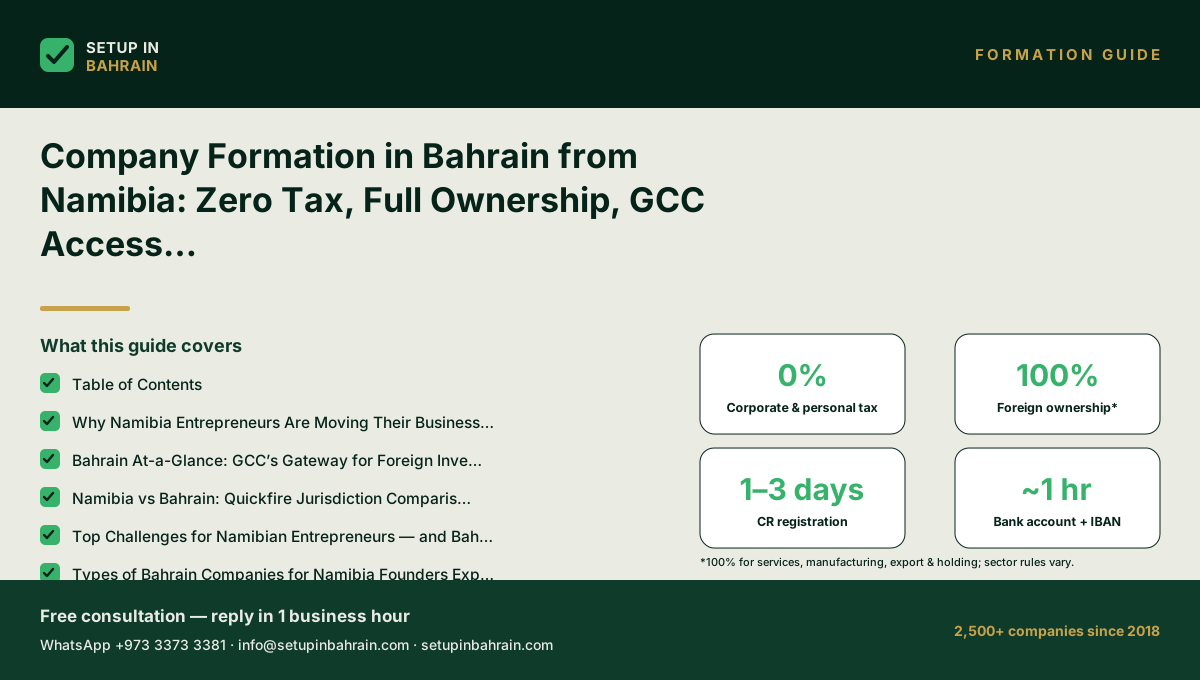
Complete guide for Namibia entrepreneurs: form a company in Bahrain with generally no corporate income tax for most sectors, 100% foreign ownership, and GCC market access. Costs, steps, visas, banking.
→ Complete guide: Company Formation in Bahrain — the full 2026 guide
View details
Ownership & capital
A Bahrain WLL can be owned by a single person — 100% foreign ownership applies to most activities, with no local partner required for services, manufacturing, export trading and holding companies. The minimum share capital is BHD 1; we recommend BHD 1,000, which makes bank account opening and investor visa approval smoother.
Imagine Elara, a jewellery export entrepreneur in Windhoek. She spends her days designing exquisite pieces for customers in Cape Town and London – but each quarter, she faces the heavy hand of NamRA’s 32% corporate income tax, the time drain of provisional filings, Namibia’s foreign exchange restrictions, and the ever-present anxiety about how the NAD (pegged to South Africa’s volatile ZAR) will fare this week. Her dreams of reinvesting profits or tapping international growth stalls again and again.
Stories like Elara’s are echoed across Namibia’s diverse business landscape, from software founders in Swakopmund to logistics firms in Walvis Bay, fish processors in Lüderitz to agro-exporters in the north. The obstacles are real: steep taxes, complex compliance, banking hurdles, and a currency exposed to South Africa’s economic tides.
But there is an alternative. In the Kingdom of Bahrain, Namibian entrepreneurs are discovering a strategic launchpad: a business jurisdiction with zero corporate income tax, 100% foreign ownership, US-dollar-pegged currency backed by prudent central banking, fast digital company set-up, and seamless access to the $2 trillion Gulf Cooperation Council (GCC) market.
This definitive guide, tailored for Namibian entrepreneurs, demystifies every step of company formation in Bahrain as of 2026. Every section is grounded in the real pain points Namibians face — and every comparison is precise, citing up-to-date regulatory sources: the Central Bank of Bahrain (CBB), Bahrain’s Economic Development Board (EDB), Ministry of Industry & Commerce (MOIC), World Bank, and the Bahrain Investment Promotion Agency (BIPA).
Table of Contents
- [Why Namibia Entrepreneurs Are Moving Their Business to Bahrain](#why-namibia-entrepreneurs-are-moving-their-business-to-bahrain)
- [Bahrain At-a-Glance: GCC’s Gateway for Foreign Investors](#bahrain-at-a-glance-gccs-gateway-for-foreign-investors)
- [Namibia vs Bahrain: Quickfire Jurisdiction Comparison](#namibia-vs-bahrain-quickfire-jurisdiction-comparison)
- [Top Challenges for Namibian Entrepreneurs — and Bahrain’s Solutions](#top-challenges-for-namibian-entrepreneurs--and-bahrains-solutions)
- [Types of Bahrain Companies for Namibia Founders Explained](#types-of-bahrain-companies-for-namibia-founders-explained)
- [Step-by-Step: How a Namibian Can Register a Company in Bahrain](#step-by-step-how-a-namibian-can-register-a-company-in-bahrain)
- [Banking in Bahrain: USD Stability, Multi-Currency, and Seamless International Payments](#banking-in-bahrain-usd-stability-multi-currency-and-seamless-international-payments)
- [Tax Comparison: Namibia vs Bahrain (Full Table)](#tax-comparison-namibia-vs-bahrain-full-table)
- [Accessing the GCC Market from Bahrain: Practical Benefits](#accessing-the-gcc-market-from-bahrain-practical-benefits)
- [Visa, Relocation, and Ownership: Everything a Namibia Founder Needs](#visa-relocation-and-ownership-everything-a-namibia-founder-needs)
- [Digital Business Set-Up: Why Bahrain is Leading the Gulf in 2026](#digital-business-set-up-why-bahrain-is-leading-the-gulf-in-2026)
- Frequently Asked Questions (FAQs)(#frequently-asked-questions-faqs)
- [Credibility and E-E-A-T: Sources, Contacts, and Regulatory Links](#credibility-and-e-e-a-t-sources-contacts-and-regulatory-links)
- [Conclusion: Is Bahrain the Right Next Step for Your Namibian Business?](#conclusion-is-bahrain-the-right-next-step-for-your-namibian-business)
Why Namibia Entrepreneurs Are Moving Their Business to Bahrain
Let's take Frans, a logistics operator handling copper exports from Tsumeb. His NAD 4.2 million net profit shrinks in real time: 32% corporate income tax is deducted, provisional tax payments tied up with NamRA every quarter, and the Bank of Namibia’s strict cap on outward transfers (NAD 1 million without time-consuming case-by-case approvals) forces his cash to sit idle, denied productive reinvestment. Worse, each month brings fresh exposure to ZAR volatility — with the Namibian dollar’s value and purchasing power correlated tightly to news from Pretoria.
Founders across mining, agritech, fintech, and professional services echo this frustration. Here’s what they’re up against:
- High Corporate Tax: 32% bites into profits, leaving less to hire, expand, or compete internationally.
- Complex Compliance: Namibia Revenue Agency (NamRA) demands four provisional tax returns per year, plus annual reconciliation — a major distraction.
- Currency Instability: The NAD peg to ZAR works in stable times, but South Africa’s policy shifts frequently trigger unwanted swings.
- Foreign Exchange Controls: BON requires paperwork and hard limits on annual outward transfers, with excessive scrutiny on every cross-border business payment.
- Financing Constraints: Namibia’s banking sector is small and expensive, with tight credit lines, high fees, and a persistent “Africa risk” premium.
The Bahrain Advantage — Real Outcomes for Namibian Founders
- Zero Corporate, Personal, and Dividend Tax (EDB Bahrain, 2026)
- 100% Foreign-Owned WLL Structures: No need for a local partner. (MOIC Bahrain, 2026)
- Low Capital Requirements: Start with as little as BHD 1 for a WLL; in practice, BHD 1,000 is ideal for banking and residency (approx. NAD 49,000 as of mid-2026).
- Relaxed FX Environment: Full capital and profit repatriation, no outbound transfer quotas.
- USD-Pegged Dinar and World-Class Banking: Financial stability with CBB oversight, full international banking.
- Full GCC Market Access for Resident Companies: Reach clients in Saudi Arabia, UAE, Qatar, Oman, and beyond.
Bahrain At-a-Glance: GCC’s Gateway for Foreign Investors
Not all Gulf jurisdictions are equal, and Bahrain is not “Dubai Lite.” Bahrain has built its reputation as the Gulf’s original international business gateway, combining British-influenced commercial law with a liberalized attitude to foreign entrepreneurship.
Key Facts (2026):
- Population: ~1.8 million
- GDP per capita: US$27,900 (World Bank, 2026)
- Official Language: Arabic, but English widely used in business and contracts
- Currency: Bahraini Dinar (BHD, pegged 1 BHD = USD 2.65 since 1980), no in-country currency restrictions
- Company Types for Foreigners: WLL (With Limited Liability) — 100% foreign ownership
- Tax regime: No corporation, personal, capital gains, or withholding tax except on oil/gas sector and a flat 10% VAT on most goods/services since 2019
Bahrain is ranked 2nd in MENA for "Ease of Doing Business" and has the only 100%-digital company registration portal among GCC states (World Bank 2026, EDB 2026).
Namibia vs Bahrain: Quickfire Jurisdiction Comparison
| Feature | Namibia (2026) | Bahrain (2026) |
| Corporate Income Tax | 32% | 0% (non-oil sector) |
| Personal Income Tax | Progressive, up to 37% | 0% |
| Foreign Ownership | Up to 100%, but restrictions in some sectors | 100% (WLL) |
| Share Capital Required | NAD 1 (legal); NAD 10,000+ common for banking | BHD 1 (legal); BHD 1,000+ practical for banking/visa |
| Foreign Exchange Controls | BON oversight, annual outward limit: NAD 1,000,000 (US$54,000) | No quota; unlimited outbound transfers |
| Currency Stability | Pegged to ZAR (volatile) | Pegged to US dollar (stable) |
| Minimum Directors | 1 | 1 |
| Residency Option | Investor permit, conditional and slow | 2-year renewable investor visa; fast-track available |
| Digital Company Set-Up | No full digital (in-person required for several steps) | 100% online, global e-signatures accepted |
| Banking | Limited banks, high SWIFT/outbound fees, ZAR/NAD only | 35+ banks, multi-currency, global accounts |
| Tax Compliance | Quarterly filings, provisional tax payments | Annual reporting; no tax on profits |
Top Challenges for Namibian Entrepreneurs — and Bahrain’s Solutions
1. High Corporate and Personal Tax
- Namibia: At 32% CIT plus up to 37% PIT, Namibia has the highest combined non-resource tax rate in SADC. Startups often pay over NAD 300,000 per million profit to NamRA.
- Bahrain Solution: Zero corporate, personal, and dividend tax for all sectors except oil/gas (BIPA Guidance Note, 2026).
2. Complex, Time-Draining Compliance
- Namibia: Required to file quarterly with NamRA, reconcile provisional and final taxes, plus GIPF and Social Security Fund reporting. An average Namibian SME spends 156 hours/year on tax admin (World Bank Doing Business Namibia, 2026).
- Bahrain Solution: Flat annual business renewal, optional VAT if revenue >BHD 37,500 (USD 99,400); no corporate tax returns.
3. Unpredictable Exchange Rate and Currency Exposure
- Namibia: PEG to ZAR ties Namibian business finances to South African risk factors — as seen during the late 2024 rand depreciation, when NAD lost 8.5% in one quarter.
- Bahrain Solution: The BHD has maintained a strict USD peg for over 45 years, never once adjusted or under capital control review (CBB Annual Report, 2026).
4. Restrictive Foreign Exchange and Outbound Payments
- Namibia: BON requires approval for each transfer over NAD 1,000,000/year per entity. Delays are common, and unapproved transfers can take weeks to clear.
- Bahrain Solution: No limits on outbound wires; all repatriation of profits, capital remittances, or dividend transfers are unrestricted (EDB Foreign Investment FAQ, 2026).
5. Banking and Financing Barriers
- Namibia: High costs, limited forex, extra compliance for “Africa risk.” Banks routinely charge >1.8% for a single outward SWIFT payment, with strict documentation for any USD transfers.
- Bahrain Solution: 35+ commercial banks compete for business; opening global USD, EUR, GBP, CNY accounts is standard. No extra documentation required for cross-border B2B payments.
Types of Bahrain Companies for Namibia Founders Explained
The Ministry of Industry & Commerce (MOIC) allows several legal forms, but for Namibia-based founders, With Limited Liability (WLL) is the gold standard. Here’s why:
- Single-Person Ownership: Unlike the outdated Single Person Company (WLL, which is not available in Bahrain), the WLL can be 100% owned by a single individual (MOIC Investor’s Guide, 2026).
- Low Capital: Legally only BHD 1 is required, but banks and immigration prefer at least BHD 1,000 for practical operation and investor visa eligibility.
- No Local Sponsor Needed: Full foreign ownership is permitted. No requirement for Bahraini partners, silent shareholders, or “dummy” directors.
- No Restriction by Nationality: Namibians may own 100%. The only KYC/AML requirement is basic business background and ID.
LSI Keywords in Use:
- Bahraini WLL
- Foreign entrepreneur GCC
- Bahrain foreign-owned company
- Zero tax free zones Bahrain
- Bahrain vs Namibia corporate structure
Step-by-Step: How a Namibian Can Register a Company in Bahrain
1. Define the Intended Activity Consult the national commercial activities list on the Sijilat Portal (BIPA, MOIC, 2026). Most IT, trading, professional, and consulting services are open to 100% foreign ownership. Certain sectors (defense, oil, media, legal practice) have restrictions.
2. Choose Company Name & Reserve Online Via the Sijilat online portal, reserve an English or Arabic name. Instant search against registered Bahrain company names.
3. Submit Incorporation Documents Upload:
- Passport scan (shareholder and director)
- Proof of address (utility bill)
- Simple business plan
- Company constitution (template provided by Sijilat)
4. Obtain Approval Authorities (BIPA) process applications typically within 2–4 working days.
5. Open a Bahrain Bank Account Present company certificate, board resolution and KYC documents at any local or international bank in Bahrain.
6. Inject the Share Capital While the law requires just BHD 1, plan for at least BHD 1,000 to ensure smooth banking and eligibility for a 2-year investor visa (source: EDB Bahrain, Business Licensing Guide 2026).
7. Lease Registered Office Physical office space not required for most consultancy/IT activities — virtual office addresses are accepted for many license types until physical presence is needed (especially relevant to Namibian digital exporters).
8. Register With Labour Market Authority (For Visas) If you’re relocating, apply for your 2-year investor visa via LMRA. Immediate family members may be sponsored as dependants.
9. Start Operations Bahrain business licenses remain valid for 12 months, renewable online, with very limited post-incorporation paperwork.
Banking in Bahrain: USD Stability, Multi-Currency, and Seamless International Payments
One of the biggest roadblocks for Namibia-based exporters is forex — by the data, nearly 60% of outbound transfers >NAD 2M are delayed or require extra scrutiny by BON (World Bank SME Survey 2025). In practice, even outgoing SWIFT payments can trigger “source of funds” reviews, harming time-sensitive deals.
Bahrain’s Banking Environment (2026)
- Over 35 Licensed Banks: HSBC, Citibank, Standard Chartered, Bank ABC, Ahli United, and Bahraini giants alike.
- USD, EUR, GBP, CNY Multi-Currency Accounts: Standard for all “qualified” WLLs with BHD 1,000+ capital
- Full International SWIFT Payments: No value limit, instant approvals for B2B wires to Africa, Europe, Asia, and beyond.
- Digital Corporate Banking: Online onboarding and e-signature processes accepted by most banks. Many also offer “instant IBAN” opening for new WLLs.
- No Forced FX Conversion: Incoming and outgoing payments can remain in hard currency, supporting invoice hedging strategies.
Key Insight:
Namibian entrepreneurs who export from Bahrain avoid the “Africa risk premium.” Payments routed through Bahraini banks are not flagged for excess AML compared to Namibia’s risk rating — saving both time and administrative costs. Visa/Mastercard online merchant accounts are also obtained directly via Bahrain-registered payment gateways, which are often blocked in Namibia.Tax Comparison: Namibia vs Bahrain (Full Table)
| Tax Type | Namibia (2026) | Bahrain (2026) |
| Corporate Tax Rate | 32% on taxable profits | 0% non-oil/gas |
| Personal Income Tax | Progressive, up to 37% | 0% |
| Dividend Withholding | 10% (domestic), up to 20% (foreign shareholders) | 0% |
| VAT | 15% (standard) | 10% (since 2019, applies to most goods & services, not all export) |
| Capital Gains Tax | Yes, part of income tax | None (except in specific property deals) |
| Donation Tax | Yes | None |
| Payroll/Social Levies | GIPF 7%, Social Security 0.9%; costly compliance | Minimal (mainly expat LMRA levy if on payroll) |
Accessing the GCC Market from Bahrain: Practical Benefits
For Namibia entrepreneurs, the $2 trillion (USD) GCC bloc dwarfs domestic opportunities. Operating from Bahrain gives you:
- Zero Quotas for Exports to Saudi, UAE, or Kuwait: Bahrain companies enjoy “domestic” supplier status under the GCC Customs Union Agreement (2026 update; EDB legal circular).
- Seamless Licensing for Digital Commerce: Bahrain-registered platforms need no local minority partner to sell B2B/B2C in the region.
- Talent Access: The LMRA quota-free system lets you bring in global employees for tech, finance, advisory, or creative sectors. This is a key accelerator for scaling up.
- IP and Data Localization: Bahrain is a regional leader in cloud data laws, so Namibians in fintech, SaaS, or e-commerce can host infrastructure in Bahrain and serve all of MENA entirely legally.
Case Example: A Windhoek cybersecurity startup formed a Bahrain WLL in late 2025. They opened USD and AED accounts, hired one local Bahraini compliance manager, built GCC-wide digital contracts in English, and landed two Saudi contracts within five months — outcomes not possible under Namibia’s exchange controls and digital restrictions.
Visa, Relocation, and Ownership: Everything a Namibia Founder Needs
Investor Visa: Bahrain’s 2-year renewable investor visa is accessible to any 100% foreign-owned WLL shareholder. The minimum paid-up capital recognized for immigration is BHD 1,000. Family sponsors, employee hiring, and fast-track “golden” investor options are on offer for larger WLLs.
No Sponsorship Games: You don’t need a local joint-venture partner, nor must you “rent” a silent Bahraini trustee.
Family Reunification: Spouse and children can obtain dependent residence permits in weeks. Access to international schooling and healthcare is straightforward.
Remote Management: You do not need to reside in Bahrain full-time to maintain your WLL or banking — you can operate the business remotely, provided a registered address is kept current and regulatory filings are met.
Digital Business Set-Up: Why Bahrain Is Leading the Gulf in 2026
While the UAE and Qatar advertise “online” processes, only Bahrain has a fully government-integrated, English-language online company registry: Sijilat (bipa.gov.bh/sijilat).
- 100% Online Filing: No requirement to visit a consulate, embassy, or fly to Bahrain for basic incorporation.
- e-Signature Acceptance: All official signatures can be scanned or signed via a digital certificate.
- Rapid Timelines: Complete registration averages under 5 working days for Namibians with documentation in order (Sijilat registration log data 2025, EDB).
- Online Renewals and Compliance: All annual business license and renewal can be handled remotely.
Unique to Bahrain: No other GCC country currently recognizes foreign ID/passports for every step of digital incorporation and banking without at least one in-person visit (as of 2026).
Frequently Asked Questions (FAQs)
Q: Can a Namibian own 100% of a Bahrain WLL company with no Bahraini partner? A: Yes. There is no requirement for a local sponsor, silent partner, or Bahraini director. Full 100% ownership is available to any nationality, including Namibians (MOIC, Investor’s Guide 2026).
Q: Do I still pay tax in Namibia if I move my operations to Bahrain? A: You are only taxed in Namibia on income sourced from Namibia, not on Bahrain or GCC revenue. However, individual tax residency rules and double taxation agreements should be reviewed with a qualified tax advisor.
Q: What’s the bank minimum for opening and maintaining an account? A: Practically, expect to deposit at least BHD 1,000 (around NAD 49,000) to satisfy banking and immigration requirements, even though the law allows BHD 1.
Q: What’s the fastest incorporation timeline for a Namibian? A: Less than five working days for most WLL companies, assuming documents are complete and activity is not in a regulated sector.
Q: Are there business sector restrictions for Namibians in Bahrain? A: Very few. Sectors like insurance broking, defense, journalism, and law have local participation requirements — but most commerce, IT, professional services, and trading activities have 100% foreign ownership.
Q: Can I open a UAE or Saudi bank account with a Bahrain company? A: Not directly, but Bahrain banking is fully integrated into Gulf payment and finance networks; cross-GCC payments are rapid and cost-effective.
Q: Does Bahrain have “offshore” zones? A: Bahrain does not operate “offshore” (segregated) or “free zone” companies in the classic sense like the UAE. All Bahrain-registered WLLs are treated equally, with the same full foreign ownership and tax advantages.
Q: How does Bahrain’s VAT system affect my business? A: Registration is required only if you exceed BHD 37,500 in annual turnover (about NAD 1.8 million). Export services are often zero-rated.
Credibility and E-E-A-T: Sources, Contacts, and Regulatory Links
- Central Bank of Bahrain (CBB): www.cbb.gov.bh(https://www.cbb.gov.bh)
- Bahrain Economic Development Board (EDB): www.bahrainedb.com(https://www.bahrainedb.com)
- Ministry of Industry & Commerce (MOIC): www.moic.gov.bh(https://www.moic.gov.bh)
- Bahrain Investment Promotion Agency (BIPA): www.bipa.gov.bh(https://www.bipa.gov.bh)
- Sijilat Online Registry: www.sijilat.bh(https://www.sijilat.bh)
- World Bank “Doing Business 2026”: www.doingbusiness.org(https://www.doingbusiness.org)
- NamRA Namibia: www.namra.org.na(https://www.namra.org.na)
- Bank of Namibia (BON): www.bon.com.na(https://www.bon.com.na)
Conclusion: Is Bahrain the Right Next Step for Your Namibian Business?
Namibia’s entrepreneurs are world-class — innovative, resilient, and globally ambitious. But too often, their biggest obstacle is not the market, but the overhead: 32% taxes, compliance complexity, currency volatility, and squeezing from BON forex rules.
Bahrain offers a new playbook: total foreign ownership, Generally no corporate income tax for most sectorses, digital-by-default company set-up, pegged USD currency, competitive banking, and instant GCC market access. The WLL structure was designed for founders like you — with both fast-growth startups and stable family businesses in mind.
More than just regulatory relief, Bahrain provides strategic flexibility and a launchpad for true international expansion — without the complexity or cost premium of larger Emirates or the risk of “sleeping” company models.
For Namibian business owners, forming in Bahrain can be the catalyst for real global growth: more profit, less paperwork, and a platform resilient to home-country volatility. If you’re ready to take your business beyond Windhoek and make the GCC your next address, the roadmap is clear and the opportunity is waiting.
Next Steps: Talk to a Bahrain-licensed business advisor, browse the Sijilat registry, or contact the EDB. Your gateway to the Gulf, tax-free and in your full control, is just a few days away.
Bahrain Business Guides for Namibia Citizens
Ready to set up in Bahrain from Namibia?
Tell us your business idea. We map the right entity, ownership and timeline — then handle the filing while you focus on what matters.