Complete guide for Morocco entrepreneurs: form a company in Bahrain with generally no corporate income tax for most sectors, 100% foreign ownership. GCC market access. Costs, steps, visas, banking.
Key Takeaways
- Why Moroccan Entrepreneurs Are Moving Their Businesses to Bahrain
- Bahrain's Unbeatable Value Proposition for Moroccan Businesses
- Navigating Legal Structures: Choosing Your Bahraini Company Type
- The Step-by-Step Company Formation Process in Bahrain
→ Complete guide: Company Formation in Bahrain — the full 2026 guide
View details
Ownership & capital
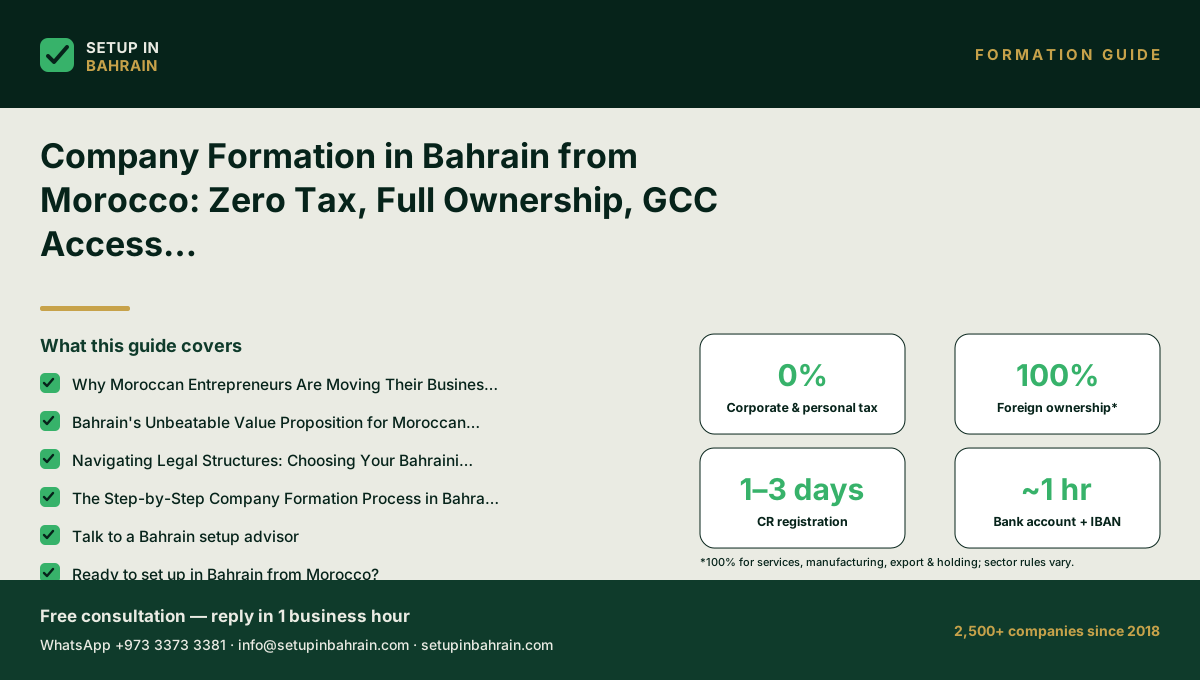
A Bahrain WLL can be owned by a single person — 100% foreign ownership applies to most activities, with no local partner required for services, manufacturing, export trading and holding companies. The minimum share capital is BHD 1 ; we recommend BHD 1,000 . This Makes bank account opening and investor visa approval smoother.
Picture this: Omar, a dynamic Moroccan entrepreneur from Casablanca, has just navigated his tech startup through its most successful year yet. His revenue has surged past the MAD 110 million mark, a testament to his vision and hard work. But what should have been a moment of triumph quickly devolved into a familiar frustration. The Q2 tax bill from the Direction Générale des Impôts (DGI) arrived. With it, a stark reminder of Morocco's progressive corporate tax structure: a hefty 35% rate on profits exceeding MAD 100 million. On top of that, his external CPA is flagging mandatory audit triggers for revenues over MAD 50 million. The Office des Changes demands extensive paperwork for every significant overseas transfer, a constant strategic dance for a currency not freely convertible.
Meanwhile, he hears from peers about Bahrain – a different reality altogether. A country where corporate profits, regardless of their magnitude, face a 0% tax rate. Where you can own 100% of your company, with no local sponsor or partner required. Where your capital is not only freely repatriated but also anchored to a stable, USD-pegged currency, eliminating forex volatility. A place where his enterprise would be just 25 kilometers from the world's fastest-growing economy, Saudi Arabia, connected by a physical causeway, offering direct access to the entire Gulf Cooperation Council (GCC) market.
This isn't just a fantasy; it's the tangible reality of company formation in Bahrain. This guide is crafted specifically for you , the ambitious Moroccan entrepreneur who has outgrown local constraints and is seeking a smarter, more efficient, and globally connected path for your business. We will dissect the pain points you currently face, contrast them with Bahrain's compelling advantages. Provide a clear, step-by-step roadmap to establish your presence in this strategic Arabian Gulf hub. By 2026, the global business landscape demands agility and foresight. Let's explore how Bahrain can become the strategic launchpad for your next phase of exponential growth.
Why Moroccan Entrepreneurs Are Moving Their Businesses to Bahrain
Let's get brutally honest about the decisions Moroccan founders face. If you're running a mid-market or scale-up business in Morocco, you understand the unique challenges and opportunities that shape your operational reality. While Morocco's business spirit is undeniable, certain structural elements can become significant growth inhibitors once you reach a certain scale.
The Heavy Hand of Moroccan Taxation: A Profit Erosion Machine
Morocco's corporate tax regime. Structured with progressive rates, can quickly become a significant burden as your business scales.
Progressive Corporate Tax Rates: * For profits up to MAD 300,000: 10% * For profits between MAD 300,001 and MAD 1,000,000: 20% * For profits between MAD 1,000,001 and MAD 100,000,000: 31% * For profits exceeding MAD 100,000,000: A staggering 35% . This 35% rate, one of the highest in North Africa, can feel like a direct penalty for success. Imagine Omar's tech startup, pushing past MAD 100 million in profit, only to see over a third of his hard-earned gains vanish in taxes. Quarterly Installment Pressure: The Direction Générale des Impôts (DGI) requires quarterly tax installments. While designed to spread the tax burden, this system often means tying up valuable working capital and adding a layer of administrative complexity to your financial planning. Instead of reinvesting these funds into growth, you're constantly managing cash flow to meet DGI deadlines. Other Levies: Beyond corporate income tax, businesses in Morocco also contend with Zakat social security contributions and other solidarity levies, further chipping away at profitability.
The Bahraini Contrast: Imagine a scenario where your corporate profits, regardless of their size, are subject to a generally no corporate income tax for most sectors. This isn't a temporary incentive; it's a fundamental pillar of Bahrain's economic strategy. The difference between 35% and 0% isn't just a slight saving; it's a transformational shift in how much capital you retain for reinvestment, expansion, talent acquisition, or simply, for your personal wealth.
Regulatory Hurdles and Currency Constraints: The Office des Changes Maze
For Moroccan businesses with international ambitions, the regulatory environment, especially concerning foreign exchange and capital movement, presents distinct challenges.
- Non-Convertible Moroccan Dirham (MAD): The Moroccan Dirham is not freely convertible, meaning you cannot freely exchange it for other currencies on international markets without restrictions. This creates complexities for international trade, investment, and capital repatriation.
- The Office des Changes Gauntlet: For any significant capital movement out of Morocco, the Office des Changes requires pre-authorization and extensive documents. For example, outward payments exceeding MAD 500,000 often necessitate a separate, detailed file, adding bureaucracy and delays to international transactions. This can be a major headache for businesses like Ahmed's textile export, where frequent, large-value payments are common.
- Mandatory CPA Audits: For businesses with revenues exceeding MAD 50 million, a mandatory CPA audit kicks in. While audits promote transparency, they also come with significant costs. Ahmed's MAD 180,000 audit fee for exceeding MAD 50 million in revenue is a tangible example of these overheads.
The Bahraini Contrast: In Bahrain, the Bahraini Dinar (BHD) is pegged directly to the US Dollar , eliminating currency exchange rate volatility and providing unparalleled stability for international transactions. There are no exchange controls or restrictions on capital repatriation. Your profits, your capital – they are freely yours to move, invest. Repatriate without the Office des Changes' bureaucratic maze. This stability and freedom simplify international trade and greatly enhance financial planning and risk management.
Limited Direct Access to the Lucrative GCC Market
The Gulf Cooperation Council (GCC) market, especially Saudi Arabia, is experiencing exponential growth and offers unparalleled opportunities. For Moroccan businesses, but, direct access can be challenging.
- GCC Entity Requirement: Many GCC importers, distributors, or partners prefer or even require dealing with a GCC-registered entity. Ahmed, wanting to launch a direct sales channel in Riyadh, quickly learned this when his Saudi importer requested a GCC-registered entity. This means that even with strong trade ties, your Moroccan entity might face friction or require additional layers of intermediation.
- Logistical Barriers: Despite years of "South-South diplomacy," physical and logistical access from Morocco to the GCC remains less direct than desired.
The Bahraini Contrast: Bahrain is literally the gateway to the GCC. Connected by the King Fahd Causeway to Saudi Arabia, the region's largest economy, Bahrain offers immediate, frictionless access. Establishing your company in Bahrain not only grants you a GCC-registered entity but also positions you within a customs union that facilitates trade across the entire region. It’s not just about proximity; it's about being inside the market.
The Cumulative Administrative Burden
The sum of these challenges – high taxes, quarterly filings, mandatory audits, currency controls. Regulatory paperwork – creates a significant administrative burden that diverts precious time, resources, and mental energy away from core business growth. For entrepreneurs, time is the most valuable asset. Morocco's complex regulatory landscape can consume too much of it.
By understanding these critical pain points, it becomes clear why a growing number of forward-thinking Moroccan entrepreneurs are actively exploring and making the strategic shift to Bahrain.
Bahrain's Unbeatable Value Proposition for Moroccan Businesses
Bahrain isn't just an alternative; it's a strategically designed economic ecosystem built for international business, offering a unique blend of benefits that directly address the challenges Moroccan entrepreneurs face.
generally no corporate income tax for most sectors, A Game-Changer for Profitability
This is arguably Bahrain's most compelling offer. Unlike Morocco's progressive rates that soar to 35%, Bahrain maintains a 0% corporate income tax on company profits. This translates into:
- Maximum Profit Retention: Every dirham (or dinar, in Bahrain) your company earns stays within your business, allowing for aggressive reinvestment in R&D, market expansion, talent acquisition, and infrastructure.
- Enhanced Cash Flow: Without the burden of quarterly tax installments or large annual tax bills, your company's cash flow greatly improves, providing greater financial agility and resilience.
- No Personal Income Tax: Beyond corporate profits, Bahrain also boasts a 0% personal income tax, 0% capital gains tax, and 0% wealth tax, making it attractive for entrepreneurs seeking to optimize their overall financial position.
Is Bahrain a Tax Haven? It's important to clarify: Bahrain is not a "tax haven" in the traditional, secretive sense. It is a legitimate, transparent jurisdiction with a robust regulatory framework overseen by the Central Bank of Bahrain (CBB) and the Ministry of Industry and Commerce (MOIC). Bahrain is committed to international best practices, including those set by the OECD, ensuring it is a reputable place to conduct business. Its tax regime is a core part of its economic diversification strategy, attracting foreign direct investment (FDI).
100% Foreign Ownership – Full Control, Zero Compromise
For many Moroccan entrepreneurs, the prospect of maintaining complete control over their business, without the need for local partners or sponsors, is incredibly appealing.
Crucial Insight: In Bahrain, a Company WLL (With Limited Liability) can be owned 100% by a single person (individual or corporate entity) . There is absolutely no requirement for a local partner or a minimum number of shareholders beyond one. This means you retain complete operational, strategic, and financial control over your Bahraini entity. Freedom to Operate: This full ownership model eliminates potential conflicts of interest, profit-sharing obligations. The administrative complexities that can arise from mandatory local partnerships in other jurisdictions.
Important Note: There is NO WLL (Single Person Company) as a distinct legal entity type in Bahrain. But, the WLL structure perfectly accommodates 100% single ownership, effectively serving the same purpose for entrepreneurs. Be wary of any advice suggesting otherwise.
Strategic Location: The Gateway to the GCC and Beyond
Bahrain's geography is one of its greatest assets, positioning it as a natural hub for regional and international trade.
Direct Access to Saudi Arabia: The King Fahd Causeway, a 25-kilometer engineering marvel, directly connects Bahrain to Saudi Arabia, the largest economy in the Middle East with a GDP exceeding $1.1 trillion in 2023. This physical link facilitates unparalleled trade, logistics, and business travel between the two nations. Regional Connectivity: Bahrain is centrally located within the GCC, providing easy access to markets in the UAE, Qatar, Kuwait. Oman. Its well-developed logistics infrastructure, including a world-class international airport (Bahrain International Airport) and Khalifa bin Salman Port, ensures seamless connectivity for goods and services across the region and globally. Free Trade Agreements: Bahrain is a signatory to numerous free trade agreements, including one with the United States – the only GCC country to have one – further enhancing its appeal as an international trade platform.
Financial Stability & USD-Pegged Currency
Economic stability and a robust financial system are cornerstones of Bahrain's business environment.
BHD Pegged to USD: The Bahraini Dinar (BHD) has been officially pegged to the US Dollar at a fixed rate of 1 BHD = 2.659 USD since 1986. This long-standing peg provides immense currency stability, protecting businesses from exchange rate fluctuations that can erode profits or complicate international transactions. Free Capital Repatriation: As highlighted, there are absolutely no restrictions or controls on the repatriation of capital or profits from Bahrain. This financial freedom is a major draw for entrepreneurs planning international expansion. Robust Banking Sector: Regulated by the Central Bank of Bahrain (CBB), the financial sector is mature, diverse. Well-developed, hosting a wide array of local, regional, and international banks offering comprehensive corporate banking services.
Ease of Doing Business & Digital-First Approach
Bahrain consistently ranks highly in global ease of doing business indices, a testament to its commitment to a streamlined, entrepreneur-friendly environment.
Streamlined Regulatory Framework: The Ministry of Industry and Commerce (MOIC) has progressively simplified company registration and licensing procedures, largely through its online Sijilat portal. The Economic Development Board (EDB), Bahrain's investment promotion agency, also plays a crucial role in facilitating foreign investment and providing support. Digital Transformation: Bahrain has embraced digital transformation across government services. The Sijilat portal allows for online company registration, license renewals. Managing various corporate affairs from anywhere in the world. This drastically reduces bureaucratic hurdles and processing times. Innovation Ecosystem: Bahrain actively fosters an innovation-driven economy, especially in sectors like FinTech, ICT, and logistics. Initiatives like Bahrain FinTech Bay and various accelerators provide a supportive ecosystem for startups and technology companies.
Skilled Workforce and Multilingual Talent Pool
Bahrain offers a well-educated, multilingual workforce, with a high proportion of local talent in skilled positions. English is widely spoken in business, alongside Arabic, simplifying communication and integration for international companies. The Labour Market Regulatory Authority (LMRA) oversees a transparent and efficient system for hiring both local and expatriate employees.
For the Moroccan entrepreneur, Bahrain offers not just a strategic location, but a holistic business ecosystem designed for growth, efficiency. Unwavering financial freedom.
Navigating Legal Structures: Choosing Your Bahraini Company Type
Selecting the right legal entity is a foundational decision for your company formation in Bahrain. While several options exist, one stands out as the overwhelming preferred choice for foreign entrepreneurs, especially those from Morocco, seeking 100% ownership and flexibility.
Company WLL (With Limited Liability): The Entrepreneur's Best Friend
The Company WLL (With Limited Liability) is by far the most popular and versatile legal structure for foreign entrepreneurs in Bahrain, offering a perfect blend of control, protection, and operational flexibility.
Key Features and Benefits: * 100% Foreign Ownership: As reiterated, a WLL can be owned 100% by a single individual or a corporate entity. This is a critical advantage, giving you absolute control without the need for any local partners or sponsors. * Limited Liability: Your personal assets are protected. Your liability, as an owner, is limited to the amount of capital you have contributed to the company. This is a fundamental aspect of risk mitigation for any business owner. * Flexibility: WLLs are suitable for a wide range of business activities, including trading, services, consulting, technology, manufacturing (with specific licensing). More. * Minimum Share Capital: This is a crucial point often misunderstood. Legally, the minimum share capital for a WLL is BHD 1 . Yes, one Bahraini Dinar. But, for practical purposes, especially when it comes to opening a corporate bank account and securing an investor visa, banks and authorities typically look for more substance. * Practical Recommendation: We strongly recommend a starting share capital of BHD 1,000 . While BHD 1 is legally permissible, major Bahraini banks (such as National Bank of Bahrain, Al Salam Bank, BBK) often have internal policies that require a more substantial initial deposit to open a corporate bank account. This BHD 1,000 shows a commitment to the business and facilitates smoother bank account approval and subsequent investor visa processing. Trying to open a bank account with BHD 1 is likely to result in significant delays or outright refusal. Ideal For: Most Moroccan entrepreneurs establishing new businesses, SMEs, startups. Those looking to tap into the GCC market with their services or products.
Bahraini Shareholding Company (BSC): For Larger, More Complex Ventures
The Bahraini Shareholding Company (BSC) is typically chosen by larger enterprises, those seeking to raise public capital, or regulated financial institutions.
Types: * BSC Public: Allows for public offering of shares, higher capital requirements. More stringent regulatory compliance (e.g., listing on Bahrain Bourse). * BSC Closed: Shares are not offered to the public. It still has higher capital requirements and more complex governance than a WLL. Capital: Minimum capital for a BSC Closed is BHD 250,000; for a BSC Public, it's BHD 1,000,000. Ideal For: Large corporations, public offerings, financial services, and institutions requiring significant capital and complex shareholder structures.
Branches of Foreign Companies: An Extension of Your Moroccan Business
If you already have an established and operating company in Morocco and primarily wish to extend its operations to Bahrain without creating a completely new legal entity, a branch might be suitable.
Key Features: * No Separate Legal Personality: The branch is not a separate legal entity; it is an extension of the parent company in Morocco. * Parent Company Liability: The parent company remains fully liable for all actions and debts of its Bahraini branch. * Simpler Setup: Can sometimes be quicker to establish than a WLL, depending on the business activity. Ideal For: Established Moroccan companies looking for a direct presence in Bahrain for specific projects, sales offices, or service delivery, where the parent company wishes to maintain direct operational control and liability.
Sole Proprietorship (Individual Setup): Limited Protection
An Individual Setup, or Sole Proprietorship, is the simplest form of business.
Key Features: * Unlimited Liability: The owner's personal assets are not separate from the business, meaning they are fully exposed to business debts and liabilities. * Simple Registration: Easiest and quickest to set up. Ideal For: Very small, individual ventures, freelancers, or home-based businesses with minimal risk. Not generally recommended for serious international business expansion due to the unlimited liability.
Critical Reminder for Moroccan Entrepreneurs: Once again, be very clear that while the concept of a "Single Person Company" might be familiar from other jurisdictions, there is NO specific legal entity called WLL in Bahrain. The WLL structure, with its allowance for a 100% single owner, perfectly serves the needs of a single entrepreneur looking for limited liability and full control. Always ensure your consultant understands this nuance.
Choosing the right structure is paramount. For most Moroccan entrepreneurs seeking full ownership, limited liability. Ease of operation, the Company WLL is overwhelmingly the recommended path.
The Step-by-Step Company Formation Process in Bahrain
Establishing your company in Bahrain is a relatively straightforward and efficient process, largely thanks to the Ministry of Industry and Commerce's (MOIC) digital Sijilat portal. Here’s a detailed breakdown of the phases involved:
Phase 1: Pre-Registration and Planning
Before you even touch an application form, a bit of strategic planning will save you time and potential headaches.
- Define Your Business Activity:
Bahrain Business Guides for Morocco Citizens
Frequently Asked Questions
How long does it take to set up?
It takes 15 to 20 days. We file all forms for you. You do not need to wait long.
What does it cost?
Company formation: Standard BHD 1,340 with 3 months of office address; Gold BHD 1,700 with 6 months; Premium BHD 2,150 with 12 months and a cabin, officer table and chair, and two guest chairs. No formation package includes visas, including Premium. Investor/work visas are priced separately: BHD 755 for one year or BHD 953 for two years, in addition to the formation package. Ask for a written, itemized quotation confirming government fees and all inclusions before payment.
Do I need to visit Bahrain?
No. You can set up your firm from home. We do all the work online. Some banks may ask for one visit.
What tax will I pay?
You pay zero tax on your profits. Bahrain has no corporate income tax. This is a key benefit of the setup.
Can I own 100% of my firm?
Yes. Foreign owners can hold all shares. No local partner is needed. Full ownership is allowed.
What do I need to start?
You need a valid passport. You also need a trade name and a business address. We help you with all of these.
How do I open a bank account?
We guide you step by step. Most banks take 3 to 6 weeks. You will need your CR and firm papers.
Who issues the Commercial Registration (CR)?
The CR is issued by the MOICT. It is your legal right to trade in Bahrain. We file the CR for you.
Can I renew my CR each year?
Company renewal packages: BHD 530 with 3 months of office address; BHD 980 with 6 months; BHD 1,520 with 12 months. These are separate renewal packages, not visa fees.
How do I get started?
Fill in our form on this page. Our team will call you back. We map your best setup plan at no cost.
Steps to Form Your Company
- Pick your trade name. We check if it is free.
- Choose your business type. WLL is the most common.
- Sign the MOA. We draft and file all legal docs.
- Pay the state fees. About BHD 432 in total.
- Get your CR. Takes 15 to 20 days.
- Open your bank account. We guide each step.
- Start trading. You are ready to do business.
Key Facts
- Tax rate: 0%
- Foreign ownership: 100%
- Setup time: 15 to 20 days
- Company formation: Standard BHD 1,340 with 3 months of office address; Gold BHD 1,700 with 6 months; Premium BHD 2,150 with 12 months and a cabin, officer table and chair, and two guest chairs. No formation package includes visas, including Premium. Investor/work visas are priced separately: BHD 755 for one year or BHD 953 for two years, in addition to the formation package. Ask for a written, itemized quotation confirming government fees and all inclusions before payment.
- Company renewal packages: BHD 530 with 3 months of office address; BHD 980 with 6 months; BHD 1,520 with 12 months. These are separate renewal packages, not visa fees.
- Client rating: 4.8 stars
- Clients served: 2,500 and more
Quick Facts
- Tax rate: 0%
- Own all of your firm: Yes, 100%
- Time to set up: 15 to 20 days
- Company formation: Standard BHD 1,340 with 3 months of office address; Gold BHD 1,700 with 6 months; Premium BHD 2,150 with 12 months and a cabin, officer table and chair, and two guest chairs. No formation package includes visas, including Premium. Investor/work visas are priced separately: BHD 755 for one year or BHD 953 for two years, in addition to the formation package. Ask for a written, itemized quotation confirming government fees and all inclusions before payment.
- Company renewal packages: BHD 530 with 3 months of office address; BHD 980 with 6 months; BHD 1,520 with 12 months. These are separate renewal packages, not visa fees.
- Rating: 4.8 stars
- Clients: 2,500 and more
Why Bahrain?
Bahrain has no tax. You keep all your profits. This is rare in the Gulf.
You can own all of your firm. No local partner is needed. The law allows full foreign ownership.
Setup takes 15 to 20 days. We file all forms for you. You can do it all from home.
Bahrain has a free trade deal with the US. Your goods face low or no tariffs. This gives you access to big markets.
We have served 2,800+ clients from 44+ countries and maintain records to substantiate that total where needed. We have 113 Google reviews; reviews represent only some clients and are not the same as the total clients served.
Our Steps
- Tell us your plan. We advise you for free.
- We pick the right firm type for you.
- We file all your forms with MOICT.
- You get your CR in 15 to 20 days.
- We help you open a bank account.
- You are ready to trade. We stay with you.
Next Steps for Morocco Citizens
You can set up a firm in Bahrain from Morocco. You do not need to fly there first. We do all the work online.
Tell us your plan. We call you back the same day. We map the best route for you at no cost.
We file all your forms. We deal with MOICT and the state. You get your CR in 15 to 20 days.
After your CR, we help you get a bank account. We also help with your Investor Visa. One firm guides you at each step.
Why Our Clients from Morocco Choose Us
- We speak your language. We know your needs.
- We have helped clients from Morocco before.
- Our fee is clear. No surprise costs.
- We have a 4.8 star rating on Google.
- We have helped more than 2,500 clients set up in Bahrain.
Fill in the form on this page. We will be in touch soon. Let us help you start your Bahrain firm today.
Ready to set up in Bahrain from Morocco?
Tell us your business idea. We map the right entity, ownership and timeline — then handle the filing while you focus on what matters.