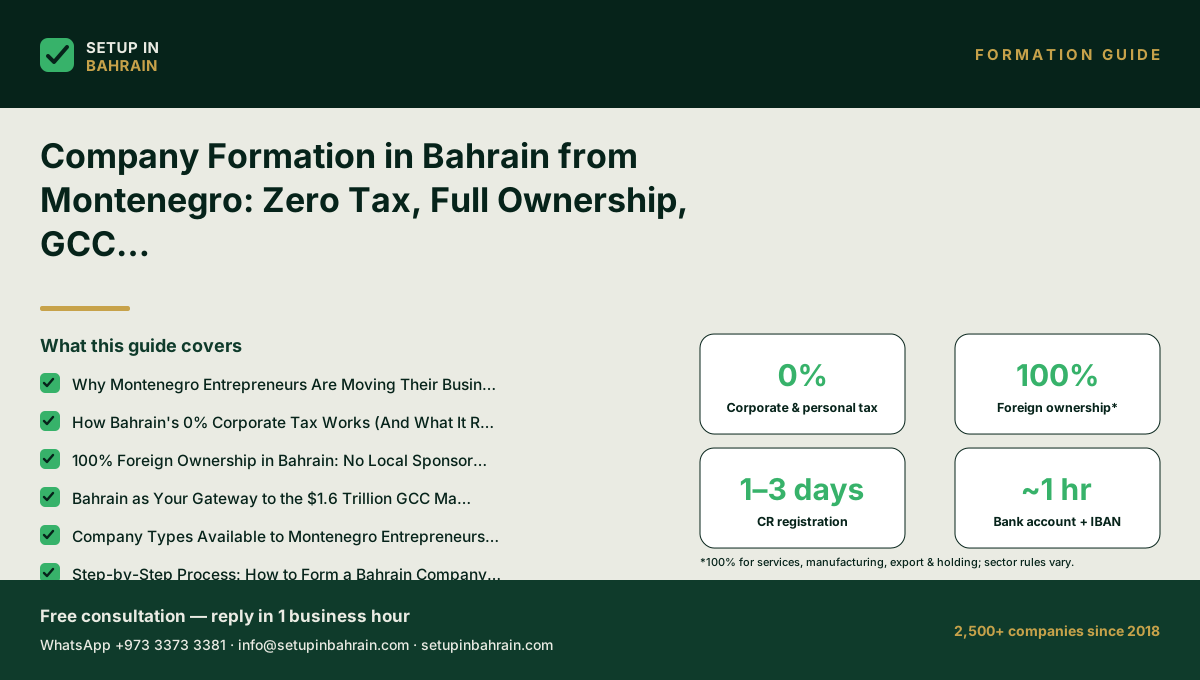
Register your Bahrain company from Montenegro with generally no corporate income tax for most sectors. Fast setup, full support for Montenegrin entrepreneurs expanding to the Gulf.
Key Takeaways
- Why Montenegro Entrepreneurs Are Moving Their Business to Bahrain
- How Bahrain's generally no corporate income tax for most sectors Works (And What It Really Means for Your Montenegro Company)
- 100% Foreign Ownership in Bahrain: No Local Sponsor Required
- Bahrain as Your Gateway to the $1.6 Trillion GCC Market
- Company Types Available to Montenegro Entrepreneurs in Bahrain
→ Complete guide: Company Formation in Bahrain — the full 2026 guide
View details
Ownership & capital
A Bahrain WLL can be owned by a single person — 100% foreign ownership applies to most activities, with no local partner required for services, manufacturing, export trading and holding companies. The minimum share capital is BHD 1 ; we recommend BHD 1,000 . This Makes bank account opening and investor visa approval smoother.
Marko had been running his digital marketing agency from Podgorica for six years. Fifteen employees, €380,000 in annual profit, clients scattered across the Balkans and Western Europe. By any reasonable measure, he'd built something worth celebrating.
Then his accountant delivered the annual tax summary, and the celebration ended.
Between Montenegro's 15% corporate tax, mandatory social contributions, and the endless COTAX filing requirements that consumed his finance manager's entire week each quarter, Marko calculated he was surrendering nearly €72,000 annually to the Montenegrin state. That's money that could fund three senior developers. That's an entire marketing budget for Western European expansion. That's the difference between growing and stagnating.
"The frustrating part," Marko explained over coffee in Stari Grad last autumn, "is that we use the euro but don't get any of the benefits that EU members enjoy. No access to ECB stability mechanisms, no single market privileges, no simplified cross-border transactions within the union. We pay European prices with Balkan limitations."
Marko relocated his company headquarters to Bahrain eight months ago. His corporate tax bill now? Zero. His ownership structure? 100% his—no local sponsor diluting his equity or complicating his decisions. His new market access? The entire Gulf Cooperation Council, starting with Saudi Arabia just 25 kilometers across the King Fahd Causeway.
This guide exists because I've helped dozens of Montenegro entrepreneurs make this exact transition over the past four years. Not because Bahrain represents some magical solution for everyone—it genuinely doesn't. But for the right Montenegro business owner with international clients, scalable services, or ambitions in the Gulf region, the arithmetic is overwhelming.
I'm going to walk you through everything: the specific pain points that make Montenegro more and more difficult for growth-oriented companies, why Bahrain addresses those problems better than alternatives like Dubai or Malta, the exact step-by-step formation process, realistic costs, common mistakes your fellow Montenegrins have made, and how to structure your transition without burning bridges back home.
Let's start with why you're probably reading this in the first place.
Why Montenegro Entrepreneurs Are Moving Their Business to Bahrain
Let me be direct about something uncomfortable: Montenegro's business environment isn't terrible. Compared to Serbia's bureaucratic maze or Bosnia's political fragmentation, Montenegro actually functions reasonably well. The problem is that "reasonable by Balkan standards" doesn't cut it when you're competing globally against companies operating from Singapore, Dubai, or yes, Bahrain.
You're operating in a market of about 620,000 people—smaller than most European cities. Your domestic customer base maxes out quickly, which means international clients become essential for any serious growth. Yet every system you interact with seems designed for a different era.
The 15% Tax Burden Nobody Talks About Honestly
Montenegro's 15% corporate income tax rate looks moderate on paper. Politicians point to it as evidence of a "business-friendly" environment. What they don't mention is context.
That 15% applies to a country using the euro without European Central Bank membership—a bizarre monetary arrangement that gives you euro-denominated costs without euro-zone protections. When the ECB makes monetary policy decisions, they're not considering Montenegro's 2.7% GDP growth or your company's cash flow needs. You absorb the consequences without representation.
Compare this to Bahrain's generally no corporate income tax for most sectors on most business activities. A Podgorica software company clearing €380,000 in annual profit pays €57,000 in corporate tax to Montenegro. The same company structured in Bahrain pays nothing. Over five years, that's €285,000 in retained earnings—enough to fund serious expansion, hire key talent, or build reserves that let you weather economic uncertainty.
The tax differential becomes even more striking when you factor in dividend distributions. Montenegro taxes dividends at 15% when paid to foreign shareholders and 9% to resident individuals. Bahrain has no personal income tax whatsoever. An entrepreneur paying themselves €100,000 annually keeps the entire amount in Bahrain; in Montenegro, they'd surrender €9,000-€15,000 before reaching their personal account.
CRPS Processing Delays That Kill Momentum
Anyone who's dealt with Montenegro's Central Register of Business Entities (CRPS) knows the particular frustration of watching business opportunities evaporate while waiting for basic administrative processing.
Registering a new company in Montenegro theoretically takes 4-10 business days. In practice, the timeline stretches considerably longer. Simple amendments to company statutes—changing a director, updating shareholding structures, modifying business activities—can take six to nine weeks when documents requirements multiply and clerks request additional notarizations.
Dragan, who operates an aluminum parts manufacturing business in Nikšić, captured this perfectly: "I needed to add my brother as a minority shareholder before closing a deal with an Austrian distributor. The Austrian wanted to see his name in official company documents before signing. CRPS took seven weeks. The Austrian found a Slovenian supplier who could move faster. I lost a €340,000 annual contract because of paperwork."
Bahrain's Ministry of Industry and Commerce (MOIC) processes standard company registrations in 3-5 business days. The Sijilat online portal handles most amendments within 48 hours. When time-sensitive deals require even faster movement, the Economic Development Board (EDB) can expedite certain approvals for priority investors.
The difference isn't just speed—it's predictability. You can plan around a system that functions consistently.
COTAX Filing Complexity
Montenegro's COTAX system for electronic tax filing represents well-intentioned modernization that somehow created additional complications rather than reducing them.
Every Montenegrin entrepreneur knows the quarterly ritual: gathering documents, reconciling accounts to COTAX specifications, submitting returns, receiving rejection notices for minor formatting issues, resubmitting, waiting for confirmation, then doing it all again three months later. Finance managers routinely dedicate full weeks to COTAX compliance. Many businesses hire dedicated accountants specifically for tax filing—an overhead cost that doesn't produce any value.
I've spoken with Montenegrin accountants who estimate their clients spend 120-180 hours annually on COTAX-related activities. At standard professional billing rates, that's €6,000-€12,000 in compliance costs alone, before paying the actual taxes owed.
Bahrain's tax system is dramatically simpler because there's dramatically less to file. Companies pay no corporate tax on most activities, no personal income tax on employee salaries, no capital gains tax on investment returns. VAT exists at 10% for domestic transactions. The filing requirements are straightforward and quarterly submissions rarely generate the back-and-forth that COTAX creates.
Limited GCC Tax Treaty Coverage
Montenegro maintains tax treaties with about 45 countries—respectable for a small nation. Conspicuously lacking coverage in the Gulf region where significant growth opportunities exist.
There's no double taxation agreement between Montenegro and Saudi Arabia, the UAE, Qatar, Kuwait, or Bahrain itself. This means Montenegrin companies conducting business in the Gulf face potential double taxation scenarios, withholding tax complications. Structural inefficiencies that competitors from treaty-network countries don't encounter.
Bahrain, conversely, sits within the GCC's integrated economic framework. The Gulf Cooperation Council Unified Economic Agreement facilitates commerce between Bahrain, Saudi Arabia, UAE, Kuwait, Qatar, and Oman. A Bahrain-registered company can move goods, services. Capital across GCC borders with minimal friction—a critical advantage when the combined GCC market exceeds $1.6 trillion in GDP.
The EU Accession Uncertainty Factor
Montenegro opened EU accession negotiations in 2012. Thirteen years later, the process remains incomplete, with chapters opened but not closed, reforms promised but not implemented. Timelines that shift with every European Commission report.
This uncertainty creates real business consequences. International clients sometimes hesitate to sign long-term contracts with Montenegrin suppliers because they're unsure what regulatory framework will govern those relationships in five years. Investors apply risk premiums to Montenegrin ventures that they wouldn't apply to EU-member alternatives. Banks price Montenegro credit at spreads that reflect "candidate country" status rather than "member state" stability.
Bahrain offers different certainty—the certainty of a stable, established framework that won't change dramatically based on Brussels politics. The Kingdom has maintained essentially the same business-friendly regulatory approach since establishing Bahrain International Investment Park in 1999 and has consistently improved its World Bank Ease of Doing Business rankings over decades.
How Bahrain's generally no corporate income tax for most sectors Works (And What It Really Means for Your Montenegro Company)
Zero percent corporate tax sounds almost too good to be true, which makes entrepreneurs appropriately skeptical. Let me explain exactly how Bahrain's tax system functions and where the exceptions lie.
The Basic Framework
Bahrain does not levy corporate income tax on profits generated by most business activities. This isn't a special incentive, a temporary exemption, or a free zone gimmick—it's the standard tax treatment for companies operating in the Kingdom.
The Central Bank of Bahrain (CBB) and the Ministry of Finance have maintained this policy for decades as a deliberate strategy to attract international business. Bahrain generates government revenue primarily through oil and gas production (still significant despite diversification efforts), real estate fees, work permit charges. A 10% VAT implemented in 2019.
For a Montenegro entrepreneur establishing a Bahrain company, the practical impact is straightforward: profits remain in the company for reinvestment, distribution to shareholders, or reserve building. There's no tax planning required to minimize corporate tax because there's no corporate tax to minimize.
The Single Exception: Oil and Gas
Bahrain does tax oil and gas companies at 46% on profits derived from petroleum extraction. This exception exists because hydrocarbon revenues have historically funded government operations. The Kingdom sees no reason to extend the exemption to the industry that generates those core revenues.
Unless you're planning to drill for oil in the Persian Gulf—and if you're reading this guide, you almost certainly aren't—this exception is irrelevant to your business planning.
National Budget Transparency Tax (Proposed)
In 2024, Bahrain's government announced plans to introduce a 15% corporate tax on large multinational enterprises to comply with the OECD's Global Minimum Tax framework (Pillar Two). This would affect companies with consolidated global revenues exceeding €750 million annually.
For context: if your Montenegro company generates €750 million in global revenue, congratulations—you have resources to hire specialized international tax advisors and probably aren't learning about Bahrain company formation from an article. For the overwhelming majority of Montenegro entrepreneurs, this proposed tax will have zero impact on their operations.
The EDB has confirmed that standard Bahrain companies—WLLs, Single Person Companies. Typical BSCs—will continue operating under the generally no corporate income tax for most sectors regime regardless of any Pillar Two implementation.
No Personal Income Tax
Beyond corporate taxation, Bahrain imposes no personal income tax on individuals. Salaries, dividends, interest, rental income, capital gains—none of these face taxation at the personal level.
A Montenegro entrepreneur paying themselves a €120,000 annual salary from their Bahrain company retains the entire €120,000. Compare this to Montenegro, where personal income tax at 9-15% plus mandatory health and pension contributions would reduce that same salary by €15,000-€25,000 before it reaches your personal account.
No Capital Gains Tax
Bahrain doesn't tax capital gains on the sale of shares, property, or other assets. If you build your Bahrain company to €5 million in value and sell it to an acquirer, you keep the entire €5 million. Montenegro would tax the gain at 15%.
This matters enormously for entrepreneurs building companies with exit potential. The after-tax difference between selling in Montenegro versus Bahrain can easily reach six or seven figures.
VAT at 10%
Bahrain implemented Value Added Tax at 5% in 2019, later increasing it to 10% in 2022. This applies to domestic transactions, with standard exemptions for financial services, basic food items, healthcare, and education.
For service companies with international clients—the profile of most Montenegro entrepreneurs exploring Bahrain—VAT impact is minimal. Services exported outside Bahrain are zero-rated, meaning you charge 0% VAT to foreign clients and can reclaim input VAT on business expenses.
Comparison Table: Montenegro vs. Bahrain Tax Burden
| Tax Category | Montenegro | Bahrain | Annual Savings (€300K Profit Example) |
| Corporate Income Tax | 15% | 0% | €45,000 |
| Personal Income Tax | 9-15% | 0% | €9,000-€15,000 on €100K salary |
| Capital Gains Tax | 15% | 0% | Variable based on gains |
| Dividend Tax | 9-15% | 0% | €13,500-€22,500 on €150K distribution |
| VAT | 21% | 10% | Varies by domestic activity |
| Social Contributions | ~33% of salary | ~19% of salary (for expats) | Significant on employee costs |
100% Foreign Ownership in Bahrain: No Local Sponsor Required
The single biggest structural advantage Bahrain offers over most Gulf alternatives is straightforward: you can own your entire company yourself.
The Historical Context
Until relatively recently, most GCC countries required foreign investors to partner with local nationals who would hold majority stakes—often 51%—in their businesses. This "sponsorship" or "kafala" system meant surrendering control to get market access. Foreign entrepreneurs frequently found themselves vulnerable to sponsor disputes, profit-sharing disagreements, or outright exploitation.
Saudi Arabia, Qatar, and Kuwait maintained strict sponsorship requirements for decades. The UAE implemented free zone structures as workarounds, but companies operating outside free zones still needed Emirati partners. The system created a cottage industry of local sponsors who contributed nothing beyond their citizenship, collecting fees for signing documents.
Bahrain eliminated mandatory local sponsorship for most business activities years before its neighbors. Today, Bahrain Investment Park Authority (BIPA) facilitates 100% foreign-owned companies as standard practice, not special exception.
What 100% Ownership Actually Means
When you establish a WLL (With Limited Liability company) in Bahrain as a Montenegro citizen, you can hold 100% of the shares in your own name or through a holding structure you control. There's no silent partner taking 51% of your equity. There's no sponsor receiving 10% of profits for attending one board meeting annually. There's no third party who can block decisions or complicate your eventual exit.
You make operational decisions independently. You retain profits according to your own priorities. You sell the company when and to whom you choose. You control the business you built.
Restricted Activities
A handful of sensitive sectors still require Bahraini participation or government approval: certain media activities, some real estate development, specific financial services requiring CBB licensing, and businesses involving national security.
For technology companies, consulting firms, trading operations, professional services. Most other activities Montenegro entrepreneurs typically pursue, 100% foreign ownership is available without restriction.
Comparison With UAE Free Zones
Many Montenegro entrepreneurs initially explore Dubai free zones, which offer 100% foreign ownership within designated areas. The limitation is that free zone companies face restrictions when doing business directly with UAE mainland customers—they often need local distributors or service agents, which recreates some sponsorship dynamics.
Bahrain doesn't have this mainland/free zone distinction. A 100% foreign-owned Bahrain company can operate throughout the Kingdom without intermediaries, contract directly with Bahraini customers. Establish physical presence anywhere commercially zoned.
Bahrain as Your Gateway to the $1.6 Trillion GCC Market
Geography matters in business. Montenegro's location provides reasonable European access but limited reach elsewhere. Bahrain's position unlocks an entirely different market universe.
The GCC Economic Zone
The Gulf Cooperation Council encompasses six countries: Bahrain, Saudi Arabia, United Arab Emirates, Kuwait, Qatar, and Oman. Combined GDP exceeds $1.6 trillion. Combined population approaches 60 million, heavily weighted toward high-income consumers and businesses with substantial purchasing power.
The GCC Unified Economic Agreement creates preferential treatment for goods and services moving between member states. A Bahrain-registered company enjoys advantages that a Montenegro company simply cannot access—reduced tariffs, simplified customs procedures, mutual recognition of certain professional certifications, and freedom of setup provisions.
Saudi Arabia: 25 Kilometers Away
The King Fahd Causeway connects Bahrain directly to Saudi Arabia's Eastern Province, home to the Kingdom's oil industry headquarters and substantial industrial activity. The drive takes about 30 minutes at the border.
Saudi Arabia's $1.1 trillion economy—the largest in the GCC—is undergoing massive transformation under Vision 2030. The government is investing hundreds of billions of dollars in entertainment, tourism, technology, and infrastructure projects. International companies are scrambling to establish Saudi market presence.
A Bahrain company can serve Saudi clients from across the causeway, attend Riyadh meetings with morning flights. Gradually build Saudi operations once the market justifies direct setup. This proximity is strategic gold for entrepreneurs building regional businesses.
Financial Hub Infrastructure
Bahrain has positioned itself as the GCC's financial services hub for decades. The Central Bank of Bahrain (CBB) regulates one of the most sophisticated banking ecosystems in the region, with major international banks maintaining significant operations alongside regional institutions.
For Montenegro entrepreneurs, this translates to banking services that work. Multi-currency accounts in BHD, USD, EUR, GBP. International wire capabilities without the correspondent banking limitations that plague Montenegro's smaller institutions. Trade finance facilities for import/export operations. Treasury services for managing working capital across currencies.
The contrast with Montenegro banking—where SWIFT transfers sometimes delay for days and foreign currency accounts carry premium fees—is substantial.
Company Types Available to Montenegro Entrepreneurs in Bahrain
Bahrain offers several corporate structures, each suited to different business models and scales. Here's what actually matters for Montenegro entrepreneurs.
WLL (With Limited Liability Company)
The WLL is Bahrain's most common structure for small to medium enterprises and the default choice for most Montenegro entrepreneurs.
Key characteristics:
- Minimum capital: BHD 20,000 (about €48,000) for most activities, though certain sectors require higher amounts
- Shareholders: 2-50 (single-shareholder WLLs aren't permitted under this structure)
- Liability: Limited to capital contribution
- Management: Managed by one or more managers who need not be shareholders
- 100% foreign ownership: Available for most activities
The minimum capital requirement sounds substantial but serves a purpose—it shows business seriousness to Bahraini authorities and provides initial working capital. The funds aren't "lost"; they remain available for business operations after formation.
For Montenegro entrepreneurs forming WLLs, the two-shareholder requirement is typically addressed by including a trusted family member, business partner, or properly structured holding company as the second shareholder with minimal stake (even 1%).
single-shareholder WLL
Bahrain introduced the Single Person Company structure specifically to accommodate solo entrepreneurs and small operators who want limited liability without partner complications.
Key characteristics:
- Minimum capital: BHD 1 (we recommend BHD 1,000)for general trading; varies by activity
- Shareholders: Exactly one—the sole proprietor
- Liability: Limited to capital contribution
- 100% foreign ownership: Available
The higher capital requirement reflects the absence of partner accountability. Bahraini authorities reason that single-owner companies present slightly higher creditor risk, hence the larger capital base.
For Montenegro entrepreneurs with sufficient capital and strong preference for sole ownership, the WLL offers structural simplicity. For those who'd rather minimize initial capital requirements, the WLL with a nominal second shareholder often makes more sense.
BSC (Bahraini Shareholding Company)
BSCs come in "closed" and "public" variants, designed for larger enterprises and eventual public listings.
Key characteristics:
- Minimum capital: BHD 250,000 (about €600,000) for closed BSC; BHD 1,000,000 for public
- Shareholders: Minimum 2 for closed; minimum 50 for public
- Liability: Limited to share value
- Board of directors required
Few Montenegro entrepreneurs need BSC structures initially. The formation costs, governance requirements. Capital minimums suit established businesses with complex shareholder arrangements or ambitions for public capital markets.
But, it's worth knowing that upgrading from WLL to BSC is possible as companies grow. Several businesses I've worked with started as WLLs and converted to closed BSCs after reaching €2-3 million in revenue and attracting institutional investment interest.
Branch Office
Montenegro companies can establish Bahrain branch offices without creating separate legal entities. The branch operates as an extension of the parent company, with the Montenegro entity retaining full legal responsibility.
Key characteristics:
- No separate capital requirement (parent company capitalization applies)
- No separate legal personality (parent liable for branch obligations)
- Requires parent company documents, including notarized and apostilled certificates
- Suitable for companies wanting Bahrain presence without full subsidiary commitment
Branch offices work well for Montenegro companies testing Bahrain markets before committing to full setup. The formation process is somewhat faster. Ongoing compliance is simpler since there's no separate Bahraini corporate entity to maintain.
The limitation: branches don't offer liability isolation. If the Bahrain branch incurs obligations, the Montenegro parent company is directly liable.
Representative Office
The simplest structure—essentially a marketing and liaison presence without commercial activity authorization.
Key characteristics:
- Cannot engage in commercial transactions (no invoicing, no sales)
- Cannot employ staff beyond administrative support
- Useful only for market research, relationship building, and promotional activities
Representative offices rarely suit Montenegro entrepreneurs who want operational businesses. I include the option for completeness, but it's almost never the right choice.
Step-by-Step Process: How to Form a Bahrain Company from Montenegro
Here's the actual process, based on formations I've supervised for Montenegro clients. I'll give you realistic timelines and flag where delays typically occur.
Step 1: Select Company Type and Business Activities
Before approaching Bahraini authorities, you need clarity on structure and activities.
Timeline: 1-3 days for research and decision
What to determine:
- WLL vs. WLL vs. Branch (WLL suits 80%+ of Montenegro entrepreneurs)
- Specific commercial activities from Bahrain's activity classification system
- Initial capital (meeting minimums while avoiding unnecessary overcapitalization)
- Shareholding structure if WLL (who holds what percentage)
The MOIC's Commercial Registration (CR) system uses standardized activity codes. Choosing appropriate codes matters—some activities require special licenses, higher capital, or regulatory approvals. A business formation specialist familiar with Bahraini requirements can navigate this quickly; attempting it yourself often leads to incorrect selections that delay registration.
Step 2: Reserve Company Name
Bahrain requires company name approval before proceeding with formation.
Timeline: 1-2 business days via Sijilat portal
Requirements:
- Name must be unique (not conflicting with existing registrations)
- Name must not include restricted terms without authorization
- Arabic translation required (most formation agents handle this)
The Sijilat system checks proposed names against existing registrations and returns approval or rejection quickly. Name reservations hold for 60 days, providing time to complete remaining steps.
Step 3: Prepare Constitutional Documents
Every Bahrain company needs foundational documents establishing its legal existence and governance.
Timeline: 2-5 business days depending on complexity
Required documents:
- Memorandum of Association (MOA) setting out company objectives, capital, shareholders
- Articles of Association (AOA) establishing governance procedures
- Shareholder resolutions for initial decisions
- Manager/director appointments
These documents require drafting in Arabic (the official legal language) with English translations for your reference. Standard templates exist for straightforward WLLs; complex structures with multiple shareholder classes or unusual provisions take longer.
Documents must be notarized before a Bahraini notary public. If you're executing documents from Montenegro, they'll need apostille certification under the Hague Convention. This Bahrain recognizes.
Step 4: Get Initial Approvals
Depending on your selected activities, you may need approvals from regulatory bodies beyond MOIC.
Timeline: Varies from 0 days (no special approvals needed) to several weeks (regulated activities)
Common approval requirements:
- CBB approval for financial services
- Telecommunications Regulatory Authority for telecom activities
- Ministry of Health for healthcare-related businesses
- Tourism licensing for hospitality operations
Standard trading, consulting, IT services. Professional services typically require no special pre-approvals, and formation proceeds directly through MOIC.
Step 5: MOIC Registration and CR Issuance
The actual company registration happens through the Ministry of Industry and Commerce.
Timeline: 3-5 business days for standard applications
Process:
- Submit application through Sijilat portal with all supporting documents
- Pay registration fees (vary by capital and activities; typically BHD 300-1,500)
- MOIC reviews application, occasionally requesting clarifications
- Commercial Registration certificate issued upon approval
The Commercial Registration (CR) is your company's legal birth certificate in Bahrain. It includes your CR number, registered activities, shareholders, managers, and registered office address.
Step 6: Capital Deposit and Bank Account
Within 90 days of CR issuance, you must deposit the stated capital into a Bahrain bank account.
Timeline: 1-2 weeks including bank account opening
Process:
- Select a Bahrain bank (major options include National Bank of Bahrain, Bank of Bahrain and Kuwait, Ahli United Bank, and international banks with local presence)
- Submit account opening application with CR, shareholder identification, proof of address, and source of funds documents
- Transfer capital from Montenegro (banks typically want to see the capital arriving from shareholder personal or corporate accounts)
- Get bank confirmation of deposit
Bank account opening has become more rigorous globally due to anti-money laundering requirements. Bahrain banks will ask detailed questions about your business model, expected transaction volumes, client base. Source of wealth. Having clear, documented answers prepared speeds the process.
Step 7: Municipality and Premises Registration
Bahrain companies need registered office addresses and municipal licensing.
Timeline: 1-2 weeks
Options:
- Physical office space (traditional lease)
- Business center / serviced office (flexible arrangements)
- Virtual office / flexi-desk (minimum presence requirement)
The appropriate choice depends on your actual operational needs. Many Montenegro entrepreneurs start with virtual office arrangements—legitimate addresses for correspondence and licensing purposes—while managing operations primarily from Montenegro during the transition period.
BIPA (Bahrain Investment Park Authority) and various business parks offer packages combining physical presence, licensing support. Administrative services.
Step 8: Labor and Immigration (If Applicable)
If you plan to work in Bahrain or employ staff, additional registrations are required.
Timeline: 2-4 weeks for work permits; faster for investor visas
Key processes:
- LMRA (Labour Market Regulatory Authority) registration as employer
- Work permit applications for foreign employees
- Residence visa processing through NPRA (Nationality, Passports and Residence Affairs)
Bahrain offers expedited processing for investors and business owners. The EDB's investor visa program can fast-track residence for entrepreneurs committing significant capital or employment creation.
Total Timeline: Realistic Expectations
| Stage | Minimum Timeline | Typical Timeline | Maximum Timeline |
| Planning and preparation | 1 day | 3-5 days | 2 weeks |
| Name reservation | 1 day | 2 days | 3 days |
| Document preparation | 2 days | 5 days | 2 weeks |
| Special approvals (if needed) | N/A | 2 weeks | 6 weeks |
| MOIC registration | 3 days | 5 days | 10 days |
| Bank account and capital | 5 days | 10 days | Banking: approximately 1 hour in 99% of our reported cases; our last 100 applications handled in 2026 were approved; subsidiaries or CIS shareholders: 3 days to 2 weeks. Subject to the bank’s final review. |
| Municipality/premises | 3 days | 7 days | 2 weeks |
| Total (standard WLL) | 2 weeks | 3-4 weeks | 8 weeks |
Complete Cost Breakdown: What Bahrain Company Formation Actually Costs
I'm giving you real numbers here, not the lowball estimates that some formation agents advertise to get you in the door.
Government Fees
| Fee Type | Approximate Cost (BHD) | Approximate Cost (EUR) |
| Name reservation | 10-20 | 24-48 |
| Commercial Registration (basic) | 200-500 | 480-1,200 |
| Activity licensing (varies by type) | 100-1,000 | 240-2,400 |
| Municipality registration | 100-300 | 240-720 |
| Chamber of Commerce membership | 50-200 | 120-480 |
| Government total (typical WLL) | 600-1,500 | 1,440-3,600 |
Professional Service Fees
| Service | Typical Cost Range (EUR) |
| Formation agent / company setup service | 2,000-5,000 |
| Legal review and documents | 1,500-3,500 |
| Accounting setup and initial filings | 500-1,500 |
| Virtual office (annual) | 1,200-3,600 |
| Physical office (annual, basic) | 6,000-15,000 |
| Nominee services if needed (annual) | 2,000-5,000 |
| Professional total (first year) | 7,000-25,000 |
Capital Requirements
| Company Type | Minimum Capital (BHD) | Minimum Capital (EUR) |
| WLL (standard activities) | 20,000 | 48,000 |
| WLL (certain regulated activities) | 50,000-100,000 | 120,000-240,000 |
| WLL | 50,000 | 120,000 |
| Branch Office | None separate | Parent company capital applies |
Ongoing Annual Costs
| Expense | Annual Cost Range (EUR) |
| CR renewal | 300-600 |
| License renewals | 200-500 |
| Accounting and bookkeeping | 2,000-6,000 |
| Audit (if required for your structure) | 2,000-8,000 |
| Virtual office renewal | 1,200-3,600 |
| Bank account maintenance | 200-500 |
| Annual maintenance total | 5,000-15,000 |
First-Year Budget: Realistic Range
For a Montenegro entrepreneur establishing a standard WLL with professional support:
- Lower end (minimal setup): €12,000-18,000 + capital
- Mid-range (typical): €20,000-35,000 + capital
- Higher end (full service, physical office): €40,000-60,000 + capital
These figures exceed what you'd spend on a Montenegro company formation by a considerable margin. The calculation that matters is: do annual tax savings exceed annual structural costs? For companies generating €150,000+ in annual profits, the answer is almost always yes—often within the first year.
Tax Planning Strategies for Maintaining Montenegro Ties
Most Montenegro entrepreneurs don't completely sever ties with their home country. Family lives there, certain clients are there, and sometimes maintaining a Montenegrin presence makes business sense. Here's how to structure things properly.
The Substance Requirements Reality
Bahrain, like any respectable jurisdiction, expects companies registered there to have genuine economic substance—actual business activity, real decision-making, meaningful presence.
This doesn't mean you need to relocate your entire life to Manama. It does mean:
- Strategic decisions should demonstrably occur in Bahrain (documented board meetings, management discussions)
- The company should have Bahrain-based infrastructure (office address, local phone, bank accounts)
- Key employees or contractors should ideally have Bahrain work authorization
- Income should relate to activities actually conducted from Bahrain, not merely routed through it
Tax authorities globally have become sophisticated at identifying "brass plate" companies that exist only on paper. Structure your Bahrain company as a real operating entity—which you can absolutely do while maintaining Montenegro connections—rather than a hollow shell.
Montenegro Controlled Foreign Corporation Rules
Montenegro implemented CFC (Controlled Foreign Corporation) rules that can attribute income from certain foreign subsidiaries back to Montenegrin tax residents.
If you remain Montenegrin tax resident while owning a Bahrain company, Montenegro may tax you on the Bahrain company's profits as if they were your personal income. This defeats the purpose of the structure.
The solution for most entrepreneurs involves establishing genuine Bahrain tax residence—spending sufficient time there, having your center of vital interests there. Properly notifying Montenegrin authorities of your changed status.
Breaking Montenegrin Tax Residence
Montenegro considers you tax resident if you:
- Spend more than 183 days per year in Montenegro
- Have your permanent home or center of vital interests in Montenegro
- Are registered with Montenegrin authorities as resident
To become non-resident:
- Spend fewer than 183 days annually in Montenegro
- Establish your primary home and family life elsewhere (Bahrain, for instance)
- Deregister from Montenegrin residence
- File departure tax declarations with Montenegrin authorities
This is a significant life change, not merely paperwork. It requires actual relocation of your primary base. Some entrepreneurs structure things with spouses or family members maintaining Montenegro residence while they personally relocate; the family law and tax implications of such arrangements need careful professional review.
What You Can Still Do in Montenegro
Breaking tax residence doesn't mean complete departure:
- You can visit Montenegro for up to 182 days annually without reestabl
Bahrain Business Guides for Montenegro Citizens
Frequently Asked Questions
How long does it take to set up?
It takes 15 to 20 days. We file all forms for you. You do not need to wait long.
What does it cost?
Company formation: Standard BHD 1,340 with 3 months of office address; Gold BHD 1,700 with 6 months; Premium BHD 2,150 with 12 months and a cabin, officer table and chair, and two guest chairs. No formation package includes visas, including Premium. Investor/work visas are priced separately: BHD 755 for one year or BHD 953 for two years, in addition to the formation package. Ask for a written, itemized quotation confirming government fees and all inclusions before payment.
Do I need to visit Bahrain?
No. You can set up your firm from home. We do all the work online. Some banks may ask for one visit.
What tax will I pay?
You pay zero tax on your profits. Bahrain has no corporate income tax. This is a key benefit of the setup.
Can I own 100% of my firm?
Yes. Foreign owners can hold all shares. No local partner is needed. Full ownership is allowed.
What do I need to start?
You need a valid passport. You also need a trade name and a business address. We help you with all of these.
How do I open a bank account?
We guide you step by step. Most banks take 3 to 6 weeks. You will need your CR and firm papers.
Who issues the Commercial Registration (CR)?
The CR is issued by the MOICT. It is your legal right to trade in Bahrain. We file the CR for you.
Can I renew my CR each year?
Company renewal packages: BHD 530 with 3 months of office address; BHD 980 with 6 months; BHD 1,520 with 12 months. These are separate renewal packages, not visa fees.
How do I get started?
Fill in our form on this page. Our team will call you back. We map your best setup plan at no cost.
Steps to Form Your Company
- Pick your trade name. We check if it is free.
- Choose your business type. WLL is the most common.
- Sign the MOA. We draft and file all legal docs.
- Pay the state fees. About BHD 432 in total.
- Get your CR. Takes 15 to 20 days.
- Open your bank account. We guide each step.
- Start trading. You are ready to do business.
Key Facts
- Tax rate: 0%
- Foreign ownership: 100%
- Setup time: 15 to 20 days
- Company formation: Standard BHD 1,340 with 3 months of office address; Gold BHD 1,700 with 6 months; Premium BHD 2,150 with 12 months and a cabin, officer table and chair, and two guest chairs. No formation package includes visas, including Premium. Investor/work visas are priced separately: BHD 755 for one year or BHD 953 for two years, in addition to the formation package. Ask for a written, itemized quotation confirming government fees and all inclusions before payment.
- Company renewal packages: BHD 530 with 3 months of office address; BHD 980 with 6 months; BHD 1,520 with 12 months. These are separate renewal packages, not visa fees.
- Client rating: 4.8 stars
- Clients served: 2,500 and more
Quick Facts
- Tax rate: 0%
- Own all of your firm: Yes, 100%
- Time to set up: 15 to 20 days
- Company formation: Standard BHD 1,340 with 3 months of office address; Gold BHD 1,700 with 6 months; Premium BHD 2,150 with 12 months and a cabin, officer table and chair, and two guest chairs. No formation package includes visas, including Premium. Investor/work visas are priced separately: BHD 755 for one year or BHD 953 for two years, in addition to the formation package. Ask for a written, itemized quotation confirming government fees and all inclusions before payment.
- Company renewal packages: BHD 530 with 3 months of office address; BHD 980 with 6 months; BHD 1,520 with 12 months. These are separate renewal packages, not visa fees.
- Rating: 4.8 stars
- Clients: 2,500 and more
Why Bahrain?
Bahrain has no tax. You keep all your profits. This is rare in the Gulf.
You can own all of your firm. No local partner is needed. The law allows full foreign ownership.
Setup takes 15 to 20 days. We file all forms for you. You can do it all from home.
Bahrain has a free trade deal with the US. Your goods face low or no tariffs. This gives you access to big markets.
We have served 2,800+ clients from 44+ countries and maintain records to substantiate that total where needed. We have 113 Google reviews; reviews represent only some clients and are not the same as the total clients served.
Our Steps
- Tell us your plan. We advise you for free.
- We pick the right firm type for you.
- We file all your forms with MOICT.
- You get your CR in 15 to 20 days.
- We help you open a bank account.
- You are ready to trade. We stay with you.
Why Set Up in Bahrain?
Bahrain is a great place to run a firm. It has no tax. You keep all your profits. This is rare in the Gulf.
You can own your firm 100%. No local partner is needed. The law is clear and fair.
It is fast to set up. You can have a CR in 15 to 20 days. We file all forms for you.
Bahrain has a free trade deal with the US. Your goods face low or no tariffs. This gives you access to big markets.
The banks are good. The roads are good. The schools are good. It is a well-run state.
We have served 2,800+ clients from 44+ countries and maintain records to substantiate that total where needed. We have 113 Google reviews; reviews represent only some clients and are not the same as the total clients served.
Our Services
- Company formation: Standard BHD 1,340 with 3 months of office address; Gold BHD 1,700 with 6 months; Premium BHD 2,150 with 12 months and a cabin, officer table and chair, and two guest chairs. No formation package includes visas, including Premium. Investor/work visas are priced separately: BHD 755 for one year or BHD 953 for two years, in addition to the formation package. Ask for a written, itemized quotation confirming government fees and all inclusions before payment.
- Company renewal packages: BHD 530 with 3 months of office address; BHD 980 with 6 months; BHD 1,520 with 12 months. These are separate renewal packages, not visa fees.
- Investor Visa — from BHD 755
- Work Visa — LMRA managed
- Virtual office — from BHD 600 per year
- Bank account opening — 3 to 6 weeks
- Family visa — for spouse and kids
- UBO filing — as required by law
Bahrain at a Glance
- Tax rate: 0%
- Foreign ownership: 100%
- Setup time: 15 to 20 days
- Free trade deal: Yes, with the US
- Language: Arabic and English
- Currency: Bahraini Dinar (BHD)
- Time zone: UTC+3
- GDP growth: Steady and strong
How to Start
- Fill in the form on this page. It takes 3 minutes.
- We call you back the same day.
- We map the best plan for your firm type and goals.
- We file all forms. We deal with MOICT for you.
- You get your CR in 15 to 20 days.
- We help you open a bank account and get your visa.
- You are ready to trade. We stay with you.
Common Questions
Do I need to visit Bahrain to set up?
No. You can do it all from home. We file online. You may need one visit to open a bank account.
Is Bahrain safe for business?
Yes. Bahrain is a stable state. It has a clear legal system. Your firm and funds are safe here.
Can I hire staff from any country?
Yes. You can hire from any country. Each hire needs a work permit from LMRA. We manage this for you.
What type of firm should I set up?
Most clients choose a WLL. This is a limited liability firm. It is flexible and well-known in Bahrain. We advise you on the best type for your case.
How do I get in touch?
Fill in our form. We call you back the same day. You can also email us or use the chat on this page.
Ready to set up in Bahrain from Montenegro?
Tell us your business idea. We map the right entity, ownership and timeline — then handle the filing while you focus on what matters.