Register your Bahrain company from Mongolia with generally no corporate income tax for most sectors. Fast setup, full foreign ownership, and easy banking access for Mongolian entrepreneurs.
Key Takeaways
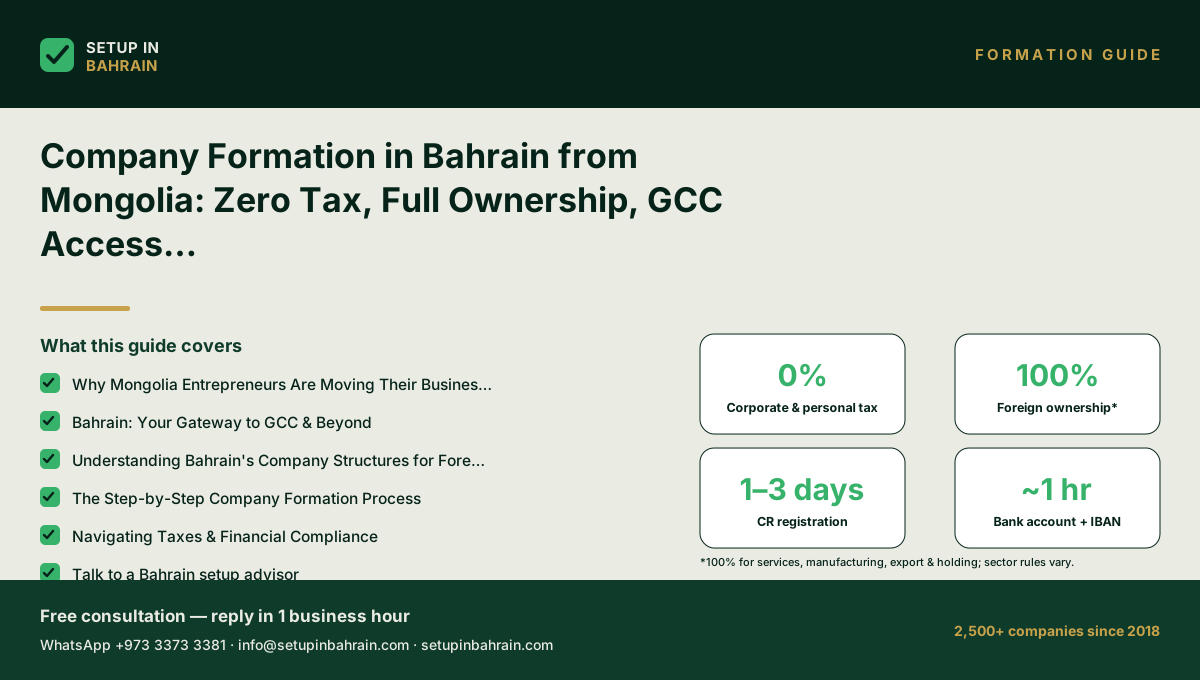
- Why Mongolia Entrepreneurs Are Moving Their Business to Bahrain
- Bahrain: Your Gateway to GCC & Beyond
- Understanding Bahrain's Company Structures for Foreign Investors
- The Step-by-Step Company Formation Process
- Navigating Taxes & Financial Compliance
→ Complete guide: Company Formation in Bahrain — the full 2026 guide
View details
Ownership & capital
A Bahrain WLL can be owned by a single person — 100% foreign ownership applies to most activities, with no local partner required for services, manufacturing, export trading and holding companies. The minimum share capital is BHD 1 ; we recommend BHD 1,000 . This Makes bank account opening and investor visa approval smoother.
Сайн байна уу, эрхэм Монгол бизнес эрхлэгчээ! (Hello, esteemed Mongolian entrepreneur!)
You're a driven entrepreneur from the heart of Asia, navigating a challenging, yet resilient, business landscape. You’ve mastered operations despite brutal winters, complex regulations, and the unique logistics of a vast, landlocked nation. You've built your business through sheer grit, adapting to extreme market shifts and an often-unpredictable regulatory environment. But let's be candid: are you truly maximizing your global potential and protecting your hard-earned profits under the current conditions? Many Mongolian business owners I speak with are facing a crossroads, looking beyond their borders for stability, growth. A more favorable environment.
This comprehensive guide is written specifically for you – a Mongolian entrepreneur – to unveil a strategic pathway to international expansion and financial freedom: company formation in Bahrain. This isn’t a generic overseas guide. This is a meticulously researched, deeply humanized roadmap designed to address your specific challenges, comparing the realities of doing business in Ulaanbaatar or Erdenet with the unparalleled advantages of Manama.
By the end of this guide, you’ll understand exactly how establishing a Bahraini company can mitigate the severe impact of MNT currency volatility, eliminate your 25% corporate income tax burden, grant you 100% foreign ownership, and unlock the immense markets of the Gulf Cooperation Council (GCC) – all through a streamlined, digitally-enabled process. We’ll walk through every step, from initial setup to banking, visas, and navigating the tax implications back home, ensuring you have the expert insights you need to make an informed decision for your business's future.
Why Mongolia Entrepreneurs Are Moving Their Business to Bahrain
Let's start with a scenario that might sound all too familiar. Imagine Nomin, a shrewd Mongolian entrepreneur running a successful cashmere export business from Ulaanbaatar. Her company has a strong international client base. Every quarter, she battles two dragons: the unpredictable swing of the Mongolian Tugrik (MNT) and a hefty 25% corporate income tax. Last year, a Ulaanbaatar-based supplier of drilling equipment to Oyu Tolgoi watched his 25% corporate income tax bill hit MNT 180 million on MNT 720 million revenue. The same year, the Tugrik dropped 14% against the dollar because of another coal-price swing, wiping out another MNT 42 million in working capital. His solution was not to cut staff or raise prices; it was to register a Bahrain WLL.
He now invoices the same Mongolian mine through a Bahrain entity taxed at zero percent, keeps the profit in Bahraini Dinars (BHD) pegged to the dollar, and pays himself a dividend with no withholding tax. The Mongolian company remains for local operations. The core revenue and profit generation moved to a more stable and fiscally efficient environment. This isn't just an anecdote; it's a strategic shift many discerning Mongolian entrepreneurs are making.
Let's dissect the core pain points that drive this decision:
1. The Burden of Corporate Income Tax: From 25% to 0%
Mongolia’s corporate income tax rate, standing at a substantial 25% for high-income businesses, can greatly erode your profits. While there are lower tiers, many thriving businesses quickly reach this maximum. This directly impacts your reinvestment capacity, your ability to expand, and ultimately, your net worth.
In Bahrain, with very few exceptions (primarily oil and gas companies. This Likely don't apply to your core business), the corporate income tax rate is a flat 0%. This isn't a temporary incentive; it's a foundational pillar of Bahrain's economic policy. For a business generating, for example, $1 million in taxable profit, this translates to $250,000 saved annually – funds you can reinvest, expand with, or retain as profit. This immediate and substantial tax relief is often the primary driver for relocation discussions among our Mongolian clients.
2. MNT Currency Volatility: A Constant Threat to Working Capital
The Mongolian Tugrik is notorious for its volatility, heavily influenced by global commodity prices, especially copper and coal. If your business deals in imports, exports, or requires significant foreign currency transactions, you know the dread of a sudden MNT depreciation. A 5-15% swing in a quarter is not uncommon, directly impacting your purchasing power, the cost of imported goods. The real value of your revenues. Imagine budgeting for equipment imports at one exchange rate, only to see your costs jump by over 10% before the transaction is complete. This financial uncertainty makes long-term planning incredibly challenging.
Bahrain, in stark contrast, offers unparalleled currency stability. The Bahraini Dinar (BHD) has been officially pegged to the US Dollar at a rate of BHD 1 = USD 2.65 for decades. This peg is a cornerstone of Bahrain's economic stability, backed by robust foreign exchange reserves managed by the Central Bank of Bahrain (CBB). For you, this means:
- Predictable Costs: Imports become predictable, hedging costs are minimal.
- Stable Revenues: Export revenues retain their value without being eroded by exchange rate fluctuations.
- Capital Protection: Your retained earnings in BHD maintain their value, protecting your working capital from the relentless erosion of MNT depreciation.
3. Complex Regulations & E-filing in Mongolian
Navigating Mongolia's regulatory landscape, especially with its mandatory e-filing systems like the MTA (Mongolian Tax Administration) portal, can be a labyrinth. While digitalization is progress, the systems are often complex, primarily in Mongolian. Require a deep understanding of local accounting nuances. For entrepreneurs focused on international growth, this administrative burden can be a significant drain on time and resources.
Bahrain has invested heavily in streamlining its business registration and compliance processes. The Ministry of Industry and Commerce (MOIC) operates Sibjilat, an intuitive, English-language online portal that allows you to manage most aspects of your company registration and subsequent filings digitally. While local knowledge is always beneficial, the barrier to entry for English-speaking entrepreneurs is greatly lower, promoting efficiency and transparency. The World Bank's 'Ease of Doing Business' reports consistently rank Bahrain highly for its investor-friendly environment.
4. Mandatory Local Partner in Strategic Sectors
In certain strategic sectors in Mongolia, foreign investors are often required to have a local partner. While intended to promote local participation, this can sometimes lead to loss of control, disputes over equity, or difficulties in aligning strategic visions. For many entrepreneurs, 100% ownership and control over their venture are non-negotiable.
Bahrain stands out by offering 100% foreign ownership in most sectors of the economy. This means you, as a Mongolian entrepreneur, can own your Bahraini company outright, without needing a local nominee shareholder or navigating complex joint venture agreements. This complete autonomy is a powerful draw, ensuring your vision for your business remains uncompromised. Crucially, let's dispel a common misconception: while some jurisdictions offer a "Single Person Company" (WLL), Bahrain does not. But, a WLL (With Limited Liability) company in Bahrain can be 100% owned by a single individual with zero partners required, offering the same functional benefits of sole ownership.
5. Limited Banking Infrastructure for International Business
While Mongolia has made strides in its banking sector, the infrastructure for seamless, low-cost international transactions and multi-currency accounts, especially for SMEs, can still be a challenge. High transaction fees, slower processing times, and stringent compliance requirements for cross-border payments can impede global operations.
Bahrain boasts a mature, sophisticated financial services sector, regulated by the Central Bank of Bahrain (CBB), renowned for its stability and international connectivity. It's home to numerous international and regional banks offering a full spectrum of services tailored for global businesses:
- Efficient International Transfers: Faster, more cost-effective SWIFT transfers.
- Multi-currency Accounts: Easily manage USD, EUR, GBP, JPY, and other major currencies.
- Robust Digital Banking: Advanced online platforms for managing your finances remotely.
- Access to Trade Finance: Facilities like Letters of Credit, guarantees, and export financing are readily available.
This robust banking environment is crucial for any business looking to operate globally, providing the liquidity, speed. Reliability often lacking in more nascent financial markets.
In summary, the move from Ulaanbaatar or Erdenet to Manama is not merely a change of address; it's a strategic realignment to secure your business's financial future, reduce tax burdens, protect capital, and access a broader, more stable market.
Bahrain: Your Gateway to GCC & Beyond
Beyond simply mitigating your Mongolian pain points, establishing a presence in Bahrain unlocks a world of new opportunities, placing your business at the nexus of a dynamic, rapidly growing economic region.
Strategic Location: The Heart of the Gulf
Bahrain's geographical position is one of its most compelling assets. Situated in the Arabian Gulf, it acts as a central hub, directly connected to Saudi Arabia via the 25-kilometer King Fahd Causeway, a major artery for trade and travel. This direct land link is critical, as Saudi Arabia represents the largest economy in the Middle East. Beyond this, Bahrain is a short flight away from major GCC markets like the UAE, Qatar, Kuwait. Oman, placing your business within easy reach of over 50 million affluent consumers.
The Bahrain International Airport (BIA) is a modern, efficient hub with excellent connectivity, ensuring that your goods, services. Personnel can move swiftly across borders. For a landlocked nation like Mongolia, this access to international shipping lanes and air cargo networks is a game-changer, dramatically reducing logistics complexities and transit times for your global trade.
Economic Diversification and Vision 2030
While traditionally known for its oil resources, Bahrain has aggressively pursued economic diversification, spearheaded by its Economic Development Board (EDB). The Bahrain Economic Vision 2030 outlines a clear strategy to shift towards a knowledge-based economy, focusing on sectors like:
- Financial Services: A long-standing regional leader, especially in Islamic finance.
- Information & Communication Technology (ICT): Attracting tech companies and fostering innovation.
- Logistics & Manufacturing: Leveraging its strategic location and excellent infrastructure.
- Tourism & Hospitality: Developing its cultural and leisure offerings.
This forward-thinking approach creates a vibrant, diversified economy that provides a stable foundation for businesses across various industries. It means you're investing in a country with a clear growth trajectory, supported by government initiatives designed to attract and retain foreign investment.
Unrestricted Access to the GCC Market
As a member of the Gulf Cooperation Council (GCC), Bahrain offers your company preferential access to one of the world's wealthiest trading blocs. The GCC common market facilitates the free movement of goods, services, capital, and people among its member states. This means:
- Expanded Customer Base: Your Bahraini company can serve the entire GCC market without significant customs duties or trade barriers. This opens up a customer base far exceeding Mongolia's 3.4 million population.
- Simplified Trade: Reduced bureaucracy and tariffs make inter-GCC trade smoother and more cost-effective.
- Regional Hub Potential: Bahrain can serve as your regional headquarters for expansion into the broader Middle East and North Africa (MENA) region.
Political Stability and Transparent Governance
Bahrain has cultivated a reputation for political stability and a commitment to transparent governance. The legal framework is based on civil law principles, and the judiciary is independent. This stability provides a predictable and secure environment for long-term business planning, a stark contrast to regions with greater geopolitical uncertainty. For an entrepreneur, knowing that your investments are protected by a robust legal system is invaluable.
Quality of Life and Talent Pool
Beyond the business benefits, Bahrain offers an exceptionally high quality of life for expatriates. The cost of living. Higher than Ulaanbaatar in some aspects, offers excellent value for money compared to other GCC nations. You'll find: Modern Infrastructure: World-class healthcare facilities, international schools, and modern residential options. Multicultural Environment: A welcoming society with a large expatriate community, making it easy to integrate. Safety & Security: Bahrain is consistently ranked as one of the safest countries in the world. Skilled Workforce: A growing pool of educated and skilled local talent, complemented by a diverse expatriate workforce.
For you and your family, establishing roots in Bahrain means access to a comfortable, secure. Internationally-oriented lifestyle, which can be a significant factor in attracting and retaining talent for your business.
Understanding Bahrain's Company Structures for Foreign Investors
Choosing the right legal structure is foundational for your Bahraini enterprise. While there are several options, for most Mongolian entrepreneurs seeking 100% foreign ownership and flexibility, one structure stands out.
1. With Limited Liability Company (WLL)
This is the workhorse of Bahraini company formation for foreign investors and is almost certainly the structure you will choose.
Key Features of a WLL: 100% Foreign Ownership: This is a crucial advantage. You, as a Mongolian national, can own 100% of your WLL without requiring any Bahraini partners or shareholders. This ensures complete control over your business operations and profits. To reiterate, there is no single-shareholder WLL legal structure in Bahrain, but a WLL can absolutely be owned by a single individual with no other partners required, offering the same practical benefits for a sole entrepreneur.* Limited Liability: As the name suggests, the liability of shareholders is limited to the amount of their share capital contribution. This protects your personal assets from the company's debts and obligations. Minimum Share Capital: Legally, the minimum share capital for a WLL is BHD 1. But, to ensure practical success, especially for bank account opening and investor visa approval, we strongly recommend a minimum paid-up capital of BHD 1,000. Banks look for substance, and BHD 1,000 shows a more serious commitment. Suitable for Diverse Activities: A WLL is versatile and suitable for a wide range of commercial, industrial. Service activities. Management Flexibility: Can be managed by a single director (who can also be the sole shareholder) or multiple directors, who can be of any nationality. Mandatory Physical Address: All WLLs must have a registered physical office address in Bahrain.
Why a WLL for Mongolian Entrepreneurs? The WLL structure directly addresses the pain points of requiring local partners and offers the maximum flexibility for sole control. Its limited liability protects your personal wealth, while the low capital requirement makes it accessible.
2. Sole Proprietorship
While possible, this structure is generally less suitable for foreign investors looking for limited liability and an investor visa. It's typically for Bahraini nationals or foreign residents with specific professional licenses. It doesn't offer the separation of personal and business liability.
3. Branch of a Foreign Company / Representative Office
These structures are for established companies wishing to extend their operations into Bahrain. A Branch Office conducts commercial activities and is fully taxable (though still generally no corporate income tax for most sectors for non-oil/gas). A Representative Office is more restricted, only promoting the parent company's business and not directly conducting sales or services. These are usually considered once your Bahraini operations mature or if you're a very large multinational.
4. Free Zones (Specific Industries)
Bahrain offers specialized free zones, each designed to foster specific industries: Bahrain International Investment Park (BIIP): Focuses on manufacturing, industrial services. Logistics. Companies here can benefit from 100% foreign ownership, zero import duties on raw materials and equipment. Excellent infrastructure. Bahrain Logistics Zone (BLZ): Tailored for logistics and re-export businesses, offering streamlined customs procedures and competitive operating costs.
While free zones offer specific benefits, many businesses find the flexibility and broad scope of activities available in the onshore jurisdiction (outside a free zone) using a WLL to be more appropriate for their initial setup.
Which one is right for you? For the vast majority of Mongolian entrepreneurs looking to establish a robust, fully owned. Flexible commercial entity with limited liability, the With Limited Liability Company (WLL) is the optimal choice. It offers the best balance of control, protection, and operational freedom.
The Step-by-Step Company Formation Process
Establishing your company in Bahrain is a relatively straightforward and digitally-enabled process, designed to be efficient for foreign investors. Here's a detailed roadmap:
Step 1: Pre-Registration & Planning (1-3 Days)
Before you even touch the application forms, some strategic groundwork is essential:
Define Your Business Activities: Clearly articulate the specific commercial activities your company will undertake. Bahrain's Ministry of Industry and Commerce (MOIC) uses a classification system (similar to NAICS or ISIC codes). Precision here avoids delays. Do you export cashmere? Provide IT services? Trade minerals? Each requires specific activity codes. Choose a Company Name: Select three preferred company names, in order of preference. The name must be unique and comply with MOIC guidelines (no offensive terms, no implied government affiliation). You can check availability via the Sibjilat portal. Shareholder Agreement (If Applicable): If you are not the sole owner, a clear shareholders' agreement outlining ownership, management. Profit distribution is crucial. Prepare a Business Plan: While not always a strict MOIC requirement for simple WLLs, a concise business plan is essential* for bank account opening and potentially for visa applications. It shows the legitimacy and viability of your venture.
Step 2: Online Registration with the MOIC (3-7 Business Days)
The bulk of the registration process is handled digitally through Bahrain's National Portal for Company Registration (Sibjilat).
Create an Account on Sibjilat: This is your gateway to the MOIC. Submit the Application: You'll input company details, proposed activities, shareholder information, and director details. Upload Required Documents: * Shareholders' Passports: Clear, color copies of passports for all shareholders and directors. * Proof of Address: For each shareholder/director (e.g., utility bill, bank statement, national ID showing address, not older than 3 months). * No-Objection Certificate (NOC): If any shareholder or director is currently employed in Bahrain, an NOC from their current employer might be required. * Power of Attorney (POA): If you're using a local consultant or legal representative to submit the application on your behalf, a notarized and apostilled POA will be necessary. * Memorandum & Articles of Association (MOA/AOA): These are foundational legal documents detailing the company's purpose, share capital. Governance. Standard templates are available through Sibjilat, which you will customize. Initial Capital Deposit Certificate: While not strictly needed at this* stage for BHD 1 WLLs, banks will require it, so be prepared. Pay Registration Fees: MOIC fees are typically reasonable and vary based on activity and capital. For a WLL, expect initial fees in the range of BHD 100-300. MOIC Review & Approval: The MOIC will review your application. Queries are common and usually relate to clarifying business activities or minor document discrepancies. Respond promptly.
Step 3: Commercial Registration (CR) Issuance (After MOIC Approval)
Once the MOIC approves your application, your Commercial Registration (CR) certificate will be issued. This is the official document confirming your company's legal existence in Bahrain. It will include your CR number, company name, activities, and other key details.
Step 4: Post-Registration Essentials (2-6 Weeks, Can run concurrently)
While your CR is issued, several crucial steps are required to make your company fully operational. This is where many foreign entrepreneurs face initial hurdles, especially with banking.
a. Bank Account Opening: The Critical Step
This is often the most challenging part for foreign-owned companies. Where our recommendation for BHD 1,000 minimum share capital becomes vital.
Choose the Right Bank: Bahrain has a robust banking sector. Consider banks like National Bank of Bahrain (NBB), Bahrain Commercial Bank (BBK), Ahli United Bank (AUB). International players like HSBC or Standard Chartered. Research their specific requirements for foreign-owned SMEs. Gather Documents: Beyond your CR and MOA/AOA, banks will require extensive Know Your Customer (KYC) documents: * Original Passports for all authorized signatories. * Personal utility bill/proof of address for signatories (less than 3 months old). * Detailed Business Plan: This is crucial. It needs to articulate your company's purpose, target market, source of funds, expected transaction volume. Key customers/suppliers. Banks use this to assess risk and legitimacy. * Proof of Source of Funds for initial capital. * CVs/Resumes of directors and shareholders. * Bank references from your home country. Due Diligence & Interviews: Expect rigorous due diligence. Banks will ask in-depth questions about your business, your background, and your intended operations. An in-person meeting with bank representatives in Bahrain is almost always mandatory for new foreign companies. Initial Deposit: Once the account is conditionally approved, you'll deposit your initial share capital (e.g., BHD 1,000). The bank will then issue a capital deposit certificate.
Insight for Mongolian Entrepreneurs: Be prepared for more scrutiny than you might expect. Banks in Bahrain are highly compliant with international anti-money laundering (AML) and counter-terrorist financing (CTF) regulations. Your business plan must be impeccable, and your answers transparent. Avoid using "virtual office" addresses solely for registration; banks prefer a more tangible presence.
b. Investor Visa & Residency
As a company owner, you'll want to secure an investor visa and residency permit for yourself and potentially your family.
Application to LMRA: The Labour Market Regulatory Authority (LMRA) handles all visa and work permit applications. Required Documents: * Passport copy. * CR copy. * Application forms. * Sponsorship from your Bahraini company. * Medical Check: Conducted in Bahrain. * Fingerprinting: For your national ID (CPR card). CPR Card Issuance: This is Bahrain's national identity card and is essential for opening personal bank accounts, signing leases. Accessing government services. It's issued after your visa is approved and fingerprints are taken. Family Sponsorship: Once you have your investor visa and CPR, you can sponsor your spouse and dependent children.
c. Office Space & Rental Agreement
A physical address is mandatory for your WLL.
Serviced Offices: A popular and cost-effective option for new businesses. These provide a fully furnished office, internet, reception services. Meeting rooms, along with a valid physical address for CR and banking purposes. Traditional Lease: Renting a dedicated office space. Virtual Offices: While some services offer virtual office addresses, banks and the MOIC prefer a demonstrable physical presence. Ensure any "virtual office" service comes with a legitimate physical address and services that meet MOIC requirements.
Step 5: Ongoing Compliance & Operations
Once your company is registered and operational, focus shifts to ongoing compliance.
- Commercial Registration Renewal: Your CR needs annual renewal.
- VAT Registration: If your taxable supplies exceed the mandatory threshold (BHD 37,500 annually) or voluntary threshold (BHD 18,750), you must register for VAT with the National Bureau for Revenue (NBR).
- Audited Financial Statements: WLLs are required to maintain proper accounting records and submit annual audited financial statements.
Total Timeline Estimation:
- MOIC Registration (CR issuance): 1-2 weeks (if all documents are perfect and queries answered promptly).
- Bank Account Opening: 2-6 weeks (highly variable, depends on bank, completeness of documents, and your responsiveness).
- Investor Visa & CPR: 2-4 weeks after bank account and office space are secured.
Overall, expect the full setup process, from initial application to having a fully functional company with a bank account and your investor visa, to take anywhere from 6 to 12 weeks. While Bahrain is efficient, a buffer for unforeseen queries or bank processing times is always advisable.
Navigating Taxes & Financial Compliance
This is where the financial advantages of Bahrain truly shine for Mongolian entrepreneurs. It’s critical to understand your dual obligations.
The Bahraini Tax System: Simplified & Zero-Tax
Bahrain is renowned for its business-friendly tax regime, especially when compared to Mongolia.
Corporate Income Tax: 0% * As repeatedly emphasized, Bahrain levies no corporate income tax on companies, with the sole exception of oil and gas companies and certain petroleum contractors. For your typical import/export, service, IT, or manufacturing business, your corporate profits will be entirely exempt from tax in Bahrain. This is a monumental saving compared to Mongolia's 25% rate. Personal Income Tax: 0% * There is no personal income tax in Bahrain. This means any salary you draw from your Bahraini company, or dividends you receive, are not subject to income tax at the federal level in Bahrain. Value Added Tax (VAT): 10% * Introduced in 2019 and increased to 10% in January 2022, VAT is applicable on most goods and services. * You must register for VAT if your annual taxable supplies exceed BHD 37,500. There's also a voluntary registration threshold of BHD 18,750. * Compliance involves quarterly VAT filings and payments to the National Bureau for Revenue (NBR). While it’s an additional administrative task, it’s a consumption tax, not a tax on your profits or income. Withholding Tax: Generally 0% * Bahrain generally does not impose withholding tax on dividends, interest, or royalties paid to non-residents. This makes profit repatriation straightforward and efficient. Social Insurance: Companies are required to contribute to social insurance for their Bahraini and
Bahrain Business Guides for Mongolia Citizens
Frequently Asked Questions
How long does it take to set up?
It takes 15 to 20 days. We file all forms for you. You do not need to wait long.
What does it cost?
Company formation: Standard BHD 1,340 with 3 months of office address; Gold BHD 1,700 with 6 months; Premium BHD 2,150 with 12 months and a cabin, officer table and chair, and two guest chairs. No formation package includes visas, including Premium. Investor/work visas are priced separately: BHD 755 for one year or BHD 953 for two years, in addition to the formation package. Ask for a written, itemized quotation confirming government fees and all inclusions before payment.
Do I need to visit Bahrain?
No. You can set up your firm from home. We do all the work online. Some banks may ask for one visit.
What tax will I pay?
You pay zero tax on your profits. Bahrain has no corporate income tax. This is a key benefit of the setup.
Can I own 100% of my firm?
Yes. Foreign owners can hold all shares. No local partner is needed. Full ownership is allowed.
What do I need to start?
You need a valid passport. You also need a trade name and a business address. We help you with all of these.
How do I open a bank account?
We guide you step by step. Most banks take 3 to 6 weeks. You will need your CR and firm papers.
Who issues the Commercial Registration (CR)?
The CR is issued by the MOICT. It is your legal right to trade in Bahrain. We file the CR for you.
Can I renew my CR each year?
Company renewal packages: BHD 530 with 3 months of office address; BHD 980 with 6 months; BHD 1,520 with 12 months. These are separate renewal packages, not visa fees.
How do I get started?
Fill in our form on this page. Our team will call you back. We map your best setup plan at no cost.
Steps to Form Your Company
- Pick your trade name. We check if it is free.
- Choose your business type. WLL is the most common.
- Sign the MOA. We draft and file all legal docs.
- Pay the state fees. About BHD 432 in total.
- Get your CR. Takes 15 to 20 days.
- Open your bank account. We guide each step.
- Start trading. You are ready to do business.
Key Facts
- Tax rate: 0%
- Foreign ownership: 100%
- Setup time: 15 to 20 days
- Company formation: Standard BHD 1,340 with 3 months of office address; Gold BHD 1,700 with 6 months; Premium BHD 2,150 with 12 months and a cabin, officer table and chair, and two guest chairs. No formation package includes visas, including Premium. Investor/work visas are priced separately: BHD 755 for one year or BHD 953 for two years, in addition to the formation package. Ask for a written, itemized quotation confirming government fees and all inclusions before payment.
- Company renewal packages: BHD 530 with 3 months of office address; BHD 980 with 6 months; BHD 1,520 with 12 months. These are separate renewal packages, not visa fees.
- Client rating: 4.8 stars
- Clients served: 2,500 and more
Quick Facts
- Tax rate: 0%
- Own all of your firm: Yes, 100%
- Time to set up: 15 to 20 days
- Company formation: Standard BHD 1,340 with 3 months of office address; Gold BHD 1,700 with 6 months; Premium BHD 2,150 with 12 months and a cabin, officer table and chair, and two guest chairs. No formation package includes visas, including Premium. Investor/work visas are priced separately: BHD 755 for one year or BHD 953 for two years, in addition to the formation package. Ask for a written, itemized quotation confirming government fees and all inclusions before payment.
- Company renewal packages: BHD 530 with 3 months of office address; BHD 980 with 6 months; BHD 1,520 with 12 months. These are separate renewal packages, not visa fees.
- Rating: 4.8 stars
- Clients: 2,500 and more
Why Bahrain?
Bahrain has no tax. You keep all your profits. This is rare in the Gulf.
You can own all of your firm. No local partner is needed. The law allows full foreign ownership.
Setup takes 15 to 20 days. We file all forms for you. You can do it all from home.
Bahrain has a free trade deal with the US. Your goods face low or no tariffs. This gives you access to big markets.
We have served 2,800+ clients from 44+ countries and maintain records to substantiate that total where needed. We have 113 Google reviews; reviews represent only some clients and are not the same as the total clients served.
Our Steps
- Tell us your plan. We advise you for free.
- We pick the right firm type for you.
- We file all your forms with MOICT.
- You get your CR in 15 to 20 days.
- We help you open a bank account.
- You are ready to trade. We stay with you.
Next Steps for Mongolia Citizens
You can set up a firm in Bahrain from Mongolia. You do not need to fly there first. We do all the work online.
Tell us your plan. We call you back the same day. We map the best route for you at no cost.
We file all your forms. We deal with MOICT and the state. You get your CR in 15 to 20 days.
After your CR, we help you get a bank account. We also help with your Investor Visa. One firm guides you at each step.
Why Our Clients from Mongolia Choose Us
- We speak your language. We know your needs.
- We have helped clients from Mongolia before.
- Our fee is clear. No surprise costs.
- We have a 4.8 star rating on Google.
- We have helped more than 2,500 clients set up in Bahrain.
Fill in the form on this page. We will be in touch soon. Let us help you start your Bahrain firm today.
Ready to set up in Bahrain from Mongolia?
Tell us your business idea. We map the right entity, ownership and timeline — then handle the filing while you focus on what matters.