Register your Bahrain company from Moldova with generally no corporate income tax for most sectors. Fast setup, full support for Moldovan entrepreneurs. Start your tax-free business today.
Key Takeaways
- Why Moldova Entrepreneurs Are Moving Their Business to Bahrain
- The Moldova Business Reality: What You're Actually Paying
- Bahrain Tax Advantages for Moldova Citizens: The Complete 2026 Picture
- 100% Foreign Ownership: What This Means for Moldova Business Owners
- GCC Market Access: Your Gateway to a $2 Trillion Economy
→ Complete guide: Company Formation in Bahrain — the full 2026 guide
View details
Ownership & capital
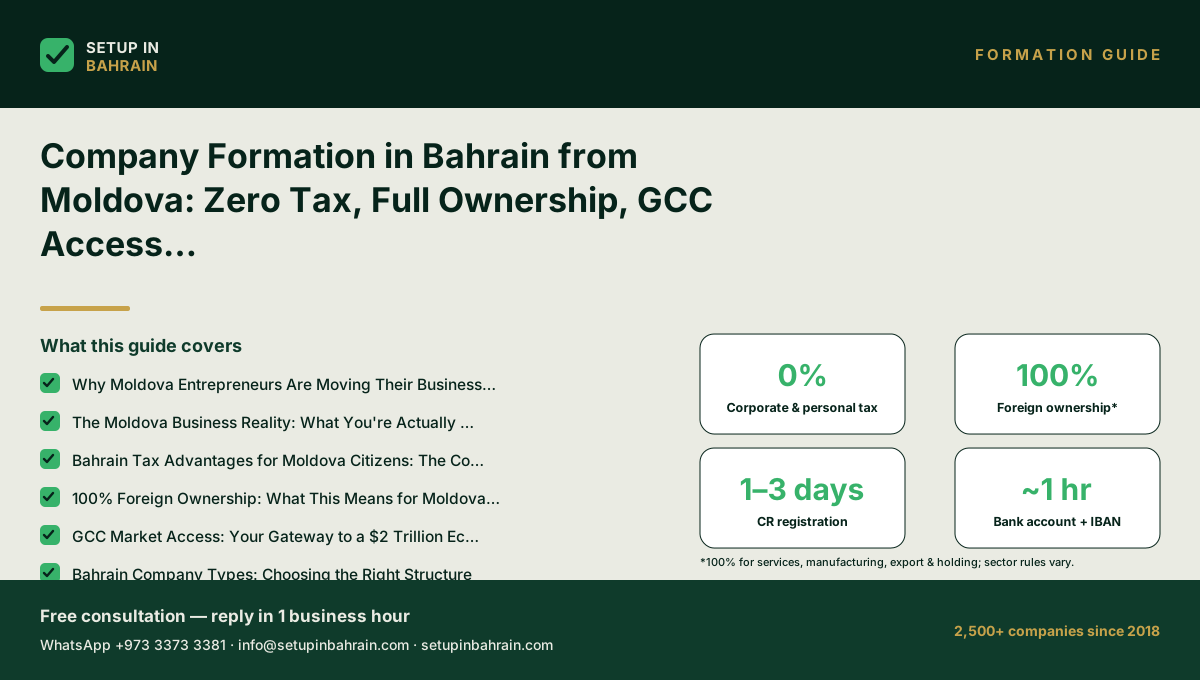
A Bahrain WLL can be owned by a single person — 100% foreign ownership applies to most activities, with no local partner required for services, manufacturing, export trading and holding companies. The minimum share capital is BHD 1 ; we recommend BHD 1,000 . This Makes bank account opening and investor visa approval smoother.
Alexandru stirred cold coffee in a Chișinău café last March, his face telling the story before his words could. His IT services firm—34 developers in Bălți, sales offices in Bucharest, $2.8 million in annual revenue—should have been thriving. Instead, he was watching his business slowly bleed out through forces entirely beyond his control.
"The MDL dropped 36% against the euro since Russia invaded Ukraine," he explained, pulling up currency charts on his phone. "I'm paying 12% corporate tax on profits that are already worth 30% less than when I earned them. And I can't even get paid in dollars because my Moldovan bank won't establish the correspondent relationship."
Alexandru's situation captures what thousands of Moldovan entrepreneurs face daily. The headline tax rate looks reasonable. The reality—currency hemorrhaging, FISC paperwork consuming weeks of productivity, commercial court cases dragging for nine months or longer. A domestic market of just 2.6 million people that cannot absorb meaningful growth—tells a different story entirely.
Twelve months after that conversation, Alexandru's company operates from Bahrain. He generally pays no corporate income tax in most sectors. His revenue arrives in Bahraini dinars, pegged to the US dollar at a fixed rate of 2.65 since 1980. His banking relationships now span the GCC, Europe, and North America. His effective take-home increased by about 40% without changing a single client or project.
This guide exists because Alexandru's path should not require luck, expensive consultants, or years of trial and error. It exists because Moldovan entrepreneurs deserve a clear, actionable roadmap to a business environment designed for growth, stability. Genuine wealth preservation.
Why Moldova Entrepreneurs Are Moving Their Business to Bahrain
The conversation typically begins with a simple calculation. A founder totals what they actually retained after a productive year, compares it to what peers in tax-efficient jurisdictions kept. Experiences a moment of clarity that permanently shifts their strategic thinking.
Moldova's 12% corporate income tax rate appears competitive when examined in isolation. It undercuts Romania's 16%, Ukraine's 18%, and greatly trails most Western European rates. On paper, this positions Moldova as a reasonable business environment.
The paper analysis misses everything that matters.
The Hidden Erosion Nobody Warns You About
Elena S. founded a software outsourcing firm in Chișinău that generated €340,000 in 2024 project revenue from Western European and Gulf clients. Her corporate tax bill came to about €40,800—manageable, expected, budgeted. What she had not budgeted was the additional 18% currency slide the Moldovan leu experienced against the US dollar in those same twelve months. This marked the third major depreciation event since 2022.
Between the 12% corporate tax, the 6% dividend withholding tax when she extracted profits, mandatory social contributions. Currency conversion losses, Elena's actual retained earnings compressed to roughly 52% of what she invoiced. Nearly half her productive output disappeared into a combination of taxation, bureaucratic compliance costs, and monetary instability.
The currency story demands particular attention. Since Russia's full-scale invasion of Ukraine in February 2022, the Moldovan leu has experienced brutal volatility, depreciating 30–40% against major currencies during various shock periods. For businesses earning in euros or dollars and holding reserves in MDL, this represents wealth destruction that compounds annually.
Consider the mathematics: A Moldovan company earning €100,000 in Q1 2022 held about MDL 2,000,000 after conversion at prevailing rates. That same €100,000 earned in Q4 2024 converted to about MDL 2,140,000—a gain that looks positive until you realize the purchasing power of those MDL holdings dropped by roughly 35% in real terms.
Bureaucratic Friction That Consumes Productive Capacity
Beyond taxation and currency, Moldovan entrepreneurs contend with FISC's paper-heavy filing requirements. The State Tax Service operates on systems that require physical documents, in-person appointments. Processing timelines that Western European or Gulf businesses would find incomprehensible.
Elena spent about 30 working days in 2024 managing tax compliance—preparing quarterly filings, responding to FISC inquiries, gathering supporting documents. Physically visiting government offices. At her billing rate, those 30 days represented roughly €25,000 in opportunity cost. Added to her actual tax burden, her true compliance cost approached 25% of revenue.
The Chisinau Commercial Court compounds these challenges when disputes arise. Contract enforcement cases routinely extend beyond nine months. For businesses operating on standard payment terms with international clients, this timeline makes meaningful legal recourse essentially theoretical.
Market Constraints That Cap Growth
Moldova's population of about 2.6 million people—smaller than many individual cities where your clients likely operate—creates an inherent ceiling on domestic market opportunity. Businesses that show product-market fit quickly exhaust local demand and must internationalize or stagnate.
This internationalization requirement, combined with limited bilateral trade agreements, banking system constraints on correspondent relationships, and Moldova's ongoing EU accession candidate status (which introduces regulatory uncertainty as compliance requirements shift), creates an environment where ambitious entrepreneurs face structural disadvantages regardless of their talent or execution quality.
Against this backdrop, Bahrain emerges not as an exotic offshore option but as a logical strategic response to documented, quantifiable challenges.
The Moldova Business Reality: What You're Actually Paying
Before examining Bahrain's advantages, Moldovan entrepreneurs benefit from understanding their current cost structure with precision. The numbers below reflect 2025-2026 conditions.
Direct Taxation
Corporate Income Tax: 12% on net profits. For a company earning MDL 1,000,000 annually (about BHD 20,200 or USD 53,500), this represents MDL 120,000 payable to FISC.
Dividend Tax: 6% withholding on distributions to shareholders. On a post-tax profit of MDL 880,000, dividend extraction triggers an additional MDL 52,800 liability—reducing your take-home to MDL 827,200 before any other deductions.
Social Contributions: Employer contributions for social insurance (24% on salaries) and medical insurance (9% on salaries) apply to all employees. For a knowledge-work business with average monthly salaries of MDL 15,000 across 10 employees, annual social contribution costs exceed MDL 594,000.
VAT: Standard rate of 20% applies to most goods and services, with reduced rates for specific categories. While theoretically recoverable through the input-output mechanism, cash flow timing and FISC processing delays create working capital pressure.
Indirect and Hidden Costs
Currency Conversion Losses: For businesses earning in EUR or USD and operating in MDL, conversion losses since 2022 have averaged 8–12% annually, compounding to 30–40% cumulative erosion.
Compliance Administration: Conservative estimates place annual compliance costs for a mid-sized Moldovan company at 15–25 working days of founder or senior management time, plus accounting and legal fees ranging from MDL 30,000–80,000 annually.
Banking Friction: Limited correspondent banking relationships restrict payment options for international clients. Many Moldovan businesses report being unable to receive USD payments directly, forcing conversion through EUR intermediaries at additional cost.
Dispute Resolution Delays: Commercial court timelines averaging 9–14 months for contract disputes create effective write-off risks on receivables and limit the enforceability of agreements with domestic counterparties.
Total Effective Burden
For a Moldovan IT services or consulting firm generating €300,000 in annual revenue with 60% gross margins, the total effective burden—combining direct taxation, social contributions, currency erosion, compliance costs, and banking friction—can consume 45–55% of economic value created.
This calculation explains why Moldova's competitive headline rate fails to translate into competitive business outcomes.
Bahrain Tax Advantages for Moldova Citizens: The Complete 2026 Picture
Bahrain offers Moldovan entrepreneurs a fundamentally different proposition. Understanding the complete picture requires examining each component systematically.
Zero Corporate Income Tax
Bahrain imposes no corporate income tax on business profits. A company generating BHD 100,000 in annual profit retains BHD 100,000. There is no headline rate, no effective rate, no graduated brackets—simply zero taxation on corporate earnings.
This policy, maintained consistently for decades, reflects Bahrain's strategic positioning as a regional business hub and its government's revenue diversification away from direct taxation toward fees, licensing, and value-added services.
The sole exception involves companies engaged in oil and gas extraction or refining. This Face a 46% tax rate under specific regulatory frameworks. For virtually all Moldova entrepreneurs—whether in IT services, consulting, trade, manufacturing, or professional services—this exception carries no relevance.
Practical Impact: Alexandru's IT services firm generated about $2.8 million in revenue with $840,000 in net profit during its first full year operating from Bahrain. His corporate tax liability: zero. In Moldova, that profit would have triggered about $100,800 in corporate tax plus additional amounts upon distribution.
Zero Personal Income Tax
Bahrain imposes no personal income tax on individuals. Salaries, dividends, interest, capital gains, and other personal income streams face zero taxation regardless of amount.
For Moldova entrepreneurs structuring their affairs through a Bahrain company, this creates complete tax efficiency on the corporate-to-personal chain. Profits accumulated in the company remain untaxed. Distributions to shareholders remain untaxed. There is no 6% dividend withholding equivalent, no progressive personal tax brackets, no social contribution obligations on shareholder distributions.
Practical Impact: Elena restructured her software business through Bahrain and now extracts her entire annual profit as shareholder distributions without any tax liability. Her previous Moldova structure retained about 52% of generated value after all taxes and currency effects. Her Bahrain structure retains about 97% (after modest administrative and banking costs).
Zero Capital Gains Tax
Investment appreciation, asset sales, and equity dispositions generate no tax liability in Bahrain. For entrepreneurs building businesses with eventual exit potential, this provision alone can represent seven-figure savings.
A Moldova-based company sold for €5 million would trigger substantial capital gains exposure under Moldovan law, with the exact treatment depending on structure, holding periods, and individual circumstances. The same transaction executed through a properly structured Bahrain entity would generate zero capital gains tax liability.
Zero Withholding Tax on Dividends, Interest, and Royalties
Bahrain imposes no withholding taxes on outbound payments. Dividends paid to foreign shareholders, interest paid on debt instruments. Royalties paid for intellectual property all leave the country without deduction.
This characteristic makes Bahrain especially attractive for holding company structures, IP licensing arrangements. Regional headquarters managing subsidiaries or affiliates across multiple countries.
Value Added Tax: The Single Consumption Levy
Bahrain implemented a 10% Value Added Tax effective January 1, 2022, following other GCC states in adopting consumption taxation. This represents the only broad-based tax Moldovan entrepreneurs will encounter.
The VAT functions similarly to European models, with businesses collecting tax on outputs and recovering tax on inputs, remitting the net difference to the National Bureau for Revenue. Standard compliance requirements include:
- Registration threshold: BHD 37,500 in annual taxable supplies (about USD 100,000)
- Filing frequency: Monthly for larger businesses, quarterly for smaller operations
- Input recovery: Full recovery available for business-related expenses
- Zero-rating: Exports, international transportation, and certain financial services qualify for 0% treatment
For service exporters—which describes most Moldova IT and consulting firms establishing in Bahrain—the practical VAT impact often approaches zero, as services rendered to clients outside Bahrain qualify for zero-rating while input VAT on local expenses remains recoverable.
Currency Stability: The Hidden Advantage
Bahrain's currency, the Bahraini dinar (BHD), has maintained a fixed peg to the US dollar at about 2.65 BHD/USD since 1980. This 45-year track record of monetary stability contrasts dramatically with the MDL's recent volatility.
For Moldova entrepreneurs, this stability provides several concrete benefits:
Predictable Invoicing: You can invoice international clients in USD (widely accepted) or BHD (directly pegged) with confidence that your receivables will maintain their value through collection.
Stable Reserves: Cash reserves held in BHD preserve purchasing power rather than eroding through currency depreciation.
Eliminated Conversion Anxiety: The psychological and practical burden of monitoring MDL movements and timing conversions disappears entirely.
Banking Flexibility: Bahraini banks routinely maintain multi-currency accounts in BHD, USD, EUR, GBP. Other major currencies, allowing natural hedging and client-preferred payment acceptance.
Comparative Tax Analysis: Moldova vs. Bahrain
| Tax Category | Moldova | Bahrain | Annual Savings (€300K Revenue Example) |
| Corporate Income Tax | 12% | 0% | €21,600 |
| Dividend Withholding | 6% | 0% | €9,504 |
| Personal Income Tax | 12% progressive | 0% | Varies by extraction |
| Capital Gains Tax | Applicable | 0% | Transaction-dependent |
| Social Contributions | 33% on wages | 0% for foreign employees | €59,400 (10-person team) |
| Currency Erosion | 8–12% annually | Near-zero | €24,000–36,000 |
| VAT Rate | 20% | 10% (often zero-rated) | Varies by model |
100% Foreign Ownership: What This Means for Moldova Business Owners
Bahrain permits complete foreign ownership of companies across virtually all economic sectors. This policy, formalized through the Commercial Companies Law and reinforced through ongoing regulatory updates, eliminates the sponsor or local partner requirements that historically complicated Gulf business operations.
Full Control Without Local Partner Requirements
Moldova entrepreneurs establishing companies in Bahrain maintain 100% equity ownership, 100% voting control, and 100% profit retention rights. There is no requirement to:
- Allocate shares to Bahraini nationals
- Appoint Bahraini directors (though local directors may provide practical benefits)
- Partner with local sponsors or agents
- Share profits with silent local stakeholders
This represents a significant departure from historical GCC business structures and from current requirements in certain neighboring jurisdictions.
Practical Implications for Moldova Founders
Strategic Decision-Making: You retain complete authority over business direction, market selection, hiring. Operational choices without needing to consult, inform, or get approval from local partners.
Profit Distribution: All generated profits belong to shareholders based on their equity stakes. There is no mandatory local participation in upside.
Exit Flexibility: You can sell, transfer, or wind up the company at your sole discretion, subject only to standard regulatory requirements applicable to all businesses.
Estate Planning: Ownership can be structured through holding companies, family trusts, or other vehicles to optimize succession planning without navigating local partner consent requirements.
Sector-Specific Considerations
While 100% foreign ownership applies broadly, certain regulated activities may have specific licensing requirements:
Financial Services: Companies providing banking, insurance, or investment services require Central Bank of Bahrain (CBB) licensing and must meet capital and operational requirements that may include local presence obligations.
Healthcare: Medical facilities and practitioners require Ministry of Health licensing with specific qualification and facility requirements.
Legal Services: Foreign law firms may operate but face restrictions on practicing Bahraini law.
Real Estate Development: Large-scale developments in certain areas may have specific approval requirements.
For the vast majority of Moldova entrepreneurs—those operating IT services, consulting, trading, logistics, professional services, or light manufacturing—100% foreign ownership is straightforward and unconditional.
GCC Market Access: Your Gateway to a $2 Trillion Economy
Bahrain's geographic position and GCC membership transform a company registration into access credentials for one of the world's most dynamic economic regions.
Understanding the GCC Opportunity
The Gulf Cooperation Council—comprising Bahrain, Saudi Arabia, UAE, Kuwait, Qatar, and Oman—represents a combined GDP exceeding $2 trillion and a population of about 60 million people, with demographics skewing heavily toward high-consumption working-age adults.
GCC economic characteristics especially relevant to Moldova entrepreneurs include:
High Per-Capita Income: GCC per-capita GDP ranges from about $25,000 (Oman) to over $80,000 (Qatar), creating consumer and business markets with substantial purchasing power.
Infrastructure Investment: Ongoing megaprojects across the region—including Saudi Arabia's NEOM and Vision 2030 initiatives, UAE's continued development. Qatar's post-World Cup economic programs—generate continuous demand for services, technology, and expertise.
Digitalization Priorities: All GCC governments have identified digital transformation as strategic priorities, creating sustained demand for IT services, software development, cybersecurity. Technology consulting.
English Business Environment: While Arabic is official, English functions as the practical business language throughout the GCC, eliminating language barriers for Moldova entrepreneurs already serving European and international clients.
Bahrain's GCC Access Advantages
Geographic Centrality: Bahrain sits at the GCC's geographic heart, connected to Saudi Arabia's Eastern Province via the 25-kilometer King Fahd Causeway and within a 1–2 hour flight of all other GCC capitals.
Saudi Market Proximity: The Eastern Province of Saudi Arabia—accessible by a 45-minute drive from Manama—contains the Kingdom's oil industry concentration, major industrial cities, and a population exceeding 4 million. Many businesses use Bahrain as their Saudi market gateway.
Regional Headquarters Status: Numerous multinational corporations have established GCC regional headquarters in Bahrain, creating a business ecosystem of potential clients, partners. Service providers.
Free Trade Agreements: Bahrain maintains free trade agreements with the United States, Singapore. Other jurisdictions, plus the GCC common market arrangements facilitating intra-regional trade.
Sector-Specific GCC Opportunities for Moldova Entrepreneurs
IT Services and Software Development: Moldova's established reputation for software development competence translates directly to GCC demand. Regional clients seek development partners offering European quality at competitive rates—precisely the value proposition Moldova firms already deliver.
Fintech and Financial Services: Bahrain has positioned itself as the GCC's fintech hub, with the Central Bank of Bahrain operating a regulatory sandbox and licensing framework that has attracted significant fintech investment. Moldova entrepreneurs with financial technology expertise find receptive regulatory and market conditions.
Agricultural Trade: Moldova's wine, produce. Food processing sectors can access GCC import markets through Bahrain-based trading companies. The region imports the vast majority of its food requirements, creating opportunities for quality European agricultural products.
Professional Services: Consulting, accounting, legal support, engineering. Other professional services supporting regional business activity can efficiently operate from a Bahrain base.
E-commerce and Digital Marketing: GCC e-commerce continues rapid growth, with regional businesses seeking digital marketing, platform development. Online commerce expertise.
Bahrain Company Types: Choosing the Right Structure
Bahrain offers several legal structures suitable for Moldova entrepreneurs, each with distinct characteristics, requirements, and optimal use cases.
Limited Liability Company (WLL)
The Shareholding Company with Limited Liability—locally termed "WLL" from the Arabic designation—represents the most common structure for foreign entrepreneurs establishing operational businesses.
Key Characteristics:
- Minimum capital: BHD 1 (we recommend BHD 1,000)for foreign-owned WLL, though lower thresholds apply for certain activities
- Shareholders: Minimum 2, maximum 50; can include individuals or corporate entities
- Liability: Limited to capital contribution
- Management: Managed by one or more managers appointed by shareholders
- Profit distribution: Per shareholder agreement
- Suitable for: Operational businesses, trading companies, service providers with multiple founders
For Moldova Entrepreneurs: WLL structures work well for established businesses relocating operations, joint ventures with regional partners, or businesses with multiple founder-shareholders. The capital requirement—while higher than some alternatives—remains modest relative to the business scale typically justifying international relocation.
single-shareholder WLL
The Single Person Company structure permits sole ownership while maintaining limited liability—an more and more popular choice for individual Moldova entrepreneurs.
Key Characteristics:
- Minimum capital: BHD 1 (we recommend BHD 1,000)for standard activities; reduced to BHD 1,000 (about USD 2,650) for certain service activities
- Shareholders: Exactly one (individual or corporate)
- Liability: Limited to capital contribution
- Management: Managed by the owner or appointed manager
- Suitable for: Solo founders, holding structures, subsidiaries of foreign parent companies
For Moldova Entrepreneurs: The WLL structure offers simplicity, complete control, and modest capital requirements for service businesses. A Moldova software developer or consultant can establish a single-shareholder WLL with BHD 1,000 capital and immediately begin invoicing international clients through a Bahrain entity.
Branch Office
Foreign companies can establish Bahrain branches to conduct activities within the Kingdom without creating a separate legal entity.
Key Characteristics:
- No separate legal entity; branch operates as extension of parent company
- Parent company retains full liability for branch obligations
- Requires local representative and registered address
- Suitable for: Companies testing the market before full setup, project-based operations, companies wanting consolidated financials
For Moldova Entrepreneurs: Branches offer lower initial commitment but expose the parent company to full liability. Generally less advantageous than subsidiary structures for long-term operations. Useful for specific project engagements or market exploration phases.
Holding Company
Bahrain's holding company framework permits foreign ownership of investment vehicles managing portfolios of regional or international subsidiaries.
Key Characteristics:
- Designed for managing equity investments in other companies
- Can own real estate, intellectual property, and financial assets
- Subject to specific regulatory requirements through the Central Bank of Bahrain for certain investment activities
- Suitable for: Multi-entity business groups, family offices, investment portfolios, IP holding structures
For Moldova Entrepreneurs: Holding structures become relevant as business complexity increases—typically for entrepreneurs managing multiple operating companies, significant IP portfolios, or investment activities beyond their primary operational business.
Free Zone Companies
Bahrain hosts the Bahrain International Investment Park (BIIP) and Bahrain Logistics Zone (BLZ), offering free zone company structures with specific incentives.
Key Characteristics:
- Often include warehousing, light manufacturing, and logistics facilities
- May offer specific incentives for target sectors
- Typically designed for businesses requiring physical operational presence
- Suitable for: Manufacturing, logistics, warehousing, industrial activities
For Moldova Entrepreneurs: Free zone structures primarily benefit businesses with physical operational requirements rather than service-based businesses. For most IT, consulting, and professional service firms, mainland structures offer equivalent benefits with greater operational flexibility.
Recommended Structure Selection
| Business Type | Recommended Structure | Minimum Capital | Typical Timeline |
| Solo IT consultant/developer | WLL | BHD 1,000 | 2–3 weeks |
| Software development agency | WLL | BHD 1,000–50,000 | 2–4 weeks |
| Trading company | WLL | BHD 50,000 | 3–4 weeks |
| Regional holding company | Holding Company | BHD 50,000+ | 4–6 weeks |
| Manufacturing/logistics | Free Zone Company | Varies | 4–8 weeks |
Step-by-Step Company Registration Process from Moldova
Establishing a Bahrain company from Moldova follows a structured process involving several government agencies. Understanding each step—and the documents requirements, timelines, and potential complications—enables efficient execution.
Phase 1: Pre-Registration Planning (Week 1)
Activity Selection and Licensing Research
Begin by identifying the specific commercial activities your company will conduct. Bahrain's Ministry of Industry and Commerce (MOIC) maintains a comprehensive classification system. Your registration must specify permitted activities from this list.
Access the Sijilat portal (Bahrain's business registration platform) to research activity classifications, licensing requirements. Any sector-specific approvals needed. Key considerations:
- IT services, software development, and digital services fall under straightforward licensing categories
- Trading activities require specification of product categories
- Regulated activities (financial services, healthcare, certain professional services) require additional approvals before company formation
Structure and Capital Planning
Based on your business model and founder composition, select the appropriate legal structure. Prepare:
- Proposed company name (Arabic and English versions)
- Shareholder details and equity allocation
- Initial capital amount and source documents
- Proposed director and manager appointments
Documents Assembly
Gather required documents for all shareholders and directors:
- Valid passports (minimum 6 months validity)
- Proof of residential address in Moldova
- Professional CV or business biography
- Bank reference letters
- Source of funds documents
Phase 2: Name Reservation and Initial Applications (Week 2)
Company Name Reservation
Submit proposed company name to MOIC for availability verification. Names must:
- Not conflict with existing registered companies
- Not contain restricted terms (royal, government, banking without appropriate licensing)
- Include appropriate legal suffix (WLL, WLL, etc.)
Processing typically completes within 2–3 business days. Reserve multiple name options to avoid delays from conflicts.
Commercial Registration Application
Submit the commercial registration application through Sijilat, including:
- Completed application forms
- Memorandum and Articles of Association
- Shareholder and director documents
- Proof of initial capital availability
- Registered office address documents
Key Document: Memorandum of Association
The Memorandum of Association (MOA) establishes the company's fundamental structure. Required contents include:
Company name and registered office Business objectives and permitted activities Share capital amount and structure Shareholder names, addresses. Ownership percentages Governance provisions Profit distribution mechanisms
For foreign shareholders, the MOA typically requires notarization in the home country (Moldova) followed by Apostille authentication under the Hague Convention—which Moldova has acceded to—and subsequent legalization at the Bahrain embassy or through the Ministry of Foreign Affairs.
Phase 3: Regulatory Approvals (Weeks 2–3)
Ministry of Industry and Commerce Review
MOIC reviews the commercial registration application, verifying:
- Document completeness and accuracy
- Activity classification appropriateness
- Name availability confirmation
- Capital adequacy for proposed activities
Labour Market Regulatory Authority Clearance
The Labour Market Regulatory Authority (LMRA) must approve foreign worker quotas and, for certain structures, the initial setup of foreign-owned businesses.
Sector-Specific Approvals
Depending on your activities, additional agency approvals may be required:
- Telecommunications: Telecommunications Regulatory Authority
- Financial services: Central Bank of Bahrain
- Food and beverages: Ministry of Health
- Import/export: Customs Affairs
Phase 4: Final Registration and Licensing (Weeks 3–4)
Commercial Registration Issuance
Upon approval, MOIC issues the Commercial Registration (CR) certificate—the foundational document establishing your company's legal existence in Bahrain.
Municipal Licensing
If operating physical premises, get municipal licenses from the relevant municipality based on your registered office location.
Chamber of Commerce Registration
Mandatory registration with the Bahrain Chamber of Commerce and Industry (BCCI) provides networking access and may be required for certain tender participations.
Phase 5: Operational Setup (Weeks 4–5)
Bank Account Opening
With CR certificate in hand, approach Bahraini banks to open corporate accounts. Required documents typically includes:
- Commercial Registration certificate
- Memorandum and Articles of Association
- Passport copies of all directors and authorized signatories
- Proof of business activity and projected transactions
- Reference letters from existing bankers
Account opening timelines vary by bank, typically ranging from 1–3 weeks depending on due diligence requirements.
Virtual Office or Physical Premises
Establish your registered office address. Options include:
- Virtual office services: Starting from about BHD 50–150 monthly for registered address, mail handling, and meeting room access
- Serviced offices: BHD 200–500 monthly for dedicated desk space with services
- Traditional lease: Varies widely based on location and size
Visa and Work Permit Processing
If you'll be physically present in Bahrain, apply for appropriate residency. Options include:
- Employment visa tied to your company
- Golden Residency for entrepreneurs meeting investment thresholds
- Flexi Permit for flexible work arrangements
Registration Timeline Summary
| Phase | Activities | Duration | Key Deliverables |
| 1 | Planning and documents | Week 1 | Structure decision, document assembly |
| 2 | Name reservation, CR application | Week 2 | Reserved name, submitted application |
| 3 | Regulatory review and approvals | Weeks 2–3 | MOIC approval, LMRA clearance |
| 4 | Registration and licensing | Weeks 3–4 | CR certificate, municipal license |
| 5 | Operational setup | Weeks 4–5 | Bank account, office, visa |
Moldova-Specific Considerations
Document Authentication: Moldova's accession to the Hague Apostille Convention simplifies document legalization. Documents requiring authentication should be notarized by a Moldovan notary, then apostilled through the Ministry of Justice before submission.
Power of Attorney: If you cannot travel to Bahrain during registration, a properly authenticated Power of Attorney allows a local representative or registered agent to act on your behalf.
Banking Introduction: Some Moldova entrepreneurs report challenges with Bahrain banks unfamiliar with Moldova documents. Working with an experienced formation agent who can help banking introductions greatly improves success rates.
Required Documents: Complete Checklist for Moldova Applicants
The following checklist covers all documents requirements for a standard WLL formation by Moldova entrepreneurs.
Personal Documents (Per Shareholder/Director)
- Valid passport (color copy, minimum 6 months validity)
- Passport-size photograph (white background, recent)
- Proof of residential address (utility bill, bank statement dated within 3 months)
- Professional CV or business biography
- Bank reference letter from current banker
- Source of funds declaration and supporting documents
Corporate Documents (For Corporate Shareholders)
- Certificate of Incorporation
- Memorandum and Articles of Association
- Certificate of Good Standing (dated within 3 months)
- Board resolution authorizing Bahrain investment
- Register of directors and shareholders
- Latest audited financial statements
- Power of Attorney for authorized representative
Formation Documents (To Be Prepared)
- Memorandum of Association for Bahrain company
- Articles of Association
- Share capital subscription agreement
- Director appointment resolutions
- Registered office agreement
- Power of Attorney (if using representative)
Authentication Requirements
All Moldova-origin documents require:
- Notarization by licensed Moldovan notary
- Apostille from Moldova Ministry of Justice
- Translation to Arabic and/or English by certified translator
- Some banks/authorities may require additional Bahrain embassy legalization
Post-Formation Documents (Provided Upon Completion)
- Commercial Registration certificate
- Memorandum of Association (authenticated and filed)
- Articles of Association (authenticated and filed)
- Share certificates
- Municipality license (if applicable)
- Chamber of Commerce membership certificate
- Corporate bank account details
Cost Breakdown: Realistic Budget for Moldova Entrepreneurs
Transparent cost planning prevents unwelcome surprises. The following breakdown reflects 2025–2026 market rates for establishing and operating a Bahrain company.
Formation Costs (One-Time)
| Cost Category | WLL (Service Business) | WLL (Trading/Operational) |
| Name reservation | BHD 10–15 | BHD 10–15 |
| Commercial Registration fees | BHD 200–400 | BHD 400–600 |
| Ministry fees and stamps | BHD 100–200 | BHD 200–400 |
| Chamber of Commerce registration | BHD 100–150 | BHD 150–250 |
| Document authentication (Moldova) | USD 200–400 | USD 300–600 |
| Formation agent/consultancy fees | BHD 800–1,500 | BHD 1,500–3,000 |
| Legal review (optional but recommended) | BHD 300–600 | BHD 500–1,000 |
| Total Formation Cost | BHD 1,700–3,000 | BHD 3,000–6,000 |
| USD Equivalent | USD 4,500–8,000 | USD 8,000–16,000 |
Share Capital Requirements
| Company Type | Minimum Capital | Notes |
| WLL (service activities) | BHD 1,000 | Certain activities only |
| WLL (standard activities) | BHD 1 (we recommend BHD 1,000) | Deposited, not necessarily expended |
| WLL | BHD 1 (we recommend BHD 1,000) | Can be structured as committed capital |
Annual Operating Costs
| Cost Category | Low Estimate | High Estimate |
| Commercial Registration renewal | BHD 200–400 | BHD 400–600 |
| Virtual office/registered address | BHD 600–1,200 | BHD 1,800–3,600 |
Bahrain Business Guides for Moldova Citizens
Frequently Asked Questions
How long does it take to set up?
It takes 15 to 20 days. We file all forms for you. You do not need to wait long.
What does it cost?
Company formation: Standard BHD 1,340 with 3 months of office address; Gold BHD 1,700 with 6 months; Premium BHD 2,150 with 12 months and a cabin, officer table and chair, and two guest chairs. No formation package includes visas, including Premium. Investor/work visas are priced separately: BHD 755 for one year or BHD 953 for two years, in addition to the formation package. Ask for a written, itemized quotation confirming government fees and all inclusions before payment.
Do I need to visit Bahrain?
No. You can set up your firm from home. We do all the work online. Some banks may ask for one visit.
What tax will I pay?
You pay zero tax on your profits. Bahrain has no corporate income tax. This is a key benefit of the setup.
Can I own 100% of my firm?
Yes. Foreign owners can hold all shares. No local partner is needed. Full ownership is allowed.
What do I need to start?
You need a valid passport. You also need a trade name and a business address. We help you with all of these.
How do I open a bank account?
We guide you step by step. Most banks take 3 to 6 weeks. You will need your CR and firm papers.
Who issues the Commercial Registration (CR)?
The CR is issued by the MOICT. It is your legal right to trade in Bahrain. We file the CR for you.
Can I renew my CR each year?
Company renewal packages: BHD 530 with 3 months of office address; BHD 980 with 6 months; BHD 1,520 with 12 months. These are separate renewal packages, not visa fees.
How do I get started?
Fill in our form on this page. Our team will call you back. We map your best setup plan at no cost.
Steps to Form Your Company
- Pick your trade name. We check if it is free.
- Choose your business type. WLL is the most common.
- Sign the MOA. We draft and file all legal docs.
- Pay the state fees. About BHD 432 in total.
- Get your CR. Takes 15 to 20 days.
- Open your bank account. We guide each step.
- Start trading. You are ready to do business.
Key Facts
- Tax rate: 0%
- Foreign ownership: 100%
- Setup time: 15 to 20 days
- Company formation: Standard BHD 1,340 with 3 months of office address; Gold BHD 1,700 with 6 months; Premium BHD 2,150 with 12 months and a cabin, officer table and chair, and two guest chairs. No formation package includes visas, including Premium. Investor/work visas are priced separately: BHD 755 for one year or BHD 953 for two years, in addition to the formation package. Ask for a written, itemized quotation confirming government fees and all inclusions before payment.
- Company renewal packages: BHD 530 with 3 months of office address; BHD 980 with 6 months; BHD 1,520 with 12 months. These are separate renewal packages, not visa fees.
- Client rating: 4.8 stars
- Clients served: 2,500 and more
Quick Facts
- Tax rate: 0%
- Own all of your firm: Yes, 100%
- Time to set up: 15 to 20 days
- Company formation: Standard BHD 1,340 with 3 months of office address; Gold BHD 1,700 with 6 months; Premium BHD 2,150 with 12 months and a cabin, officer table and chair, and two guest chairs. No formation package includes visas, including Premium. Investor/work visas are priced separately: BHD 755 for one year or BHD 953 for two years, in addition to the formation package. Ask for a written, itemized quotation confirming government fees and all inclusions before payment.
- Company renewal packages: BHD 530 with 3 months of office address; BHD 980 with 6 months; BHD 1,520 with 12 months. These are separate renewal packages, not visa fees.
- Rating: 4.8 stars
- Clients: 2,500 and more
Why Bahrain?
Bahrain has no tax. You keep all your profits. This is rare in the Gulf.
You can own all of your firm. No local partner is needed. The law allows full foreign ownership.
Setup takes 15 to 20 days. We file all forms for you. You can do it all from home.
Bahrain has a free trade deal with the US. Your goods face low or no tariffs. This gives you access to big markets.
We have served 2,800+ clients from 44+ countries and maintain records to substantiate that total where needed. We have 113 Google reviews; reviews represent only some clients and are not the same as the total clients served.
Our Steps
- Tell us your plan. We advise you for free.
- We pick the right firm type for you.
- We file all your forms with MOICT.
- You get your CR in 15 to 20 days.
- We help you open a bank account.
- You are ready to trade. We stay with you.
Why Set Up in Bahrain?
Bahrain is a great place to run a firm. It has no tax. You keep all your profits. This is rare in the Gulf.
You can own your firm 100%. No local partner is needed. The law is clear and fair.
It is fast to set up. You can have a CR in 15 to 20 days. We file all forms for you.
Bahrain has a free trade deal with the US. Your goods face low or no tariffs. This gives you access to big markets.
The banks are good. The roads are good. The schools are good. It is a well-run state.
We have served 2,800+ clients from 44+ countries and maintain records to substantiate that total where needed. We have 113 Google reviews; reviews represent only some clients and are not the same as the total clients served.
Our Services
- Company formation: Standard BHD 1,340 with 3 months of office address; Gold BHD 1,700 with 6 months; Premium BHD 2,150 with 12 months and a cabin, officer table and chair, and two guest chairs. No formation package includes visas, including Premium. Investor/work visas are priced separately: BHD 755 for one year or BHD 953 for two years, in addition to the formation package. Ask for a written, itemized quotation confirming government fees and all inclusions before payment.
- Company renewal packages: BHD 530 with 3 months of office address; BHD 980 with 6 months; BHD 1,520 with 12 months. These are separate renewal packages, not visa fees.
- Investor Visa — from BHD 755
- Work Visa — LMRA managed
- Virtual office — from BHD 600 per year
- Bank account opening — 3 to 6 weeks
- Family visa — for spouse and kids
- UBO filing — as required by law
Bahrain at a Glance
- Tax rate: 0%
- Foreign ownership: 100%
- Setup time: 15 to 20 days
- Free trade deal: Yes, with the US
- Language: Arabic and English
- Currency: Bahraini Dinar (BHD)
- Time zone: UTC+3
- GDP growth: Steady and strong
How to Start
- Fill in the form on this page. It takes 3 minutes.
- We call you back the same day.
- We map the best plan for your firm type and goals.
- We file all forms. We deal with MOICT for you.
- You get your CR in 15 to 20 days.
- We help you open a bank account and get your visa.
- You are ready to trade. We stay with you.
Common Questions
Do I need to visit Bahrain to set up?
No. You can do it all from home. We file online. You may need one visit to open a bank account.
Is Bahrain safe for business?
Yes. Bahrain is a stable state. It has a clear legal system. Your firm and funds are safe here.
Can I hire staff from any country?
Yes. You can hire from any country. Each hire needs a work permit from LMRA. We manage this for you.
What type of firm should I set up?
Most clients choose a WLL. This is a limited liability firm. It is flexible and well-known in Bahrain. We advise you on the best type for your case.
How do I get in touch?
Fill in our form. We call you back the same day. You can also email us or use the chat on this page.
Ready to set up in Bahrain from Moldova?
Tell us your business idea. We map the right entity, ownership and timeline — then handle the filing while you focus on what matters.