Complete guide for Micronesia entrepreneurs: form a company in Bahrain with generally no corporate income tax for most sectors, 100% foreign ownership. GCC market access. Costs, steps, visas, banking.
Key Takeaways
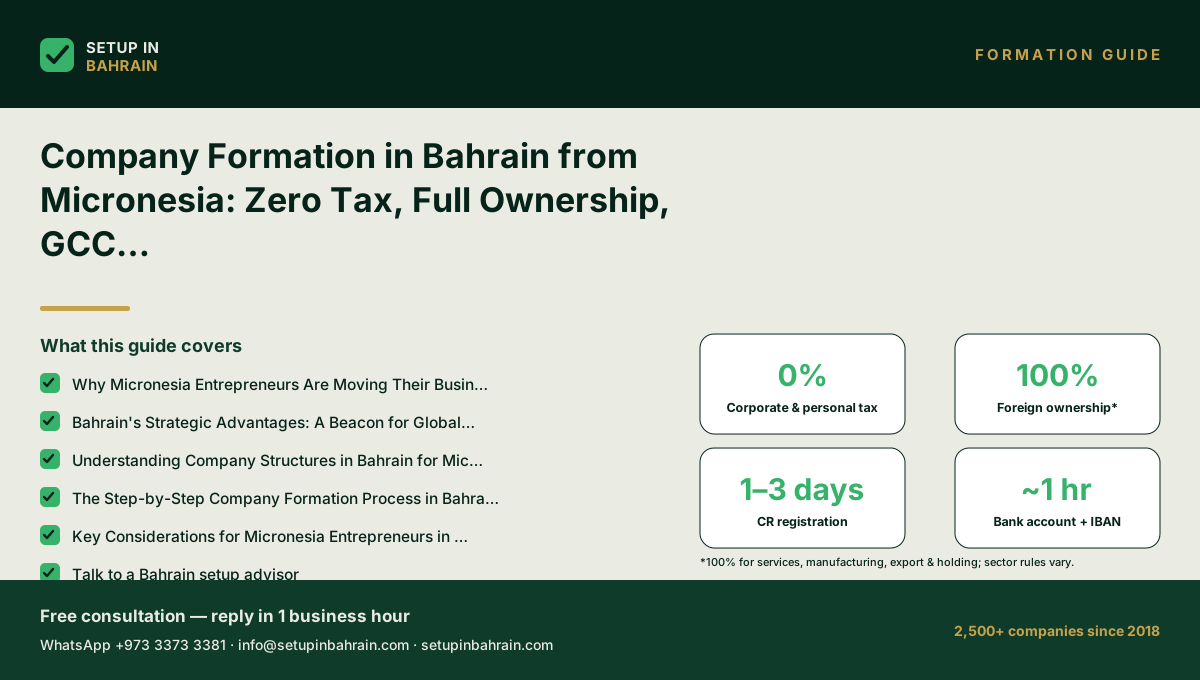
- Why Micronesia Entrepreneurs Are Moving Their Business to Bahrain
- Bahrain's Strategic Advantages: A Beacon for Global Business
- Understanding Company Structures in Bahrain for Micronesia Entrepreneurs
- The Step-by-Step Company Formation Process in Bahrain
- Key Considerations for Micronesia Entrepreneurs in Bahrain
→ Complete guide: Company Formation in Bahrain — the full 2026 guide
View details
Ownership & capital
A Bahrain WLL can be owned by a single person — 100% foreign ownership applies to most activities, with no local partner required for services, manufacturing, export trading and holding companies. The minimum share capital is BHD 1 ; we recommend BHD 1,000 . This Makes bank account opening and investor visa approval smoother.
For the intrepid entrepreneur in Micronesia, navigating the waters of global business can often feel like charting an unknown course across the vast Pacific. You've built your enterprise, whether it's supplying goods to your community, exporting local delicacies like kava, or providing vital services, often starting with little more than ingenuity and a strong work ethic. But as your business grows, so too do the complexities and the costs back home. You’ve likely felt the sting of a 21% corporate income tax, wrestled with the paper-based bureaucracy of the Division of Revenue and Taxation across Pohnpei, Chuuk, Yap, or Kosrae, and perhaps experienced the frustrations of the FSM Development Bank’s limited international banking capabilities.
The morning email from your Micronesian accountant hits different when it shows a 21% corporate income tax bill on profits you worked 80-hour weeks to generate. You're exporting services to clients in Guam, Hawaii. The mainland US — but your company is registered in Kolonia, or Weno, and the Division of Revenue and Taxation expects its cut. Paper forms, four-state compliance. Zero international banking flexibility can feel like an insurmountable barrier to true growth.
What if there was a strategic waypoint, a gateway not just to financial stability but to unparalleled growth, offering a stark contrast to the challenges you face today? Imagine a place where your business income isn't eroded by taxes, where your ownership is 100% secure without local partners. Where your operational costs are greatly lower. This isn't a distant dream; it's the reality of company formation in Bahrain, a dynamic island nation in the Arabian Gulf, and a reality more and more relevant for forward-thinking entrepreneurs from Micronesia in 2026.
This guide is designed specifically for you . It’s a roadmap from the unique business landscape of Micronesia to the thriving, tax-efficient ecosystem of Bahrain. We understand your concerns about geographic isolation, the dependency created by the Compact of Free Association with the US. The search for truly global opportunities beyond your home islands. Let’s explore how Bahrain can unlock that potential.
Why Micronesia Entrepreneurs Are Moving Their Business to Bahrain
Picture this: You’re a successful small business owner in Micronesia, perhaps running a fishing export operation based in Pohnpei, shipping high-value tuna loins to processors in the Philippines. Or maybe you manage a specialized IT consultancy in Chuuk, serving clients across the Pacific Rim. After paying the mandatory 21% corporate income tax on your hard-earned profits that the Division of Revenue and Taxation collects through its often cumbersome paper forms across the four states, plus the added cost and delay of routing every dollar through the FSM Development Bank’s limited correspondent network, you watch your margins shrink to single digits. The dependency created by the Compact of Free Association with the United States keeps the economy tied to federal grants and aid cycles, making any attempt to scale beyond subsistence volumes immediately hit the same tax and compliance walls.
This scenario isn't unique; it's a common experience for many ambitious entrepreneurs across the Federated States of Micronesia (FSM). The fundamental drive to grow, diversify. Secure a more robust financial future often clashes with the inherent limitations of a small, geographically isolated economy. Here are the core pain points that prompt Micronesian entrepreneurs to look beyond their shores. Why Bahrain emerges as an exceptionally compelling solution:
The Burden of a 21% Corporate Income Tax
One of the most immediate and impactful challenges for any profitable business in Micronesia is the significant 21% corporate income tax. In a USD-denominated economy where every dollar counts, nearly a quarter of your net profits disappearing into tax obligations can severely limit your ability to reinvest, expand, or even build a substantial capital reserve.
- Impact on Reinvestment: Imagine having an extra 21% of your profits available for new equipment, marketing campaigns, or talent acquisition. In Micronesia, that capital is diverted.
- Reduced Competitiveness: When competing with businesses in tax-efficient jurisdictions, your Micronesian-based enterprise starts with a significant disadvantage. Your pricing might be higher, or your margins thinner, impacting your ability to offer competitive rates or absorb market fluctuations.
- Limited Capital Accumulation: Building a significant war chest for future expansion, research and development, or simply to weather economic downturns becomes inherently more difficult with such a high tax rate.
In stark contrast, Bahrain offers a 0% corporate income tax for most business activities. This isn't a temporary incentive; it's a cornerstone of their economic policy designed to attract foreign investment. For a Micronesian entrepreneur, this means every dollar of profit earned in Bahrain remains within your business, available for strategic growth, dividend distribution, or robust savings. This single factor alone can fundamentally transform a company's financial health and growth trajectory.
Navigating the Paper Labyrinth of the Division of Revenue and Taxation
The administrative burden of tax compliance in Micronesia is often exacerbated by a predominantly paper-based system operated by the Division of Revenue and Taxation across its four states. This isn't just about filing forms; it's about navigating a multi-state system that can be slow, prone to errors. Lacking the digital efficiency expected in modern global commerce.
Time Consumption: Preparing and submitting physical paperwork, often requiring travel or mail across islands, consumes valuable time that could be spent on core business operations. Lack of Standardization: While the FSM is a single nation, practical implementation across Pohnpei, Chuuk, Yap. Kosrae can present subtle differences in procedure or interpretation, leading to confusion and potential non-compliance risks. Limited Transparency and Speed: Manual processes inherently lack the real-time tracking and transparency of digital systems. Getting clarifications, processing refunds, or resolving discrepancies can be a protracted affair.
Bahrain, on the other hand, boasts a highly digitized and streamlined regulatory environment. The Ministry of Industry and Commerce (MOIC) has invested heavily in online portals, allowing for seamless company registration, document submission. Regulatory compliance. This translates into:
- Efficiency: Processes that might take weeks in a paper-based system can often be completed in days or even hours online in Bahrain.
- Transparency: Digital platforms provide clear instructions, status updates, and a paper trail, reducing ambiguity and human error.
- Centralized System: A unified national system, accessible online, eliminates the complexities of multi-state compliance.
The FSM Development Bank’s Limited International Banking Capabilities
For any business aiming for international trade or global service delivery, robust, efficient. Cost-effective international banking is non-negotiable. The FSM Development Bank. Vital for local economic growth, faces inherent limitations when it comes to international transactions.
Limited Correspondent Network: International transfers often rely on a network of correspondent banks. The FSM Development Bank's network might be narrow, leading to delays, higher fees. Complex routing for transactions involving diverse currencies or distant geographies. Swift Transfers and FX: Executing swift (Society for Worldwide Interbank Financial Telecommunication) transfers can be cumbersome. Foreign exchange rates might not always be the most competitive due to limited market access. Perceived Risk: Smaller, regionally focused banks can sometimes face higher scrutiny from larger international banks, potentially leading to increased compliance requirements or even refusal of services for certain types of cross-border transactions.
Bahrain is a well-established and highly regarded financial hub in the Middle East. Regulated by the Central Bank of Bahrain (CBB), its banking sector is mature, diverse, and globally integrated. This offers Micronesian entrepreneurs:
- Global Connectivity: Access to a wide array of international and local banks (e.g., Ahli United Bank, National Bank of Bahrain, HSBC, Citibank) with extensive correspondent networks, facilitating smooth and rapid international transfers worldwide.
- Competitive FX Rates: A deeper financial market often translates to more competitive foreign exchange rates, saving your business money on currency conversions.
- Robust Digital Banking: Most Bahraini banks offer sophisticated online and mobile banking platforms, enabling entrepreneurs to manage international finances from anywhere with an internet connection.
- Credibility: Operating out of a respected financial jurisdiction like Bahrain can enhance your company's credibility in the eyes of international clients and partners.
The Compact of Free Association and the Search for Diversification
The Compact of Free Association (COFA) with the United States provides significant financial assistance and unique opportunities for Micronesian citizens. It also creates a certain dependency and can limit economic diversification beyond the immediate sphere of US aid and grants.
Economic Dependency: While beneficial, heavy reliance on external aid can sometimes stifle the organic development of diverse private sectors that are truly globally competitive. Limited Export Markets: The small domestic market and the strong ties to the US can make it challenging to organically develop export markets beyond traditional partners, limiting growth potential. Innovation Challenges: Breaking free from established economic models often requires access to different capital markets, diverse talent pools. Broader industry exposure.
By establishing a presence in Bahrain, Micronesian entrepreneurs are actively pursuing economic diversification and breaking free from geographical and economic constraints:
Gateway to New Markets: Bahrain serves as a literal gateway to the $1.6 trillion GCC (Gulf Cooperation Council) market. A strategic entry point to the wider MENA (Middle East and North Africa) region, as well as Asia and Europe. Access to Diverse Capital: Bahrain's financial sector provides access to regional and international investors, venture capitalists. Private equity funds looking for promising ventures, a stark contrast to the more localized capital options in FSM. Global Talent Pool: The expatriate-friendly environment in Bahrain attracts talent from around the world, offering diverse skills and perspectives that can drive innovation and growth. Strategic Independence: While maintaining ties to FSM, establishing a Bahraini entity provides a platform for truly independent global operations, allowing businesses to thrive based on their intrinsic value rather than geopolitical dependencies.
In essence, for the Micronesian entrepreneur, Bahrain isn't just an alternative; it's a strategic upgrade. It offers a pro-business ecosystem designed for international growth, allowing you to shed the burdens of high taxes and inefficient bureaucracy. Instead focus on scaling your vision on a truly global stage.
Bahrain's Strategic Advantages: A Beacon for Global Business
Beyond simply addressing the pain points faced by Micronesian entrepreneurs, Bahrain offers a compelling suite of advantages that position it as a premier destination for international business. Its commitment to economic liberalization, digital transformation, and fostering a robust private sector has garnered global recognition.
Zero Corporate Income Tax
This is often the headline advantage and one that resonates profoundly with entrepreneurs accustomed to high tax rates. Bahrain maintains a 0% corporate income tax on most business activities. This isn't a complex system of deductions and credits; it's a direct policy choice to encourage investment and stimulate economic activity. This means:
- Maximized Profit Retention: Every dollar your Bahraini company earns, after operational expenses, is yours to keep, reinvest, or distribute.
- Simplified Accounting: Without corporate income tax, the complexities of tax planning and compliance are greatly reduced, freeing up resources and minimizing accounting costs.
- Competitive Edge: Your Bahraini entity can offer more competitive pricing or enjoy higher margins compared to businesses operating in jurisdictions with significant corporate taxation.
It's important to note that while corporate income tax is zero, businesses are subject to social insurance contributions for employees, a municipal tax on rental properties, and a 5% Value Added Tax (VAT) on most goods and services, which is typically passed on to the consumer. But, the absence of corporate profit tax remains a monumental advantage.
100% Foreign Ownership Without a Local Partner
One of the most significant barriers to foreign investment in many countries is the requirement for a local sponsor or partner, often owning a majority share. This can lead to concerns about control, profit sharing, and strategic direction. Bahrain has pioneered a fully liberalized ownership structure:
Complete Control: You, as the Micronesian entrepreneur, can own 100% of your Bahraini company, ensuring full control over operations, strategy. Profits. No Mandated Local Equity: Unlike some other GCC nations where local partners were historically mandatory, Bahrain offers complete autonomy, streamlining decision-making and preventing potential conflicts of interest. Simplified Structure: This removes a layer of complexity from your company's legal structure and ongoing management.
This policy underscores Bahrain's commitment to creating an attractive and trusted environment for international investors, ensuring that entrepreneurs have complete confidence in their ownership and intellectual property.
Strategic Location and Unparalleled GCC Market Access
Bahrain's geographical position is arguably one of its greatest assets. Situated in the heart of the Arabian Gulf, it acts as a natural bridge between East and West. Crucially, within the booming GCC market.
Gateway to a $1.6 Trillion Market: The GCC (Saudi Arabia, UAE, Qatar, Kuwait, Oman, Bahrain) represents a collective market of over 50 million affluent consumers with a combined GDP exceeding $1.6 trillion. Bahrain provides immediate access to this economic powerhouse. The King Fahd Causeway: This 25-kilometer bridge directly connects Bahrain to Saudi Arabia, the largest economy in the GCC. This physical link facilitates seamless trade, logistics. Business travel, opening up the immense opportunities of Saudi Arabia's Vision 2030 projects, estimated to be worth over $800 billion. Proximity to MENA and Beyond: Beyond the GCC, Bahrain is strategically located for easy access to the broader Middle East and North Africa (MENA) region, as well as established trade routes to Asia, Africa, and Europe. Excellent Logistics Infrastructure: Bahrain boasts Khalifa Bin Salman Port, a deep-water port. A modern international airport, facilitating efficient import, export, and regional distribution. The Bahrain Logistics Zone (BLZ) offers dedicated facilities for supply chain management.
A Robust and Well-Regulated Financial Hub
For generations, Bahrain has been a financial services pioneer in the region. Its banking sector is sophisticated, diverse. Operates under the vigilant oversight of the Central Bank of Bahrain (CBB).
Diverse Banking Landscape: The CBB regulates a wide array of conventional and Islamic banks, investment firms. Insurance providers. This diverse ecosystem provides entrepreneurs with choice and access to specialized financial products and services. Financial Technology (FinTech) Prowess: Bahrain has positioned itself as a leading FinTech hub, with initiatives like the FinTech Bay and regulatory sandboxes, fostering innovation in financial services. This means cutting-edge banking solutions are often available. Currency Stability: The Bahraini Dinar (BHD) is pegged to the US Dollar, providing stability and predictability for international transactions, a stark contrast to potentially volatile currencies in other emerging markets. Investor Protection: The CBB's stringent regulatory framework ensures a high degree of investor protection and transparency, instilling confidence in the financial system.
A Pro-Business Environment and Streamlined Regulations
The government of Bahrain, through entities like the Economic Development Board (EDB) and the Ministry of Industry and Commerce (MOIC), is unequivocally committed to attracting and facilitating foreign investment.
The EDB's Role: The Bahrain EDB acts as a single point of contact for international investors, providing guidance, support. Introductions to key government agencies and business networks. They are instrumental in making the transition smooth. Digital Transformation: MOIC has spearheaded initiatives to digitize government services, making company registration, licensing. Compliance processes greatly faster and more user-friendly. The 'Sijilat 2.0' online portal is a prime example of this efficiency. Transparent Legal Framework: Bahrain operates under a clear, English-language-friendly legal system, drawing on common law principles, providing predictability and clarity for business operations. Ease of Doing Business: The World Bank's annual "Ease of Doing Business" reports consistently rank Bahrain highly, reflecting its commitment to reducing bureaucratic hurdles and fostering an efficient business environment.
Low Operating Costs and Excellent Quality of Life
Compared to some of its regional counterparts and many developed economies, Bahrain offers a highly competitive cost of doing business and an attractive quality of life.
Competitive Rental Costs: Commercial rents for offices and industrial spaces are generally more affordable than in Dubai or Riyadh, reducing overheads. Affordable Utilities: Energy, water, and internet costs are typically competitive. Skilled Workforce: A well-educated local workforce, combined with an influx of skilled expatriate talent, provides access to a diverse and capable employee base at reasonable wage costs. Multicultural Society: Bahrain is home to a large expatriate community, creating a vibrant, tolerant, and multicultural society. English is widely spoken in business. High Quality of Life: Excellent healthcare facilities, world-class education options (including international schools), diverse entertainment. A safe environment contribute to a high quality of life for entrepreneurs and their families. This is a crucial factor for those considering relocation.
These advantages collectively present Bahrain as not just a strategic location but a complete ecosystem designed to help international businesses, especially those from emerging economies like Micronesia, flourish on a global scale.
Understanding Company Structures in Bahrain for Micronesia Entrepreneurs
Choosing the right legal structure for your company is a foundational decision that impacts everything from liability to tax obligations and ease of management. For Micronesian entrepreneurs, understanding Bahrain's corporate structures is key. While several options exist, one stands out for its flexibility, protection. Suitability for single foreign owners: the With Limited Liability (WLL) company.
The With Limited Liability (WLL) Company: Your Primary Choice
The WLL is the most common and recommended legal entity for foreign entrepreneurs establishing a commercial presence in Bahrain. It provides a robust framework that balances ownership flexibility with crucial legal protection.
100% Foreign Ownership: This is a critical benefit. A WLL company in Bahrain can be entirely owned by a single foreign individual or a corporate entity. There is absolutely no requirement for a local Bahraini partner or shareholder. This means you retain complete control over your business, its assets, and its strategic direction. Limited Liability: As the name suggests, the liability of the shareholders is limited to the amount of their capital contribution. This means your personal assets are protected from the company's debts and obligations, offering a crucial layer of security. Single Shareholder Permitted: Unlike some jurisdictions that require multiple shareholders for a limited liability company, a WLL in Bahrain can be formed by a single person. This is ideal for solo entrepreneurs or small business owners from Micronesia looking to expand independently. It's crucial to reiterate: There is NO single-shareholder WLL structure in Bahrain. The WLL fulfills the purpose of a single-owner entity effectively.* Minimum Share Capital: Legally, the minimum share capital for a WLL in Bahrain is BHD 1 (one Bahraini Dinar). While this is the legal minimum, it's highly impractical for operational purposes. * Practical Recommendation: BHD 1,000. For an investor visa application and, critically, for opening a corporate bank account with any reputable bank in Bahrain, a minimum share capital of BHD 1,000 (one thousand Bahraini Dinars) is strongly recommended. Banks typically require a more substantial initial deposit to deem a company credible and worthy of a corporate account. This BHD 1,000 acts as a practical starting point, demonstrating financial solvency. Reputation and Flexibility: The WLL is a well-understood and respected corporate structure both locally and internationally, providing credibility for your operations. It offers considerable flexibility in terms of permissible business activities. Ongoing Compliance: A WLL is required to maintain proper accounting records, file annual financial statements. Renew its Commercial Registration (CR) annually. While Bahrain has zero corporate income tax, audit requirements depend on the scale of activity. Compliance with general commercial laws and VAT regulations is mandatory.
For Micronesian entrepreneurs seeking full control, limited risk. A straightforward path to establishing a global presence, the WLL company is overwhelmingly the most suitable and recommended option.
Other Company Structures (Brief Overview):
While the WLL will be your primary focus, it's good to be aware of other options:
- Foreign Branch Office: If you already have a well-established company in Micronesia and wish to operate under the same legal name, you can register a branch office. This entity is legally an extension of your parent company and does not have a separate legal personality. It's often used for specific projects or market entry testing.
- Public Shareholding Company (P.S.C.): Designed for larger enterprises that intend to raise capital from the public by issuing shares. This is generally not relevant for most Micronesian entrepreneurs starting out.
- Partnership Company: Suitable for two or more individuals who wish to engage in business together, where partners have unlimited liability. Less common for foreign investors seeking limited liability.
- Holding Company: Can be structured as a WLL or P.S.C., primarily for holding shares in other companies or assets.
Given the typical profile of a Micronesian entrepreneur expanding abroad – often a single owner or a small group seeking control and protection – the WLL remains the most practical, efficient, and advantageous legal structure.
The Step-by-Step Company Formation Process in Bahrain
Establishing your company in Bahrain, especially as a foreign investor, has been greatly streamlined by the government. The process is largely digitized through the 'Sijilat 2.0' online portal, managed by the Ministry of Industry and Commerce (MOIC). Here’s a detailed breakdown of the steps:
Step 1: Planning and Initial Due Diligence
Before you even touch a keyboard for registration, thorough planning is essential.
Define Your Business Activities: Clearly articulate the specific commercial activities your Bahraini company will undertake. Bahrain has a comprehensive list of permitted activities, each associated with specific Commercial Registration (CR) codes. You'll need to select these carefully, as they dictate your operational scope and any specific licenses required. For instance, a trading company, a consultancy, or a software development firm will have different codes. Choose Your Company Name: Select a unique company name. It should be distinctive, not already registered, and not violate public morals or religious sensitivities. You can check name availability via the Sijilat portal. Typically, you'll need to propose a few options in order of preference. Appoint Directors and Ultimate Beneficial Owners (UBOs): Identify who will serve as directors (minimum one for a WLL, who can be the sole owner) and confirm the UBOs. This requires preparing copies of their passports. Registered Office Address: Your company will require a physical address in Bahrain. This can be a traditional office lease or a serviced/virtual office arrangement. This Is often a cost-effective solution for new entrants. Many reputable business centers offer virtual office packages that include a physical address for CR purposes and mail handling.
Step 2: Applying for Commercial Registration (CR) via Sijilat 2.0
The bulk of the registration process is conducted online through the MOIC’s Sijilat 2.0 portal (www.sijilat.bh). This is where Bahrain’s digital efficiency truly shines.
Sijilat Portal Access: You or your appointed agent (e.g., a law firm or business consultant) will log in to the Sijilat portal. Application Submission: * Initial Application: You'll submit an application for your chosen company name and proposed business activities. The system will guide you through selecting the appropriate CR codes. * Document Upload: You'll need to upload scanned copies of required documents. For a foreign individual, this typically includes: * Passport copy of all shareholders and directors. * National ID copy (if applicable, for Bahraini nationals). * Proof of residential address (e.g., utility bill from home country). * Bank reference letter (sometimes required, demonstrating solvency). * Signed Memorandum of Association (MoA) and Articles of Association (AoA). These legal documents outline the company's purpose, structure, share capital, and internal regulations. Templates are often provided or drafted by your legal advisor. * Proof of registered office address (e.g., virtual office agreement or lease contract). * Pre-Approvals (if necessary): For certain regulated activities (e.g., financial services, healthcare, education), you might need initial approval from relevant government ministries or bodies (e.g., CBB for financial services). The Sijilat system will flag these requirements and help the submission of these pre-approvals. Review and Approval: MOIC officers will review your application and submitted documents. This process is usually quite swift thanks to the digitized system. You'll receive notifications about the status of your application.
Step 3: Share Capital Deposit (Crucial for Banking and Visa)
Once your initial CR approval is granted, the next critical step is to deposit the share capital.
- Provisional Bank Account: You'll receive a provisional approval from MOIC, allowing you to approach a Bahraini bank to open a temporary or "under formation" account in the name of your proposed company.
- Deposit the Capital: You must deposit the declared share capital into this provisional account. As advised, while the legal minimum is BHD 1, deposit at least BHD 1,000 to ensure eligibility for a corporate bank account and to help your investor visa application.
- Bank Confirmation Letter: The bank will issue a letter confirming the deposit of the share capital. This letter is a vital document for the next stage of your CR.
Step 4: Final Commercial Registration Issuance
With the bank confirmation in hand, you return to the Sijilat portal.
- Submit Bank Confirmation: Upload the bank's confirmation letter to your application on Sijilat.
- Pay Registration Fees: Pay the final government registration fees. These fees vary based on the company type and selected activities but are generally reasonable.
- CR Issuance: Upon successful payment and final review, MOIC will issue your official Commercial Registration (CR) certificate electronically. This document is your company's legal birth certificate in Bahrain.
Step 5: Post-Registration Compliance and Setup
Receiving your CR is a major milestone, but several important steps follow to make your company fully operational.
- Tax Identification (VAT Registration): While Bahrain has zero corporate income tax, your company will likely need to register for Value Added Tax (VAT) if its annual taxable supplies exceed the mandatory registration threshold (BHD 37,500). VAT registration is done through the National Bureau for Revenue (NBR) online portal.
- Social Insurance Registration: If you plan to hire employees (Bahraini or expatriate), your company must register with the Social Insurance Organization (SIO). Contributions will be required for employee pensions and unemployment benefits.
- Corporate Bank Account Activation: Once your full CR is issued, you can finalize the activation of your corporate bank account, transitioning it from a provisional account to a fully operational one. You may need to provide the bank with copies of your CR, MoA, and passports.
- Investor Visa Application: For Micronesian entrepreneurs wishing to reside and manage their business in Bahrain, applying for an investor visa is essential. This process is typically handled by the Nationality, Passports & Residence Affairs (NPRA) and often facilitated through an authorized agent or PRO (Public Relations Officer). The investor visa is usually linked to your company's ownership and your financial contribution (hence, the BHD 1,000 share capital is important).
- Office Setup: Whether it's moving into your physical office or fully activating your virtual office services, ensure your operational base is ready.
- Licenses and Permits: Depending on your specific business activities, you might need additional operational licenses from other ministries (e.g., Ministry of Health for medical clinics, Ministry of Education for training centers). The EDB or your consultant can guide you on these specific requirements.
By following these steps, you can efficiently establish your company in Bahrain, leveraging its pro-business environment and digital infrastructure to launch your global venture. Engaging a reputable local legal firm or business setup consultant is highly recommended to navigate the nuances and ensure a smooth, compliant process, especially for those unfamiliar with Bahraini regulations.
Key Considerations for Micronesia Entrepreneurs in Bahrain
While Bahrain offers significant advantages, a move from Micronesia involves unique considerations. Understanding these will help you bridge the geographical, cultural, and operational gaps successfully.
Visa and Residency: Securing Your Presence
For Micronesian entrepreneurs planning to relocate or spend significant time in Bahrain, securing the appropriate visa and residency is paramount.
- Investor Visa: This is the most common route. As a shareholder in a Bahraini company (especially a WLL), you are
Bahrain Business Guides for Micronesia Citizens
Frequently Asked Questions
How long does it take to set up?
It takes 15 to 20 days. We file all forms for you. You do not need to wait long.
What does it cost?
Company formation: Standard BHD 1,340 with 3 months of office address; Gold BHD 1,700 with 6 months; Premium BHD 2,150 with 12 months and a cabin, officer table and chair, and two guest chairs. No formation package includes visas, including Premium. Investor/work visas are priced separately: BHD 755 for one year or BHD 953 for two years, in addition to the formation package. Ask for a written, itemized quotation confirming government fees and all inclusions before payment.
Do I need to visit Bahrain?
No. You can set up your firm from home. We do all the work online. Some banks may ask for one visit.
What tax will I pay?
You pay zero tax on your profits. Bahrain has no corporate income tax. This is a key benefit of the setup.
Can I own 100% of my firm?
Yes. Foreign owners can hold all shares. No local partner is needed. Full ownership is allowed.
What do I need to start?
You need a valid passport. You also need a trade name and a business address. We help you with all of these.
How do I open a bank account?
We guide you step by step. Most banks take 3 to 6 weeks. You will need your CR and firm papers.
Who issues the Commercial Registration (CR)?
The CR is issued by the MOICT. It is your legal right to trade in Bahrain. We file the CR for you.
Can I renew my CR each year?
Company renewal packages: BHD 530 with 3 months of office address; BHD 980 with 6 months; BHD 1,520 with 12 months. These are separate renewal packages, not visa fees.
How do I get started?
Fill in our form on this page. Our team will call you back. We map your best setup plan at no cost.
Steps to Form Your Company
- Pick your trade name. We check if it is free.
- Choose your business type. WLL is the most common.
- Sign the MOA. We draft and file all legal docs.
- Pay the state fees. About BHD 432 in total.
- Get your CR. Takes 15 to 20 days.
- Open your bank account. We guide each step.
- Start trading. You are ready to do business.
Key Facts
- Tax rate: 0%
- Foreign ownership: 100%
- Setup time: 15 to 20 days
- Company formation: Standard BHD 1,340 with 3 months of office address; Gold BHD 1,700 with 6 months; Premium BHD 2,150 with 12 months and a cabin, officer table and chair, and two guest chairs. No formation package includes visas, including Premium. Investor/work visas are priced separately: BHD 755 for one year or BHD 953 for two years, in addition to the formation package. Ask for a written, itemized quotation confirming government fees and all inclusions before payment.
- Company renewal packages: BHD 530 with 3 months of office address; BHD 980 with 6 months; BHD 1,520 with 12 months. These are separate renewal packages, not visa fees.
- Client rating: 4.8 stars
- Clients served: 2,500 and more
Quick Facts
- Tax rate: 0%
- Own all of your firm: Yes, 100%
- Time to set up: 15 to 20 days
- Company formation: Standard BHD 1,340 with 3 months of office address; Gold BHD 1,700 with 6 months; Premium BHD 2,150 with 12 months and a cabin, officer table and chair, and two guest chairs. No formation package includes visas, including Premium. Investor/work visas are priced separately: BHD 755 for one year or BHD 953 for two years, in addition to the formation package. Ask for a written, itemized quotation confirming government fees and all inclusions before payment.
- Company renewal packages: BHD 530 with 3 months of office address; BHD 980 with 6 months; BHD 1,520 with 12 months. These are separate renewal packages, not visa fees.
- Rating: 4.8 stars
- Clients: 2,500 and more
Why Bahrain?
Bahrain has no tax. You keep all your profits. This is rare in the Gulf.
You can own all of your firm. No local partner is needed. The law allows full foreign ownership.
Setup takes 15 to 20 days. We file all forms for you. You can do it all from home.
Bahrain has a free trade deal with the US. Your goods face low or no tariffs. This gives you access to big markets.
We have served 2,800+ clients from 44+ countries and maintain records to substantiate that total where needed. We have 113 Google reviews; reviews represent only some clients and are not the same as the total clients served.
Our Steps
- Tell us your plan. We advise you for free.
- We pick the right firm type for you.
- We file all your forms with MOICT.
- You get your CR in 15 to 20 days.
- We help you open a bank account.
- You are ready to trade. We stay with you.
Next Steps for Micronesia Citizens
You can set up a firm in Bahrain from Micronesia. You do not need to fly there first. We do all the work online.
Tell us your plan. We call you back the same day. We map the best route for you at no cost.
We file all your forms. We deal with MOICT and the state. You get your CR in 15 to 20 days.
After your CR, we help you get a bank account. We also help with your Investor Visa. One firm guides you at each step.
Why Our Clients from Micronesia Choose Us
- We speak your language. We know your needs.
- We have helped clients from Micronesia before.
- Our fee is clear. No surprise costs.
- We have a 4.8 star rating on Google.
- We have helped more than 2,500 clients set up in Bahrain.
Fill in the form on this page. We will be in touch soon. Let us help you start your Bahrain firm today.
Ready to set up in Bahrain from Micronesia?
Tell us your business idea. We map the right entity, ownership and timeline — then handle the filing while you focus on what matters.