Complete guide for Mexico entrepreneurs: form a company in Bahrain with generally no corporate income tax for most sectors, 100% foreign ownership, and GCC market access. Costs, steps, visas, banking.
→ Complete guide: Company Formation in Bahrain — the full 2026 guide
View details
Ownership & capital
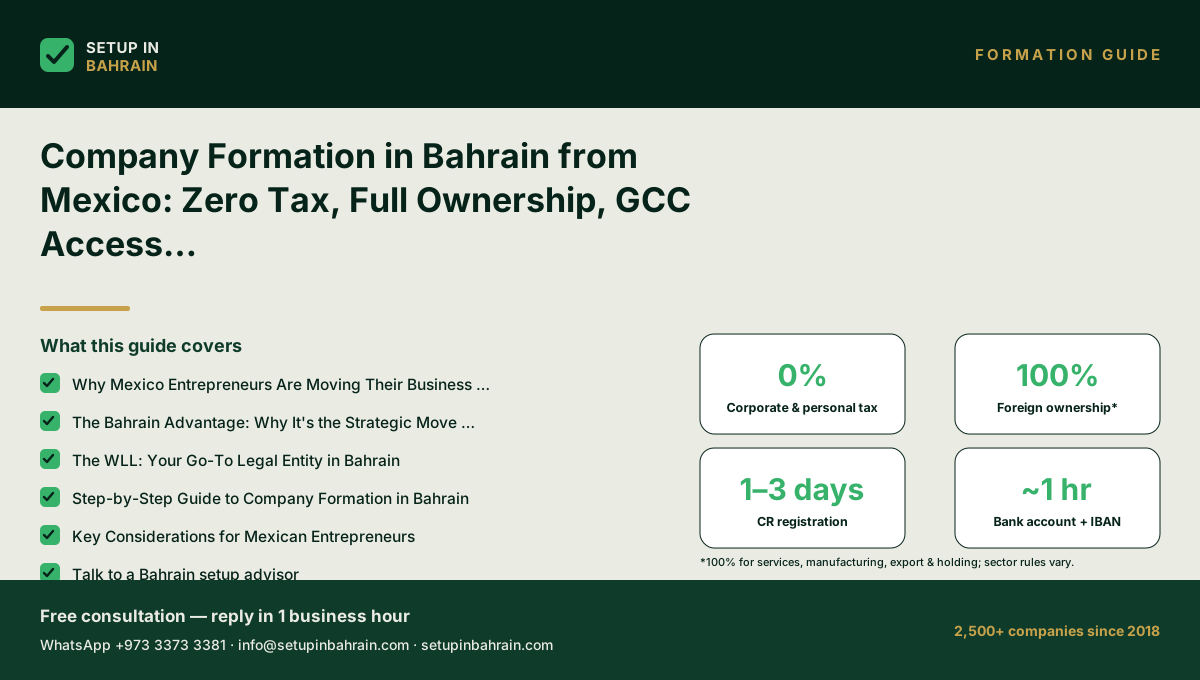
A Bahrain WLL can be owned by a single person — 100% foreign ownership applies to most activities, with no local partner required for services, manufacturing, export trading and holding companies. The minimum share capital is BHD 1; we recommend BHD 1,000, which makes bank account opening and investor visa approval smoother.
The sun beats down on Monterrey. Your factory hums, your team is pushing hard, and sales are up. You should be celebrating, but instead, you're staring at your profit and loss statement, a familiar knot tightening in your stomach. Your accountant has just delivered the news: another substantial chunk of your hard-earned revenue is vanishing into the 30% Impuesto Sobre la Renta (ISR). Then there are the mandatory IMSS and INFONAVIT employer contributions, which, when tallied, add roughly another 30% to your labor costs. And don't forget the endless hours spent wrestling with SAT CFDI digital invoicing, mandatory since 2022, and the ever-present anxiety of the MXN currency volatility, a wild card especially pronounced with the nearshoring boom.
You’re a Mexican entrepreneur, a creator of value, a risk-taker. You’ve built your business with sweat and ingenuity, navigating complex regulations and the SHCP (Secretaría de Hacienda y Crédito Público) transfer pricing documentation requirements that add layer upon layer of compliance burden. You dream of expanding beyond the Americas, of reaching the vast, affluent markets of the Middle East, North Africa, and South Asia (MENASA), but you know that your limited Mexican entity recognition often makes direct market access into the GCC a bureaucratic labyrinth.
What if there was a place where your profits weren't immediately halved by corporate tax? A jurisdiction where you could own 100% of your company, without local partners or sponsors? A stable, dollar-pegged currency, eliminating all forex anxiety? A direct, unhindered gateway to Saudi Arabia and the broader $2 trillion GCC market?
This isn't a pipe dream. This is Bahrain.
Imagine this: You're running a thriving logistics firm in Monterrey, but you've just received your SAT assessment. Between 30% Impuesto Sobre la Renta (ISR), a battalion of IMSS and INFONAVIT filings, constant CFDI digital invoice headaches, and this quarter’s wild MXN/USD swings triggered by nearshoring speculation — you look at your books and ask, “Why am I doing this here?”
This is the scenario hundreds of Mexican entrepreneurs are now facing — and why more are executing a borderless pivot to Bahrain. Bahrain isn't just another “offshore” location; it’s a zero-corporate-tax, 100% foreign-owned, fast-track access point to the GCC and Saudi Arabia. Crucially, it offers a regulatory environment in fluent English, a hardened USD-pegged currency, and a business regime built for international growth and innovation.
Welcome to the complete 2026 guide for Mexican entrepreneurs looking to strategically optimize their business structure and unlock unparalleled global opportunities by establishing a company in Bahrain. We’ll map out exactly how Bahrain can transform the reality for Mexican founders frustrated with local constraints, and break down each step, cost, risk, and compliance angle in language no generic country guide will ever capture.
Why Mexico Entrepreneurs Are Moving Their Business to Bahrain
Let's go back to Javier, a mid-sized exporter in Guadalajara. Each month, he faces a familiar triad of challenges that eat into his margins and time:
- Exorbitant Corporate Tax Rates: Javier's company, like many Mexican businesses, is subject to a flat 30% Impuesto Sobre la Renta (ISR) on its profits. This is a substantial chunk of revenue that could otherwise be reinvested into growth, technology, or market expansion. For an entrepreneur operating with tight margins, a 30% tax burden is a significant drag on competitiveness. This rate positions Mexico as one of the higher-tax jurisdictions in the region, especially when compared to countries actively seeking foreign investment through tax incentives.
- Skyrocketing Labor Costs from Mandatory Contributions: Beyond the direct salaries, Mexican employers face a complex web of mandatory contributions that can easily add another 30% to 35% to their labor costs. This includes: * IMSS (Instituto Mexicano del Seguro Social): Contributions for social security, healthcare, and pensions. These are substantial and vary based on employee salaries and risk classifications. * INFONAVIT (Instituto del Fondo Nacional de la Vivienda para los Trabajadores): Employer contributions for employee housing funds. * SAR (Sistema de Ahorro para el Retiro): Retirement savings system contributions. * Impuesto Sobre Nóminas (Payroll Tax): A state-level tax that further inflates labor expenses. For Javier, whose payroll is one of his largest expenses, these contributions mean that a worker earning 10,000 MXN in salary effectively costs his company closer to 13,000-13,500 MXN. This makes scaling teams and remaining competitive on labor-intensive projects incredibly challenging.
- The Digital Invoicing Nightmare: SAT CFDI 4.0: Since its full implementation in 2022, the SAT CFDI (Comprobante Fiscal Digital por Internet) 4.0 digital invoicing system has become a source of constant frustration. It mandates highly specific formats, detailed data requirements, and real-time validation with the SAT. Javier often finds himself: * Maintaining a dedicated compliance person: Just to manage CFDI generation, validation, and reconciliation. * Dealing with frequent format changes: Leading to costly software updates and re-training. * Facing random SAT audits: Which can halt operations and demand significant resources to resolve, even for minor discrepancies. The administrative burden is immense, diverting valuable resources from core business activities to bureaucratic compliance.
- MXN Currency Volatility: While nearshoring has brought significant foreign investment into Mexico, it has also introduced periods of extreme MXN currency volatility. A stronger peso, while seemingly good for the national economy, can erode the local value of dollar-denominated revenues for exporters like Javier. In 2025, for example, the MXN/USD exchange rate saw nearly a 13% variance year-over-year at certain points. This unpredictability makes cash flow planning a daily headache, complicates international transactions, and introduces an unwelcome layer of financial risk for businesses operating across borders. Imagine selling goods in USD but paying your local costs in MXN – a strengthening peso means your effective local revenue shrinks.
- SHCP Transfer Pricing Documentation: For Mexican businesses with international affiliates, the SHCP’s stringent transfer pricing documentation requirements add another layer of complexity. Ensuring that intercompany transactions comply with arm's-length principles demands extensive analysis, detailed reports, and often costly external consulting. This is a significant hurdle for companies looking to expand globally through subsidiaries or related entities.
- Limited Mexican Entity Recognition Globally: While a Mexican S.A. de C.V. is perfectly valid locally, it often faces limited recognition or bureaucratic hurdles when trying to operate directly in distant markets like the GCC. Establishing bank accounts, signing contracts, or even just building trust with local partners can be disproportionately harder without an internationally recognized and strategically positioned legal entity. For entrepreneurs aiming for global reach, this can mean missed opportunities or unnecessarily complex market entry strategies.
More Mexican business owners are now realizing that their customers, especially those abroad in the US, EU, and Middle East, don't necessarily require a Mexican legal entity. They just want effective service, reliable billing, and a professional, compliant counterparty. The compliance costs in Mexico, particularly after 2022's digital invoice changes and the ongoing currency swings, keep ballooning, pushing entrepreneurs to seek more efficient, globally-minded jurisdictions.
The Bahrain Advantage: Why It's the Strategic Move for Mexican Founders
Bahrain is not merely an "offshore" jurisdiction; it is a strategically designed economic hub within the Gulf Cooperation Council (GCC) that specifically addresses the pain points Mexican entrepreneurs face, while offering unparalleled access to lucrative new markets. Let's delve into the core advantages:
Generally no corporate income tax for most sectors: Maximize Your Profits
One of Bahrain's most compelling drawcards is its zero-corporate-tax environment. For most business activities, companies operating in Bahrain pay 0% corporate income tax. This stands in stark contrast to Mexico's 30% ISR, representing an immediate and substantial boost to your company's net profitability.
- What this means for you: Every peso (or rather, every Dinar) saved from tax can be reinvested directly into your business – be it for R&D, market expansion, hiring talent, or improving your product/service. This isn't just a temporary incentive; it's a fundamental pillar of Bahrain's economic diversification strategy, driven by the Economic Development Board (EDB), aimed at attracting foreign direct investment (FDI). While there is a 10% VAT introduced in 2019, it's primarily a consumption tax, and businesses with an annual turnover below BHD 37,500 are exempt. For most B2B operations, VAT is reclaimable, making its net impact minimal compared to the absence of corporate tax.
100% Foreign Ownership Nationwide: Full Control, No Partners
Unlike many jurisdictions, including some in the GCC, Bahrain allows 100% foreign ownership of companies across most sectors, nationwide. This is a critical distinction and a significant relief for Mexican entrepreneurs who might be wary of mandatory local partners or sponsors, which can dilute control and complicate decision-making.
- What this means for you: You maintain complete control over your business strategy, operations, and profits. There's no need to search for a local partner, negotiate equity stakes, or navigate potential conflicts of interest. This streamlined ownership structure simplifies governance and ensures your vision remains uncompromised. The widely used company type, the With Limited Liability (WLL) company, allows for a single shareholder who can be 100% foreign-owned.
Strategic Location & Unparalleled Market Access: The Gateway to a $2 Trillion Economy
Bahrain's geographical position is arguably its most significant strategic asset. It sits at the heart of the GCC, a region with a combined GDP exceeding $2 trillion and a young, affluent population of over 50 million.
- Direct Access to Saudi Arabia: Bahrain is physically connected to Saudi Arabia, the largest economy in the Middle East, by the King Fahd Causeway. This 25-kilometer bridge facilitates seamless movement of goods and people, offering Mexican businesses a direct and efficient logistics corridor to the vast Saudi market. Imagine fulfilling orders in Riyadh, Dammam, or Jeddah from your Bahraini base with ease – a logistical advantage that is hard to overstate for industries like logistics, e-commerce, and services.
- Regional Hub: Beyond Saudi Arabia, Bahrain provides easy access to Kuwait, Qatar, UAE, and Oman. Its well-developed air and sea infrastructure (Bahrain International Airport, Khalifa bin Salman Port) position it as a regional logistics and distribution hub for the wider MENASA (Middle East, North Africa, South Asia) region, encompassing a consumer base of over 1.5 billion people.
- A "Soft Landing" for Global Expansion: For Mexican businesses eyeing global expansion, Bahrain serves as an ideal "soft landing" – a familiar, English-speaking business environment that acts as a launchpad into broader, high-growth markets without the initial complexities often associated with direct entry into larger GCC countries.
Stable, USD-Pegged Currency: Eliminate Forex Headaches
The Bahraini Dinar (BHD) has been pegged to the US Dollar at a fixed rate of 1 BHD = 2.659 USD since 1987. This long-standing peg is a cornerstone of Bahrain's financial stability, managed by the Central Bank of Bahrain (CBB).
- What this means for you: Say goodbye to the MXN's unpredictable swings. With a USD-pegged currency, you gain immense predictability for your international revenues and expenditures. This simplifies financial planning, eliminates the need for costly currency hedging strategies, and provides a solid foundation for cross-border transactions. For Mexican entrepreneurs frustrated by how MXN volatility impacts their dollar-denominated revenues or international supplier payments, the BHD offers a haven of stability. Your profits earned in Bahrain retain their value in relation to the global reserve currency.
Pro-Business Regulatory Environment & English Language Fluency
Bahrain prides itself on being one of the most liberal and open economies in the Middle East. Its legal and regulatory frameworks are transparent, well-established, and largely based on common law principles, making them familiar to international investors.
- Ease of Doing Business: The World Bank's Ease of Doing Business Report consistently ranks Bahrain highly, reflecting its efficient company registration processes, robust investor protection, and ease of trading across borders. The government is committed to digital transformation, with platforms like Sijilat.bh (the commercial registration portal) simplifying bureaucratic procedures.
- English as the Language of Business: While Arabic is the official language, English is widely spoken and used in business, government, and legal contexts. All official documents, regulations, and communication with government bodies like the Ministry of Industry and Commerce (MOIC) and the EDB are readily available in English. This eliminates language barriers, reduces translation costs, and makes the legal and administrative processes much more accessible for non-Arabic speakers. This contrasts sharply with the need to navigate complex Spanish legal and tax documents in Mexico, often requiring specialist advisors.
Robust Financial Sector & Fintech Hub
Bahrain has a long-standing reputation as a regional financial hub, housing numerous international banks, investment firms, and a burgeoning FinTech ecosystem. The CBB is a progressive regulator, often at the forefront of adopting new financial technologies.
- Access to International Banking: Establishing corporate bank accounts with international banks is straightforward, allowing for efficient global funds management.
- FinTech Innovation: For technology-driven Mexican startups, Bahrain offers a supportive regulatory sandbox and a conducive environment for FinTech innovation, attracting talent and investment in areas like blockchain, open banking, and digital payments.
By leveraging these distinct advantages, Mexican entrepreneurs can transform their operational efficiency, unlock new markets, and secure a stable, globally competitive future for their businesses.
The WLL: Your Go-To Legal Entity in Bahrain
For most Mexican entrepreneurs looking to establish a presence in Bahrain, the With Limited Liability (WLL) company will be your go-to legal entity. It is the most common and versatile corporate structure, offering significant advantages and flexibility.
Understanding the WLL Structure
A WLL company in Bahrain is analogous to an LLC (Limited Liability Company) in many Western jurisdictions or an S. de R.L. (Sociedad de Responsabilidad Limitada) in Mexico. Key characteristics include:
- Limited Liability: The personal liability of the shareholders is limited to their capital contribution to the company. This means your personal assets are protected from the company's debts and obligations, a fundamental aspect of modern corporate governance.
- Separate Legal Entity: The WLL is a distinct legal entity from its owners, capable of entering into contracts, owning assets, and incurring liabilities in its own name.
- Flexibility in Activities: A WLL can be licensed for a wide range of commercial, industrial, and service activities, as approved by the Ministry of Industry and Commerce (MOIC). However, certain regulated activities (e.g., banking, insurance, investment funds) may require specific licensing from bodies like the Central Bank of Bahrain (CBB) and might necessitate other entity types.
CRITICAL: 100% Foreign Ownership with Zero Partners
One of the most crucial points for Mexican entrepreneurs is that a WLL in Bahrain can be 100% owned by a single person or a single corporate entity, and zero local partners or sponsors are required.
This is a direct answer to the concerns about diluting ownership, navigating complex local partnership agreements, or the perceived need for a "silent partner" that is common in some other Middle Eastern jurisdictions. Bahrain’s progressive foreign investment laws ensure you retain full operational and equity control over your venture.
CRITICAL: WLL Minimum Share Capital: BHD 1 (Legal), BHD 1,000 (Practical)
The legal minimum share capital for a WLL in Bahrain is remarkably low: BHD 1 (one Bahraini Dinar). This statutory minimum, set by the MOIC, makes company formation incredibly accessible from a capital perspective.
However, while BHD 1 is legally compliant, it is CRITICAL to understand that a practical starting capital of at least BHD 1,000 is strongly recommended. Here's why:
- Bank Account Approval: While MOIC will register a company with BHD 1 capital, opening a corporate bank account in Bahrain can be challenging with such a negligible amount. Banks conduct rigorous due diligence (KYC – Know Your Customer) and typically prefer to see a more substantial capital injection, signaling serious business intent and operational viability. BHD 1,000 is often cited by local bankers as a more realistic minimum to facilitate smooth bank account opening.
- Investor Visa Eligibility: If you, as the Mexican entrepreneur, intend to apply for an investor visa (which grants residency and allows you to manage the company on the ground), the immigration authorities will typically look for a reasonable level of investment. While not a strict legal requirement for the visa itself, demonstrating a share capital of BHD 1,000 or more significantly strengthens your application and indicates a genuine commitment to establishing a business presence.
- Credibility and Substance: A higher share capital, even if modest, provides a perception of greater financial stability and credibility to suppliers, clients, and potential investors. It signals that the company has a minimum buffer for initial operational expenses.
Therefore, always plan for a practical minimum share capital of BHD 1,000 when establishing your WLL.
Directors and Shareholders
- Shareholders: A WLL can have a minimum of one shareholder (as discussed, 100% foreign-owned is permitted) and a maximum of 50 shareholders. Shareholders can be individuals or corporate entities.
- Directors: A WLL requires a minimum of one director. There are no residency requirements for directors, meaning you can serve as the sole director from Mexico, initially. However, having a local resident director or manager can simplify certain administrative tasks, especially when you are not physically present in Bahrain.
- Company Secretary: There is no mandatory requirement for a company secretary for a WLL in Bahrain.
Key Applications for Mexican Entrepreneurs
The WLL structure is ideal for:
- Consulting Services: IT consulting, marketing agencies, management consulting.
- Trading and E-commerce: Importing/exporting goods, online retail.
- Logistics and Distribution: Establishing a regional hub for goods movement.
- Technology and Software Development: Software houses, app development.
- Holding Companies: For managing regional investments.
- Light Manufacturing: Small-scale assembly or production.
In essence, the WLL offers a robust, flexible, and investor-friendly framework that perfectly aligns with the needs of Mexican entrepreneurs seeking full control, limited liability, and efficient access to new markets.
Step-by-Step Guide to Company Formation in Bahrain
Establishing your WLL in Bahrain is a streamlined process, largely facilitated by the government's commitment to ease of doing business. Here’s a comprehensive, step-by-step guide:
Step 1: Preliminary Planning & Activity Selection (1-3 Days)
Before you even touch an application form, a clear strategic outline is essential.
- Define Your Business Activities: Clearly articulate what your company will do. Bahrain’s Ministry of Industry and Commerce (MOIC) classifies business activities with specific CR (Commercial Registration) codes. Your chosen activities will determine potential licensing requirements and associated fees. For example, a general trading activity will have different requirements than a financial services activity regulated by the CBB.
- Choose a Company Name: Select three preferred company names in order of preference. The name must be unique and not similar to existing registered companies. You can check availability via the Sijilat portal.
- Understand Shareholder/Director Structure: Confirm who the shareholders will be (individual or corporate) and who will serve as directors. Decide on your initial share capital (remember the practical BHD 1,000 recommendation).
Step 2: Prepare Required Documentation (3-7 Days)
Gathering the correct documents is crucial to avoid delays.
- For Individual Shareholders/Directors (Mexican nationals):
- For Corporate Shareholders (Mexican S.A. de C.V. or S. de R.L.):
Step 3: Commercial Name Reservation (1-2 Days)
This is done via the Sijilat.bh online portal. Submit your preferred company names to the MOIC. Once approved, the name is reserved for a limited period (usually 6 months), giving you time to complete the remaining steps.
Step 4: Initial MOIC Application & Document Submission (5-10 Days)
This is the core application for your Commercial Registration (CR).
- Online Application via Sijilat.bh: Input all company details, shareholder/director information, and chosen business activities.
- Upload Documents: Attach all scanned and certified documents prepared in Step 2.
- Payment of Fees: Pay the initial government fees for CR application and name reservation. These fees are relatively low, typically in the range of BHD 100-200 for initial registration.
Step 5: Regulatory Body Approvals (Varies Widely: 1 Week to 3 Months)
Depending on your chosen business activities, your application may be automatically approved by the MOIC, or it might be referred to other regulatory bodies for specific licensing approvals.
- MOIC Approval: For general commercial or consulting activities, MOIC approval is often the primary one.
- Sector-Specific Approvals:
- Crucial Tip: This stage is where delays can occur. Engaging a local consultant or legal firm with experience in Bahraini company formation is highly recommended to proactively identify and manage these secondary approvals. They can guide you through specific requirements and accelerate the process.
Step 6: Commercial Registration (CR) Issuance (1-3 Days Post-Approvals)
Once all necessary approvals (MOIC and any sector-specific ones) are obtained, the MOIC will issue your company's Commercial Registration (CR) certificate. This is your company's official birth certificate and legal authorization to operate.
Step 7: Bank Account Opening (2-4 Weeks)
This is a critical practical step and can sometimes be challenging without proper preparation.
- Choose a Bank: Bahrain hosts numerous local and international banks (e.g., HSBC, Standard Chartered, BBK, NBB). Research which one best suits your needs for international transfers, online banking, and services.
- KYC Requirements: Banks have stringent Know Your Customer (KYC) and Anti-Money Laundering (AML) regulations. You will need to provide:
- Initial Deposit: Be prepared to make an initial deposit into the account once opened.
Step 8: Investor Visa & Residency Permit (CPR) (2-4 Weeks)
If you plan to live in Bahrain or need to be physically present to manage operations, an investor visa is essential.
- LMRA Application: The Labour Market Regulatory Authority (LMRA) is responsible for issuing work permits and residency visas.
- Investor Visa Requirements:
- CPR Card: Once your investor visa is approved, you will be issued a CPR (Central Population Registry) card, which serves as your national ID in Bahrain and is necessary for various services (e.g., utility connections, driving license, opening personal bank accounts). You can also apply for dependent visas for your family members.
Step 9: Office Space & Utilities (Ongoing)
- Office Options: You will need a registered office address. Options include:
- Utilities: Once you have a physical office and CPR card, you can apply for electricity, water, and internet connections.
By following these steps, Mexican entrepreneurs can efficiently establish their WLL in Bahrain, setting the stage for regional and international expansion. While the process is streamlined, professional guidance can significantly de-risk and accelerate your journey.
Key Considerations for Mexican Entrepreneurs
Moving your business to a new jurisdiction, even one as business-friendly as Bahrain, requires careful planning and understanding of local nuances. Here are critical considerations specifically tailored for Mexican entrepreneurs:
1. Banking and Financial Management
Opening a corporate bank account in Bahrain is a pivotal step, and while the CBB aims for efficiency, global KYC/AML regulations are strict.
- Due Diligence: Expect thorough due diligence from Bahraini banks. They will scrutinize the source of funds, the nature of your business, and your background. A clean financial history in Mexico is paramount.
Bahrain Business Guides for Mexico Citizens
Ready to set up in Bahrain from Mexico?
Tell us your business idea. We map the right entity, ownership and timeline — then handle the filing while you focus on what matters.