Complete guide for Mauritius entrepreneurs: form a company in Bahrain with generally no corporate income tax for most sectors, 100% foreign ownership. GCC market access. Costs, steps, visas, banking.
Key Takeaways
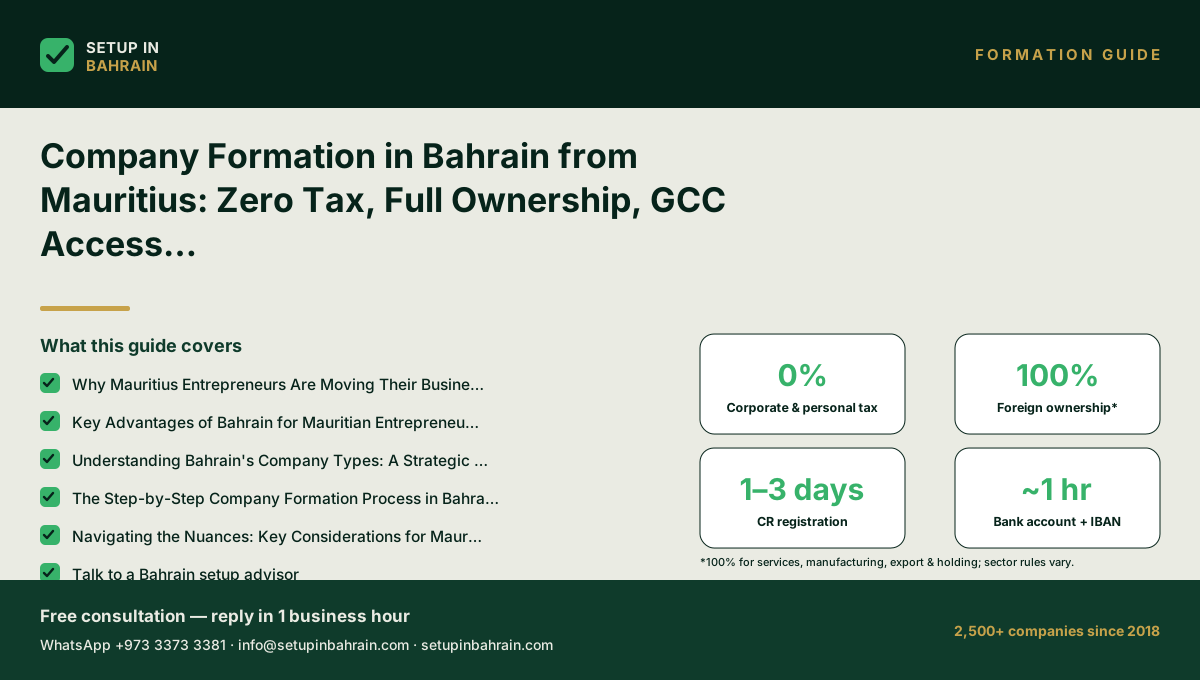
- Why Mauritius Entrepreneurs Are Moving Their Business to Bahrain
- Key Advantages of Bahrain for Mauritian Entrepreneurs
- Understanding Bahrain's Company Types: A Strategic Choice for You
- The Step-by-Step Company Formation Process in Bahrain
- Navigating the Nuances: Key Considerations for Mauritian Entrepreneurs
→ Complete guide: Company Formation in Bahrain — the full 2026 guide
View details
Ownership & capital
A Bahrain WLL can be owned by a single person — 100% foreign ownership applies to most activities, with no local partner required for services, manufacturing, export trading and holding companies. The minimum share capital is BHD 1 ; we recommend BHD 1,000 . This Makes bank account opening and investor visa approval smoother.
Entrepreneurship in Mauritius is a vibrant testament to the island nation's dynamic spirit. You've built your business with resilience, navigated the intricacies of a growing economy. Likely even leveraged the Global Business Company (GBC) framework to your advantage. Yet, as you gaze across the global economic landscape, a quiet but persistent question often arises: "Am I truly operating with optimal efficiency, stability, and access to the world's most rapidly expanding markets?"
For many forward-thinking Mauritian entrepreneurs, the answer more and more points away from the familiar shores of the Indian Ocean and towards the strategic, tax-efficient hub of Bahrain in the Arabian Gulf.
This isn't about abandoning the success you've cultivated in Mauritius; it's about intelligent expansion, strategic diversification. Securing your future growth in a truly advantageous environment. Imagine a business landscape where your corporate tax rate is a flat 0%, where your hard-earned profits aren't silently eroded by currency depreciation, and where the colossal $1.7 trillion GCC market – driven by mega-projects like Saudi Vision 2030 – is literally a short causeway away. This is not a distant dream for a select few; it’s the tangible reality Bahrain offers today, a reality that directly addresses the unique challenges and aspirations of Mauritian-based enterprises.
As a Mauritian founder, you've likely experienced the growing pressure on global business structures, the relentless erosion of the Mauritius Rupee (MUR), and the logistical hurdles of operating at a significant distance from the Middle East's burgeoning economic powerhouses. This comprehensive guide isn't just a comparison; it’s a strategic roadmap, designed to help you understand why Bahrain isn't merely an alternative but a superior operational base for your international ambitions in 2026 and beyond. We'll delve into the hard numbers, cut through the complexities. Show you exactly how to make Bahrain your next strategic move.
Why Mauritius Entrepreneurs Are Moving Their Business to Bahrain
Let's paint a common picture. You're a successful fintech founder in Ebene, Mauritius. Your company has grown, perhaps serving clients across Africa and Asia. You appreciate the 15% corporate tax rate, which initially seemed competitive, and the established legal framework. But, the last few years have brought new pressures. You've seen the Mauritius Rupee (MUR) depreciate by roughly 25% against the US Dollar since 2018, eroding your foreign currency revenues when repatriated. You're also paying annual Global Business License (GBL) renewal fees and grappling with increasing compliance costs for your offshore structure, which. Beneficial, isn't always perceived with the same prestige as a mainland GCC entity.
Now, consider a Port Louis-based software exporter who built a steady client base across East Africa and India. In 2023, his company paid the standard 15% corporate tax on profits. He absorbed another MUR 180,000 in Global Business License renewal and compliance fees. And he watched the Mauritian Rupee lose another 6% against the dollar, further squeezing his margins on international contracts. When a Bahraini client offered a three-year contract worth USD 1.2 million, the founder realized the same revenue booked through a Bahrain entity would face Generally no corporate income tax for most sectors, zero withholding on the eventual dividend, and a currency that has not moved against the US dollar since 1980.
These aren't isolated anecdotes. They represent a growing trend among savvy Mauritian entrepreneurs who are recognizing Bahrain as a strategically superior hub for international business. Here's a breakdown of the compelling reasons:
1. The Silent Erosion: Currency Stability vs. Depreciation
One of the most insidious threats to profitability for any internationally focused business is currency volatility. For Mauritian entrepreneurs, the depreciation of the MUR is a very real and persistent concern. Since 2018, the MUR has lost about 25% of its value against the USD, directly impacting the real value of foreign currency earnings when converted back home. If your business earns in USD, EUR, or GBP, that 25% loss is a significant hit to your bottom line before you even consider taxes or operational costs.
Bahrain, by contrast, offers rock-solid currency stability. The Bahraini Dinar (BHD) has been pegged to the US Dollar at a fixed rate of BHD 0.376 per USD since 1980. That's over four decades of unwavering stability. This eliminates currency risk, providing an unparalleled level of financial predictability that allows you to forecast profits, manage expenses. Plan investments with absolute confidence. For a business heavily reliant on international trade or services, this stability alone can be a game-changer, preserving your capital and maximizing your real returns.
2. The Tax Advantage: 15% vs. 0%
Mauritius proudly advertises a 15% corporate tax rate. For GBCs, even lower effective rates can sometimes be achieved through partial exemptions on foreign-sourced income. But, this still means a portion of your profits is paid to the government. Also, there might be withholding taxes on dividends paid out to shareholders.
Bahrain stands apart with a flat 0% corporate income tax rate on most business activities. There are no corporate taxes, no personal income taxes, no capital gains taxes. No withholding taxes on dividends, interest, or royalties. This means every Dinar your business earns (or Dollar, given the peg) is yours to reinvest or distribute. For a Mauritian business, this immediately translates to a 15% uplift in retained earnings compared to operating solely from Mauritius. When combined with currency stability, the financial leverage is immense. This isn't just about saving money; it's about having more capital to fuel innovation, expand operations. Capture new markets.
3. Streamlined Operations & Reduced Compliance Burden
While Mauritius has worked to enhance its business environment, operating a Global Business Company (GBC) still entails specific annual compliance requirements and associated costs. For instance, the annual GBL renewal fee, along with mandatory local director requirements and substance regulations, can add up to significant administrative and financial burdens. Your local GBC administrator in Port Louis handles these, but they are tangible costs.
Bahrain, especially with its popular WLL (With Limited Liability) company type, offers a straightforward, transparent. Greatly less bureaucratic setup. While substance requirements exist globally and should always be adhered to, Bahrain's framework is designed for ease of doing business on the mainland. The regulatory environment, overseen by the Ministry of Industry and Commerce (MOIC) and the Central Bank of Bahrain (CBB) for financial services, is modern and efficient. This translates to lower annual compliance costs and less administrative overhead, allowing you to focus more on your core business activities.
4. Unparalleled Market Access: The Gateway to the GCC
Mauritius offers access to African and Asian markets, which are valuable. But, the sheer scale and growth potential of the Gulf Cooperation Council (GCC) market are in a league of their own. With a combined GDP exceeding $1.7 trillion and a population of over 50 million affluent consumers, the GCC represents an economic powerhouse. Saudi Arabia alone, with its ambitious Vision 2030 projects totaling over $800 billion in investment, is driving unprecedented demand across virtually every sector.
Bahrain's geographical location is its ultimate strategic asset. Connected to Saudi Arabia by the 25-kilometer King Fahad Causeway, Bahrain offers direct, rapid land access to the largest economy in the Middle East. This means a product shipped from your Bahraini warehouse can be on a client's doorstep in Riyadh in a matter of hours, not days or weeks via sea or air freight from Mauritius. Bahrain is truly the commercial gateway to Saudi Arabia and the broader GCC, offering unparalleled logistical advantages for businesses targeting this lucrative region, as well as easy access to the wider MENA (Middle East and North Africa) market.
5. Reputation and Global Perception
Mauritius, despite its efforts, has faced scrutiny from international bodies about its financial services sector, including a period on the FATF grey list. While it has made significant strides to exit such lists, the perception can still impact international banking relationships and investor confidence for some businesses.
Bahrain, on the other hand, boasts a long-standing reputation as a highly regulated and transparent financial hub. The Central Bank of Bahrain (CBB) is considered one of the most respected regulators in the region, fostering a robust and trustworthy ecosystem. Establishing your business in Bahrain often enhances your international credibility, making it easier to secure banking facilities with reputable global institutions and attract foreign investment. It positions your enterprise firmly within a well-regarded jurisdiction, signaling stability and compliance to global partners.
For these reasons and more, savvy Mauritian entrepreneurs are more and more viewing Bahrain not just as an option. As a superior operational base for their international ambitions.
Key Advantages of Bahrain for Mauritian Entrepreneurs
Beyond the compelling reasons to shift focus from Mauritius, Bahrain offers a suite of inherent advantages that make it an attractive destination for any global business.
1. 0% Corporate Income Tax for Most Activities
Let’s reiterate this foundational benefit: Bahrain maintains a 0% corporate income tax rate for the vast majority of commercial activities. This means your business profits are not subject to direct taxation by the Bahraini government. This applies across various sectors, from manufacturing and logistics to technology and professional services. The only exceptions typically relate to specific activities in the oil and gas sector or the rental of commercial real estate. For a Mauritian business, this zero-tax environment translates directly into enhanced profitability and greater retained earnings for reinvestment or distribution. It’s a powerful incentive that places Bahrain among the world’s most tax-efficient jurisdictions.
2. 100% Foreign Ownership
Unlike some other GCC nations that historically mandated local partnerships or sponsorship, Bahrain has long been a leader in allowing 100% foreign ownership of companies in most sectors. This is a critical advantage for Mauritian entrepreneurs, as it means you retain complete control over your business, its operations. Its profits. There is no requirement to find a local partner or cede any equity, providing full autonomy and simplifying the corporate governance structure. This applies directly to the most popular company type for foreign investors: the With Limited Liability (WLL) company.
3. Strategic Location and Unrivalled Market Access
Bahrain's geographic position is arguably its strongest strategic asset. Situated at the heart of the Arabian Gulf, it offers: Direct Access to Saudi Arabia: The King Fahad Causeway connects Bahrain directly to Saudi Arabia, facilitating swift logistical and commercial links to the region's largest economy. This is invaluable for businesses targeting the $800+ billion Saudi Vision 2030 projects. Gateway to the GCC: Bahrain is a central hub for accessing the entire GCC market, including the UAE, Qatar, Kuwait. Oman. Its well-developed air and sea ports offer efficient connectivity across the region and beyond. Global Connectivity: Bahrain International Airport is a modern, efficient hub, offering direct flights to major cities in Europe, Asia, Africa. The Middle East, making international business travel and logistics seamless. Free Trade Agreements: Bahrain benefits from numerous free trade agreements, including the groundbreaking FTA with the United States – the first of its kind between the U.S. and a GCC member. This provides preferential access to a vast consumer market.
4. Robust and Stable Economy with a USD Peg
The stability of the Bahraini Dinar, pegged to the US Dollar at BHD 0.376 for over four decades, provides an economic bedrock for businesses. This fixed exchange rate eliminates currency risk, a significant concern for Mauritian businesses accustomed to MUR volatility. The Bahraini economy itself is well-diversified, with strong financial services, manufacturing, tourism. Logistics sectors complementing its traditional oil and gas industry. The Central Bank of Bahrain (CBB) maintains a strong regulatory framework, ensuring the stability and integrity of the financial system. This institutional stability is a key E-E-A-T signal for global investors.
5. Pro-Business and Forward-Thinking Regulatory Environment
Bahrain has consistently ranked highly in global ease of doing business indices (World Bank's Doing Business report, for instance, has highlighted Bahrain's reforms). The Economic Development Board (EDB) of Bahrain actively works to attract foreign investment by streamlining processes, providing support. Championing business-friendly policies. The government is committed to digital transformation, making company registration and ongoing compliance more and more efficient through platforms like Sijilat. This pro-business stance means less red tape and a more supportive ecosystem for entrepreneurs.
6. Talented and Diverse Workforce
Bahrain boasts a highly educated and skilled local workforce, augmented by a diverse expatriate talent pool. The government invests heavily in education and training, ensuring a pipeline of qualified professionals. The multicultural environment is welcoming, and the cost of living, while not as low as some parts of Asia, is generally more affordable than other major GCC cities, contributing to a stable and attractive environment for skilled professionals. This makes talent acquisition and retention more manageable for businesses.
7. Modern Infrastructure and Quality of Life
From state-of-the-art office spaces and logistics parks to reliable utilities and high-speed internet, Bahrain offers world-class infrastructure. Beyond business, it provides an excellent quality of life with diverse entertainment options, international schools, healthcare facilities. A safe, tolerant society. This holistic environment makes it an attractive place not just to do business. Also for entrepreneurs and their families to live and thrive.
Understanding Bahrain's Company Types: A Strategic Choice for You
Choosing the right legal structure is foundational to your success in Bahrain. While there are several options, for most Mauritian entrepreneurs looking for direct investment and full control, two types stand out, with one being the overwhelmingly preferred choice.
CRITICAL BAHRAIN FACT: It is important to note that there is NO single-shareholder WLL as a distinct legal entity type in Bahrain. This is a common misconception often found in outdated guides or applied incorrectly from other jurisdictions. In Bahrain, the functionality of a single-owner company is seamlessly integrated into the Limited Liability Company (WLL) structure.
1. With Limited Liability Company (WLL) – The Default Recommendation
For the vast majority of foreign investors, including those from Mauritius, the WLL is the most recommended and widely used company type. It perfectly balances flexibility, limited liability, and ease of setup.
Key Features of a WLL:
100% Foreign Ownership: Crucially, a WLL can be owned 100% by foreign individuals or corporate entities. There is no requirement for a Bahraini partner or shareholder. This provides you with complete control over your operations and profits. Single Shareholder Allowed: A WLL can be owned by a single individual or a single corporate entity. You do not need multiple partners to form a WLL, making it ideal for sole entrepreneurs or wholly-owned subsidiaries. Limited Liability: As the name suggests, the liability of shareholders is limited to the amount of their capital contribution to the company. Your personal assets are protected from business debts and obligations. Minimum Share Capital: BHD 1 (Legal Minimum), BHD 1,000 (Practical Recommendation): * Legally, the minimum share capital for a WLL is BHD 1. This is the absolute statutory minimum. * But, for practical purposes, especially for opening a corporate bank account and securing an investor visa, we strongly recommend a minimum paid-up capital of BHD 1,000. Banks in Bahrain typically require a higher capital to show the company's financial seriousness and operational viability. Attempting to open an account with just BHD 1 can lead to significant delays and rejections. Permitted Activities: A WLL can undertake a broad range of commercial and industrial activities, subject to MOIC approval and specific licensing requirements (e.g., CBB for financial services). Governance: Requires at least one director (who can be the sole shareholder) and a company secretary (optional but recommended).
Why a WLL is Ideal for Mauritian Entrepreneurs: The WLL structure directly addresses the pain points of control and ownership that can sometimes arise in other jurisdictions. Its simplicity, combined with the 100% foreign ownership and single shareholder allowance, makes it the most straightforward and effective vehicle for establishing a robust presence in Bahrain.
2. Setup (Sole Proprietorship)
An Setup is essentially a sole proprietorship, suitable for micro-businesses or individuals providing professional services.
Key Features:
Owned by a Single Individual: Only one natural person can own an Setup. Unlimited Liability: The owner's personal assets are not separated from the business. This means the individual is personally liable for all business debts and obligations, a significant risk compared to a WLL. Simpler Setup (but higher risk): Generally has fewer formal requirements than a WLL. The unlimited liability is a major drawback for most serious entrepreneurs. Limited Scope: Often restricted to specific professional activities or very small-scale trading.
Recommendation: While an Setup is an option, its unlimited liability feature makes it less desirable for most growth-oriented Mauritian entrepreneurs. The WLL offers far greater protection and flexibility for a minimal additional administrative step.
3. Branch of a Foreign Company
If you already have a well-established company in Mauritius (or elsewhere) and wish to expand its operations directly into Bahrain without creating a separate legal entity, you can register a Branch.
Key Features:
- Extension of Parent Company: The branch is not a separate legal entity; it operates as an extension of the Mauritian parent company.
- Unlimited Liability (of parent): The parent company in Mauritius is fully liable for the debts and obligations of its Bahraini branch.
- Limited Activities: The activities of the branch are typically restricted to those performed by the parent company.
- Higher Compliance: Often involves more detailed reporting requirements back to the parent company.
Recommendation: A Branch might be suitable for very large, established Mauritian corporations expanding internationally. But, for most startups or SMEs, a WLL provides more flexibility, better liability protection. Often simpler administration, especially if the intent is to have the Bahrain entity operate somewhat independently.
The Step-by-Step Company Formation Process in Bahrain
Establishing a company in Bahrain is a streamlined process, designed for efficiency by the Ministry of Industry and Commerce (MOIC). Here’s a detailed, humanized guide for Mauritian entrepreneurs:
Phase 1: Pre-Registration & Strategic Planning
Before you even touch a form, some critical strategic decisions need to be made. Think of this as laying the foundation.
Define Your Business Activity: Be precise. What exactly will your company do? Will it be software development, trading, consulting, logistics, or something else? The MOIC's "Sijilat" portal (Bahrain's national commercial registration system) lists approved activities. Your chosen activity will dictate licensing requirements and sometimes even the type of company. For instance, financial services activities require direct licensing from the Central Bank of Bahrain (CBB). Choose Your Company Name: Select three potential names in order of preference. The name must be unique, relevant to your activity, and not infringe on existing trademarks. A quick search on Sijilat can help you check availability. Determine Your Share Capital: * Legal Minimum: As discussed, for a WLL, the legal minimum is BHD 1. * Practical Recommendation: Strongly commit to BHD 1,000 as your starting paid-up capital. This is crucial for successful corporate bank account opening and shows financial viability to local institutions. Trying to proceed with BHD 1 will almost certainly lead to frustration and delays with banks. Identify Shareholders and Directors: Decide who will own the company (individuals or corporate entities from Mauritius) and who will serve as the director(s). For a single-shareholder WLL, you (as the Mauritian entrepreneur) can be both the sole shareholder and the sole director. Secure an Office Address (Virtual or Physical): All companies in Bahrain require a registered office address. * Virtual Office: For many service-based businesses or startups, a virtual office provides a cost-effective solution in the initial stages. Many business centers in Bahrain offer this. * Physical Office: If you require staff, inventory, or physical operations, a dedicated physical office or commercial space will be necessary. Develop a Simple Business Plan: While not always a mandatory submission for basic WLLs, having a clear outline of your business objectives, market, operations, and financial projections is invaluable for your own clarity and for discussions with banks or potential investors.
Phase 2: Documents & Initial Submission
Once your plan is clear, it's time to gather the necessary documents.
For Individual Shareholder(s) (Mauritian Entrepreneurs):
- Passport Copy: Clear, valid copy of the passport for each shareholder and director.
- CV/Resume: A professional CV outlining your experience and qualifications.
- Bahraini CPR (Central Population Registry) Card (if applicable): If you already reside in Bahrain.
- No-Objection Certificate (NOC) (if employed in Bahrain): If you're currently employed in Bahrain and wish to start your own business.
- Bank Reference Letter: From your personal bank in Mauritius or elsewhere, confirming your good standing (sometimes requested, especially for higher capital amounts).
- Specimen Signature: A sample of your signature.
For Corporate Shareholder(s) (e.g., your existing Mauritian company):
Certificate of Incorporation: Certified copy of your Mauritian company's registration. Memorandum and Articles of Association (M&AA): Certified copy. Board Resolution: A resolution from the Mauritian company's board approving the setup of a subsidiary in Bahrain, appointing directors. Authorizing signatories. Passport & CV of Directors/Authorized Signatories: For the individuals who will represent the corporate shareholder in Bahrain. Good Standing Certificate: From the Registrar of Companies in Mauritius, confirming the parent company is active.
General Documents:
Proposed Company Name(s). Defined Business Activity. Memorandum and Articles of Association (M&AA) for the Bahraini WLL: This is a standard template provided by MOIC. This You will customize. Lease Agreement/Virtual Office Agreement: Proof of your registered office address.
Authentication & Translation: All foreign documents (from Mauritius) must typically be apostilled or attested by the Bahrain Embassy in Mauritius (or Mauritian Embassy in Bahrain) and then translated into Arabic by a sworn translator. This is a crucial step that can take time, so factor it into your timeline.
Phase 3: Registration & Licensing
This is where your company officially comes to life.
- Name Reservation: Submit your preferred company name(s) to the MOIC via Sijilat. This usually takes 1-2 business days.
- Initial Approval (MOIC): Once the name is approved, you'll submit all your documents (digital copies via Sijilat). The MOIC will review your application for completeness and adherence to regulations. This stage includes approval from relevant government agencies based on your business activity (e.g., Ministry of Health for medical, Ministry of Education for training institutes). This can take anywhere from 3-7 business days, depending on the complexity and number of required approvals.
- Capital Deposit (if required by MOIC): In some cases, for higher capital or specific activities, MOIC might require you to deposit the capital into a temporary bank account. But, for a standard WLL with BHD 1,000, this is often handled after the CR is issued.
- Commercial Registration (CR) Issuance: Once all approvals are received and documents verified, the MOIC will issue your Commercial Registration (CR). This is your company’s official license to operate in Bahrain. This is a digital certificate.
Phase 4: Post-Registration Formalities – Bringing Your Business to Life
Receiving your CR is a major milestone. A few critical steps remain to make your company fully operational.
Open a Corporate Bank Account: * This is often cited as the most challenging step for non-residents. This is precisely why the BHD 1,000 capital recommendation is so vital. Banks are more and more scrutinizing new accounts to combat financial crime. * You will need your CR, M&AA, shareholder/director passports and CVs. Often a detailed explanation of your business activities and projected transactions. * Be prepared for extensive Know Your Customer (KYC) checks and potentially several weeks for approval. Get Investor Visa & CPR Card: * As a director/owner, you can apply for an investor visa through the Labour Market Regulatory Authority (LMRA) and Nationality, Passports & Residency Affairs (NPRA). * This typically requires your company’s CR, a medical check. Proof of your investment (your role as shareholder/director). * Once the investor visa is granted, you can get your Bahraini Central Population Registry (CPR) card. This Acts as your national ID. Secure Lease Agreement (if not already done): If you opted for a virtual office, ensure the agreement is properly registered. If you need a physical office, finalize the lease and get it officially registered. Register for VAT (if applicable): Bahrain implemented 5% Value Added Tax (VAT) in 2019. This Increased to 10% in January 2022. If your business’s annual taxable supplies exceed BHD 37,500, you are legally required to register for VAT with the National Bureau for Revenue (NBR). Even if below this threshold, voluntary registration might be strategic for input tax recovery. Subscribe to the General Organization for Social Insurance (GOSI): If you plan to hire employees (Bahraini or expatriate), your company must register with GOSI and make mandatory social insurance contributions. Apply for Specific Operational Licenses (if needed): Depending on your activity, you might need additional licenses (e.g., an industrial license, food safety permits, specific CBB licenses for financial firms).
The entire process, from initial submission to getting your CR, can typically take 2-4 weeks for a straightforward WLL, assuming all documents are in order and approvals are swift. Post-registration steps like banking and visas can add another 4-8 weeks. Engaging a reputable local consultant can greatly expedite and smooth this process, helping you navigate the nuances and avoid common pitfalls.
Navigating the Nuances: Key Considerations for Mauritian Entrepreneurs
While Bahrain offers a welcoming and efficient business environment, understanding these specific considerations will ensure a smoother transition and long-term success.
1. Banking for Non-Residents: More Than Just Capital
Opening a corporate bank account in Bahrain is a critical step. It often proves to be the most challenging, especially for non-resident owners. Mauritian entrepreneurs should be prepared for robust Know Your Customer (KYC) and Anti-Money Laundering (AML) checks.
- The BHD 1,000 Capital is Non-Negotiable (Practically): As stressed, while BHD 1 is the legal minimum, banks almost universally require a higher initial capital (BHD 1,000 is the recommended minimum) to show serious intent and operational capacity. Without this, your application is likely to be rejected or greatly delayed.
- Detailed Business Plan & Activity: Be ready to
Bahrain Business Guides for Mauritius Citizens
Frequently Asked Questions
How long does it take to set up?
It takes 15 to 20 days. We file all forms for you. You do not need to wait long.
What does it cost?
Company formation: Standard BHD 1,340 with 3 months of office address; Gold BHD 1,700 with 6 months; Premium BHD 2,150 with 12 months and a cabin, officer table and chair, and two guest chairs. No formation package includes visas, including Premium. Investor/work visas are priced separately: BHD 755 for one year or BHD 953 for two years, in addition to the formation package. Ask for a written, itemized quotation confirming government fees and all inclusions before payment.
Do I need to visit Bahrain?
No. You can set up your firm from home. We do all the work online. Some banks may ask for one visit.
What tax will I pay?
You pay zero tax on your profits. Bahrain has no corporate income tax. This is a key benefit of the setup.
Can I own 100% of my firm?
Yes. Foreign owners can hold all shares. No local partner is needed. Full ownership is allowed.
What do I need to start?
You need a valid passport. You also need a trade name and a business address. We help you with all of these.
How do I open a bank account?
We guide you step by step. Most banks take 3 to 6 weeks. You will need your CR and firm papers.
Who issues the Commercial Registration (CR)?
The CR is issued by the MOICT. It is your legal right to trade in Bahrain. We file the CR for you.
Can I renew my CR each year?
Company renewal packages: BHD 530 with 3 months of office address; BHD 980 with 6 months; BHD 1,520 with 12 months. These are separate renewal packages, not visa fees.
How do I get started?
Fill in our form on this page. Our team will call you back. We map your best setup plan at no cost.
Steps to Form Your Company
- Pick your trade name. We check if it is free.
- Choose your business type. WLL is the most common.
- Sign the MOA. We draft and file all legal docs.
- Pay the state fees. About BHD 432 in total.
- Get your CR. Takes 15 to 20 days.
- Open your bank account. We guide each step.
- Start trading. You are ready to do business.
Key Facts
- Tax rate: 0%
- Foreign ownership: 100%
- Setup time: 15 to 20 days
- Company formation: Standard BHD 1,340 with 3 months of office address; Gold BHD 1,700 with 6 months; Premium BHD 2,150 with 12 months and a cabin, officer table and chair, and two guest chairs. No formation package includes visas, including Premium. Investor/work visas are priced separately: BHD 755 for one year or BHD 953 for two years, in addition to the formation package. Ask for a written, itemized quotation confirming government fees and all inclusions before payment.
- Company renewal packages: BHD 530 with 3 months of office address; BHD 980 with 6 months; BHD 1,520 with 12 months. These are separate renewal packages, not visa fees.
- Client rating: 4.8 stars
- Clients served: 2,500 and more
Quick Facts
- Tax rate: 0%
- Own all of your firm: Yes, 100%
- Time to set up: 15 to 20 days
- Company formation: Standard BHD 1,340 with 3 months of office address; Gold BHD 1,700 with 6 months; Premium BHD 2,150 with 12 months and a cabin, officer table and chair, and two guest chairs. No formation package includes visas, including Premium. Investor/work visas are priced separately: BHD 755 for one year or BHD 953 for two years, in addition to the formation package. Ask for a written, itemized quotation confirming government fees and all inclusions before payment.
- Company renewal packages: BHD 530 with 3 months of office address; BHD 980 with 6 months; BHD 1,520 with 12 months. These are separate renewal packages, not visa fees.
- Rating: 4.8 stars
- Clients: 2,500 and more
Why Bahrain?
Bahrain has no tax. You keep all your profits. This is rare in the Gulf.
You can own all of your firm. No local partner is needed. The law allows full foreign ownership.
Setup takes 15 to 20 days. We file all forms for you. You can do it all from home.
Bahrain has a free trade deal with the US. Your goods face low or no tariffs. This gives you access to big markets.
We have served 2,800+ clients from 44+ countries and maintain records to substantiate that total where needed. We have 113 Google reviews; reviews represent only some clients and are not the same as the total clients served.
Our Steps
- Tell us your plan. We advise you for free.
- We pick the right firm type for you.
- We file all your forms with MOICT.
- You get your CR in 15 to 20 days.
- We help you open a bank account.
- You are ready to trade. We stay with you.
Next Steps for Mauritius Citizens
You can set up a firm in Bahrain from Mauritius. You do not need to fly there first. We do all the work online.
Tell us your plan. We call you back the same day. We map the best route for you at no cost.
We file all your forms. We deal with MOICT and the state. You get your CR in 15 to 20 days.
After your CR, we help you get a bank account. We also help with your Investor Visa. One firm guides you at each step.
Why Our Clients from Mauritius Choose Us
- We speak your language. We know your needs.
- We have helped clients from Mauritius before.
- Our fee is clear. No surprise costs.
- We have a 4.8 star rating on Google.
- We have helped more than 2,500 clients set up in Bahrain.
Fill in the form on this page. We will be in touch soon. Let us help you start your Bahrain firm today.
Ready to set up in Bahrain from Mauritius?
Tell us your business idea. We map the right entity, ownership and timeline — then handle the filing while you focus on what matters.