Complete guide for Mauritania entrepreneurs: form a company in Bahrain with generally no corporate income tax for most sectors, 100% foreign ownership. GCC market access. Costs, steps, visas, banking.
Key Takeaways
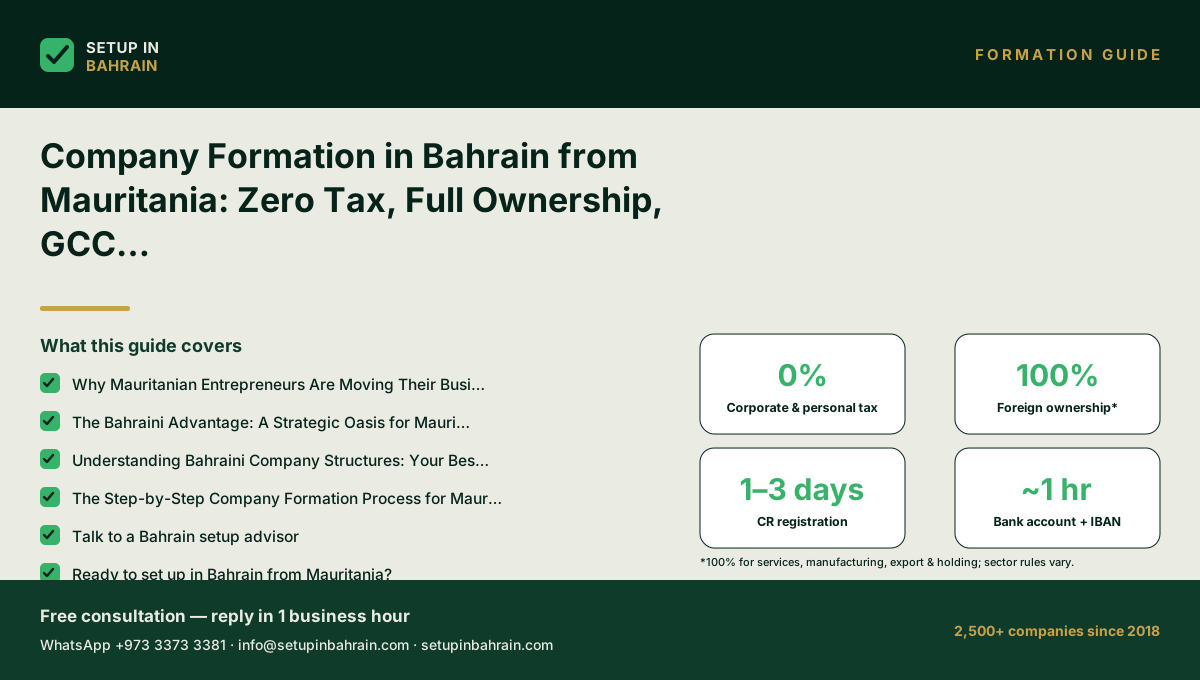
- Why Mauritanian Entrepreneurs Are Moving Their Business to Bahrain
- The Bahraini Advantage: A Strategic Oasis for Mauritanian Ventures
- Understanding Bahraini Company Structures: Your Best Options
- The Step-by-Step Company Formation Process for Mauritanian Entrepreneurs
→ Complete guide: Company Formation in Bahrain — the full 2026 guide
View details
Ownership & capital
A Bahrain WLL can be owned by a single person — 100% foreign ownership applies to most activities, with no local partner required for services, manufacturing, export trading and holding companies. The minimum share capital is BHD 1 ; we recommend BHD 1,000 . This Makes bank account opening and investor visa approval smoother.
Imagine you're Fatima, a driven entrepreneur from Nouakchott. For years, you've diligently built your import-export business, navigating the bustling markets, fostering relationships across the Maghreb and Sub-Saharan Africa. You've invested late nights and early mornings, pouring your soul into your venture. Yet, every quarter, a significant portion of your hard-earned profits disappears into the 25% corporate income tax in Mauritania.
Then there's the insidious erosion of your capital as the Mauritanian Ouguiya (MRU) depreciates, often 8 to 12% annually, making international trade a constant battle against currency volatility. You wrestle with the DGTCP’s (Direction Générale des Impôts et des Domaines) complex bilingual Arabic and French tax filings, a bureaucratic maze that demands precious time and resources from your small team. When you need to transfer funds internationally, the BCM's (Banque Centrale de Mauritanie) limited international banking access creates delays and headaches, hindering your global ambitions.
Consider Ahmed, who runs a flourishing fisheries export business also out of Nouakchott. In 2024, he watched his corporate tax bill hit 25 percent of profits while the Ouguiya lost another 9 percent against the dollar. He had already spent three months trying to open a basic USD account with local banks, only to be met with BCM restrictions on foreign currency transactions. When a key Saudi buyer asked for faster delivery terms and more flexible payment options, Ahmed realized he was losing lucrative contracts simply because his company sat in a jurisdiction that could not move money quickly or predictably across international borders.
This isn't just Fatima's or Ahmed's story; it's the reality for countless Mauritanian entrepreneurs. You dream of a stable environment, a place where your business can truly thrive, where your profits are truly yours . Where the world feels less complicated.
This comprehensive guide is written specifically for you. It's time to discover Bahrain – a strategic, forward-thinking island nation that stands in stark contrast to the challenges you face today. This isn't about escaping Mauritania, but about intelligently expanding your horizons, securing your financial future. Leveraging a dynamic, tax-free platform to access a multi-trillion-dollar market.
In 2026, Bahrain is more accessible and advantageous than ever for Mauritanian investors. Forget the ambiguities of operating between the Maghreb and Sub-Saharan Africa; Bahrain offers clarity, stability. Direct access to the thriving Gulf Cooperation Council (GCC) economy. We'll explore how this island kingdom, known for its progressive business environment and welcoming stance towards foreign investment, can be the catalyst your business needs to achieve global scale and unprecedented profitability.
Why Mauritanian Entrepreneurs Are Moving Their Business to Bahrain
The decision to relocate or expand a business jurisdiction isn't taken lightly. It's often born out of frustration with existing limitations and a clear vision for greater potential. For Mauritanian entrepreneurs, the journey to Bahrain is typically driven by a direct response to several deeply entrenched pain points in their home market. Understanding these challenges is key to appreciating the profound advantages Bahrain offers.
The Weight of Taxation in Mauritania: A Quarter of Your Hard-Earned Profits Gone
Let's start with the most immediate impact on your bottom line: taxation. Mauritania imposes a 25% corporate income tax on company profits. For a growing business, this represents a significant drain on capital that could otherwise be reinvested in expansion, innovation, or talent acquisition.
Consider a Mauritanian company generating 100 million MRU in net profit. 25 million MRU of that immediately goes to taxes. In a competitive global market, this 25% burden can greatly reduce your ability to price competitively, offer attractive employee benefits, or fund research and development. It's a constant headwind, making it harder to build a robust war chest for future growth or weather economic downturns. This high tax rate not only reduces your current profitability but also dampens the incentive for large-scale investment, as a substantial portion of the returns will be claimed by the state.
The Silent Erosion of Capital: MRU Depreciation and Currency Volatility
Beyond direct taxation, the instability of the Mauritanian Ouguiya (MRU) presents a more insidious challenge: the silent erosion of your capital. The MRU has consistently experienced annual depreciation rates of 8 to 12% against major international currencies like the US Dollar and Euro.
What does this mean for your business? Reduced Purchasing Power: If you're importing goods, services, or machinery, a depreciating MRU means you need more local currency to buy the same foreign goods year after year. This directly increases your operational costs and reduces profit margins on imported items. Unpredictable International Trade: For exporters. A weaker currency can theoretically make your goods cheaper abroad, the volatility makes long-term planning incredibly difficult. Hedging strategies can be costly and complex, eating into profits. Capital Preservation Challenges: Saving or accumulating capital in MRU means watching its real value diminish over time. Entrepreneurs are effectively penalized for retaining profits within Mauritania, forcing them to constantly seek ways to convert assets into more stable currencies or invest in non-MRU denominated assets, often with limited options locally. Investor Hesitation: This currency risk makes Mauritania less attractive for foreign direct investment, as international investors are wary of their returns being wiped out by currency fluctuations.
This continuous battle against currency depreciation adds a layer of complexity and risk that drains business energy and resources, diverting attention from core business strategy.
Bureaucratic Labyrinth: DGTCP and BCM Challenges
Mauritania's regulatory and financial infrastructure, while evolving, still poses significant hurdles for internationally ambitious businesses.
DGTCP's Bilingual Tax Filings: The Direction Générale des Impôts et des Domaines (DGTCP) requires tax filings to be submitted in both Arabic and French. This bilingual requirement, coupled with often opaque and complex procedural rules, creates a significant administrative burden. Businesses often need specialized accountants and legal advisors fluent in both languages and intimately familiar with the local tax code, adding to operational costs and the potential for errors. This complexity can also lead to delays in approvals and increased compliance risks. BCM's Limited International Banking Access: The Banque Centrale de Mauritanie (BCM) operates within a framework that. Aiming to stabilize the national economy, often restricts ease of international banking. Mauritanian banks face limitations on foreign currency transactions and international transfers. For entrepreneurs engaged in import-export, e-commerce, or any business requiring frequent cross-border payments: * Delays: Transferring funds in or out of Mauritania can be notoriously slow, impacting supply chain efficiency and client relationships. * High Costs: Correspondent banking fees and conversion charges can be substantial, eroding profits. * Limited Access to Global Services: Accessing international payment gateways, merchant accounts, or foreign credit lines can be challenging, severely limiting a business's global reach and ability to participate in the digital economy. Many businesses find it nearly impossible to open basic USD accounts with local banks, or face strict limits on their usage.
These challenges collectively hinder the agility and global competitiveness of Mauritanian enterprises, making international expansion a necessity rather than a luxury for serious growth.
Limited Global Reach & Market Access
The combined effect of high taxation, currency volatility, and banking restrictions is a significant constraint on market access. While Mauritania is a gateway between the Maghreb and Sub-Saharan Africa, the internal friction makes it difficult to fully leverage this geographical advantage.
- Difficulty Attracting Foreign Investment: The inherent risks make foreign investors hesitant, limiting access to crucial growth capital.
- Challenges in International Partnerships: International partners prefer jurisdictions with stable banking and predictable regulatory environments. The complexities in Mauritania can make potential collaborators look elsewhere.
- Missed Growth Opportunities: Businesses lose out on contracts, unable to offer competitive pricing or timely deliveries due to financial and logistical bottlenecks. This directly impacts their ability to scale and diversify their revenue streams.
For Mauritanian entrepreneurs with a global vision, these obstacles are not merely inconveniences; they are fundamental barriers to achieving their full potential. This is precisely why a strategic move to a jurisdiction like Bahrain becomes not just an option. A critical imperative for sustainable growth and financial security.
The Bahraini Advantage: A Strategic Oasis for Mauritanian Ventures
Having understood the challenges faced by Mauritanian entrepreneurs, the contrast with Bahrain’s business environment becomes strikingly clear. Bahrain is not just an alternative; it's a meticulously designed economic ecosystem geared towards fostering business growth, financial freedom. Global connectivity.
A Tax-Free Haven: Maximizing Your Profits
The most immediate and compelling advantage Bahrain offers is its exceptionally favorable tax regime. For most commercial activities, Bahrain has zero corporate income tax. This stands in stark contrast to Mauritania’s 25% corporate tax rate.
Think about the implications: Full Profit Retention: Every dinar your company earns is retained within the business, available for reinvestment, expansion, or distribution to shareholders. This greatly boosts your return on investment and accelerates growth. Enhanced Competitiveness: With no corporate tax burden, your Bahraini entity can offer more competitive pricing, invest more in product development, or allocate greater resources to marketing and sales, giving you a distinct edge in regional and international markets. Simplicity: The absence of corporate income tax vastly simplifies accounting and compliance. While VAT applies (currently at 5% for most goods and services), the overall tax burden and administrative complexity are dramatically reduced compared to high-tax jurisdictions. No Personal Income Tax: Beyond corporate profits, Bahrain also imposes no personal income tax, no capital gains tax. No inheritance tax . This means entrepreneurs and their employees can enjoy a higher disposable income, making Bahrain an attractive destination for talent and encouraging wealth creation.
This tax-free environment is not merely an incentive; it's a foundational pillar of Bahrain's economic strategy, attracting global businesses and fostering a dynamic business landscape.
100% Foreign Ownership: Complete Control of Your Venture
For many years in the GCC, foreign investors were often required to have a local partner who held a majority stake. Bahrain, but, has consistently led the way in liberalizing its foreign ownership laws. Today, a critical advantage for Mauritanian entrepreneurs is the ability to achieve 100% foreign ownership of most business entities, especially the widely used With Limited Liability Company (WLL).
This means:
- Full Control: You retain complete operational and strategic control over your company. There's no need to share profits, decision-making, or intellectual property with a local nominee.
- Simplified Governance: Management structures are streamlined. You appoint your directors and managers without external influence.
- Protection of Assets: Your assets and intellectual property are fully under your purview, providing greater security and peace of mind.
- Direct Equity Ownership: Your investment is directly in your name, giving you clear ownership rights and facilitating future transactions like selling shares or attracting international investors.
This level of ownership security and autonomy is a major draw for entrepreneurs seeking to build and scale their businesses without unnecessary complications or dilution of control.
Gateway to a Multi-Trillion Dollar GCC Market
Bahrain's geographical location is a significant strategic asset. Positioned at the heart of the Arabian Gulf, it offers Mauritanian businesses direct, unfettered access to the entire Gulf Cooperation Council (GCC) market, which boasts a combined GDP in excess of $2.4 trillion and a population of over 55 million.
Key benefits of this access include: Free Trade Agreements: Bahrain is part of the GCC common market, meaning goods and services can move freely between member states (Saudi Arabia, UAE, Qatar, Kuwait, Oman) with minimal customs duties or restrictions. The King Fahd Causeway, a 25km land bridge, directly connects Bahrain to Saudi Arabia, the GCC's largest economy. Diverse and Wealthy Consumer Base: The GCC states are characterized by high disposable incomes and a strong demand for quality goods and services across various sectors, from technology and finance to logistics and consumer goods. Regional Hub Potential: Bahrain has a long-standing reputation as a financial hub and is more and more developing as a logistics and technology center, making it an ideal base for regional operations. Global Connectivity: Beyond the GCC, Bahrain's free trade agreements and strategic location provide excellent connectivity to broader Middle Eastern, African. Asian markets.
For Mauritanian businesses currently navigating regional complexities, establishing a base in Bahrain opens doors to a vast, affluent. Rapidly growing market with clear regulatory frameworks and robust infrastructure.
World-Class Financial Ecosystem
Bahrain has a well-earned reputation as a sophisticated financial hub, home to over 380 financial institutions, including conventional and Islamic banks, investment firms, and insurance companies. The Central Bank of Bahrain (CBB) is recognized globally for its forward-thinking and robust regulatory oversight.
What this means for your business: Stable Currency: The Bahraini Dinar (BHD) is pegged to the US Dollar at a fixed rate of 1 BHD = 2.659 USD. This peg provides incredible currency stability, eliminating the MRU's depreciation risk and offering predictable financial planning for international transactions. Ease of International Transactions: Unlike the BCM's limitations, Bahraini banks offer seamless and efficient international banking services. Swift, reliable transfers, multi-currency accounts. Access to global payment gateways are standard, facilitating smooth import-export operations and global business dealings. Access to Capital: As a financial hub, Bahrain offers access to a wide range of funding options, from conventional bank loans to Islamic finance products and venture capital, supporting business growth and expansion. Fintech Innovation: The CBB has been proactive in fostering a vibrant FinTech ecosystem, offering regulatory sandboxes and incentives for innovative financial services, making Bahrain an attractive location for technology-driven financial businesses.
The stark contrast to the challenges faced with BCM and local Mauritanian banking is a primary motivator for businesses seeking financial freedom and efficiency.
Streamlined Business Environment & Investor Support
Bahrain has consistently ranked high in global "ease of doing business" indices (e.g., World Bank's Doing Business Report), a testament to its commitment to creating an investor-friendly climate.
- Government Support: The Economic Development Board (EDB), a government agency, is dedicated to attracting and facilitating foreign investment. They act as a one-stop-shop, offering guidance, support, and introductions to relevant government entities.
- Efficient Registration Processes: The Ministry of Industry, Commerce and Tourism (MOIC) has digitalized many aspects of commercial registration, allowing for quicker and more transparent company formation processes.
- Clear Regulations: Bahrain operates under a transparent, English common law-influenced legal framework, providing predictability and investor confidence.
- Support for SMEs: There are various initiatives and programs aimed at supporting Small and Medium Enterprises (SMEs), including access to funding and mentorship.
These factors greatly reduce the bureaucratic hurdles and time commitment typically associated with setting up a new business in a foreign country, a welcome relief from DGTCP's complexities.
Stable & Predictable Legal Framework
Bahrain’s legal system is based on a mix of Islamic law (Sharia) and civil law, with significant influence from English common law in commercial matters, especially for foreign investors. This provides a clear and predictable framework for business operations.
- Contract Enforcement: Robust legal mechanisms ensure the enforceability of contracts, vital for international business relationships.
- Intellectual Property Protection: Bahrain has modern laws protecting intellectual property rights, offering peace of mind for innovative businesses.
- Dispute Resolution: A well-established judicial system, including arbitration centers, offers effective mechanisms for resolving commercial disputes.
For Mauritanian entrepreneurs, this stable legal environment contrasts sharply with environments where legal clarity and enforcement might be less robust, providing a secure foundation for long-term investment and growth.
Understanding Bahraini Company Structures: Your Best Options
Choosing the right legal structure is a foundational decision for any new venture. In Bahrain, the options are diverse. For Mauritanian entrepreneurs, one specific entity stands out as the most flexible and advantageous: the With Limited Liability Company (WLL).
CRITICAL NOTE: There is NO single-shareholder WLL as a distinct legal entity in Bahrain. But, a WLL can be 100% owned by a single individual. Be wary of consultants who incorrectly market an "WLL." The flexibility of the WLL negates the need for a separate WLL designation.
With Limited Liability Company (WLL): The Gold Standard for Single Owners and Partnerships
The WLL is by far the most popular and versatile company structure in Bahrain, perfectly suited for the majority of Mauritanian entrepreneurs. It offers the best balance of liability protection, ownership flexibility, and ease of operation.
Key Features of a WLL:
100% Foreign Ownership: This is a crucial point for Mauritanian investors. A WLL can be entirely owned by a single foreign individual or a single foreign corporate entity. You do not need a local Bahraini partner to establish or operate a WLL. This ensures complete control over your business. Limited Liability: As the name suggests, the personal liability of the shareholders is limited to the amount of their capital contribution. Your personal assets are protected from the company's debts and obligations, a significant advantage for risk management. Minimum Share Capital: Legally, the minimum share capital for a WLL in Bahrain is a symbolic BHD 1 (one Bahraini Dinar) . But, from a practical standpoint, we strongly recommend a minimum share capital of BHD 1,000 . Why? Because most reputable banks in Bahrain will require a higher initial deposit to open a corporate bank account. The immigration authorities for investor visas often look for a more substantial commitment to the local economy. While BHD 1 is technically legal, aiming for BHD 1,000 ensures smoother processing for vital services. Managerial Flexibility: A WLL must appoint at least one manager, who can be of any nationality. This allows you to manage the company directly or appoint a trusted professional. Broad Range of Activities: WLLs can engage in a vast array of commercial, industrial, and service activities. Certain regulated sectors (e.g., financial services, insurance, healthcare) may require specific licenses from their respective regulatory bodies (like the CBB). Residency Eligibility: Owning a WLL typically qualifies the primary shareholder (and often their family) for a Bahraini investor visa and residency permit, providing a stable base for living and operating.
Why a WLL is Ideal for Mauritanian Entrepreneurs:
Direct Control & Profitability: You own 100% of the company, and 100% of the profits are yours, free from corporate tax. Risk Mitigation: The limited liability protects your personal wealth, a stark contrast to operating as a sole proprietor with unlimited liability. Credibility: A WLL is a recognized and respected legal entity, enhancing your business's credibility with clients, suppliers. Financial institutions both within Bahrain and internationally. Scalability: The WLL structure can easily accommodate growth, whether through increasing capital, adding shareholders, or expanding operations.
The Versatility of a WLL for Single Founders
As mentioned, there is no distinct "single-shareholder WLL" in Bahrain. Instead, the WLL structure is inherently flexible enough to cater to single founders. A WLL can be established with just one shareholder who also acts as the sole manager. This configuration provides all the benefits of limited liability and 100% ownership for a solo entrepreneur, making it the de facto single-owner company choice in Bahrain.
Branch of a Foreign Company: Extending Your Mauritanian Presence
If you already have a well-established company in Mauritania and wish to extend its operations into Bahrain without creating an entirely new, separate legal entity, setting up a Branch of a Foreign Company might be an option.
Key Features:
- Extension of Parent Company: The branch is not a separate legal entity but an extension of your Mauritanian parent company. Its liabilities are typically tied to the parent company.
- Restricted Activities: The branch can only engage in activities identical to those of its parent company.
- Local Management: A local manager must be appointed, who will be responsible for the branch's operations.
- Ownership: The ownership structure is identical to the parent company.
Considerations for Mauritanian Businesses:
- This option is generally more complex and requires more documents from the parent company in Mauritania.
- It does not offer the same level of liability protection as a WLL, as the parent company is ultimately responsible.
- It's more suitable for large, established Mauritanian corporations looking to have a physical presence for specific projects or market entry, rather than for new ventures or small to medium enterprises.
Exempt Company (EXC): For Pure Offshore Operations
An Exempt Company (EXC) is a type of company primarily designed for offshore activities, meaning it conducts business predominantly outside Bahrain and does not engage in significant trade with individuals or entities within the Kingdom.
Key Features:
- Offshore Focus: Best for international holding companies, asset protection, or pure international trading where no local Bahraini clients or operations are involved.
- Tax Benefits: Also benefits from Bahrain’s Generally no corporate income tax for most sectors environment.
- Less Local Presence: Typically does not require significant physical presence or many local employees.
Considerations for Mauritanian Businesses:
- While it offers privacy and tax efficiency, it's not suitable if your aim is to actively trade or provide services within the Bahraini market or the wider GCC.
- If your ambition is to tap into the GCC consumer base or establish a physical operational hub, a WLL is a much more appropriate structure.
For the vast majority of Mauritanian entrepreneurs seeking to establish a robust, tax-efficient, and globally connected operational base in Bahrain, the With Limited Liability Company (WLL) remains the unequivocally recommended choice due to its flexibility, 100% foreign ownership, limited liability protection, and direct path to residency.
The Step-by-Step Company Formation Process for Mauritanian Entrepreneurs
Navigating company registration in a new country can seem daunting, especially from a distance. But, Bahrain has made significant strides in streamlining its process through digital platforms and investor-friendly initiatives. Here’s a clear, step-by-step guide tailored for Mauritanian entrepreneurs.
H3: Step 1: Strategic Planning & Activity Selection (MOIC Classification)
Before you even submit an application, thorough planning is crucial. Define Your Business Activities: Clearly articulate what your business will do. Bahrain's Ministry of Industry, Commerce and Tourism (MOIC) classifies business activities. You need to select the most appropriate ones. This is critical as it determines required licenses, fees, and even permissible company structures. Be specific – e.g., "Import and Export of General Goods" rather than just "Trading." Market Research: Understand the Bahraini and GCC market. Are there specific demands your Mauritanian expertise can meet? What is the competitive landscape? Jurisdiction Confirmation: Reconfirm that a WLL is the most suitable structure for your chosen activities and ownership preferences (which, as discussed, it likely is for 100% foreign ownership).
Tip: A professional business setup consultant in Bahrain can provide invaluable guidance at this stage, helping you select the correct activities and navigate the MOIC classification system efficiently.
H3: Step 2: Name Reservation & Initial Approval
Once your business activities are defined, the next step is to secure your company name. Online Application: This process is typically done online via the MOIC Commercial Registration portal (Sijilat Portal). Name Uniqueness: Submit several preferred company names in order of preference. The name must be unique, not already registered. Adhere to Bahraini naming conventions (e.g., no offensive terms, not misleading). Initial Approval: Upon successful name reservation and initial review of your proposed activities, you'll receive an initial approval from MOIC. This signifies that your proposed business is generally permissible.
H3: Step 3: Document Preparation & Submission
This is often the most time-consuming part, especially for international investors, as it involves gathering and legalizing documents from Mauritania.
Key Documents Required (for a WLL owned by an individual):
Memorandum of Association (MoA) & Articles of Association (AoA): These are the foundational legal documents for your company. * MoA: Outlines the company's name, objectives (business activities), share capital, and the names of shareholders and directors. * AoA: Details the internal management structure, rules for meetings, share transfers, and other operational procedures. Crucially for a WLL:* These documents will clearly state that the company is 100% owned by a single shareholder (you, the Mauritanian entrepreneur) and that your liability is limited to your capital contribution. Shareholder/Director Identity Documents: * Passport Copy: Valid passport copy for all shareholders and appointed managers. * Mauritanian National ID (if applicable): Copy of your Mauritanian national identification card. * Proof of Residential Address: Recent utility bill (electricity, water, or telephone) or bank statement, typically not older than three months, showing your
Bahrain Business Guides for Mauritania Citizens
Frequently Asked Questions
How long does it take to set up?
It takes 15 to 20 days. We file all forms for you. You do not need to wait long.
What does it cost?
Company formation: Standard BHD 1,340 with 3 months of office address; Gold BHD 1,700 with 6 months; Premium BHD 2,150 with 12 months and a cabin, officer table and chair, and two guest chairs. No formation package includes visas, including Premium. Investor/work visas are priced separately: BHD 755 for one year or BHD 953 for two years, in addition to the formation package. Ask for a written, itemized quotation confirming government fees and all inclusions before payment.
Do I need to visit Bahrain?
No. You can set up your firm from home. We do all the work online. Some banks may ask for one visit.
What tax will I pay?
You pay zero tax on your profits. Bahrain has no corporate income tax. This is a key benefit of the setup.
Can I own 100% of my firm?
Yes. Foreign owners can hold all shares. No local partner is needed. Full ownership is allowed.
What do I need to start?
You need a valid passport. You also need a trade name and a business address. We help you with all of these.
How do I open a bank account?
We guide you step by step. Most banks take 3 to 6 weeks. You will need your CR and firm papers.
Who issues the Commercial Registration (CR)?
The CR is issued by the MOICT. It is your legal right to trade in Bahrain. We file the CR for you.
Can I renew my CR each year?
Company renewal packages: BHD 530 with 3 months of office address; BHD 980 with 6 months; BHD 1,520 with 12 months. These are separate renewal packages, not visa fees.
How do I get started?
Fill in our form on this page. Our team will call you back. We map your best setup plan at no cost.
Steps to Form Your Company
- Pick your trade name. We check if it is free.
- Choose your business type. WLL is the most common.
- Sign the MOA. We draft and file all legal docs.
- Pay the state fees. About BHD 432 in total.
- Get your CR. Takes 15 to 20 days.
- Open your bank account. We guide each step.
- Start trading. You are ready to do business.
Key Facts
- Tax rate: 0%
- Foreign ownership: 100%
- Setup time: 15 to 20 days
- Company formation: Standard BHD 1,340 with 3 months of office address; Gold BHD 1,700 with 6 months; Premium BHD 2,150 with 12 months and a cabin, officer table and chair, and two guest chairs. No formation package includes visas, including Premium. Investor/work visas are priced separately: BHD 755 for one year or BHD 953 for two years, in addition to the formation package. Ask for a written, itemized quotation confirming government fees and all inclusions before payment.
- Company renewal packages: BHD 530 with 3 months of office address; BHD 980 with 6 months; BHD 1,520 with 12 months. These are separate renewal packages, not visa fees.
- Client rating: 4.8 stars
- Clients served: 2,500 and more
Quick Facts
- Tax rate: 0%
- Own all of your firm: Yes, 100%
- Time to set up: 15 to 20 days
- Company formation: Standard BHD 1,340 with 3 months of office address; Gold BHD 1,700 with 6 months; Premium BHD 2,150 with 12 months and a cabin, officer table and chair, and two guest chairs. No formation package includes visas, including Premium. Investor/work visas are priced separately: BHD 755 for one year or BHD 953 for two years, in addition to the formation package. Ask for a written, itemized quotation confirming government fees and all inclusions before payment.
- Company renewal packages: BHD 530 with 3 months of office address; BHD 980 with 6 months; BHD 1,520 with 12 months. These are separate renewal packages, not visa fees.
- Rating: 4.8 stars
- Clients: 2,500 and more
Why Bahrain?
Bahrain has no tax. You keep all your profits. This is rare in the Gulf.
You can own all of your firm. No local partner is needed. The law allows full foreign ownership.
Setup takes 15 to 20 days. We file all forms for you. You can do it all from home.
Bahrain has a free trade deal with the US. Your goods face low or no tariffs. This gives you access to big markets.
We have served 2,800+ clients from 44+ countries and maintain records to substantiate that total where needed. We have 113 Google reviews; reviews represent only some clients and are not the same as the total clients served.
Our Steps
- Tell us your plan. We advise you for free.
- We pick the right firm type for you.
- We file all your forms with MOICT.
- You get your CR in 15 to 20 days.
- We help you open a bank account.
- You are ready to trade. We stay with you.
Next Steps for Mauritania Citizens
You can set up a firm in Bahrain from Mauritania. You do not need to fly there first. We do all the work online.
Tell us your plan. We call you back the same day. We map the best route for you at no cost.
We file all your forms. We deal with MOICT and the state. You get your CR in 15 to 20 days.
After your CR, we help you get a bank account. We also help with your Investor Visa. One firm guides you at each step.
Why Our Clients from Mauritania Choose Us
- We speak your language. We know your needs.
- We have helped clients from Mauritania before.
- Our fee is clear. No surprise costs.
- We have a 4.8 star rating on Google.
- We have helped more than 2,500 clients set up in Bahrain.
Fill in the form on this page. We will be in touch soon. Let us help you start your Bahrain firm today.
Ready to set up in Bahrain from Mauritania?
Tell us your business idea. We map the right entity, ownership and timeline — then handle the filing while you focus on what matters.