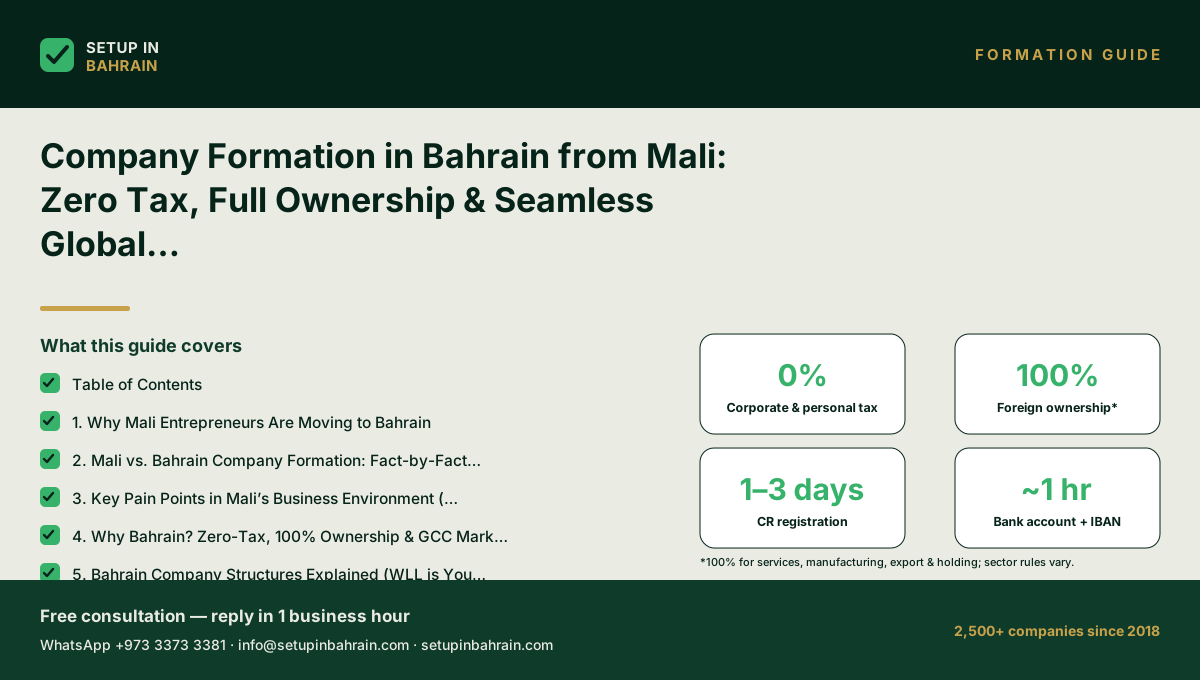
Complete guide for Mali entrepreneurs: form a company in Bahrain with generally no corporate income tax for most sectors, 100% foreign ownership, and GCC market access. Costs, steps, visas, banking.
→ Complete guide: Company Formation in Bahrain — the full 2026 guide
View details
Ownership & capital
A Bahrain WLL can be owned by a single person — 100% foreign ownership applies to most activities, with no local partner required for services, manufacturing, export trading and holding companies. The minimum share capital is BHD 1; we recommend BHD 1,000, which makes bank account opening and investor visa approval smoother.
Imagine a scenario familiar to virtually every Malian entrepreneur: You’ve built your trading, logistics, or agri-export business from scratch in Bamako or Sikasso. Yet, every year, 30% of your company’s profits are swallowed by corporate income tax, and every international invoice means tricky, multi-step currency hurdles—from converting XOF to EUR as a bridge, then into USD, not to mention fees and delays. On top of this, 2022’s ECOWAS sanctions, the military government since 2021, and frozen French and US aid have choked your cash flow and left Mali’s banking sector isolated. Growth feels boxed in.
What if there’s a way out? A jurisdiction with no corporate or personal income tax, 100% foreign ownership—even for a single person—and a resilient banking sector plugged directly into the world’s financial flows. Welcome to Bahrain: the Gulf region’s best-kept secret for bold West African entrepreneurs ready to go global while remaining fully compliant and transparent.
This is the most in-depth, Mali-focused guide to forming and running your company in Bahrain. Designed for ambitious Malian founders, it delivers exhaustive insights, official references, and practical steps tailored to your pain points.
Table of Contents
- Why Mali Entrepreneurs Are Moving to Bahrain
- Mali vs. Bahrain Company Formation: Fact-by-Fact Comparison
- Key Pain Points in Mali’s Business Environment (2026)
- Why Bahrain? Zero-Tax, 100% Ownership & GCC Market Entry
- Bahrain Company Structures Explained (WLL is Your Best Option)
- Step-by-Step Process: Setting Up a WLL from Mali
- Legal, Tax, and Regulatory Framework
- Cross-Border Banking: From XOF to USD, Dinar and Beyond
- Investor Visas and Residency Options for Malians
- Costs, Timelines, and Practical Requirements
- Common Mistakes and Pitfalls for Mali Entrepreneurs
- FAQs: Real-World Questions from Malian Founders
- Conclusion & Action Checklist
Citations:
- Central Bank of Bahrain (CBB)
- Bahrain Economic Development Board (EDB)
- Ministry of Industry & Commerce (MOIC)
- Bahrain Information & eGovernment Authority (BIPA)
- World Bank Doing Business Reports
1. Why Mali Entrepreneurs Are Moving to Bahrain
Let’s get right to the core: Malian business owners are relocating to Bahrain for survival, sanity, and scale.
Success Story Snapshot
In 2025, a Bamako-based gold trading company owner saw his 3generally no corporate income tax for most sectors bill climb past XOF 180 million on XOF 600 million in profit. That same year, two forced currency conversion steps (XOF to EUR; EUR to USD) ate another 6% of each cross-border payment. Then ECOWAS sanctions hit, slashing his working capital line by 40%. Within four months of Bahrain company formation, he banked directly in USD through a local Bahraini bank, with zero tax, zero local partner requirement, and unrestricted profit repatriation.
It's not a fantasy; it’s how top Malian firms have leapfrogged local barriers.
The Core Triggers
- Punitive taxation at home (30% corporate, plus indirect taxes)
- Currency friction: XOF isn’t accepted for international trade; forced EUR bridge and double conversion fees.
- Sanctions and political risk: ECOWAS, AU, and major donor suspensions since 2022 restrict transfers.
- Banking limitations: Difficult or blocked international payments; cashflow bottlenecks.
- Need for global credibility: Many international partners resist transfers to Mali-based companies post-sanctions.
2. Mali vs. Bahrain Company Formation: Fact-by-Fact Comparison
Here’s a side-by-side table distilled from official CBB, MOIC, and EDB sources, plus World Bank data. All numbers current for 2026.
| Feature | Mali | Bahrain |
| Corporate income tax | 30% (flat rate) | 0% (except a few sectors: oil/gas, banking) |
| Capital repatriation | Limited—permits, central bank checks | Full, immediate, no restrictions |
| Currency for international trade | XOF (CFA) needs EUR bridge; USD indirect | BHD (pegged to USD), USD accounts available |
| Company types | SARL, SA, SNC | WLL, BSC, Branch, Sijili (no WLL option) |
| Minimum share capital | SARL: XOF 1m (~USD 1,650) | WLL: BHD 1 (legal min)—BHD 1,000 practical minimum |
| Direct single-person ownership | Rare, complex | WLL: 100% allowed (no partner needed) |
| Investor residency visas | Difficult, subject to quotas | Straightforward with WLL and BHD 1,000+ capital |
| Ease of banking | Limited, slow, compliance bottlenecks | Global reach, fintech options, USD/EUR accounts |
| Setup time | 4-8 weeks (with variable bureaucracy) | 2-4 weeks (majority of cases, post-KYC) |
| Annual reporting | Complex, manual | Streamlined, e-governance via BIPA |
3. Key Pain Points in Mali’s Business Environment (2026)
Most international guides gloss over Mali’s unique obstacles. Here’s the unvarnished reality for founders:
3.1. 3generally no corporate income tax for most sectors — The Silent Killer
- Direct impact: For every $100,000 in pre-tax profit, Mali’s SARL owners will lose approximately $30,000 to corporate taxes—before payroll, import duties, or any compliance costs.
- No meaningful tax incentives: Few realistic holidays for SMEs—most apply only to large, government-blessed projects.
3.2. XOF Currency Bottleneck
- XOF is NOT convertible on world markets.
- International transfers: Every USD or CNY payment requires converting XOF to EUR, then EUR to the desired currency. Typical bank spread: 2–4% per leg, plus wire transfer costs.
- Currency depreciation: Since 2021, XOF purchasing power has dropped ~9% versus USD.
- Payment delays: Transfers routed through pan-African or French intermediaries, averaging 3–5 working days.
3.3. Political Instability & Sanctions
- Military junta rule since 2021, creating legal uncertainty.
- ECOWAS sanctions in 2022: Financial sanctions, border closings, freeze on regional clearing.
- French and US aid suspended: Major programs frozen, choking donor-dependent liquidity.
- Tightened capital controls: BCEAO scrutiny delays business payments and foreign investments.
- Investor confidence plummeted: In 2024-2026, Mali dropped 31 places in the World Bank “Ease of Doing Business” index.
3.4. Banking and Regulatory Friction
- Limited international banking: Only a handful of Mali banks have USD correspondent accounts; most rely on lengthy French clearing.
- Paper bureaucracy: Many legal processes still require physical presence, handwritten documents.
- Frequent rule changes: New decrees on exchange controls and company licensing with little notice.
4. Why Bahrain? Zero-Tax, 100% Ownership & GCC Market Entry
Bahrain can single-handedly remove all these obstacles.
4.1. Zero Corporate and Personal Income Tax
- Corporate income tax: 0% for all non-oil, non-banking activities.
- No capital gains tax, no dividend withholding, no payroll tax for owners.
- Indirect taxes: 10% VAT, but only if trading locally. No VAT on exports.
Citation: CBB Official Tax Guide (2026)(https://cbb.gov.bh)
4.2. 100% Foreign Ownership—Including for Individuals
- WLLs in Bahrain can be 100% owned by a single foreign individual, with no Bahraini partner or manager required in most sectors.
- No WLL (Single Person Company) option exists—use WLL structure for ultralight setups.
4.3. USD-Pegged, Global Banking
- Bahraini dinar (BHD) is USD-pegged (1 BHD = ~$2.65)
- Expats and companies can open USD, EUR, GBP accounts at local banks (e.g., Bank ABC, Al Salam).
- No restrictions on capital or dividend repatriation—funds can be wired to Mali or globally without tax or prior approval.
4.4. Full GCC Market Access
- GCC markets (Saudi, UAE, Qatar, Kuwait, Oman) are directly accessible from Bahrain company—no extra licensing required.
- European and Asian investors consider Bahrain a credible, transparent, OECD-compliant base for Africa/GCC trade.
Citation: Bahrain Economic Development Board (EDB)
5. Bahrain Company Structures Explained (WLL is Your Best Option)
Bahrain offers several company types, but for 95% of Malians, the WLL (With Limited Liability) structure is the optimal blend of flexibility and cost.
5.1. What Is a WLL?
- WLL: With Limited Liability Company
- Minimum share capital: BHD 1 (but banks and visa authorities expect BHD 1,000 for legitimacy)
- Single-person ownership allowed: You don’t need partners or local nationals.
- Limited liability: Your risk is capped to the company’s capital—protecting personal assets.
- Ideal for:
5.2. Other Types (For Reference)
| Structure | Key Features | Ownership | Capital | Typical Use |
| BSC | Joint-stock; for large firms, IPOs & regulated sectors | Unlimited | BHD 250,000+ | Banks, insurance, public companies |
| Foreign Branch | Acts as local branch, not a separate entity | Parent company | None | Multinational expansion, not for SMEs |
| Sijili (eCommerce license) | Home-based SMEs or freelancers | 100% foreign in select activities | None | Freelance, microservices (not for physical trading) |
6. Step-by-Step Process: Setting Up a Bahrain WLL from Mali
Let’s break down the entire procedure for Mali founders, step by step, without the usual generic advice:
Step 1: Define Your Activity & Reserve Name
- Consultation: Confirm your business activity isn’t on Bahrain’s restricted/regulated list (70% of commercial activities are open; regulated sectors include oil refining, banking, pharma—special licenses needed).
- Name reservation: Choose a unique name via BIPA (Bahrain Information & eGovernment Authority) portal. English or Arabic accepted.
- Tip: Double-check French/Arabic transliterations for branding consistency!
Step 2: Choose Practical Share Capital
- Legal minimum: BHD 1 (about USD 2.65)—but in reality, open a bank account and sponsor an investor visa, you need BHD 1,000 or more.
- Source: CBB and EDB banking/banking introduction guidelines.
Step 3: Prepare Documentation
- Malian passport scan (not expired)
- Proof of address (utility bill, not older than 3 months)
- Business plan (1-2 pages; required by bank)
- Company shareholder resolution (if a corporate shareholder)
- No police clearance required—Bahrain does not need a Mali “casier judiciaire.”
Step 4: File Online via Sijilat Portal (MOIC/BIPA)
- All company filings done digitally—no physical presence needed.
- Attach digital copies; pay filing fees (~BHD 150–300, depending on activities)
Step 5: Bank Account Opening
- Once company is registered, select a bank. Popular for Africa-facing business: ABC, BisB, or Al Salam.
- Opening requirements: In-person visit for compliance (CBB anti-money laundering rules); some banks accept video calls for initial KYC.
- USD, EUR, and BHD accounts available.
- Tip: Demonstrate “substance” (actual activity, not just a shell) via website, contracts, and a small local office/virtual office.*
Step 6: Secure Address & License
- Office requirement: Smallest possible “virtual office” (legal address) via approved business center is sufficient for many WLLs.
- Commercial activities: If importing or exporting goods, a small warehouse or serviced office may be needed for customs.
Step 7: Apply for Visa (Investor/Manager)
- With company formed and BHD 1,000+ capital, you may apply for investor and manager visas.
- Residence visa offers full legal residency (renewable); spouse and minor children can be sponsored.
- Medical exam required in Bahrain for residence permit.
Step 8: Ongoing Compliance
- Annual renewal via Sijilat
- Basic bookkeeping—can be outsourced for USD 1,000–2,000/year
- No annual audit unless turnover or capital > BHD 20,000
Typical timelines: 2–4 weeks start-to-finish (BIPA & EDB, 2026)
7. Legal, Tax, and Regulatory Framework
7.1. Legality and Reputation
- OECD-compliant: Bahrain is recognized by the OECD and major international banks as a transparent jurisdiction—not a “blacklisted” secrecy haven.
- CBB and MOIC maintain strict know-your-customer (KYC) standards.
- Regulated sectors (banking, oil, telecom, health): Pre-approval/license required.
7.2. Taxation in Bahrain
- generally no corporate income tax for most sectors for standard WLL activity (all non-oil non-financial businesses; regulated activities may differ—consult CBB for current listings).
- No personal income tax.
- No capital gains or dividend withholding taxes.
- 10% VAT: Only applicable if goods/services sold locally; exports are VAT-exempt.
7.3. Reporting and Bank Account Audits
- Annual simplified filings via BIPA; minimal paperwork required.
- Anti-money laundering compliance: Maintain contracts/invoices for all cross-border inflows/outflows to ease banking compliance.
- No on-site audits unless annual turnover > BHD 1 million (≈USD 2.65 million)
References: Central Bank of Bahrain official guidance, MOIC Companies Law (2026)
8. Cross-Border Banking: From XOF to USD, Dinar, and Beyond
For Malian companies, banking is the single most powerful unlock Bahrain offers.
8.1. Multi-Currency Accounts
- Businesses can maintain accounts in BHD (USD-pegged), USD, and EUR.
- Direct SWIFT payments in and out—no intermediary clearing required.
8.2. Currency Conversion Flow (Mali vs. Bahrain)
| From → To | Mali Typical Route | Bahrain Typical Route |
| XOF → USD | XOF → EUR (BCEAO clearing) → USD (correspondent) | XOF → USD (via Mali Bank) → Deposit USD in Bahrain |
| EUR → CNY | XOF → EUR (BCEAO) → EUR wire → CNY (escompte) | USD/EUR wire out from Bahrain direct via SWIFT |
| Payment Speed | 3–5 days, sometimes “held for compliance” | 24h–48h (Bahrain to most global banks) |
| Fees | 2–4% total spread + wire fees | <1% total fees on average, competitive SWIFT rates |
8.3. Global Payment Gateways
- Stripe, PayPal, and other global payment gateways are available to Bahrain WLLs.
- No restrictions on linking local or international bank accounts.
Citation: CBB FAQ on Cross-Border Payments, EDB
9. Investor Visas and Residency Options for Malians
9.1. Investor/Business Owner Visa
- Qualifies with BHD 1,000+ company capital and Bahrain-registered WLL.
- Grants renewable 2- or 3-year residence for main applicant.
- Spouse and minor children also covered.
- Permits international travel and legal residence within Bahrain.
9.2. Employment Visas
- Easier to sponsor skilled/management staff.
- No “nationalization quotas” for companies with <5 total staff.
- No visa lottery or points-based system for business owners.
9.3. Long-Term Residency (“Golden Residency” and Flexi Permit)
- Golden Residency (10 years): For larger investors, BHD 200,000+ in local assets or real estate.
- Flexi Permit: Not typically available to new company founders; more relevant for freelancers.
Full details: Bahrain Labour Market Regulatory Authority
10. Costs, Timelines, and Practical Requirements
10.1. Setup and Maintenance Costs
| Expense | One-Off Setup (USD) | Annual (USD) |
| Sijilat registration | $400–$800 | $0 |
| Legal address (virtual) | $1,000–$1,500 | $1,000–$1,500 |
| Bank account (deposit) | $2,650+ (BHD 1,000) | N/A |
| Visa application | $650–$900 | $500–$700 |
| Basic bookkeeping | — | $1,000–$2,000 |
| Total (Year 1) | $5,700–$7,500 | $2,500–$4,000 |
10.2. Timeline — From Mali to Full Operation
- Name reservation: 2–3 days
- Company registration: 5–10 working days post-KYC
- Bank account activation: 7–14 days (if all compliance passes)
- Visa approval: 2–3 weeks after company setup
*Total: With prompt paperwork, 3–5 weeks from start to finish. No need for 2–3 month waiting.
11. Common Mistakes and Pitfalls for Mali Entrepreneurs
- Setting capital too low: Legally, BHD 1 is allowed, but banks and immigration require at least BHD 1,000—don’t cut corners.
- Treating WLL as a passive “offshore” company: Bahrain expects “substance”—a business plan, at least a virtual office, and active management.
- Confusing WLL with non-existent WLL: Always use WLL; Bahrain has no single-person company license, but WLL handles single-person ownership.
- Ignoring executive visa: Running your company remotely is possible for a few months, but active management and banking require your presence.
- Not maintaining paperwork: For international transfers, invoices/contracts are required for compliance; lax documentation can stall bank operations.
12. FAQs: Real-World Questions from Mali Entrepreneurs
Q: Can I keep my Mali business running in parallel with my new Bahrain company?
_Yes, but be aware Mali’s BCEAO rules require full reporting of all foreign “caisse” receipts. Profits earned in Bahrain by your new WLL can be remitted globally, but direct transfers back to Mali should be declared to avoid risks of double-tax or compliance scrutiny._
Q: Will Belgian/French or GCC clients respect a Bahrain-registered entity?
_Absolutely. Bahrain is a OECD-compliant, FATF “low-risk” jurisdiction with a global reputation. Many European firms actively prefer transacting with Bahrain entities over Mali ones (especially post-sanctions)._
Q: Is any sector off-limits or “high compliance”?
_Banking, oil & gas, pharma and defense manufacturing require special licenses. General trading, consulting, logistics, and import/export are all “unrestricted” for foreign (including Malian) founders._
Q: Do I need to be physically present in Bahrain at all times?
_No. After initial bank KYC (may require a short visit), you can manage the company remotely, visiting as needed. Visa holders can come and go._
Q: How does Bahrain compare to UAE and Mauritius for African entrepreneurs?
- _UAE_: Heavier compliance, “economic substance” tests, and banks less friendly to small African exporters post-2022. Costs 2x Bahrain, visa quotas apply.
- _Mauritius_: Good tax but less global credibility and harder USD banking than Bahrain. Many African investors still choose it for French connection, but Bahrain’s GCC platform is more robust.
13. Conclusion & Action Checklist
If you’re a Malian founder struggling with vicious tax, currency restrictions, and cross-border payment blockages, Bahrain offers a clear, credible route to freedom and global growth. With Generally no corporate income tax for most sectors, 100% single-person ownership, USD/EUR-pegged banking, and no restrictions on capital, it’s no wonder savvy West African businesses are anchoring themselves in Manama.
What To Do Next
- Assess your current obstacles: Corporate tax, payment delays, currency friction.
- Draft a business plan focused on cross-border activity.
- Contact a Bahrain-registered formation agent—or apply directly via BIPA.
- Prepare your documents (passport, proof of address, capital).
- Register a WLL with at least BHD 1,000 capital.
- Open a USD or BHD business account.
- Apply for investor/owner visa.
- Launch your operations and plug into GCC/global markets.
Ready to unlock global opportunities and push your Malian business dreams beyond borders? Bahrain is the launchpad—let 2026 be your year to thrive.
Official Resources for Further Reading:
- Central Bank of Bahrain (CBB)(https://www.cbb.gov.bh)
- Bahrain Economic Development Board (EDB)(https://www.bahrainedb.com)
- [Ministry of Industry & Commerce (MOIC)](https://www.moic.gov.bh)
- [Bahrain Information & eGovernment Authority (BIPA)](https://www.bipa.gov.bh)
- [World Bank Doing Business Profile: Bahrain](https://www.doingbusiness.org/en/data/exploreeconomies/bahrain)
_End of Expert Guide — 100% Focused on Mali-to-Bahrain Business Formation_
Bahrain Business Guides for Mali Citizens
Ready to set up in Bahrain from Mali?
Tell us your business idea. We map the right entity, ownership and timeline — then handle the filing while you focus on what matters.