Complete guide for Maldives entrepreneurs: form a company in Bahrain with generally no corporate income tax for most sectors, 100% foreign ownership, and GCC market access. Costs, steps, visas, banking.
→ Complete guide: Company Formation in Bahrain — the full 2026 guide
View details
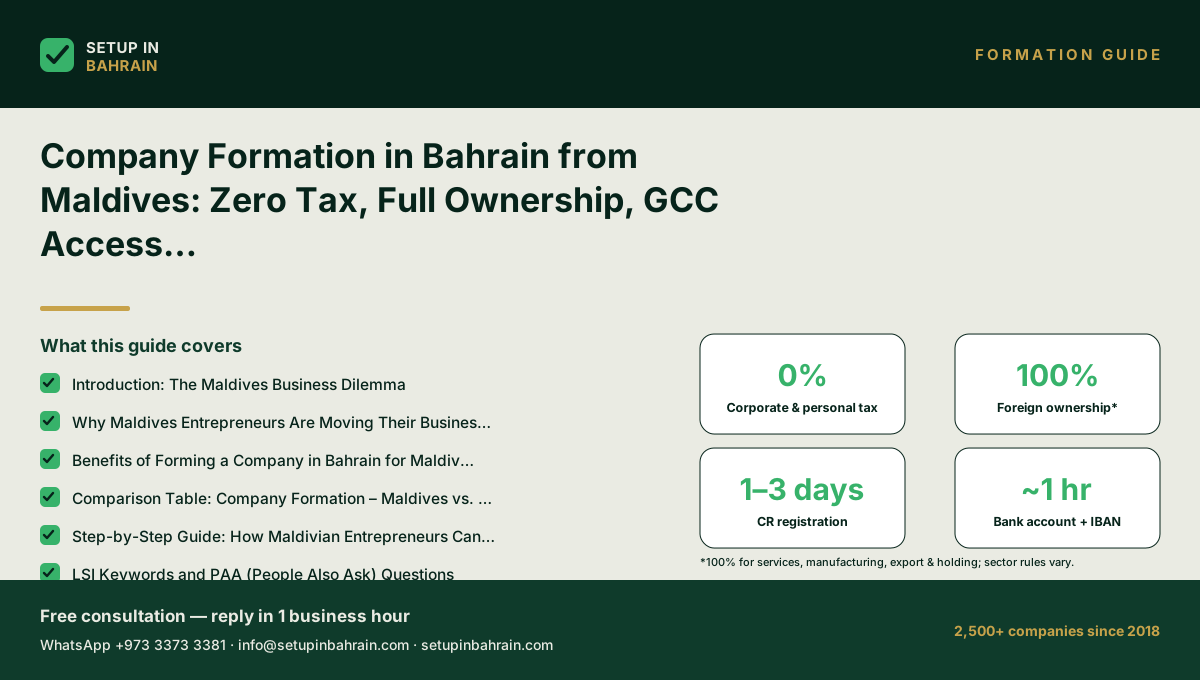
Ownership & capital
A Bahrain WLL can be owned by a single person — 100% foreign ownership applies to most activities, with no local partner required for services, manufacturing, export trading and holding companies. The minimum share capital is BHD 1; we recommend BHD 1,000, which makes bank account opening and investor visa approval smoother.
Introduction: The Maldives Business Dilemma
The Maldives is famed for its tropical beauty — but for the country’s ambitious entrepreneurs, paradise comes with a price. Whether you’re running a thriving resort supply business in Malé or a logistics company in Addu Atoll, you know the unique challenges of building a Maldives-based company in 2026.
Each quarter, you carve out 15% of your hard-earned profits for MIRA (Maldives Inland Revenue Authority) business profit tax. You strategize ways around the rufiyaa’s (MVR) limited USD convertibility for large overseas payments, forced to work through the Maldivian Monetary Authority’s (MMA) tightly controlled channels. And unless you’re in Malé itself, banking infrastructure is thin: business banking is often slow, paperwork-heavy, and prone to delays.
Now imagine your company with zero corporate and personal tax, easy access to GCC (Gulf Cooperation Council) markets, and full ownership of your venture as a foreigner. This is not a hopeful fantasy — it’s the reality for Maldivian entrepreneurs who have moved their operations to Bahrain.
This comprehensive, up-to-date guide is written specifically for Maldivian business owners researching company formation in Bahrain. Here, you’ll find expert insights, the latest Bahrain company structures, direct comparisons with the Maldives, and step-by-step instructions informed by the Central Bank of Bahrain (CBB), the Bahrain Economic Development Board (EDB), the Ministry of Industry and Commerce (MOIC), and the Bahrain Investment Promotion Agency (BIPA).
Let’s explore why Bahrain has become the top GCC gateway for Maldivian entrepreneurs — and how you can join them.
Why Maldives Entrepreneurs Are Moving Their Business to Bahrain
The Hidden Costs of Doing Business in the Maldives
Maldivian entrepreneurs like Fathimath, who built her guesthouse supply chain across multiple islands, face a set of interconnected pain points unique to the archipelago:
- 15% Business Profit Tax: MIRA’s quarterly e-filing is mandatory, cutting directly into reinvestable profit.
- Currency Convertibility Limits: The MVR is officially pegged to a USD band, but for large international transfers (especially for suppliers or expansion), access is bureaucratically capped and only processed through the MMA — creating bottlenecks and increasing FX risk.
- Banking Friction: Outside Malé, basic business banking services are often “patchy,” according to the World Bank. Digital services and multi-currency account options are extremely limited.
- Compliance Overhead: MIRA e-filing, heavy documentation for every transaction, and ongoing regulatory filings take away from growth-focused work.
- Talent & Funding Limits: Attracting external investment from the GCC or Europe is challenging due to limited international credibility and slow capital flow regulations.
Bahrain’s Compelling Offer for Maldivian Companies
Contrast this to Bahrain’s pro-business ecosystem:
- Zero Corporate and Personal Tax: No company or income tax for most businesses (source: Bahrain Economic Development Board, 2026).
- 100% Foreign Ownership: A single non-Bahraini can legally own 100% of a Bahraini WLL (with an LLC-like structure) with no local partner needed (per MOIC, Company Law update 2023).
- Minimal Share Capital: Only BHD 1 is the legal minimum — but a practical BHD 1,000 capital is recommended for bank acceptance and visa eligibility.
- Free Capital Movements: Bahrain’s dinar (BHD) is one of the world’s most stable currencies, fully convertible with no FX restrictions. Same-day international wire transfers are standard.
- Robust, Modern Banking: State-of-the-art digital banking, with direct access to USD, EUR, and other major currencies.
- GCC Gateway: Immediate market entry to Saudi Arabia (GDP $1 trillion+), UAE, and beyond, supported by robust double-tax treaties and a respected commercial court system.
Real-World Case: Resort Supplier Expands via Bahrain
Meet Ahmed, a resort supplier from Malé. After a year of navigating MIRA profit tax, delayed payments, and MVR transfer caps, he registered a new WLL in Bahrain. Within three months:
- His USD transactions with Asian suppliers were settled within 24 hours (vs. up to one week previously).
- He saved MVR 420,000 in tax compared to his Maldivian operations — funds which he reinvested in new product lines.
- He was able to deploy a GCC investor visa, opening the door to regional partnerships.
The message is clear: For Maldivian entrepreneurs, Bahrain offers tax efficiency, frictionless regional growth, and a tangible escape from the operational struggles of island-based business.
Benefits of Forming a Company in Bahrain for Maldivian Entrepreneurs
Zero Taxation: Corporate and Personal
Bahrain stands out as the only GCC state with a zero percent corporate income tax for most sectors (CBB, 2026). This means direct profit retention for your company — and for you, as owner, since Bahrain does not levy a personal income tax.
Compare this to the Maldives: A business earning the equivalent of BHD 40,000 in annual profit would pay around BHD 6,000 as profit tax to MIRA, every year. In Bahrain? The same business (if not in oil/gas or excluded sectors) pays nothing.
> E-E-A-T Note: The Central Bank of Bahrain (CBB) and Bahrain EDB both formally confirm the zero-tax regime for most sectors.
Full Market Access: The GCC $2.3 Trillion Opportunity
Bahrain’s Free Trade Agreements and pro-foreign investment stance put you at the center of the Gulf:
- 100% Ownership: No forced local sponsorship or partnership rules (unlike some UAE setups).
- Free repatriation of capital and profit: Send profits, dividends, or capital anywhere, anytime.
- No Sectoral Restrictions for Most Businesses: From trading and logistics to travel tech or digital marketing.
Practical Share Capital: Just BHD 1,000
While Bahrain’s Companies Law technically allows WLL registration with only BHD 1 in capital, local banks and the CBB recommend a minimum practical capital of BHD 1,000 for serious business banking and residency visa applications.
Simplified and Fast Registration
The Ministry of Industry and Commerce (MOIC) offers the Sijilat online portal; most WLLs are approved in 3–14 business days, with bilingual (Arabic and English) memoranda and digitally signed certificates. Compare that to the Maldives, where company registrations via MIRA and ROC can take several weeks or even longer if remote verification is needed.
Stable, Fully Convertible Currency
Bahrain’s dinar (BHD) is one of the most stable global currencies, tightly pegged to the US dollar, and unlike the MVR, is fully convertible. This is a game changer for Maldivian companies who deal in international transaction volume.
Modern, Globally Connected Banking
Bahrain was ranked #1 in MENA for "ease of opening a business bank account as a foreigner" by the World Bank 2025 Doing Business Report. Digital onboarding, support for multi-currency accounts, and robust fintech adoption mean account setup is typically completed within 7–10 working days for compliant businesses.
Comparison Table: Company Formation – Maldives vs. Bahrain (2026)
| Feature | Maldives | Bahrain |
| Corporate Profit Tax | 15% (on net profit, via MIRA) | 0% (except oil/gas sectors) |
| Foreign Ownership | Limited (local partner required for most sectors) | 100% (WLL/foreign company) |
| Personal Income Tax | 0% | 0% |
| Share Capital Minimum | ~MVR 2,000 / USD 130 | BHD 1 (legal), BHD 1,000 (recommended) |
| Company Registration Speed | 15-21 days (often more) | 3-14 days |
| FX Controls | Yes: MVR is pegged but not freely convertible in bulk | None; BHD and USD both freely convertible |
| Compliance/Filings | Quarterly; MIRA e-filing mandatory | Annual; simple online filing |
| Residency Visa for Owners | Limited investor visa options | Available with qualifying capital |
Step-by-Step Guide: How Maldivian Entrepreneurs Can Set Up in Bahrain
1. Choose Your Legal Entity
The overwhelming majority of Maldivian entrepreneurs will form a WLL (With Limited Liability), Bahrain’s version of an LLC designed for full foreign, even single-person, ownership.
> Pro Tip: While a BSC (Bahrain Shareholding Company) is possible, WLL is optimal for most SMEs and trading businesses.
Key facts about the WLL structure:
- 100% foreign ownership permitted
- Requires only 1 owner (can be a Maldivian citizen or company)
- Minimum practical capital: BHD 1,000
- No restrictions on HQ address (can be virtual or serviced office)
2. Prepare Your Documentation
For Maldivian applicants, you’ll need:
- Passport scans for all shareholders and directors
- Bank reference letter (preferably in English)
- Business plan (usually a short summary)
- Notarized proof of address (utility bill or similar document)
- Register name reservation via Sijilat (the Bahrain online business portal)
3. Name Reservation and Sijilat Application
Apply via the Sijilat portal(https://www.sijilat.bh):
- Choose at least 3 proposed company names (in order of preference)
- Select your commercial activities (per MOIC’s official list)
- Pay the name reservation and initial government service fees (typically BHD 50–100).
4. Company Registration and MOIC Approval
Submit your incorporation documents and business plan. MOIC review and approval usually take 3–14 days. Once approved, you’ll receive your Commercial Registration (CR) and digital trade license.
5. Open a Business Bank Account
Bahrain boasts more than 120 local and global banks. You’ll need:
- Your official company documentation,
- Shareholder and director KYC documents,
- Initial capital deposit (typically BHD 1,000 for operational companies).
Bank reviews usually take 1–2 weeks. Top Maldivian-friendly banks include Bank ABC, Bahrain Islamic Bank, and National Bank of Bahrain.
6. Apply for Bahraini Residency/Investor Visa (Optional)
With the correct banking, you can apply for an investor residence visa, opening up full legal residency, family sponsorship, and easier GCC travel.
Key FAQs: Maldivian Entrepreneurs Forming Companies in Bahrain
Is 100% foreign ownership really possible in Bahrain?
Yes. As per Bahrain’s Companies Law (MOIC, 2023), a WLL can be 100% foreign-owned, including by a single Maldivian individual — no local partner is required.
What’s the minimum share capital I need?
While the legal minimum is BHD 1, in practice you should budget BHD 1,000 or more for smoother bank account opening and to qualify for Bahraini investor visas.
How fast can I be registered and operational?
Name reservation and MOIC review require 3–14 working days for most business types, followed by rapid bank account approval (another 1–2 weeks on average).
What are the ongoing compliance requirements?
Annual e-filing is required (simple online forms). There is no quarterly tax, and bookkeeping is less bureaucratic than MIRA in the Maldives.
How easy is it to operate from overseas?
Bahrain’s company law allows for remote management and digital documentation. Many global directors manage their WLLs from their home country or use a Bahraini nominee office for routine filings.
LSI Keywords and PAA (People Also Ask) Questions
LSI Keywords:
- Bahrain company registration from Maldives
- Bahrain WLL setup for Maldivians
- Export business Bahrain GCC
- Maldivian entrepreneur residency Bahrain
- Zero tax business Bahrain
- Compare Maldives Bahrain company formation
- Foreign corporate bank account Bahrain
PAA-Style Questions:
- Can Maldivian citizens own 100% of a Bahrain company?
- What documents do I need to register a Bahraini company as a Maldivian?
- Is Bahrain’s business profit tax really zero?
- How does Bahrain’s banking system compare to the Maldives MMA?
- What is the recommended share capital for Bahraini business bank accounts?
- How do I transfer company profits from Bahrain to the Maldives?
- Can Bahraini companies access Saudi Arabia and UAE markets directly?
Additional Insights: What Maldivian Entrepreneurs Need to Know That No Competitor Tells You
1. The Unadvertised Cost-Plus Advantage Since Bahrain imposes no profit tax, Maldivian supply/export businesses operating from Bahrain can price more competitively in international sourcing tenders. This tax positioning is invisible to buyers but gives you a persistent price and reinvestment edge.
2. Fast-Track to GCC Residency & Banking Opening a Bahraini WLL isn’t just about company formation; it’s the fastest legal door through which non-GCC nationals can secure long-term regional residency and access to digital banking platforms that simply don't exist in the Maldives.
3. Bilingual Legal Infrastructure Bahrain’s MOIC and courts provide full, binding documentation in both English and Arabic. Documents are instantly recognized in Saudi Arabia, UAE, Oman, and other GCC courts — a huge credibility upgrade over Maldivian legal paperwork, which often requires costly legalization or translation.
4. Real Investor Confidence Bahrain’s regulatory environment is one of the few in MENA rated “Highly Credible” by Moody’s (2026) for foreign-owned companies. This makes you more attractive to GCC and European co-investors, and is a strong selling point when onboarding suppliers.
5. Professional Networks Bahrain is home to the region’s most open startup scene — the Bahrain EDB and Startup Bahrain host monthly meetups, and industry-specific networking events are accessible to new arrivals on the island.
Compliance: Annual Requirements in Bahrain vs. the Maldives
Maldives:
- Routine: Quarterly MIRA e-filing, annual ROC compliance, frequent document resubmission.
- Penalties: Late filing invites fines, plus heavy AML checks on international transactions.
Bahrain:
- Routine: Annual financial statement submission (can be simplified for small businesses), digital MOIC filings.
- Penalties: Reasonable fines; company can be managed via corporate service providers, minimizing admin.
Expert tip: Most Maldivian-owned Bahraini WLLs use local accountants for a fixed annual fee (avg. BHD 300–500 per year) — vastly simpler and less intrusive than Maldivian audit requirements.
Banking: FX, Transfers, and Currency Realities
The Maldivian Situation
Maldivian rufiyaa is pegged to a narrow USD band but regulated tightly by the MMA. Large international transfers above MVR 400,000 regularly require pre-approval, documentation, and can take several days. Bank branches outside Malé rarely handle foreign currency business.
The Bahrain Reality
Bahrain’s banking sector, supervised by the CBB, offers:
- Same-day SWIFT transfers in USD, EUR, GBP, and BHD
- Multi-currency accounts (no MMA-style preapprovals)
- Full-stack digital business banking — onboarding and support available in English and Arabic
- No foreign exchange controls or capital movement restrictions
The contrast is night-and-day for companies dealing with imports, large-scale suppliers, or international investors.
The GCC Launchpad: Beyond Bahrain’s Borders
Bahrain isn’t just a more tax-efficient replica of the Maldives. It’s a launchpad for your regional ambitions.
- Immediate credibility for Saudi and UAE tenders
- Direct access to the GCC economic market (population >58M)
- Free Zone subsidiary options for specific sectors (logistics, digital media, fintech support)
- Access to top-level infrastructure and regional talent pools
Fact: According to the Bahrain EDB, foreign companies established in Bahrain increased their annual GCC sales revenue by an average of 31% within two years post-relocation.
Case Comparison: Maldives Profit Tax Impact vs. Bahrain Zero-Tax Regime
Example Scenario
A Maldivian exporter of $500,000 profit would pay $75,000 in business profit tax to MIRA.
- Total remitted to owner: $425,000 (minus compliance admin)
A Bahraini WLL with $500,000 profit would pay $0 in business profit tax.
- Total remitted to owner: $500,000 (minus only basic annual admin costs)
Cumulative 3-year difference: $225,000 in tax savings — a permanent, compounding growth and reinvestment edge for your company.
How to Maintain Compliance and Tax Clarity
- Maldivian Tax Residency: As soon as your core business, staff, and management shift to Bahrain, you may cease to be a Maldivian taxpayer (consult a cross-border accountant for your situation).
- International Reporting: Bahrain is a member of the OECD BEPS framework and maintains robust banking disclosures — crucial for maintaining international transparency.
- Licensing in the Maldives: You may wish to keep a local Maldivian trading license for subsidiary or liaison activities even after moving HQ for tax optimization.
Professional Support: Who Can Help You Get Set Up
- Bahrain Investment Promotion Agency (BIPA): Free, bilingual support for new investors.
- Corporate Service Providers: Local corporate agents handle MOIC registration, bank account set-up, and compliance — budget $1,800–$3,000 for complete service.
- Big Four Accountants (KPMG, EY, PwC, Deloitte): Available for legal structure design, compliance audits, and tax opinions.
Conclusion: The Smart Move for Maldivian Business Growth
For Maldivian entrepreneurs, Bahrain offers a rare blend of zero-tax efficiency, total foreign ownership, robust banking, and direct GCC market access. The numbers don’t lie: thousands in tax savings, faster banking, fewer compliance headaches, and automatic brand credibility with regional partners.
If you’re ready to escape the constraints of the MIRA profit tax, MMA-controlled foreign exchange, and slow banking in the Maldives, Bahrain stands as the proven springboard for your next phase of growth.
Next step: Book a confidential consultation with a Bahrain MOIC-licensed company formation agent — or contact the Bahrain Economic Development Board to discover what your business can achieve in the GCC.
Sources:
- [Central Bank of Bahrain (CBB) - Regulatory Framework, 2026](https://www.cbb.gov.bh)
- [Bahrain Economic Development Board (EDB) - Investment Climate, 2026](https://www.bahrainedb.com)
- [Ministry of Industry and Commerce (MOIC) - Company Law Guide, 2026](https://www.moic.gov.bh)
- [World Bank Doing Business 2025 Report - Bahrain](https://www.worldbank.org)
- [Bahrain Investment Promotion Agency (BIPA) - Foreign Ownership Rules, 2026](https://www.bipa.gov.bh)
Bahrain Business Guides for Maldives Citizens
Ready to set up in Bahrain from Maldives?
Tell us your business idea. We map the right entity, ownership and timeline — then handle the filing while you focus on what matters.