Register your Bahrain company from Malaysia with generally no corporate income tax for most sectors. Enjoy strategic Gulf access, easy setup process, and tax-free business benefits for Malaysian entrepreneurs.
Key Takeaways
- Why Malaysian Entrepreneurs Are Moving Their Business to Bahrain
- Bahrain's Unrivalled Advantages for Malaysian Entrepreneurs
- Understanding Company Structures in Bahrain: Your Primary Options
- The Step-by-Step Company Formation Process from Malaysia
- Opening a Corporate Bank Account in Bahrain: A Key Milestone
→ Complete guide: Company Formation in Bahrain — the full 2026 guide
View details
Ownership & capital
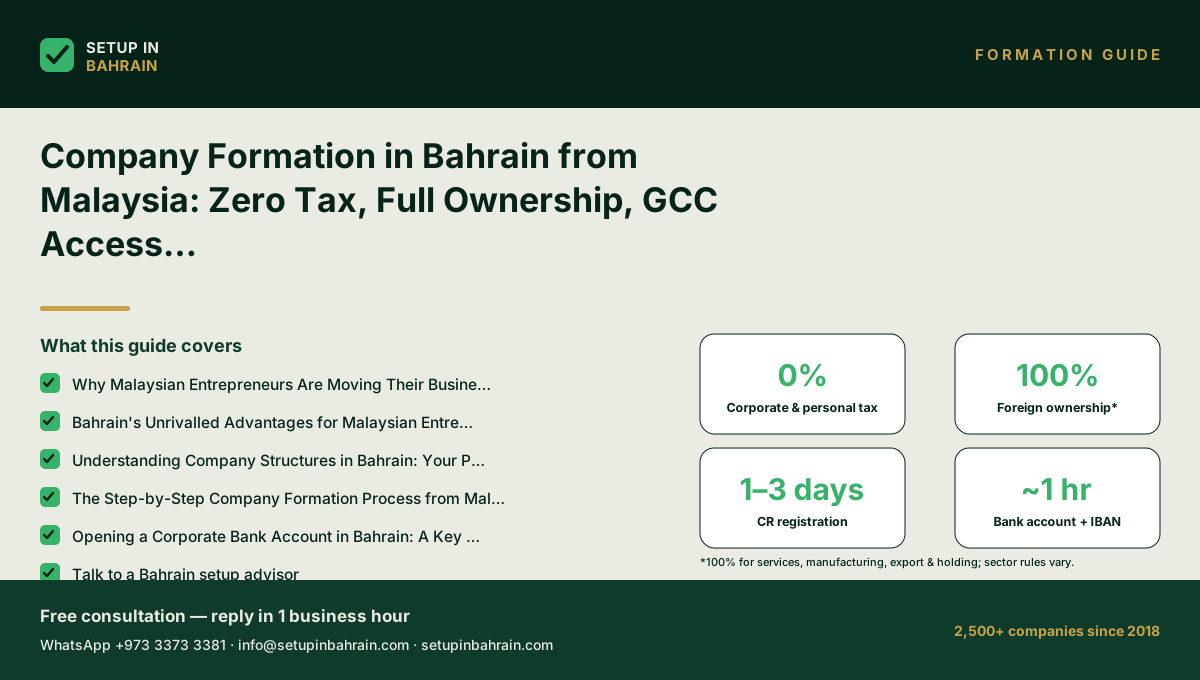
A Bahrain WLL can be owned by a single person — 100% foreign ownership applies to most activities, with no local partner required for services, manufacturing, export trading and holding companies. The minimum share capital is BHD 1 ; we recommend BHD 1,000 . This Makes bank account opening and investor visa approval smoother.
Imagine this: Puan Azlina, a seasoned entrepreneur from Subang Jaya, has spent over a decade building her IT consulting firm. She's scaled it past the RM 600,000 profit threshold, putting her firmly in the 24% corporate tax bracket. Every quarter, the LHDN e-filing feels like a complex chore. She often finds herself in late-night discussions with her accountant about transfer pricing or the latest SST amendments. The thought of expanding into the booming GCC market is exciting, but the logistics of local sponsorship requirements in neighbouring countries, coupled with Bank Negara’s capital controls on larger foreign currency transactions, feel like insurmountable hurdles. And then there's the creeping worry about the Malaysian Ringgit's persistent depreciation, eroding her business's purchasing power on international software licenses.
Now, picture Amir, who owns a burgeoning logistics business in Penang. His company is growing fast. Every time he pays international vendors, the MYR's weakness against the USD eats into his margins. He’s also acutely aware of the mandatory EPF and SOCSO contributions for his staff, adding another layer to his employer costs. When he explored diversifying his investments locally, he encountered the complexities of Bumiputera equity rules, necessitating unwelcome partnerships and further red tape.
These aren't hypothetical scenarios. They are the lived realities of thousands of Malaysian entrepreneurs who, like Puan Azlina and Amir, are asking a crucial question: "Is there a smarter, more efficient way to structure my business for 2026 and beyond?"
For forward-thinking Malaysian founders looking for an alternative, the idea of a business hub offering Generally no corporate income tax for most sectors, 100% foreign ownership, a USD-pegged stable currency, and direct access to a multi-trillion-dollar market like Saudi Arabia, sounds almost too good to be true. But it’s not. It’s Bahrain.
This isn't another generic "offshore" guide. This is a tailored blueprint, written specifically for you, the Malaysian entrepreneur, addressing your unique pain points and showing you exactly how Bahrain can be your strategic launchpad for unparalleled growth and financial resilience. We understand the landscape you operate in, the complexities you navigate daily. The aspirations you hold for global expansion without the traditional headaches. Let's delve into why Bahrain is fast becoming the preferred destination for savvy Malaysian businesses.
Why Malaysian Entrepreneurs Are Moving Their Business to Bahrain
The decision to consider relocating or expanding your business operations abroad is rarely taken lightly. It’s driven by a confluence of factors – a desire for greater profitability, less regulatory burden, better access to markets. Financial stability. For Malaysian entrepreneurs, a specific set of challenges often catalyses this search:
1. The Heavy Hand of Corporate Taxation: A 24% Burden
In Malaysia, the corporate tax landscape can feel like a significant drag on growth, especially for successful SMEs. While smaller enterprises enjoy a lower rate, the moment your company’s profits cross the RM 600,000 threshold, you are hit with a standard 24% corporate tax rate.
Consider a software developer from Kuala Lumpur running a B2B SaaS tool. His company clears RM 1.8 million in annual profit. At the 24% corporate tax rate, he pays LHDN RM 432,000 every year. That’s nearly half a million ringgit that could have been reinvested into R&D, talent acquisition, or market expansion. This is a substantial drain on capital, directly impacting the speed and scale at which Malaysian businesses can grow.
In stark contrast, Bahrain operates a Generally no corporate income tax for most sectors regime for most business activities. This means that if your company generates RM 1.8 million in profit, nearly all of it remains within your business, ready for reinvestment or distribution. This fundamental difference in tax policy alone can transform your financial outlook and accelerate your business trajectory in ways that are simply not possible under current Malaysian regulations.
2. The Labyrinth of Compliance: LHDN, SST, EPF & SOCSO
Beyond corporate tax, Malaysian entrepreneurs face a continuous stream of compliance obligations. LHDN’s ever-changing e-filing requirements, mandatory SST registration once your turnover exceeds RM 500,000. The constant need to stay updated on amendments can be time-consuming and costly. Add to this the mandatory EPF and SOCSO contributions for employees – a necessary social safety net. An undeniable additional employer cost. For Amir’s logistics business, EPF contributions for his eight staff add another RM 96,000 in mandatory employer costs annually. This combination of taxes, levies. Extensive reporting can divert valuable resources and managerial focus away from core business development.
Bahrain, while having its own regulatory framework, is renowned for its pro-business and streamlined approach. The government, especially through the Economic Development Board (EDB) and the Ministry of Industry and Commerce (MOIC), actively seeks to reduce red tape and help business operations. With no corporate income tax for most sectors, the complexity of annual tax filings greatly diminishes. While there is a 5% Value Added Tax (VAT) and social insurance contributions, the overall compliance burden is considerably lighter, allowing entrepreneurs to focus on innovation and growth rather than administrative overhead.
3. Currency Volatility and Capital Controls: The MYR Dilemma
The Malaysian Ringgit (MYR) has experienced significant depreciation over the past decade, losing more than 30% of its value against the USD since 2013. This quiet erosion of purchasing power directly impacts businesses that deal with international suppliers, pay for global cloud services, or have international revenue streams that are converted back into MYR. Every time the ringgit slips against the USD, your effective take-home in real terms drops further.
Moreover, Bank Negara Malaysia maintains strict capital controls. While necessary for macroeconomic stability, these controls can complicate large international transactions. Any attempt to transfer more than RM 200,000 abroad often flags a compliance review, causing expensive project delays and adding layers of scrutiny. For a growing business looking to expand internationally or repatriate profits, these controls can be a significant bottleneck.
In Bahrain, the national currency, the Bahraini Dinar (BHD), is pegged directly to the US Dollar at a rate of 1 USD = 0.376 BHD. This provides unparalleled currency stability, shielding your business from exchange rate fluctuations and offering predictable international purchasing power. Crucially, Bahrain also operates with no capital controls and allows for 100% unrestricted profit repatriation. This means your earnings are truly yours to move, invest, or spend as you see fit, without bureaucratic hurdles or unforeseen delays.
4. Ownership and Equity Restrictions: The Bumiputera Factor
For certain sectors and large-scale projects in Malaysia, entrepreneurs may encounter Bumiputera equity rules . This Mandate a minimum level of ownership by Bumiputera individuals or entities. While intended to promote equitable economic participation, these requirements can force entrepreneurs into partnerships they might not desire, complicate equity structuring. Potentially deter foreign investment or specific local expansion plans. For Amir, exploring local expansion in F&B, running straight into these rules added new hoops and partners he never wanted.
Bahrain champions a policy of 100% foreign ownership for companies in the vast majority of sectors. This is a game-changer for Malaysian entrepreneurs. You maintain complete control over your business, its equity. Its strategic direction, without the need for local sponsors or mandated equity splits. This level of autonomy is invaluable for protecting your vision and intellectual property as you scale globally.
5. Market Access and Regional Expansion Hurdles
While Malaysia offers a robust domestic market, expanding beyond its borders, especially into the lucrative Gulf Cooperation Council (GCC) region, can present its own set of challenges. Navigating diverse legal frameworks, cultural nuances, and potential sponsorship requirements in other GCC countries can be daunting.
Bahrain offers a unique proposition: it serves as a natural gateway to the entire GCC market , a multi-trillion-dollar economy with significant growth potential. Its strategic location, especially its causeway connection to Saudi Arabia (the King Fahd Causeway), provides unparalleled logistical advantages. From Bahrain, Malaysian businesses can efficiently serve customers across Saudi Arabia, Kuwait, Qatar, UAE. Oman, accessing a consumer base with high disposable income and a demand for diverse goods and services. This proximity, coupled with Bahrain’s liberal trade policies, positions it as an ideal springboard for regional expansion, eliminating many of the traditional hurdles faced when trying to enter these markets directly from outside the region.
Bahrain's Unrivalled Advantages for Malaysian Entrepreneurs
Having identified the pain points that drive Malaysian entrepreneurs to seek new horizons, let’s delve deeper into the specific, tangible advantages that make Bahrain such a compelling destination. This isn't just about escaping challenges; it's about embracing opportunities for unparalleled growth and financial freedom.
1. Zero Corporate and Personal Income Tax
This is often the most significant draw. The fact that the Kingdom of Bahrain levies no corporate income tax on most business activities and no personal income tax on salaries, dividends, or capital gains is a transformative benefit. This means that your business’s profits, after essential operating expenses, remain entirely within your company’s control. For entrepreneurs, this translates to:
- Maximized Profit Retention: More capital available for reinvestment, R&D, product development, or aggressive market expansion.
- Enhanced Cash Flow: Better liquidity for day-to-day operations and unforeseen opportunities.
- Greater Personal Wealth Accumulation: No tax on your earnings means your take-home pay or dividends are greatly higher.
This fundamental difference from Malaysia's 24% corporate tax rate (for profits over RM 600K) or even the 17% for SMEs, provides an immediate and substantial competitive advantage.
2. 100% Foreign Ownership and No Local Partner Requirements
Unlike many jurisdictions, including some in the GCC and certain sectors in Malaysia, Bahrain allows for 100% foreign ownership of companies in the vast majority of economic activities. This is especially true for the most common company type for SMEs, the With Limited Liability (WLL) company.
What does this mean for you?
- Complete Control: You retain full operational and strategic control over your business without the need to find, appoint, or cede equity to a local partner.
- Simplified Decision-Making: No complex partnership agreements, fewer bureaucratic layers, and direct command over your intellectual property.
- Flexibility: The ability to structure your business exactly as you envision it, without external impositions.
This freedom from local partnership requirements greatly de-risks your international expansion, ensuring your vision remains uncompromised.
3. Unrestricted Profit Repatriation and No Capital Controls
As we've touched upon, Malaysia's capital controls can hinder international financial movements. Bahrain offers a stark contrast:
- Full Repatriation: You can freely repatriate 100% of your company's profits and capital back to Malaysia or any other jurisdiction without any restrictions or special permissions.
- Financial Freedom: Your business funds are truly global, allowing for seamless international investment, payments, and wealth management.
- USD-Pegged Currency (BHD): The Bahraini Dinar (BHD) is firmly pegged to the US Dollar (1 USD = 0.376 BHD), providing exceptional currency stability and predictability. This eliminates currency risk from your international transactions, a critical advantage over the depreciating MYR.
This combination of free capital movement and a stable currency ensures your financial resources are secure and accessible whenever and wherever you need them.
4. Strategic Gateway to the Multi-Trillion Dollar GCC Market
Bahrain's geographical location is one of its most potent assets. Situated in the heart of the Arabian Gulf, it offers:
- Direct Access to Saudi Arabia: The King Fahd Causeway provides a direct, overland link to Saudi Arabia, the largest economy in the GCC. This is invaluable for logistics, trade, and tapping into a massive consumer and industrial market. Many Malaysian businesses establish in Bahrain specifically to serve the Saudi market.
- Regional Connectivity: Bahrain International Airport and its world-class port facilities (Khalifa Bin Salman Port) offer excellent air and sea links to the wider GCC, the Middle East, Africa, and beyond.
- Ease of Doing Business: Compared to some larger GCC economies, Bahrain is often cited by the World Bank as having a more agile and less bureaucratic environment, making it an ideal entry point for SMEs.
For a Malaysian business looking to expand beyond Southeast Asia, Bahrain is not just a country; it's a strategic launchpad into a vibrant, high-growth regional market.
5. Highly Competitive Operating Costs
While Bahrain offers world-class infrastructure and services, it remains a highly cost-effective place to do business compared to some of its GCC neighbours, especially the UAE.
Lower Rent: Commercial and residential rents are generally more affordable, reducing overheads. Affordable Workforce: A highly skilled, multilingual. Diverse workforce is available at competitive wage rates, often more accessible than in other hubs. Government Support: The EDB actively works to attract and support foreign investment, often providing guidance and facilitating various aspects of company setup and operations.
These lower operating costs mean that your zero-tax profits can stretch even further, enhancing your overall profitability and sustainability.
6. World-Class Infrastructure and Connectivity
Despite its smaller size, Bahrain boasts highly developed infrastructure that rivals larger nations:
Advanced Telecoms: State-of-the-art fibre optics and 5G networks ensure seamless global communication. Modern Transportation: Efficient road networks, a modern international airport. A well-equipped port help smooth logistics and travel. Smart City Initiatives: Ongoing investment in smart technology and urban development ensures a high quality of life and business environment.
This robust infrastructure provides a reliable foundation for any business, especially those reliant on digital connectivity and efficient supply chains.
7. Progressive, Transparent, and Pro-Business Regulatory Environment
Bahrain’s government is genuinely committed to fostering a business-friendly ecosystem.
- Economic Development Board (EDB): The EDB acts as a single point of contact for foreign investors, offering comprehensive support from initial inquiry to full operation. They are instrumental in streamlining processes and providing market insights.
- Ministry of Industry and Commerce (MOIC): Responsible for commercial registrations, MOIC continually strives for efficiency and transparency in business setup procedures.
- Central Bank of Bahrain (CBB): The CBB oversees a well-regulated and stable financial sector, fostering confidence for investors and businesses.
- Strong Legal Framework: Based on common law principles, Bahrain's legal system provides clarity and protection for commercial activities.
This stable, transparent, and supportive regulatory environment contrasts sharply with the often-perceived complexities and frequent changes in some other jurisdictions, offering Malaysian entrepreneurs peace of mind.
8. Diverse, Multilingual, and Skilled Workforce
Bahrain has a well-educated and diverse talent pool, with a significant expatriate population contributing to a multicultural work environment.
English as a Business Language: English is widely spoken in business, making it easy for Malaysian entrepreneurs to integrate and communicate effectively. Skilled Talent: Bahrainis are highly educated. The country has invested heavily in vocational training and higher education, producing a capable local workforce. Ease of Hiring: The process for obtaining work permits and visas for expatriate staff is relatively straightforward, allowing you to access global talent.
For Malaysian companies looking to expand their team internationally, Bahrain offers a ready supply of skilled professionals without significant language barriers.
Understanding Company Structures in Bahrain: Your Primary Options
When considering company formation in Bahrain, choosing the right legal structure is crucial. While there are several types, the With Limited Liability Company (WLL) is overwhelmingly the most popular and recommended option for Malaysian SMEs and entrepreneurs due to its flexibility, full foreign ownership allowance, and protection against personal liability.
Let's break down the most relevant structures:
1. With Limited Liability Company (WLL) – The Recommended Choice
The WLL is the Bahraini equivalent of a private limited company. It is by far the most versatile and preferred legal entity for small to medium-sized enterprises (SMEs) and foreign investors in Bahrain.
Key Features and Benefits for Malaysian Entrepreneurs:
100% Foreign Ownership: This is a critical advantage. A WLL can be owned 100% by a single person or a corporate entity, meaning zero partners are required . This directly addresses the pain point of Bumiputera equity rules or the need for local sponsors often encountered in other markets. Limited Liability: As the name suggests, the liability of the shareholders is limited to the amount of their share capital contribution. This protects your personal assets from the company's debts and obligations. Minimum Share Capital: Legally, the minimum share capital for a WLL is only BHD 1 . This extremely low legal threshold reflects Bahrain’s commitment to facilitating business entry. * Practical Recommendation: While the legal minimum is BHD 1, we strongly recommend a practical starting share capital of at least BHD 1,000 . Why? Because banks require a meaningful amount of capital to be deposited to approve a corporate bank account. The Investor Visa (residency permit) application also looks for substantial investment, with BHD 1,000 being a generally accepted practical starting point. Trying to operate with BHD 1 capital will create significant hurdles for banking and visa approvals. No single-shareholder WLL: It's crucial to understand that there is NO WLL (Single Person Company) as a distinct legal entity type in Bahrain . The WLL structure itself is designed to accommodate single shareholders, effectively serving the purpose that a single-shareholder WLL might in other jurisdictions. Do not search for an "WLL" option; the WLL is your answer for sole ownership. Flexibility in Activities: A WLL can engage in a wide range of commercial activities, from trading and consulting to IT services and manufacturing, subject to MOIC approval. Ease of Management: Relatively straightforward corporate governance requirements compared to public companies.
When a WLL is Ideal:
- You are a Malaysian entrepreneur wanting full ownership and control.
- You are establishing a new venture, whether it’s a startup, an SME, or a regional office.
- You require limited liability protection.
- You plan to serve the GCC market from Bahrain.
2. Foreign Branch Office
A foreign branch office is an extension of an existing foreign company. It does not have a separate legal identity from its parent company.
Key Features:
- No Separate Legal Entity: The branch is legally part of the parent company, meaning the parent company is fully liable for the branch's obligations.
- Restricted Activities: Activities are limited to those specified in the parent company's commercial registration.
- No Minimum Capital: Generally, there is no fixed minimum capital requirement, as the branch is funded by the parent.
When a Branch Office is Suitable:
- Large Malaysian corporations looking to establish a presence purely for representational purposes, or to execute specific contracts, without creating a new separate legal entity.
- When the parent company wishes to remain directly liable for the Bahraini operations.
3. Representative Office
Similar to a branch, but with even more restricted activities. A representative office is limited to marketing, promotion. Gathering information without engaging in direct commercial activities or sales.
When a Representative Office is Suitable:
- For Malaysian companies exploring the Bahraini and GCC markets, conducting market research, or establishing initial contact points without immediate commercial engagement.
4. Commercial Registration for an Individual Setup
This is for sole proprietorships, owned and operated by a single individual, where the owner is personally liable for all debts and obligations.
When an Individual Setup is Suitable:
- For very small, individual-led businesses where the owner is willing to accept unlimited personal liability. But, for most Malaysian entrepreneurs, the limited liability and professional standing of a WLL are preferred.
Recommendation for Malaysian Entrepreneurs:
For nearly all Malaysian entrepreneurs seeking to establish a business in Bahrain, the With Limited Liability (WLL) company is the most advantageous and highly recommended structure. Its combination of 100% foreign ownership, limited liability, flexibility. Practical capital requirements makes it the ideal vehicle for growth and stability.
The Step-by-Step Company Formation Process from Malaysia
Setting up your company in Bahrain from Malaysia might seem like a complex undertaking. With the right guidance and understanding of the process, it’s remarkably straightforward. The Bahrain government, through the Ministry of Industry and Commerce (MOIC) and the Economic Development Board (EDB), has greatly streamlined the procedures.
Here’s a practical, step-by-step guide:
Step 1: Initial Consultation and Business Plan Development
Before anything else, it’s vital to have a clear vision.
- Define Your Business Activity: What exactly will your company do in Bahrain? This will determine your Commercial Registration (CR) activity codes.
- Consult with Experts: Engage with a reputable local business setup consultant in Bahrain (many offer initial consultations remotely). They can guide you on feasible activities, optimal company structures (confirming WLL as ideal), and estimated costs.
- Develop a Solid Business Plan: While not always a mandatory submission for MOIC, a well-structured business plan is crucial for your own clarity, for attracting investors if needed, and definitely for successfully opening a corporate bank account. It should detail your market analysis, financial projections, and operational strategy.
Step 2: Commercial Name Reservation
This is your first official step with the MOIC.
- Check Availability: Your chosen company name must be unique and not infringe on existing trademarks. Your consultant can help perform a preliminary search.
- Submit Application: An online application is submitted to the MOIC. You typically provide a few preferred names in order of priority.
- Approval: Once approved, your name is reserved for a certain period (usually 30-60 days), allowing you to proceed with other steps.
Step 3: Drafting Constitutive Documents
With your name reserved, the legal framework for your company is prepared.
- Memorandum of Association (MoA) & Articles of Association (AoA): These are the foundational legal documents for a WLL. They outline the company’s objectives, share capital, shareholder details, management structure, and operational rules.
- Shareholder Details: For a WLL, you’ll specify the single shareholder (or multiple, if applicable) and their share capital contribution. Remember our recommendation for at least BHD 1,000 as practical capital.
- Manager(s) Appointment: You’ll name the director(s)/manager(s) of the company.
Your chosen consultant will draft these documents in Arabic and English, ensuring compliance with Bahraini company law.
Step 4: MOIC Preliminary Approval & Activity License Application
This is where your primary business activities get reviewed and approved.
Submission of Documents: The draft MoA/AoA, along with shareholder identity documents (passport copies, national ID if applicable for Malaysians). Proof of address, are submitted to the MOIC. Review by Relevant Ministries: Depending on your business activity, the MOIC may forward your application to other government ministries for approval (e.g., Ministry of Health for medical activities, Central Bank of Bahrain for financial services, Ministry of Transportation for logistics). This is a crucial step where your business activity is officially licensed. Pre-Approval Letter: Once all necessary approvals are granted, the MOIC issues a preliminary approval letter.
Step 5: Capital Deposit (Crucial for Banking & Visa)
This is a critical practical step, even if legally simple.
Temporary Bank Account: While your company doesn’t have a permanent corporate bank account yet, you will need to open a temporary account with a local bank to deposit the subscribed share capital (e.g., BHD 1,000 or more). This can often be done with the preliminary approval letter from MOIC. Deposit Certificate: The bank will issue a certificate confirming the deposit of the share capital. This Is required for the final MOIC registration.
Step 6: Commercial Registration (CR) Issuance
This is the final step in legally establishing your company.
Final Submission: With the capital deposit certificate and all other pre-approvals in hand, the final application is submitted to the MOIC. CR Issuance: The MOIC will then issue your Commercial Registration (CR) certificate. This Is your company's official operating license in Bahrain. This certificate is vital for all future business operations, including opening your permanent corporate bank account and applying for visas.
Step 7: Post-Registration Steps
Your company is legally formed, but a few essential tasks remain:
Corporate Bank Account Activation: Use your CR to activate your permanent corporate bank account. This is where your BHD 1,000 (or more) share capital will be transferred from the temporary account. We’ll cover this in more detail later. Office Space (Virtual or Physical): Depending on your needs, secure a physical office space or register for a virtual office address. This Is often sufficient for many service-based businesses initially. Investor and Employee Visas: Apply for your investor visa (for yourself) and any employee visas (for your staff) through the Labour Market Regulatory Authority (LMRA). VAT Registration (if applicable): If your taxable supplies and imports exceed the mandatory threshold (BHD 37,500 annually), you will need to register for VAT with the National Bureau for Revenue (NBR).
Typical Timeline:
The entire process from initial submission to CR issuance can typically take 2-4 weeks, assuming all documents are in order and there are no complex external ministry approvals required. Financial services or highly regulated activities may take longer. With a reputable consultant, this can be a very smooth process.
Opening a Corporate Bank Account in Bahrain: A Key Milestone
For any Malaysian entrepreneur setting up in Bahrain, securing a functional corporate bank account is as crucial as the Commercial Registration itself. Without it, conducting business operations – receiving payments, paying suppliers, managing cash flow – is impossible.
Why It's Crucial and Where the BHD 1,000 Capital Comes In
While the legal minimum share capital for a WLL is BHD 1, this amount is entirely impractical for opening a corporate bank account. Banks are commercial entities. They need to see a viable business with sufficient initial capital to manage operational costs and conduct transactions.
This is precisely why we strongly recommend a minimum share capital of BHD 1,000. Depositing BHD 1,000 (or more) into a temporary bank account during the company formation process signals financial credibility to the banks. It tells them that your business is serious and has a base level of funding to operate, greatly increasing your chances of a successful bank account application.
Key Players in Bahrain's Banking Sector
Bahrain has a sophisticated and well-regulated banking sector, supervised by the Central Bank of Bahrain (CBB). You'll find a mix of conventional and Islamic banks, both local and international.
Prominent Banks for Corporate Accounts:
- National Bank of Bahrain (NBB): The largest commercial bank in Bahrain, offering a full range of corporate banking services.
Bahrain Business Guides for Malaysia Citizens
Frequently Asked Questions
How long does it take to set up?
It takes 15 to 20 days. We file all forms for you. You do not need to wait long.
What does it cost?
Company formation: Standard BHD 1,340 with 3 months of office address; Gold BHD 1,700 with 6 months; Premium BHD 2,150 with 12 months and a cabin, officer table and chair, and two guest chairs. No formation package includes visas, including Premium. Investor/work visas are priced separately: BHD 755 for one year or BHD 953 for two years, in addition to the formation package. Ask for a written, itemized quotation confirming government fees and all inclusions before payment.
Do I need to visit Bahrain?
No. You can set up your firm from home. We do all the work online. Some banks may ask for one visit.
What tax will I pay?
You pay zero tax on your profits. Bahrain has no corporate income tax. This is a key benefit of the setup.
Can I own 100% of my firm?
Yes. Foreign owners can hold all shares. No local partner is needed. Full ownership is allowed.
What do I need to start?
You need a valid passport. You also need a trade name and a business address. We help you with all of these.
How do I open a bank account?
We guide you step by step. Most banks take 3 to 6 weeks. You will need your CR and firm papers.
Who issues the Commercial Registration (CR)?
The CR is issued by the MOICT. It is your legal right to trade in Bahrain. We file the CR for you.
Can I renew my CR each year?
Company renewal packages: BHD 530 with 3 months of office address; BHD 980 with 6 months; BHD 1,520 with 12 months. These are separate renewal packages, not visa fees.
How do I get started?
Fill in our form on this page. Our team will call you back. We map your best setup plan at no cost.
Steps to Form Your Company
- Pick your trade name. We check if it is free.
- Choose your business type. WLL is the most common.
- Sign the MOA. We draft and file all legal docs.
- Pay the state fees. About BHD 432 in total.
- Get your CR. Takes 15 to 20 days.
- Open your bank account. We guide each step.
- Start trading. You are ready to do business.
Key Facts
- Tax rate: 0%
- Foreign ownership: 100%
- Setup time: 15 to 20 days
- Company formation: Standard BHD 1,340 with 3 months of office address; Gold BHD 1,700 with 6 months; Premium BHD 2,150 with 12 months and a cabin, officer table and chair, and two guest chairs. No formation package includes visas, including Premium. Investor/work visas are priced separately: BHD 755 for one year or BHD 953 for two years, in addition to the formation package. Ask for a written, itemized quotation confirming government fees and all inclusions before payment.
- Company renewal packages: BHD 530 with 3 months of office address; BHD 980 with 6 months; BHD 1,520 with 12 months. These are separate renewal packages, not visa fees.
- Client rating: 4.8 stars
- Clients served: 2,500 and more
Quick Facts
- Tax rate: 0%
- Own all of your firm: Yes, 100%
- Time to set up: 15 to 20 days
- Company formation: Standard BHD 1,340 with 3 months of office address; Gold BHD 1,700 with 6 months; Premium BHD 2,150 with 12 months and a cabin, officer table and chair, and two guest chairs. No formation package includes visas, including Premium. Investor/work visas are priced separately: BHD 755 for one year or BHD 953 for two years, in addition to the formation package. Ask for a written, itemized quotation confirming government fees and all inclusions before payment.
- Company renewal packages: BHD 530 with 3 months of office address; BHD 980 with 6 months; BHD 1,520 with 12 months. These are separate renewal packages, not visa fees.
- Rating: 4.8 stars
- Clients: 2,500 and more
Why Bahrain?
Bahrain has no tax. You keep all your profits. This is rare in the Gulf.
You can own all of your firm. No local partner is needed. The law allows full foreign ownership.
Setup takes 15 to 20 days. We file all forms for you. You can do it all from home.
Bahrain has a free trade deal with the US. Your goods face low or no tariffs. This gives you access to big markets.
We have served 2,800+ clients from 44+ countries and maintain records to substantiate that total where needed. We have 113 Google reviews; reviews represent only some clients and are not the same as the total clients served.
Our Steps
- Tell us your plan. We advise you for free.
- We pick the right firm type for you.
- We file all your forms with MOICT.
- You get your CR in 15 to 20 days.
- We help you open a bank account.
- You are ready to trade. We stay with you.
Next Steps for Malaysia Citizens
You can set up a firm in Bahrain from Malaysia. You do not need to fly there first. We do all the work online.
Tell us your plan. We call you back the same day. We map the best route for you at no cost.
We file all your forms. We deal with MOICT and the state. You get your CR in 15 to 20 days.
After your CR, we help you get a bank account. We also help with your Investor Visa. One firm guides you at each step.
Why Our Clients from Malaysia Choose Us
- We speak your language. We know your needs.
- We have helped clients from Malaysia before.
- Our fee is clear. No surprise costs.
- We have a 4.8 star rating on Google.
- We have helped more than 2,500 clients set up in Bahrain.
Fill in the form on this page. We will be in touch soon. Let us help you start your Bahrain firm today.
Ready to set up in Bahrain from Malaysia?
Tell us your business idea. We map the right entity, ownership and timeline — then handle the filing while you focus on what matters.