Complete guide for Madagascar entrepreneurs: form a company in Bahrain with generally no corporate income tax for most sectors, 100% foreign ownership. GCC market access. Costs, steps, visas, banking.
Key Takeaways
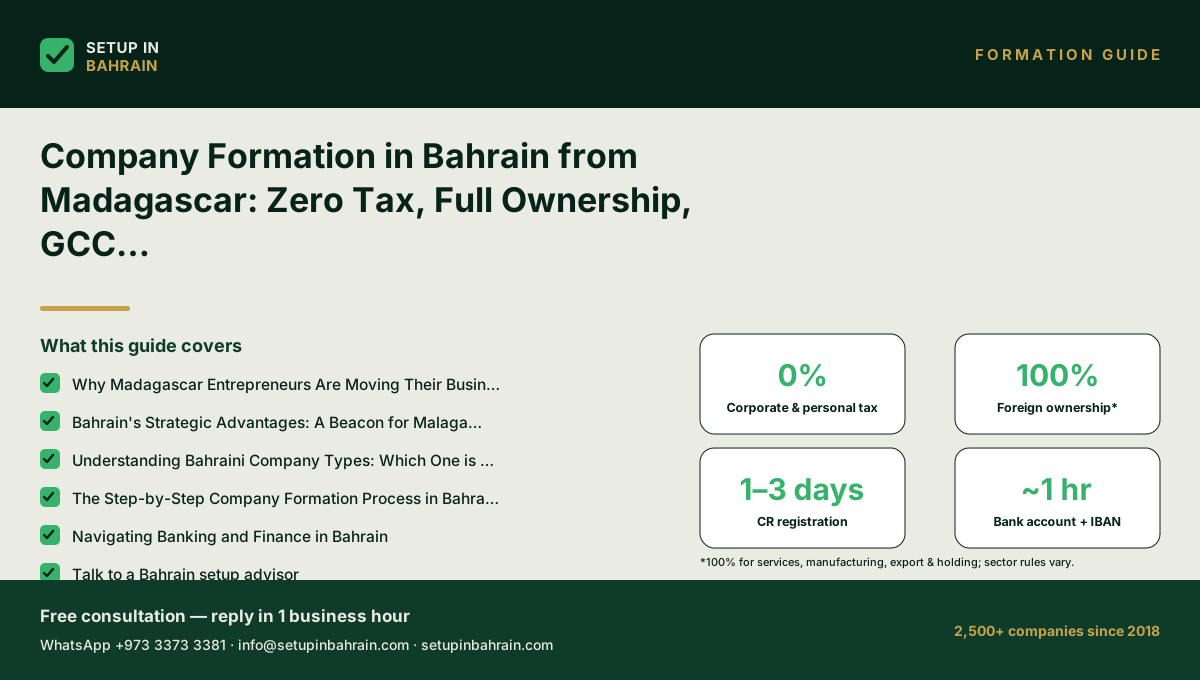
- Why Madagascar Entrepreneurs Are Moving Their Business to Bahrain
- Bahrain's Strategic Advantages: A Beacon for Malagasy Businesses
- Understanding Bahraini Company Types: Which One is Right for You?
- The Step-by-Step Company Formation Process in Bahrain
- Navigating Banking and Finance in Bahrain
→ Complete guide: Company Formation in Bahrain — the full 2026 guide
View details
Ownership & capital
A Bahrain WLL can be owned by a single person — 100% foreign ownership applies to most activities, with no local partner required for services, manufacturing, export trading and holding companies. The minimum share capital is BHD 1 ; we recommend BHD 1,000 . This Makes bank account opening and investor visa approval smoother.
Imagine Hery, a textiles exporter based in Antananarivo. Last year, a crucial shipment to France was held up by payment delays, a common frustration driven by the restrictive banking controls of the Banky Foiben’i Madagasikara (BFM). He meticulously calculated that the persistent 13% annual depreciation of the Malagasy Ariary (MGA) against the USD, a trend confirmed by IMF data for over a decade, had already eroded a significant portion of his profit even before the funds cleared.
Then, the Directorate General of Taxes (DGI) sent a paper notice for a corporate tax audit, demanding a hefty 20% of his profits, plus potential fines. Simultaneously, his ambitious expansion plans stalled, awaiting basic permit approvals from the Economic Development Board of Madagascar (EDBM), a process notorious for its delays and paper-intensive bureaucracy.
Hery found himself asking a question that echoes across the business landscape of Madagascar: “How do I break free from this cycle where my capital constantly diminishes, and every significant transaction feels like an uphill battle?”
This isn't an isolated lament. Think of Jean-Luc, another dedicated textile manufacturer in Antananarivo, who pours his heart into unique designs. His dream is to scale his brand beyond Madagascar, perhaps tapping into the booming markets of the Middle East. But he, too, faces the DGI’s largely paper-based tax filings, watching 20% of his corporate profits vanish annually.
The relentless MGA depreciation, often losing 10-15% of its value against major currencies each year, makes importing raw materials more and more expensive and erodes his international purchasing power. Adding to this burden are mandatory CNAPS social security contributions and the logistical nightmare of dealing with BFM’s minimal international correspondent banking relationships. Jean-Luc’s global ambitions, like those of so many Malagasy founders, often feel like an insurmountable climb.
Consider, too, the case of a vanilla exporter in Antalaha. A few years ago, after a devastating cyclone cut the harvest, his company managed to clear roughly MGA 2.8 billion in revenue. But, after the mandatory 20% corporate income tax, substantial CNAPS contributions. The labyrinthine process of obtaining countless stamps and approvals from the DGI, he was left with less than MGA 1.7 billion.
The remaining capital then lost another 12% of its value against the dollar during the agonizing three-week wait for BFM to finally release his foreign-currency transfers. That same exporter today runs the trading side of his business through a Bahraini With Limited Liability (WLL) company. The 20% tax bill? Gone. The currency erosion? Mitigated by a USD-pegged currency. The banking delays? A distant memory.
These stories, while distinct, paint a vivid picture of the systemic challenges faced by Malagasy entrepreneurs. It's not about a lack of talent, innovation, or resilience; it’s about a business environment that, despite its familiarity, actively hinders growth, wealth preservation, and global competitiveness.
This guide is not about abandoning Madagascar. It is about empowering you, the visionary Malagasy entrepreneur, to build a stronger, more resilient. Globally competitive business foundation. It’s about showing you how Bahrain, a stable, agile island nation nestled in the heart of the Arabian Gulf, offers an unparalleled sanctuary and springboard for your international aspirations.
Why Madagascar Entrepreneurs Are Moving Their Business to Bahrain
The decision to look beyond familiar shores is rarely taken lightly. For Malagasy entrepreneurs, but, the mounting pressures within the domestic business environment are becoming more and more unsustainable. The daily reality is a relentless battle against systemic inefficiencies and wealth erosion.
Let’s be unequivocal about the pain points you encounter in Madagascar:
Punitive Corporate Income Tax: Every year, your hard-earned corporate profits face a mandatory 20% income tax levied by the DGI. This isn't just a number; it’s a significant chunk of your reinvestment capital, your expansion budget. Your personal wealth. The World Bank’s 2025 reports indicate that businesses in Madagascar contend with an average of 38 annual tax payments , largely through a largely paper-based system, making compliance a time-consuming and often frustrating ordeal.
Relentless Currency Depreciation: The Malagasy Ariary (MGA) is notoriously volatile. For over a decade, the MGA has consistently depreciated against the USD by 10% to 15% annually , as confirmed by IMF data. This means that any capital you hold in MGA loses substantial value each year, making international trade, asset acquisition. Even long-term planning a high-risk endeavor. Your purchasing power for imported goods, raw materials, or foreign investments dwindles month by month.
Bureaucratic and Inefficient Tax Authority: The DGI’s operations are still heavily reliant on paper filings and manual processes. This outdated system translates into delays, opaque procedures. A high administrative burden, diverting precious business time and resources away from core business activities. Audits, often triggered by paper notices, can become protracted and resource-intensive, further hindering growth. Limited International Banking Access: The Banky Foiben’i Madagasikara (BFM) maintains minimal international correspondent banking relationships.
For any Malagasy entrepreneur seeking to open a USD or EUR account, or to execute swift international transfers, the reality is often a lengthy, paperwork-laden process, frequently met with polite but firm rejection. This severely constrains cross-border trade, capital movement, and access to global financial markets. Mandatory Social Security Contributions (CNAPS): Every salary paid, even modest ones, incurs mandatory CNAPS social security contributions.
While intended for social welfare, these contributions add another layer of overhead and administrative complexity to payroll management, eating into profit margins and increasing the cost of employment. Overall Ease of Doing Business Challenges: Madagascar ranks unfavorably, often around #161 globally , in terms of ease of doing business, according to World Bank indicators. This low ranking reflects a challenging regulatory environment, slow permit approvals (like those from the EDBM). Infrastructural deficiencies exacerbated by events like cyclone season.
These aren't abstract statistics from economic reports; they are the lived experience, the daily struggles. The profound frustrations that prevent ambitious Malagasy entrepreneurs from realizing their full potential.
Contrast this with Bahrain. Here, the landscape shifts dramatically. You move from a system designed with significant friction to one built for fluidity and growth. Imagine: Zero corporate income tax on most business activities. A currency (Bahraini Dinar, BHD) that is pegged directly to the US Dollar , offering unparalleled stability and protection against depreciation. A fully digitalized government and tax authority , streamlining compliance and reducing administrative burden.
A central bank (Central Bank of Bahrain, CBB) that is globally connected , facilitating seamless international transactions and multi-currency accounts. No mandatory social security contributions for expatriate workers (though GOSI applies to Bahraini nationals). A business environment ranked among the top in the MENA region for ease of doing business, actively encouraging foreign investment and swift company formation.
For the Malagasy entrepreneur, moving to Bahrain isn't just a geographical shift; it's a strategic pivot from limitation to liberation, from erosion to expansion.
Bahrain's Strategic Advantages: A Beacon for Malagasy Businesses
Bahrain is more than just an escape; it's a strategic launchpad. For entrepreneurs from Madagascar, this small island nation offers a powerful combination of economic stability, business-friendly policies. Unparalleled access to lucrative markets.
1. Zero Corporate and Personal Income Tax
This is often the first, and most compelling, advantage for Malagasy entrepreneurs. Unlike Madagascar’s 20% corporate income tax, Bahrain imposes zero corporate income tax on most business activities. The only exceptions are companies operating in the oil and gas sector. Some specific industries, which are subject to a modest tax rate. Crucially, there is also no personal income tax in Bahrain.
This means that your business profits. Your personal earnings, remain largely in your pocket, ready for reinvestment or personal wealth building. This radical difference profoundly impacts your profitability and capital accumulation.
2. 100% Foreign Ownership
A cornerstone of Bahrain's appeal is the ability to retain 100% foreign ownership of your company in most sectors. This is a significant departure from jurisdictions that often require local partners or sponsors. This Can lead to complex ownership structures and potential disputes. In Bahrain, you maintain full control and complete decision-making authority over your venture, a critical factor for independent-minded entrepreneurs.
This applies especially to the With Limited Liability (WLL) company. This Can be owned entirely by a single foreign individual.
3. Strategic Gateway to the GCC and Beyond
Bahrain holds a unique geographical position. It is connected to Saudi Arabia, the largest economy in the GCC, by the 25-kilometer King Fahd Causeway, allowing for seamless overland trade and logistical access to a market of over 35 million people. Also, its central location in the Arabian Gulf places it within easy reach of the entire Middle East, North Africa. South Asia.
This strategic access means your Bahraini company can serve as a hub for expanding into a consumer market worth trillions of dollars, unencumbered by the trade barriers or logistical complexities you might face from Madagascar. The Economic Development Board (EDB) actively promotes Bahrain as a regional business hub, leveraging its Free Trade Agreements with 22 countries, including the US and Singapore.
4. Robust and Stable Economy with a USD-Pegged Currency
The Bahraini Dinar (BHD) has been pegged to the US Dollar at a fixed rate of 1 BHD = 2.659 USD since 1987 . This long-standing peg provides an extraordinary level of currency stability and predictability, eliminating the anxiety of constant MGA depreciation. For international traders, importers. Exporters, this stability is invaluable, protecting profits and making financial forecasting far more reliable.
The Central Bank of Bahrain (CBB) maintains strict monetary policies to uphold this peg, ensuring a stable and predictable economic environment.
5. Streamlined and Digitalized Business Environment
Bahrain has invested heavily in digitalizing its government services. The Ministry of Industry and Commerce (MOIC) offers an efficient online portal (Sijilat) for company registration, allowing for greatly faster setup times compared to many other jurisdictions. The entire process, from name reservation to commercial registration, can often be completed in a matter of days or weeks, rather than months. This commitment to efficiency is reflected in Bahrain's consistently high rankings in global ease of doing business reports.
The Bahrain Investors Centre (BIP) further aids entrepreneurs by offering a single point of contact for various government approvals.
6. Low Operating Costs and Skilled Workforce
Compared to some of its GCC neighbors, Bahrain offers highly competitive operating costs for businesses, including affordable office rentals, utilities. Professional services. The country also boasts a well-educated, bilingual (Arabic and English) workforce, supported by strong government initiatives in education and vocational training. This combination allows businesses to establish a strong presence without the prohibitive overheads often found in other regional hubs.
7. Progressive Regulatory Framework
The Central Bank of Bahrain (CBB) is a respected and forward-thinking regulator, especially in financial services. It has been at the forefront of Islamic finance, fintech innovation, and open banking. This progressive approach ensures a transparent, secure. Internationally compliant regulatory environment, providing a solid foundation for financial transactions and business growth.
8. High Quality of Life
Beyond the boardroom, Bahrain offers an excellent quality of life. It is a cosmopolitan, multicultural society with a welcoming expatriate community. The country boasts world-class healthcare facilities, international schools, diverse dining options, and a vibrant cultural scene. Its low crime rate, political stability. Tolerant society make it an attractive place for entrepreneurs and their families to live and thrive.
These combined advantages make Bahrain an incredibly attractive proposition for Malagasy entrepreneurs seeking to transcend the limitations of their home market and build a globally competitive enterprise.
Understanding Bahraini Company Types: Which One is Right for You?
Choosing the right legal structure is a critical first step. Bahrain offers several company types, each suited to different business needs. For most Malagasy entrepreneurs looking for flexibility, full ownership, and scalability, one type stands out.
CRITICAL NOTE: Unlike some jurisdictions that offer a "Single Person Company" (WLL), Bahrain does NOT have a single-shareholder WLL company type. This is a common misconception; please disregard any information suggesting otherwise. The closest and most suitable option for a single founder is a specific structure within the With Limited Liability framework.
1. With Limited Liability Company (WLL) – The Recommended Choice
For the vast majority of foreign entrepreneurs, especially those starting individually or with a small number of partners, the With Limited Liability Company (WLL) is the optimal choice in Bahrain.
Key Features and Why It's Ideal for You:
100% Foreign Ownership: This is a game-changer. A Bahraini WLL can be 100% owned by a single foreign individual or corporate entity with absolutely zero partners required. This ensures you retain complete control over your business, strategy, and profits. This directly addresses the potential friction and shared control concerns that might arise from mandatory local partnership requirements in other countries.
Limited Liability: As the name suggests, your personal liability is limited to the amount of capital you have contributed to the company. This protects your personal assets from business debts and obligations, offering crucial peace of mind. Minimum Share Capital: Legally, the minimum share capital required to form a WLL in Bahrain is a symbolic BHD 1 (Bahraini Dinar One) . But, while legally permissible, this minimum is rarely practical.
To secure essential services like a corporate bank account and to successfully apply for an investor visa, you should aim for a practical starting capital of BHD 1,000 (Bahraini Dinar One Thousand) . This shows genuine financial commitment and greatly streamlines the approval processes with financial institutions and immigration authorities. We strongly recommend setting BHD 1,000 as your initial share capital.
Flexibility: A WLL is highly versatile, suitable for a wide range of commercial activities, including trading, services, consulting, IT. More. Ease of Setup: The registration process for a WLL is relatively straightforward and can be largely completed online through the MOIC's Sijilat portal. Credibility: A WLL is a well-recognized and respected corporate structure within Bahrain and internationally, lending credibility to your business operations.
How it Differs from a Misconceived "WLL": While there isn't a specific "Single Person Company" legal entity, the Bahraini WLL framework allows a single individual to own and operate a company with limited liability and 100% foreign ownership. It effectively serves the same purpose for a solo entrepreneur without being a distinct legal form.
Other Company Types (Brief Overview for Context):
While a WLL is usually best, it's good to be aware of other options for more specific needs:
Bahraini Shareholding Company (BSC): * Public (BSC Public): For larger enterprises seeking to raise capital from the public, typically requiring a minimum of 7 founders and substantial share capital (BHD 1 million). This is usually not relevant for starting entrepreneurs. * Closed (BSC Closed): For private shareholding companies, requiring a single shareholder (one person can own 100%) and BHD 250,000 capital. This offers flexibility in transferring shares but is more complex than a WLL.
Sole Proprietorship (Setup): * This is owned by a single individual, but it does not offer limited liability . The owner’s personal assets are fully exposed to business debts. While simpler to set up, the lack of asset protection makes it less advisable for most entrepreneurs seeking growth and risk mitigation. Branch of a Foreign Company: * Allows a foreign company to establish a presence in Bahrain without forming a new local entity.
It's an extension of the parent company, suitable for existing businesses looking to expand their operations. It requires the parent company to have a significant presence and operational history. Representative Office: * Primarily for market research, promotion, and identifying business opportunities. It cannot engage in direct commercial activities or generate revenue. It's a non-trading entity.
Holding Company: * Often structured as a WLL or BSC Closed, its primary purpose is to hold shares in other companies rather than engaging in direct commercial operations.
Free Zones vs. Mainland:
Bahrain operates with a unified regulatory environment, meaning there's less distinction between "free zones" and "mainland" compared to places like the UAE. Most businesses register directly with the Ministry of Industry and Commerce (MOIC) and operate from any location within Bahrain. There are specialized zones, such as Bahrain International Investment Park (BIIP) and Bahrain Logistics Zone (BLZ). This Offer specific benefits for manufacturing and logistics companies, but they are not restrictive "free zones" in the traditional sense.
For most service, trading, or consulting businesses, registering a WLL directly with MOIC allows for maximum flexibility to operate anywhere in the country.
Recommendation: For the Malagasy entrepreneur focused on control, limited liability, and ease of setup, the With Limited Liability (WLL) company, with 100% foreign ownership and a practical minimum share capital of BHD 1,000, is the unequivocally recommended path.
The Step-by-Step Company Formation Process in Bahrain
One of Bahrain’s standout features is its streamlined and largely digital company formation process, especially when compared to the protracted, paper-based systems often encountered in Madagascar. The Ministry of Industry and Commerce (MOIC) has invested heavily in its online Sijilat portal, making the journey efficient and transparent.
Here's a detailed breakdown of the steps you’ll undertake:
Step 1: Business Activity and Legal Structure Selection
- Define Your Activities: Clearly identify the specific commercial activities your company will undertake. Bahrain has a comprehensive list of approved activities. Be precise, as these will be listed on your commercial registration.
- Choose Your Legal Form: As discussed, for most Malagasy entrepreneurs, the With Limited Liability (WLL) company is the recommended structure due to its flexibility, 100% foreign ownership, and limited liability.
Step 2: Name Reservation
- Check Availability: Access the Sijilat portal (www.sijilat.bh) and submit your proposed company names. You should have 3-5 options in mind, in order of preference, to increase the likelihood of approval. The name must be unique and not conflict with existing registered businesses.
- Language: Names can be in Arabic and English.
- Approval Time: Name reservation is typically very quick, often approved within hours or a day.
Step 3: Initial Approvals and Documents Submission
This is where you gather and submit your core documents to the MOIC.
Draft Memorandum of Association (MoA) and Articles of Association (AoA): These are the foundational legal documents for your company. They outline its purpose, share capital, ownership structure, management, and internal governance. A local legal consultant can assist in drafting these in accordance with Bahraini company law. * Crucially, for a WLL owned by a single person, the MoA and AoA will clearly state the sole shareholder.
* It will also specify the practical share capital of BHD 1,000 (or higher if you choose). Required Documents (for a foreign individual founder): * Copy of your passport (valid for at least 6 months). * Copy of your national ID (if applicable). * Current CV (Curriculum Vitae). * Proof of residential address (e.g., utility bill from your home country, if not yet residing in Bahrain). * Bank reference letter (from your home country bank, confirming good standing).
* MOIC application forms (completed online via Sijilat). * Signed MoA and AoA. * Details of the company's proposed physical address in Bahrain (virtual office solutions are often accepted initially for administrative purposes. A physical presence might be required for certain activities or later visa processes). MOIC Review: The Ministry will review your submitted documents and the proposed business activities.
Depending on the activity, additional external approvals might be required from relevant ministries (e.g., Central Bank of Bahrain for financial services, Ministry of Health for medical activities). This is typically coordinated by MOIC.
Step 4: Capital Deposit (Practical Recommendation)
While the legal minimum capital for a WLL is BHD 1, banks will generally not open a corporate account without a more substantial amount. This is why we recommend BHD 1,000 (or more). Bank Account Opening (Post-Registration): You will typically open the corporate bank account after your company is fully registered and you have your Commercial Registration (CR) certificate. But, some banks might require proof of funds or a specific deposit during* the initial stages for due diligence.
It is essential to confirm this with your chosen bank. Some banks may require you to physically be in Bahrain to open the account.
Step 5: Commercial Registration (CR) Issuance
Once all documents are approved and any necessary external permits are secured, the MOIC will issue your Commercial Registration (CR) Certificate . This is your company's official birth certificate, confirming its legal existence. This certificate will clearly state your company's name, CR number, legal type (WLL), registered activities, and shareholders.
Approval Time: The total time for initial approvals and CR issuance can range from 3-10 working days , assuming all documents are in order and no complex external approvals are needed. This is a stark contrast to the weeks or months often experienced in Madagascar.
Step 6: Obtaining Your Trade License(s)
The CR grants your company legal existence. To operate* commercially, you need a Trade License for each specific activity. For most standard activities, this is typically issued concurrently with or immediately after the CR. Specific Licenses: For regulated industries (e.g., financial services, healthcare, education), you will need to apply for additional, specific licenses from the relevant regulatory bodies (e.g., CBB, Ministry of Health, Ministry of Education) once your CR is issued.
Step 7: Post-Registration Formalities
Company Seal and Stamps: Get an official company seal and stamps. Corporate Bank Account: Proceed with opening your corporate bank account (if not already initiated) with a Bahraini bank. Office Space: Secure your physical office space (if not already done). Even if starting with a virtual office, certain activities or visa applications may require a physical address.
Register with the Social Insurance Organization (SIO): While GOSI (General Organization for Social Insurance) applies to Bahraini employees, foreign employees typically do not contribute to SIO, but the company must still register with the SIO. This differs greatly from Madagascar's mandatory CNAPS for all employees. Customs Registration (if importing/exporting): If your business involves import/export, you will need to register with Bahrain Customs.
Assistance and Resources:
Business Formation Consultants: Many local consulting firms specialize in company formation in Bahrain. They can guide you through the entire process, draft documents, interact with MOIC. Connect you with legal and banking contacts. This is highly recommended to ensure a smooth and efficient setup, especially given the language differences and specific local requirements. Bahrain Investors Centre (BIP): The BIP serves as a single window for investors, providing information and facilitating interactions with various government agencies.
Economic Development Board (EDB): The EDB is the government agency responsible for attracting investment to Bahrain. They can offer guidance and support, especially for larger projects or those in strategic sectors.
By following these steps, and with the right guidance, you can establish your Bahraini company far more quickly and predictably than you might be accustomed to in Madagascar, setting a solid foundation for your international business.
Navigating Banking and Finance in Bahrain
For Malagasy entrepreneurs, the experience of banking in Bahrain will be a refreshing contrast to the limitations of the BFM. The Central Bank of Bahrain (CBB) supervises a robust, internationally integrated financial sector known for its stability, efficiency. Wide range of services.
The Central Bank of Bahrain (CBB): A World-Class Regulator
The CBB is a respected financial regulator with a reputation for foresight and innovation. It ensures the stability of the BHD currency (pegged to the USD), oversees a diverse banking landscape. Maintains strong anti-money laundering (AML) and know-your-customer (KYC) regulations. This means:
- Financial Stability: Your funds are held in a secure and well-regulated environment.
- Global Connectivity: Bahraini banks have extensive correspondent relationships with major international banks worldwide, facilitating seamless global transfers, unlike the BFM's minimal connections.
- Multi-Currency Accounts: You can easily open accounts in major currencies (USD, EUR, GBP) alongside BHD, essential for international trade and managing foreign exchange risk.
Opening a Corporate Bank Account in Bahrain
This is a critical step for your new WLL company. While the process is generally straightforward for registered companies, it requires thorough due diligence from the banks.
Key Requirements and Process:
Company Documents: * Original Commercial Registration (CR) Certificate. * Memorandum and Articles of Association (MoA & AoA). * Board Resolution (if applicable, for corporate shareholders) authorizing account opening and signatory powers. * Company stamp. Shareholder/Director Documents (for all beneficial owners, directors, and authorized signatories): * Valid Passport copy. * National ID copy (if applicable). * Visa and CPR (Central Population Registry) ID (once obtained after moving to Bahrain).
* Proof of residential address (e.g., utility bill from Bahrain or your home country). * Bank reference letter from your previous bank (confirming good standing, ideally for the beneficial owner/signatory). * Detailed CV/Resume. * Source of funds declaration (to comply with AML regulations). Physical Presence: While some initial paperwork can be done remotely, most Bahraini banks will require the authorized signatory(ies) to be physically present in Bahrain to complete the account opening formalities, verify identity, and sign documents.
This is a standard KYC requirement. Initial Deposit: As mentioned. The WLL legal minimum capital is BHD 1, banks generally require a more substantial initial deposit to activate a corporate account. This is another reason we recommend a BHD 1,000 share capital for your WLL – it signals seriousness and facilitates bank approval.
Due Diligence Interview: You may be required to have an interview with the bank's relationship manager, where you'll discuss your business activities, expected transaction volumes, and source of funds. Transparency is key.
Recommended Banks for Corporate Accounts:
Bahrain hosts a wide array of local and international banks. Some prominent options for corporate banking include:
- National Bank of Bahrain (NBB): The largest local bank, offering comprehensive services and a strong digital banking platform.
- Bahrain Kuwait Bank (BBK): Another leading local bank with extensive corporate banking solutions.
Bahrain Business Guides for Madagascar Citizens
Frequently Asked Questions
How long does it take to set up?
It takes 15 to 20 days. We file all forms for you. You do not need to wait long.
What does it cost?
Company formation: Standard BHD 1,340 with 3 months of office address; Gold BHD 1,700 with 6 months; Premium BHD 2,150 with 12 months and a cabin, officer table and chair, and two guest chairs. No formation package includes visas, including Premium. Investor/work visas are priced separately: BHD 755 for one year or BHD 953 for two years, in addition to the formation package. Ask for a written, itemized quotation confirming government fees and all inclusions before payment.
Do I need to visit Bahrain?
No. You can set up your firm from home. We do all the work online. Some banks may ask for one visit.
What tax will I pay?
You pay zero tax on your profits. Bahrain has no corporate income tax. This is a key benefit of the setup.
Can I own 100% of my firm?
Yes. Foreign owners can hold all shares. No local partner is needed. Full ownership is allowed.
What do I need to start?
You need a valid passport. You also need a trade name and a business address. We help you with all of these.
How do I open a bank account?
We guide you step by step. Most banks take 3 to 6 weeks. You will need your CR and firm papers.
Who issues the Commercial Registration (CR)?
The CR is issued by the MOICT. It is your legal right to trade in Bahrain. We file the CR for you.
Can I renew my CR each year?
Company renewal packages: BHD 530 with 3 months of office address; BHD 980 with 6 months; BHD 1,520 with 12 months. These are separate renewal packages, not visa fees.
How do I get started?
Fill in our form on this page. Our team will call you back. We map your best setup plan at no cost.
Steps to Form Your Company
- Pick your trade name. We check if it is free.
- Choose your business type. WLL is the most common.
- Sign the MOA. We draft and file all legal docs.
- Pay the state fees. About BHD 432 in total.
- Get your CR. Takes 15 to 20 days.
- Open your bank account. We guide each step.
- Start trading. You are ready to do business.
Key Facts
- Tax rate: 0%
- Foreign ownership: 100%
- Setup time: 15 to 20 days
- Company formation: Standard BHD 1,340 with 3 months of office address; Gold BHD 1,700 with 6 months; Premium BHD 2,150 with 12 months and a cabin, officer table and chair, and two guest chairs. No formation package includes visas, including Premium. Investor/work visas are priced separately: BHD 755 for one year or BHD 953 for two years, in addition to the formation package. Ask for a written, itemized quotation confirming government fees and all inclusions before payment.
- Company renewal packages: BHD 530 with 3 months of office address; BHD 980 with 6 months; BHD 1,520 with 12 months. These are separate renewal packages, not visa fees.
- Client rating: 4.8 stars
- Clients served: 2,500 and more
Quick Facts
- Tax rate: 0%
- Own all of your firm: Yes, 100%
- Time to set up: 15 to 20 days
- Company formation: Standard BHD 1,340 with 3 months of office address; Gold BHD 1,700 with 6 months; Premium BHD 2,150 with 12 months and a cabin, officer table and chair, and two guest chairs. No formation package includes visas, including Premium. Investor/work visas are priced separately: BHD 755 for one year or BHD 953 for two years, in addition to the formation package. Ask for a written, itemized quotation confirming government fees and all inclusions before payment.
- Company renewal packages: BHD 530 with 3 months of office address; BHD 980 with 6 months; BHD 1,520 with 12 months. These are separate renewal packages, not visa fees.
- Rating: 4.8 stars
- Clients: 2,500 and more
Why Bahrain?
Bahrain has no tax. You keep all your profits. This is rare in the Gulf.
You can own all of your firm. No local partner is needed. The law allows full foreign ownership.
Setup takes 15 to 20 days. We file all forms for you. You can do it all from home.
Bahrain has a free trade deal with the US. Your goods face low or no tariffs. This gives you access to big markets.
We have served 2,800+ clients from 44+ countries and maintain records to substantiate that total where needed. We have 113 Google reviews; reviews represent only some clients and are not the same as the total clients served.
Our Steps
- Tell us your plan. We advise you for free.
- We pick the right firm type for you.
- We file all your forms with MOICT.
- You get your CR in 15 to 20 days.
- We help you open a bank account.
- You are ready to trade. We stay with you.
Next Steps for Madagascar Citizens
You can set up a firm in Bahrain from Madagascar. You do not need to fly there first. We do all the work online.
Tell us your plan. We call you back the same day. We map the best route for you at no cost.
We file all your forms. We deal with MOICT and the state. You get your CR in 15 to 20 days.
After your CR, we help you get a bank account. We also help with your Investor Visa. One firm guides you at each step.
Why Our Clients from Madagascar Choose Us
- We speak your language. We know your needs.
- We have helped clients from Madagascar before.
- Our fee is clear. No surprise costs.
- We have a 4.8 star rating on Google.
- We have helped more than 2,500 clients set up in Bahrain.
Fill in the form on this page. We will be in touch soon. Let us help you start your Bahrain firm today.
Ready to set up in Bahrain from Madagascar?
Tell us your business idea. We map the right entity, ownership and timeline — then handle the filing while you focus on what matters.