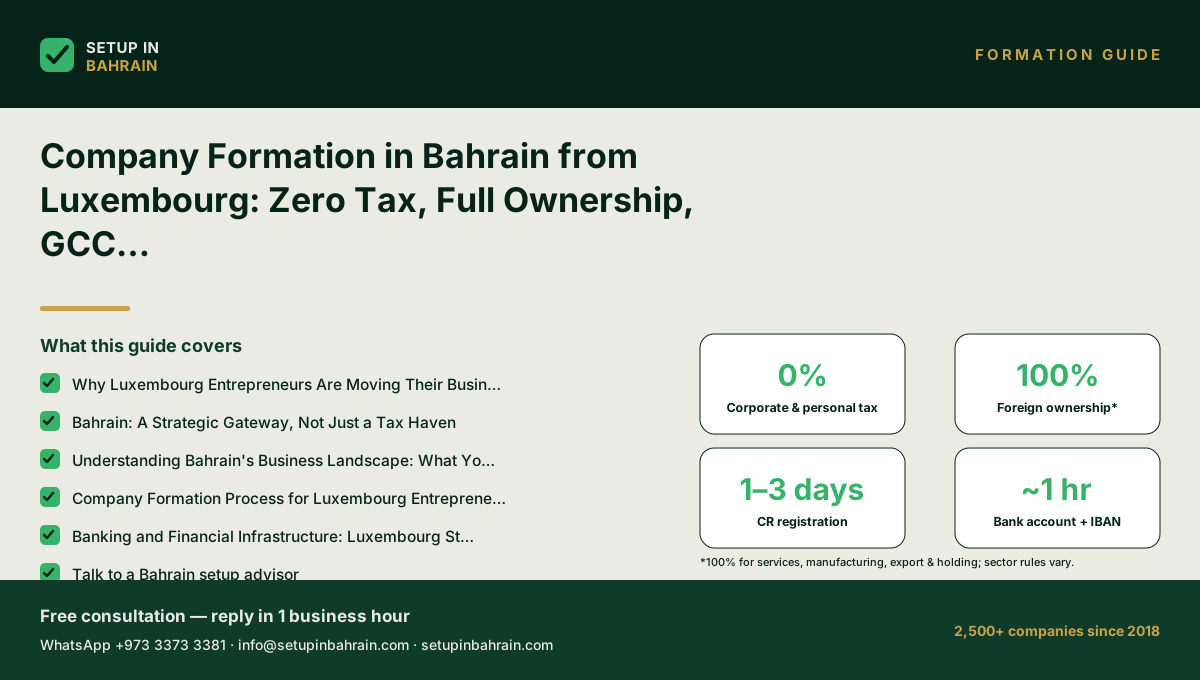
Register your Bahrain company from Luxembourg with generally no corporate income tax for most sectors. Benefit from strategic Gulf access, easy setup process, and tax-efficient business expansion.
Key Takeaways
- Why Luxembourg Entrepreneurs Are Moving Their Business to Bahrain
- Bahrain: A Strategic Gateway, Not Just a Tax Haven
- Understanding Bahrain's Business Landscape: What You Need to Know
- Company Formation Process for Luxembourg Entrepreneurs in Bahrain
- Banking and Financial Infrastructure: Luxembourg Standards, Bahraini Efficiency
→ Complete guide: Company Formation in Bahrain — the full 2026 guide
View details
Ownership & capital
A Bahrain WLL can be owned by a single person — 100% foreign ownership applies to most activities, with no local partner required for services, manufacturing, export trading and holding companies. The minimum share capital is BHD 1 ; we recommend BHD 1,000 . This Makes bank account opening and investor visa approval smoother.
Last month, I had a call with Sophie, a shrewd entrepreneur from Capellen. She runs a successful software development firm serving clients across Europe. Like many of my Luxembourgish clients, she’s navigating an more and more complex and costly business environment.
"My accountant just showed me the projections for 2026," Sophie explained, her frustration palpable. "After corporate income tax, municipal business tax. The wealth tax on our holding structure, we’re looking at an effective tax rate nearing 25%. And that's before the constant CSSF compliance costs, DAC6 disclosures for every cross-border arrangement. The eye-watering fees from our legal and fiduciary partners just to keep our SOPARFI compliant. Honestly, at this point, what’s the incentive to scale when nearly a quarter of every euro we earn goes straight to the taxman and the compliance machine?"
Sophie’s question isn't isolated. It's a sentiment echoed by countless Luxembourg entrepreneurs I speak with, whether they're in FinTech, IT, consulting, or trading. The Grand Duchy has long been synonymous with stability and sophisticated financial services, attracting holding companies and investment vehicles with its advantageous tax treaties and regulatory rigour. But for operating businesses – companies that generate active revenue, employ staff. Face the full brunt of local and EU-driven regulations – the equation has shifted dramatically.
The reality is stark: Luxembourg's combined corporate income tax (17%), municipal business tax (averaging 6.75%). The 1.19% wealth tax for holding companies can culminate in an effective corporate tax rate that often reaches 24.94% . Add to this the significant administrative burden and the costs associated with maintaining complex structures like a SOPARFI, adhering to CSSF mandates. Grappling with EU-wide reporting initiatives like DAC6. The competitive edge for active businesses is eroding.
This isn't about avoiding legitimate tax obligations; it's about strategic optimization and building a business structure that allows you to compete globally, maximize retained earnings for reinvestment, and reduce unnecessary operational friction.
And this is precisely where Bahrain steps in.
Imagine a jurisdiction that offers:
- 0% corporate income tax.
- 100% foreign ownership of your company, without local partners or silent nominees.
- A fast-track registration process, often taking just days.
- A sophisticated, bilingual regulatory environment (speaking Arabic and English fluently).
- Unfettered access to the $2 trillion GCC market, with a physical causeway connecting you directly to Saudi Arabia, the region's largest economy.
- No personal income tax, no capital gains tax, and full repatriation of profits.
This isn't a speculative proposition; it's a tangible reality that more and more internationally minded Luxembourg entrepreneurs are discovering. This comprehensive guide is designed to walk you through exactly how Bahrain can transform your business trajectory, addressing your specific pain points and offering a compelling alternative to your current operational challenges.
Why Luxembourg Entrepreneurs Are Moving Their Business to Bahrain
Let's dissect the core motivations. You’ve mastered the intricacies of Luxembourg’s business environment, but at what cost? The move to Bahrain isn't just a geographical relocation; it's a strategic recalibration driven by several critical factors:
1. The Burden of Luxembourg's Effective Tax Rate
For many operating companies in Luxembourg, the once-favorable tax landscape has become a significant liability.
- Corporate Income Tax (CIT): A standard rate of 17% for companies with taxable income exceeding €200,000.
- Municipal Business Tax (MBT): This varies by commune but averages around 6.75% (e.g., Luxembourg City's rate is 6.75%).
- Wealth Tax (Impôt sur la fortune): While primarily impacting holding companies, it applies at 0.5% on net wealth up to €500 million, and 0.05% thereafter. For SOPARFI structures, even if you are operating, this can contribute to the overall effective rate.
- Solidarity Surcharge: An additional 7% of the CIT payable, effectively raising the 17% to 18.19%.
When you combine these, as Sophie's accountant did, the effective rate easily climbs to 24.94%. Imagine a tech consultancy generating €2.8 million in annual revenue with a €1.1 million profit margin. After these layered taxes, over €270,000 would be diverted before any other distributions.
The Bahraini Contrast: In Bahrain, for almost all business activities, the corporate income tax rate is 0%. There are no municipal business taxes, no wealth taxes on corporate assets, and no solidarity surcharges. This dramatic difference means that nearly a quarter of your profits, currently earmarked for the tax authorities in Luxembourg, remains in your business, ready for reinvestment, expansion, or distribution. This alone can fundamentally alter your growth strategy and competitive positioning.
2. The Weight of Regulatory Compliance and Administration
Luxembourg’s robust regulatory environment, while ensuring stability, has also become a labyrinth for entrepreneurs. SOPARFI Complexity and Costs: While beneficial for certain holding activities, maintaining a SOPARFI (Société de Participations Financières) for an active business operation is resource-intensive. Annual compliance, including auditing, legal review. Tax advice, can easily exceed €18,000 to €47,000 , depending on complexity and the firm you engage. These are recurring costs that deliver no direct operational value. CSSF Authorisation and Reporting: If your business touches on any regulated financial activity – and with Luxembourg’s strong FinTech ecosystem, many do – you face stringent, costly, and time-consuming compliance with the Commission de Surveillance du Secteur Financier (CSSF). Annual authorisation fees can start from €15,000 and escalate greatly with increased scope and complexity. The ongoing reporting burden requires dedicated resources, often necessitating additional hires or outsourced expertise. EU DAC6 Disclosures: The EU's Directive on Administrative Cooperation (DAC6) mandates reporting of certain cross-border tax arrangements. For any Luxembourgish entity engaged in international trade or structuring, this adds another layer of reporting complexity and potential penalties, requiring careful legal and tax review. SARL Minimum Capital: Establishing a Société à responsabilité limitée* (SARL), the most common company type, requires a minimum share capital of €12,394 . While not a massive sum, it’s capital tied up that could otherwise be deployed for operational growth. Compliance Fatigue: Beyond the direct costs, there's the sheer mental and time burden. The constant need to monitor regulatory changes, update internal policies. Engage with multiple authorities distracts from core business activities. It's a non-value-adding drain on business energy.
The Bahraini Contrast: Bahrain, while having its own robust regulatory framework (overseen primarily by the Central Bank of Bahrain (CBB) for financial services and the Ministry of Industry and Commerce (MOIC) for general businesses), is designed for efficiency and ease of doing business. The regulatory approach is often more pragmatic, prioritizing clarity and swift approvals. Streamlined Registration: The MOIC's "Sijilat" portal offers a largely digitized and expedited company formation process. Minimal Capital Requirements: For many business types, especially a With Limited Liability (WLL) company, the minimum capital requirement is nominal (e.g., BHD 50. This Is about €120), far less restrictive than Luxembourg. Simpler Ongoing Compliance: While annual reporting and auditing are mandatory, the scope is generally less onerous for non-regulated entities, reducing the costs associated with external advisors. No DAC6 Equivalent: As a non-EU jurisdiction, Bahrain is not subject to EU directives like DAC6, simplifying international arrangements.
3. The Challenge of High Professional Service Fees
Luxembourg’s highly specialized and competitive professional services sector, while excellent, comes at a premium. Engaging top-tier legal, accounting, and fiduciary firms can incur substantial annual costs. For a mid-sized SARL with a SOPARFI, these fees can easily range from €30,000 to €100,000+ per year, depending on the scope of services. These costs further eat into profit margins, making it harder to justify reinvestment or expand into new markets.
The Bahraini Contrast: While Bahrain also boasts a highly professional service sector, including international and local firms, the overall cost base for legal, accounting, and administrative support is greatly lower than in Luxembourg. This translates to substantial operational cost savings, freeing up capital that can be directly invested into your core business.
Bahrain: A Strategic Gateway, Not Just a Tax Haven
To view Bahrain solely through a tax lens would be to miss its profound strategic advantages. For a Luxembourg entrepreneur, Bahrain offers much more than just tax efficiency; it provides a springboard into a dynamic, rapidly growing economic region.
1. Unparalleled Access to the $2 Trillion GCC Market
This is arguably Bahrain's most compelling non-tax advantage. The Gulf Cooperation Council (GCC) — comprising Bahrain, Saudi Arabia, UAE, Qatar, Kuwait. Oman — represents a combined GDP exceeding $2 trillion and a population of over 50 million with high disposable income. This market is characterized by: Rapid Digital Transformation: Significant government investment in technology infrastructure and digitalization initiatives. Diversification Away from Oil: Huge opportunities in non-oil sectors like tourism, entertainment, logistics, manufacturing, and financial services. Youthful Demographics: A large, digitally native population eager for innovative products and services.
Bahrain, strategically located at the heart of this market, offers the easiest and most cost-effective entry point.
2. The Saudi Gateway: Just 25 Kilometres Away
Crucially, Bahrain is connected to Saudi Arabia, the region's largest economy (a G20 member with a GDP exceeding $1 trillion), by the King Fahd Causeway. This 25-kilometre land bridge means you can incorporate your company in Bahrain and physically access the Saudi market within an hour’s drive. For businesses looking to tap into the enormous Vision 2030 projects in Saudi Arabia – from NEOM to AlUla – Bahrain offers an unparalleled logistical and operational advantage without the complexities of direct Saudi setup initially. Many businesses use Bahrain as a regional hub specifically to serve the Saudi market.
3. Economic Stability and Pro-Business Environment
Bahrain has a long-standing reputation for being the most liberal economy in the GCC. The government, through entities like the Economic Development Board (EDB) , is actively committed to attracting foreign investment and simplifying business operations. World Bank Recognition: Bahrain consistently ranks highly in the World Bank’s Ease of Doing Business index within the GCC, often leading the region. While the World Bank has paused publishing new reports, Bahrain's consistent performance previously highlighted its commitment to reforms. Diversified Economy: Unlike some neighbours, Bahrain began diversifying its economy away from oil decades ago, focusing on financial services, manufacturing, logistics. Tourism. This creates a resilient and stable economic foundation. Free Trade Agreements: Bahrain has Free Trade Agreements (FTAs) with over 20 countries, including the United States, giving businesses operating from Bahrain preferential access to major global markets. This is especially attractive for manufacturing and trading companies.
4. A Sophisticated Financial Hub
Long before the UAE’s rise, Bahrain was the established financial capital of the Gulf. The Central Bank of Bahrain (CBB) is a highly respected regulator, known for its progressive stance on FinTech and digital innovation. This means: Robust Banking Sector: A mature and diverse banking ecosystem with numerous conventional and Islamic banks, providing comprehensive financial services for international businesses. FinTech Pioneer: The CBB was one of the first in the region to establish a regulatory sandbox, attracting numerous FinTech startups and innovators. If you're a FinTech entrepreneur from Luxembourg, you'll find a welcoming and forward-thinking regulatory environment. Talent Pool: A well-educated, bilingual. Regionally experienced workforce, especially strong in financial services and technology, ready to support your operations.
Understanding Bahrain's Business Landscape: What You Need to Know
Transitioning from Luxembourg requires a clear understanding of Bahrain's specific operational environment. Here's a breakdown:
1. The Zero-Tax Advantage (and its Nuances)
- Corporate Income Tax: As mentioned, Bahrain imposes 0% corporate income tax on most business activities. The only exceptions are companies operating in the oil and gas sector (subject to a 46% tax) – which is unlikely to apply to most Luxembourg entrepreneurs – and certain designated companies within the free zones that might have specific arrangements, though a 0% rate is standard.
- Personal Income Tax: There is no personal income tax in Bahrain. Your salary, bonuses, and investment gains are untaxed.
- Capital Gains Tax: Bahrain does not impose capital gains tax.
- Withholding Tax: Generally, no withholding tax on dividends, interest, or royalties.
- Repatriation of Profits: There are no restrictions on the repatriation of 100% of profits and capital, giving you complete financial flexibility.
The VAT Distinction: It's crucial to distinguish between income tax and Value Added Tax (VAT). Bahrain implemented VAT in 2019, currently at a standard rate of 10% (increased from 5% in January 2022). Businesses exceeding a certain annual turnover threshold (BHD 37,500 for mandatory registration) must register for and charge VAT on their goods and services. While this adds a layer of indirect taxation, it is a consumption tax and does not impact your corporate profits directly in the same way income tax does.
2. 100% Foreign Ownership: Unfettered Control
Unlike some other GCC countries, Bahrain has long permitted 100% foreign ownership in most sectors. This means you retain complete control over your entity, without the need for a local sponsor or partner. This Is a significant relief for entrepreneurs accustomed to the EU's direct ownership models. This simplifies governance, decision-making, and profit distribution.
3. Regulatory Bodies: Your Key Contacts
Ministry of Industry and Commerce (MOIC): This is your primary point of contact for company registration, commercial licenses. Ongoing corporate compliance. The MOIC's "Sijilat" online portal is the central hub for all commercial registration services. Central Bank of Bahrain (CBB): For any business involving financial services (FinTech, insurance, banking, asset management), the CBB is your regulator. They are known for their progressive approach and clear guidelines. Economic Development Board (EDB): While not a regulator, the EDB is instrumental in attracting foreign investment. They act as a facilitator, offering advice, connecting you with local partners. Guiding you through the setup process. They are an invaluable resource for new businesses.
4. Low Operating Costs
Compared to Luxembourg, Bahrain offers greatly lower operational costs across the board:
- Office Space: Rent for prime office space in Bahrain is considerably more affordable than in Kirchberg or Cloche d'Or.
- Utilities: Competitive rates for electricity, water, and internet.
- Staffing: While competitive salaries are offered, the overall cost of employment, including social security contributions, can be lower than in high-cost EU jurisdictions.
- Professional Services: As highlighted earlier, legal, accounting, and advisory services are more competitively priced.
Company Formation Process for Luxembourg Entrepreneurs in Bahrain
The process of establishing a company in Bahrain is designed to be straightforward and efficient, especially for foreign investors. The MOIC's Sijilat portal is a user-friendly system, consolidating most government services.
1. Initial Planning and Business Activity Definition
Before you even touch a form, you need to clearly define your business activities. Bahrain uses a classification system for commercial activities (e.g., "Software Development," "Management Consulting," "FinTech Solutions"). Your commercial registration will be tied to these specific activities. Be precise, as some activities might require additional approvals from sector-specific ministries (e.g., health for medical services, CBB for financial services).
2. Choosing Your Legal Structure: WLL vs. WLL vs. Branch
For most Luxembourg entrepreneurs, the primary choices will be:
With Limited Liability Company (WLL - W.L.L.*): * Most Common: This is the most popular choice for foreign investors due to its flexibility and limited liability protection. * Shareholders: Can have a single shareholder and up to 50 shareholders. * Capital: Nominal minimum share capital (e.g., BHD 50, approx. €120), though a higher amount might be advised for credibility or specific licensing requirements. * Flexibility: Ideal for a wide range of trading, consulting, and service-based businesses.
Single Person Company (WLL - S.P.C.*): * For Solo Entrepreneurs: Similar to a WLL but with a single shareholder. * Capital: Also nominal minimum share capital. * Simplicity: Excellent for individual consultants, freelancers, or small businesses where the entrepreneur is the sole owner.
Branch of a Foreign Company: * Extension of Existing Entity: Allows your existing Luxembourg company to establish a presence in Bahrain without creating a separate legal entity. * Liability: The parent company remains fully liable for the branch's operations. * Activities: Usually limited to the activities of the parent company. * Good for: Market testing, project-based work, or when maintaining a direct link to the Luxembourg parent is critical. * Capital: No separate share capital requirement.
- Holding Company (similar to SOPARFI logic): While not a distinct legal form, you can structure a WLL in Bahrain to act purely as a holding company for regional assets or investments, leveraging the generally no corporate income tax for most sectors on dividends and capital gains. This provides a clean, tax-efficient structure without the compliance overhead of a Luxembourg SOPARFI.
3. Essential Documents & Regulatory Compliance
Once you've chosen your structure, the documents phase begins. The process is largely digitized via Sijilat.
Name Reservation: Reserve your company name through Sijilat. Drafting Articles of Association (Memorandum & Articles): These are the foundational legal documents outlining your company's purpose, structure. Internal regulations. For a WLL, these will be tailored to your specific activities. Shareholder Documents: * Copies of passports for all shareholders and directors. * Proof of residence (utility bills, bank statements). * CVs/resumes (especially for regulated activities). * Good Standing Certificate/Certificate of Incumbency for corporate shareholders (from Luxembourg Registry of Commerce). * Board Resolution from the Luxembourg parent company (if establishing a branch or corporate shareholder). Local Office Address: You will need a registered physical address in Bahrain. Many businesses start with serviced offices or business centres. Bank Account: Proof of opening a bank account in Bahrain (often done after initial registration. Some activities might require capital deposit upfront).
Regulatory Approvals: MOIC Commercial Registration (CR): Once all documents are submitted and approved, the MOIC issues your Commercial Registration (CR). This Acts as your core business license. This typically takes 3-5 working days if all documents are in order. Activity-Specific Licenses: For certain sectors (e.g., FinTech, healthcare, education), you'll need additional approvals from relevant ministries or regulatory bodies. For FinTech, the CBB will oversee your licensing. The EDB can assist greatly in navigating these sector-specific requirements.
4. Visa and Residency Considerations
For Luxembourg entrepreneurs looking to relocate or manage operations directly, securing residency visas is straightforward.
- Investor Visa: As a company owner, you are eligible for an investor visa, typically multi-year.
- Employee Visas: If you plan to hire staff (local or expatriate), you'll need to apply for their work permits and residency visas.
- Family Visas: The investor visa generally allows you to sponsor your dependents (spouse, children).
The process, while requiring documents, is generally efficient and supported by online government portals.
Banking and Financial Infrastructure: Luxembourg Standards, Bahraini Efficiency
As a financial services hub, Bahrain’s banking sector is highly developed, mature, and globally connected. For entrepreneurs used to Luxembourg’s robust financial ecosystem, Bahrain will feel familiar in its professionalism but superior in its ease of access for new businesses.
Diverse Banking Options: Bahrain hosts a wide array of international and local banks, including conventional and Islamic institutions. Names like HSBC, Citibank, Standard Chartered, Arab Bank. Local powerhouses like National Bank of Bahrain (NBB) and Al Baraka Banking Group offer comprehensive corporate banking services. Ease of Account Opening: While KYC (Know Your Customer) and AML (Anti-Money Laundering) regulations are stringent (as expected in a reputable financial hub), opening a corporate bank account in Bahrain is generally quicker and less bureaucratic for new entities than in many EU jurisdictions. Most banks are well-versed in dealing with international businesses and 100% foreign-owned entities.
Bahrain Business Guides for Luxembourg Citizens
Frequently Asked Questions
How long does it take to set up?
It takes 15 to 20 days. We file all forms for you. You do not need to wait long.
What does it cost?
Company formation: Standard BHD 1,340 with 3 months of office address; Gold BHD 1,700 with 6 months; Premium BHD 2,150 with 12 months and a cabin, officer table and chair, and two guest chairs. No formation package includes visas, including Premium. Investor/work visas are priced separately: BHD 755 for one year or BHD 953 for two years, in addition to the formation package. Ask for a written, itemized quotation confirming government fees and all inclusions before payment.
Do I need to visit Bahrain?
No. You can set up your firm from home. We do all the work online. Some banks may ask for one visit.
What tax will I pay?
You pay zero tax on your profits. Bahrain has no corporate income tax. This is a key benefit of the setup.
Can I own 100% of my firm?
Yes. Foreign owners can hold all shares. No local partner is needed. Full ownership is allowed.
What do I need to start?
You need a valid passport. You also need a trade name and a business address. We help you with all of these.
How do I open a bank account?
We guide you step by step. Most banks take 3 to 6 weeks. You will need your CR and firm papers.
Who issues the Commercial Registration (CR)?
The CR is issued by the MOICT. It is your legal right to trade in Bahrain. We file the CR for you.
Can I renew my CR each year?
Company renewal packages: BHD 530 with 3 months of office address; BHD 980 with 6 months; BHD 1,520 with 12 months. These are separate renewal packages, not visa fees.
How do I get started?
Fill in our form on this page. Our team will call you back. We map your best setup plan at no cost.
Steps to Form Your Company
- Pick your trade name. We check if it is free.
- Choose your business type. WLL is the most common.
- Sign the MOA. We draft and file all legal docs.
- Pay the state fees. About BHD 432 in total.
- Get your CR. Takes 15 to 20 days.
- Open your bank account. We guide each step.
- Start trading. You are ready to do business.
Key Facts
- Tax rate: 0%
- Foreign ownership: 100%
- Setup time: 15 to 20 days
- Company formation: Standard BHD 1,340 with 3 months of office address; Gold BHD 1,700 with 6 months; Premium BHD 2,150 with 12 months and a cabin, officer table and chair, and two guest chairs. No formation package includes visas, including Premium. Investor/work visas are priced separately: BHD 755 for one year or BHD 953 for two years, in addition to the formation package. Ask for a written, itemized quotation confirming government fees and all inclusions before payment.
- Company renewal packages: BHD 530 with 3 months of office address; BHD 980 with 6 months; BHD 1,520 with 12 months. These are separate renewal packages, not visa fees.
- Client rating: 4.8 stars
- Clients served: 2,500 and more
Quick Facts
- Tax rate: 0%
- Own all of your firm: Yes, 100%
- Time to set up: 15 to 20 days
- Company formation: Standard BHD 1,340 with 3 months of office address; Gold BHD 1,700 with 6 months; Premium BHD 2,150 with 12 months and a cabin, officer table and chair, and two guest chairs. No formation package includes visas, including Premium. Investor/work visas are priced separately: BHD 755 for one year or BHD 953 for two years, in addition to the formation package. Ask for a written, itemized quotation confirming government fees and all inclusions before payment.
- Company renewal packages: BHD 530 with 3 months of office address; BHD 980 with 6 months; BHD 1,520 with 12 months. These are separate renewal packages, not visa fees.
- Rating: 4.8 stars
- Clients: 2,500 and more
Why Bahrain?
Bahrain has no tax. You keep all your profits. This is rare in the Gulf.
You can own all of your firm. No local partner is needed. The law allows full foreign ownership.
Setup takes 15 to 20 days. We file all forms for you. You can do it all from home.
Bahrain has a free trade deal with the US. Your goods face low or no tariffs. This gives you access to big markets.
We have served 2,800+ clients from 44+ countries and maintain records to substantiate that total where needed. We have 113 Google reviews; reviews represent only some clients and are not the same as the total clients served.
Our Steps
- Tell us your plan. We advise you for free.
- We pick the right firm type for you.
- We file all your forms with MOICT.
- You get your CR in 15 to 20 days.
- We help you open a bank account.
- You are ready to trade. We stay with you.
Next Steps for Luxembourg Citizens
You can set up a firm in Bahrain from Luxembourg. You do not need to fly there first. We do all the work online.
Tell us your plan. We call you back the same day. We map the best route for you at no cost.
We file all your forms. We deal with MOICT and the state. You get your CR in 15 to 20 days.
After your CR, we help you get a bank account. We also help with your Investor Visa. One firm guides you at each step.
Why Our Clients from Luxembourg Choose Us
- We speak your language. We know your needs.
- We have helped clients from Luxembourg before.
- Our fee is clear. No surprise costs.
- We have a 4.8 star rating on Google.
- We have helped more than 2,500 clients set up in Bahrain.
Fill in the form on this page. We will be in touch soon. Let us help you start your Bahrain firm today.
Ready to set up in Bahrain from Luxembourg?
Tell us your business idea. We map the right entity, ownership and timeline — then handle the filing while you focus on what matters.