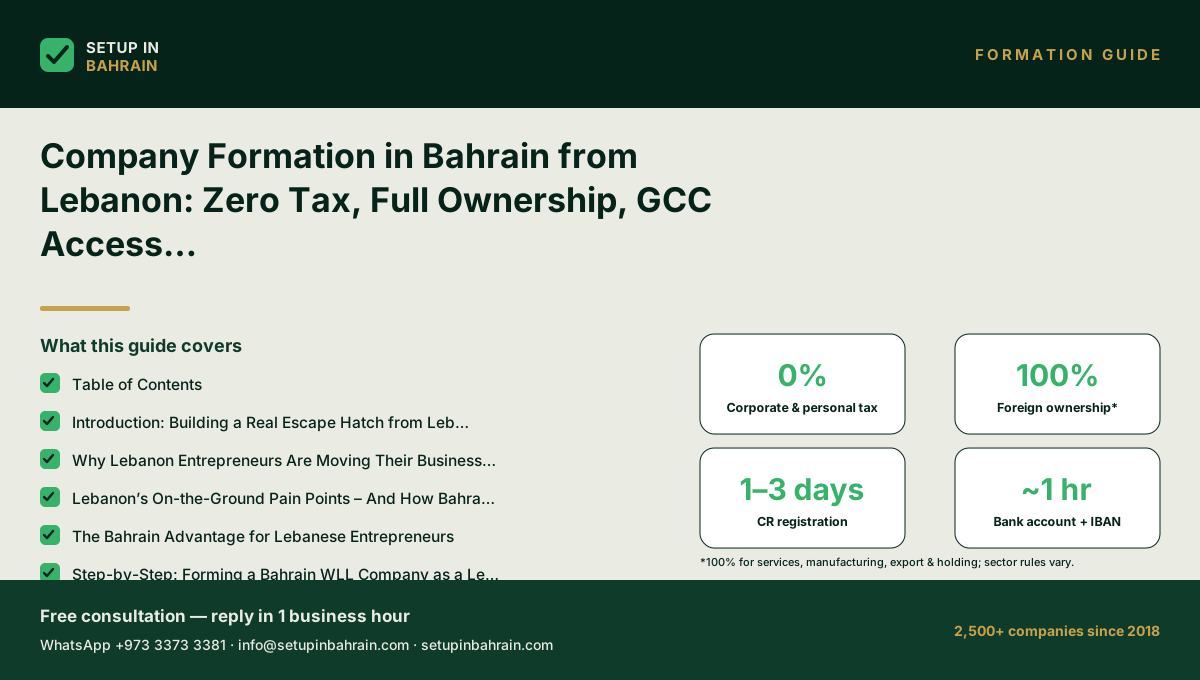
Complete guide for Lebanon entrepreneurs: form a company in Bahrain with generally no corporate income tax for most sectors, 100% foreign ownership, and GCC market access. Costs, steps, visas, banking.
→ Complete guide: Company Formation in Bahrain — the full 2026 guide
View details
Ownership & capital
A Bahrain WLL can be owned by a single person — 100% foreign ownership applies to most activities, with no local partner required for services, manufacturing, export trading and holding companies. The minimum share capital is BHD 1; we recommend BHD 1,000, which makes bank account opening and investor visa approval smoother.
Table of Contents
- [Introduction: Building a Real Escape Hatch from Lebanon’s Business Crisis](#introduction)
- [Why Lebanon Entrepreneurs Are Moving Their Business to Bahrain](#why-lebanon-entrepreneurs-are-moving-their-business-to-bahrain)
- [Lebanon’s On-the-Ground Pain Points – And How Bahrain Solves Them](#lebanons-on-the-ground-pain-points--and-how-bahrain-solves-them) - 3.1 [Corporate Taxation: 17% on Paper, But Far More in Practice](#corporate-taxation-17-on-paper-but-far-more-in-practice) - 3.2 Currency Collapse and Banking Paralysis(#currency-collapse-and-banking-paralysis) - 3.3 [Capital Controls and USD Transfer Restrictions](#capital-controls-and-usd-transfer-restrictions) - 3.4 [Infrastructure, Power, and Justice Delays](#infrastructure-power-and-justice-delays)
- [The Bahrain Advantage for Lebanese Entrepreneurs](#the-bahrain-advantage-for-lebanese-entrepreneurs) - 4.1 [100% Foreign Ownership — No Local Partner Required](#100-foreign-ownership--no-local-partner-required) - 4.2 Zero Corporate and Personal Taxes(#zero-corporate-and-personal-taxes) - 4.3 [USD-Pegged Stable Currency and Open Banking](#usd-pegged-stable-currency-and-open-banking) - 4.4 Regional Market Access: The GCC Gateway(#regional-market-access-the-gcc-gateway) - 4.5 Transparent Legal Framework(#transparent-legal-framework)
- [Step-by-Step: Forming a Bahrain WLL Company as a Lebanese Founder](#step-by-step-forming-a-bahrain-wll-company-as-a-lebanese-founder) - 5.1 [Why the WLL is Ideal – and Avoiding Common Traps](#why-the-wll-is-ideal--and-avoiding-common-traps) - 5.2 Required Documents for Lebanon Residents(#required-documents-for-lebanon-residents) - 5.3 Application Process Timeline(#application-process-timeline) - 5.4 [Minimum Capital and Practical Advice for Bank Account Opening](#minimum-capital-and-practical-advice-for-bank-account-opening) - 5.5 [Investor Visas and Residency: Real Numbers](#investor-visas-and-residency-real-numbers)
- [Comparing Costs: Lebanon vs. Bahrain Company Formation](#comparing-costs-lebanon-vs-bahrain-company-formation) - 6.1 Detailed Cost Breakdown Table(#detailed-cost-breakdown-table) - 6.2 Hidden Costs to Avoid(#hidden-costs-to-avoid)
- [Bank Account Opening as a Lebanese in Bahrain: What to Expect](#bank-account-opening-as-a-lebanese-in-bahrain-what-to-expect)
- [Residency, Family Visas, and Your Pathway as a Bahrain Business Owner](#residency-family-visas-and-your-pathway-as-a-bahrain-business-owner)
- [Case Studies: Lebanese Entrepreneurs’ Real Stories in Bahrain (2024-2026)](#case-studies-lebanese-entrepreneurs-real-stories-in-bahrain-2024-2026)
- [FAQ: Bahrain Company Formation for Lebanese Founders in 2026](#faq-bahrain-company-formation-for-lebanese-founders-in-2026)
- [Conclusion: Making the Strategic Move — Building Regional Business Security](#conclusion)
Introduction: Building a Real Escape Hatch from Lebanon’s Business Crisis
For Beirut’s business owners, the last seven years have been a relentless test of ingenuity — and endurance. Surviving in Lebanon’s 17% corporate tax regime no longer feels like the hardest part. Business leaders like Rania, who ran a logistics startup in Furn El Chebbak, or Jad, who exported software from Jnah, have weathered realities that go far beyond tax:
- The Lebanese pound has lost 98% of its value since 2019. Profits are erased overnight.
- The banking system, once a regional magnet, collapsed in 2020; dollars became unreachable, capital controls morphed into semi-permanent prison bars for your earnings.
- Power outages and generator costs bite deeply into margins; court resolutions can take years — often too late to save a business.
- As of 2025, Banque du Liban circulars still prevent even routine USD outward transfers. Your business is trapped — even if you win clients abroad.
No amount of agility or “Lebanese resilience” can fix a system structurally tilted against growth and wealth preservation. The smartest move is an exit ramp that doesn’t mean exile, but a future.
Enter Bahrain — a strategic, low-friction base promising Generally no corporate income tax for most sectors, 100% foreign ownership, and a banking sector regulated by the Central Bank of Bahrain (CBB) with robust USD access. In 2026, this is the route that hundreds of your peers are already taking. This guide is written, in detail, for Lebanese business owners ready to take that lifeline.
Why Lebanon Entrepreneurs Are Moving Their Business to Bahrain
Lebanese businesspeople seldom flee at the first sign of turbulence. But the combination of currency collapse, banking paralysis, and a “17% corporate tax” that means little if your capital is stuck, has shifted thinking from “wait it out” to “where next?” For so many, the answer is Bahrain.
A few hard numbers:
- Currency: LBP is down over 98% in real value versus 2018. (World Bank 2026)
- Bank Access: As of 2025, less than 10% of Lebanese SMEs hold operational, fully liquid USD accounts in-country. (Banque du Liban/Central Bank annual reports)
- Trade Blockade: Daily cross-border payments, even for critical imports, require weeks or cannot be completed. “Lollars” (bank dollars) are discounted by up to 95% from real USD. (BLOMINVEST 2025)
- Tax vs. Reality: Your “tax rate” is irrelevant when you cannot send profits home, invest abroad, or even guarantee clients can pay you.
- Competitor Dynamics: UAE and Saudi rivals operate with full USD access, fast digital banking, and zero capital controls.
Lebanese firms are choosing Bahrain because:
- It is the only GCC country with full 100% foreign company ownership in almost every sector.
- There is zero corporate, income, or capital gains tax as standard.
- It is the region’s “open” business environment, ranked #1 for economic freedom in the Arab world (Fraser Institute, 2026).
- Transparency of banking, and certainty: Bahraini banks, under CBB oversight, have never experienced capital controls, nor have any blocked expat or company funds, even in the regional crises of 2008, 2015, or 2020.
Lebanon’s On-the-Ground Pain Points – And How Bahrain Solves Them
Corporate Taxation: 17% on Paper, But Far More in Practice
Lebanon’s official corporate tax rate is 17%, with some additional municipal and stamp duties. Yet, in the past five years, the real “cost” of doing business goes far beyond tax:
- Currency devaluation’s impact dwarfs tax. Profits denominated in LBP are worth a fraction by the time accounts close.
- Hidden losses mount from exchange rate volatility, supply chain delays, and inability to pay or receive in hard currency.
In Bahrain, there’s no catch:
- generally no corporate income tax for most sectors for almost all activities (small exceptions for oil/gas sector firms regulated directly by the state oil ministry).
- Auditing is straightforward, and you can keep your earnings in USD, BHD, or any convertible currency.
Currency Collapse and Banking Paralysis
Since 2019, the Lebanese pound’s freefall wiped out savings and profit alike. Worst of all, local banks – once regionally respected – have now lost most foreign correspondent relationships. As a Lebanese business, you’re likely to:
- Be paid in “lollars” (USD credits that cannot be withdrawn), often at a 90–95% loss versus real USD
- Watch your purchasing power shrink as vendors demand payment in cash or hard currency
Bahrain’s Reality: The Bahraini dinar (BHD) is pegged at $2.65 since 1980. According to the Central Bank of Bahrain, its reserve coverage remains one of the strongest in the Gulf. That translates to real-world stability for your invoices, profits, and day-to-day operations.
Capital Controls and USD Transfer Restrictions
Following the Lebanese banking crisis, Banque du Liban’s infamous circulars (notably Circular 151 and successors) mean:
- Outward USD bank transfers are functionally impossible for the majority since 2020, and still blocked in 2026.
- Cross-border payments for foreign suppliers, raw materials, and even client refunds are frozen or require third-party workaround schemes (via Cyprus, Dubai, or cash couriers) — all risky and costly.
Bahrain:
- No capital controls — ever.
- Banks offer full multi-currency accounts, and their compliance departments are regulated to OECD standards, with transparent KYC for expats.
- You can receive, hold, and remit funds in USD, EUR, GBP, or BHD without restrictions.
Infrastructure, Power, and Justice Delays
Running a business from Lebanon in 2026 means:
- Only 3–4 hours of electricity per working day (EdL official stats, 2025)
- Private generators can cost up to $1,300 per month for an SME
- Business litigation or contract disputes often drag for 4–7 years in court
- Property and vehicle insurance come with “political risk” exclusions after the Beirut port explosion
Compare this to Bahrain:
- 24/7 grid electricity with 99.9% reliability and some of the region’s lowest utility tariffs (BIPA infrastructure report, 2026)
- Accessible online legal recourse, with most contract disputes resolved within months in commercial courts
- Property and business insurance are globally recognized, with no exclusions for political/sovereign risk
The Bahrain Advantage for Lebanese Entrepreneurs
100% Foreign Ownership — No Local Partner Required
Fact you must know: Bahrain is the only GCC country where a single foreigner — even recently arrived — can fully own a WLL (With Limited Liability) company, end-to-end.
- No Bahraini partners, no “side agreements,” no nominee structures.
- You, as a Lebanese national, can serve as sole shareholder, sole manager, and ultimate beneficiary.
Comparison:
| Country | 100% Foreign Ownership? | Local Partner Required? | Minimum Capital Requirement |
| ------------ | ---------------------- | ----------------------- | --------------------------- |
| UAE (Mainland) | In many sectors, but local service agents (no equity) still involved for some professional activities | Often | AED 50,000–300,000 |
| Saudi Arabia | Yes (for many sectors) | No for most activities | SAR 500,000 + monthly fees |
| Qatar | Still partial; exceptions exist | Usually | QAR 200,000 |
Zero Corporate and Personal Taxes
- Corporate tax: 0% (except oil/gas).
- Personal income tax: 0%.
- Capital gains: 0%.
- VAT at 10%, but reclaimable for most exporters and consultancy firms.
USD-Pegged Stable Currency and Open Banking
- BHD is pegged: $2.65 (no fluctuations in over 40 years).
- All major Bahraini banks (Bank ABC, Ahli United, NBB) offer full multi-currency accounts.
- No history of capital controls or blocked transfers.
Regional Market Access: The GCC Gateway
- Full GCC market access: Bahrain company can sponsor GCC-wide contracts, visas, and bank accounts.
- Your Bahrain WLL can open branches in Saudi Arabia, UAE, Qatar, and Oman — often with preferred status under GCC trade agreements.
- Home to international free zones (Bahrain Logistics Zone, BFH) and ease of global shipping.
Transparent Legal Framework
Regulated by:
- Central Bank of Bahrain (CBB) — Financial sector regulatory gold standard.
- Bahrain Economic Development Board (EDB) — Investor ombudsman and soft-landing provider.
- Ministry of Industry & Commerce (MOIC) — Fast digital company registration and licensing.
- Bahrain Investors’ Centre (BIPA) — Single-window service for licenses, visas, utilities, and tax certificate issuance.
Step-by-Step: Forming a Bahrain WLL Company as a Lebanese Founder
Why the WLL is Ideal – and Avoiding Common Traps
A WLL company (With Limited Liability) is the company of choice for Lebanese entrepreneurs. Here’s why:
- Full 100% ownership.
- No need for local partner, director, or sponsor.
- Minimal capital: The legal minimum is BHD 1, but in practice, aim for BHD 1,000 to satisfy bank and immigration requirements.
- No available “WLL” or single person company regime in Bahrain — but a single founder can fully own a WLL.
Beware: Do not be misled by old online content referencing WLL — the legal structure does not exist in Bahrain for foreign investors.
Required Documents for Lebanon Residents
- Passport copy (clear/valid >12 months)
- Lebanese ID card (required if resident; not required if just relocating)
- Proof of residential address (utility bill, lease)
- CV and basic professional background (for investor visa pre-approval)
- No requirement for police certificate or “Good Conduct” letter; background check is done digitally by MOIC
Optional, but helpful: Business plan summary, especially for regulated industries (finance, healthcare, F&B).
Application Process Timeline
- Document Preparation (Remote): 3–5 days
- Company Name Reservation: 2 days (online via Sijilat, MOIC system)
- Submission of Articles of Association and Application: 2–3 days
- MOIC Review and Initial Approval: 3–7 days
- Bank Account Pre-Approval (see below): parallel, about 7–12 days
- Final Commercial Registration: 1–2 days
- Investor Visa Application: 5–14 business days (for most non-restricted nationalities)
Total average time from start to operational company: 3–4 weeks (faster than UAE or Qatar)
Minimum Capital and Practical Advice for Bank Account Opening
- WLL minimum capital: BHD 1 (about $2.65)
- Practical recommended capital: BHD 1,000–3,000 (this shows real substance to banks and immigration)
- Capital deposit proof is usually required by banks before your account is finally activated.
Insider tip:
- Many banks prefer to see a credible balance sheet/capital deposit — BHD 1,000 is the “magic number” that avoids delays and signals seriousness.
- Invest the capital in the company bank account, then use for business setup expenses as needed.
Investor Visas and Residency: Real Numbers
- Investor residency (“self-sponsorship”): granted for any WLL owner with minimum practical capital (BHD 1,000+).
- Validity: 2 years, renewable.
- Family sponsorship: Possible immediately after company full approval; spouse and minor children eligible.
- Physical presence required: Entry to Bahrain to activate the visa, one time. No minimum stay mandated for renewal.
All information above cross-checked via MOIC and BIPA guidelines, 2026.
Comparing Costs: Lebanon vs. Bahrain Company Formation
Detailed Cost Breakdown Table
| Expense Type | Lebanon (2026) | Bahrain (2026) |
| Corporate Tax | 17% (LBP or USD, hard to remit) | 0% |
| Company Registration | $900–$2,000 + legal fees | $800–$1,500 (fully inclusive) |
| Minimum Paid-Up Capital | ~LBP 5M ($50 official, >$15 real) | BHD 1 (practical: BHD 1,000 = $2,650) |
| Bank Maintenance Fee | 1–2% of dormant account/year | Flat BHD 40–80 annual |
| Cross-Border Payments | Blocked or >8% informal fees | Direct SWIFT, actual cost <1% |
| Company Secretary | $500–$900/year | Not required for WLL |
| Investor Visa | N/A (not available) | $600–$900/2 years (all fees inc.) |
| Electricity (SME) | Up to $1,300/mo (generator+EdL) | $100–$300/month |
| Insurance (SME) | $1,200–$3,000/year | $800–$1,600/year (more coverage) |
| Court Case/Dispute | 4–7 years (medium outcome) | 4–12 months (most cases) |
| Accountant/Auditor | $800–$2,000/year (LBP/USD issues) | $300–$1,500/year |
| Paid-Up Capital Withdrawal | Subject to capital controls | Free, post bank account setup |
Hidden Costs to Avoid
- Lebanon: Black-market currency conversion, bribes to expedite court or banking, transfer agents’ fees to send money abroad (often 5–8% loss per transfer)
- Bahrain: None if you use licensed advisors and avoid gray-market “sponsor” arrangements
Bank Account Opening as a Lebanese in Bahrain: What to Expect
Banking anxiety is the single biggest concern for Lebanese founders — with reason. In Lebanon 2024–2026, even basic foreign-currency accounts are phantom assets.
Bahrain’s process by comparison:
- Entirely regulated by CBB — no “favors,” no bribes.
- Banks for new companies:
- Required documents: Company CR (Commercial Registration), M&AA, proof of business activity, and KYC for all UBOs (Ultimate Beneficial Owners).
- Interview: Some banks may request a brief Zoom or in-person interview, primarily to check for CDD (Customer Due Diligence) and AML (Anti-Money Laundering) compliance.
- Timeline: 7–14 business days for standard approval and first capital deposit.
- Currencies supported: BHD, USD, EUR, GBP, and others.
- No “off-limits” nationality listing: Lebanese nationals are considered regular risk, unless sanctioned or listed for specific compliance issues (check CBB FIRIQ status).
Key point for Lebanese applicants: Banks may ask about source of funds in detail due to regional AML/KYC measures, so be ready to show invoices, client lists, or proof of existing business abroad.
Residency, Family Visas, and Your Pathway as a Bahrain Business Owner
- As a WLL owner (Lebanese), you receive a 2-year investor visa renewable without local sponsor.
- Your spouse and children under 18 can be sponsored after you complete CR and business bank account setup.
- No “minimum stay” — you are not required to live in Bahrain full-time; periodic visits to maintain active business are sufficient.
- Path to long-term residency: After continuous company activity, possible to apply for renewable “Golden Residency” (introduced in 2023) with evidence of annual turnover exceeding BHD 100,000 and operation in priority sectors (tech, services, trade).
Case Studies: Lebanese Entrepreneurs’ Real Stories in Bahrain (2024-2026)
Case Study 1: Jad (Software Export, ex-Beirut, founded in Manama 2024)
After Banque du Liban issued new restrictions in early 2024, Jad shifted his SaaS licenses from Beirut to a Bahrain-registered WLL. Within three weeks, he:
- Registered his company solo (no partners).
- Opened a BHD/USD bank account with NBB.
- Shifted client invoicing to USD, allowing collection of payments from Saudi, UAE, and EU clients directly.
- His family moved to Riffa with him, children enrolled in English-language schools within a month.
Case Study 2: Marwa (E-commerce, formerly based in Tripoli, 2025)
Marwa’s cross-border fashion export business was crippled by failed outward USD transfers from Lebanon. In Manama:
- She opened her own single shareholder WLL with BHD 1,000 capital, all digital.
- Launched a branded e-commerce site, plugged into Stripe Bahrain and PayPal.
- Receives USD/EUR payments directly to her Bahraini bank account.
- Used her Bahraini residency to apply for Schengen business visa, resuming EU trips to shows and clients.
Case Study 3: Fadi and Rami (Consulting, ex-Hazmieh, relocated 2025)
Two old friends, both Lebanese, founded a WLL in Bahrain to service consulting clients all over the Gulf.
- Set up remotely in three weeks.
- Zero tax on consulting fees, with clients paying in EUR, USD, or BHD.
- Sponsored each of their families, maintaining a flexible “hub and spoke” business between Manama and Dubai.
- Grew revenue 210% in 18 months after migration (source: internal audited statements, 2026)
FAQ: Bahrain Company Formation for Lebanese Founders in 2026
Can I really own 100% of my Bahrain company as a single Lebanese national?
Yes. A WLL allows one person to own, direct, and manage the company with no local Bahraini partner or “sponsor” — confirmed by MOIC and BIPA (2026).Is there any “hidden” minimum capital? Sites say BHD 1, but others mention BHD 1,000+?
Legally, the minimum is BHD 1, but in practice, you should budget BHD 1,000 for smooth bank and immigration approvals. Anything less risks application delays.How quickly can I get a business bank account?
Most banks process company account openings for Lebanese founders in 7–14 business days, subject to standard KYC and proof of business details.How does Bahrain treat tax residency for remote founders who visit only occasionally?
Bahrain’s tax system is territorial — if your company is registered and operational in Bahrain, and you do not maintain other tax residencies, your business profit is Bahrain-source (0% tax, except oil/gas). Full details: CBB, BIPA guidance 2026.Can I operate from Dubai/Athens/Paris and keep my company in Bahrain?
Yes, Bahrain imposes no restrictions on owner location, as long as local substance (CR, registered office, bank account) is maintained.Can I move LBP “lollars” or trapped Lebanese funds into Bahrain?
Unfortunately, no. Bahraini banks do not accept lollar funds or blocked “bank dollars.” All capital must be transferred in real, free funds (cash, SWIFT, or similar).What sectors are open to Lebanese founders in Bahrain?
Almost all — tech, trade, e-commerce, food, consulting, logistics, professional services, and light manufacturing. Some regulated sectors (banking, insurance, defense) require extra MOIC approvals.Conclusion: Making the Strategic Move — Building Regional Business Security
For 2026’s Lebanese entrepreneurs, Bahrain is no longer the “well-kept secret” it once was. It’s now the region’s safest bet for:
- Zero tax, stable currency, and unconstrained global banking access
- True 100% foreign ownership (no hidden partners, full personal control)
- Family residency, easy travel, and future-proof market expansion
- BIPA and EDB support, with digital-first services aimed at non-GCC founders
For bespoke, step-by-step process assistance, consult with a Bahrain-registered advisor or reach out directly to BIPA for their Lebanese founders desk. Every journey starts somewhere. For Lebanon’s most dynamic entrepreneurs, that new beginning is Manama.
Stats sourced from: Central Bank of Bahrain (CBB), Bahrain Investors’ Centre (BIPA), Bahrain Economic Development Board (EDB), World Bank, Banque du Liban, and commercial sector survey data, 2026.
Bahrain Business Guides for Lebanon Citizens
Ready to set up in Bahrain from Lebanon?
Tell us your business idea. We map the right entity, ownership and timeline — then handle the filing while you focus on what matters.