Register your Bahrain company from Kyrgyzstan with generally no corporate income tax for most sectors. Fast setup, full foreign ownership, and easy banking for Kyrgyz entrepreneurs.
Key Takeaways
- The Kyrgyzstan Business Environment: Real Challenges You're Facing
- Why Bahrain for Kyrgyzstan Entrepreneurs Specifically
- Types of Business Entities for Kyrgyzstan Entrepreneurs
- Step-by-Step: How to Register Your Bahrain Company from Kyrgyzstan
- Banking and Financial Considerations for Kyrgyz Entrepreneurs
→ Complete guide: Company Formation in Bahrain — the full 2026 guide
View details
Ownership & capital
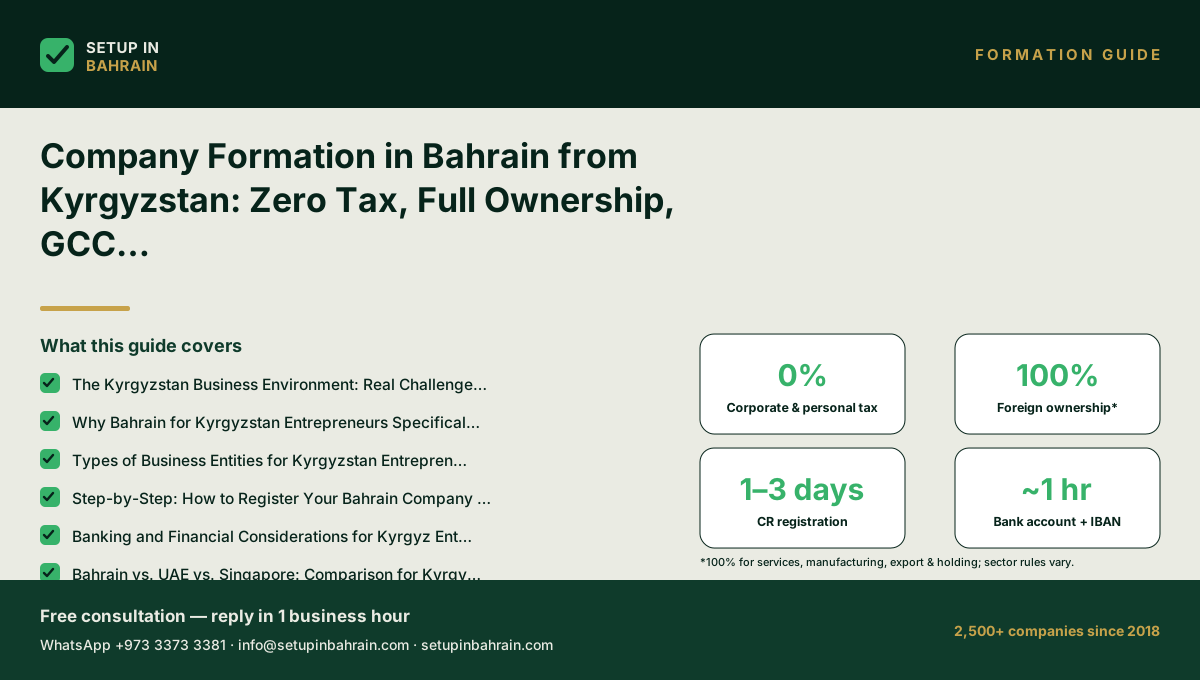
A Bahrain WLL can be owned by a single person — 100% foreign ownership applies to most activities, with no local partner required for services, manufacturing, export trading and holding companies. The minimum share capital is BHD 1 ; we recommend BHD 1,000 . This Makes bank account opening and investor visa approval smoother.
Azamat runs a logistics coordination company from Bishkek. Last year, his business cleared 12 million som in profit—a milestone that should have felt like victory. Instead, he watched the Kyrgyz som slide another 8.3% against the dollar while his costs stayed pegged to international freight rates. After paying his 1generally no corporate income tax for most sectors, his 3% sales tax obligations. His mandatory social contributions, the actual purchasing power of his retained earnings dropped by nearly 17% in real terms.
"I'm working harder every year just to stay in the same place," he told me during a consultation in his cramped office near Osh Bazaar. "My clients pay in dollars. By the time that money converts to som and I pay everything I owe, I'm losing ground."
Azamat's story isn't unique. Across Kyrgyzstan's business class—from tech developers in Bishkek's emerging startup scene to textile exporters in Naryn, from gold service providers in Jalalabad to the growing cohort of digital nomad employers—the same frustration echoes. The math simply doesn't work anymore.
The som has depreciated between 5% and 10% annually for most of the past decade. National Bank of the Kyrgyz Republic reserves hover around $2.8 billion, barely adequate for four months of import cover according to recent IMF assessments. Meanwhile, regional instability and Russia-related secondary sanctions concerns have made international banking relationships more and more precarious for Kyrgyz businesses seeking to operate globally.
This is why Bahrain has emerged as more than just another offshore option. For Kyrgyzstan entrepreneurs specifically, the Gulf kingdom offers something rare: a complete structural solution to almost every pain point that makes running a Kyrgyz business unnecessarily expensive and risky.
Generally no corporate income tax for most sectors—not 10%, not reduced rates, zero. A currency pegged to the US dollar since 1980, eliminating forex erosion overnight. A banking system with 400+ correspondent relationships worldwide, according to the Central Bank of Bahrain (CBB). Full foreign ownership without local sponsors. And perhaps most critically for Kyrgyz entrepreneurs navigating an more and more complicated geopolitical landscape: a jurisdiction with clean international standing and no secondary sanctions exposure.
Over the past 18 months, more than 70 Kyrgyzstani founders have established holding companies or operating subsidiaries in Bahrain—not in Dubai, not in Cyprus, not in Singapore. This guide explains exactly why, and precisely how you can do the same.
The Kyrgyzstan Business Environment: Real Challenges You're Facing
Before examining why Bahrain works, let's be honest about what you're dealing with at home. These aren't theoretical problems—they're the daily reality that makes scaling a Kyrgyz business feel like pushing a boulder uphill.
Currency Depreciation: The Silent Profit Killer
The Kyrgyz som has lost about 40% of its value against the US dollar over the past five years. In 2023 alone, the KGS dropped from roughly 85 to 89 per dollar. In 2024, it slid past 89 and touched 95 at various points. As of early 2025, the rate hovers between 87 and 92, with consistent downward pressure.
For businesses earning in som but paying international suppliers, licensing software, or servicing dollar-denominated debts, this depreciation functions as a hidden tax far exceeding the official 10% corporate rate. Consider Gulnara, a textile exporter from Osh who closed a significant deal with a European buyer last year. Her team worked tirelessly, the quality was exceptional, and the profit margin looked healthy on paper. But as she converted her earnings, the familiar knot tightened in her stomach. That 8% som depreciation didn't appear on any tax form. It eroded her purchasing power just as effectively as if the government had doubled her tax rate.
The National Bank maintains reserves of about $2.8 billion—enough for roughly four months of import cover. Compare this to Bahrain's position: the Bahraini dinar has been pegged at 0.376 to the US dollar since 1980, backed by CBB reserves exceeding $4.1 billion and the implicit support of Gulf Cooperation Council (GCC) monetary stability mechanisms.
The UKMK Filing Reality: Paper Meets Primitive Digital
If you've ever tried to complete a full tax year with the State Tax Service (UKMK), you understand the peculiar frustration of Kyrgyzstan's hybrid system. The e-filing platform exists—technically. But critical functions still require paper submissions. The system crashes predictably during peak filing periods in April. Error messages appear in Russian, Kyrgyz, and occasionally untranslated database codes that even tax officers struggle to interpret.
One Bishkek accountant described the process to me as "filing your taxes with one hand in 2024 and the other in 1994." Reconciling VAT credits requires physical visits to district offices. Disputing assessments means navigating a bureaucracy where decisions can take 6-18 months. For entrepreneurs trying to run businesses that compete internationally, the administrative burden alone consumes hundreds of hours annually.
Bahrain's Ministry of Industry and Commerce (MOIC) operates a fully digital registration system. The Sijilat online portal handles company formation, amendments, license renewals. Annual compliance in a unified English-language interface. The Economic Development Board (EDB) reports average company registration completion times of 3-5 business days. No paper. No office visits. No mysterious error codes.
Secondary Sanctions: The Russia Transit Problem
This is perhaps the most sensitive issue facing Kyrgyz entrepreneurs in 2025-2026. One that deserves direct discussion.
Kyrgyzstan's geographic position makes it a natural transit point for goods moving between Russia, China. Central Asia. This has been economically beneficial—Kyrgyz re-exports to Russia surged after Western sanctions began in 2022. But it has also created serious compliance headaches for businesses trying to maintain relationships with European, American. Gulf partners.
Several Kyrgyz banks have faced correspondent banking restrictions. International payment processing has become unpredictable. European buyers have begun asking uncomfortable questions about supply chain exposure. American software companies have added enhanced due diligence requirements for Kyrgyz business customers.
One tech founder in Bishkek told me his company lost a $180,000 annual contract with a German client specifically because the client's compliance team flagged Kyrgyzstan's Russia-adjacent position as an unacceptable risk. "They didn't accuse us of anything," he said. "They just said their insurance wouldn't cover doing business with Central Asian entities anymore."
Bahrain maintains strong relationships with Western financial systems while operating as a neutral GCC hub. The kingdom has implemented FATF-compliant anti-money laundering frameworks, maintains correspondent banking relationships with major US and European institutions. Actively positions itself as a clean jurisdiction for international business. For Kyrgyz entrepreneurs, a Bahrain entity can serve as a compliance-friendly interface between your operations and international partners who might otherwise hesitate.
The 6.5 Million Population Ceiling
Kyrgyzstan's domestic market is fundamentally limited. With a population of about 6.5 million and GDP per capita around $1,500, the ceiling for local-focused businesses is low. Even the most successful domestic companies eventually face the question: where do we grow next?
Traditional answers pointed toward Russia (complicated by sanctions), Kazakhstan (competitive, with its own strong entrepreneurs), or China (challenging market access, language barriers, regulatory complexity). Bahrain offers an alternative vector: the GCC market of 55+ million consumers with GDP per capita ranging from $23,000 (Oman) to $85,000 (Qatar).
A Bahrain company can sell into Saudi Arabia, the UAE, Kuwait. The broader Middle East without the jurisdictional baggage that more and more attaches to Central Asian entities. For service businesses, technology companies, and consultancies, this market access alone can justify the formation costs.
Why Bahrain for Kyrgyzstan Entrepreneurs Specifically
Having established the problems, let's examine why Bahrain—rather than Dubai, Singapore, Estonia, or other popular jurisdictions—makes particular sense for Kyrgyz business owners.
Generally no corporate income tax for most sectors: The Mathematics of Keeping Your Money
Bahrain charges generally no corporate income tax for most sectors for most business activities. This isn't a temporary incentive, a special economic zone carve-out, or a rate that requires complex structuring to access. It's the standard rate, applicable to foreign-owned companies operating across virtually all sectors except hydrocarbons.
Let's run the comparison with real numbers:
| Factor | Kyrgyzstan | Bahrain |
| Corporate Tax Rate | 10% | 0% |
| Dividend Withholding Tax | 10% | 0% |
| Capital Gains Tax | 10% | 0% |
| VAT/Sales Tax | 12% (many goods) | 10% (Value Added Tax) |
| Currency Stability (5-year) | -40% vs USD | Pegged at 0.376 BHD/USD |
| Personal Income Tax | 10% | 0% |
In Bahrain, you'd pay $0 in corporate tax, $0 in dividend tax. Experience $0 in currency erosion. Your effective retention rate: 100%, minus only operational costs and the modest annual licensing fees (typically $1,000-5,000 depending on license type).
Over a five-year period, the difference compounds dramatically. That $500,000 annual profit becomes roughly $1.75 million in retained capital in Bahrain versus about $1.2 million in Kyrgyzstan—assuming the som doesn't depreciate faster than historical averages.
Dollar-Pegged Currency: Eliminating Forex Risk
The Bahraini dinar's peg to the US dollar isn't a recent policy response or an experimental monetary stance. It's been maintained since 1980—through oil shocks, regional conflicts, the 2008 financial crisis. The COVID-19 pandemic. The CBB maintains reserves specifically to defend this peg. The broader GCC monetary cooperation framework provides additional stability.
For Kyrgyz entrepreneurs who've spent years watching the som erode their purchasing power, this stability is transformative. You can plan, invest. Price contracts knowing that the money you earn today will have the same value next year. You can hold retained earnings without watching them depreciate. You can quote international clients without building currency hedging costs into every proposal.
One Bishkek entrepreneur who relocated his IT consultancy's headquarters to Bahrain described the psychological shift: "I used to wake up and check the exchange rate before I checked my email. Now I don't even think about it. The dinar is the dinar. My money is my money."
100% Foreign Ownership: No Sponsors, No Partners, No Complications
Bahrain was the first GCC country to allow 100% foreign ownership across most sectors. This isn't limited to free zones—it applies to mainland commercial registrations as well, though certain regulated activities (healthcare, education, some retail categories) may have additional requirements.
For Kyrgyz entrepreneurs accustomed to full ownership of their businesses, this matches expectations. But it's worth understanding how rare this is in the region. The UAE still requires local sponsors for many mainland activities (though free zones offer alternatives). Saudi Arabia has been liberalizing but retains restrictions in numerous sectors. Bahrain's approach is genuinely exceptional and has been consistently maintained since initial reforms in 2001.
You register your company. You own 100% of it. You control all decisions. There's no sleeping partner taking 51% of your equity for a signature, no annual "sponsorship fees" that function as a private tax, no complex side agreements trying to structure around local ownership requirements.
Banking Infrastructure: 400+ Correspondent Relationships
Perhaps no single factor matters more for Kyrgyz entrepreneurs than banking access. The CBB reports that Bahrain-licensed banks maintain over 400 correspondent banking relationships worldwide, including with major institutions in the US, UK, EU, and Asia.
This means:
- Wire transfers actually complete, typically within 1-3 business days
- Multi-currency accounts are standard (USD, EUR, GBP, and BHD at minimum)
- Trade finance facilities are available from institutions familiar with international commerce
- Card acquiring and payment processing works with global networks
- Your bank has heard of your client's bank, and vice versa
Compare this to the Kyrgyz banking reality, where correspondent relationships have been strained by sanctions concerns, where international wires can take 5-10 business days and sometimes fail entirely, where opening a simple dollar account requires justification and documents that would satisfy a money laundering investigation.
Bahrain's banking sector includes major international names (HSBC, Standard Chartered, Citibank, BNP Paribas) alongside strong regional and local banks. The Bahrain Islamic Bank, Ahli United Bank, and National Bank of Bahrain all offer corporate banking services to foreign-owned entities with relatively straightforward onboarding—assuming your business has substance and legitimate commercial purpose.
Geographic and Time Zone Advantages
Bahrain sits at the crossroads of East-West commerce. The time zone (GMT+3) overlaps with European business hours in the morning and Asian hours in the afternoon. Direct flights connect Manama to London, Frankfurt, Singapore, Mumbai, and dozens of regional cities. Gulf Air, the national carrier, operates an extensive network.
For Kyrgyz entrepreneurs, this positioning enables something Bishkek's location makes difficult: real-time business with both European and Asian clients without requiring anyone to wake up at 3 AM. The 3.5-hour flight to Dubai, 6 hours to London, 4 hours to Mumbai. Reasonable connections onward to Hong Kong and Singapore make Bahrain genuinely accessible.
The Bahrain-Kyrgyzstan direct connection is admittedly limited—you'll typically route through Dubai, Istanbul, or occasionally Almaty. But once established in Bahrain, your access to global markets improves dramatically versus operating from Bishkek.
Types of Business Entities for Kyrgyzstan Entrepreneurs
Understanding Bahrain's entity types helps you choose the structure that matches your business model, compliance tolerance. Budget. The MOIC oversees commercial registration, while the CBB handles financial services licensing.
Work From Home License (WFH)
Best for: Solo consultants, freelancers, digital service providers
The WFH license is Bahrain's entry-level option, costing about BHD 80-100 ($212-$265) annually. It allows you to conduct business activities from a residential address, eliminating the need for commercial office space.
Restrictions apply: you cannot hire employees, cannot sponsor dependents on this license. Cannot conduct activities requiring a physical commercial presence. But for Kyrgyz consultants selling services internationally—software development, design, writing, marketing, business advisory—the WFH license provides a legitimate Bahrain legal presence at minimal cost.
single-shareholder WLL
Best for: Individual entrepreneurs seeking formal corporate structure
The WLL allows one natural person to establish a limited liability company. Capital requirements are minimal (BHD 50 minimum for many activities). The structure provides the liability protection absent from sole proprietorship arrangements.
This works well for Kyrgyz entrepreneurs testing the Bahrain market before larger commitments, or for those who want corporate structure without the complexity of multi-shareholder governance.
Limited Liability Company (WLL or LLC)
Best for: Operating businesses, partnerships, companies expecting growth
The WLL (With Limited Liability, the local terminology for LLC) is Bahrain's standard corporate vehicle. It a single shareholder (one person can own 100%) (though these can be corporate entities), has no minimum capital requirement for most activities, and offers the flexibility to issue different share classes, admit new investors, and structure governance arrangements.
For Kyrgyz entrepreneurs planning to raise investment, partner with others, or build companies intended for eventual sale, the WLL provides the structure expected by sophisticated counterparties.
Closed Joint Stock Company (BSC Closed)
Best for: Larger ventures, companies planning significant investment rounds
The BSC structure resembles international corporation formats, with shares, a board of directors, and more formal governance requirements. Minimum capital requirements are higher (typically BHD 250,000 for many activities), and regulatory compliance is more demanding.
Most Kyrgyz entrepreneurs won't need this structure initially. It's available for those building larger ventures or receiving investment from institutional sources that prefer familiar corporate formats.
Bahrain Free Zones
Best for: Manufacturing, logistics, technology, specific sectors
Bahrain offers several free zone options, including the Bahrain Logistics Zone (BLZ), the Bahrain Investment Wharf. The Bahrain International Investment Park (BIIP). These zones offer additional incentives:
- 100% exemption from customs duties
- Streamlined licensing for specific activities
- Purpose-built infrastructure
- Potential additional tax holidays (though given generally no corporate income tax for most sectors, this matters less than in other jurisdictions)
The Bahrain Economic Development Board (EDB) can advise on whether free zone registration makes sense for your specific business model.
Step-by-Step: How to Register Your Bahrain Company from Kyrgyzstan
The practical process of forming a Bahrain company has been streamlined greatly through the Sijilat online portal. Here's what to expect:
Step 1: Choose Your Business Activity and License Type
Before touching any forms, you need to determine your Commercial Registration (CR) activity codes. Bahrain uses a standardized classification system—you're not writing a freeform business description but selecting from predefined categories.
Common choices for Kyrgyz entrepreneurs include:
- IT and software development services
- Management consulting
- Import/export trading
- Marketing and advertising services
- Professional services
Each activity code corresponds to specific licensing requirements and may affect which additional approvals you need. The MOIC website lists all available codes, or you can engage a local formation agent to advise.
Step 2: Reserve Your Company Name
Name reservations are processed through Sijilat and typically approved within 1-2 business days. Names must:
- Be unique (not identical or confusingly similar to existing registrations)
- Not include restricted terms (bank, insurance, government, etc.) without appropriate licensing
- Be provided in both Arabic and English
You can reserve multiple name options at once to avoid delays if your first choice is unavailable.
Step 3: Prepare Required Documents
For Kyrgyz entrepreneurs, you'll need:
Personal documents:
- Valid passport (minimum 6 months validity remaining)
- Passport-sized photographs
- Proof of address (utility bill, bank statement—these may require notarization and apostille)
Corporate documents (if parent company involved):
- Certificate of incorporation from Kyrgyzstan
- Memorandum and articles of association
- Board resolution authorizing Bahrain subsidiary formation
- Certificate of good standing (if available)
All foreign documents must be:
- Notarized in Kyrgyzstan
- Apostilled (Kyrgyzstan is a Hague Apostille Convention member)
- Translated into Arabic by a certified translator
The apostille process in Kyrgyzstan typically runs through the Ministry of Justice or Ministry of Foreign Affairs. Expect 3-7 business days domestically before documents can be submitted to Bahrain.
Step 4: Secure Registered Address
Every Bahrain company requires a registered address for official correspondence. Options include:
- Virtual office packages (starting from about BHD 100-200/month)
- Shared workspace arrangements
- Commercial lease (required for certain activity types)
For service businesses without physical presence requirements, virtual office solutions are cost-effective and legally compliant. The address will appear on your CR, so choose a professional option.
Step 5: Submit Application Through Sijilat
The Sijilat portal (www.sijilat.bh) accepts applications 24/7. You'll create an account, upload documents, pay the required fees (typically BHD 100-300 depending on entity type and activities). Submit for review.
The MOIC targets 3-5 business day turnaround for standard applications. Complex cases or applications requiring additional regulatory approval may take longer.
Step 6: Receive Commercial Registration Certificate
Upon approval, you'll receive your CR certificate electronically. This document confirms your company's legal existence and includes your CR number—the identifier you'll use for banking, contracts. Official interactions.
Step 7: Additional Registrations and Licenses
Depending on your activities, you may need:
- LMRA registration: Required before hiring employees. The Labour Market Regulatory Authority manages work permits and employment compliance.
- VAT registration: Mandatory if taxable supplies exceed BHD 37,500 annually. Administered by the National Bureau for Revenue (NBR).
- Industry-specific licenses: CBB approval for financial services, Ministry of Health approval for healthcare, etc.
Step 8: Open Corporate Bank Account
With your CR in hand, you can approach Bahrain banks for corporate account opening. Required documents typically include:
- CR certificate
- Memorandum and articles of association
- Board resolution authorizing account opening
- Director/shareholder identification documents
- Business plan or description of activities
- Expected transaction volumes and counterparties
Bank onboarding takes 2-4 weeks on average, though some banks offer expedited processing. Expect enhanced due diligence questions about your Kyrgyzstan connections—banks will want to understand your business model, source of funds. Client base to satisfy compliance requirements.
Banking and Financial Considerations for Kyrgyz Entrepreneurs
Successfully opening and maintaining Bahrain banking relationships requires understanding what banks are looking for and how to present your business appropriately.
What Banks Want to See
Bahrain banks operating under CBB supervision must satisfy anti-money laundering (AML) and know-your-customer (KYC) requirements. For Kyrgyz entrepreneurs, this means being prepared to address:
Source of funds: Where did the capital to establish and operate your business originate? Bank statements, tax returns, employment history, or business sale documents may be requested.
Business rationale: Why Bahrain? Banks want to understand the commercial logic of your presence—legitimate reasons (GCC market access, currency stability, international client requirements) are fine; inability to articulate any reason raises concerns.
Expected activity: What currencies, volumes, and counterparties do you anticipate? A software consultancy receiving payments from European clients has a different profile than a trading company moving goods through Central Asia.
Kyrgyzstan connections: Banks will note your country of origin and may ask about ongoing ties to Kyrgyzstan, Russia-exposure. How you've addressed sanctions compliance in your existing business.
Recommended Approach
Be transparent and well-documented. Prepare a clear business plan summarizing your activities, target markets, and expected financials. Provide clean source-of-wealth documents. Explain your legitimate reasons for choosing Bahrain. Answer compliance questions directly rather than defensively.
Banks reject applications that seem evasive, inconsistent, or designed to obscure the business's true nature. They approve applications from entrepreneurs with clear commercial purposes and appropriate documents, even when those entrepreneurs come from jurisdictions that receive enhanced scrutiny.
Multi-Currency Account Benefits
Most Bahrain corporate accounts include multi-currency functionality as standard. You can hold and transact in USD, EUR, GBP, and BHD without requiring separate accounts for each currency. This simplifies treasury management and reduces conversion costs when dealing with international clients and suppliers.
For Kyrgyz entrepreneurs accustomed to the currency friction of domestic banking, this functionality alone transforms operational efficiency.
Payment Processing and Fintech Options
Beyond traditional banking, Bahrain's fintech ecosystem offers additional payment processing options. The Central Bank of Bahrain has implemented a regulatory sandbox approach that has attracted numerous payment providers.
Options include:
- International payment processors (Stripe, PayPal) that work with Bahrain entities
- Regional payment gateways serving GCC e-commerce
- B2B payment platforms for invoice financing and accelerated receivables
The Bahrain FinTech Bay, a dedicated fintech hub, can provide introductions to relevant providers for specific business needs.
Bahrain vs. UAE vs. Singapore: Comparison for Kyrgyz Business Owners
Kyrgyz entrepreneurs often consider multiple jurisdictions before selecting Bahrain. Here's how the key alternatives compare:
| Factor | Bahrain | UAE (Dubai) | Singapore |
| Corporate Tax | 0% | 9% (above AED 375K) | 17% (with exemptions) |
| Personal Income Tax | 0% | 0% | Up to 22% |
| 100% Foreign Ownership | Yes (most sectors) | Free zones only (mainland requires sponsor for many activities) | Yes |
| Minimum Capital | BHD 50 (varies) | AED 0-300,000 (varies) | SGD 1 (but realistic minimums higher) |
| Banking Accessibility | High | Medium (enhanced scrutiny) | High but expensive |
| Formation Cost | $2,000-5,000 | $5,000-15,000 | $3,000-7,000 |
| Annual Maintenance | $1,000-3,000 | $5,000-20,000+ | $2,000-5,000 |
| Visa Pathway | Yes | Yes | Points-based, competitive |
| Time Zone | GMT+3 | GMT+4 | GMT+8 |
| GCC Market Access | Native | Native | Requires structuring |
Why Bahrain Often Wins for Kyrgyz Entrepreneurs
Cost efficiency: Dubai's higher formation and maintenance costs (driven by expensive real estate and visa requirements) make it less attractive for bootstrapped entrepreneurs. Singapore's corporate tax, while well-structured, still exceeds Bahrain's 0%.
Banking reality: UAE banks have become greatly more cautious about Central Asian entrepreneurs, especially since 2022. Enhanced due diligence, longer onboarding times, and higher rejection rates make Dubai banking relationships harder to establish. Bahrain banks, while thorough, remain more accessible.
Authenticity: Bahrain attracts fewer entrepreneurs seeking pure tax arbitrage without commercial substance. This means the jurisdiction maintains cleaner international standing and less regulatory backlash risk.
Cost of living (if relocating): Bahrain's housing, schooling. Daily expenses run 30-50% lower than Dubai for comparable quality. For entrepreneurs considering personal relocation alongside business formation, this matters greatly.
When UAE Makes Sense
Dubai excels for businesses requiring physical logistics infrastructure, consumer-facing retail, or close proximity to the world's busiest transit hub. If your business model depends on Dubai's specific ecosystem advantages, the higher costs may be justified.
When Singapore Makes Sense
Singapore offers unmatched access to Southeast Asian markets and exceptional infrastructure for financial services. If your primary growth target is Asia-Pacific rather than Middle East/Europe, Singapore's positioning may outweigh Bahrain's tax advantages.
Visa Options and Personal Relocation to Bahrain
Many Kyrgyz entrepreneurs prefer to establish their business first and remain based in Bishkek, traveling to Bahrain as needed. Others want to relocate personally, whether for lifestyle reasons, to be closer to their business, or to access Bahrain's benefits personally as well as corporately.
Self-Sponsorship Through Your Company
Once your Bahrain company is operational and registered with the LMRA, you can sponsor yourself for a work visa. This process involves:
- Obtaining LMRA authorization to hire
- Applying for your work permit through your company
- Completing the visa process through Bahrain's immigration system
The Golden Residency program offers longer-term options for qualifying investors and entrepreneurs, with validity periods of 5-10 years and the ability to sponsor family members.
Family Residency
Dependent visas are available for spouses and children of Bahrain work visa holders. Your company sponsors your dependents, and they receive residence permits tied to your employment status.
Kyrgyz Passport Considerations
Kyrgyzstan passport holders require visas for Bahrain. Options include:
- e-Visa: Available online for short visits
- Visa on arrival: Available at Bahrain airport for stays up to 14 days (check current eligibility)
- Sponsored visa: For longer stays or employment
For business formation, most Kyrgyz entrepreneurs can complete the process remotely without personal travel. For ongoing operations, the visa process is manageable but requires planning—Bahrain is not a visa-free destination for Kyrgyz citizens.
Annual Compliance and Ongoing Requirements
Operating a Bahrain company requires meeting ongoing compliance obligations. These are simpler than many jurisdictions but cannot be ignored.
Commercial Registration Renewal
Your CR must be renewed annually. The process is handled through Sijilat, requires payment of the annual fee (typically BHD 100-300). Confirmation that your business information remains accurate.
Financial Statements
Companies with annual turnover exceeding BHD 250,000 generally require audited financial statements. Smaller companies may use unaudited accounts prepared by qualified accountants. Filing requirements vary by entity type.
VAT Compliance
If your company is VAT-registered (mandatory above BHD 37,500 in annual taxable supplies), you must:
- File quarterly VAT returns through the NBR portal
- Maintain proper VAT invoices and records
- Pay any VAT due within 30 days of the quarter end
The standard VAT rate is 10%. Many services exported outside Bahrain qualify for 0% rating.
Economic Substance Requirements
Bahrain has implemented economic substance regulations for certain activities, including banking, insurance, shipping, holding companies. Intellectual property businesses. If your business falls within these categories, you must show adequate substance in Bahrain (premises, employees, expenditure, decision-making).
For most service businesses and trading companies, substance requirements are minimal or non-applicable. But, if you're structuring a holding company or IP-related entity, proper planning is essential to ensure compliance.
Beneficial Ownership Reporting
Bahrain requires companies to maintain accurate beneficial ownership information and report to relevant authorities. This aligns with international transparency standards and presents no issues for entrepreneurs with straightforward ownership structures.
Common Questions About Bahrain Company Formation from Kyrgyzstan
Can I form a Bahrain company without traveling there?
Yes. The entire formation process can be completed remotely through the Sijilat portal, with documents submitted electronically after proper notarization and apostille in Kyrgyzstan. Bank account opening may require either personal presence or video verification depending on the bank.
How long does the complete process take?
From initial document preparation to receiving your CR certificate, expect 2-4 weeks for standard applications. Add another 2-4 weeks for bank account opening. End-to-end, most entrepreneurs are fully operational within 6-8 weeks.
What's the realistic total cost to establish a Bahrain company?
Budget BHD 800-2,000 ($2,100-5,300) for formation costs, including government fees, registered address. Basic professional assistance. Annual maintenance runs BHD 500-1,500 ($1,300-4,000) depending on your structure and service providers.
Do I need to live in Bahrain to operate my company?
No. Many entrepreneurs maintain Bahrain companies while residing elsewhere, including Kyrgyzstan. But, if you're claiming certain benefits (like economic substance requirements for regulated activities), you'll need to show actual presence and management in Bahrain.
How do Bahrain banks view applications from Kyrgyzstan entrepreneurs?
With appropriate due diligence, Bahrain banks accept well-documented applications from Kyrgyz entrepreneurs. Be prepared to explain your business model, show source of funds. Address any questions about your Kyrgyzstan operations. Transparency and documents are key.
What happens to my Kyrgyzstan company?
You have options: maintain your Kyrgyz entity for domestic operations while using Bahrain for international business, wind down the Kyrgyz company entirely, or restructure the Kyrgyz entity as a subsidiary of your Bahrain holding company. The right approach depends on your specific situation, tax residency considerations, and operational needs.
Is Bahrain trying to attract businesses away from Dubai?
Bahrain has positioned itself as a cost-effective alternative to Dubai for over a decade. The EDB actively recruits entrepreneurs and businesses from other jurisdictions, including those finding Dubai too expensive or complicated. This isn't coincidental—it's explicit policy.
What about the "substance over form" concerns I've read about?
International tax authorities more and more scrutinize arrangements that appear designed purely for tax avoidance. The key protection: ensure your Bahrain company has genuine commercial purpose beyond tax reduction. Real clients, real services, real business activity. If Bahrain serves your legitimate operational needs and you conduct actual business there, substance concerns don't apply.
Making the Decision: Is Bahrain Right for Your Kyrgyzstan Business?
After examining the mechanics, costs. Comparative advantages, the decision ultimately comes down to whether Bahrain solves your specific problems.
Bahrain makes strong sense if you:
- Earn income in stable currencies but currently operate through KGS
- Face currency depreciation as a major profit erosion factor
- Need banking relationships that work reliably for international transactions
- Want to access GCC markets without the cost and complexity of Dubai
- Seek 100% ownership without local partnership requirements
- Plan to scale internationally and need a credible, clean jurisdiction
Bahrain may not be ideal if you:
- Operate a purely domestic Kyrgyz business with no international component
- Require physical manufacturing or logistics infrastructure (free zones help, but may not match your specific needs)
- Target Southeast Asian markets primarily (Singapore might be more strategic)
- Have minimal profits that wouldn't justify the formation and maintenance costs
For most internationally-oriented Kyrgyz entrepreneurs—tech companies, consultancies, trading businesses, service providers—Bahrain offers a compelling combination of zero tax, currency stability, banking access, and market positioning that no other jurisdiction fully matches.
Your Action Plan: Next 30 Days
If you've decided Bahrain makes sense for your business, here's a practical timeline:
Week 1:
- Determine your business activities and entity type
- Begin gathering personal
Bahrain Business Guides for Kyrgyzstan Citizens
Frequently Asked Questions
How long does it take to set up?
It takes 15 to 20 days. We file all forms for you. You do not need to wait long.
What does it cost?
Company formation: Standard BHD 1,340 with 3 months of office address; Gold BHD 1,700 with 6 months; Premium BHD 2,150 with 12 months and a cabin, officer table and chair, and two guest chairs. No formation package includes visas, including Premium. Investor/work visas are priced separately: BHD 755 for one year or BHD 953 for two years, in addition to the formation package. Ask for a written, itemized quotation confirming government fees and all inclusions before payment.
Do I need to visit Bahrain?
No. You can set up your firm from home. We do all the work online. Some banks may ask for one visit.
What tax will I pay?
You pay zero tax on your profits. Bahrain has no corporate income tax. This is a key benefit of the setup.
Can I own 100% of my firm?
Yes. Foreign owners can hold all shares. No local partner is needed. Full ownership is allowed.
What do I need to start?
You need a valid passport. You also need a trade name and a business address. We help you with all of these.
How do I open a bank account?
We guide you step by step. Most banks take 3 to 6 weeks. You will need your CR and firm papers.
Who issues the Commercial Registration (CR)?
The CR is issued by the MOICT. It is your legal right to trade in Bahrain. We file the CR for you.
Can I renew my CR each year?
Company renewal packages: BHD 530 with 3 months of office address; BHD 980 with 6 months; BHD 1,520 with 12 months. These are separate renewal packages, not visa fees.
How do I get started?
Fill in our form on this page. Our team will call you back. We map your best setup plan at no cost.
Steps to Form Your Company
- Pick your trade name. We check if it is free.
- Choose your business type. WLL is the most common.
- Sign the MOA. We draft and file all legal docs.
- Pay the state fees. About BHD 432 in total.
- Get your CR. Takes 15 to 20 days.
- Open your bank account. We guide each step.
- Start trading. You are ready to do business.
Key Facts
- Tax rate: 0%
- Foreign ownership: 100%
- Setup time: 15 to 20 days
- Company formation: Standard BHD 1,340 with 3 months of office address; Gold BHD 1,700 with 6 months; Premium BHD 2,150 with 12 months and a cabin, officer table and chair, and two guest chairs. No formation package includes visas, including Premium. Investor/work visas are priced separately: BHD 755 for one year or BHD 953 for two years, in addition to the formation package. Ask for a written, itemized quotation confirming government fees and all inclusions before payment.
- Company renewal packages: BHD 530 with 3 months of office address; BHD 980 with 6 months; BHD 1,520 with 12 months. These are separate renewal packages, not visa fees.
- Client rating: 4.8 stars
- Clients served: 2,500 and more
Quick Facts
- Tax rate: 0%
- Own all of your firm: Yes, 100%
- Time to set up: 15 to 20 days
- Company formation: Standard BHD 1,340 with 3 months of office address; Gold BHD 1,700 with 6 months; Premium BHD 2,150 with 12 months and a cabin, officer table and chair, and two guest chairs. No formation package includes visas, including Premium. Investor/work visas are priced separately: BHD 755 for one year or BHD 953 for two years, in addition to the formation package. Ask for a written, itemized quotation confirming government fees and all inclusions before payment.
- Company renewal packages: BHD 530 with 3 months of office address; BHD 980 with 6 months; BHD 1,520 with 12 months. These are separate renewal packages, not visa fees.
- Rating: 4.8 stars
- Clients: 2,500 and more
Why Bahrain?
Bahrain has no tax. You keep all your profits. This is rare in the Gulf.
You can own all of your firm. No local partner is needed. The law allows full foreign ownership.
Setup takes 15 to 20 days. We file all forms for you. You can do it all from home.
Bahrain has a free trade deal with the US. Your goods face low or no tariffs. This gives you access to big markets.
We have served 2,800+ clients from 44+ countries and maintain records to substantiate that total where needed. We have 113 Google reviews; reviews represent only some clients and are not the same as the total clients served.
Our Steps
- Tell us your plan. We advise you for free.
- We pick the right firm type for you.
- We file all your forms with MOICT.
- You get your CR in 15 to 20 days.
- We help you open a bank account.
- You are ready to trade. We stay with you.
Next Steps for Kyrgyzstan Citizens
You can set up a firm in Bahrain from Kyrgyzstan. You do not need to fly there first. We do all the work online.
Tell us your plan. We call you back the same day. We map the best route for you at no cost.
We file all your forms. We deal with MOICT and the state. You get your CR in 15 to 20 days.
After your CR, we help you get a bank account. We also help with your Investor Visa. One firm guides you at each step.
Why Our Clients from Kyrgyzstan Choose Us
- We speak your language. We know your needs.
- We have helped clients from Kyrgyzstan before.
- Our fee is clear. No surprise costs.
- We have a 4.8 star rating on Google.
- We have helped more than 2,500 clients set up in Bahrain.
Fill in the form on this page. We will be in touch soon. Let us help you start your Bahrain firm today.
Ready to set up in Bahrain from Kyrgyzstan?
Tell us your business idea. We map the right entity, ownership and timeline — then handle the filing while you focus on what matters.