
Start your business in Bahrain from Kuwait with generally no corporate income tax for most sectors. Expert guidance for Kuwaiti entrepreneurs seeking tax-free company registration in Bahrain.
Key Takeaways
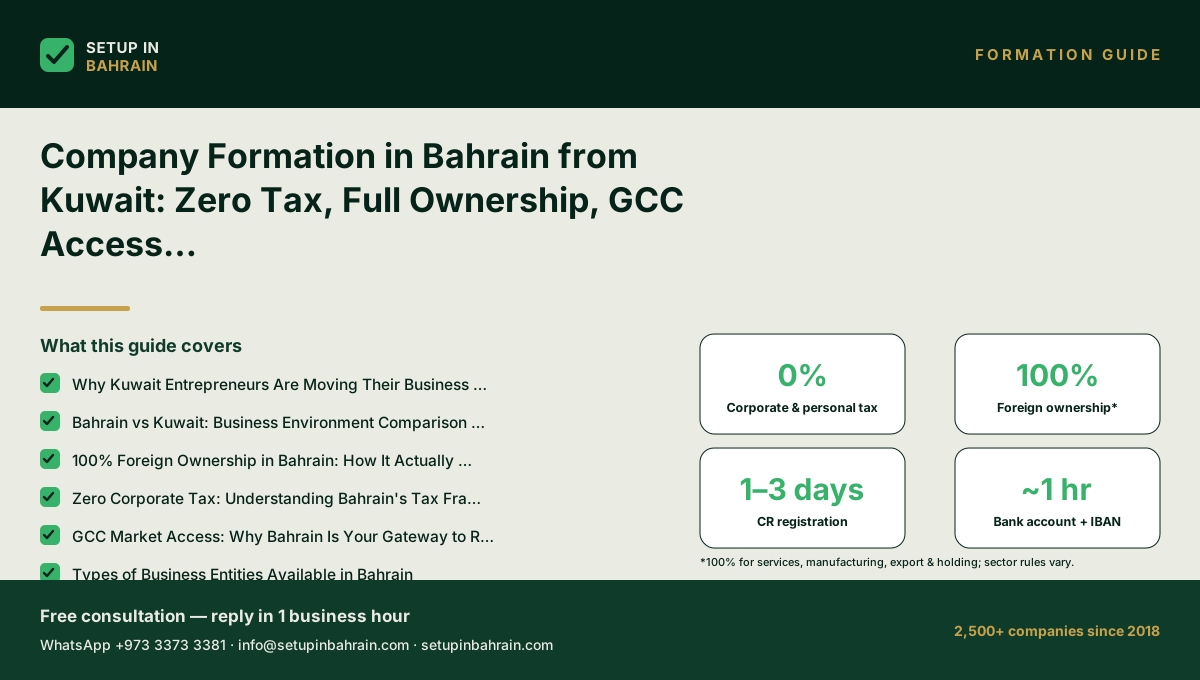
- Why Kuwait Entrepreneurs Are Moving Their Business to Bahrain
- Bahrain vs Kuwait: Business Environment Comparison for GCC Entrepreneurs
- 100% Foreign Ownership in Bahrain: How It Actually Works
- Generally no corporate income tax for most sectors: Understanding Bahrain's Tax Framework
- GCC Market Access: Why Bahrain Is Your Gateway to Regional Trade
→ Complete guide: Company Formation in Bahrain — the full 2026 guide
View details
Ownership & capital
A Bahrain WLL can be owned by a single person — 100% foreign ownership applies to most activities, with no local partner required for services, manufacturing, export trading and holding companies. The minimum share capital is BHD 1 ; we recommend BHD 1,000 . This Makes bank account opening and investor visa approval smoother.
Last Updated: January 2026 Reading Time: 24 minutes
Ahmed Al-Rashid had built a successful logistics company in Kuwait over 12 years. Revenue hit KWD 1.2 million annually. His problem? He owned exactly 49% of his own company. The remaining 51% belonged to a Kuwaiti partner he met at a diwaniya—a man who contributed zero operational value but collected 51% of every profit distribution.
Every strategic decision required his partner's approval. When Ahmed wanted to expand into Saudi Arabia's $800 billion Vision 2030 market, his partner blocked it—citing "too much risk." When a Qatari client offered a five-year contract worth KWD 400,000, his partner demanded renegotiation of their internal profit split before signing. Ahmed had built the relationships, hired the team, secured the contracts. Solved problems at 3 AM when shipments went wrong. His partner hadn't visited the office in nineteen months.
"I realized I was renting my own business," Ahmed told me during a consultation last October. "Twelve years of work, and I needed permission to make decisions about a company I built from nothing."
Here's what Ahmed did: he incorporated a With Limited Liability (WLL) company in Bahrain in seven business days, maintained 100% ownership, generally pays no corporate income tax in most sectors, and now routes his GCC logistics contracts through Manama. His Kuwaiti partner was bought out for a fraction of what the mandatory arrangement was costing annually. Ahmed's take-home profit increased by 47% in the first year—not from new revenue. From eliminating the structural tax of forced partnership.
Ahmed's story isn't unusual. It represents the quiet calculation thousands of Kuwaiti entrepreneurs are making right now: Why am I giving away majority control of my own company when a better option exists 25 kilometers across the King Fahd Causeway?
This guide is built specifically for Kuwait-based entrepreneurs who've asked themselves that same question. Whether you're running a trading company, a tech startup, a consultancy, or an e-commerce operation, the structural advantages of Bahrain company formation address every major pain point you're experiencing in Kuwait's business environment.
Why Kuwait Entrepreneurs Are Moving Their Business to Bahrain
The mandatory 51% Kuwaiti partner requirement isn't just frustrating—it's fundamentally broken for serious entrepreneurs. Let me explain why this specific pain point is driving a measurable exodus of Kuwaiti business talent across the causeway.
The 51% Partner Problem: Kuwait's Hidden Business Tax
Under Kuwait's Commercial Companies Law, foreign investors cannot hold more than 49% equity in most mainland company structures. Even Kuwaiti entrepreneurs who bring foreign partners, or who want to structure their businesses for international investment, face this constraint. The result is a system where operational control and profit distribution are legally disconnected from actual contribution.
I've consulted with dozens of Kuwaiti business owners who describe variations of the same story:
The sleeping partner scenario: A Kuwaiti national holds 51% ownership, contributes nothing operationally, and collects majority profits. Many entrepreneurs pay their "partner" a fixed monthly fee (often KWD 500-2,000) plus profit share simply to satisfy the legal requirement.
The decision-blocking scenario : Partners who contributed only their nationality suddenly have veto power over expansion, hiring, contracts. Strategic pivots. Businesses stall because entrepreneurs cannot move without majority approval.
The exit nightmare scenario: When entrepreneurs want to sell, restructure, or bring in investors, they discover their 51% partner has leverage to demand premium buyout terms—regardless of their actual contribution to business value.
According to Kuwait's Public Authority for Civil Information, about 18,000 commercial enterprises in Kuwait operate under structures requiring mandatory local partnership. Conservative estimates suggest Kuwaiti entrepreneurs collectively transfer over KWD 200 million annually to partners whose primary contribution is nationality.
The 15% Corporate Tax Reality
For foreign-owned entities operating in Kuwait, corporate income tax reaches 15% on profits. This rate applies to the foreign-owned portion of business income, creating a structural disadvantage for international entrepreneurs and for Kuwaiti businesses with foreign investment components.
Compare this to Bahrain: zero corporate income tax for most business activities. No tax on profits. No tax on capital gains. No withholding tax on dividends. The savings aren't marginal—they're transformational for reinvestment capacity and long-term wealth building.
A Kuwaiti tech entrepreneur I worked with last year calculated that his company's 15% tax liability on KWD 340,000 annual profit (KWD 51,000) would compound to over KWD 400,000 in lost capital over a decade when accounting for foregone investment returns. In Bahrain, that capital stays in the business.
MOCI Approval Delays and Bureaucratic Friction
Kuwait's Ministry of Commerce and Industry (MOCI) maintains authority over business licensing, activity amendments, and corporate changes. Entrepreneurs consistently report:
- License renewal delays extending 4-8 weeks during peak periods
- Activity additions requiring multiple ministry approvals and documents rounds
- Foreign ownership structure changes taking 3-6 months for processing
- Limited online processing requiring physical ministry visits
One e-commerce entrepreneur shared that adding a "warehousing" activity to his existing trading license required 11 weeks of processing, four separate ministry visits, and intervention from a contact (wasta) to expedite the final approval. The same activity addition in Bahrain takes 3-5 business days through the Sijilat online platform.
Oil-Dependent Economy and Diversification Constraints
Kuwait's economy remains about 90% dependent on hydrocarbon revenues, according to World Bank data. While the government has announced diversification initiatives, the business ecosystem continues to revolve around oil sector contracts, government procurement. Domestic retail.
For entrepreneurs building businesses designed for regional or international scale, Kuwait's economic structure creates limitations:
- Limited fintech licensing: Kuwait's Central Bank maintains conservative approval processes for digital financial services, leaving most fintech activities unlicensed or operating in regulatory gray zones.
- Restricted e-commerce frameworks: Cross-border e-commerce operations face customs and licensing complexities that limit GCC-wide fulfillment models.
- Narrow industry specialization: Business licenses often restrict activity to specific categories, requiring separate entities for diversified operations.
Bahrain's Economic Development Board (EDB) reports that over 340 Kuwaiti-owned companies now operate from Bahrain, with formation rates increasing 23% year-over-year since 2023. The trend reflects not dissatisfaction with Kuwait as a home market. Recognition that regional business operations require a more flexible corporate base.
Bahrain vs Kuwait: Business Environment Comparison for GCC Entrepreneurs
Understanding the structural differences between Kuwait and Bahrain helps clarify why the 45-minute drive across the causeway changes everything for business owners.
Ownership and Control
| Factor | Kuwait | Bahrain |
| Foreign ownership (mainland) | Maximum 49% in most activities | 100% permitted in most sectors |
| Local partner requirement | Mandatory 51% Kuwaiti national | Not required |
| Sectoral restrictions | Extensive list of reserved activities | Limited to specific sectors (media, real estate) |
| Ownership transfer | Requires partner consent and MOCI approval | Standard commercial process |
Taxation and Profit Retention
| Factor | Kuwait | Bahrain |
| Corporate income tax | 15% on foreign-owned profits | 0% (except oil companies) |
| Capital gains tax | Applicable in certain cases | 0% |
| Withholding tax on dividends | Applicable on foreign distributions | 0% |
| Personal income tax | 0% | 0% |
| VAT | 0% (implementation delayed) | 10% (standard rated supplies) |
Regulatory Speed and Digital Infrastructure
| Factor | Kuwait | Bahrain |
| Company incorporation timeline | 4-12 weeks typical | 3-7 business days |
| License amendment processing | 2-8 weeks | 1-5 business days |
| Online incorporation | Partial | Fully digital via Sijilat |
| Ministry visits required | Multiple | Minimal to none |
| English documents | Arabic primary, translation required | English and Arabic accepted |
Banking and Financial Services
| Factor | Kuwait | Bahrain |
| Corporate account opening | 2-6 weeks typical | 5-15 business days |
| Multi-currency accounts | Available but limited | Standard offering |
| Fintech company licensing | Highly restricted | Regulatory sandbox available |
| International bank presence | Limited | 400+ financial institutions |
100% Foreign Ownership in Bahrain: How It Actually Works
When I tell Kuwaiti entrepreneurs they can own 100% of their Bahrain company, the first question is always: "What's the catch?"
Let me address this directly: there is no catch for most business activities.
Sectors Permitting Full Foreign Ownership
Under Bahrain's Commercial Companies Law and foreign investment framework administered by the Bahrain Investors Center, foreigners (including GCC nationals operating through personal or corporate vehicles) can own 100% of companies in:
- Trading and distribution: General trading, import/export, wholesale, retail
- Professional services: Consulting, accounting, legal services, engineering
- Technology: Software development, IT services, fintech (with CBB licensing), digital marketing
- Manufacturing: Light manufacturing, food processing, assembly operations
- Logistics and transport: Freight forwarding, warehousing, courier services
- E-commerce: Online retail, marketplace operations, digital services
- Hospitality: Restaurants, cafes, tourism services (certain restrictions apply)
- Education: Training centers, tutoring, corporate education services
- Healthcare: Clinics, diagnostic services (licensing requirements apply)
Restricted Sectors
Full foreign ownership is restricted in limited sectors:
- Media and publishing: Bahraini majority ownership required
- Real estate: Commercial restrictions on certain property types
- Certain retail categories: Specific local goods require Bahraini partnership
For the vast majority of business activities Kuwaiti entrepreneurs pursue—trading, consulting, technology, e-commerce, logistics—100% ownership is the default option.
The Legal Structure: WLL Companies
The With Limited Liability (WLL) company structure is the most common choice for Kuwaiti entrepreneurs establishing in Bahrain. Key characteristics:
- Minimum capital: BHD 50 (about KWD 48.50) for most activities
- Shareholders: Minimum 2, maximum 50 (single-shareholder WLL also available)
- Director requirements: At least one director; no nationality requirement
- Liability: Limited to capital contribution
- Profit distribution: At shareholder discretion
Unlike Kuwait's mandatory partnership structure, Bahrain WLL shareholders can be entirely foreign—including Kuwaiti individuals, Kuwaiti companies, or any combination of international investors.
single-shareholder WLL Option
For entrepreneurs who want sole ownership without any co-shareholders, Bahrain's WLL structure permits:
- 100% ownership by single individual or corporate entity
- Minimum capital: BHD 50 for most activities
- No board requirement: Single director sufficient
- Full control: No shareholder negotiations or approvals
The WLL structure directly addresses the frustration Kuwaiti entrepreneurs feel with mandatory partnership—one person, one company, complete control.
Generally no corporate income tax for most sectors: Understanding Bahrain's Tax Framework
The Generally no corporate income tax for most sectors headline requires clarification. Let me explain exactly what this means for your business.
What "Zero Tax" Actually Covers
Under Bahrain's tax framework:
- Corporate income tax: 0% for all companies except those engaged in oil and gas extraction/refining (46% rate applies to oil companies)
- Capital gains tax: 0% on investment gains, business sale proceeds, and asset appreciation
- Withholding tax: 0% on dividends distributed to foreign shareholders
- Payroll tax: 0% (no income tax on wages)
For a Kuwaiti entrepreneur operating a consulting, trading, technology, or services business through a Bahrain entity, the tax rate on profits is zero. Period.
VAT Considerations
Bahrain implemented Value Added Tax (VAT) at 5% in January 2019, then increased to 10% in January 2022. VAT applies to:
- Most goods and services sold in Bahrain
- Imports into Bahrain
- Certain services provided to customers in Bahrain
VAT exemptions and zero-rating apply to:
- Financial services (largely exempt)
- Exports (zero-rated)
- Basic food items (zero-rated)
- Healthcare and education (zero-rated)
For B2B service businesses serving clients outside Bahrain—a common structure for Kuwaiti entrepreneurs operating regionally—VAT impact is often minimal due to export zero-rating provisions.
Social Insurance Contributions
Businesses with employees in Bahrain contribute to the Social Insurance Organization (SIO):
- Bahraini employees: Employer contributes 12% of gross salary; employee contributes 8%
- Foreign employees: Employer contributes 3% of gross salary; employee contributes 1%
These contributions are lower than comparable social insurance requirements in other GCC jurisdictions and greatly lower than European or North American employer tax burdens.
The Real-World Tax Savings Calculation
Consider a Kuwaiti trading company generating annual profits:
| Profit Level | Kuwait Tax (15% foreign portion) | Bahrain Tax | Annual Savings |
| KWD 100,000 | KWD 15,000 | KWD 0 | KWD 15,000 |
| KWD 250,000 | KWD 37,500 | KWD 0 | KWD 37,500 |
| KWD 500,000 | KWD 75,000 | KWD 0 | KWD 75,000 |
| KWD 1,000,000 | KWD 150,000 | KWD 0 | KWD 150,000 |
GCC Market Access: Why Bahrain Is Your Gateway to Regional Trade
For Kuwaiti entrepreneurs, Bahrain's strategic value extends beyond incorporation benefits. The kingdom serves as a launchpad for the broader GCC market—especially Saudi Arabia's massive economy.
The Saudi Arabia Connection
The King Fahd Causeway connects Bahrain to Saudi Arabia's Eastern Province, home to:
- Aramco headquarters: The world's most valuable company
- SABIC operations: Major petrochemical manufacturing
- Eastern Province population: Over 5 million residents
- Industrial City of Jubail: Largest industrial complex in the Middle East
Daily traffic across the causeway exceeds 60,000 vehicles. For Bahrain-based businesses, Saudi Arabia's $800 billion economy is a 45-minute drive away.
More importantly, Bahrain serves as a testing ground and regional hub for companies targeting Saudi expansion. The smaller market (1.5 million population) allows entrepreneurs to:
- Refine products and services before Saudi launch
- Build GCC track record and references
- Establish banking relationships with regional coverage
- Develop logistics and fulfillment capabilities
Many multinational corporations use this exact strategy—Bahrain regional headquarters serving Saudi Arabian and broader Gulf markets.
GCC Customs Union Benefits
Bahrain membership in the GCC Customs Union means:
- Common external tariff: 5% on most imported goods
- Free movement of GCC-origin goods: Zero tariffs between member states
- Simplified customs procedures: For intra-GCC trade
A Bahrain-incorporated trading company can import goods, add value. Re-export across the GCC with minimal customs friction. This structure supports distribution businesses, light manufacturing, and assembly operations serving regional markets.
Free Trade Agreement Network
Bahrain maintains free trade agreements providing preferential access to:
- United States: Bahrain-US FTA (2006) eliminates tariffs on most goods
- EFTA countries: Switzerland, Norway, Iceland, Liechtenstein
- Singapore: Bilateral trade agreement
- Greater Arab Free Trade Area: 18 Arab League members
For Kuwaiti entrepreneurs building export-oriented businesses, Bahrain's FTA network creates competitive advantages unavailable from a Kuwait base.
Financial Services Hub Status
The Central Bank of Bahrain oversees one of the region's most developed financial ecosystems:
- 400+ licensed financial institutions
- Regulatory sandbox for fintech innovation
- Open banking framework
- Crypto asset regulations
For entrepreneurs building fintech companies, payment platforms, or digital financial services, Bahrain offers regulatory clarity that Kuwait currently lacks.
Types of Business Entities Available in Bahrain
Selecting the right legal structure depends on your business model, ownership preferences, and operational requirements.
With Limited Liability Company (WLL)
Best for: Trading companies, service businesses, consulting firms, general commercial activities
Key Features:
- a single shareholder (one person can own 100%), maximum 50
- Minimum capital: BHD 50 for most activities
- Limited liability protection
- Flexible profit distribution
- No nationality requirements for shareholders or directors
Formation Timeline: 3-7 business days
Kuwaiti Entrepreneur Use Case: Faisal operates a building materials trading company supplying contractors across the GCC. His Bahrain WLL imports materials from Asia, warehouses in Bahrain, and distributes to Saudi Arabia, Qatar, and Kuwait. He owns 70% personally; his brother holds 30%. No local partner required.
single-shareholder WLL
Best for: Solo entrepreneurs, consultants, freelancers scaling to company structure
Key Features:
- 100% single-owner structure
- Minimum capital: BHD 50 for most activities
- Simplified governance (no shareholder meetings)
- Full decision-making authority
- Personal liability limited to capital
Formation Timeline: 3-5 business days
Kuwaiti Entrepreneur Use Case : Noura runs a digital marketing consultancy serving clients in Kuwait, Saudi Arabia, and UAE. Her Bahrain WLL allows her to invoice internationally, maintain full ownership. Avoid the Kuwaiti partnership requirement that would apply to her mainland activity.
Branch Office
Best for: Established Kuwaiti companies seeking formal Bahrain presence while maintaining parent company structure
Key Features:
- Extension of existing legal entity
- Activities limited to parent company scope
- Parent company bears full liability
- Requires registered agent in Bahrain
- Simpler structure for existing businesses
Formation Timeline: 5-10 business days
Kuwaiti Entrepreneur Use Case: A Kuwait-based engineering firm opens a Bahrain branch to pursue contracts in Bahrain and use the office as a regional business development hub for Saudi opportunities.
Holding Company
Best for: Entrepreneurs with multiple business interests, investment structures, family wealth planning
Key Features:
- Designed to hold shares in other companies
- Asset protection benefits
- Tax-efficient dividend flows
- Succession planning advantages
- No operational activities (investment only)
Formation Timeline: 5-10 business days
Kuwaiti Entrepreneur Use Case : A Kuwaiti family establishes a Bahrain holding company to consolidate ownership of trading, real estate. Technology subsidiaries across the GCC, simplifying governance and enabling efficient capital allocation.
Free Zone Companies
Best for: Specific industry focus, import/export operations, tech companies seeking ecosystem benefits
Bahrain Investment Wharf: Manufacturing, logistics, light industrial Bahrain Logistics Zone: Warehousing, distribution, e-commerce fulfillment Bahrain FinTech Bay: Financial technology companies
Key Features:
- Sector-specific benefits and infrastructure
- 100% foreign ownership
- Customs advantages for certain activities
- Industry clustering and networking
Formation Timeline: 7-14 business days (varies by zone)
Step-by-Step Company Formation Process from Kuwait
Let me walk through exactly how Bahrain company formation works for Kuwait-based entrepreneurs—from initial decision to operational business.
Phase 1: Pre-Formation Planning (1-2 Weeks)
Step 1: Define Business Activities
Bahrain uses a commercial registration system with specific activity codes. Your CR (Commercial Registration) must list all activities your company will conduct. Common activities for Kuwaiti entrepreneurs include:
- General trading
- Management consultancy
- IT services and software development
- E-commerce
- Import/export
- Marketing services
- Professional services
Pro Tip: Include anticipated future activities in your initial registration. Adding activities later is straightforward but requires additional processing time.
Step 2: Select Company Structure
Based on ownership preferences, liability concerns, and operational requirements, choose between WLL, WLL, branch, or holding company structures.
Step 3: Prepare Required Documents
For Kuwaiti individual shareholders:
- Valid Kuwaiti passport (color scan)
- Kuwaiti Civil ID (front and back)
- Proof of address (utility bill or bank statement)
- Passport-size photograph
For Kuwaiti corporate shareholders:
- Company Commercial Registration (CR)
- Memorandum and Articles of Association
- Board resolution authorizing Bahrain incorporation
- Authorized signatory documents
- Certificate of good standing
All documents require:
- Notarization by Kuwaiti notary
- Authentication by Kuwaiti Ministry of Foreign Affairs
- Authentication by Bahrain Embassy in Kuwait (or Bahrain Ministry of Foreign Affairs)
Phase 2: Incorporation Submission (1-3 Days)
Step 4: Reserve Company Name
Through Bahrain's Sijilat portal (sijilat.bh) or through your registered agent, submit company name for approval. Names must:
- Be unique (not identical to existing registrations)
- Not contain restricted terms without approval
- Include legal structure suffix (WLL, WLL, etc.)
Name approval typically takes 24-48 hours.
Step 5: Submit Incorporation Application
Via Sijilat or through registered agent, submit:
- Memorandum of Association (MOA) and Articles of Association (AOA)
- Shareholder and director details
- Registered office address
- Share capital declaration
- Activity codes selection
Step 6: Pay Government Fees
Current fee structure (2026):
- CR registration: BHD 10
- MOIC fee: BHD 100-300 depending on activities
- Chamber of Commerce membership: BHD 30-50
- Municipal fee: Varies by location
Total government fees typically range BHD 200-500 for standard WLL formations.
Phase 3: Approval and Registration (3-5 Days)
Step 7: MOIC Review and Approval
The Ministry of Industry and Commerce reviews applications for completeness and compliance. Standard applications receive approval within 2-3 business days. Complex structures or restricted activities may require additional review.
Step 8: Commercial Registration Issuance
Upon approval, MOIC issues Commercial Registration (CR) certificate—your company's official proof of legal existence in Bahrain.
Step 9: Additional Registrations
Post-CR issuance:
- Social Insurance Organization (SIO) registration (required before hiring)
- National Bureau for Revenue (VAT registration if applicable)
- Chamber of Commerce formal membership
Phase 4: Operational Setup (1-3 Weeks)
Step 10: Corporate Bank Account
With CR in hand, approach Bahrain banks for corporate account opening. Major options include:
- Ahli United Bank: Strong GCC regional network
- Bank of Bahrain and Kuwait (BBK): Kuwaiti connection, familiar processes
- National Bank of Bahrain (NBB): Largest local bank, comprehensive services
- Bahrain Islamic Bank (BIsB): Sharia-compliant banking
- Standard Chartered: International bank with multi-currency capabilities
Account opening requirements:
- CR copy
- MOA/AOA
- Shareholder and director documents
- Proof of business address
- Initial deposit (varies by bank; typically BHD 500-5,000)
Timeline: 5-15 business days depending on bank and complexity
Step 11: Office Space and Address
Options range from:
- Virtual office: BHD 50-150/month for registered address and mail handling
- Serviced office: BHD 300-800/month for furnished workspace
- Traditional lease: BHD 400-2,000/month depending on location and size
For entrepreneurs maintaining primary operations in Kuwait, virtual office arrangements satisfy legal requirements while minimizing overhead.
Step 12: Visa and Residency (If Applicable)
Bahrain company formation does not automatically require relocation. Many Kuwaiti entrepreneurs operate Bahrain entities while residing in Kuwait, traveling as needed.
For those seeking Bahrain residence:
- Investor visa: Available for company shareholders meeting investment thresholds
- Self-sponsorship: Possible for certain business activities
- Golden Residency: 10-year visa for significant investors
GCC nationals (including Kuwaitis) can enter Bahrain without visa and engage in business activities during visits without residency requirements.
Costs and Fees: Complete Breakdown for 2026
Understanding the full cost structure helps you budget accurately and compare against Kuwait incorporation expenses.
Government and Official Fees
| Fee Category | Amount (BHD) | Notes |
| Name reservation | 10 | Valid 60 days |
| CR registration | 10 | One-time |
| MOIC activity license | 100-300 | Varies by activity |
| Chamber of Commerce | 30-50 | Annual membership |
| Municipal fee | 50-200 | Varies by location |
| Notarization (Bahrain) | 20-50 | Per document |
| Total Government Fees | 220-620 | Typical range |
Professional Service Fees
Most Kuwaiti entrepreneurs work with formation specialists or registered agents who handle:
- Document preparation and review
- Sijilat submission and follow-up
- Bank introduction and account opening support
- Ongoing compliance reminders
| Service | Typical Fee Range (BHD) |
| Company formation package | 800-2,000 |
| Registered agent (annual) | 300-600 |
| Document attestation assistance | 200-400 |
| Bank account opening support | 200-500 |
Ongoing Annual Costs
| Expense | Annual Cost (BHD) |
| CR renewal | 10 |
| License renewal | 100-300 |
| Chamber of Commerce | 30-50 |
| Virtual office (if used) | 600-1,800 |
| Accounting/bookkeeping | 1,200-3,600 |
| Audit (if required) | 1,500-5,000 |
Total First-Year Investment Comparison
| Expense Category | Low Estimate (BHD) | High Estimate (BHD) |
| Government fees | 220 | 620 |
| Professional services | 1,000 | 2,500 |
| Office setup | 600 | 3,000 |
| Bank account | 500 | 2,000 |
| First Year Total | 2,320 | 8,120 |
Compare this to the ongoing cost of a mandatory Kuwaiti partner collecting 51% of profits, plus 15% corporate tax on foreign-owned portions. The Bahrain formation investment pays for itself within months for most profitable businesses.
Banking in Bahrain: Opening Corporate Accounts as a Kuwaiti Entrepreneur
Corporate banking is often the most time-consuming element of Bahrain company formation. Here's what Kuwaiti entrepreneurs need to know.
Bank Selection Considerations
For GCC regional business: Ahli United Bank offers strong presence across Kuwait, Bahrain. Broader GCC Bank of Bahrain and Kuwait (BBK) provides natural familiarity for Kuwaiti entrepreneurs Gulf International Bank serves larger corporate requirements
For international trade:
- Standard Chartered offers global correspondent banking networks
- HSBC provides extensive trade finance capabilities
- Citibank serves multinational and larger regional businesses
For digital-first operations:
- Ila Bank (digital bank) offers streamlined onboarding
- Bahrain Islamic Bank provides Sharia-compliant digital options
Documents Requirements
Standard corporate account opening requires:
- Company documents:
- Shareholder/Director documents:
- Business information:
Account Opening Timeline
| Bank Type | Typical Timeline |
| Local Bahraini banks | Banking: approximately 1 hour in 99% of our reported cases; our last 100 applications handled in 2026 were approved; subsidiaries or CIS shareholders: 3 days to 2 weeks. Subject to the bank’s final review. |
| Regional GCC banks | Banking: approximately 1 hour in 99% of our reported cases; our last 100 applications handled in 2026 were approved; subsidiaries or CIS shareholders: 3 days to 2 weeks. Subject to the bank’s final review. |
| International banks | Banking: approximately 1 hour in 99% of our reported cases; our last 100 applications handled in 2026 were approved; subsidiaries or CIS shareholders: 3 days to 2 weeks. Subject to the bank’s final review. |
- Prepare comprehensive documents before bank appointment
- Provide clear business description with specific activities
- Include existing business credentials (Kuwait CR, financial statements)
- Work with bank relationship manager rather than branch-level staff
Multi-Currency and International Transfer Capabilities
Bahrain banks routinely offer:
- USD, EUR, GBP, SAR, KWD, AED accounts
- SWIFT transfers to global correspondent banks
- Regional transfer networks (GCC RTGS systems)
- Online banking with international transfer capabilities
- Trade finance facilities (letters of credit, guarantees)
For Kuwaiti entrepreneurs invoicing clients across GCC and internationally, Bahrain corporate banking provides full operational capability.
Industries Thriving in Bahrain: Best Sectors for Kuwaiti Entrepreneurs
Certain sectors show particular strength in Bahrain, offering Kuwaiti entrepreneurs sector-specific advantages beyond the general incorporation benefits.
Financial Technology (Fintech)
Bahrain's Central Bank has established the most progressive fintech regulatory environment in the GCC:
- Regulatory Sandbox: Test innovative financial products with real customers under CBB supervision
- Open Banking: Mandated framework requiring banks to share data via APIs
- Crypto Asset Regulations: Clear licensing framework for digital asset businesses
- Payment Service Provider licensing: Streamlined process for payment companies
Opportunity for Kuwaiti entrepreneurs: Kuwait's Central Bank maintains conservative fintech licensing. Entrepreneurs building payment platforms, robo-advisors, digital lending, or crypto services can get Bahrain licenses and serve GCC markets—including Kuwaiti customers—from a regulated base.
Success story: A Kuwaiti fintech founder I advised spent 18 months pursuing Kuwait licensing without success. His Bahrain sandbox approval came in 8 weeks; full license followed in 6 months. His B2B payment platform now serves 200+ GCC corporate clients.
E-Commerce and Digital Retail
Bahrain's compact geography and advanced logistics infrastructure support e-commerce operations:
- Bahrain Logistics Zone: Dedicated e-commerce fulfillment facilities
- Efficient customs: Same-day clearance for many shipments
- Saudi access: E-commerce fulfillment serving Eastern Province via causeway
- No import duties on re-exports: For goods transiting to other GCC states
Opportunity for Kuwaiti entrepreneurs: Build GCC-wide e-commerce operations with Bahrain fulfillment hub, avoiding the licensing complexity of operating e-commerce businesses from Kuwait's more restrictive framework.
Professional Services and Consulting
Management consulting, IT consulting, engineering services, and professional advisory firms benefit from:
- 100% ownership: No local partner taking profit share
- Regional client service: Saudi Arabia's consulting market exceeds $3 billion annually
- Talent access: Bahrain's labor market includes skilled professionals at competitive rates
- Regional headquarters: Many multinationals use Bahrain for GCC professional services operations
Opportunity for Kuwaiti entrepreneurs: Kuwaiti consultants serving GCC clients can restructure through Bahrain, eliminating partnership requirements and improving profit retention.
Trading and Distribution
Bahrain's GCC Customs Union membership and free trade agreements support trading operations:
- **5% common
Bahrain Business Guides for Kuwait Citizens
Frequently Asked Questions
How long does it take to set up?
It takes 15 to 20 days. We file all forms for you. You do not need to wait long.
What does it cost?
Company formation: Standard BHD 1,340 with 3 months of office address; Gold BHD 1,700 with 6 months; Premium BHD 2,150 with 12 months and a cabin, officer table and chair, and two guest chairs. No formation package includes visas, including Premium. Investor/work visas are priced separately: BHD 755 for one year or BHD 953 for two years, in addition to the formation package. Ask for a written, itemized quotation confirming government fees and all inclusions before payment.
Do I need to visit Bahrain?
No. You can set up your firm from home. We do all the work online. Some banks may ask for one visit.
What tax will I pay?
You pay zero tax on your profits. Bahrain has no corporate income tax. This is a key benefit of the setup.
Can I own 100% of my firm?
Yes. Foreign owners can hold all shares. No local partner is needed. Full ownership is allowed.
What do I need to start?
You need a valid passport. You also need a trade name and a business address. We help you with all of these.
How do I open a bank account?
We guide you step by step. Most banks take 3 to 6 weeks. You will need your CR and firm papers.
Who issues the Commercial Registration (CR)?
The CR is issued by the MOICT. It is your legal right to trade in Bahrain. We file the CR for you.
Can I renew my CR each year?
Company renewal packages: BHD 530 with 3 months of office address; BHD 980 with 6 months; BHD 1,520 with 12 months. These are separate renewal packages, not visa fees.
How do I get started?
Fill in our form on this page. Our team will call you back. We map your best setup plan at no cost.
Steps to Form Your Company
- Pick your trade name. We check if it is free.
- Choose your business type. WLL is the most common.
- Sign the MOA. We draft and file all legal docs.
- Pay the state fees. About BHD 432 in total.
- Get your CR. Takes 15 to 20 days.
- Open your bank account. We guide each step.
- Start trading. You are ready to do business.
Key Facts
- Tax rate: 0%
- Foreign ownership: 100%
- Setup time: 15 to 20 days
- Company formation: Standard BHD 1,340 with 3 months of office address; Gold BHD 1,700 with 6 months; Premium BHD 2,150 with 12 months and a cabin, officer table and chair, and two guest chairs. No formation package includes visas, including Premium. Investor/work visas are priced separately: BHD 755 for one year or BHD 953 for two years, in addition to the formation package. Ask for a written, itemized quotation confirming government fees and all inclusions before payment.
- Company renewal packages: BHD 530 with 3 months of office address; BHD 980 with 6 months; BHD 1,520 with 12 months. These are separate renewal packages, not visa fees.
- Client rating: 4.8 stars
- Clients served: 2,500 and more
Quick Facts
- Tax rate: 0%
- Own all of your firm: Yes, 100%
- Time to set up: 15 to 20 days
- Company formation: Standard BHD 1,340 with 3 months of office address; Gold BHD 1,700 with 6 months; Premium BHD 2,150 with 12 months and a cabin, officer table and chair, and two guest chairs. No formation package includes visas, including Premium. Investor/work visas are priced separately: BHD 755 for one year or BHD 953 for two years, in addition to the formation package. Ask for a written, itemized quotation confirming government fees and all inclusions before payment.
- Company renewal packages: BHD 530 with 3 months of office address; BHD 980 with 6 months; BHD 1,520 with 12 months. These are separate renewal packages, not visa fees.
- Rating: 4.8 stars
- Clients: 2,500 and more
Why Bahrain?
Bahrain has no tax. You keep all your profits. This is rare in the Gulf.
You can own all of your firm. No local partner is needed. The law allows full foreign ownership.
Setup takes 15 to 20 days. We file all forms for you. You can do it all from home.
Bahrain has a free trade deal with the US. Your goods face low or no tariffs. This gives you access to big markets.
We have served 2,800+ clients from 44+ countries and maintain records to substantiate that total where needed. We have 113 Google reviews; reviews represent only some clients and are not the same as the total clients served.
Our Steps
- Tell us your plan. We advise you for free.
- We pick the right firm type for you.
- We file all your forms with MOICT.
- You get your CR in 15 to 20 days.
- We help you open a bank account.
- You are ready to trade. We stay with you.
Why Set Up in Bahrain?
Bahrain is a great place to run a firm. It has no tax. You keep all your profits. This is rare in the Gulf.
You can own your firm 100%. No local partner is needed. The law is clear and fair.
It is fast to set up. You can have a CR in 15 to 20 days. We file all forms for you.
Bahrain has a free trade deal with the US. Your goods face low or no tariffs. This gives you access to big markets.
The banks are good. The roads are good. The schools are good. It is a well-run state.
We have served 2,800+ clients from 44+ countries and maintain records to substantiate that total where needed. We have 113 Google reviews; reviews represent only some clients and are not the same as the total clients served.
Our Services
- Company formation: Standard BHD 1,340 with 3 months of office address; Gold BHD 1,700 with 6 months; Premium BHD 2,150 with 12 months and a cabin, officer table and chair, and two guest chairs. No formation package includes visas, including Premium. Investor/work visas are priced separately: BHD 755 for one year or BHD 953 for two years, in addition to the formation package. Ask for a written, itemized quotation confirming government fees and all inclusions before payment.
- Company renewal packages: BHD 530 with 3 months of office address; BHD 980 with 6 months; BHD 1,520 with 12 months. These are separate renewal packages, not visa fees.
- Investor Visa — from BHD 755
- Work Visa — LMRA managed
- Virtual office — from BHD 600 per year
- Bank account opening — 3 to 6 weeks
- Family visa — for spouse and kids
- UBO filing — as required by law
Bahrain at a Glance
- Tax rate: 0%
- Foreign ownership: 100%
- Setup time: 15 to 20 days
- Free trade deal: Yes, with the US
- Language: Arabic and English
- Currency: Bahraini Dinar (BHD)
- Time zone: UTC+3
- GDP growth: Steady and strong
How to Start
- Fill in the form on this page. It takes 3 minutes.
- We call you back the same day.
- We map the best plan for your firm type and goals.
- We file all forms. We deal with MOICT for you.
- You get your CR in 15 to 20 days.
- We help you open a bank account and get your visa.
- You are ready to trade. We stay with you.
Common Questions
Do I need to visit Bahrain to set up?
No. You can do it all from home. We file online. You may need one visit to open a bank account.
Is Bahrain safe for business?
Yes. Bahrain is a stable state. It has a clear legal system. Your firm and funds are safe here.
Can I hire staff from any country?
Yes. You can hire from any country. Each hire needs a work permit from LMRA. We manage this for you.
What type of firm should I set up?
Most clients choose a WLL. This is a limited liability firm. It is flexible and well-known in Bahrain. We advise you on the best type for your case.
How do I get in touch?
Fill in our form. We call you back the same day. You can also email us or use the chat on this page.
Ready to set up in Bahrain from Kuwait?
Tell us your business idea. We map the right entity, ownership and timeline — then handle the filing while you focus on what matters.