
Complete guide for Kiribati entrepreneurs: form a company in Bahrain with generally no corporate income tax for most sectors, 100% foreign ownership. GCC market access. Costs, steps, visas, banking.
Key Takeaways
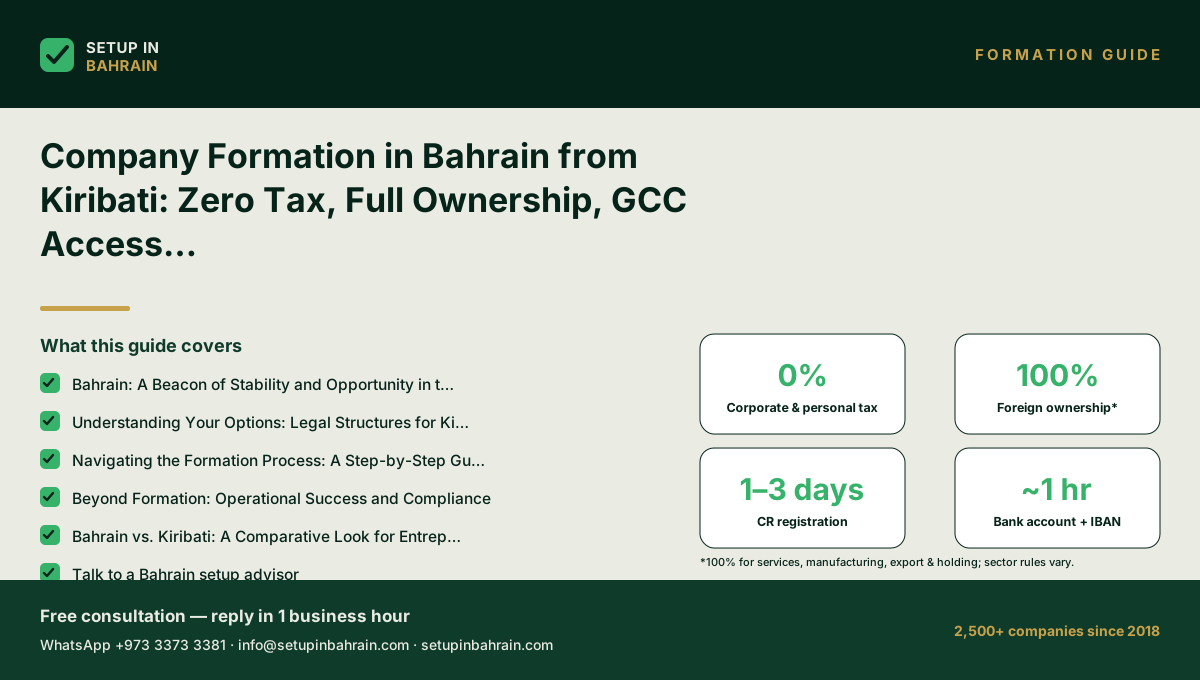
- Bahrain: A Beacon of Stability and Opportunity in the Middle East
- Understanding Your Options: Legal Structures for Kiribati Entrepreneurs in Bahrain
- Navigating the Formation Process: A Step-by-Step Guide
- Beyond Formation: Operational Success and Compliance
- Bahrain vs. Kiribati: A Comparative Look for Entrepreneurs
→ Complete guide: Company Formation in Bahrain — the full 2026 guide
View details
Ownership & capital
A Bahrain WLL can be owned by a single person — 100% foreign ownership applies to most activities, with no local partner required for services, manufacturing, export trading and holding companies. The minimum share capital is BHD 1 ; we recommend BHD 1,000 . This Makes bank account opening and investor visa approval smoother.
At sunset on Tarawa’s lagoon, Tewete, a seasoned Kiribati fisheries exporter, often found himself pacing his sandy porch. The gentle ocean breeze was a constant. The figures in his year-end accounts were anything but calming. December in Kiribati is typically a period for quiet reflection, yet the reality of his business operations brought a familiar pang of frustration. A staggering 35% of his company’s hard-fought earnings were routinely chewed up by corporate tax, even as the AUD-based local economy provided a semblance of stability often lauded by financial institutions. This wasn't just a number on a spreadsheet; it was capital that could have been reinvested into larger freezer units, more efficient boats, or perhaps a processing plant that creates more local jobs.
Tewete’s frustration is not unique. For many entrepreneurs across Kiribati, the journey of building a business is an uphill battle against an array of systemic challenges that would daunt even the most resilient founder. These are the corporate 'monsters' that small and medium-sized businesses, built with struggle and sea salt, face daily:
Tax as a Business Breaker: A 35% corporate income tax rate, while a significant contributor to government revenue that fluctuates wildly with fishing license demand and climate impacts, often wipes out critical growth margins for private sector businesses, leaving them vulnerable to sudden shocks. For instance, a Tarawa-based tuna exporter processing 800 tonnes of skipjack annually under a longline license might find that in a year like 2025, after a modest profit, their Kiribati-registered entity paid AUD 312,000 in corporate income tax. That single payment could equal the cost of two new 12-metre fishing vessels – a direct loss of reinvestment potential. Paper-Based Drudgery: The labyrinthine, often strictly paper-based filing requirements of the Ministry of Finance and Economic Development (MFED) can consume weeks for just one compliance document. This isn't just an inconvenience; it’s a significant drain on time and resources that could be better spent on core business development and market expansion. Banking Bottleneck: The reliance on Bank of Kiribati, the country’s sole commercial bank, presents a formidable barrier to international trade. While the bank does its best, its limited international correspondent banking access means every export transfer often requires lengthy queues, followed by days or even weeks for international payments to clear. For the tuna exporter, this meant the Bank of Kiribati could not issue a letter of credit acceptable to Japanese buyers, forcing him to route payments through an Australian correspondent bank at an extra 2.8% fee per transaction. This constant stress of ensuring international transactions clear without a hitch, coupled with higher fees, stifles global ambitions. Climate Fragility and Existential Threats: Beyond the immediate economic hurdles, the existential threat of rising sea levels looms large. Many forward-thinking founders are already exploring relocation options – not just for tax relief, but for economic survival, securing their future. Establishing a gateway into robust global markets. When sea-level rise forecasts pushed his village relocation planning forward another two years, our hypothetical tuna exporter realized he needed to secure his business's future independently of his homeland's physical challenges. Export Dependence and Economic Volatility: Kiribati’s economy is heavily reliant on fishing license fees and foreign aid. This creates a volatile environment where government revenues fluctuate dramatically, leaving private sector businesses exposed to sudden policy shifts or economic downturns that directly impact their operating costs and market stability.
For Kiribati entrepreneurs, the logical leap isn't merely about saving money on taxes; it's about securing stability, scalability. A sustainable place in the global market. As you read this in 2026, record numbers of Pacific business owners are actively seeking environments that offer not just fiscal advantages. Also robust infrastructure, diverse financial services, and strategic market access. This is where Bahrain enters the picture – a thriving hub in the heart of the Middle East, offering a compelling alternative to the challenges faced on the distant shores of Kiribati.
Bahrain: A Beacon of Stability and Opportunity in the Middle East
Imagine a business environment that actively supports your growth, where efficiency is prioritized. Where your hard-earned profits remain largely within your business for reinvestment and expansion. This is the promise of Bahrain, a small but mighty island nation strategically located in the Arabian Gulf. A significant player in the trillion-dollar GCC (Gulf Cooperation Council) economy.
For an entrepreneur accustomed to the specific challenges of Kiribati, Bahrain presents a stark and refreshing contrast. Its pro-business environment, driven by forward-thinking economic diversification policies, is specifically designed to attract foreign direct investment and help seamless business operations.
A Financial Oasis: Generally no corporate income tax for most sectors and Open Markets
One of Bahrain's most compelling attractions, especially for entrepreneurs burdened by Kiribati's 35% corporate tax rate, is its zero corporate income tax policy for most business activities. This isn't a temporary incentive; it's a fundamental pillar of Bahrain's economic strategy to position itself as a global business hub. For companies engaged in manufacturing, services, trading, or technology, the default is no corporate tax on profits. The only significant exception is for oil and gas companies, or businesses directly involved in hydrocarbon extraction. This Face a 46% tax rate. For the vast majority of sectors relevant to Kiribati entrepreneurs – fisheries export, logistics, consultancy, e-commerce, or tourism – your profits remain untouched by corporate taxation. This means that the AUD 312,000 paid by our hypothetical tuna exporter in Kiribati could, in Bahrain, be reinvested entirely into new vessels, technology upgrades, or market expansion.
Beyond tax, Bahrain boasts an extensive network of free trade agreements , including with the United States, Singapore. Various regional blocs. This provides preferential access to markets far beyond its borders, opening doors to a combined consumer base of hundreds of millions. The Economic Development Board (EDB) of Bahrain consistently highlights the nation's open market policies and its commitment to fostering a competitive and innovation-friendly ecosystem, ranking it highly for ease of doing business globally. This proactive approach to economic development stands in sharp contrast to economies more constrained by internal or geographical limitations.
Unlocking Global Banking: Beyond the Bottleneck
The frustration of relying on a sole commercial bank with limited international reach is a major pain point for Kiribati businesses. In Bahrain, you enter a world-class financial ecosystem regulated by the Central Bank of Bahrain (CBB), recognized as one of the most progressive and robust regulatory bodies in the region.
Bahrain hosts a vibrant landscape of over 40 retail banks and numerous wholesale banks, offering a full spectrum of sophisticated financial services. This means:
Diverse Options: You'll have access to multiple local and international banks, each offering competitive services, allowing you to choose the best fit for your business needs. Seamless International Transactions: Forget the days of weeks-long waits for payments to clear. Bahraini banks are fully integrated into global Swift networks, enabling efficient and secure international transfers. Letters of credit, crucial for global trade, are readily issued and accepted worldwide, eliminating the need for costly intermediaries. Advanced Financial Products: From multi-currency accounts to trade finance solutions, hedging instruments. Digital banking platforms, Bahrain's financial sector is designed to support complex international business operations. This level of financial sophistication provides the vital infrastructure for scalability that is simply unavailable in Kiribati.
For a Kiribati business owner, moving from a banking bottleneck to a financial oasis like Bahrain is not just an upgrade; it's a fundamental shift that empowers truly global operations.
Understanding Your Options: Legal Structures for Kiribati Entrepreneurs in Bahrain
When establishing your business in Bahrain, selecting the right legal structure is a crucial first step. The Kingdom offers several options. For most international entrepreneurs, especially those from Kiribati seeking full control and flexibility, one stands out prominently.
The Workhorse: With Limited Liability Company (WLL)
The With Limited Liability Company (WLL) is by far the most popular and versatile choice for foreign investors in Bahrain, including entrepreneurs from Kiribati. It offers a balance of liability protection, ownership flexibility, and credibility.
Here are the critical facts you need to know about a Bahraini WLL:
100% Foreign Ownership: This is a key advantage. Unlike some jurisdictions that require local partners or nominee shareholders, a WLL in Bahrain can be 100% owned by a single foreign individual or entity . You do not need any local partners, nor are there any requirements for a minimum number of shareholders. You, as the Kiribati entrepreneur, can be the sole owner and director, maintaining full control over your business decisions. Limited Liability Protection: As the name suggests, a WLL protects your personal assets from business debts and obligations. Your liability is limited to the amount of your share capital in the company, providing a crucial layer of security for your investment. Minimum Share Capital: Legally, the minimum share capital for a WLL in Bahrain is BHD 1 (one Bahraini Dinar) . While this nominal amount technically satisfies the legal requirement, it is crucial to understand the practical implications. We strongly recommend setting a practical starting capital of BHD 1,000 (one thousand Bahraini Dinars) . This higher amount is widely considered the practical minimum by local banks for opening a corporate bank account and is also generally required to help the application for an investor visa for the owner. Attempting to start with BHD 1 will likely lead to significant hurdles in banking and visa processes. Suitable for Diverse Activities: A WLL is suitable for a wide range of business activities, including trading, consulting, services, manufacturing, e-commerce, logistics, and more. Credibility and Professionalism: Establishing a WLL provides your business with a professional and credible image, both within Bahrain and internationally. This Is vital for building trust with clients, suppliers, and financial institutions.
For a Kiribati entrepreneur, the WLL structure offers the freedom and control you might not find in your home country, coupled with the security of limited liability and access to a robust financial ecosystem.
Exploring Other Structures (Briefly):
While the WLL is often the best fit, other structures exist, though they are typically less common or suitable for Kiribati entrepreneurs starting fresh:
Foreign Branch Office: If you already have an established company in Kiribati (or another jurisdiction) and wish to expand its operations into Bahrain, a branch office might be an option. But, it operates as an extension of the parent company, with the parent company bearing full liability. Setup (Sole Proprietorship): This structure is essentially a single-owner business where the owner and the business are legally one entity, meaning no limited liability protection. It's generally not recommended for international investors due to the personal liability risk and lower perceived credibility compared to a WLL. Public Shareholding Company (BSC): For larger enterprises planning to raise capital from the public, a BSC is an option. It comes with far more stringent regulatory requirements and higher capital demands, making it unsuitable for most SME entrepreneurs.
A Critical Point to Remember: It is imperative to note that there is NO single-shareholder WLL legal structure in Bahrain. While a WLL can be 100% owned by a single person, it is still classified as a With Limited Liability Company, not a single-shareholder WLL. Any information suggesting a single-shareholder WLL option in Bahrain is incorrect and should be disregarded.
Navigating the Formation Process: A Step-by-Step Guide
The process of forming a company in Bahrain is notably streamlined and digital-first, a welcome change from the paper-based systems many Kiribati entrepreneurs are accustomed to. The Ministry of Industry and Commerce (MOIC) oversees company registration, with strong support from the Economic Development Board (EDB) to help foreign investment.
Pre-Registration Checklist: Laying the Groundwork
Before you even touch an application form, a little preparation goes a long way:
Define Your Business Activity: Clearly articulate what your business will do. Bahrain has a specific classification system for commercial activities. This will determine the licenses you need and the fees involved. For example, a "fisheries export and trade" activity will be distinct from "IT consultancy services." The MOIC website provides a comprehensive list of activities. Choose Your Company Name: Select a unique name that reflects your business and adheres to MOIC guidelines (e.g., no offensive terms, not identical to existing companies). You can perform a preliminary name availability check online. Plan Your Capital: As discussed, while the legal minimum for a WLL is BHD 1, practically aim for BHD 1,000 for bank account approval and investor visa eligibility. Ensure you have these funds readily available. Gather Due Diligence Documents: For a Kiribati national, this typically includes: * Certified passport copy (valid for at least 6 months). * Copy of your national ID (if applicable). * Proof of residential address (e.g., utility bill from the last 3 months). * A comprehensive business plan outlining your objectives, market analysis, financial projections, and operational strategy. * Curriculum Vitae (CV) of the proposed director/shareholder. * A signed lease agreement for your office space (physical or virtual). Identify Your Office Location: You will need a registered office address in Bahrain. This can be a physical office, or for many startups and SMEs, a cost-effective virtual office solution provided by licensed business centres is an excellent option. Ensure your chosen virtual office provider is reputable and approved by the MOIC.
The MOIC Application: Your Digital Gateway
Bahrain has invested heavily in digitalizing government services. The entire company registration process, from application submission to document upload and fee payment, can largely be completed through the Sijilat portal – MOIC’s integrated online business registration system. This is a significant leap from the paper-based filing that can plague Kiribati entrepreneurs.
Here’s a general overview of the steps:
Initial Application & Name Reservation: Log into the Sijilat portal and submit your initial application, including your chosen company name and proposed business activities. The system will guide you through reserving your name. Document Submission: Upload all required KYC documents, your business plan, proposed Articles of Association (Memorandum). The lease agreement. The portal provides clear instructions on document formats. Review and Approvals: Your application will be reviewed by the MOIC and potentially other relevant ministries or regulatory bodies, depending on your business activity (e.g., Central Bank of Bahrain for financial services, Ministry of Health for medical activities). The EDB can assist in coordinating these approvals. Fee Payment: Once approvals are granted, you will be notified to pay the registration fees. These typically include commercial registration fees, activity fees, and possibly others depending on your specific setup. Commercial Registration Issuance: Upon successful payment, your Commercial Registration (CR) certificate will be issued digitally. This document is your official proof of company formation.
The timeline for this process can vary. For straightforward WLL formations with all documents in order, it can take as little as 3-5 working days. But, if additional external approvals are required or documents are incomplete, it might extend to 2-4 weeks. The EDB reports that Bahrain consistently ranks among the top countries for ease of starting a business in the region, a testament to its efficient processes.
Post-Registration Essentials: Setting Up Shop
Receiving your Commercial Registration is a major milestone. A few crucial steps follow to get your business fully operational:
Open a Corporate Bank Account: This is where your recommended BHD 1,000 share capital becomes vital. With your CR, you can approach any commercial bank in Bahrain. They will require your company's CR, Articles of Association, director's/shareholder's passport copy. Possibly a resolution from the board (if multiple directors). The process is generally straightforward and efficient compared to the challenges faced in Kiribati. Get Necessary Licenses: While your initial CR covers your primary business activity, some specialized activities may require additional permits or licenses from specific government ministries. For instance, a food processing business would need health permits from the Ministry of Health. A recruitment agency would require licensing from the Ministry of Labour. Secure Office Space: If you haven't already, finalize your physical office space or ensure your virtual office provider is fully set up. Many free zones and business parks in Bahrain offer excellent facilities. Register for VAT: While Bahrain has zero corporate income tax, it does implement a 5% Value Added Tax (VAT) on most goods and services. If your annual turnover exceeds specific thresholds (currently BHD 37,500), you are required to register for VAT with the National Bureau for Revenue (NBR). This is a simple online process.
By following these steps, Kiribati entrepreneurs can swiftly transition from a concept to a fully operational business in Bahrain, ready to tap into regional and global markets.
Beyond Formation: Operational Success and Compliance
Establishing your company in Bahrain is just the beginning. To ensure sustained growth and avoid compliance pitfalls, understanding the ongoing operational and regulatory landscape is key.
Taxation and Accounting: Keeping it Simple
One of Bahrain's most attractive features, especially compared to Kiribati's 35% corporate tax, is its zero corporate income tax for most businesses. This greatly simplifies tax compliance for entrepreneurs. But, this doesn't mean you are entirely free from tax obligations:
Value Added Tax (VAT): As mentioned, Bahrain implemented a 5% VAT in 2019 (with some changes in 2022 increasing it to 10% for certain items, though the general rate for many services and goods remains 5%). Businesses with an annual turnover exceeding BHD 37,500 must register for VAT, collect it on sales. Submit quarterly VAT returns to the National Bureau for Revenue (NBR). Proper record-keeping is essential for VAT compliance. Bookkeeping Requirements: Even without corporate income tax, all companies in Bahrain are required to maintain proper accounting records in accordance with International Financial Reporting Standards (IFRS). This includes maintaining ledgers, journals, bank statements, invoices, and other financial documents. These records are crucial for internal management, potential audits, and for demonstrating financial health to banks or investors. Annual Financial Statements: While not always required to be audited for smaller WLLs, it's good practice to prepare annual financial statements. Audited financials might be required by banks for financing, or for larger companies and those operating in specific regulated sectors.
Navigating Bahrain's tax and accounting landscape is considerably less complex than in many other jurisdictions, allowing you to focus more on business development rather than extensive tax planning.
Employee Sponsorship and Investor Visas
For Kiribati entrepreneurs looking to relocate themselves and potentially their staff, Bahrain offers clear pathways for residency and employment:
Investor Visa: As a company owner in Bahrain, you are generally eligible for an investor visa. This visa allows you to reside in Bahrain and actively manage your business. The eligibility typically depends on your shareholding in the company and the company's capital (hence the recommendation for BHD 1,000 capital for a WLL). The visa is usually issued for two years and is renewable. Employee Work Permits: If you plan to hire employees, whether local or foreign, you will need to apply for work permits through the Labour Market Regulatory Authority (LMRA). Bahrain operates a flexible labour market with a strong emphasis on attracting skilled expatriate talent while also encouraging the employment of Bahraini nationals. The LMRA portal streamlines the application process, which involves submitting employee details, passport copies, qualifications. Paying associated fees. Companies must comply with Bahraini labour laws about contracts, working hours, and benefits.
The clear and relatively efficient visa processes make Bahrain an attractive destination for entrepreneurs seeking to establish a new base for themselves and their business.
Annual Renewals and Ongoing Compliance
Maintaining your company's good standing in Bahrain involves a few annual obligations:
Commercial Registration Renewal: Your Commercial Registration (CR) must be renewed annually through the MOIC's Sijilat portal. This involves submitting updated company information, ensuring all required licenses are current, and paying the annual renewal fees. Annual General Meetings (WLL): While a WLL can be owned by a single person, it is still legally required to hold an Annual General Meeting (AGM) to approve the previous year's financial statements and conduct other necessary business, even if you are the sole director and shareholder. Minutes of these meetings should be kept. Compliance with Regulations: Staying abreast of any changes in MOIC regulations, CBB guidelines (if in finance), or LMRA labour laws is crucial. Reputable corporate service providers in Bahrain can offer ongoing support and ensure your business remains compliant. By adhering to these ongoing requirements, Kiribati entrepreneurs can ensure their Bahraini company operates smoothly, legally. Sustainably for years to come.
Bahrain vs. Kiribati: A Comparative Look for Entrepreneurs
To truly appreciate the strategic move to Bahrain, it’s helpful to conduct a direct comparison across key business metrics. This table highlights the stark differences that can impact an entrepreneur’s bottom line and growth potential.
| Feature | Kiribati | Bahrain |
| :----------------- | :--------------------------------------------- | :--------------------------------------------------------------------------- |
| Corporate Income Tax | 35% | 0% (for most sectors) |
| Minimum Share Capital (WLL) | N/A (different structures) | BHD 1 (legal), BHD 1,000 (practical for bank/visa) |
| Foreign Ownership (WLL Equivalent) | Often requires local partners/limits | 100% foreign ownership by single individual/entity, zero partners required |
| Banking Sector | Sole commercial bank (Bank of Kiribati), limited international correspondent access, frequent delays, higher fees. | Robust, CBB-regulated, over 40 retail banks, global correspondent network, efficient transfers, diverse financial products. |
Bahrain Business Guides for Kiribati Citizens
Frequently Asked Questions
How long does it take to set up?
It takes 15 to 20 days. We file all forms for you. You do not need to wait long.
What does it cost?
Company formation: Standard BHD 1,340 with 3 months of office address; Gold BHD 1,700 with 6 months; Premium BHD 2,150 with 12 months and a cabin, officer table and chair, and two guest chairs. No formation package includes visas, including Premium. Investor/work visas are priced separately: BHD 755 for one year or BHD 953 for two years, in addition to the formation package. Ask for a written, itemized quotation confirming government fees and all inclusions before payment.
Do I need to visit Bahrain?
No. You can set up your firm from home. We do all the work online. Some banks may ask for one visit.
What tax will I pay?
You pay zero tax on your profits. Bahrain has no corporate income tax. This is a key benefit of the setup.
Can I own 100% of my firm?
Yes. Foreign owners can hold all shares. No local partner is needed. Full ownership is allowed.
What do I need to start?
You need a valid passport. You also need a trade name and a business address. We help you with all of these.
How do I open a bank account?
We guide you step by step. Most banks take 3 to 6 weeks. You will need your CR and firm papers.
Who issues the Commercial Registration (CR)?
The CR is issued by the MOICT. It is your legal right to trade in Bahrain. We file the CR for you.
Can I renew my CR each year?
Company renewal packages: BHD 530 with 3 months of office address; BHD 980 with 6 months; BHD 1,520 with 12 months. These are separate renewal packages, not visa fees.
How do I get started?
Fill in our form on this page. Our team will call you back. We map your best setup plan at no cost.
Steps to Form Your Company
- Pick your trade name. We check if it is free.
- Choose your business type. WLL is the most common.
- Sign the MOA. We draft and file all legal docs.
- Pay the state fees. About BHD 432 in total.
- Get your CR. Takes 15 to 20 days.
- Open your bank account. We guide each step.
- Start trading. You are ready to do business.
Key Facts
- Tax rate: 0%
- Foreign ownership: 100%
- Setup time: 15 to 20 days
- Company formation: Standard BHD 1,340 with 3 months of office address; Gold BHD 1,700 with 6 months; Premium BHD 2,150 with 12 months and a cabin, officer table and chair, and two guest chairs. No formation package includes visas, including Premium. Investor/work visas are priced separately: BHD 755 for one year or BHD 953 for two years, in addition to the formation package. Ask for a written, itemized quotation confirming government fees and all inclusions before payment.
- Company renewal packages: BHD 530 with 3 months of office address; BHD 980 with 6 months; BHD 1,520 with 12 months. These are separate renewal packages, not visa fees.
- Client rating: 4.8 stars
- Clients served: 2,500 and more
Quick Facts
- Tax rate: 0%
- Own all of your firm: Yes, 100%
- Time to set up: 15 to 20 days
- Company formation: Standard BHD 1,340 with 3 months of office address; Gold BHD 1,700 with 6 months; Premium BHD 2,150 with 12 months and a cabin, officer table and chair, and two guest chairs. No formation package includes visas, including Premium. Investor/work visas are priced separately: BHD 755 for one year or BHD 953 for two years, in addition to the formation package. Ask for a written, itemized quotation confirming government fees and all inclusions before payment.
- Company renewal packages: BHD 530 with 3 months of office address; BHD 980 with 6 months; BHD 1,520 with 12 months. These are separate renewal packages, not visa fees.
- Rating: 4.8 stars
- Clients: 2,500 and more
Why Bahrain?
Bahrain has no tax. You keep all your profits. This is rare in the Gulf.
You can own all of your firm. No local partner is needed. The law allows full foreign ownership.
Setup takes 15 to 20 days. We file all forms for you. You can do it all from home.
Bahrain has a free trade deal with the US. Your goods face low or no tariffs. This gives you access to big markets.
We have served 2,800+ clients from 44+ countries and maintain records to substantiate that total where needed. We have 113 Google reviews; reviews represent only some clients and are not the same as the total clients served.
Our Steps
- Tell us your plan. We advise you for free.
- We pick the right firm type for you.
- We file all your forms with MOICT.
- You get your CR in 15 to 20 days.
- We help you open a bank account.
- You are ready to trade. We stay with you.
Next Steps for Kiribati Citizens
You can set up a firm in Bahrain from Kiribati. You do not need to fly there first. We do all the work online.
Tell us your plan. We call you back the same day. We map the best route for you at no cost.
We file all your forms. We deal with MOICT and the state. You get your CR in 15 to 20 days.
After your CR, we help you get a bank account. We also help with your Investor Visa. One firm guides you at each step.
Why Our Clients from Kiribati Choose Us
- We speak your language. We know your needs.
- We have helped clients from Kiribati before.
- Our fee is clear. No surprise costs.
- We have a 4.8 star rating on Google.
- We have helped more than 2,500 clients set up in Bahrain.
Fill in the form on this page. We will be in touch soon. Let us help you start your Bahrain firm today.
Ready to set up in Bahrain from Kiribati?
Tell us your business idea. We map the right entity, ownership and timeline — then handle the filing while you focus on what matters.