
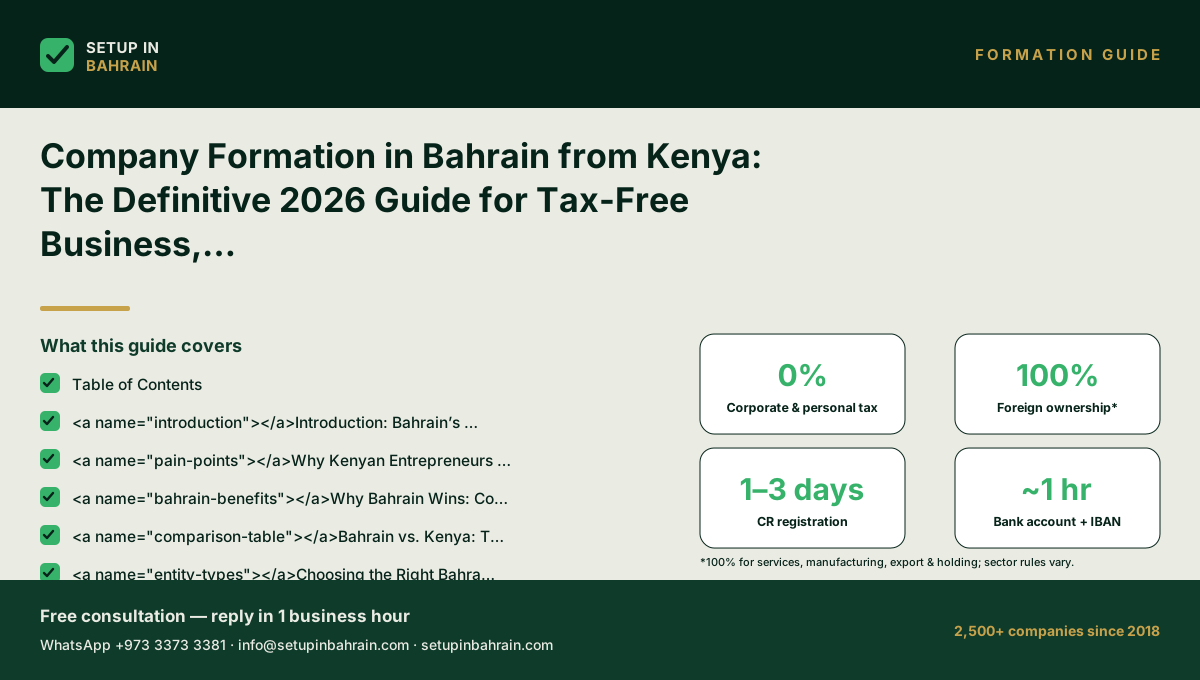
Complete guide for Kenya entrepreneurs: form a company in Bahrain with generally no corporate income tax for most sectors, 100% foreign ownership, and GCC market access. Costs, steps, visas, banking.
→ Complete guide: Company Formation in Bahrain — the full 2026 guide
View details
Ownership & capital
A Bahrain WLL can be owned by a single person — 100% foreign ownership applies to most activities, with no local partner required for services, manufacturing, export trading and holding companies. The minimum share capital is BHD 1; we recommend BHD 1,000, which makes bank account opening and investor visa approval smoother.
Table of Contents
- [Introduction: Bahrain’s Rise for Kenyan Entrepreneurs](#introduction)
- [Why Kenyan Entrepreneurs Are Looking Abroad: Crunching the Numbers](#pain-points)
- [Why Bahrain Wins: Core Advantages for Kenyan Business Owners](#bahrain-benefits)
- [Bahrain vs. Kenya: Tax, Currency, and Compliance Comparison Table](#comparison-table)
- [Choosing the Right Bahrain Entity: WLL and Beyond](#entity-types)
- [Step-by-Step Bahrain Company Formation Process for Kenyans](#formation-process)
- Practical Costs and Bank Account Opening(#costs-banking)
- [Investor Visas, Residency, and Relocation](#visas-residency)
- [Taxation, Profit Repatriation, and Compliance in Bahrain](#tax-compliance)
- [Protecting Assets: Legal Security, IP, and Data](#legal-assets)
- Frequently Asked Questions(#faqs)
- [Expert Take: Is Bahrain the Optimal Launchpad for Kenyan Entrepreneurs?](#expert-insights)
- [Key Government Resources and Further Reading](#resources)
<a name="introduction"></a>Introduction: Bahrain’s Rise for Kenyan Entrepreneurs
Imagine walking out of your Nairobi office after another marathon KRA iTax session—staring at accounting spreadsheets that have reduced your corporate profits by over 30%, not even counting the headache of NHIF/NSSF, the endless county fees, and yet another shock as the CBK’s foreign currency account restrictions lock your USD profits out of reach. Meanwhile, your local currency (KES) slips another 12% against the USD this quarter—a painful reality faced by thousands of Kenyan businesses just since 2022.
Now picture an alternative as real as Nairobi traffic, but with none of the bureaucratic bottlenecks: Bahrain. A business environment with generally no corporate income tax for most sectors, legally secure 100% foreign ownership, easy online company formation, and world-class banking—all powered by a dollar-pegged (and stable) currency, with direct access to the $2.08 trillion GCC marketplace.
This is not just hype: top-tier bodies like the Central Bank of Bahrain (CBB), Bahrain Economic Development Board (EDB), Ministry of Industry & Commerce (MOIC), and Bahrain Investors Center (BIPA) are all working in tandem to make Bahrain the Gulf’s most founder-friendly ecosystem, especially for African entrepreneurs with global ambitions.
This definitive 2026 guide breaks down, in candid detail, exactly how Kenyan founders are now registering and running tax-free Bahraini companies—sidestepping local tax, payroll, and forex headaches for the first time.
<a name="pain-points"></a>Why Kenyan Entrepreneurs Are Looking Abroad: Crunching the Numbers
Let’s get brutally honest about the triggers driving Kenyan founders to look outside their borders:
1. Punishing Corporate Tax Environment
Kenya’s corporate income tax is officially 30% (KRA, 2026). That’s up to three times the rate in many top global business jurisdictions and a full 50% higher than the average across emerging markets. For a Kenyan company posting KES 20 million profit, that’s KES 6 million straight to tax—before any other deductions.
2. Complex, Risky KRA iTax System
Even experienced accountants struggle with the KRA’s online iTax portal, which features labyrinthine forms, frequent outages, unpredictable audits, and legal penalties for even minor clerical mistakes. Many small firms now spend at least KES 150,000 per year on accountants and consultants just to remain compliant.
3. Payroll Headaches: NHIF and NSSF
Every Kenyan employer must deduct and submit both NHIF (National Hospital Insurance Fund) and NSSF (National Social Security Fund) contributions for each employee—adding up to an extra 2-5% wage cost plus monthly admin. Penalties for late or missing payments are now routinely enforced under the Companies (General) Regulations of 2023.
4. KES Currency Depreciation: Over 25% Since 2022
Kenya’s shilling has lost more than 25% against the USD since 2022 (CBK FX Data). For importers and exporters—anyone paid in hard currency—this means reduced retained earnings and unpredictable pricing for international clients.
5. CBK Foreign Currency Account Restrictions
The Central Bank of Kenya (CBK) has tightened the ability for non-export businesses to operate foreign currency accounts, making it difficult to retain and reinvest hard currency earnings from outside Kenya—a major pain for SaaS, consulting, and digital export entrepreneurs.
6. Other Hidden Costs
- VAT on most B2B and digital services (16%)
- County single business permits, often costing KES 90,000+ year per Nairobi business
- Digital Service Tax on all cross-border revenues
- Complex cross-border dividend and IP repatriation rules
The result? Shrinking margins, limited reinvestment, and a constant compliance burden for Kenyan SMEs—especially those with cross-border ambition.
<a name="bahrain-benefits"></a>Why Bahrain Wins: Core Advantages for Kenyan Business Owners
If Dubai is the Middle East’s glitzy showroom, Bahrain is its highly functional, startup-friendly engine room—offering a decisive set of benefits almost unmatched for African entrepreneurs:
1. Zero Corporate, Withholding, or Dividend Tax
- No corporate income tax: Profit retained and reinvested 100%.
- No capital gains tax, no dividend tax, no personal income tax: All business profits are distributable with zero statutory deductions.
- VAT: Most B2B and exported services are outright zero-rated.
According to the CBB, only select oil & gas activities are taxed—all other sectors pay nothing.
2. Full 100% Foreign Ownership in a WLL
- No need for a local partner or sponsor (unlike the old Dubai regime): A Bahraini WLL (With Limited Liability Co.) allows full single-person ownership with or without additional shareholders.
3. Stable, Dollar-Pegged Currency (BHD)
- The Bahraini Dinar is pegged at 1 BHD = 2.65 USD, and has remained so for over 30 years.
- No local currency shocks—profit is protected when trading and saving in USD or Euro.
4. Seamless GCC Market Access
- Bahrain is part of the GCC Common Market, giving companies streamlined access to markets worth $2.08 trillion.
- Simple visa and customs rules for business travelers to Saudi, the UAE, Qatar, and Oman.
5. English-Language, Pro-Investor Regulation
- All commercial registration and contracting can be done 100% in English.
- Bahrain ranked 1st for investor protection in the MENA region (World Bank Doing Business Report, 2023).
6. Startup-Friendly Cost Structure
- Minimum share capital: BHD 1 (but recommended BHD 1,000 for real-life banking/visa needs)
- No hidden formation fees, no mandatory office lease for most service firms
7. Digital-First, Paper-Free Formation
- Most companies can be incorporated online through the Bahrain Investors Center (BIPA) portal in as little as 5 business days.
8. Plug-and-Play Banking Ecosystem
- All major international banks operate in Bahrain, and fintech-friendly policies have enabled easy digital onboarding for new foreign founders.
9. Easy Residency for Entrepreneurs and Their Families
- Business owner and key staff receive renewable 2-3 year Investor visas.
- Spousal and dependent visas are also available.
<a name="comparison-table"></a>Bahrain vs. Kenya: Tax, Currency, and Compliance Comparison Table
| Feature / Cost | Kenya (as of 2026) | Bahrain (as of 2026) |
| Corporate Income Tax | 30% (fixed) | 0% |
| NHIF / NSSF Staff Contributions | 2–5% (Employer + Employee) | 0% |
| Currency | Kenyan Shilling (KES, -25% vs USD since 2022) | Bahraini Dinar (BHD, pegged to USD) |
| Foreign Currency Account Rules | CBK restricts for non-export companies | No restrictions |
| Minimum Share Capital | KES 100,000 (as Ltd.) | BHD 1 (legal), BHD 1,000 (recommended) |
| Foreign Ownership | 100% allowed (Ltd.) | 100% allowed (WLL) |
| Bank Account Setup | 2–6 weeks, documentation heavy | Banking: approximately 1 hour in 99% of our reported cases; our last 100 applications handled in 2026 were approved; subsidiaries or CIS shareholders: 3 days to 2 weeks. Subject to the bank’s final review. |
| Corporate Setup Time | 2-8 weeks (manual steps) | 5–7 business days (digital) |
| Resident/Investor Visa | <i>Unavailable</i> (with Kenyan company) | 2–3 year renewable residency for owner & family |
| Dividend Tax | 5–10% | 0% |
<a name="entity-types"></a>Choosing the Right Bahrain Entity: WLL and Beyond
What Is a Bahrain WLL (With Limited Liability Company)?
For almost all Kenyan founders, the WLL is the most compelling company format. Key facts:
- Single founder/owner is allowed—no requirement for a local or foreign partner. This is a legal distinction from other GCC countries which historically required local partners.
- Minimum capital: Legally BHD 1, but most banks prefer at least BHD 1,000 for account approvals and to secure investor visas.
- Sectors: Can operate across consulting, tech, trading, manufacturing, logistics, e-commerce, and more (some restricted activities require special licenses).
- Limited liability: Founder’s exposure is limited to capital contribution only.
Other Bahraini Company Types
- BSC (Bahrain Shareholding Company): For large public/listed ventures.
- Branch Office: Suitable only for established foreign companies expanding into Bahrain (not for first-time founders).
- Limited Partnership: Minimum two partners, not relevant for sole founders.
There is no WLL (Single Person Company) in Bahrain—the WLL is its functional equivalent, and permits a single foreign founder by law (MOIC Regulations, 2026).
<a name="formation-process"></a>Step-by-Step Bahrain Company Formation Process for Kenyans
1. Determine Business Activity and Approvals
- Choose your NBR (National Business Register) category via the BIPA portal.
- Check with MOIC for any activity-specific permits (e.g., fintech, health, education).
2. Choose and Reserve a Unique Company Name
- English or Arabic allowed, subject to MOIC/NBR naming rules.
- Name reservation processed via BIPA, usually within 2 business days.
3. Submit Founders’ Details and Documents
- Certified passport copy of founder(s)
- Kenyan KRA PIN and proof of address (for anti-money laundering compliance)
- Digital passport photos and basic business plan
4. Draft and Submit Articles of Association (AoA)
- Template AoAs are available, and bilingual English/Arabic versions are accepted.
- Submit through the BIPA system.
5. Pay Initial Share Capital
- Deposit BHD 1,000 to a designated pre-incorporation account (not less—realistically required by all Bahraini banks for SME onboarding).
6. Apply for MOIC Commercial Registration
- Full online application (with digital signatures)
- Typically assigned a CR number within 5 working days
7. Open Corporate Bank Account
- Use your Commercial Registration (CR), AoA, and founder KYC to open an account with a Bahraini or international bank (CBB-approved).
- Standard onboarding time: 2–3 weeks
8. Register for Optional Investor Visa
- Upon CR and bank account approval, you or your manager can apply for a 2–3 year renewable investor visa from Bahrain’s LMRA.
- Family visas can be added after this stage.
9. Register for (Optional) VAT or Industry Licenses
- Required only if turnover meets the VAT threshold (BHD 37,500), or if engaging in regulated sectors.
10. Start Operations
- Invoice globally, hold funds in USD/BHD, and repatriate profits to Kenya (or elsewhere) without restriction.
Timeline:
In practice, company formation to bank account opening can be achieved within 4–6 weeks. Investor visa processing may add another 2 weeks.<a name="costs-banking"></a>Practical Costs and Bank Account Opening
Breakdown of Typical Costs (2026 ROI):
| Step | Estimated Cost (USD) | Key Notes |
| Government Formation Fees | $500 – $900 | Paid to MOIC/BIPA |
| Name Reservation | $60 – $120 | |
| Legal/AoA Notarization | $250 | Digital notarization accepted |
| Recommended Share Capital | $2,650 (BHD 1,000) | Direct bank deposit; not government fee |
| Bank Account Opening | $0 – $250 | Banks may require minimum deposits |
| Compliance/AML Checks | Included (with banker) | Outsourced KYC is standard |
| Investor Visa (owner) | $1,100 (2 years) | Family visas extra |
| Annual Filing/CorpSec Maintenance | $350 – $650 | Lower than Nairobi professional fees |
| Total: First year estimated | $5,000 – $6,000 | All-inc. incorporating, banking, visas |
- Most startup founders spend at least KES 900,000–1.5M per year on equivalent Kenyan compliance, payroll, and tax—Bahrain wins easily on total cost of ownership.
- Bahrain’s all-digital banking allows you to invoice and receive in major international currencies, with online onboarding for both traditional and fintech banks (e.g., Bank ABC, Al Salam Bank).
<a name="visas-residency"></a>Investor Visas, Residency, and Relocation
How do Kenyan founders get long-term residency in Bahrain?
- Investor/Owner Visas: Bahrain’s LMRA grants 2- to 3-year renewable residency to the principal WLL shareholders and appointed managers.
- Family Visas: After owner’s visa is issued, spouses and children under 24 can apply for dependent residency under streamlined rules.
- Remote Work Friendly: Unlike the UAE, there is no requirement for expensive office space or minimum salary thresholds for founders.
Key Pro-Tip: Unlike European “Golden Visas”, Bahrain’s residency is directly tied to active business operations and is considered more “future-proof” for digital founders.
<a name="tax-compliance"></a>Taxation, Profit Repatriation, and Compliance in Bahrain
Corporate Tax
- Zero corporate income tax for all non-oil/gas activities (CBB and EDB confirmation, 2026).
- VAT only applies if annual turnover exceeds BHD 37,500, and most digital/export services are zero-rated.
Payroll and Social Security
- No NHIF, NSSF, or payroll tax analogous to Kenya.
- Employer contributions only required for Bahraini nationals (not foreign majority-owned enterprises).
Dividend, Royalty, and IP Taxation
- Zero withholding tax on outbound payments (per MOIC and CBB guidance).
- No government restrictions on paying Kenyans or other foreigners, including for IP licensing and royalties.
Profit Repatriation
- All dividends and profits can be sent back to Kenya or onward to any international destination at zero additional tax, capital control, or currency loss.
Annual Compliance
- Submit audited annual accounts (if turnover > BHD 100,000)
- Renew MOIC registration annually
- No complex tax return or iTax equivalent for ordinary businesses
<a name="legal-assets"></a>Protecting Assets: Legal Security, IP, and Data
Robust Rule of Law
- Bahrain ranks top in MENA for contract enforcement (World Bank 2023).
- Courts accept English documentation and contract clauses.
Intellectual Property
- Register trademarks and patents with the Bahrain Industrial Property Office (BIPO).
- Recognized under the Paris Convention and Madrid Protocol.
- Digital IP, SaaS, and creative works are all legally enforcible.
Data Protection
- Bahrain’s data laws (PDPL) modeled on EU GDPR—valuable for tech, SaaS, and data-driven Kenyan ventures with global clients.
<a name="faqs"></a>Frequently Asked Questions
1. Can I really own 100% of my Bahrain company as a single Kenyan founder?
Yes, absolutely. WLLs permit 100% foreign and single-person ownership (no partners or Bahraini sponsors required).2. Do I need to relocate to Bahrain or maintain a local address?
Not unless you want to. Many consulting and SaaS businesses operate “remotely” with a Bahrain CR and PO Box (virtual presence accepted for many categories).3. Is a Bahraini company legal for invoicing African, EU, and US clients?
Yes. Bahrain is internationally recognized (FATF-compliant) and enables cross-border business with banking in all major currencies.4. Will the Bahraini bank let me operate in USD or GBP?
Yes. Most banks open multi-currency accounts and are regulated (CBB) to international AML/KYC standards.5. What sectors are best for Kenyans starting in Bahrain?
Tech, consulting, logistics, trading, fintech, digital marketing, holding companies/IP portfolios, and cross-border e-commerce. Local licenses are only required for regulated sectors.6. How fast is company registration from Kenya?
As fast as 5–7 business days for company formation; 2–3 weeks for full bank account activation (depending on KYC).7. Do I have to pay VAT in Bahrain?
Only if turnover exceeds BHD 37,500 AND your sector is VAT-liable. Most export- or digital-service WLLs are zero-rated.8. Is there a minimum paid-up capital?
Yes. Legally BHD 1; practically BHD 1,000 is required for real-world banking/onboarding.<a name="expert-insights"></a>Expert Take: Is Bahrain the Optimal Launchpad for Kenyan Entrepreneurs?
Unlike headline-hungry hubs like Dubai or Singapore, Bahrain rewards the practical, ambitious founder: there’s no corporate tax drag, no payroll penalties on foreign workers, and—critically—no risk your hard-earned profits will be wiped out by a crashing local currency.
For Kenyan founders in SaaS, consulting, digital exports, or any IP-based business, the combination of zero tax, zero capital controls, full-foreign ownership, no hidden payroll liabilities, and continent-wide market access is almost impossible to match. Compared to Kenya, where local taxes, payroll compliance, and currency losses sap up to 40% of annual margins, Bahrain can improve net retained earnings by up to 60% for cross-border business models.
Original Insight: The real secret weapon? In Bahrain, your entire profit is protected from both government overreach and currency devaluation. You can build truly global, multi-jurisdictional models with steady value accretion in hard currency—something not even possible in Mauritius, and still complex in the UAE for small firms.
Entrepreneurs who ignore Bahrain in 2026 are missing the GCC’s best-kept growth secret.
<a name="resources"></a>Key Government Resources and Further Reading
- Central Bank of Bahrain (CBB): www.cbb.gov.bh(https://www.cbb.gov.bh)
- Bahrain Economic Development Board (EDB): www.bahrainedb.com(https://www.bahrainedb.com)
- Ministry of Industry and Commerce (MOIC): www.moic.gov.bh(https://www.moic.gov.bh)
- Bahrain Investors Center (BIPA): www.bahrain.bh(https://www.bahrain.bh)
- World Bank Doing Business Bahrain: www.doingbusiness.org/en/data/exploreeconomies/bahrain(https://www.doingbusiness.org/en/data/exploreeconomies/bahrain)
In Summary
For the Kenyan entrepreneur finally tired of profit leakage, tax headaches, and currency risk: Bahrain is your passport to scale. With next-generation regulatory support, fully digital company formation, and robust legal security, Bahrain’s WLL structure just might be the African founder’s ultimate cross-border launchpad for 2026 and beyond.
Have questions about your specific case? Smart founders start with a free consultation via BIPA or EDB—your Bahraini success story could be a decision away.
Bahrain Business Guides for Kenya Citizens
Ready to set up in Bahrain from Kenya?
Tell us your business idea. We map the right entity, ownership and timeline — then handle the filing while you focus on what matters.