
Start your Bahrain company from Japan with generally no corporate income tax for most sectors. Fast registration, full foreign ownership, and strategic Gulf market access for Japanese businesses.
→ Complete guide: Company Formation in Bahrain — the full 2026 guide
View details
Ownership & capital
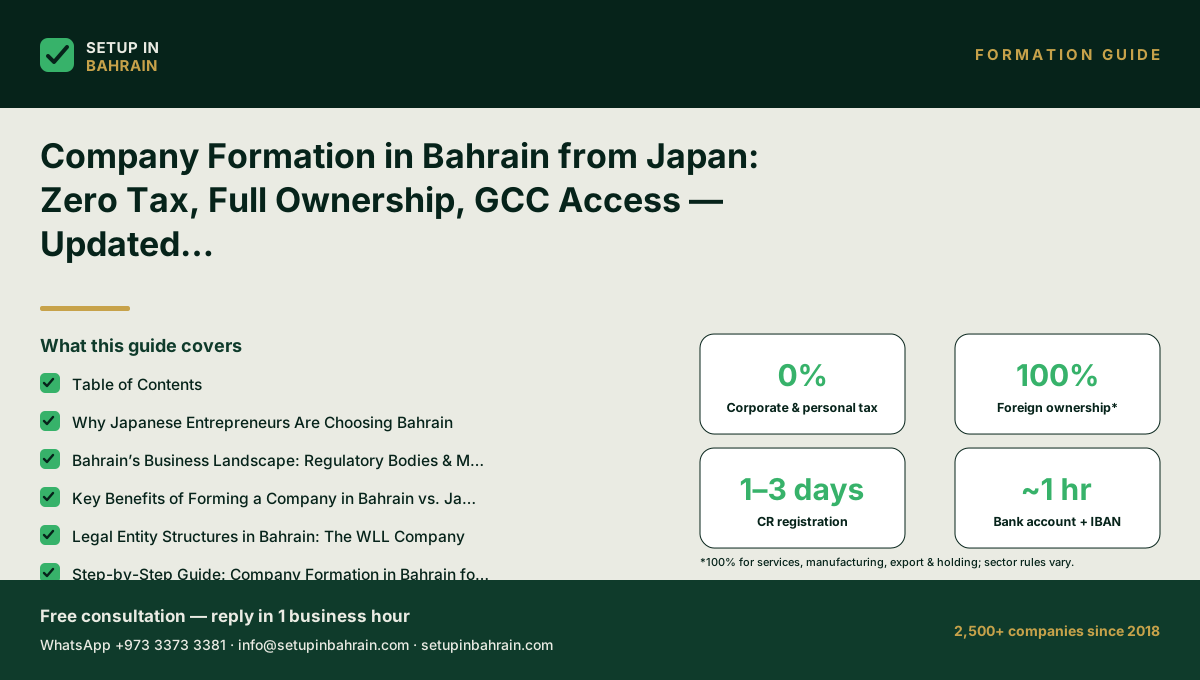
A Bahrain WLL can be owned by a single person — 100% foreign ownership applies to most activities, with no local partner required for services, manufacturing, export trading and holding companies. The minimum share capital is BHD 1; we recommend BHD 1,000, which makes bank account opening and investor visa approval smoother.
Imagine the scene: Kenji Saito, a seasoned SME founder in Osaka, scans his quarterly financials with a sigh. Last year, his growing consulting firm generated ¥250 million in profits, but after Japan’s corporate tax (23.2%), the local inhabitant tax (0.9%), and the enterprise tax (up to 5.9%), nearly 30% of those hard-earned earnings vanished to the tax office. The regulatory paperwork—quarterly consumption tax returns, transfer pricing documentation, and government notifications—demands days every month. A recent audit request from the National Tax Agency (NTA) around his international dealings only piled on more anxiety.
It’s a familiar pain point for many Japanese business owners: the double punch of high corporate tax and complex regulation, worsening as the yen weakens and global competition intensifies. How, Kenji wonders, are overseas founders able to grow so quickly with less friction and keep more of their profits?
Bahrain, a strategically located and business-friendly Gulf state, is quietly becoming the answer for Japanese entrepreneurs seeking to globalize, scale, and cut red tape. This guide walks you through every essential step and strategic detail about establishing a 100% Japanese-owned company in Bahrain. You’ll see why more founders are looking to the Middle East for growth—and how you can do the same.
Table of Contents
- [Why Japanese Entrepreneurs Are Choosing Bahrain](#why-japanese-entrepreneurs-are-choosing-bahrain)
- [Bahrain’s Business Landscape: Regulatory Bodies & Market Primer](#bahrains-business-landscape)
- [Key Benefits of Forming a Company in Bahrain vs. Japan](#key-benefits-of-forming-a-company-in-bahrain-vs-japan)
- [Legal Entity Structures in Bahrain: The WLL Company](#legal-entity-structures-in-bahrain-the-wll-company)
- [Step-by-Step Guide: Company Formation in Bahrain for Japanese Nationals](#step-by-step-guide-company-formation-in-bahrain-for-japanese-nationals)
- [Opening a Bahrain Bank Account as a Japanese Owner](#opening-a-bahrain-bank-account-as-a-japanese-owner)
- Visas, Relocation, and Hiring in Bahrain(#visas-relocation-and-hiring-in-bahrain)
- [Taxation in Bahrain vs. Japan: Concrete Numbers & Case Studies](#taxation-in-bahrain-vs-japan-concrete-numbers-case-studies)
- [Transfer Pricing, IP Structuring, and Compliance: Japan vs. Bahrain](#transfer-pricing-ip-structuring-and-compliance-japan-vs-bahrain)
- [FAQ: Japanese Business Owners’ Burning Questions About Bahrain](#faq-japanese-business-owners-burning-questions-about-bahrain)
- Action Checklist: Making the Move(#action-checklist-making-the-move)
All figures and regulatory insights are derived from official sources, including the Central Bank of Bahrain (CBB), Bahrain Economic Development Board (EDB), Ministry of Industry and Commerce (MOIC), Bahrain Investment Promotion Agency (BIPA), and the World Bank, as of 2026.
Why Japanese Entrepreneurs Are Choosing Bahrain
Entrepreneurs in Japan are deeply familiar with barriers to rapid international growth. Here’s what founders like Kenji Saito and Hiroshi Tanaka have faced:
- Tax Burden: After local and enterprise taxes, Japan’s effective corporate tax rate is 29.74%, among the highest in the OECD. For a company earning ¥500 million in profits, this means remitting roughly ¥148.7 million to tax authorities every year.
- Quarterly Consumption Tax Filing: Even modestly international firms must file and pay consumption tax (currently 10%, with quarterly compliance requirements).
- Transfer Pricing NTA Scrutiny: The National Tax Agency has intensified transfer pricing reviews—demanding robust documentation, adding audit risk even for small overseas deals.
- Currency Risk: The yen has depreciated roughly 35% against the USD since 2021, shrinking the value of global revenues when converted back home—while the cost of USD-pegged expenses (cloud platforms, foreign hires) keeps rising.
- Keiretsu Barriers: For startups and SMEs outside entrenched networks, breaking into new international markets, or building cross-border partnerships in the GCC and beyond, is slow and costly.
- Operational Delays: Golden Week, Obon, and long public holiday shutdowns can delay key paperwork, contract execution, or cross-border business for weeks at a stretch.
Why Bahrain? Bahrain provides a rare trifecta for Japanese business owners:
- Zero percent corporate and personal income tax for most sectors
- 100% foreign ownership in most company types (including for Japanese nationals)
- No currency controls—the Bahraini dinar is pegged to the US dollar, providing stability and predictability for global ventures
- Rapid digital company registration and an English-friendly bureaucracy
- Strategic location: Direct access to the GCC (Gulf Cooperation Council), Saudi Arabia (a $1.1 trillion economy), and India’s Western markets.
In 2024, the World Bank ranked Bahrain among the Top 10 globally for “Starting a Business,” and the EDB reports that new foreign company registrations have surged 16% year-on-year since 2022. Japanese trading houses, logistics providers, and tech startups are increasingly present in Bahrain’s business parks and fintech clusters.
Bahrain’s Business Landscape: Regulatory Bodies & Market Primer
Key Government Players:
- MOIC (Ministry of Industry and Commerce): Handles all corporate registration, records, and licensing. Its Sijilat platform offers one-stop digital registration for foreign investors.
- CBB (Central Bank of Bahrain): Regulates financial services, fintech, and all licensed banking activities.
- EDB (Economic Development Board): Bahrain’s promotional agency, provides foreign investors with personalized sector briefings, legal introductions, and aftercare services.
- BIPA (Bahrain Investment Promotion Agency): Focused on FDI promotion and offers a Japan Desk service for Japanese entrepreneurs.
Market Demographics:
Bahrain is a gateway: with a population just under 1.5 million, but access to a GCC region with 57 million consumers and a combined GDP exceeding $2.3 trillion. Bahrain’s labor force is 51% expatriate, and the government’s Vision 2030 targets a leading regional role in technology, logistics, and financial services.
Key Benefits of Forming a Company in Bahrain vs. Japan
| Feature | Bahrain WLL | Japanese KK/LLC |
| Corporate Income Tax Rate | 0% (most sectors) | 29.74% (national + local + enterprise) |
| Minimum Share Capital | BHD 1 legal minimum (BHD 1,000 practical for banks/visas) | ¥1 for GK, ¥3 million for KK |
| Foreign Ownership | 100% allowed | Heavily restricted |
| Annual Audit Requirement | Above BHD 20,000 turnover | Mandatory for most entities |
| Regulatory Language | English/Arabic | Japanese |
| Processing Time (Setup) | 7–15 days (typical) | 30–60 days + postal lag |
| Personal Income Tax | 0% | 5–45% |
| Capital Repatriation/Dividend Tax | 0% | 20.42% (standard withholding) |
| Visa/Residency For Owners | Yes, via company | Highly restricted |
| Transfer Pricing Scrutiny | Minimal (except for banks, oil & gas) | Intense (NTA enforcement) |
| Currency Exposure (USD) | Dinar pegged to USD | Yen easily loses ground |
- Bahrain eliminates Japan’s most painful tax and reporting burdens for SMEs and internationalizing founders.
- 100% Japanese ownership is permitted in WLL (With Limited Liability) companies—completely unlike restrictions in the UAE, Singapore, or even within some Japanese sectors for foreign capital.
- Only BHD 1,000 share capital is needed in practice to satisfy business banks and immigration, making the entry cost accessible.
Legal Entity Structures in Bahrain: The WLL Company
No single-shareholder WLL: Bahrain used to have a single-shareholder WLL legal form, but since 2021, all such entities must convert to a WLL (“With Limited Liability”). Do not be misled by outdated guides: Bahrain’s WLL is now the gold standard entry vehicle for both one-person and multi-owner structures.
WLL Company Quick Facts:
- 100% owned by a single individual: No partners or local equity required.
- Liability limited to capital: The owner’s responsibility is capped at the paid-up share capital.
- Eligibility: Available to GCC and foreign nationals, including Japanese citizens.
- Flexible Structure: Can have one or multiple owners, but zero requirement for local directors or partners.
- Minimum Share Capital: BHD 1 is the legal minimum, but in reality, you need at least BHD 1,000 (about $2,650 in 2026) to open a business bank account and for investor visa eligibility.
- Allowed Activities: Most commercial and service activities, except certain regulated sectors (banking, insurance).
LLC vs. WLL: Functionally, a Bahrain WLL is similar to the Japanese GK (合同会社) or an LLC elsewhere, but with critical improvements: no corporate tax, no annual local director requirements, and no forced profit distribution.
Case Study: Masato Iguchi, founder of a Japan-based AI EdTech startup, set up a 100% owned Bahrain WLL in 2023. With BHD 1,000 capital, no local partner, and English-language contracts, he was able to negotiate a seven-figure SaaS deal with a Saudi client faster than if he had set up a branch in Tokyo or Singapore.
Step-by-Step Guide: Company Formation in Bahrain for Japanese Nationals
1. Pre-Planning & Feasibility
- Define Activity: The MOIC provides a list of licensed business activities. Consulting, technology, trading, and most services require only basic sectoral approval.
- Name Reservation: Reserve your English business name (Arabic translation will be matched by MOIC if needed) through the Sijilat online portal.
- Choose Share Capital: Legally, BHD 1 is enough; practically, BHD 1,000 is the minimum you need to avoid bank delays.
2. Application & Registration
- Prepare Documentation: Japanese passport copy, residential address, business plan, and clean police/non-criminal record certificate.
- Appoint Director(s): You (the Japanese owner) may also serve as the company director/manager.
- Draft Articles of Association: English template is available—customize as needed.
- Submit on Sijilat Portal: Upload documents and pay registration fees (typically BHD 150–300).
- MOIC Review: Most applications are reviewed within 7–15 working days. EDB and BIPA can advocate for “fast track” processing for innovative/FDI projects.
3. Licensing & Domiciliation
- Obtain Commercial Registration (CR): This is the official company license in Bahrain.
- Physical/Virtual Office: Required—many Japanese founders opt for cost-effective business centers or innovation hubs in Manama or Bahrain FinTech Bay.
- Professional License for Regulated Activities: Extra MOIC/CBB approvals needed for industries such as financial services, legal, or engineering.
4. Post-Registration Essentials
- Bank Account Opening: Apply at a Bahrain-based bank (more on this process below).
- Visa Applications: Owner visa (“investor permit”) and staff visas can be initiated after CR is issued.
- Tax Certificate: Although generally no corporate income tax for most sectors, some global partners will request a tax residency certificate—issued by the Bahrain Ministry of Finance.
Timeline: Setup completion typically within three weeks (excluding local holidays). Compare this to Japan’s 1–2 month process, involving multiple postal mailings and local government filings.
Opening a Bahrain Bank Account as a Japanese Owner
Real-World Barrier: More than 80% of foreign-owned startups in Bahrain report initial frustrations with business account opening—not because of local hostility, but due to post-2021 global anti-money-laundering (AML) protocols. Here’s how Japanese owners can navigate this efficiently:
Required Documents
- MOIC-issued Commercial Registration
- Articles of Association (English version)
- Japanese owner’s passport and 3-month address proof (utility bill, bank letter)
- Source of funds explanations (example: prior years’ Japanese company dividend statement, salary, etc.)
- Clean criminal record certificate (translated and attested if not in English)
- Proof of local business address (even if virtual office)
Bank Selection & Best Practices
- Bahrain Islamic Bank (BisB) and Bank ABC are most experienced with foreign individual owners.
- Tip: Always provide BHD 1,000 as share capital, fully paid-in, for a decisive and fast approval.
- BIPA/EDB Introduction: Ask the Japan Desk of BIPA or EDB to provide a reference letter—banks move significantly faster for FDI partners.
Timeframe & Notes
- 2–3 weeks is standard from application to full account activation.
- Online banking: Available in English.
- Multi-currency accounts: Offered at most major banks, allowing seamless USD/EUR transfers and global payroll.
Case Study: Yoko Sugimoto, a Kobe-based SaaS founder, reported that her Bahrain WLL’s bank account was activated within 15 business days, with her BHD 1,000 capital visible immediately, and zero friction in handling inbound USD enterprise payments.
Visas, Relocation, and Hiring in Bahrain
Investor/Owner Visa: A Bahrain company owner can directly apply for an “investor permit” without a local sponsor. Documents: CR, business license, police certificate, and medical check (local hospital).
Visa Benefits:
- Multi-year validity (1–5 years)
- Bring spouse and children under dependent visas
- No minimum salary thresholds for company owners
- Fast-track residency possible for projects highlighted by EDB/BIPA
Employee Recruitment:
- No fixed “nationalization” (Bahrainization) requirements for companies under 10 employees, unlike stricter quotas elsewhere in the GCC
- Access to highly skilled tech and business talent pools, local and expat (India, Philippines, Europe)
- Simple LMRA work permit portal for foreign staff
Office Flexibility:
- Co-working and business centers are legally permissible as company headquarters for non-physical businesses
- MOIC accepts virtual office tenancy as proof for fintech, consulting, or eCommerce companies
Taxation in Bahrain vs. Japan: Concrete Numbers & Case Studies
Tax Head-to-Head: Bahrain WLL vs. Japan KK
| Yearly Profit (JPY) | After-Tax Profit (Japan, 29.74%) | After-Tax Profit (Bahrain, 0%) |
| ¥50 million | ¥35,130,000 | ¥50,000,000 |
| ¥250 million | ¥175,650,000 | ¥250,000,000 |
| ¥1 billion | ¥702,600,000 | ¥1,000,000,000 |
- Kenji Saito’s consulting firm earns ¥250 million net profit annually. Remaining profit in Japan: ¥175.6 million. In Bahrain: ¥250 million. The difference—¥74.4 million, or roughly $658,000—can be reinvested every single year into new markets, product development, or strategic hires.
Consumption Tax Differences
- Japan: 10% consumption tax (quasi-VAT), mandatory quarterly filings for most SMEs, even with limited cross-border business.
- Bahrain: 10% VAT exists, but only for businesses exceeding BHD 37,500 annual turnover (about $99,000 in 2026). Registration and filing is straightforward online; many service companies, especially B2B exporters, are outside the filing threshold.
Dividend Tax:
- Japan: Standard 20.42% withholding tax rate on shareholder dividends.
- Bahrain: No dividend withholding tax, whether distributed to local or foreign shareholders.
Transfer Pricing, IP Structuring, and Compliance: Japan vs. Bahrain
Transfer Pricing in Japan:
- NTA enforcement is strict, requiring annual documentation and benchmarking.
- Even SMEs must defend transfer prices for foreign affiliate transactions (e.g., software licenses, royalty payments, intercompany loans).
- Best-case: hiring a “Big Four” TP consultant for annual compliance costs at least ¥2.5 million ($22,000+).
Transfer Pricing in Bahrain:
- No general TP regime for most sectors outside oil/gas and banking. Fewer compliance obligations for cross-border structures, unless structured as a financial institution.
- Intellectual property (IP) can reside in the WLL; license fees are payable globally with minimal local reporting overhead.
- Many Japanese SaaS, consultancy, and digital content companies enjoy “headquarters” privileges—consolidated global revenues without Japan-style intercompany price scrutiny.
Other Compliance Obligations:
- No local director or Bahrain-resident board requirements for WLLs.
- No annual corporate tax returns, unless falling under VAT or local payroll schemes.
IP Revenue Routing Example:
- A Japanese parent company pays a Bahrain WLL affiliate for software license fees. In Japan, these qualify as deductible expenses, reducing effective profit before corporate tax.
- In Bahrain, those fees are received tax-free (subject to local substance rules for anti-treaty abuse).
FAQ: Japanese Business Owners’ Burning Questions About Bahrain
Q1: Can I truly own a Bahrain company 100% as a Japanese national, with no local partner? Yes. The Bahrain WLL structure is fully open to 100% foreign ownership by a single individual. No Bahraini partner, sponsor, or nominee is needed. (Cited: MOIC “Company Law” 2026 update.)
Q2: What is the minimum share capital to start? Legally, BHD 1. In practice, allocate BHD 1,000 (about $2,650) as shown in all applications to avoid any bank or visa hurdles.
Q3: How does VAT in Bahrain compare to Japan’s consumption tax? Both are at 10%, but Bahrain’s VAT only applies if your company exceeds BHD 37,500 in annual local sales, and B2B exports are largely out of scope.
Q4: How long does setup take? Usually under three weeks from name reservation to CR issue, provided all documents are in order and capital is ready. (Source: EDB Bahrain, Current 2026.)
Q5: Are there ongoing requirements? Annual MOIC CR renewals, basic accounting, and—if exceeding BHD 20,000 in turnover—an annual audit. No mandatorily employed Bahraini director required.
Q6: Can I relocate to Bahrain as the owner? Yes, through the investor visa. No minimum salary requirement. Spousal/dependent visas available as well.
Q7: What is the USD exposure in Bahrain? The Bahraini dinar is fully pegged to the US dollar (0.376 dinar per USD), giving your international business maximum currency stability versus the weaker-yen exposure for Japanese exporters.
Q8: How is the regulatory environment for Japanese founders? Bahrain’s MOIC and EDB offer Japan Desk consultations, and almost all business registration is English-language friendly.
Action Checklist: Making the Move
- Audit your current Japanese company’s international revenue split and tax cost.
- Contact BIPA or EDB (Japan Desk) for a pre-registration consultation.
- Reserve your company name online via Sijilat.
- Appoint yourself (and/or any partners) as WLL shareholder and director.
- Prepare all required KYC, legal, and business documents in advance.
- Set up a Bahrain office address—virtual or physical as appropriate.
- Register the company, pay fees, and receive your CR.
- Open your Bahrain bank account with at least BHD 1,000 capital.
- Apply for investor/owner visa (if desired).
- Register for VAT only if needed (after BHD 37,500 turnover).
- Establish any required cross-border invoicing, IP licensing, and bookkeeping systems.
- *Consider appointing a local agent for first-year compliance/Q&A.
Final Thoughts: Bahrain as Japan’s Strategic Global Launchpad
While Japan remains a powerhouse of innovation, its high-tax, high-compliance environment handicaps globally ambitious founders. Bahrain—uniquely pro-entrepreneur, stable, and forward-looking—offers Japan’s business community a frictionless, zero-tax gateway to GCC markets and worldwide growth.
From keiretsu-walled SMEs in Osaka to ambitious SaaS startups in Tokyo, Bahrain’s business model lets Japan’s founders keep more earnings, scale into the world’s fastest-growing economies, and control their legal destiny—with zero tax and full ownership. No other jurisdiction is as streamlined for this purpose. As GCC demand for quality Japanese products and services surges, this may well be the most strategic move you make this decade.
References:
- Central Bank of Bahrain (CBB) Regulatory Updates 2026
- Bahrain Economic Development Board (EDB) FDI and “Japan Desk” 2026 Reports
- Ministry of Industry and Commerce (MOIC) Company Law 2026
- Bahrain Investment Promotion Agency (BIPA) Official Guidance 2026
- World Bank, “Doing Business in Bahrain 2026”
Bahrain Business Guides for Japan Citizens
Ready to set up in Bahrain from Japan?
Tell us your business idea. We map the right entity, ownership and timeline — then handle the filing while you focus on what matters.