Irish entrepreneurs can establish a Bahrain company with generally no corporate income tax for most sectors. Enjoy seamless formation, full foreign ownership, and strategic Gulf market access.
Key Takeaways
- Why Ireland Entrepreneurs Are Moving Their Business to Bahrain
- Bahrain vs Ireland: Tax, Ownership, and Business Environment Comparison
- Legal Framework and Investment Protection (BIPA and Treaties)
- Types of Companies You Can Register in Bahrain
- Step-by-Step Process to Register a Business in Bahrain from Ireland
→ Complete guide: Company Formation in Bahrain — the full 2026 guide
View details
Ownership & capital
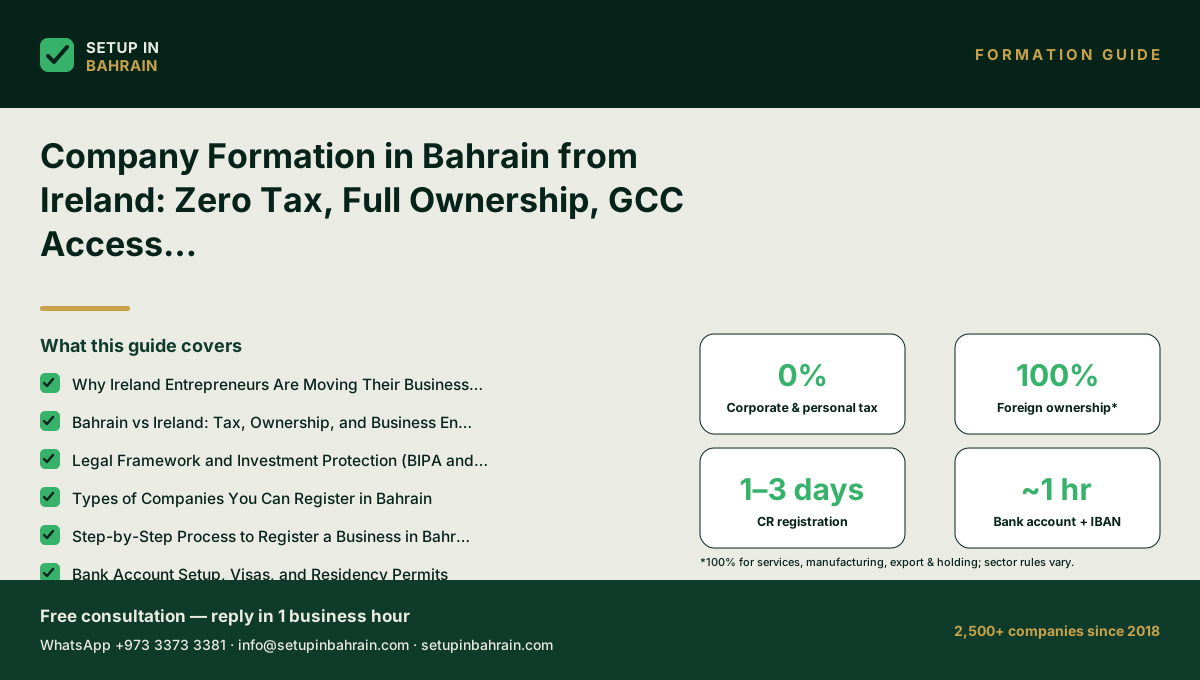
A Bahrain WLL can be owned by a single person — 100% foreign ownership applies to most activities, with no local partner required for services, manufacturing, export trading and holding companies. The minimum share capital is BHD 1 ; we recommend BHD 1,000 . This Makes bank account opening and investor visa approval smoother.
Ciarán spent eighteen years building his software consultancy in Dublin. From a two-person startup in a Rathmines apartment to a 45-employee operation with €3.2 million in annual revenue, he'd done everything right. Then came the letter from Revenue that changed everything.
The transfer pricing enquiry wasn't unexpected—his company had legitimate IP arrangements with a UK subsidiary established pre-Brexit. But the audit cost him €127,000 in professional fees, eleven months of management distraction. Ultimately resulted in an "adjustment" that pushed his effective tax rate to 19.3% for that year. When his tax adviser mentioned the OECD Pillar Two changes coming into full effect, Ciarán realised he wasn't running a business anymore. He was funding a compliance operation that happened to develop software on the side.
Six months later, Ciarán's primary operating entity runs from Manama, Bahrain. His Irish company still exists—scaled down to a genuine EU sales presence—but his profit centre, his IP, and his future sit in a jurisdiction where he pays precisely zero percent corporate tax, owns 100% of his company without any local partner, and can drive twenty-five kilometres across a causeway to meet clients in the largest economy in the Middle East.
This guide explains exactly how Irish entrepreneurs can replicate his journey.
Why Ireland Entrepreneurs Are Moving Their Business to Bahrain
The conversation has shifted dramatically since 2023. Five years ago, suggesting that an Irish entrepreneur relocate their business to the Gulf would have seemed exotic, possibly risky, certainly unconventional. Today, it's becoming a rational response to an Irish business environment that has fundamentally changed.
The End of Ireland's Tax Advantage
Ireland's signature competitive advantage—the 12.5% corporate tax rate that attracted every major tech company from Boston to Bangalore—is being systematically dismantled. The OECD Pillar Two framework, which Ireland formally adopted in December 2023, mandates a 15% minimum effective tax rate for multinational enterprises with consolidated revenues exceeding €750 million. But here's what the headlines miss: the psychological and regulatory ripple effects extend far beyond companies meeting that threshold.
Revenue Commissioners have intensified substance-over-form scrutiny across all company sizes. Transfer pricing documents requirements that were once reserved for multinationals now apply to SMEs with related-party transactions. The "double Irish" died years ago. The compliance apparatus built to police it remains fully operational and actively seeking new targets.
Consider the numbers facing a typical Irish tech entrepreneur in 2025:
- Corporate tax: 12.5% (rising to 15% for qualifying companies)
- Employer PRSI: 11.05% on all earnings
- USC: Up to 8% for higher earners
- Dublin commercial rent: €700-1,000 per square metre annually in prime locations
- Senior developer salary expectations: €85,000-120,000 base, plus equity
For a profitable €3 million revenue company with 60% gross margins and 15 employees, the effective government take—combining corporate tax, employer contributions, and the personal tax burden that drives salary expectations—can exceed 45% of pre-tax profits.
Post-Brexit Complications
The UK border complexity adds another layer of friction. Irish businesses that once shipped freely to their largest natural export market now navigate customs declarations, Rules of Origin documents. VAT deferment schemes. A Galway-based e-commerce company I advised recently calculated that post-Brexit administrative costs added €4.70 to every parcel shipped to British customers—not tariffs, just compliance overhead.
For service businesses, the regulatory divergence is equally problematic. UK financial services passporting ended in 2021. Data adequacy remains under periodic review. Professional qualifications require separate recognition processes.
The Talent Crisis
Dublin's talent market has become genuinely dysfunctional. According to Morgan McKinley's 2024 salary survey, software engineering salaries in Dublin increased 12.3% year-on-year, yet 67% of tech companies reported difficulty filling senior roles. The combination of unaffordable housing (average Dublin rent exceeded €2,100 monthly in 2024), aggressive US tech company recruiting. Remote work normalisation means Irish businesses compete for talent against Silicon Valley budgets.
Meanwhile, Bahrain's average monthly salary for a senior software developer sits at BHD 2,500-3,500 (€6,100-8,500), with no employer social contributions beyond minimal labour fund payments. The cost differential isn't marginal—it's transformational.
Bahrain vs Ireland: Tax, Ownership, and Business Environment Comparison
Understanding the magnitude of difference requires examining both jurisdictions across multiple dimensions. This isn't simply about tax arbitrage—it's about operational freedom.
Corporate Taxation
| Factor | Ireland | Bahrain |
| Standard corporate tax rate | 12.5% (15% under Pillar Two) | 0% |
| Capital gains tax | 33% | 0% |
| Dividend withholding tax | 25% (reduced by treaties) | 0% |
| VAT/GST | 23% standard rate | 10% (effective January 2022) |
| Personal income tax | Up to 40% + USC | 0% |
| Employer social contributions | 11.05% PRSI | 0% (minimal labour fund only) |
Ownership Structure
Ireland permits 100% foreign ownership of companies. So does Bahrain—and Bahrain does so without the extensive compliance infrastructure. The critical difference lies in regulatory burden:
Ireland requires:
- Annual returns to CRO (€20 filing fee, but €1,500-3,000 in accountant costs)
- Audited accounts for companies exceeding size thresholds
- Director compliance statements
- Beneficial ownership registration
- Transfer pricing documents for related-party transactions
- Potential substance questionnaires from Revenue
Bahrain requires:
- Company renewal packages: BHD 530 with 3 months of office address; BHD 980 with 6 months; BHD 1,520 with 12 months. These are separate renewal packages, not visa fees.
- Simplified financial statements (no audit required for most SMEs)
- No beneficial ownership public register
- No transfer pricing regime
- Minimal ongoing compliance beyond licence renewal
Banking and Financial Infrastructure
The Central Bank of Bahrain (CBB) regulates one of the most sophisticated financial sectors in the Middle East. With over 400 licensed financial institutions, Bahrain serves as the regional headquarters for Citi, HSBC, Standard Chartered. BNP Paribas. Opening a corporate bank account typically requires 2-3 weeks and a straightforward documents package.
By contrast, Irish entrepreneurs more and more report 8-12 week waiting periods for corporate account opening, with extensive source-of-funds interrogation even for established businesses.
Geographic and Market Access
| Market Access | From Ireland | From Bahrain |
| EU Single Market | Full access | Requires EU subsidiary |
| UK Market | Customs friction, regulatory divergence | Similar to Ireland |
| GCC Market (Saudi, UAE, Kuwait, Qatar, Oman) | Requires local presence | Preferential access via causeway to Saudi |
| MENA Region | Limited presence | 400 million consumers within 3-hour flight |
| Asia | 10+ hour flights | 3-6 hour flights to major hubs |
Legal Framework and Investment Protection (BIPA and Treaties)
Irish entrepreneurs considering Bahrain legitimately ask: "What protections exist if something goes wrong?" The answer is more robust than most expect.
The Bahrain-Ireland Bilateral Investment Treaty
Bahrain and Ireland maintain a bilateral investment promotion and protection agreement (BIPA) that provides:
- Fair and equitable treatment: Your investment must receive treatment no less favourable than that accorded to domestic investors
- Protection against expropriation: Any nationalisation or expropriation requires due process, non-discrimination, and prompt, adequate, and effective compensation
- Free transfer of funds: Guaranteed right to repatriate profits, dividends, capital gains, and proceeds from asset sales in freely convertible currency
- International arbitration: Disputes can be submitted to ICSID (International Centre for Settlement of Investment Disputes) or UNCITRAL arbitration, bypassing local courts entirely
This treaty framework means your Bahrain investment carries formal legal protections enforceable through international mechanisms—the same mechanisms that multinational corporations rely upon globally.
World Bank Indicators
The World Bank's Doing Business rankings (before their discontinuation in 2021) consistently placed Bahrain among the top 50 globally for ease of doing business, and first in the MENA region for several categories. The 2024 World Bank Governance Indicators show Bahrain scoring in the 60th-70th percentile globally for regulatory quality and rule of law—comparable to several EU member states.
Regulatory Stability
Unlike some Gulf neighbours, Bahrain's legal framework has remained stable for decades. The Commercial Companies Law dates to 2001 with consistent, incremental updates rather than wholesale restructuring. The absence of sudden regulatory changes provides planning certainty that Irish entrepreneurs value highly after years of Irish/EU regulatory churn.
Types of Companies You Can Register in Bahrain
The Ministry of Industry and Commerce (MOIC) and the Economic Development Board (EDB) have created multiple corporate structures suitable for different Irish business models. Understanding which fits your situation prevents costly restructuring later.
single-shareholder WLL
Best for: Solo consultants, freelancers, individual IP holders
The WLL allows a single shareholder—individual or corporate—to establish a limited liability company. Minimum capital requirements are minimal (BHD 50 for most activities), and administrative simplicity is maximised.
Irish use case: A Dublin-based marketing consultant with €200,000 annual revenue from international clients could establish a single-shareholder WLL, invoice from Bahrain, and eliminate both Irish corporate tax and personal income tax on profits.
With Limited Liability Company (WLL)
Best for: Multi-owner businesses, family companies, partnership conversions
The WLL requires 2-50 shareholders and operates similarly to an Irish private limited company. Shareholders' liability is limited to their capital contribution. This structure suits Irish businesses with multiple founders or family involvement.
Minimum capital: Varies by activity (typically BHD 20,000-50,000 for most service businesses)
Irish use case : Three co-founders of a Cork-based SaaS company could establish a WLL in Bahrain, transfer their IP. Operate their subscription business from a zero-tax jurisdiction while maintaining a minimal Irish presence for EU customer service.
Closed Joint Stock Company (Closed JSC)
Best for: Larger companies planning future capital raises, venture-backed startups
The Closed JSC allows 3-50 shareholders and provides a structure recognised by institutional investors. Share transfers require existing shareholder approval, maintaining control while enabling growth capital.
Minimum capital: BHD 250,000 (about €610,000)
Irish use case: A growth-stage Irish fintech raising Series A could establish a Bahrain Closed JSC as the group holding company, benefiting from zero capital gains tax on eventual exit while accessing GCC banking partnerships.
Foreign Branch
Best for: Testing the market before full commitment, existing multinationals
A foreign branch of an Irish company can operate in Bahrain while maintaining the Irish parent. Profits remain attributable to the Irish entity (and subject to Irish tax). This structure allows market testing with minimal restructuring.
Irish use case: An Irish construction consultancy could establish a Bahrain branch to bid on GCC projects, repatriating profits to Ireland only if the Irish tax position remains advantageous.
Holding Company (Special Purpose)
Best for: Group restructuring, IP holding, investment portfolios
Bahrain's holding company regime allows zero-tax consolidation of international investments. With no capital gains tax, no dividend withholding tax. Treaty access to multiple jurisdictions, Bahrain holding companies serve as efficient intermediate structures.
Irish use case : An Irish entrepreneur with equity in multiple international startups could establish a Bahrain holding company, consolidate those interests. Realise gains without Irish CGT exposure.
Step-by-Step Process to Register a Business in Bahrain from Ireland
Registration typically completes within 10-15 working days for straightforward applications. The EDB's Investor Centre handles most cases, though certain regulated activities require additional approvals.
Step 1: Define Your Business Activity and Structure
Before approaching authorities, clarify precisely what activities your Bahrain company will conduct. Bahrain uses an activity-based licensing system—your commercial registration specifies permitted activities. Conducting unlicensed activities triggers penalties.
Common activity categories for Irish businesses include:
- Information technology services
- Management consultancy
- E-commerce and digital services
- Marketing and advertising
- Financial technology (requires CBB licensing)
- Import/export trading
Practical tip: Select slightly broader activity descriptions than your immediate needs. Adding activities later requires modification applications and additional fees.
Step 2: Reserve Your Company Name
Submit your proposed company name to MOIC for approval. Names must:
- Not duplicate existing registered companies
- Not contain restricted terms (banking, insurance, royal references) without appropriate licences
- Include the appropriate legal designation (WLL, WLL, etc.)
Arabic names are required; English translations appear alongside. The EDB can assist with appropriate Arabic naming.
Timeline: 1-2 working days Cost: Approximately BHD 10
Step 3: Prepare Required Documents
For an Irish individual establishing a Bahrain company:
- Passport copy (notarised and apostilled)
- Proof of address (utility bill or bank statement, notarised and apostilled)
- Bank reference letter
- CV/resume detailing relevant business experience
- Business plan summary (1-2 pages outlining intended activities)
For an Irish company establishing a Bahrain subsidiary:
- Certificate of incorporation (apostilled)
- Memorandum and articles of association (apostilled)
- Board resolution authorising Bahrain company formation
- Passport copies of directors and authorised signatories
- Good standing certificate from CRO
- Latest filed accounts (apostilled)
Irish-specific note: Ireland uses apostille certification under the Hague Convention. The Department of Foreign Affairs in Dublin handles apostilles, typically within 5 working days. Cost is €20 per document.
Step 4: Submit Application to MOIC via Sijilat
Bahrain's Sijilat online portal handles commercial registration. Applications can be submitted remotely, though many Irish entrepreneurs use local formation agents for convenience.
Required submissions include:
- Completed application forms
- Memorandum and articles of association (Arabic translation required)
- Proof of registered office address
- All shareholder/director documents
Timeline: 3-5 working days for initial approval Cost: Filing fees about BHD 100-300 depending on structure
Step 5: Get Commercial Registration (CR)
Upon application approval, MOIC issues the Commercial Registration—your company's primary legal identity document. The CR specifies:
- Company name and registration number
- Registered address
- Permitted activities
- Shareholding structure
- Authorised signatories
Timeline: Issued at once with approval Cost: Approximately BHD 200-500 annually (varies by activity)
Step 6: Register with Labour Market Regulatory Authority (LMRA)
Even companies without initial employees must register with LMRA to:
- Get permission to sponsor visas
- Access the e-government portal
- Comply with Bahrainisation requirements when scaling
Timeline: 2-3 working days Cost: Minimal registration fees
Step 7: Open Corporate Bank Account
With your CR in hand, approach your chosen bank with:
- Commercial registration certificate
- Memorandum and articles
- Board resolution for banking relationship
- Passport copies of signatories
- Proof of registered address
- Business plan and projected turnover
Major banks serving Irish entrepreneurs include:
- Ahli United Bank: Strong regional network, good SME services
- BBK (Bank of Bahrain and Kuwait): Established local bank, competitive fees
- HSBC Bahrain: Familiar to Irish entrepreneurs, potential integration with existing HSBC relationships
- Standard Chartered: Strong international payments infrastructure
Timeline: 2-3 weeks for account opening Practical tip: Initiate bank introductions during company formation, not after. The EDB can help introductions to relationship managers, greatly accelerating the process.
Bank Account Setup, Visas, and Residency Permits
Entrepreneur Residence Permits
Irish entrepreneurs don't simply register companies—they often relocate personally, at least partially. Bahrain's residence permit system accommodates this efficiently.
Investor Visa Route: With a registered Bahrain company, you can sponsor your own residence visa. Requirements include:
- Valid commercial registration
- BHD 50 monthly guaranteed salary (self-employed basis)
- Health insurance coverage
- Clean criminal record
Golden Residency Programme: Launched in 2022, Bahrain's Golden Residency provides 10-year renewable residence for:
- Company owners employing Bahraini nationals
- Real estate investors (BHD 200,000+ property value)
- Individuals with exceptional talent designations
For Irish entrepreneurs committing to substantial Bahrain operations, Golden Residency provides long-term security without annual renewal uncertainty.
Family Sponsorship
Residence visa holders can sponsor:
- Spouse
- Children under 25 (extended age limit)
- Parents (in certain circumstances)
Dependent visas process within 1-2 weeks and include work permission for spouses—a significant advantage for dual-career Irish families.
Practical Living Considerations for Irish Families
Housing: Expect BHD 400-800 monthly (€980-1,960) for a three-bedroom apartment in Juffair, Seef, or Amwaj Islands—about 40-60% less than equivalent Dublin accommodation.
Healthcare: Private health insurance is mandatory but affordable. Comprehensive family coverage runs about BHD 500-1,000 annually (€1,220-2,440). Hospital quality is high—the American Mission Hospital and King Hamad University Hospital provide Western-standard care.
Education: International schools following British, American, or IB curricula serve the expatriate community. Annual fees range from BHD 3,000-8,000 (€7,300-19,500) depending on school and year level. St Christopher's School and the British School of Bahrain are popular with European families.
Climate adjustment: Summers are genuinely hot—40°C+ from June to September. Irish families typically travel during August. Air conditioning is universal and affordable. The November-April climate is exceptional: 20-25°C, minimal rain, outdoor lifestyle.
Sector-Specific Considerations for Irish Businesses
Technology and SaaS Companies
Bahrain positions itself as a regional technology hub, and Irish tech companies find particular advantages:
Amazon Web Services: AWS operates its Middle East region from Bahrain. For Irish SaaS companies serving GCC clients, deploying from the Bahrain AWS region provides sub-50ms latency throughout the Gulf—compared to 150ms+ from Dublin.
Financial Technology: The CBB's regulatory sandbox allows fintech testing without full licensing. Irish fintech companies can pilot products with GCC banks before committing to full market entry.
Data Localisation: Certain GCC clients (especially government and financial services) require regional data hosting. A Bahrain presence satisfies these requirements more readily than serving from Ireland.
Bahrain FinTech Bay : Located in Bahrain Bay, this fintech accelerator provides co-working space, mentorship. Introductions specifically for technology companies. Irish fintechs have successfully used FinTech Bay residency to access GCC banking partnerships.
Professional Services and Consulting
Irish consultancies—management, engineering, architecture, accounting—find Bahrain advantageous for GCC market access:
Regional headquarters: Major consulting firms (McKinsey, BCG, Big Four accountancies) maintain Bahrain regional offices. Subcontracting relationships are common, providing market entry without direct sales infrastructure.
Government procurement: Bahrain's Tender Board publishes procurement opportunities online. Irish companies with Bahrain registration can bid directly, whereas foreign companies face additional qualification requirements.
Saudi access: The 25-minute causeway crossing allows same-day meetings in Dammam, Dhahran, and (with early starts) Riyadh. Saudi Arabia's Vision 2030 has generated massive consulting demand across education, healthcare, entertainment, and infrastructure sectors.
E-Commerce and Trading
Irish e-commerce entrepreneurs targeting GCC customers benefit from:
Logistics hub: Bahrain International Airport handles air cargo efficiently, and the Khalifa Bin Salman Port provides shipping access. Both offer bonded warehouse facilities.
No customs duties on many goods: GCC unified customs applies 5% duty on most imports, with numerous exemptions for re-export and free zone activities.
Cross-border simplicity: Unlike post-Brexit UK-Ireland friction, GCC internal borders remain relatively frictionless for goods movement.
Holding and Investment Structures
Irish entrepreneurs with investment portfolios or multinational interests find Bahrain holding companies especially efficient:
Zero capital gains tax: Selling subsidiary shares or exiting investments generates no Bahrain tax liability.
No CFC rules: Bahrain doesn't impose controlled foreign corporation rules that attribute subsidiary profits to the holding company.
Treaty network: Bahrain maintains double tax agreements with over 40 countries, enabling efficient profit repatriation throughout the network.
Cost Comparison: Ireland vs Bahrain Business Operations
Understanding total cost of operations—not just tax rates—determines whether Bahrain relocation makes financial sense. The following comparison assumes a €2 million revenue service company with 10 employees.
Annual Operational Cost Comparison
| Cost Category | Ireland (Dublin) | Bahrain (Manama) |
| Office space (200 sqm) | €140,000-200,000 | €24,000-36,000 |
| Average salary (10 employees) | €65,000 × 10 = €650,000 | €40,000 × 10 = €400,000 |
| Employer social contributions | €71,825 (11.05%) | €0 |
| Corporate tax (25% margin = €500k profit) | €62,500-75,000 | €0 |
| Accounting and compliance | €25,000-40,000 | €8,000-12,000 |
| Legal and regulatory | €15,000-25,000 | €5,000-10,000 |
| TOTAL ANNUAL SAVINGS | — | €262,000-382,000 |
One-Time Setup Costs
| Expense | Ireland | Bahrain |
| Company formation | €300-500 | €3,000-8,000 (including agent fees) |
| Legal structuring advice | €5,000-15,000 | €5,000-10,000 |
| Initial visa and residency | N/A | €2,000-3,000 |
| Bank account opening | €0 | €500-1,000 (agent fees) |
| TOTAL SETUP | €5,300-15,500 | €10,500-22,000 |
Frequently Asked Questions from Irish Entrepreneurs
Can I maintain my Irish company while operating from Bahrain?
Yes, and many Irish entrepreneurs do precisely this. The typical structure involves:
- Irish company scaled down to genuine EU sales/support functions
- Bahrain company serving as primary profit centre and operational hub
- Intercompany agreements for services, IP licensing, or cost-sharing
The critical requirement is substance. Revenue Commissioners will challenge arrangements where the Irish company appears to be the economic substance while the Bahrain company appears to be merely a letterbox. Genuine operational relocation—real employees, real decision-making, real customer-facing activity—in Bahrain is essential.
What about Irish exit tax and CGT implications?
If you transfer assets (shares, IP, goodwill) from an Irish company to a Bahrain entity, Irish exit taxation may apply. This typically means:
- Deemed disposal at market value
- CGT at 33% on the gain
- Potential entrepreneur relief (10% rate on first €1 million of gains)
Professional structuring advice before any transfer is essential. Timing, valuation methodology, and entity selection greatly impact the tax cost of transition.
How do I handle EU VAT if my Bahrain company sells to European customers?
A Bahrain company selling digital services to EU consumers generally must register for VAT under the EU's One-Stop Shop (OSS) scheme and charge VAT at customer-country rates. But:
- B2B sales to VAT-registered EU businesses use reverse-charge mechanism (no Bahrain VAT collection required)
- Physical goods sold into the EU may require customs and import VAT procedures
The complexity here mirrors what Irish companies already manage for UK post-Brexit sales—Bahrain doesn't add additional EU complexity beyond existing reality.
Is Bahrain safe for my family?
Bahrain consistently ranks among the safest countries globally. The 2023 Global Peace Index placed Bahrain 106th of 163 countries—comparable to Italy and France, safer than the United States. Street crime is exceptionally rare. The expatriate community is large (over 50% of the population) and well-established. Irish families typically report feeling safer in Bahrain than in Dublin.
What happens if Bahrain introduces corporate tax?
Unlike some jurisdictions that promise low taxes through administrative practice (easily changed), Bahrain's Generally no corporate income tax for most sectors is legislatively embedded. Any introduction would require parliamentary process and substantial notice.
More practically, Bahrain's economic model depends on attracting foreign investment—introducing corporate tax would undermine that model. The more likely trajectory is refined incentives and sector-specific benefits, not taxation.
That said, businesses should maintain flexibility. A well-structured Bahrain company can relocate or restructure if circumstances change, just as you're considering restructuring from Ireland now.
Do I need to speak Arabic?
No. English is the primary business language in Bahrain. Government portals, banking, legal documents, and commercial interactions all function entirely in English. Arabic appears on formal documents alongside English translations. You won't need Arabic language skills for business operations.
How do I find reliable local partners—accountants, lawyers, formation agents?
The EDB maintains approved service provider lists and actively facilitates introductions. When vetting providers:
- Verify they're licensed by relevant authorities (MOIC for company formation agents, CBB for financial advisors)
- Request Irish client references specifically
- Confirm they understand Irish tax residence rules and Revenue Commissioners requirements
- Avoid anyone promising unrealistic timelines or guaranteed approvals
Working with the Bahrain EDB and MOIC
The Economic Development Board (EDB)
The EDB functions as Bahrain's investment promotion agency and should be your first formal contact. Their services—provided free—include:
- Sector-specific guidance: Understanding which activities suit Bahrain and which face restrictions
- Incentive identification: Certain activities qualify for additional benefits (subsidised office space, training grants, fee waivers)
- Bank introductions: Facilitating corporate account opening through relationship manager introductions
- Visa expedition: Accelerating residence permit processing for investors
- Ongoing support: The EDB relationship continues post-incorporation, assisting with expansion challenges
Practical approach: Email invest@bahrainedb.com with a summary of your business, intended activities, and timeline. The EDB assigns a dedicated relationship manager who guides you through the process.
The Ministry of Industry and Commerce (MOIC)
MOIC handles actual company registration through the Sijilat system. While the EDB assists strategically, MOIC handles execution. Key MOIC interactions include:
- Commercial registration applications and renewals
- Activity licensing and modifications
- Trade name reservations
- Memorandum and articles approval
Most Irish entrepreneurs use formation agents for MOIC interactions. The system is accessible for direct applications if you prefer.
Central Bank of Bahrain (CBB)
If your business involves financial services—payments, lending, investment, insurance, cryptocurrency—you'll interact with CBB. Bahrain's regulatory sandbox allows limited activity testing before full licensing, providing a market entry pathway that doesn't exist in Ireland's CBI framework.
Timeline: From Dublin Decision to Manama Operation
A realistic timeline for an Irish entrepreneur establishing a fully operational Bahrain company:
| Week | Activity |
| Week 1-2 | Initial EDB consultation, structure selection, Irish tax advice |
| Week 2-3 | Document preparation and apostilling in Ireland |
| Week 3-4 | Name reservation and company formation application submitted |
| Week 4-5 | Commercial registration issued, LMRA registration |
| Week 5-7 | Bank account opening process |
| Week 6-8 | Residence visa application (if relocating personally) |
| Week 8-10 | Fully operational: bank account active, visa issued, ready to invoice |
Managing the Transition: Practical Advice from Experience
Don't Rush the Irish Wind-Down
The temptation is to minimise Irish tax exposure immediately. Resist it. Revenue Commissioners specifically scrutinise rapid restructurings, especially where:
- Irish company transfers IP to related foreign entity at questionable valuations
- Irish company becomes loss-making immediately after restructuring
- Directors relocate to low-tax jurisdictions while maintaining Irish lifestyle patterns
A phased transition—demonstrably building genuine Bahrain substance before reducing Irish activity—withstands scrutiny far better than aggressive restructuring.
Build Real Bahrain Substance
"Substance" means genuine economic activity, not just paperwork. Demonstrate substance through:
- Physical presence: Actual office space with real employees working there
- Decision-making: Board meetings held in Bahrain, strategic decisions documented as taken in Bahrain
- Customer-facing activity: Contracts signed in Bahrain, customer meetings in Bahrain, Bahrain contact details on marketing materials
- Banking activity: Bahrain bank account as the primary operating account, not just a dormant holding
If your Bahrain company looks like a shell—no employees, no office, no local activity—Revenue Commissioners will argue the real business remains Irish.
Maintain Irish Connections Thoughtfully
Many Irish entrepreneurs don't relocate permanently. They maintain Dublin homes, children in Irish schools, social networks centred on Ireland. This creates residence risk—if you're physically present in Ireland more than 183 days annually, you're Irish tax resident regardless of your business structure.
For dual-location arrangements:
- Track days meticulously (there are apps for this)
- Understand the "tie-breaker" rules in Ireland-Bahrain tax treaty
- Consider whether genuine relocation, rather than geographical arbitrage, better serves your long-term interests
Communicate with Stakeholders
Clients, employees, and partners need to understand what's changing and why. Messages that work:
- "We're establishing Middle East operations to better serve our growing GCC client base"
- "Our Bahrain office handles international operations while our Dublin team focuses on European customers"
- "This restructuring positions us for the next growth phase"
Messages that don't work:
- "We're moving to Bahrain to avoid Irish tax"
Conclusion: The Irish Entrepreneur's Bahrain Decision
Eighteen months ago, the idea of advising Irish entrepreneurs to establish companies in Bahrain would have seemed niche. Today, with OECD Pillar Two implementation, intensified Revenue scrutiny, post-Brexit UK friction, Dublin cost escalation. Genuine Bahrain infrastructure maturation, the equation has changed.
Bahrain offers what Ireland's political class claims to offer but more and more cannot deliver: a genuinely business-friendly environment where entrepreneurs keep the wealth they create, where compliance doesn't consume disproportionate resources, where geographic position enables rather than constrains growth.
Not every Irish business should relocate. If your customers are exclusively European, your employees are Dublin-settled. Your scale doesn't justify restructuring complexity, Ireland may remain appropriate. But if you're building an internationally-oriented business, serving global clients, competing for mobile talent. Frustrated by the widening gap between Ireland's reputation and reality—Bahrain deserves serious consideration.
Ciarán, the Dublin software entrepreneur from this guide's opening, describes his decision simply: "I didn't leave Ireland. Ireland left the position that made it sensible for growth companies. Bahrain simply occupies that position now."
Your circumstances differ. Your decision will be your own. But the option exists, the pathway is clear, and the numbers speak plainly.
Summary: Key Takeaways for Irish Entrepreneurs
| Factor | Why It Matters for Irish Entrepreneurs |
| generally no corporate income tax for most sectors | Compared to Ireland's 12.5-15%, this transforms reinvestment capacity |
| 0% personal income tax | Director compensation retains full value |
| 100% foreign ownership | No local partner requirement, full control maintained |
Bahrain Business Guides for Ireland Citizens
Frequently Asked Questions
How long does it take to set up?
It takes 15 to 20 days. We file all forms for you. You do not need to wait long.
What does it cost?
Company formation: Standard BHD 1,340 with 3 months of office address; Gold BHD 1,700 with 6 months; Premium BHD 2,150 with 12 months and a cabin, officer table and chair, and two guest chairs. No formation package includes visas, including Premium. Investor/work visas are priced separately: BHD 755 for one year or BHD 953 for two years, in addition to the formation package. Ask for a written, itemized quotation confirming government fees and all inclusions before payment.
Do I need to visit Bahrain?
No. You can set up your firm from home. We do all the work online. Some banks may ask for one visit.
What tax will I pay?
You pay zero tax on your profits. Bahrain has no corporate income tax. This is a key benefit of the setup.
Can I own 100% of my firm?
Yes. Foreign owners can hold all shares. No local partner is needed. Full ownership is allowed.
What do I need to start?
You need a valid passport. You also need a trade name and a business address. We help you with all of these.
How do I open a bank account?
We guide you step by step. Most banks take 3 to 6 weeks. You will need your CR and firm papers.
Who issues the Commercial Registration (CR)?
The CR is issued by the MOICT. It is your legal right to trade in Bahrain. We file the CR for you.
Can I renew my CR each year?
Company renewal packages: BHD 530 with 3 months of office address; BHD 980 with 6 months; BHD 1,520 with 12 months. These are separate renewal packages, not visa fees.
How do I get started?
Fill in our form on this page. Our team will call you back. We map your best setup plan at no cost.
Steps to Form Your Company
- Pick your trade name. We check if it is free.
- Choose your business type. WLL is the most common.
- Sign the MOA. We draft and file all legal docs.
- Pay the state fees. About BHD 432 in total.
- Get your CR. Takes 15 to 20 days.
- Open your bank account. We guide each step.
- Start trading. You are ready to do business.
Key Facts
- Tax rate: 0%
- Foreign ownership: 100%
- Setup time: 15 to 20 days
- Company formation: Standard BHD 1,340 with 3 months of office address; Gold BHD 1,700 with 6 months; Premium BHD 2,150 with 12 months and a cabin, officer table and chair, and two guest chairs. No formation package includes visas, including Premium. Investor/work visas are priced separately: BHD 755 for one year or BHD 953 for two years, in addition to the formation package. Ask for a written, itemized quotation confirming government fees and all inclusions before payment.
- Company renewal packages: BHD 530 with 3 months of office address; BHD 980 with 6 months; BHD 1,520 with 12 months. These are separate renewal packages, not visa fees.
- Client rating: 4.8 stars
- Clients served: 2,500 and more
Quick Facts
- Tax rate: 0%
- Own all of your firm: Yes, 100%
- Time to set up: 15 to 20 days
- Company formation: Standard BHD 1,340 with 3 months of office address; Gold BHD 1,700 with 6 months; Premium BHD 2,150 with 12 months and a cabin, officer table and chair, and two guest chairs. No formation package includes visas, including Premium. Investor/work visas are priced separately: BHD 755 for one year or BHD 953 for two years, in addition to the formation package. Ask for a written, itemized quotation confirming government fees and all inclusions before payment.
- Company renewal packages: BHD 530 with 3 months of office address; BHD 980 with 6 months; BHD 1,520 with 12 months. These are separate renewal packages, not visa fees.
- Rating: 4.8 stars
- Clients: 2,500 and more
Why Bahrain?
Bahrain has no tax. You keep all your profits. This is rare in the Gulf.
You can own all of your firm. No local partner is needed. The law allows full foreign ownership.
Setup takes 15 to 20 days. We file all forms for you. You can do it all from home.
Bahrain has a free trade deal with the US. Your goods face low or no tariffs. This gives you access to big markets.
We have served 2,800+ clients from 44+ countries and maintain records to substantiate that total where needed. We have 113 Google reviews; reviews represent only some clients and are not the same as the total clients served.
Our Steps
- Tell us your plan. We advise you for free.
- We pick the right firm type for you.
- We file all your forms with MOICT.
- You get your CR in 15 to 20 days.
- We help you open a bank account.
- You are ready to trade. We stay with you.
Why Set Up in Bahrain?
Bahrain is a great place to run a firm. It has no tax. You keep all your profits. This is rare in the Gulf.
You can own your firm 100%. No local partner is needed. The law is clear and fair.
It is fast to set up. You can have a CR in 15 to 20 days. We file all forms for you.
Bahrain has a free trade deal with the US. Your goods face low or no tariffs. This gives you access to big markets.
The banks are good. The roads are good. The schools are good. It is a well-run state.
We have served 2,800+ clients from 44+ countries and maintain records to substantiate that total where needed. We have 113 Google reviews; reviews represent only some clients and are not the same as the total clients served.
Our Services
- Company formation: Standard BHD 1,340 with 3 months of office address; Gold BHD 1,700 with 6 months; Premium BHD 2,150 with 12 months and a cabin, officer table and chair, and two guest chairs. No formation package includes visas, including Premium. Investor/work visas are priced separately: BHD 755 for one year or BHD 953 for two years, in addition to the formation package. Ask for a written, itemized quotation confirming government fees and all inclusions before payment.
- Company renewal packages: BHD 530 with 3 months of office address; BHD 980 with 6 months; BHD 1,520 with 12 months. These are separate renewal packages, not visa fees.
- Investor Visa — from BHD 755
- Work Visa — LMRA managed
- Virtual office — from BHD 600 per year
- Bank account opening — 3 to 6 weeks
- Family visa — for spouse and kids
- UBO filing — as required by law
Bahrain at a Glance
- Tax rate: 0%
- Foreign ownership: 100%
- Setup time: 15 to 20 days
- Free trade deal: Yes, with the US
- Language: Arabic and English
- Currency: Bahraini Dinar (BHD)
- Time zone: UTC+3
- GDP growth: Steady and strong
How to Start
- Fill in the form on this page. It takes 3 minutes.
- We call you back the same day.
- We map the best plan for your firm type and goals.
- We file all forms. We deal with MOICT for you.
- You get your CR in 15 to 20 days.
- We help you open a bank account and get your visa.
- You are ready to trade. We stay with you.
Common Questions
Do I need to visit Bahrain to set up?
No. You can do it all from home. We file online. You may need one visit to open a bank account.
Is Bahrain safe for business?
Yes. Bahrain is a stable state. It has a clear legal system. Your firm and funds are safe here.
Can I hire staff from any country?
Yes. You can hire from any country. Each hire needs a work permit from LMRA. We manage this for you.
What type of firm should I set up?
Most clients choose a WLL. This is a limited liability firm. It is flexible and well-known in Bahrain. We advise you on the best type for your case.
How do I get in touch?
Fill in our form. We call you back the same day. You can also email us or use the chat on this page.
Ready to set up in Bahrain from Ireland?
Tell us your business idea. We map the right entity, ownership and timeline — then handle the filing while you focus on what matters.