
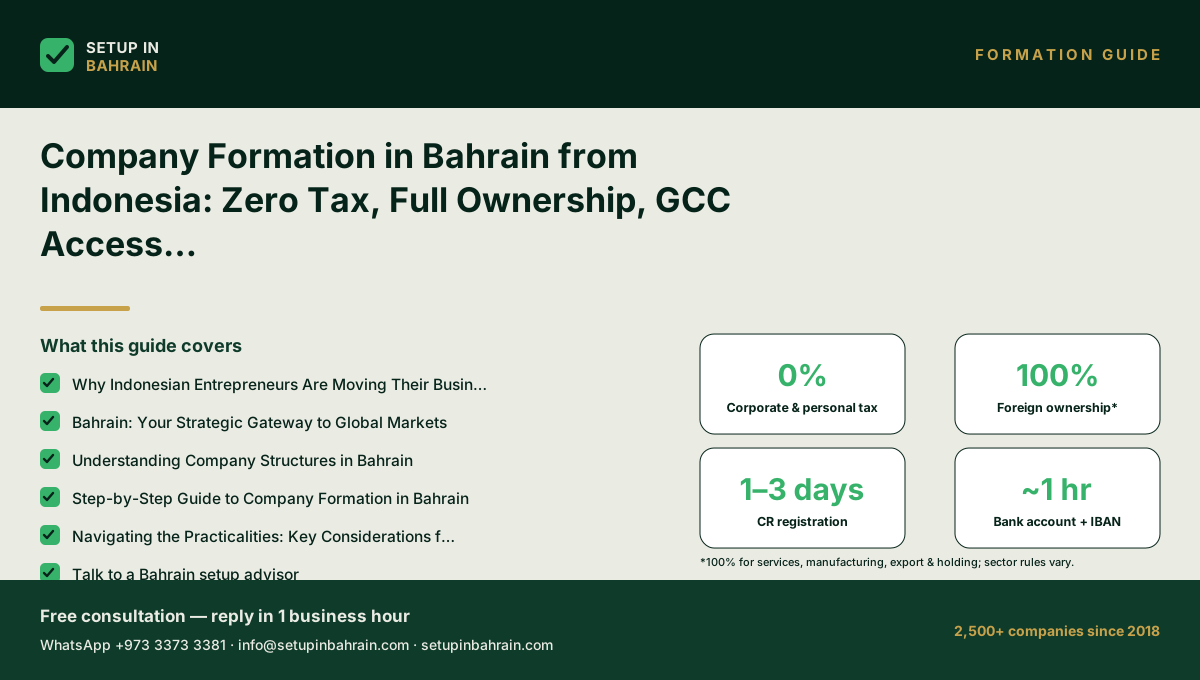
Start your business in Bahrain from Indonesia with generally no corporate income tax for most sectors. Easy company registration, full foreign ownership & strategic Middle East market access.
Key Takeaways
- Why Indonesian Entrepreneurs Are Moving Their Business to Bahrain
- Bahrain: Your Strategic Gateway to Global Markets
- Understanding Company Structures in Bahrain
- Step-by-Step Guide to Company Formation in Bahrain
- Navigating the Practicalities: Key Considerations for Indonesians
→ Complete guide: Company Formation in Bahrain — the full 2026 guide
View details
Ownership & capital
A Bahrain WLL can be owned by a single person — 100% foreign ownership applies to most activities, with no local partner required for services, manufacturing, export trading and holding companies. The minimum share capital is BHD 1 ; we recommend BHD 1,000 . This Makes bank account opening and investor visa approval smoother.
Are you an entrepreneur in Indonesia, diligently building your business, but feeling the relentless squeeze of a 22% corporate income tax rate, the complexity of DJP e-filing, and the constant threat of currency depreciation eroding your hard-earned profits? Perhaps you've dreamt of expanding beyond the archipelago, but the bureaucratic maze of BKPM investment approvals, the IDR 10 billion minimum investment for a foreign-owned PT PMA, and the restrictive Negative Investment List feel like insurmountable barriers.
You’re not alone. Indonesia’s business spirit is powerful, but for many ambitious founders, the pain points—a significant 22% corporate income tax, IDR depreciation, shifting Omnibus Laws, and often-complex foreign investment rules—hold them back from truly global scale. For a growing number of Indonesian business owners, Bahrain has quietly become the strategic escape hatch: Generally no corporate income tax for most sectors, full foreign ownership. Automatic, tariff-free access to the entire GCC market, including Saudi Arabia, just 25km away across the King Fahd Causeway.
This guide is for you. It's a deep dive into how Bahrain, a forward-thinking island nation in the heart of the Arabian Gulf, is becoming the strategic launchpad for Indonesian businesses looking for unburdened growth and international expansion. If you’re ready to scale with fewer restrictions and new opportunities, this article unpacks every unique detail for Indonesians considering a Bahrain company in 2026.
Why Indonesian Entrepreneurs Are Moving Their Business to Bahrain
Let’s start with a common scenario. Imagine Rudi, who runs a Jakarta-based export trading company supplying halal food ingredients to the Middle East. After a successful year, Rudi watched his 2024 net profit shrink from an impressive IDR 2.8 billion to IDR 2.18 billion after the statutory 22% corporate income tax and mandatory social security contributions. The real blow came when he tried to expand into Saudi Arabia directly from Indonesia: every cross-border contract needed BKPM approval, the Negative Investment List (Daftar Negatif Investasi) blocked majority foreign ownership in critical distribution sectors, and the rupiah had lost more than half its value against the dollar over the past decade, severely impacting his imported raw material costs.
Rudi's frustration isn't unique. It's a sentiment shared by countless Indonesian business owners who feel the weight of a system that. Supportive in many ways, presents significant obstacles to scaling globally. Thousands of Indonesian businesses each year consider offshore expansion—not for "tax evasion," but for operational sanity and a fair shot at global markets.
Here’s a closer look at the specific pain points driving this shift:
Tax Burden in Indonesia: Beyond the 22%
Indonesia’s 22% corporate income tax rate is a significant drain on profits, especially for growing businesses. But, the financial burden extends far beyond this headline number. Indonesian entrepreneurs must also contend with:
Complex DJP E-Filing: The Directorate General of Taxes (DJP) e-filing system. Modernized, still presents a formidable challenge. Monthly tax reports, reconciling various income streams. Navigating intricate regulations can consume countless hours and often necessitate dedicated accounting teams or external consultants, adding to overheads. Errors can lead to penalties, further impacting profitability. Mandatory Social Security Contributions: Companies are required to make significant contributions to schemes like BPJS Kesehatan (health) and BPJS Ketenagakerjaan (employment), which. Beneficial for employees, represent a substantial fixed cost for employers, often exceeding IDR 600 million for larger teams annually. Withholding Taxes & Other Levies: A web of withholding taxes (PPh Pasal 21, 23, 4(2)), VAT (PPN). Regional taxes further complicate the financial landscape, making cash flow management and accurate financial forecasting a constant battle.
For a business owner like Rudi, who is already managing thin margins in international trade, these cumulative tax and compliance costs can make the difference between sustained growth and stagnation.
Investment & Ownership Restrictions
Indonesia, while opening up greatly, still retains certain restrictions on foreign investment that can stifle growth for ambitious Indonesian companies looking to structure their international operations.
- PT PMA Minimum Investment: For a foreign-owned company (PT PMA), Indonesian regulations traditionally require a substantial minimum investment of IDR 10 billion (about USD 650,000 at current exchange rates). This high barrier to entry often forces Indonesian entrepreneurs to retain complex local partnership structures even when seeking international capital, or limits their ability to fully own and control their global operations from an Indonesian base.
- Negative Investment List (Daftar Negatif Investasi - DNI): Despite recent relaxations, Indonesia’s DNI still restricts or prohibits foreign ownership in over 20 key sectors. This can be a major hurdle for companies in areas like certain logistics, retail, specific agricultural industries, or creative services, preventing them from achieving 100% foreign control and simplifying their global corporate structure. For Rudi, wanting direct distribution into Saudi Arabia, these restrictions forced him into indirect models, adding cost and complexity.
- Bureaucratic BKPM Investment Approvals: The Investment Coordinating Board (BKPM) plays a crucial role in foreign investment approvals. While streamlined, obtaining investment approvals can still be a lengthy process, often taking several months. This delay can greatly impede market entry strategies and rapid expansion plans.
Currency Instability & Forex Controls
The Indonesian Rupiah (IDR) has experienced significant volatility against major global currencies like the US Dollar over the past decade, depreciating by more than 50%. This creates several challenges for international businesses:
- Eroding Profits: For businesses dealing with international transactions, IDR depreciation directly eats into profits. If your costs are in USD but revenues are initially in IDR, a weakening rupiah means higher operational costs or lower effective revenue in a stable currency.
- Unpredictable Planning: Forecasting and budgeting become incredibly difficult amidst currency fluctuations. Long-term strategic planning for international expansion is jeopardized when the base currency’s value is unpredictable.
- Forex Controls: While Indonesia generally has a relatively open capital account, the lingering possibility of capital controls or restrictions on foreign exchange transactions can add an element of risk and uncertainty for businesses heavily involved in international trade and investment.
When Siti, an e-commerce entrepreneur from Jakarta, considers expanding her "Batik & Beyond" brand into the affluent Middle East, the thought of currency risk and the complexities of managing foreign exchange for international suppliers and customers adds a layer of anxiety to an otherwise exciting prospect.
Bureaucracy & Regulatory Fatigue
Finally, the sheer volume and complexity of regulations in Indonesia can lead to significant "regulatory fatigue" for entrepreneurs.
Omnibus Law Changes: While designed to simplify, the frequent updates and changes introduced by the Omnibus Law (e.g., Job Creation Law) can lead to a period of uncertainty as businesses adapt to new rules about labor, business licensing. Investment. Keeping abreast of these changes requires constant attention. Mandatory Contracts in Bahasa Indonesia: While understandable for local legal certainty, the requirement for all legal contracts to be in Bahasa Indonesia (alongside a foreign language translation if applicable) can add an extra layer of complexity and cost for international businesses, requiring double documents and legal review. Administrative Overheads: From various permits and licenses to regular reporting requirements, the administrative burden on Indonesian companies can be substantial, diverting valuable time and resources away from core business activities.
For these reasons, many Indonesian entrepreneurs are not looking for a "tax haven" in the traditional sense, but rather a stable, transparent. Pro-business environment that allows them to operate efficiently, protect their capital, and compete on a global stage without excessive domestic constraints. This is precisely where Bahrain enters the picture.
Bahrain: Your Strategic Gateway to Global Markets
When Dimas, an e-commerce founder in Bandung, looked at his options, Bahrain offered a compelling alternative to his struggles in Indonesia. The appeal isn't just about escaping pain; it's about unlocking massive potential. Bahrain is positioning itself as a leading business hub in the Middle East and North Africa (MENA) region, offering a distinct advantage for international companies, especially those from Southeast Asia.
The Zero-Tax Advantage: Beyond Just "No Tax"
Let’s be absolutely clear: Bahrain has zero corporate income tax. This isn't a temporary measure or a special incentive zone; it's a fundamental pillar of the country's economic strategy. Unlike some jurisdictions, Bahrain is an OECD-compliant economy, meaning its tax regime is recognized as transparent and legitimate, without being blacklisted for harmful tax practices.
- No Sunset Clause: This isn’t a tax holiday that expires. The zero-tax policy is deeply ingrained in Bahrain’s economic model and has no "sunset clause" or expiry date. This provides long-term certainty for businesses.
- No Personal Income Tax: Beyond corporate tax, Bahrain also levies no personal income tax, making it attractive for entrepreneurs and their staff who relocate.
- Minimal Indirect Taxes: While Bahrain introduced a 10% Value Added Tax (VAT) in 2019 (increased to 10% in 2022), this is a common consumption tax and businesses can typically reclaim input VAT. There are no other significant indirect taxes that burden businesses.
For Dimas, the thought of keeping 100% of his profits, rather than seeing 22% vanish before he even considers expansion, was a game-changer. This isn't about avoiding taxes; it's about optimizing operational efficiency and reinvesting more into growth, R&D. Market expansion.
100% Foreign Ownership & Control
One of Bahrain's most attractive features, especially compared to Indonesia's PT PMA requirements and the Negative Investment List, is the ability for foreign nationals to own 100% of a company in most sectors.
- Full Control: This means complete operational and strategic control over your entity, without the need for local partners or nominee shareholders. This simplifies governance, speeds up decision-making, and eliminates potential conflicts of interest.
- Flexibility: Whether you’re setting up a trading company, a consultancy, a tech startup, or a logistics hub, the 100% ownership rule applies to the most common company types, like the With Limited Liability (WLL) company.
- Streamlined Structure: For Indonesian entrepreneurs accustomed to navigating complex local partnership agreements, the simplicity of full foreign ownership is a significant relief, allowing for a cleaner and more efficient global corporate structure.
Unrestricted Access to the GCC Market
Bahrain isn’t just an island; it’s a strategic bridge. Located at the heart of the Arabian Gulf, it offers unparalleled access to the lucrative Gulf Cooperation Council (GCC) market. This Boasts a combined GDP exceeding USD 1.7 trillion and a population of over 50 million affluent consumers.
- Proximity to Saudi Arabia: The King Fahd Causeway, a 25km land bridge, directly connects Bahrain to Saudi Arabia’s Eastern Province (Dammam, Al Khobar), a key economic engine of the largest GCC economy. This provides direct land access for logistics and business travel.
- Free Trade Agreements: As a member of the GCC, Bahrain is part of a customs union and common market. This means goods and services produced in Bahrain can move freely, without tariffs, to all other GCC member states (Saudi Arabia, UAE, Qatar, Kuwait, Oman). This is a massive advantage for Indonesian businesses aiming to serve the entire region.
- Diversified Economy: Bahrain itself has a highly diversified economy beyond oil and gas, with strong growth in finance (especially Islamic finance), FinTech, ICT, logistics, manufacturing, and tourism, creating robust local opportunities.
For Rudi, the ability to operate a logistics hub in Bahrain and distribute directly to Saudi Arabia and beyond, without navigating separate local entity requirements in each GCC country, transformed his regional expansion strategy.
Stable Currency & No Capital Controls
For Indonesian entrepreneurs weary of IDR volatility, Bahrain offers a beacon of stability.
- BHD Pegged to USD: The Bahraini Dinar (BHD) has been officially pegged to the US Dollar at a fixed rate of 1 BHD = USD 2.65 (about IDR 41,225) since 2001. This long-standing peg provides immense currency stability, eliminating exchange rate risks for businesses trading internationally.
- No Foreign Exchange Controls: There are no restrictions on the repatriation of capital, profits, or dividends from Bahrain. This means you can freely move your money in and out of the country, providing complete financial liquidity and peace of mind.
- Ease of International Transactions: With a stable, fully convertible currency and a well-developed banking sector, international transactions are smooth and efficient, crucial for businesses with global supply chains and customer bases.
Pro-Business Regulations & Digital Infrastructure
The Bahrain government, through entities like the Bahrain Economic Development Board (EDB) and the Ministry of Industry and Commerce (MOIC), has made significant strides in creating a streamlined, pro-business regulatory environment.
Ease of Doing Business: Bahrain consistently ranks high in global "Ease of Doing Business" indices (e.g., World Bank). While the World Bank has paused its specific report, Bahrain’s commitment to improving its business environment remains strong, with continuous reforms. Digitalization: The government has heavily invested in digitalizing business registration processes. The "Sijilat" portal, managed by MOIC, allows for online application, submission. Tracking of commercial registrations, greatly speeding up the setup process. Support for Startups & SMEs: The EDB actively promotes foreign direct investment and provides support for startups and Small and Medium-sized Enterprises (SMEs), including access to funding initiatives and incubators, especially in growth sectors like FinTech and ICT. Robust Legal Framework: Bahrain operates under a well-established civil law system, influenced by Islamic Sharia principles, with a transparent and independent judiciary, providing legal certainty for businesses.
This supportive ecosystem, combined with state-of-the-art digital infrastructure and competitive operating costs, makes Bahrain an attractive proposition for Indonesian entrepreneurs seeking efficiency and stability.
Understanding Company Structures in Bahrain
When considering company formation in Bahrain, understanding the available legal structures is crucial. For Indonesian entrepreneurs, one type stands out as the most common and advantageous choice: the Bahrain With Limited Liability (WLL) company.
Bahrain WLL (With Limited Liability): The Go-To Choice
The WLL company is the equivalent of a Private Limited Company (Pty Ltd) or a Limited Liability Company (LLC) in many other jurisdictions. It’s the preferred choice for most foreign investors due to its flexibility, limited liability protection. Full foreign ownership allowance.
Limited Liability: As the name suggests, shareholders' liability is limited to the amount of their unpaid share capital, protecting personal assets from business debts and obligations. 100% Foreign Ownership: This is a critical point. A Bahraini WLL can be owned 100% by a single foreign individual or a single foreign corporate entity. There are absolutely no partners required, and you do not need a Bahraini nominee shareholder. This is a significant advantage over many other GCC countries and certainly over Indonesia's PT PMA rules for certain sectors. Flexibility: WLLs can engage in a wide range of commercial, industrial. Service activities, subject to specific licensing requirements.
Capital Requirements: Legal Minimum vs. Practical Recommendation
This is a crucial detail for Indonesian entrepreneurs:
Legal Minimum: Legally, the minimum share capital for a Bahraini WLL is BHD 1 (one Bahraini Dinar) . This is a remarkably low threshold, reflecting Bahrain's pro-business stance. Practical Recommendation: While BHD 1 is the legal minimum, for all practical purposes, especially for obtaining a bank account and securing an investor visa, we strongly recommend a minimum share capital of BHD 1,000 (one thousand Bahraini Dinars) . * Bank Account Approval: Bahraini banks, like banks worldwide, conduct stringent Know Your Customer (KYC) and Anti-Money Laundering (AML) checks. A BHD 1 capital. Legal, often raises red flags for banks, making it extremely difficult to open a corporate bank account. BHD 1,000 shows a more serious commitment and operational viability. Investor Visa: For an investor to qualify for a residency visa in Bahrain, a higher share capital typically strengthens the application, indicating a substantial investment in the local economy. While not a strict legal requirement for all* visas, it greatly aids the process.
Ownership Structure: Single Shareholder Power
One of the most empowering aspects of the Bahraini WLL for Indonesian entrepreneurs is the ability for a single person to own it completely.
- Solo Entrepreneurship: If you are a solo founder like Dimas or Siti, you can establish your WLL and retain 100% ownership and control without needing to find a local partner or share equity.
- Corporate Ownership: Similarly, if your Indonesian PT is looking to set up an international subsidiary, your existing Indonesian company can be the sole shareholder of the Bahraini WLL.
Key Advantages for Indonesian Entrepreneurs
For those coming from Indonesia, the WLL offers clear benefits:
- Simplicity: No complex partnership agreements, no navigating Negative Investment Lists for ownership.
- Control: Full strategic and operational control.
- Protection: Limited liability protects personal assets.
- Credibility: A WLL is a recognized and respected corporate structure globally, lending credibility to your international operations.
Other Company Types (Briefly Mention)
While the WLL is most common, Bahrain offers other structures depending on your specific needs:
Setup (Sole Proprietorship): Suitable for individual entrepreneurs operating under their own name. This type offers no limited liability protection and generally requires the owner to be a Bahraini national or GCC citizen, making it less suitable for most Indonesian investors unless they meet specific criteria. Partnership Company: For two or more individuals or entities looking to form a general partnership. Partners have unlimited liability. Less common for foreign investors seeking limited liability. Bahrain Shareholding Company (BSC): Similar to a Public Limited Company. A BSC (Public) allows for public subscription of shares. A BSC (Closed) is a private company with shares held by a limited number of individuals. Generally used for larger ventures requiring significant capital and often more complex regulatory requirements. Foreign Branch Office: Allows an existing foreign company to establish a presence in Bahrain. The branch is an extension of the parent company and does not have a separate legal personality. It can conduct the same activities as the parent company. While offering simplicity, it means the liability of the branch extends to the parent company. Representative Office: Primarily for marketing, promotion, and gathering information, not for conducting commercial transactions or earning revenue. Useful for market research before a full commercial setup.
For the vast majority of Indonesian entrepreneurs looking to expand and optimize their global structure, the Bahrain WLL is undoubtedly the most suitable and recommended option.
Step-by-Step Guide to Company Formation in Bahrain
Establishing a company in Bahrain, especially a WLL, is a relatively straightforward process, especially when compared to the bureaucratic hurdles in Indonesia. The Bahrain government, led by the Ministry of Industry and Commerce (MOIC), has greatly streamlined the process through its online "Sijilat" portal. The entire process, from initial application to Commercial Registration (CR) issuance, can often be completed within 2-4 weeks, provided all documents are in order.
Here’s a breakdown of the phases:
Phase 1: Pre-Registration & Planning
Before you even touch the Sijilat portal, some critical groundwork is required.
Business Activity & NACE Code Selection
- Define Your Activities: Clearly identify the core business activities your Bahraini company will undertake (e.g., e-commerce, consulting, trading, software development, logistics).
- NACE Codes: Bahrain uses the Statistical Classification of Economic Activities in the European Community (NACE) codes. You will need to select the appropriate NACE codes that accurately describe your intended activities. This is crucial as your Commercial Registration (CR) will only permit activities listed under these codes. Choosing correctly upfront avoids costly amendments later.
Trade Name Reservation
- Uniqueness Check: You will need to propose several trade names in order of preference. The name must be unique and not similar to existing registered companies in Bahrain.
- Relevance: The name should ideally reflect your business activities.
- Reservation: Once approved, the name can be reserved for a limited period (usually 30-60 days) while you complete other steps. This is done through the Sijilat portal.
Required Documents for Indonesian Nationals
Prepare these essential documents, often requiring notarization and apostille/legalization in Indonesia, then potentially consular legalization by the Bahraini Embassy in Jakarta (or nearest embassy/consulate):
Passport Copy: Clear, valid passport copy of all shareholders and directors. Visa/Entry Stamp Copy: If you are already in Bahrain. National ID (KTP): Copy of Indonesian National ID card. Curriculum Vitae (CV): For all shareholders/directors, outlining their professional experience. Bank Reference Letter: From your personal bank in Indonesia, confirming your good standing and financial capability. Proof of Residential Address: Utility bill or bank statement (not older than 3 months). Memorandum of Association (MoA) & Articles of Association (AoA): These are the foundational legal documents outlining the company's purpose, share capital, structure. Operational rules. While templates are available, it's highly recommended to have these drafted by a local corporate service provider to ensure compliance with Bahraini law and your specific needs. Board Resolution (if corporate shareholder): If your Indonesian PT is a shareholder, a board resolution from the PT authorizing the setup of the Bahraini WLL and appointing its representative. Certificate of Incorporation (if corporate shareholder): For corporate shareholders, legalized copy of the Indonesian PT's certificate of incorporation and Articles of Association.
Critical Note on Legalization: The legalization process for documents can be time-consuming. Documents typically need to be notarized in Indonesia, then legalized by the Ministry of Law and Human Rights (AHU), then the Ministry of Foreign Affairs (KEMLU) in Indonesia, and finally by the Embassy of the Kingdom of Bahrain in Jakarta (if available, otherwise the nearest Bahraini embassy). Factor this into your timeline.
Phase 2: Formal Registration with MOIC
This phase involves the actual application on the Sijilat portal.
Submitting the Application
Online Portal: All applications are submitted digitally via the MOIC’s "Sijilat" portal. You will create an account and fill in all company details, including proposed activities, share capital, shareholder information. Director details. Upload Documents: Scan and upload all required legalized documents. Fee Payment: Pay the government registration fees online. These fees are relatively modest, usually in the range of BHD 100-200 for initial registration, plus recurring annual fees.
Share Capital Deposit
- Initial Approval: Once the application is provisionally approved by MOIC, you will receive an "Initial Approval" letter.
- Bank Account Opening for Capital: Take this initial approval letter to a Bahraini bank to open a temporary bank account (often a "capital deposit account"). Deposit the recommended share capital (e.g., BHD 1,000) into this account.
- Bank Confirmation: The bank will issue a letter confirming the deposit of the share capital. This letter is crucial for the next step.
Obtaining Commercial Registration (CR)
- Final Submission: Upload the bank's share capital deposit confirmation letter to the Sijilat portal.
- MOIC Review: MOIC will conduct a final review of your application and all supporting documents.
- CR Issuance: Upon successful review, your Commercial Registration (CR) will be issued. This is the official document confirming your company's legal existence in Bahrain. You can usually download it digitally from Sijilat. This is the moment your Bahraini company is officially born!
Phase 3: Post-Registration & Operational Setup
With your CR in hand, you can now focus on making your company fully operational.
Bank Account Opening (Full Corporate Account)
Convert Temporary Account: Return to the bank where you deposited your share capital. With your CR, you can now convert the temporary capital deposit account into a full operational corporate bank account. Additional Documents: Banks will require additional documents, including the CR, MoA/AoA, board resolution (if applicable), shareholder/director passports. A clear understanding of your business model and transaction volumes. Online Banking: Ensure you set up online banking and international transfer capabilities.
Commercial Address & Lease Agreement
- Physical Presence: All Bahraini companies must have a registered physical commercial address. This can be a traditional office, a co-working space, or a virtual office (for certain activities and with proper licensing).
- Lease Agreement: You will need a formal lease agreement for your chosen commercial premises. This agreement is typically registered with the relevant municipal authorities.
- Virtual Office Considerations: While virtual offices can be cost-effective, ensure they meet MOIC and municipal requirements for your specific business activity. For a stronger E-E-A-T signal, a dedicated office or co-working space often adds more credibility.
Visa & Residency for Investor/Employees
- Investor Visa: As a shareholder in a Bahraini WLL, you are eligible to apply for an investor residency visa. This process typically involves applying to the Nationality, Passports & Residence Affairs (NPRA) via the Labour Market Regulatory Authority (LMRA).
- Required Documents: This usually includes your passport, CR, company MoA/AoA, proof of funds, and medical examination.
- Employee Visas: If you plan to hire staff (local or expatriate), you will need to apply for their work permits and residency visas through the LMRA. This requires demonstrating a need for their skills and adherence to Bahraini labor laws.
Licensing & Approvals (Sector-Specific)
Primary CR: Your CR covers your general business activities. Secondary Licenses: Depending on your NACE codes and industry, you might need additional operational licenses from specific ministries or authorities. For example, a restaurant needs a health license, a financial service provider needs CBB authorization. A logistics company might need port authority permits. Compliance: Ensure all necessary licenses are obtained before commencing operations to avoid penalties.
Navigating the Practicalities: Key Considerations for Indonesians
While the process is streamlined, specific practical considerations will make your journey from Jakarta to Manama much smoother.
Banking in Bahrain: More Than Just an Account
Securing a corporate bank account is often the most challenging part of setting up a new company anywhere. Bahrain is no exception.
- Due Diligence: Bahraini banks are highly regulated by the Central Bank of Bahrain (CBB) and adhere to strict international AML/KYC standards. Expect thorough due diligence checks on shareholders, directors, and the nature of your business.
- Share Capital Impact: As mentioned, aiming for at least BHD 1,000 in paid-up capital for your WLL will greatly improve your chances of bank account approval.
- Personal Presence: While some initial setup can be done remotely with power of attorney, banks often prefer the beneficial owner or a key signatory to be physically present for the final signing of bank account opening documents.
- Major Banks: Consider well-established local and international banks such as National Bank of Bahrain (NBB), Al Baraka Islamic Bank, HSBC, Standard Chartered, and Citibank. Research their offerings for SMEs.
- Financial Technology (FinTech) Focus: Bahrain is a regional FinTech hub. If your business is in this sector, you might find specialized banking services or regulatory sandboxes tailored to your needs.
Choosing the Right Business Activity
The activities listed in your Commercial Registration (CR) define what your company can legally do.
- Precision is Key: Be precise and comprehensive in listing your intended business activities during the application phase. Adding activities later requires an amendment to your CR, incurring additional fees and potential delays.
- Future-Proofing: Think about your mid-term and long-term business plans. If you anticipate diversifying into related services in a year or two, consider including those NACE codes from the outset.
- Consultation: A local corporate service provider or legal consultant can help you navigate the NACE code selection and identify any
Bahrain Business Guides for Indonesia Citizens
Frequently Asked Questions
How long does it take to set up?
It takes 15 to 20 days. We file all forms for you. You do not need to wait long.
What does it cost?
Company formation: Standard BHD 1,340 with 3 months of office address; Gold BHD 1,700 with 6 months; Premium BHD 2,150 with 12 months and a cabin, officer table and chair, and two guest chairs. No formation package includes visas, including Premium. Investor/work visas are priced separately: BHD 755 for one year or BHD 953 for two years, in addition to the formation package. Ask for a written, itemized quotation confirming government fees and all inclusions before payment.
Do I need to visit Bahrain?
No. You can set up your firm from home. We do all the work online. Some banks may ask for one visit.
What tax will I pay?
You pay zero tax on your profits. Bahrain has no corporate income tax. This is a key benefit of the setup.
Can I own 100% of my firm?
Yes. Foreign owners can hold all shares. No local partner is needed. Full ownership is allowed.
What do I need to start?
You need a valid passport. You also need a trade name and a business address. We help you with all of these.
How do I open a bank account?
We guide you step by step. Most banks take 3 to 6 weeks. You will need your CR and firm papers.
Who issues the Commercial Registration (CR)?
The CR is issued by the MOICT. It is your legal right to trade in Bahrain. We file the CR for you.
Can I renew my CR each year?
Company renewal packages: BHD 530 with 3 months of office address; BHD 980 with 6 months; BHD 1,520 with 12 months. These are separate renewal packages, not visa fees.
How do I get started?
Fill in our form on this page. Our team will call you back. We map your best setup plan at no cost.
Steps to Form Your Company
- Pick your trade name. We check if it is free.
- Choose your business type. WLL is the most common.
- Sign the MOA. We draft and file all legal docs.
- Pay the state fees. About BHD 432 in total.
- Get your CR. Takes 15 to 20 days.
- Open your bank account. We guide each step.
- Start trading. You are ready to do business.
Key Facts
- Tax rate: 0%
- Foreign ownership: 100%
- Setup time: 15 to 20 days
- Company formation: Standard BHD 1,340 with 3 months of office address; Gold BHD 1,700 with 6 months; Premium BHD 2,150 with 12 months and a cabin, officer table and chair, and two guest chairs. No formation package includes visas, including Premium. Investor/work visas are priced separately: BHD 755 for one year or BHD 953 for two years, in addition to the formation package. Ask for a written, itemized quotation confirming government fees and all inclusions before payment.
- Company renewal packages: BHD 530 with 3 months of office address; BHD 980 with 6 months; BHD 1,520 with 12 months. These are separate renewal packages, not visa fees.
- Client rating: 4.8 stars
- Clients served: 2,500 and more
Quick Facts
- Tax rate: 0%
- Own all of your firm: Yes, 100%
- Time to set up: 15 to 20 days
- Company formation: Standard BHD 1,340 with 3 months of office address; Gold BHD 1,700 with 6 months; Premium BHD 2,150 with 12 months and a cabin, officer table and chair, and two guest chairs. No formation package includes visas, including Premium. Investor/work visas are priced separately: BHD 755 for one year or BHD 953 for two years, in addition to the formation package. Ask for a written, itemized quotation confirming government fees and all inclusions before payment.
- Company renewal packages: BHD 530 with 3 months of office address; BHD 980 with 6 months; BHD 1,520 with 12 months. These are separate renewal packages, not visa fees.
- Rating: 4.8 stars
- Clients: 2,500 and more
Why Bahrain?
Bahrain has no tax. You keep all your profits. This is rare in the Gulf.
You can own all of your firm. No local partner is needed. The law allows full foreign ownership.
Setup takes 15 to 20 days. We file all forms for you. You can do it all from home.
Bahrain has a free trade deal with the US. Your goods face low or no tariffs. This gives you access to big markets.
We have served 2,800+ clients from 44+ countries and maintain records to substantiate that total where needed. We have 113 Google reviews; reviews represent only some clients and are not the same as the total clients served.
Our Steps
- Tell us your plan. We advise you for free.
- We pick the right firm type for you.
- We file all your forms with MOICT.
- You get your CR in 15 to 20 days.
- We help you open a bank account.
- You are ready to trade. We stay with you.
Next Steps for Indonesia Citizens
You can set up a firm in Bahrain from Indonesia. You do not need to fly there first. We do all the work online.
Tell us your plan. We call you back the same day. We map the best route for you at no cost.
We file all your forms. We deal with MOICT and the state. You get your CR in 15 to 20 days.
After your CR, we help you get a bank account. We also help with your Investor Visa. One firm guides you at each step.
Why Our Clients from Indonesia Choose Us
- We speak your language. We know your needs.
- We have helped clients from Indonesia before.
- Our fee is clear. No surprise costs.
- We have a 4.8 star rating on Google.
- We have helped more than 2,500 clients set up in Bahrain.
Fill in the form on this page. We will be in touch soon. Let us help you start your Bahrain firm today.
Ready to set up in Bahrain from Indonesia?
Tell us your business idea. We map the right entity, ownership and timeline — then handle the filing while you focus on what matters.