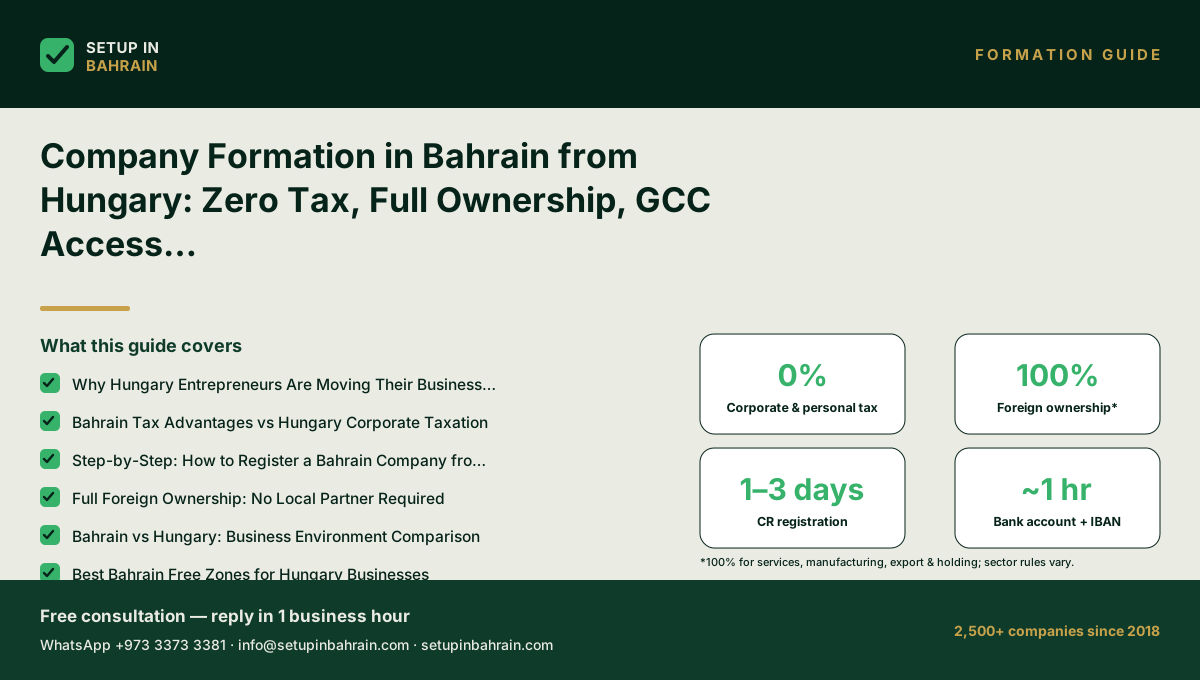
Register your Bahrain company from Hungary with generally no corporate income tax for most sectors. Fast setup, full foreign ownership & expert support for Hungarian entrepreneurs.
Key Takeaways
- Why Hungary Entrepreneurs Are Moving Their Business to Bahrain
- Bahrain Tax Advantages vs Hungary Corporate Taxation
- Step-by-Step: How to Register a Bahrain Company from Hungary
- Full Foreign Ownership: No Local Partner Required
- Bahrain vs Hungary: Business Environment Comparison
→ Complete guide: Company Formation in Bahrain — the full 2026 guide
View details
Ownership & capital
A Bahrain WLL can be owned by a single person — 100% foreign ownership applies to most activities, with no local partner required for services, manufacturing, export trading and holding companies. The minimum share capital is BHD 1 ; we recommend BHD 1,000 . This Makes bank account opening and investor visa approval smoother.
László had built his software development company in Budapest over eight years. Profitable, growing, respected. Yet every quarter, he watched the same pattern unfold: strong euro-denominated revenue from German clients, converted into forint at more and more unpredictable rates, then taxed, then converted again for supplier payments. The 9% corporate tax rate—Europe's lowest—looked attractive on paper. The reality? Currency hedging costs ate 2-3% of margins. NAV audits consumed weeks of productive time. His accountant's fees for complying with the számviteli törvény had tripled since 2019.
Then a former university colleague, now running an IT consultancy from Manama, showed him his numbers. Generally no corporate income tax for most sectors. Zero personal income tax. Zero currency volatility against the dollar. Full profit repatriation with no restrictions. Company setup in four business days.
László isn't an outlier. He represents a growing wave of Hungarian entrepreneurs discovering what global business strategists have known for years: Bahrain offers something Hungary simply cannot—complete tax efficiency combined with genuine operational substance in the world's fastest-growing economic region.
This guide exists because Hungarian entrepreneurs face unique circumstances. Your challenges aren't the same as a German or British founder. The HUF volatility that keeps you awake at night, the NAV enforcement patterns that feel more and more arbitrary, the EU regulatory pressure that makes long-term planning feel impossible—these require specific solutions, not generic offshore advice.
Let's build your roadmap to Bahrain.
Why Hungary Entrepreneurs Are Moving Their Business to Bahrain
The conversation happening in Budapest's startup circles, in Debrecen's manufacturing networks. Among Hungary's growing community of digital entrepreneurs has shifted dramatically since 2023. It's no longer "should we consider international expansion?" but rather "why are we still operating exclusively from Hungary?"
Let me introduce you to Gábor, a Budapest-based IT outsourcing founder I consulted last year. He ran a 12-person software development firm, paid Hungary's 9% corporate tax—Europe's lowest—and thought he had it good. Then the forint dropped 12% against the euro in six weeks. His USD-denominated contracts suddenly lost value. His $200,000 annual revenue effectively became HUF 20 million less overnight. The NAV tax authority added another layer: a surprise audit triggered by a misinterpreted invoice from a Romanian subcontractor. Three months, three lawyers. HUF 4.2 million later, Gábor was cleared—but his cash flow was wrecked.
The Real Cost of Hungary's "Low Tax" Environment
Hungary's 9% corporate tax rate looks like paradise on paper. In 2025, Forbes ranked Hungary first for corporate tax rate in Europe—beating Bulgaria at 10% and Ireland at 12.5%. Yet when we talk to Hungarian business owners, the "real" cost of staying isn't captured in that headline figure.
HUF Volatility Destroys Margins Silently
The forint dropped from 370 HUF/EUR in January 2023 to over 420 by October 2025—a staggering 13.5% decline over 33 months. If you invoice customers or pay suppliers in USD, EUR, or GBP, constant conversion exposes you to profit erosion beyond your ability to hedge cost-effectively.
For a Hungarian company earning €500,000 annually, that currency swing represents €67,500 in purchasing power—vanished. Not taxed away. Not spent on growth. Simply evaporated through exchange rate mechanics.
Contrast this with Bahrain: the Bahraini Dinar (BHD) has been pegged to the US dollar since 1980 at a fixed rate of 0.376 BHD to 1 USD. According to the Central Bank of Bahrain (CBB), this peg has never been adjusted. Your dollar-denominated contracts retain their value. Your euro transactions convert predictably. Currency risk becomes a non-factor in your business planning.
NAV Enforcement Has Become Unpredictable
Hungarian entrepreneurs consistently report that NAV (Nemzeti Adó- és Vámhivatal) enforcement has intensified since 2021. The agency employs sophisticated AI-driven risk assessment tools that flag businesses for audit based on patterns that remain opaque to taxpayers.
Emese, a SaaS founder in Budapest with a team of ten, filed her 2025 annual return feeling almost confident about her compliance. By September, NAV's audit queries had consumed three weeks of her finance team's time. She faced a penalty for an arcane számviteli törvény clause that didn't exist in its current form two years prior.
The Hungarian accounting law—számviteli törvény—has undergone 47 amendments since Hungary's EU accession in 2004. Each EU infringement proceeding, each Brussels directive, each domestic political shift creates new compliance requirements. Your accountant's job isn't getting easier; it's becoming a full-time archaeology project.
EU Regulatory Pressure Creates Long-Term Uncertainty
Hungary's ongoing disputes with the European Commission create a unique risk profile for Hungarian businesses. Frozen EU funds, rule-of-law proceedings. The constant threat of Article 7 measures generate uncertainty that affects everything from investor confidence to banking relationships.
Two of Gábor's potential investors delayed their funding round in 2024—not because of his company's fundamentals. Because they were rattled by Brussels' latest infringement probe. The political risk premium of operating a Hungarian entity has become tangible and measurable.
What Bahrain Offers That Hungary Cannot
Bahrain's value proposition for Hungarian entrepreneurs isn't about escaping legitimate taxation—it's about accessing a business environment designed from the ground up for international commerce.
Generally no corporate income tax for most sectors as Structural Policy
Bahrain's generally no corporate income tax for most sectors isn't a temporary incentive or a scheme that might change after the next election. It's embedded in the kingdom's economic DNA since the 1971 independence constitution. The Economic Development Board (EDB) confirms this policy remains unchanged and is not under review.
For a Hungarian company generating €500,000 in annual profit, this represents €45,000 in immediate savings compared to Hungary's 9% rate. Over a decade, assuming modest 5% annual growth, the cumulative difference exceeds €600,000—capital that compounds when reinvested rather than transferred to government coffers.
100% Foreign Ownership Without Sponsors
Unlike most GCC jurisdictions that traditionally required local partners or sponsors, Bahrain permits 100% foreign ownership across virtually all business sectors. The 2018 reforms solidified this position. The Ministry of Industry and Commerce (MOIC) actively promotes it as a cornerstone of investment policy.
For Hungarian entrepreneurs, this means retaining complete control over your company's direction, profits, and exit strategy. No silent partner taking 51%. No sponsor fees consuming 5-10% of revenue. Your company, your decisions, your outcomes.
GCC Market Access Without GCC Complexity
The Gulf Cooperation Council represents a $2.5 trillion economic bloc with some of the world's highest per-capita incomes. Bahrain serves as your entry point without the operational complexity of larger GCC markets.
Saudi Arabia's market is enormous but requires navigating Saudization quotas, GOSI complexities, and Nitaqat compliance. UAE offers opportunity but more and more demands economic substance that many service businesses struggle to show. Qatar remains relatively closed. Kuwait's bureaucracy frustrates even patient entrepreneurs.
Bahrain offers the sweet spot: full GCC trade agreement access, straightforward company formation, reasonable substance requirements. A government actively courting international business rather than merely tolerating it.
Bahrain Tax Advantages vs Hungary Corporate Taxation
Understanding the precise tax differential requires examining both jurisdictions in detail. Hungarian entrepreneurs often underestimate how much the total tax burden exceeds the headline 9% rate.
Hungary's True Tax Burden
Corporate Income Tax: 9% (Plus Hidden Costs)
Yes, Hungary's 9% corporate tax rate is Europe's lowest. But, the effective burden includes:
- Local Business Tax (helyi iparűzési adó): Up to 2% of net revenue, not profit. For a company with €1 million revenue and €200,000 profit, this 2% on revenue equals 10% on profit—doubling your effective tax rate.
- Innovation Contribution: 0.3% of adjusted net revenue for companies exceeding HUF 800 million turnover.
- Social Contribution Tax: 13% on employment costs, affecting your ability to hire competitively.
- Dividend Tax: 15% on distributions to shareholders, meaning profit taxed at 9% faces another 15% extraction when you actually want to use it.
A Hungarian company earning €500,000 profit, paying 2% local business tax on €2 million revenue, then distributing dividends, faces an effective combined rate approaching 28-32%—not the advertised 9%.
Bahrain's Tax Structure
Corporate Tax: 0%
Bahrain levies no corporate income tax on businesses operating within its jurisdiction. The only exception applies to oil and gas companies. This Face a 46% rate—irrelevant for Hungarian service, technology, or trading companies.
Personal Income Tax: 0%
Founder salaries, bonuses, and profit distributions face no personal income tax in Bahrain. This represents a dramatic contrast to Hungary's 15% personal income tax plus 18.5% social contributions.
VAT: 10%
Bahrain implemented VAT in 2019 at 5%, increased to 10% in 2022. This applies to domestic consumption but not to exports or B2B services destined for foreign clients—meaning most internationally-oriented Hungarian businesses would face minimal VAT impact.
Withholding Tax: 0%
No withholding tax on dividends, interest, or royalties. Profit repatriation to Hungary (or anywhere else) occurs without deduction.
Comparative Analysis Table
| Tax Category | Hungary | Bahrain | Annual Savings (€500K Profit) |
| Corporate Income Tax | 9% | 0% | €45,000 |
| Local Business Tax | Up to 2% of revenue | 0% | €40,000* |
| Dividend Withholding | 15% | 0% | €68,250** |
| Personal Income Tax | 15% + 18.5% soc. | 0% | Variable |
| Effective Total Rate | 28-32% | 0-10% | €150,000+ |
Hungary-Bahrain Tax Treaty Implications
Hungary and Bahrain signed a Double Taxation Agreement (DTA) in 2014, entered into force in 2017. This treaty provides crucial protections for Hungarian entrepreneurs establishing Bahraini entities:
- Permanent Setup Clarity: The treaty defines when Hungarian tax authorities can claim a Bahraini company has taxable presence in Hungary, providing planning certainty.
- Reduced Withholding Rates: Though Bahrain charges no withholding tax regardless, the treaty ensures Hungary cannot impose withholding on payments flowing to legitimate Bahraini entities.
- Exchange of Information: Both countries committed to tax information sharing, confirming Bahrain's status as a transparent, OECD-compliant jurisdiction rather than a secrecy haven.
The treaty's existence legitimizes Bahrain operations for Hungarian tax purposes. Your Bahraini company isn't hiding; it's operating under a formal bilateral framework both governments endorsed.
Step-by-Step: How to Register a Bahrain Company from Hungary
Forming a Bahraini company from Budapest is more straightforward than you might expect. The process has been digitized greatly. The Bahrain Investors Center (BIC) operates as a genuine one-stop shop rather than a bureaucratic maze.
Step 1: Determine Your Optimal Company Structure
Limited Liability Company (WLL)
The most common structure for Hungarian entrepreneurs, requiring minimum capital of BHD 20,000 (about €50,000). Despite this capital requirement, Bahrain doesn't mandate immediate full payment—typically 50% at formation.
WLLs suit operational businesses planning to hire local staff, lease office space, and conduct substantial activities within Bahrain.
single-shareholder WLL
Ideal for solo founders or husband-wife teams, requiring only BHD 50 (about €125) minimum capital. WLLs offer the liability protection of a limited company without the complexity of multiple shareholders.
This structure appeals to Hungarian consultants, freelancers. Digital service providers who need a legitimate business entity without significant physical presence.
Branch Office
If your Hungarian company wants Bahraini presence while maintaining the parent entity, a branch office requires no separate capital but means the Hungarian parent bears full liability for branch activities.
Holding Company
For Hungarian entrepreneurs with multiple ventures or investment portfolios, Bahrain's holding company structure offers an efficient vehicle for managing regional investments with no capital gains tax on share disposals.
Step 2: Reserve Your Company Name
Name reservation occurs through the MOIC portal (Sijilat). Requirements include:
- Name must be unique and not similar to existing registered entities
- Cannot imply government affiliation or protected terms
- Arabic translation required (though the company operates under its English name)
- Reservation valid for 60 days, renewable once
The online system provides instant availability checking. Most Hungarian entrepreneurs secure their preferred name within 24 hours.
Step 3: Prepare Required Documents
From Hungary, You'll Need:
- Passport copies of all shareholders and directors (notarized)
- Proof of address (utility bill or bank statement, not older than 3 months)
- Hungarian company registration if establishing a subsidiary (apostilled)
- Bank reference letter from your Hungarian bank confirming good standing
- Curriculum vitae of the manager/general manager
- Memorandum of Association (prepared in Bahrain using standard templates)
Apostille Requirements
Hungary is party to the Hague Apostille Convention. Documents requiring authentication for Bahrain use must be apostilled by the Hungarian Ministry of Foreign Affairs and Trade (Külgazdasági és Külügyminisztérium). The apostille itself then requires authentication by the Bahraini Embassy in Vienna (which covers Hungary).
This process takes 5-7 business days for standard service, 2-3 days for expedited.
Step 4: Submit Through Sijilat Portal
Bahrain's Sijilat system (sijilat.bh) allows complete online company registration. You'll need:
- Digital copies of all prepared documents
- Proposed share capital and distribution
- Registered office address (can use a registered agent's address initially)
- Selected commercial activities (choose from MOIC's approved list)
The system guides you through each requirement. Fees are payable online via credit card or bank transfer.
Step 5: Get Commercial Registration (CR)
The Ministry of Industry and Commerce issues your Commercial Registration within 2-4 business days of complete submission. This CR number becomes your company's primary identifier for all subsequent activities.
CR Fee Structure:
- Registration fee: BHD 50-200 depending on capital
- Chamber of Commerce membership: BHD 35-100 annually
- CR certificate: BHD 10
- Signboard fee: BHD 50
Total formation costs typically range BHD 500-1,500 (€1,250-3,750) depending on structure complexity.
Step 6: Complete Secondary Registrations
Central Bank of Bahrain (CBB) Notification
If your business involves any financial services, even tangentially, CBB registration or exemption confirmation is required. Pure service or trading companies typically need only confirm they fall outside CBB jurisdiction.
GOSI Registration
The General Organisation for Social Insurance requires employer registration before hiring any staff. Contributions run 12% employer, 7% employee for Bahraini nationals; 3% employer, 1% employee for expatriate workers.
Municipal Registration
Your business premises (even a serviced office) require municipal licensing. This is straightforward and typically processed within 48 hours.
Step 7: Open Corporate Bank Account
Bahrain's banking sector includes international names familiar to Hungarian entrepreneurs—HSBC, Standard Chartered, Citibank—alongside strong regional banks like Ahli United Bank and National Bank of Bahrain.
Account Opening Requirements:
- Company CR certificate
- Memorandum of Association
- Board resolution authorizing account opening
- Shareholder and director identification documents
- Completed bank application (varies by institution)
- Expected transaction volumes and client base information
Account opening typically takes 2-4 weeks, with enhanced due diligence for certain business types. Starting the banking process at once with company registration saves time.
Full Foreign Ownership: No Local Partner Required
This point deserves emphasis because it fundamentally differentiates Bahrain from historical GCC business environments and from what many Hungarian entrepreneurs assume about Middle Eastern markets.
The Old Model (And Why Bahrain Abandoned It)
Traditionally, GCC countries required foreign businesses to partner with local nationals holding majority stakes—typically 51%. The ostensible purpose was technology transfer and local economic development. The practical effect was foreign entrepreneurs surrendering control and profit share to partners whose contribution often consisted solely of nationality.
Saudi Arabia maintained this requirement until 2021 for most sectors. UAE's mainland companies required local partners until recent free zone expansions. Kuwait still enforces similar restrictions.
Bahrain's 100% Ownership Framework
Bahrain eliminated foreign ownership restrictions across virtually all commercial sectors through progressive reforms culminating in the 2018 Commercial Companies Law amendments. Today, a Hungarian entrepreneur can own 100% of a Bahraini company conducting:
- Professional services (consulting, legal, accounting)
- Technology development and IT services
- Trading and distribution
- Manufacturing and light industry
- Education and training services
- Healthcare services
- Tourism and hospitality
- Real estate services
The Bahrain Economic Development Board (EDB) confirms: "Bahrain allows 100% foreign ownership in most sectors without the need for a local partner."
Restricted Sectors (Limited List)
Certain activities still require Bahraini partnership or licensing restrictions:
- Oil and gas exploration/extraction
- Defense and security services
- Certain media activities
- Hajj and Umrah services
- Fishing within territorial waters
For Hungarian technology, consulting, trading. Service companies—the categories most likely to consider Bahrain—restrictions simply don't apply.
Practical Benefits for Hungarian Entrepreneurs
Complete Decision-Making Authority
No partner approval needed for contracts, hiring, investments, or strategic direction. Your Budapest team can operate the Bahraini entity exactly as intended without local partner negotiations.
Full Profit Retention
Every dirham of profit belongs to you. No mandatory profit sharing with a sponsor who contributes nothing beyond a signature.
Clean Exit Options
When selling, merging, or closing your Bahraini company, you control the process entirely. No buyout provisions, no partner consent requirements, no complicated unwinding.
Simplified Due Diligence
Investors evaluating your Bahraini entity face cleaner cap tables and clearer governance structures. The absence of local partners with undefined roles simplifies every aspect of corporate development.
Bahrain vs Hungary: Business Environment Comparison
Making an informed decision requires comprehensive comparison beyond tax rates. Here's how Bahrain and Hungary stack up across dimensions that matter to operating businesses.
Regulatory Environment
| Factor | Hungary | Bahrain |
| Company Formation Time | 5-10 business days | 2-4 business days |
| Minimum Capital (LLC) | HUF 3 million (€7,500) | BHD 50-20,000 (€125-50,000) |
| Annual Filing Complexity | High (számviteli törvény) | Low (simplified standards) |
| Audit Requirement | Revenue >€1.9M | Revenue >BHD 1M (€2.5M) |
| Language of Business | Hungarian mandatory | English accepted universally |
World Bank Ease of Doing Business
Though the World Bank discontinued its Doing Business rankings in 2021, the final 2020 report provides useful reference points:
- Bahrain Global Ranking: 43rd
- Hungary Global Ranking: 52nd
Bahrain outperformed Hungary on starting a business (7 days vs. 7 days), dealing with construction permits (54 days vs. 192 days), and getting electricity (50 days vs. 257 days).
Banking and Financial Infrastructure
Hungary
Hungarian banks operate within EU frameworks, providing SEPA access but more and more burdened by compliance requirements. International transfers face scrutiny. Correspondent banking relationships have become more complex for Hungarian institutions facing EU political pressures.
OTP Bank, Hungary's largest, maintains strong regional coverage but limited Gulf presence. Currency accounts face conversion costs and volatility exposure.
Bahrain
The Central Bank of Bahrain (CBB) regulates one of the region's most sophisticated financial sectors. Over 400 financial institutions maintain Bahraini presence, including every major international bank.
Multi-currency accounts in USD, EUR, GBP, and GBP are standard. International wire transfers process within 24 hours to most destinations. The USD peg eliminates currency risk for dollar-denominated business.
Infrastructure and Connectivity
Physical Infrastructure
Bahrain's compact geography (roughly the size of Lake Balaton's watershed) means efficient logistics. The 25-kilometer King Fahd Causeway provides direct road access to Saudi Arabia—the region's largest economy. Bahrain International Airport serves as a regional hub with direct connections to Budapest via Gulf Air or connecting through major European hubs.
Digital Infrastructure
Bahrain ranks first in the Middle East for internet connectivity speed and penetration. 5G coverage is universal. Data centers operated by AWS, Microsoft Azure, and regional providers support demanding technology operations.
For Hungarian tech companies, Bahrain's digital infrastructure matches or exceeds what's available domestically.
Quality of Life for Relocating Founders
Many Hungarian entrepreneurs ultimately consider personal relocation, making lifestyle factors relevant:
| Factor | Hungary | Bahrain |
| Personal Income Tax | 15% + social contributions | 0% |
| Safety Ranking | Good | Excellent |
| Healthcare | Universal (variable quality) | Private (high quality, employer-provided) |
| International Schools | Limited | Extensive (British, American, IB curricula) |
| Cost of Living | Lower | Higher (offset by zero income tax) |
| Climate | Continental (cold winters) | Desert (hot summers, mild winters) |
| Alcohol Availability | Unrestricted | Licensed venues only |
| Cultural Scene | Rich | Developing |
Best Bahrain Free Zones for Hungary Businesses
Bahrain offers specialized free zone environments providing additional incentives beyond the already-favorable mainland framework. Hungarian entrepreneurs should evaluate these based on their specific business activities.
Bahrain International Investment Park (BIIP)
Best For: Manufacturing, logistics, light industry
Key Features:
- 100% foreign ownership
- Zero customs duties on imports/exports
- Pre-built industrial facilities available
- Proximity to port and airport
Relevance for Hungarian Companies: Hungarian manufacturers exploring Gulf markets find BIIP attractive for establishing regional production or distribution centers. The automotive supply chain presence growing in Bahrain aligns with Hungary's manufacturing strengths.
Bahrain Logistics Zone (BLZ)
Best For: Distribution, warehousing, re-export operations
Key Features:
- Direct port connectivity
- Customs bonded facilities
- Advanced logistics infrastructure
- Competitive land lease rates
Relevance for Hungarian Companies: Trading companies seeking GCC distribution hubs benefit from BLZ's position adjacent to Khalifa Bin Salman Port. Goods can be stored, consolidated, and re-exported across the Gulf without customs complications.
Bahrain FinTech Bay
Best For: Financial technology, payment services, blockchain
Key Features:
- CBB regulatory sandbox access
- Accelerator programs
- Investor network connections
- Specialized licensing pathways
Relevance for Hungarian Companies: Budapest's growing fintech scene produces companies ready for international expansion. Bahrain FinTech Bay offers soft-landing infrastructure with regulatory support that would take years to replicate independently.
Investment Gateway Bahrain (Bahrain EDB Facilitation)
Best For: Professional services, headquarters operations, holding companies
Key Features:
- Dedicated investor support
- Expedited processing
- Government liaison services
- Strategic investor incentives
Relevance for Hungarian Companies: Technology companies, consulting firms, and investment vehicles benefit from EDB's personalized support. The board actively courts European expansion businesses and provides hands-on assistance throughout setup.
Free Zone vs. Mainland: Decision Framework
| Factor | Mainland Company | Free Zone Company |
| Tax Rate | 0% | 0% |
| Foreign Ownership | 100% (most sectors) | 100% |
| Local Market Access | Unrestricted | Some restrictions may apply |
| Physical Presence | Required | Flexible (some zones) |
| Setup Speed | Fast | Fast to very fast |
| Ideal For | Service companies, local trading | Manufacturing, logistics, fintech |
Residency and Investor Visa Pathways for Hungarians
Company formation often leads to founder residency questions. Bahrain offers several pathways for Hungarian entrepreneurs seeking to establish personal presence.
Business Owner/Investor Residence
Golden Residency Visa
Bahrain's Golden Residency program, launched in 2022, provides 10-year renewable residence for qualifying investors.
Eligibility Criteria:
- Real estate investment minimum BHD 200,000 (about €500,000), OR
- Business investment creating employment, OR
- Exceptional talent designation
Benefits:
- 10-year residence permit
- No sponsor requirement
- Family inclusion
- Work authorization
- Path to potential permanent residence
For Hungarian entrepreneurs establishing substantial Bahraini operations, Golden Residency provides long-term security without visa renewal concerns.
Self-Sponsorship for Business Owners
Entrepreneurs owning Bahraini companies can sponsor their own residence visas, eliminating dependence on employment relationships.
Requirements:
- Active Commercial Registration
- Minimum capital investment (varies by business type)
- Genuine business activity demonstration
Process:
- Company formation completed
- Labour Market Regulatory Authority (LMRA) registration
- Residence visa application
- Medical examination (in Bahrain)
- Residence permit issuance
Processing typically requires 2-4 weeks once the company is operational.
Hungary-Specific Considerations
No EU Free Movement Application
Unlike moving to another EU country, Bahrain relocation requires formal visa sponsorship. Hungarian passport holders receive visa-on-arrival for tourism (14 days, extendable) but must convert to appropriate residence status for business activities.
Tax Residency Transition
Hungarian tax residents moving to Bahrain should plan carefully around tax residency transition. Hungary taxes worldwide income of tax residents; establishing Bahraini tax residence while maintaining Hungarian ties creates potential dual residence complications.
Professional tax advice—ideally from advisors familiar with both jurisdictions—is essential before physical relocation.
Healthcare Transition
Hungary's universal healthcare system doesn't extend to Bahrain residents. Employers in Bahrain must provide private health insurance for employees. Self-employed founders should budget BHD 500-2,000 annually (€1,250-5,000) for comprehensive coverage.
Banking, Payments, and Financial Setup in Bahrain
Financial infrastructure underpins every successful international expansion. Bahrain's banking sector provides sophisticated solutions for Hungarian businesses.
Corporate Banking Options
International Banks with Hungarian Familiarity
- HSBC Bahrain: Strong EU correspondent banking relationships, multi-currency capabilities, trade finance expertise
- Standard Chartered: Focus on emerging market trade, robust digital platform
- Citibank Bahrain: Corporate treasury services, cash management solutions
Regional Banks with Competitive Pricing
- Ahli United Bank: Largest regional bank by assets, competitive fees
- National Bank of Bahrain: Government-linked stability, straightforward services
- Kuwait Finance House Bahrain: Islamic banking option for relevant business models
Account Opening Timeline and Requirements
Realistic Timeline: 2-4 weeks from complete documents submission
Required Documents:
- Company Commercial Registration
- Memorandum and Articles of Association
- Board resolution authorizing account opening
- Passport copies (all signatories)
- Proof of address (all signatories)
- Business plan or description
- Expected account activity summary
- Source of funds documents
Enhanced Due Diligence Triggers:
- Cryptocurrency-related activities
- Money service business elements
- Complex ownership structures
- Politically exposed person connections
Hungarian entrepreneurs in standard service or trading businesses typically face straightforward due diligence. Fintech or payment-adjacent activities require additional documents and patience.
Multi-Currency Capabilities
Bahrain banks routinely offer accounts in:
- Bahraini Dinar (BHD)
- US Dollar (USD)
- Euro (EUR)
- British Pound (GBP)
- Saudi Riyal (SAR)
This multi-currency flexibility eliminates the conversion costs plaguing Hungarian businesses. Euro receipts stay in euros. Dollar payments remain in dollars. Conversion happens when strategically advantageous, not when operationally forced.
Payment Gateway Integration
For e-commerce and digital service businesses, Bahrain supports major payment processors:
- Stripe: Available via UAE entity, serviceable for Bahrain operations
- PayPal: Business accounts available
- Tap Payments: Regional specialist, strong local acquiring
- Checkout.com: Enterprise-grade processing
Card acceptance, digital wallets, and bank transfers all function smoothly. The infrastructure supports sophisticated payment operations that Hungarian startups more and more require.
Crypto and Digital Asset Considerations
Bahrain has emerged as a regional leader in crypto regulation. The CBB licenses crypto exchanges and custodians under a defined regulatory framework. For Hungarian blockchain companies, Bahrain offers:
- Clear regulatory pathway (unlike Hungary's uncertain stance)
- Licensed exchange operations possible
- Institutional banking relationships for compliant crypto businesses
Rain Financial, the region's first licensed crypto exchange, operates from Bahrain—demonstrating the jurisdiction's genuine commitment to digital asset business.
How to Move Your Hungary Business to Bahrain (Restructuring Guide)
Many Hungarian entrepreneurs don't start fresh—they want to restructure existing operations. Here's how to approach this strategically.
Option 1: Establish Bahrain as New Headquarters
Structure: Hungarian entity becomes subsidiary; Bahrain entity becomes parent holding company.
Process:
- Form Bahraini holding company
- Transfer shares of Hungarian company to Bahrain entity
- Hungarian company continues operations as subsidiary
- Profits flow to Bahrain parent via dividends
Advantages:
- Hungarian operational continuity
- Bahrain captures investment returns
- Clean international structure
Considerations:
- Hungarian transfer pricing rules apply
- Exit charges may arise on share transfer
- NAV scrutiny on restructuring
Option 2: Operational Migration
Structure: Wind down Hungarian operations; restart in Bahrain.
Process:
- Establish Bahrain operating company
- Transfer contracts, clients, IP to new entity
- Gradually reduce Hungarian activities
- Eventually liquidate Hungarian company
Advantages:
- Clean break from Hungarian regulatory environment
- No ongoing Hungarian compliance
- Full Bahrain operational benefits
Considerations:
- Client transition complexity
- Employee relocation or termination
- Contract novation requirements
Option 3: Parallel Operations
Structure: Maintain separate Hungarian and Bahrain entities serving different markets/functions.
Process:
- Establish Bahrain company
- Allocate activities logically (e.g., EU clients to Hungary, GCC clients to Bahrain)
- Maintain arm's length relationships
- Independent operations, coordinated strategy
Advantages:
- EU market presence maintained
- GCC market expansion enabled
- Risk diversification
Considerations:
- Duplicate compliance costs
- Transfer pricing complexity
- Management bandwidth
Transfer Pricing Essentials
Hungarian tax law requires transactions between related entities to occur at arm's length prices. When your Hungarian and Bahraini companies transact:
Document Everything:
- Intercompany service agreements
- Transfer pricing studies
- Benchmarking analysis
- Economic substance evidence
Acceptable Intercompany Transactions:
- Management fees (for genuine services)
- Royalties (for actual IP)
- Interest (on real loans, at market rates)
- Cost recharges (at cost, without markup)
NAV actively scrutinizes intercompany transactions involving low-tax jurisdictions. Despite Bahrain's OECD compliance, expect enhanced documents requirements.
Protecting Intellectual Property
For technology companies, IP location often determines where profits legitimately reside.
Options:
Develop IP in Bahrain: Establish genuine R&D activities in Bahrain. IP created there legitimately belongs to the Bahraini entity.
- Transfer existing IP: Sell IP from Hungarian to Bahrain entity at fair market value. This triggers potential Hungarian exit taxation but establishes clean Bahrain ownership.
- License arrangements: Hungarian entity retains IP ownership; Bahrain entity licenses for its activities. Royalty flows create ongoing intercompany complexity.
Compliance Requirements After Bahrain Company Formation
Establishing a Bahrain company is straightforward; maintaining compliance ensures long-term success. Here's what Hungarian entrepreneurs must understand about ongoing obligations.
Annual Requirements
Commercial Registration Renewal
CRs require annual renewal through the MOIC
Bahrain Business Guides for Hungary Citizens
Frequently Asked Questions
How long does it take to set up?
It takes 15 to 20 days. We file all forms for you. You do not need to wait long.
What does it cost?
Company formation: Standard BHD 1,340 with 3 months of office address; Gold BHD 1,700 with 6 months; Premium BHD 2,150 with 12 months and a cabin, officer table and chair, and two guest chairs. No formation package includes visas, including Premium. Investor/work visas are priced separately: BHD 755 for one year or BHD 953 for two years, in addition to the formation package. Ask for a written, itemized quotation confirming government fees and all inclusions before payment.
Do I need to visit Bahrain?
No. You can set up your firm from home. We do all the work online. Some banks may ask for one visit.
What tax will I pay?
You pay zero tax on your profits. Bahrain has no corporate income tax. This is a key benefit of the setup.
Can I own 100% of my firm?
Yes. Foreign owners can hold all shares. No local partner is needed. Full ownership is allowed.
What do I need to start?
You need a valid passport. You also need a trade name and a business address. We help you with all of these.
How do I open a bank account?
We guide you step by step. Most banks take 3 to 6 weeks. You will need your CR and firm papers.
Who issues the Commercial Registration (CR)?
The CR is issued by the MOICT. It is your legal right to trade in Bahrain. We file the CR for you.
Can I renew my CR each year?
Company renewal packages: BHD 530 with 3 months of office address; BHD 980 with 6 months; BHD 1,520 with 12 months. These are separate renewal packages, not visa fees.
How do I get started?
Fill in our form on this page. Our team will call you back. We map your best setup plan at no cost.
Steps to Form Your Company
- Pick your trade name. We check if it is free.
- Choose your business type. WLL is the most common.
- Sign the MOA. We draft and file all legal docs.
- Pay the state fees. About BHD 432 in total.
- Get your CR. Takes 15 to 20 days.
- Open your bank account. We guide each step.
- Start trading. You are ready to do business.
Key Facts
- Tax rate: 0%
- Foreign ownership: 100%
- Setup time: 15 to 20 days
- Company formation: Standard BHD 1,340 with 3 months of office address; Gold BHD 1,700 with 6 months; Premium BHD 2,150 with 12 months and a cabin, officer table and chair, and two guest chairs. No formation package includes visas, including Premium. Investor/work visas are priced separately: BHD 755 for one year or BHD 953 for two years, in addition to the formation package. Ask for a written, itemized quotation confirming government fees and all inclusions before payment.
- Company renewal packages: BHD 530 with 3 months of office address; BHD 980 with 6 months; BHD 1,520 with 12 months. These are separate renewal packages, not visa fees.
- Client rating: 4.8 stars
- Clients served: 2,500 and more
Quick Facts
- Tax rate: 0%
- Own all of your firm: Yes, 100%
- Time to set up: 15 to 20 days
- Company formation: Standard BHD 1,340 with 3 months of office address; Gold BHD 1,700 with 6 months; Premium BHD 2,150 with 12 months and a cabin, officer table and chair, and two guest chairs. No formation package includes visas, including Premium. Investor/work visas are priced separately: BHD 755 for one year or BHD 953 for two years, in addition to the formation package. Ask for a written, itemized quotation confirming government fees and all inclusions before payment.
- Company renewal packages: BHD 530 with 3 months of office address; BHD 980 with 6 months; BHD 1,520 with 12 months. These are separate renewal packages, not visa fees.
- Rating: 4.8 stars
- Clients: 2,500 and more
Why Bahrain?
Bahrain has no tax. You keep all your profits. This is rare in the Gulf.
You can own all of your firm. No local partner is needed. The law allows full foreign ownership.
Setup takes 15 to 20 days. We file all forms for you. You can do it all from home.
Bahrain has a free trade deal with the US. Your goods face low or no tariffs. This gives you access to big markets.
We have served 2,800+ clients from 44+ countries and maintain records to substantiate that total where needed. We have 113 Google reviews; reviews represent only some clients and are not the same as the total clients served.
Our Steps
- Tell us your plan. We advise you for free.
- We pick the right firm type for you.
- We file all your forms with MOICT.
- You get your CR in 15 to 20 days.
- We help you open a bank account.
- You are ready to trade. We stay with you.
Why Set Up in Bahrain?
Bahrain is a great place to run a firm. It has no tax. You keep all your profits. This is rare in the Gulf.
You can own your firm 100%. No local partner is needed. The law is clear and fair.
It is fast to set up. You can have a CR in 15 to 20 days. We file all forms for you.
Bahrain has a free trade deal with the US. Your goods face low or no tariffs. This gives you access to big markets.
The banks are good. The roads are good. The schools are good. It is a well-run state.
We have served 2,800+ clients from 44+ countries and maintain records to substantiate that total where needed. We have 113 Google reviews; reviews represent only some clients and are not the same as the total clients served.
Our Services
- Company formation: Standard BHD 1,340 with 3 months of office address; Gold BHD 1,700 with 6 months; Premium BHD 2,150 with 12 months and a cabin, officer table and chair, and two guest chairs. No formation package includes visas, including Premium. Investor/work visas are priced separately: BHD 755 for one year or BHD 953 for two years, in addition to the formation package. Ask for a written, itemized quotation confirming government fees and all inclusions before payment.
- Company renewal packages: BHD 530 with 3 months of office address; BHD 980 with 6 months; BHD 1,520 with 12 months. These are separate renewal packages, not visa fees.
- Investor Visa — from BHD 755
- Work Visa — LMRA managed
- Virtual office — from BHD 600 per year
- Bank account opening — 3 to 6 weeks
- Family visa — for spouse and kids
- UBO filing — as required by law
Bahrain at a Glance
- Tax rate: 0%
- Foreign ownership: 100%
- Setup time: 15 to 20 days
- Free trade deal: Yes, with the US
- Language: Arabic and English
- Currency: Bahraini Dinar (BHD)
- Time zone: UTC+3
- GDP growth: Steady and strong
How to Start
- Fill in the form on this page. It takes 3 minutes.
- We call you back the same day.
- We map the best plan for your firm type and goals.
- We file all forms. We deal with MOICT for you.
- You get your CR in 15 to 20 days.
- We help you open a bank account and get your visa.
- You are ready to trade. We stay with you.
Common Questions
Do I need to visit Bahrain to set up?
No. You can do it all from home. We file online. You may need one visit to open a bank account.
Is Bahrain safe for business?
Yes. Bahrain is a stable state. It has a clear legal system. Your firm and funds are safe here.
Can I hire staff from any country?
Yes. You can hire from any country. Each hire needs a work permit from LMRA. We manage this for you.
What type of firm should I set up?
Most clients choose a WLL. This is a limited liability firm. It is flexible and well-known in Bahrain. We advise you on the best type for your case.
How do I get in touch?
Fill in our form. We call you back the same day. You can also email us or use the chat on this page.
Ready to set up in Bahrain from Hungary?
Tell us your business idea. We map the right entity, ownership and timeline — then handle the filing while you focus on what matters.