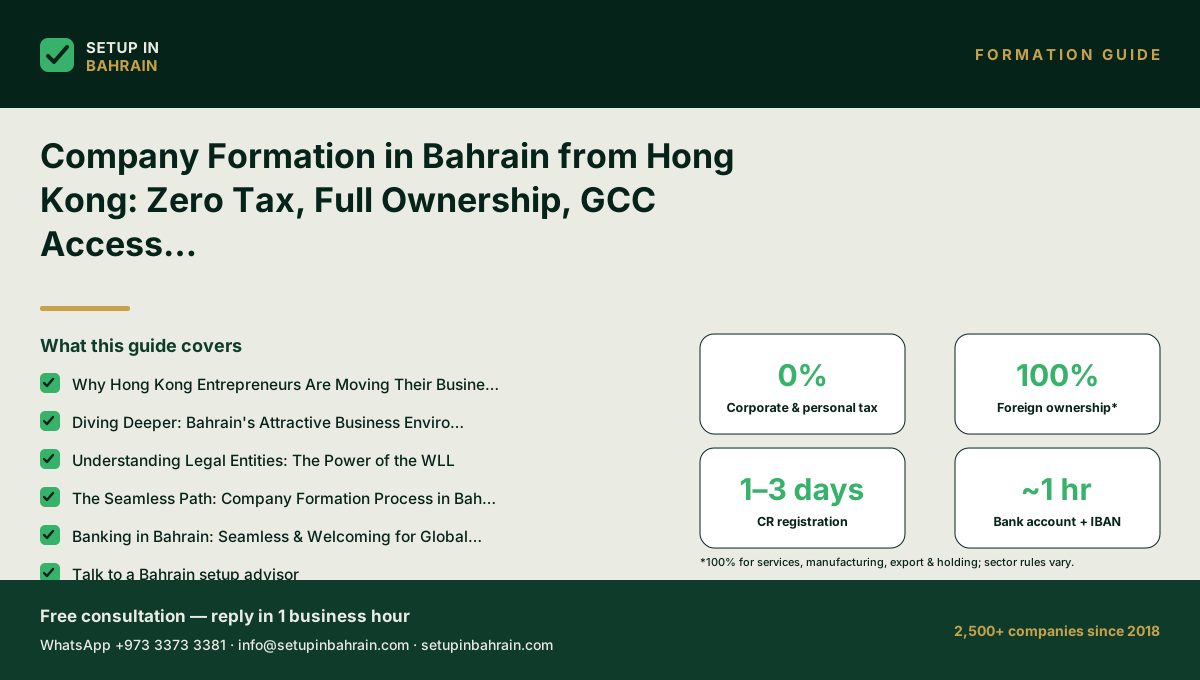
Register your Bahrain company from Hong Kong with generally no corporate income tax for most sectors. Fast setup, full foreign ownership, and strategic Gulf market access for HK entrepreneurs.
Key Takeaways
- Why Hong Kong Entrepreneurs Are Moving Their Business to Bahrain
- Diving Deeper: Bahrain's Attractive Business Environment
- Understanding Legal Entities: The Power of the WLL
- The Seamless Path: Company Formation Process in Bahrain
- Banking in Bahrain: Seamless & Welcoming for Global Entrepreneurs
→ Complete guide: Company Formation in Bahrain — the full 2026 guide
View details
Ownership & capital
A Bahrain WLL can be owned by a single person — 100% foreign ownership applies to most activities, with no local partner required for services, manufacturing, export trading and holding companies. The minimum share capital is BHD 1 ; we recommend BHD 1,000 . This Makes bank account opening and investor visa approval smoother.
On the twentieth floor of a glass tower in Wan Chai, Lawrence Chan reviews yet another letter from his auditors: another round of document requests from the IRD, queries about offshore income, reminders of tight deadlines. His trading business, once primarily focused on Southeast Asia, has truly globalized since 2021—clients in the UK, suppliers in Germany. A rapidly expanding sales footprint across the Gulf Cooperation Council (GCC) states. But despite revenues tripling, Hong Kong isn’t getting easier.
Lawrence’s effective tax rate hovers at 16.5% on assessable profits. While Hong Kong boasts a territorial tax system, proving the true offshore nature of income has become an more and more burdensome and often subjective process with the Inland Revenue Department (IRD). Each year, he dedicates more time and resources to compliance, less to growth. The enactment of the National Security Law in 2020, once dismissed by some as a distant political development, has become an undeniable commercial reality.
Three of his European partners, citing perceived legal and operational risks, demanded new indemnity clauses in their contracts. Two others outright moved a significant portion of their business away from Hong Kong-based entities. Worse, his newer mainland Chinese staff, critical for his supply chain management, found local HKD bank account opening requirements almost impossible to meet, leading to frustrating delays and administrative nightmares.
He’s lost countless hours to compliance and banking hurdles, time he desperately needs for sales and strategic development.
Meanwhile, a Kowloon-based logistics company owner found himself in a similar bind. Throughout 2024, his attempts to open a second HKD corporate bank account to diversify risk were met with unprecedented scrutiny. His existing bank, citing “enhanced due diligence” stemming from an more and more stringent global regulatory landscape and local policy shifts, flagged every new application with additional compliance layers.
Despite operating a legitimate business, paying the standard 16.5% profits tax. Maintaining immaculate financial records, the account opening process dragged on for four months, threatening his ability to manage cash flow effectively.
If you, like Lawrence and our Kowloon entrepreneur, are grappling with these shifts – increasing regulatory burdens, banking complexities. The feeling that the ground beneath your feet is less stable – this comprehensive guide is for you.
Why do shrewd Hong Kong entrepreneurs like yourself more and more look to Bahrain? Because Bahrain’s pitch, once a theoretical alternative, is suddenly a concrete solution: generally no corporate income tax for most sectors, 0% personal income tax, and 100% foreign ownership in a stable, transparent, English-speaking jurisdiction. Bahrain offers direct access to the affluent GCC market, a critical advantage for any business with global ambitions. There are no nationality restrictions for bank account opening, a stark contrast to the challenges faced in Hong Kong.
While Hong Kong’s system demands annual audits, complex filings. Constant vigilance against banking "de-risking" practices, Bahrain's Ministry of Industry & Commerce (MOIC) offers a streamlined, digital-first approach. You can register a company online, in English, often in under a week. Also, with the right guidance, it is entirely possible to open a corporate bank account in Bahrain without setting foot in the country.
Thanks to a national currency (the Bahraini Dinar, BHD) pegged directly to the US dollar, global entrepreneurs are insulated from unpredictable FX swings. The Economic Development Board (EDB) of Bahrain has further streamlined the process for investor visas and residency applications, often handling them in days, not months.
Bahrain is not a “tax haven” in the traditional, often pejorative sense. It is a fully transparent, OECD-compliant financial centre with real business substance, a stable legal framework. A commitment to economic diversification. It supports real businesses, real growth, and offers a predictable, secure environment for your ventures.
This guide is built specifically for the Hong Kong entrepreneur – we understand your unique challenges, your drive for efficiency. Your desire for a predictable business landscape. We’ll delve into the specifics that truly matter: from Generally no corporate income tax for most sectors and a stable, USD-pegged currency, to how Bahrain can serve as your gateway to the vast opportunities of the Saudi Arabian market, just 25 kilometers across the King Fahd Causeway.
By the end of this article, you'll have a clear roadmap to transitioning your business, understanding every nuance of company formation and operation in this dynamic Gulf nation.
Why Hong Kong Entrepreneurs Are Moving Their Business to Bahrain
The decision to relocate or expand a business is never taken lightly. For Hong Kong entrepreneurs, who have long thrived in one of the world's most dynamic financial hubs, such a move reflects a significant re-evaluation of their operational landscape. Bahrain is emerging as a compelling alternative, offering specific solutions to the pain points currently experienced in Hong Kong.
The Shifting Sands of Business Confidence in Hong Kong
For decades, Hong Kong has been synonymous with free enterprise, rule of law, and unparalleled business efficiency. But, recent geopolitical shifts have undeniably impacted the perception and reality of doing business there.
National Security Law (NSL) Impact: The enactment of the National Security Law in 2020 introduced a new layer of political and legal uncertainty. While its direct commercial impact might not be immediately visible to every small business, the broader sentiment it generated has been undeniable. International partners, investors. Even employees have more and more raised concerns about legal autonomy, data security, and long-term stability.
This has translated into a cautious approach from many foreign entities, leading to increased due diligence requirements, reduced appetite for risk, and, in some cases, a complete re-evaluation of their Hong Kong footprint. This directly impacts the ease of doing business, potentially slowing down transactions and increasing compliance costs for Hong Kong companies dealing with international clients.
Banking Sector "De-risking": Hong Kong's banking sector, once a bastion of efficiency, has become more and more stringent, especially for non-resident entrepreneurs or those with complex international structures. Driven by global anti-money laundering (AML) and know-your-customer (KYC) regulations. Arguably exacerbated by geopolitical concerns, banks have engaged in "de-risking." This often means: * Lengthy Account Opening: What once took days can now stretch to weeks or months, with exhaustive documents requests.
* Account Closures: Some legitimate businesses, especially those with perceived higher risk profiles (e.g., cross-border e-commerce, certain trading activities), have faced account closures with little explanation. * Increased Scrutiny for Non-Residents: Entrepreneurs without a clear physical presence or residency in Hong Kong find it greatly harder to open and maintain corporate bank accounts, impacting their ability to operate effectively.
* Challenges for Mainland Staff: As noted in our opening anecdote, even for critical staff members, opening personal bank accounts in Hong Kong has become disproportionately difficult, creating operational bottlenecks.
The Tax Burden: 16.5% vs. 0%
Hong Kong boasts a competitive two-tiered profits tax system, with a 8.25% rate on the first HK$2 million of assessable profits and 16.5% thereafter. While attractive on paper, the reality for many global entrepreneurs is more complex.
Territorial Source Principle Scrutiny: Hong Kong's territorial source principle, where only profits "arising in or derived from" Hong Kong are taxable, often becomes a battleground. For international businesses, proving that income is truly* offshore and not subject to Hong Kong tax requires extensive documents, legal opinions. Often, an ongoing dialogue with the IRD. This process is time-consuming, expensive, and leaves room for interpretation, introducing uncertainty into financial planning.
No Capital Gains Tax is Not Enough: While the absence of capital gains tax is a benefit, for businesses generating active trading or service income globally, the 16.5% corporate profits tax on locally sourced income remains a significant outflow.
Bahrain's Advantage: Bahrain offers a clear, unequivocal generally no corporate income tax for most sectors and 0% personal income tax. This is not a nuance or a condition; it is the fundamental structure of its tax regime for most business activities. This clarity translates directly into:
100% Profit Retention: Every dollar of profit generated by your Bahraini entity remains within your business, available for re-investment, dividends, or strategic use. Simplified Financial Planning: No complex tax calculations, no annual tax filings (beyond basic financial statements for audit purposes). No ambiguity. This drastically reduces administrative overhead and costs associated with tax compliance.
Full Ownership and Control: No Local Partners Required
Hong Kong, being a highly open economy, generally allows 100% foreign ownership for most business activities. But, the experience of navigating the regulatory landscape and finding suitable local services can sometimes feel like an indirect requirement for local connections.
Bahrain's Advantage: Bahrain explicitly champions 100% foreign ownership across most sectors, removing any ambiguity. For the popular With Limited Liability (WLL) company structure. This We will delve into, a single individual can own 100% of the shares. There is no requirement for local partners or sponsors. This ensures:
Complete Autonomy: You maintain full control over your business decisions, strategy. Operations without needing to appease or negotiate with a local stakeholder. Streamlined Decision-Making: Faster, more agile management without the complexities of co-ownership or partnership agreements.
Gateway to the GCC: A Market of 50 Million Affluent Consumers
While Hong Kong provides unparalleled access to mainland China and wider Asia, many Hong Kong entrepreneurs are more and more looking beyond this traditional focus, especially to the booming economies of the Middle East.
Proximity to Saudi Arabia: Bahrain's strategic location, connected to Saudi Arabia via the 25-kilometer King Fahd Causeway, positions it as an ideal launchpad into the GCC's largest economy. Saudi Arabia alone boasts a population of over 36 million, with ambitious Vision 2030 initiatives driving massive infrastructure projects and economic diversification. For many Hong Kong businesses, having a physical or registered presence in Bahrain is the most efficient and cost-effective way to tap into this market.
GCC Customs Union: Bahrain is a full member of the Gulf Cooperation Council, which includes Saudi Arabia, UAE, Qatar, Kuwait. Oman. This means businesses operating from Bahrain gain preferential access to a combined market of over 50 million affluent consumers, with largely unified customs duties and free movement of goods, services, and people. This unified market offers substantial economies of scale and growth potential that an Asian-centric operation might miss.
Diversified Economy: Bahrain itself has a highly diversified economy, moving beyond oil and gas to become a regional leader in financial services, ICT, logistics, and manufacturing. This creates a robust domestic market and skilled talent pool.
Regulatory Ease and Digital-First Approach
The Hong Kong regulatory environment. Transparent, can be perceived as demanding, especially for small and medium-sized enterprises (SMEs) managing multiple international jurisdictions.
Bahrain's Advantage: Bahrain has made significant strides in regulatory simplification and digital transformation.
"Sijilat" Online Portal: The Ministry of Industry & Commerce (MOIC) operates "Sijilat," a user-friendly online portal where entrepreneurs can register their business, manage licenses, and make filings. This digital-first approach greatly speeds up the process and reduces paperwork. EDB Support: The Economic Development Board (EDB) acts as a proactive facilitator, assisting foreign investors with everything from initial consultations to visa processing and connecting them with local service providers. This dedicated support simplifies market entry.
Predictable Legal Framework: Bahrain operates under a modern, codified legal system influenced by English common law principles, providing a familiar and predictable framework for international businesses. The Central Bank of Bahrain (CBB) is a respected regulator, ensuring financial stability and transparency.
In essence, Bahrain offers Hong Kong entrepreneurs a compelling proposition: a stable, tax-efficient. Strategically located base that addresses current pain points while unlocking significant new market opportunities. It's about regaining control, optimizing financial structures, and positioning your business for sustainable global growth.
Diving Deeper: Bahrain's Attractive Business Environment
Beyond the direct solutions to Hong Kong's current challenges, Bahrain presents a uniquely attractive environment for business growth and investment. Its strategic vision and supportive ecosystem are designed to foster international enterprise.
Economic Landscape and Diversification
Bahrain was one of the first Gulf states to recognize the need to diversify its economy away from reliance on oil and gas. This foresight has led to a resilient and multi-faceted economy.
Financial Services Hub: Bahrain boasts a long history as a regional financial hub, regulated by the respected Central Bank of Bahrain (CBB). It hosts numerous conventional and Islamic banks, insurance companies. Investment firms, offering a sophisticated array of financial products and services. This mature financial infrastructure is a significant advantage for international businesses. ICT and Innovation: The Kingdom is investing heavily in its digital infrastructure, positioning itself as a hub for technology and innovation.
Initiatives like the Bahrain FinTech Bay, the largest FinTech hub in the Middle East and Africa, attract tech startups and talent. Government support for digital transformation is evident in its digital-first public services. Logistics and Manufacturing: With modern ports, an efficient airport. Its direct link to Saudi Arabia, Bahrain is building its capacity as a logistics and manufacturing hub. Its free zones offer attractive incentives for light manufacturing and distribution.
Tourism: Significant investments are being made in tourism and hospitality, further diversifying the economy and creating new business opportunities.
According to the World Bank's Ease of Doing Business reports (before its suspension), Bahrain consistently ranked highly in several key indicators, reflecting its commitment to a business-friendly environment. The EDB's strategic focus on attracting foreign direct investment (FDI) underscores this commitment.
Legal and Regulatory Framework
Bahrain’s legal system is a civil law system, but its commercial laws, company regulations, and financial services regulations are heavily influenced by international best practices and common law principles, making it familiar and navigable for Western and Asian businesses.
Ministry of Industry & Commerce (MOIC): The primary authority for company registration and commercial licensing. Its commitment to digitalization through the "Sijilat" portal is a testament to its modern approach. Central Bank of Bahrain (CBB): The independent regulator for the financial sector, known for its robust and transparent regulatory framework. This Underpins the country's reputation as a stable financial centre. Economic Development Board (EDB): A government agency mandated to attract foreign investment and support economic growth.
The EDB acts as a strategic partner for international businesses, offering invaluable guidance and support throughout the setup and operational phases. Bahrain Investment Primary Authority (BIPA): While not a separate entity, BIPA refers to the overall framework and ease of investment supported by the EDB and MOIC, emphasizing a single window approach for investors.
OECD Compliance: Bahrain is fully compliant with OECD standards on tax transparency and information exchange. This is crucial for entrepreneurs seeking legitimate, substance-based operations, avoiding the stigma often associated with non-compliant "tax havens." Your Bahraini entity will be a real business with a real presence, not just a paper company.
Free Zones vs. Onshore: Choosing Your Operational Base
Bahrain offers both free zones and onshore options for company formation, each with distinct advantages. For most Hong Kong entrepreneurs looking for broad market access and a straightforward setup, an onshore company is often the preferred route.
Onshore Companies: * Full Market Access: Companies formed onshore can conduct business anywhere within Bahrain and the wider GCC. This is critical for businesses aiming to serve the Saudi Arabian or UAE markets directly. * generally no corporate income tax for most sectors: The generally no corporate income tax for most sectors applies to most onshore businesses, not just those in free zones. * Ease of Setup: The MOIC's Sijilat portal makes onshore company formation highly efficient.
* Ideal for: Businesses aiming for direct engagement with the Bahraini and GCC domestic markets, consulting firms, trading companies, technology firms. Financial services (with CBB licensing).
Free Zones (e.g., Bahrain International Investment Park - BIIP, Bahrain Logistics Zone - BLZ): * Specific Benefits: Free zones offer specific incentives for manufacturing, logistics, or certain industrial activities, such as duty-free import of raw materials or dedicated infrastructure. * Restricted Operations: Businesses in free zones are typically restricted from directly engaging in the Bahraini domestic market without specific licenses or agreements. * Ideal for: Large-scale manufacturing, logistics hubs for re-export, or businesses requiring specific industrial infrastructure.
For the majority of Hong Kong entrepreneurs seeking to leverage Bahrain's tax efficiency and GCC market access for service, trading, or tech-related businesses, an onshore WLL company will be the most suitable and flexible option.
Understanding Legal Entities: The Power of the WLL
When forming a company in Bahrain, you have several legal entity options. For Hong Kong entrepreneurs, especially those seeking 100% foreign ownership, simplicity. Limited liability, the With Limited Liability Company (WLL) is overwhelmingly the most popular and recommended choice.
The With Limited Liability (WLL) Company: Your Ideal Structure
The WLL company in Bahrain is akin to a Limited Liability Company (LLC) in other jurisdictions. It offers the perfect balance of flexibility, protection, and operational freedom.
100% Foreign Ownership: This is a critical advantage. Unlike some other GCC countries, Bahrain allows a single foreign individual or corporate entity to own 100% of a WLL company. Crucially, no local partner or sponsor is required. This ensures complete control over your business operations and profits. Single Shareholder Permitted: You do not need to find a second partner to establish a WLL. A single person can be the sole shareholder and director, simplifying governance and decision-making.
(This is a key distinction and why there is no separate "Single Person Company" type; the WLL perfectly serves this need). Limited Liability: As the name suggests, shareholders' liability is limited to the amount of their capital contribution to the company. This protects your personal assets from business debts and obligations.
Broad Scope of Activities: A WLL can engage in a wide range of commercial, industrial. Service activities, subject to specific licensing requirements for regulated sectors (e.g., financial services, healthcare). Perpetual Existence: The WLL continues to exist regardless of changes in ownership, providing stability and longevity to your business.
Capital Requirements for a WLL: Practical vs. Legal
This is one of the most important practical considerations for Hong Kong entrepreneurs.
Legal Minimum Share Capital: BHD 1. Yes, you read that correctly. Legally, the minimum share capital required to register a WLL in Bahrain is just one Bahraini Dinar (BHD 1). This ultra-low barrier to entry reflects Bahrain's commitment to supporting new businesses. Practical Recommendation: BHD 1,000.
While BHD 1 is the legal minimum, for practical purposes, especially when it comes to opening a corporate bank account and securing an investor visa, we strongly recommend a minimum paid-up capital of BHD 1,000 (about USD 2,650) . * Bank Account Approval: Bahraini banks, while welcoming to foreign investors, perform their own due diligence. A nominal BHD 1 capital can be seen as insufficient for a functioning business, potentially delaying or even jeopardizing bank account approval.
BHD 1,000 shows a more serious commitment and operational viability. * Investor Visa: For obtaining an investor visa and residency in Bahrain, demonstrating a reasonable investment in your company, such as BHD 1,000 in paid-up capital, greatly strengthens your application. It signals genuine intent to establish and operate a substantive business. * Operational Credibility: Starting with BHD 1,000 provides a small but credible initial capital base for basic operational expenses, even if you plan to inject more funds later.
The process for contributing this capital is typically straightforward: once the company is registered and the bank account is open, the capital is transferred to the company's account.
Other Company Types (Briefly)
While WLL is the most common choice, it's worth noting other structures for specific needs:
Bahraini Shareholding Company (BSC): For larger enterprises seeking to raise capital publicly or for joint ventures with significant local capital. Requires more shareholders and higher capital. Partnership Company: For two or more partners. Less common for foreign investors seeking limited liability. Setup/Sole Proprietorship: For individual practitioners or very small businesses. Does not offer limited liability. Branch of a Foreign Company: Allows an existing overseas company to establish a presence in Bahrain without forming a new local entity.
Suitable for companies looking for a direct extension of their existing operations. With potential tax implications in the home jurisdiction.
For 90% of Hong Kong entrepreneurs, the WLL provides the optimal blend of control, protection. Operational flexibility within Bahrain's zero-tax environment.
The Seamless Path: Company Formation Process in Bahrain
One of Bahrain’s key differentiators is the efficiency and accessibility of its company formation process, especially when contrasted with the bureaucratic hurdles sometimes encountered elsewhere. The digital platform, Sijilat, is at the heart of this streamlined approach.
Step-by-Step Company Formation
While engaging a local consultant (which we'll discuss later) is highly recommended, understanding the general steps empowers you.
Select Your Business Activity: Define the precise nature of your business operations. Each activity has a specific classification code. Some (e.g., financial services, healthcare, education) require additional approvals from relevant ministries or regulatory bodies (e.g., CBB for financial firms, Ministry of Health for medical practices). This is the foundation of your commercial registration. Consultant Insight:* A good consultant will help you accurately classify your activities and identify any pre-approvals needed.
Choose a Company Name: Select a unique name that complies with MOIC guidelines. It must not be already in use, nor can it be offensive or misleading. The Sijilat portal allows for real-time name availability checks. Practical Tip:* Have 2-3 alternative names ready in case your first choice is unavailable. Prepare Required Documents: * Passport Copies: For all shareholders, directors, and authorized signatories (clear, color copies).
* Proof of Address: For all individuals (utility bill, bank statement, etc., usually not older than 3 months). * CV/Resume: For shareholders and directors, especially if they will be managing the company. * Memorandum of Association (MOA) and Articles of Association (AOA): These are the foundational legal documents outlining the company's purpose, share capital, governance structure, and shareholder rights. These must be prepared in Arabic and often English.
* Board Resolution/Power of Attorney: If a corporate entity is a shareholder, a board resolution authorizing the investment and appointing a representative is needed. If you're not physically present, a Power of Attorney for your chosen consultant is essential. * Lease Agreement for Office Space: A virtual office or serviced office agreement is typically sufficient for initial registration for many service-based businesses. * Bank Reference Letter: For shareholders, showing good standing.
Hong Kong Specific:* Ensure all documents are clear and readily available. Hong Kong ID card copies (if applicable) and business registration certificates (for corporate shareholders) will also be required. Initial Approval and Name Reservation: Submit your chosen company name and proposed business activities through the Sijilat portal. The MOIC will review and grant initial approval, reserving your company name. Draft and Notarize MOA/AOA: With initial approval, your legal consultant will draft the MOA and AOA.
These documents then need to be signed by shareholders (or their authorized representative via POA) and notarized at the Ministry of Justice (or through e-notarization where applicable). Capital Deposit (Post-Approval): While the BHD 1,000 capital is recommended , it's usually deposited after the company is registered and a bank account is opened. For the registration phase, a declaration of capital contribution is sufficient. Submit Final Application via Sijilat: Upload all notarized documents and supplementary information to the Sijilat portal.
Pay the official government registration fees. Commercial Registration Certificate Issuance: Once the MOIC reviews and approves the complete application, your Commercial Registration (CR) certificate will be issued. This is the official document confirming your company's legal existence. Get Necessary Licenses: Depending on your business activity, you may need additional licenses from specific ministries or municipalities (e.g., municipal license for office space, CBB license for financial activities). These are typically applied for concurrently or immediately after CR issuance.
Timeline Expectations
The beauty of Bahrain's digital system is its speed.
Company Name Reservation & Initial Approval: Can be as quick as a few hours to 1-2 business days. Full Commercial Registration (CR): Once all documents are prepared and submitted, the CR can be issued in 3-5 business days . This assumes no complex pre-approvals or missing documents. Total Time (from start to CR): With all documents ready and the help of an experienced consultant, a WLL can often be registered within 1-2 weeks .
Post-CR Licensing: Additional licenses might take longer, ranging from days to weeks depending on the regulatory body and complexity.
Compared to the multi-month processes often encountered in other jurisdictions, Bahrain offers remarkable efficiency.
The Crucial Role of a Local Company Formation Consultant
While the Sijilat portal makes the process accessible, navigating it effectively, especially remotely from Hong Kong, is best done with expert local assistance.
Language Barrier: While English is widely spoken, official documents and filings are primarily in Arabic. A local consultant ensures accuracy in translation and submission. Local Knowledge & Nuance: Consultants understand the specific requirements, unwritten rules. Best practices that aren't always clear in official guides. They can anticipate issues and proactively address them. Document Preparation: Drafting compliant MOA/AOA, board resolutions. Ensuring all documents meet the MOIC's precise specifications is critical.
Remote Processing: For Hong Kong entrepreneurs who may not wish to travel initially, a consultant acts as your authorized representative in Bahrain, handling notarizations, submissions, and follow-ups. Banking Connections: Reputable consultants often have established relationships with Bahraini banks, facilitating smoother and quicker corporate bank account opening, even remotely. Ongoing Compliance: They can assist with post-registration requirements, such as VAT registration, annual general meetings. Financial statement submissions.
Choosing the right local partner is arguably the most important decision after deciding on Bahrain itself. Look for firms with a proven track record, transparent fee structures, and strong references.
Banking in Bahrain: Seamless & Welcoming for Global Entrepreneurs
One of the most significant advantages Bahrain offers to Hong Kong entrepreneurs is its highly developed and welcoming banking sector, a stark contrast to the challenges often faced in Hong Kong. The Central Bank of Bahrain (CBB) meticulously regulates a diverse array of conventional and Islamic banks, providing a stable and efficient financial ecosystem.
Why Bahraini Banking Stands Out
No Nationality Restrictions: Unlike some jurisdictions where non-residents face uphill battles, Bahraini banks are accustomed to dealing with international clients. Your Hong Kong passport is not a barrier; it's a standard part of their KYC process. Remote Account Opening Possibilities: For many reputable banks in Bahrain, it is possible to initiate and even complete the corporate bank account opening process without physically visiting Bahrain . This is a huge convenience for busy entrepreneurs in Hong Kong.
The process typically involves video calls for verification and courier services for document exchange. USD-Pegged Currency: The Bahraini Dinar (BHD) is pegged to the US Dollar at a fixed rate of 1 BHD = 2.65957 USD. This eliminates foreign exchange risk for businesses dealing in USD, providing stability and predictability for international trade and financial planning.
Robust and Transparent Regulation: The CBB's stringent but clear regulatory framework ensures that Bahraini banks operate with high standards of compliance and security, building trust for international investors. Diverse Financial Products: From traditional corporate accounts, trade finance facilities. Treasury services to sophisticated Islamic finance products, Bahraini banks offer a full spectrum of services tailored for international businesses.
Choosing the Right Bank for Your Bahraini Company
Selecting a bank that aligns with your business needs is crucial. Consider factors such as:
- Minimum Balance Requirements: Some banks have higher minimum balance requirements for corporate accounts.
- Transaction Fees: Understand the fee structure for local and international transfers.
- Digital Banking Capabilities: Look for banks with robust online and mobile banking platforms for
Bahrain Business Guides for Hong Kong Citizens
Frequently Asked Questions
How long does it take to set up?
It takes 15 to 20 days. We file all forms for you. You do not need to wait long.
What does it cost?
Company formation: Standard BHD 1,340 with 3 months of office address; Gold BHD 1,700 with 6 months; Premium BHD 2,150 with 12 months and a cabin, officer table and chair, and two guest chairs. No formation package includes visas, including Premium. Investor/work visas are priced separately: BHD 755 for one year or BHD 953 for two years, in addition to the formation package. Ask for a written, itemized quotation confirming government fees and all inclusions before payment.
Do I need to visit Bahrain?
No. You can set up your firm from home. We do all the work online. Some banks may ask for one visit.
What tax will I pay?
You pay zero tax on your profits. Bahrain has no corporate income tax. This is a key benefit of the setup.
Can I own 100% of my firm?
Yes. Foreign owners can hold all shares. No local partner is needed. Full ownership is allowed.
What do I need to start?
You need a valid passport. You also need a trade name and a business address. We help you with all of these.
How do I open a bank account?
We guide you step by step. Most banks take 3 to 6 weeks. You will need your CR and firm papers.
Who issues the Commercial Registration (CR)?
The CR is issued by the MOICT. It is your legal right to trade in Bahrain. We file the CR for you.
Can I renew my CR each year?
Company renewal packages: BHD 530 with 3 months of office address; BHD 980 with 6 months; BHD 1,520 with 12 months. These are separate renewal packages, not visa fees.
How do I get started?
Fill in our form on this page. Our team will call you back. We map your best setup plan at no cost.
Steps to Form Your Company
- Pick your trade name. We check if it is free.
- Choose your business type. WLL is the most common.
- Sign the MOA. We draft and file all legal docs.
- Pay the state fees. About BHD 432 in total.
- Get your CR. Takes 15 to 20 days.
- Open your bank account. We guide each step.
- Start trading. You are ready to do business.
Key Facts
- Tax rate: 0%
- Foreign ownership: 100%
- Setup time: 15 to 20 days
- Company formation: Standard BHD 1,340 with 3 months of office address; Gold BHD 1,700 with 6 months; Premium BHD 2,150 with 12 months and a cabin, officer table and chair, and two guest chairs. No formation package includes visas, including Premium. Investor/work visas are priced separately: BHD 755 for one year or BHD 953 for two years, in addition to the formation package. Ask for a written, itemized quotation confirming government fees and all inclusions before payment.
- Company renewal packages: BHD 530 with 3 months of office address; BHD 980 with 6 months; BHD 1,520 with 12 months. These are separate renewal packages, not visa fees.
- Client rating: 4.8 stars
- Clients served: 2,500 and more
Quick Facts
- Tax rate: 0%
- Own all of your firm: Yes, 100%
- Time to set up: 15 to 20 days
- Company formation: Standard BHD 1,340 with 3 months of office address; Gold BHD 1,700 with 6 months; Premium BHD 2,150 with 12 months and a cabin, officer table and chair, and two guest chairs. No formation package includes visas, including Premium. Investor/work visas are priced separately: BHD 755 for one year or BHD 953 for two years, in addition to the formation package. Ask for a written, itemized quotation confirming government fees and all inclusions before payment.
- Company renewal packages: BHD 530 with 3 months of office address; BHD 980 with 6 months; BHD 1,520 with 12 months. These are separate renewal packages, not visa fees.
- Rating: 4.8 stars
- Clients: 2,500 and more
Why Bahrain?
Bahrain has no tax. You keep all your profits. This is rare in the Gulf.
You can own all of your firm. No local partner is needed. The law allows full foreign ownership.
Setup takes 15 to 20 days. We file all forms for you. You can do it all from home.
Bahrain has a free trade deal with the US. Your goods face low or no tariffs. This gives you access to big markets.
We have served 2,800+ clients from 44+ countries and maintain records to substantiate that total where needed. We have 113 Google reviews; reviews represent only some clients and are not the same as the total clients served.
Our Steps
- Tell us your plan. We advise you for free.
- We pick the right firm type for you.
- We file all your forms with MOICT.
- You get your CR in 15 to 20 days.
- We help you open a bank account.
- You are ready to trade. We stay with you.
Next Steps for Hong Kong Citizens
You can set up a firm in Bahrain from Hong Kong. You do not need to fly there first. We do all the work online.
Tell us your plan. We call you back the same day. We map the best route for you at no cost.
We file all your forms. We deal with MOICT and the state. You get your CR in 15 to 20 days.
After your CR, we help you get a bank account. We also help with your Investor Visa. One firm guides you at each step.
Why Our Clients from Hong Kong Choose Us
- We speak your language. We know your needs.
- We have helped clients from Hong Kong before.
- Our fee is clear. No surprise costs.
- We have a 4.8 star rating on Google.
- We have helped more than 2,500 clients set up in Bahrain.
Fill in the form on this page. We will be in touch soon. Let us help you start your Bahrain firm today.
Ready to set up in Bahrain from Hong Kong?
Tell us your business idea. We map the right entity, ownership and timeline — then handle the filing while you focus on what matters.