Complete guide for Honduras entrepreneurs: form a company in Bahrain with generally no corporate income tax for most sectors, 100% foreign ownership, and GCC market access. Costs, steps, visas, banking.
→ Complete guide: Company Formation in Bahrain — the full 2026 guide
View details
Ownership & capital
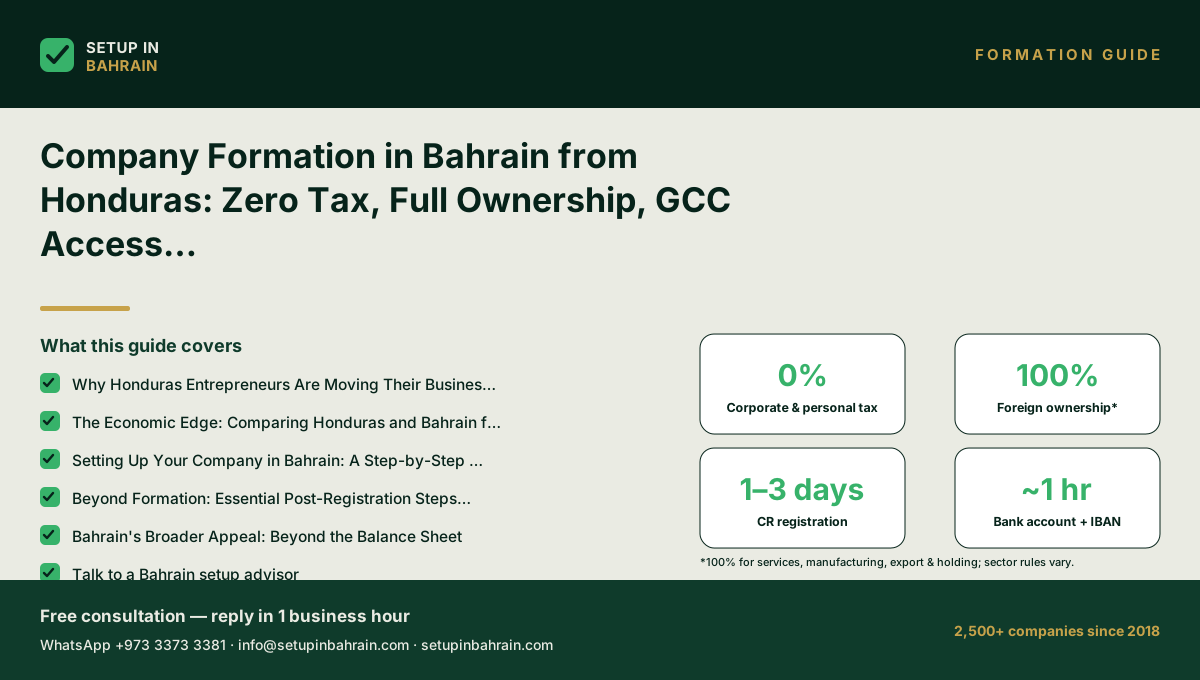
A Bahrain WLL can be owned by a single person — 100% foreign ownership applies to most activities, with no local partner required for services, manufacturing, export trading and holding companies. The minimum share capital is BHD 1; we recommend BHD 1,000, which makes bank account opening and investor visa approval smoother.
Why Honduras Entrepreneurs Are Moving Their Business to Bahrain
Imagine a moment, perhaps late at night, staring at your balance sheet. You’ve just crunched the numbers, and the reality of your Honduran enterprise hits you: another quarter, another significant portion of your hard-earned profits earmarked for the Dirección Ejecutiva de Ingresos (DEI). You’re looking at a 25% corporate income tax, and if your profits cross the HNL 1 million threshold, there’s an additional 5% solidarity tax. That’s a staggering 30% of your gains, gone before you can even think about reinvesting, expanding, or simply enjoying the fruits of your labor.
This isn’t just a hypothetical scenario for you, the ambitious entrepreneur from Honduras. This is your everyday reality. You’ve navigated the complexities of the Honduran business landscape—the intricate filing system of the Servicio de Administración de Rentas (SAR), the persistent challenge of HNL currency depreciation eating 5 to 8% of your purchasing power annually, the frustrating foreign exchange restrictions imposed by the Banco Central de Honduras (BCH). You’ve absorbed the mandatory IHSS and RAP contributions, which quietly add another 14% to your employment costs, making growth feel like an uphill battle. Perhaps you even explored the now legally uncertain ZEDE special economic zones, only to see their promise crumble after the 2022 government repeal, leaving a vacuum of stability.
A textile exporter in San Pedro Sula recently described his situation to me: his company cleared HNL 2.8 million in profit last year. After the 25% corporate income tax and the additional 5% solidarity tax on everything above HNL 1 million, he paid HNL 1.15 million to the tax authorities. Then came mandatory IHSS and RAP contributions that added another 14% on top of every salary, plus the constant hassle of SAR filings and the 5–8% annual slide in the lempira that quietly eroded whatever remained. He asked the obvious question: “Why am I still doing this here?”
You know, deep down, there has to be a better way. A place where your entrepreneurial spirit isn't constantly battling a system designed to take a large chunk of your success. A place where your capital is stable, your profits are yours to keep, and new markets are not just concepts but tangible realities.
This isn't just about moving your money; it’s about moving your potential. It’s about securing your legacy and giving your business the platform it deserves. And that platform, for a growing number of savvy entrepreneurs from Honduras, is Bahrain.
By 2026, more Honduras founders are shaping their global growth strategies around Bahrain’s unbeatable blend: real 0% taxation, full foreign control, and direct GCC market gateway. Let’s dig into the numbers and practical steps.
The Economic Edge: Comparing Honduras and Bahrain for Business
Let's lay out the facts, stark and clear, comparing the business environments in Honduras and Bahrain. As a Honduran entrepreneur, you're constantly weighing risks and rewards. This comparison isn't just theoretical; it's about your bottom line and your peace of mind.
Taxation: A World of Difference
For most entrepreneurs, taxes are the most immediate and impactful factor.
Honduras: The Tax Burden
In Honduras, the corporate income tax rate stands at a significant 25%. But for businesses like yours, generating profits over HNL 1 million, an additional 5% solidarity tax kicks in. This means a combined effective tax rate of 30% on a substantial portion of your earnings. This isn't just an abstract number; it's 30 cents out of every lempira of profit that you cannot reinvest into your business, use for expansion, or save for future opportunities. This significantly hampers your growth potential and capital accumulation.
Beyond corporate taxes, the Honduran social security system, specifically the Instituto Hondureño de Seguridad Social (IHSS) and the Régimen de Aportaciones Privadas (RAP), imposes mandatory contributions that add approximately 14% to your payroll expenses. While essential for employee welfare, these costs directly impact your competitiveness and the overall cost of doing business.
Bahrain: The Zero-Tax Advantage
Now, consider Bahrain. The Kingdom of Bahrain has a 0% corporate income tax for most business activities. Yes, you read that correctly – zero. There is no personal income tax either. This single fact alone fundamentally transforms your business model. Imagine retaining 100% of your profits, free to reinvest, expand, or distribute as you see fit.
The only significant tax businesses in Bahrain generally contend with is a 10% Value Added Tax (VAT), introduced in 2019, which is a consumption tax passed on to the end consumer. For financial institutions and oil & gas companies, there are specific tax regimes, but for the vast majority of commercial and industrial businesses, the generally no corporate income tax for most sectors holds true. This unparalleled fiscal environment, championed by entities like the Economic Development Board (EDB), is a cornerstone of Bahrain's appeal as a global business hub.
- Impact: A Honduran company making HNL 2.8 million in profit would pay HNL 1.15 million in taxes. A similar company in Bahrain would pay BHD 0 in corporate tax (equivalent to HNL 0), a difference that could fund significant expansion or provide a safety net.
Currency Stability and Foreign Exchange Control
The stability of your operating currency is critical for international trade and long-term planning.
Honduras: Lempira Volatility and BCH Restrictions
The Honduran Lempira (HNL) has seen consistent depreciation against the US Dollar, typically losing 5% to 8% of its value annually. This constant erosion of purchasing power significantly impacts any business dealing with imports, exports, or international investments. Your hard-earned capital effectively shrinks over time when held in HNL.
Furthermore, the Banco Central de Honduras (BCH) maintains stringent foreign exchange restrictions. Transferring capital out of the country, repatriating profits, or even facilitating international payments can be a cumbersome, time-consuming, and often frustrating process. These restrictions act as a practical barrier to global expansion and can tie up vital capital.
Bahrain: Dollar-Pegged Stability
Bahrain's currency, the Bahraini Dinar (BHD), has been pegged to the US Dollar at a fixed rate of 1 BHD = 2.6596 US Dollars since 2001. This is not just a nominal peg; it's robustly maintained by the Central Bank of Bahrain (CBB) and is a symbol of the Kingdom's commitment to financial stability. For you, this means:
- Predictability: No more sleepless nights worrying about currency fluctuations eating into your profits or increasing your import costs.
- Ease of International Trade: Seamless transactions with global partners, knowing the value of your funds is secure.
- Capital Mobility: Zero restrictions on capital repatriation. You can move your profits and capital freely in and out of Bahrain, a stark contrast to the BCH's tight controls. This financial openness is a key driver for foreign investment.
Regulatory Environment and Ease of Doing Business
How easy is it to start, operate, and manage a business? This impacts both time and money.
Honduras: Bureaucracy and Uncertainty
The Servicio de Administración de Rentas (SAR) in Honduras is known for its complex filing systems, often requiring physical submissions and significant administrative overhead. The entire process of company formation can be lengthy, involve multiple governmental layers, and often lacks transparency, making it difficult to predict timelines or costs accurately.
The legal uncertainty surrounding Special Economic Zones (ZEDEs) since their repeal in 2022 further highlights the potential for policy shifts that can disrupt business planning. This kind of environment breeds caution and can deter long-term investment.
Bahrain: Digital Efficiency and Clear Frameworks
Bahrain has consistently ranked high in the World Bank’s Ease of Doing Business reports, often leading the GCC for several indicators. This is no accident. The Ministry of Industry, Commerce and Tourism (MOIC) has invested heavily in digitalizing services. You can:
- Register a company online in days: Often within 3-5 business days for straightforward setups, sometimes even faster.
- Manage licenses and permits digitally: The Sijilat portal is a one-stop-shop for most government services related to business.
- Benefit from clear, transparent laws: Bahrain operates under a modern, investor-friendly legal framework, minimizing ambiguity and administrative hurdles.
- No local sponsorship required: Unlike some other GCC nations, you don't need a local partner or sponsor for most business activities, ensuring 100% foreign ownership.
This efficient, digital-first approach means less time spent on paperwork and more time focused on growing your business.
Ownership, Control, and Investment Protection
Your control over your own enterprise is paramount.
Honduras: Local Requirements and Shifting Sands
While Honduras generally allows foreign investment, specific sectors might have limitations, and the overall perception of investment security can be influenced by political and economic instability. The constant battle against currency depreciation and capital controls means your investment might not hold its value or be easily repatriated when needed.
Bahrain: 100% Foreign Ownership and Robust Protection
Bahrain stands out by allowing 100% foreign ownership in most sectors. This is a crucial distinction. As a Honduran entrepreneur, you can own your company entirely, without the need for a local partner or nominee, ensuring full control over your operations, profits, and strategic direction.
The Kingdom also offers strong legal protection for investors, underpinned by a transparent judiciary and adherence to international commercial laws. Entities like the Bahrain Investors Protection Agency (BIPA) are dedicated to ensuring a secure and equitable environment for foreign capital. This commitment to investor rights provides a robust framework for securing your assets and future.
Market Access: Regional and Global Reach
Where can your business operate from?
Honduras: Regional Focus, Global Hurdles
From Honduras, your primary market is often Central America, with potential links to North and South America. However, tariffs, trade agreements, and logistical challenges can complicate access to broader global markets. The BCH's forex restrictions, as mentioned, are a practical barrier to international transactions.
Bahrain: Gateway to the GCC and Beyond
Bahrain is strategically located at the heart of the Arabian Gulf, making it an ideal gateway to the entire GCC (Gulf Cooperation Council) market of over 50 million consumers. This includes Saudi Arabia, UAE, Kuwait, Qatar, and Oman. From Bahrain, you can:
- Access Saudi Arabia directly: Via the King Fahd Causeway, Bahrain offers unparalleled logistical access to the largest market in the GCC.
- Benefit from free trade agreements: The GCC has various free trade agreements, expanding your reach to a wider network of economies.
- Leverage world-class logistics: Bahrain boasts modern ports, a highly efficient airport, and excellent road networks, facilitating seamless regional and international trade.
Beyond the GCC, Bahrain serves as a bridge between East and West, offering direct access to markets in Africa, Asia, and Europe. This strategic positioning significantly amplifies your market potential.
Setting Up Your Company in Bahrain: A Step-by-Step Guide
The process of forming a company in Bahrain is designed to be straightforward and efficient, especially when compared to the administrative labyrinths you might be used to in Honduras. The Ministry of Industry, Commerce and Tourism (MOIC) has streamlined many procedures through its user-friendly Sijilat portal.
Step 1: Choosing Your Business Activity
This is the foundational step. What will your company do? Bahrain's MOIC maintains a comprehensive list of commercial activities. Each activity has specific legal requirements, licensing needs, and approvals.
- Research: Use the Sijilat portal to explore permitted activities. Be precise. For example, "general trading" is too broad; you'll need to specify "trading in textiles," "trading in electronics," etc.
- Licensing: Some activities are "light" (requiring only MOIC approval), while others are "heavy" (requiring additional approvals from sector-specific ministries like the CBB for financial services, the Ministry of Health for medical, or the Ministry of Education for training centers).
- Consultation: This is where an experienced consultant becomes invaluable, helping you identify the correct activity codes and anticipate any special licensing requirements, ensuring there are no surprises down the line.
Step 2: Selecting Your Company Legal Structure
For foreign investors in Bahrain, the most common and recommended legal structure is the With Limited Liability (WLL) company.
With Limited Liability (WLL) Company: Your Best Bet
- 100% Foreign Ownership: This is a critical advantage. Unlike some other GCC nations or older Bahraini regulations, a WLL can be 100% owned by a single person – you, the Honduran entrepreneur – with zero local partners required. This gives you complete control.
- Limited Liability: Your personal assets are protected from business liabilities. This is a fundamental safeguard for any entrepreneur.
- Flexibility: WLLs are suitable for a wide range of commercial activities, from trading and consulting to manufacturing and services.
- Minimum Shareholders: Can be established with one or more shareholders (no limit to maximum).
- Minimum Share Capital: The legal minimum share capital for a WLL in Bahrain is a symbolic BHD 1. However, for practical purposes, particularly when it comes to opening a corporate bank account and obtaining an investor's visa, we strongly recommend a starting capital of BHD 1,000. This demonstrates financial solvency and helps secure necessary banking and residency approvals.
- Why BHD 1,000? Banks look for a substantive initial deposit to process corporate accounts. A BHD 1 capital, while legally compliant, signals minimal commitment and can delay or complicate your banking setup. BHD 1,000 shows serious intent.
Other Legal Structures (Less Common for Initial Setup)
- Closed Shareholding Company (BSC): For larger enterprises, publicly listed companies, or those requiring more complex corporate governance structures. Requires a higher minimum share capital (BHD 25,000 for private, BHD 1,000,000 for public).
- Branch of a Foreign Company: Suitable if you already have an established company in Honduras and wish to operate a direct extension in Bahrain. The branch must undertake the same activities as the parent company. It doesn't create a separate legal entity.
- Establishment: For sole proprietorships by Bahraini or GCC nationals. Not applicable for Honduran entrepreneurs.
- single-shareholder WLL: CRITICAL FACT: There is NO single-shareholder WLL legal structure in Bahrain. Do not be misled by information suggesting otherwise. The WLL structure effectively serves the purpose of a single-owner entity, allowing 100% foreign ownership by one person.
Step 3: Reserving Your Company Name
- Uniqueness: Your proposed company name must be unique and not conflict with existing registered companies.
- Guidelines: Adhere to MOIC guidelines (e.g., no offensive language, no political connotations).
- Reservation: This can be done online through the Sijilat portal and is usually approved within hours. Having a few options ready is always a good idea.
Step 4: Preparing Required Documents
This is where organization is key. Ensure all documents are clear, current, and correctly attested.
For the Shareholder(s) and Director(s) (if individuals):
- Passport Copy: Clear, colored copy of the biodata page.
- ID Card Copy: If applicable from Honduras or another country of residence.
- Proof of Residence: Utility bill, bank statement, or similar, not older than 3 months, showing your residential address.
- CV/Resume: Outlining your professional background.
- Bank Statement: Personal bank statement (not older than 3 months) showing sufficient funds to support the proposed capital (e.g., BHD 1,000). This is for MOIC verification of financial standing, not a deposit.
For Corporate Shareholder(s) (if another company owns shares):
- Certificate of Incorporation: Legal document confirming the existence of the parent company in Honduras or elsewhere.
- Memorandum & Articles of Association: The founding documents of the parent company.
- Board Resolution: A formal resolution from the parent company's board of directors, approving the establishment of the Bahraini subsidiary, appointing directors, and authorizing signatories.
- Passport/ID of Authorized Signatories: For the individuals representing the parent company.
All Documents: Attestation and Translation
- Attestation: Documents issued in Honduras (e.g., corporate documents) will need to be attested by the Ministry of Foreign Affairs in Honduras, then by the Bahraini Embassy in Washington D.C. (as there is no Bahraini embassy in Honduras), and finally by the Ministry of Foreign Affairs in Bahrain. This is a crucial, often time-consuming step if done manually, highlighting the benefit of using a consultant who can guide or assist with this process.
- Translation: All non-Arabic documents must be translated into Arabic by a sworn legal translator in Bahrain.
Step 5: Draft the Memorandum of Association (MOA)
The MOA is the constitutional document of your company. It outlines:
- Company Name and Legal Form: Your chosen name and confirmation it's a WLL.
- Registered Address: Your physical office address in Bahrain. (You'll need a virtual or physical office lease agreement).
- Company Activities: The specific business activities approved in Step 1.
- Share Capital: The proposed capital (e.g., BHD 1,000) and how it's divided among shareholders.
- Shareholders' Details: Full names, nationalities, and shares held.
- Directors' Details: Names of appointed directors and their powers.
- Company Management: How the company will be run.
A consultant will help you draft this document accurately, ensuring it complies with Bahraini Commercial Companies Law.
Step 6: Submit Application to MOIC via Sijilat
Once all documents are prepared, attested, translated, and the MOA is drafted, the entire application package is submitted online through the Sijilat portal.
- Online Portal: The Sijilat system is user-friendly, but precision is key. Any error or missing document can lead to delays.
- Review Process: MOIC officials will review your application. This usually takes 3-5 working days for simple WLL formations if all documents are in order.
- Payment of Fees: Government fees for company registration will be paid at this stage. These vary based on company type and activities but are generally transparent and reasonable.
Step 7: Obtain Commercial Registration (CR)
Upon successful review and payment, the MOIC will issue your company’s Commercial Registration (CR) certificate. This is your official license to operate in Bahrain. Congratulations, your company is legally formed!
Beyond Formation: Essential Post-Registration Steps for Honduran Entrepreneurs
Getting your CR is a significant milestone, but it’s just the beginning. To truly operate effectively and leverage Bahrain’s advantages, several crucial steps follow.
Opening a Corporate Bank Account
This is often the most challenging part for new foreign companies, especially for a single-shareholder WLL with BHD 1 capital.
- Why BHD 1,000 Capital is Crucial: As mentioned, while BHD 1 is the legal minimum, most reputable banks in Bahrain (and globally, under KYC/AML regulations) require a more substantial initial deposit (typically BHD 1,000 to BHD 5,000) and evidence of genuine business intent before opening a corporate account. This is why recommending BHD 1,000 as practical capital is critical.
- Documentation: Banks require extensive due diligence (Know Your Customer/Anti-Money Laundering – KYC/AML). You’ll need:
- Bank Options: Bahrain has a robust banking sector, regulated by the CBB, with local and international banks. Consider banks known for their support of SMEs and foreign investors.
- Personal Presence: Often, at least one director/shareholder will need to be physically present in Bahrain to sign bank account opening documents.
- Timeline: This process can take anywhere from 2 weeks to 2 months, depending on the bank's internal processes and the completeness of your documentation.
Obtaining an Investor Visa and Residency
As a Honduran entrepreneur, securing an investor visa is essential for your long-term stay and management of your business.
- Eligibility: Typically, a foreign investor who owns a significant share in a Bahraini company (e.g., 100% of a WLL) and meets the minimum capital requirement (or demonstrates sufficient investment) is eligible.
- Application Process:
- Required Documents (Typical):
- Family Visas: Once you have your investor visa, you can typically sponsor dependent family members (spouse, children) for their residency visas, allowing them to live with you in Bahrain.
- Validity: Investor visas are typically issued for 2 years initially and are renewable.
Office Space and Virtual Offices
Having a registered physical address is a legal requirement for company formation.
- Physical Office: For larger operations or those requiring a permanent presence, leasing traditional office space is an option. Bahrain offers a range of commercial properties at competitive rates.
- Virtual Office: For startups, consultants, or businesses not requiring a full-time physical presence, a virtual office solution is highly cost-effective and perfectly acceptable to the MOIC. These services provide a registered address, mail handling, and often meeting room access, fulfilling the legal requirement without the overhead of a traditional lease.
Hiring Employees and Labour Laws
If your business grows to require local staff, you'll engage with Bahrain's labour laws.
- LMRA: The Labour Market Regulatory Authority (LMRA) governs employment of both Bahraini and expatriate workers. All employees must have work permits issued by LMRA.
- Bahrainization: Bahrain encourages the employment of its nationals. While there are no strict quotas for most small businesses, a strategic approach to local hiring is beneficial.
- Expat Employment: Hiring expatriates is straightforward, provided all LMRA requirements are met, including medical checks and relevant qualifications.
- Employment Contracts: All employees must have written employment contracts in Arabic and English, outlining terms, conditions, and benefits.
Compliance and Ongoing Obligations
Maintaining good standing requires adherence to local regulations.
- Annual Renewals: Your Commercial Registration must be renewed annually with the MOIC.
- Economic Substance Regulations: Bahrain introduced Economic Substance Regulations (ESR) in 2019 for certain "relevant activities" (e.g., banking, insurance, fund management, holding company business). If your company undertakes such activities, you must demonstrate genuine economic substance in Bahrain (e.g., adequate employees, physical office, local expenditures, strategic decisions made in Bahrain). Most standard WLLs for trading or services are exempt from ESR, but it’s crucial to verify with a consultant.
- VAT Filings: If your company's annual taxable supplies exceed BHD 37,500, it must register for VAT with the National Bureau for Revenue (NBR) and file quarterly VAT returns.
- Annual Audits: All WLLs in Bahrain are required to prepare audited financial statements annually and submit them to the MOIC. This requires engaging a local auditor.
Bahrain's Broader Appeal: Beyond the Balance Sheet
While the financial and regulatory advantages are compelling, Bahrain offers much more to the discerning entrepreneur from Honduras. It's about establishing a business in an environment that supports growth, innovation, and a high quality of life.
Strategic Location and Connectivity
Bahrain's geographical position is a significant asset.
- Middle East Hub: Located in the heart of the Gulf, it’s a natural pivot point for trade and logistics across the region.
- King Fahd Causeway: This direct link to Saudi Arabia makes Bahrain a unique entry point to the largest economy in the GCC. Imagine the logistical benefits for distribution into Saudi Arabia.
- World-Class Airport & Port: Bahrain International Airport (BIA) and Khalifa Bin Salman Port provide excellent air and sea cargo facilities, connecting you to global supply chains.
Quality of Life and Expat Experience
Moving your business often means moving your life. Bahrain excels here.
- Safe and Welcoming: Bahrain is known for its low crime rate, political stability, and a genuinely welcoming attitude towards expatriates. It's a multicultural society where people from all backgrounds coexist peacefully.
- Cost of Living: Compared to regional neighbours like Dubai or Doha, Bahrain offers a more affordable cost of living, particularly for housing and schooling, without compromising on quality.
- Excellent Infrastructure: Modern roads, reliable utilities, high-speed internet, and world-class healthcare facilities are standard.
- Leisure and Lifestyle: From pristine beaches and watersports to vibrant dining scenes, cultural attractions, and international schools, Bahrain offers a balanced and engaging lifestyle for individuals and families.
- Education: A wide array of international schools following various curricula (British, American, IB) means your children can continue their education without disruption.
Support for Innovation and Entrepreneurship
Bahrain is actively fostering a vibrant startup ecosystem.
- FinTech Hub: The Central Bank of Bahrain (CBB) has been a pioneer in creating a regulatory sandbox for FinTech companies, making it an attractive destination for innovative financial technology startups.
- Incubators and Accelerators: Numerous government-backed and private initiatives support new businesses with mentorship, funding access, and co-working spaces. The Bahrain Economic Development Board (EDB) plays a pivotal role in these initiatives.
- Skilled Workforce: Bahrain boasts a young, educated, and tech-savvy local workforce, complemented by a diverse pool of international talent.
Overcoming Common Hurdles: FAQs for Honduran Entrepreneurs
1. Can I really own 100% of my company in Bahrain?
Yes, absolutely. For most commercial activities, Bahrain allows 100% foreign ownership of a With Limited Liability (WLL) company. You do not need a local partner or sponsor. This is a fundamental advantage and a key reason entrepreneurs choose Bahrain.
2. Is there a minimum capital requirement?
Legally, the minimum share capital for a WLL is BHD 1. However, to ensure smooth bank account opening and investor visa processing, we strongly recommend a practical starting capital of BHD 1,000. This demonstrates serious
Bahrain Business Guides for Honduras Citizens
Ready to set up in Bahrain from Honduras?
Tell us your business idea. We map the right entity, ownership and timeline — then handle the filing while you focus on what matters.