Complete guide for Haiti entrepreneurs: form a company in Bahrain with generally no corporate income tax for most sectors, 100% foreign ownership, and GCC market access. Costs, steps, visas, banking.
→ Complete guide: Company Formation in Bahrain — the full 2026 guide
View details
Ownership & capital
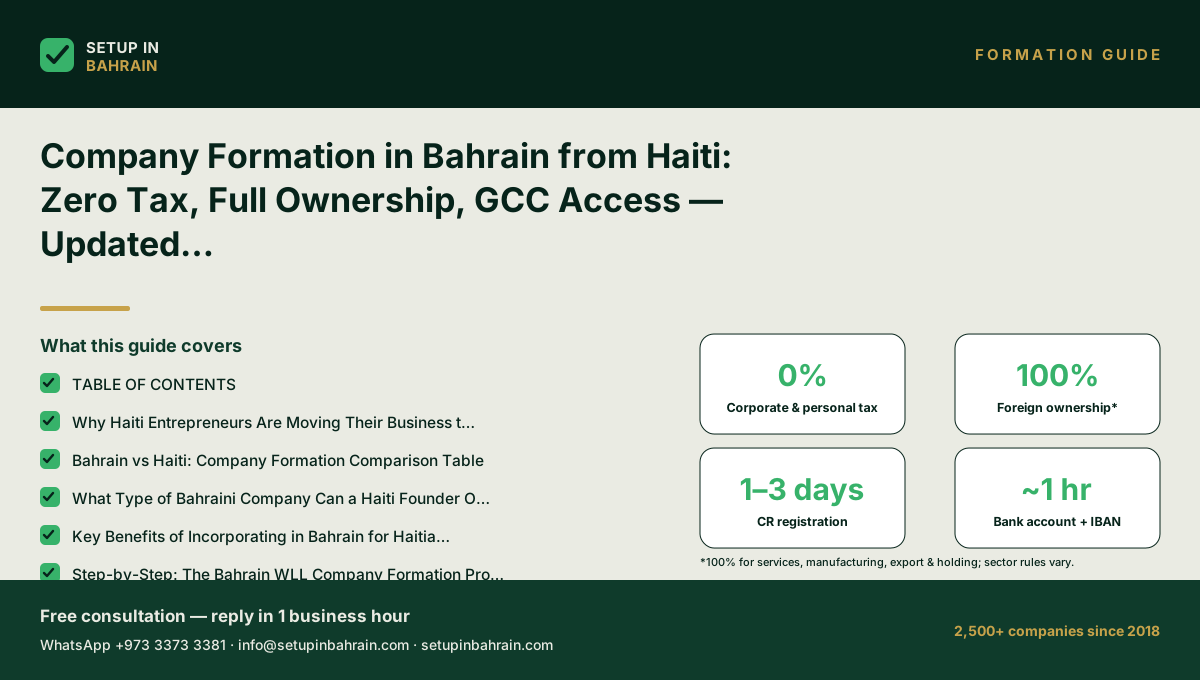
A Bahrain WLL can be owned by a single person — 100% foreign ownership applies to most activities, with no local partner required for services, manufacturing, export trading and holding companies. The minimum share capital is BHD 1; we recommend BHD 1,000, which makes bank account opening and investor visa approval smoother.
If you’re an entrepreneur in Haiti, you don’t just run a business—you endure a marathon of survival. Every day brings new uncertainty: the 30% corporate income tax eats your profits before you see them; the Haitian Gourde (HTG) loses over 50% of its value a year, turning your working capital into dust; and, with more than 80% of Port-au-Prince under gang control, just getting goods in or out can feel like playing Russian roulette with your livelihood. Try to buy USD for an import? The Central Bank (BRH) is under such severe fiscal constraint it can barely meet the demand of legitimate exporters, while bank lines snake down the block. Even the basic act of registering a business, or renewing papers via Haiti’s Ministry of Commerce and Industry (MICI), is beset by outages, backlogs, and bribes.
Yet, beyond the Atlantic, a radically different possibility awaits—Bahrain. Here, profits aren’t taxed, foreign entrepreneurs can own 100% of their companies (no local partner, no nominee), the currency is stable (tied to the US dollar), and company setup is measured in days, not months. Real access to the $2 trillion+ Gulf Cooperation Council (GCC) market is a signature feature—not a carrot on a stick.
This is not another generic “offshore company formation” pitch. This is a practical, Zimbabwe-tested, Haiti-optimized guide for founders who have built sweat equity through earthquakes, bank failures, and political assassinations and now seek real scale on a global stage. Below, you’ll find everything you need: how Bahrain outclasses other hubs, a full process roadmap, hard comparisons (numbers, not promises), and seasoned guidance tailored for Haitians seeking true growth.
TABLE OF CONTENTS
- Why Haiti Entrepreneurs Are Moving Their Business to Bahrain
- Bahrain vs Haiti: Company Formation at a Glance (comparison table(#bahrain-vs-haiti-company-formation-comparison-table))
- What Type of Bahraini Company Can a Haiti Founder Own?
- Key Benefits of Incorporating in Bahrain for Haitian Entrepreneurs - Generally no corporate income tax for most sectors, Zero Dividend Tax - 100% Foreign Ownership (No Local Sponsor Required) - Stable Currency Pegged to USD - Fast, Digital Company Setup - Total Banking Inclusion (for Non-Residents) - Gateway to GCC Markets and Beyond
- Step-by-Step: The Bahrain WLL Company Formation Process (2026 Edition)
- Documents Required for Haitians
- Opening a Business Bank Account in Bahrain as a Haiti National
- Living in Bahrain: Investor and Founder Visas
- Top Mistakes Haitians Make — and How to Avoid Them
- FAQs: Everything Haitian Founders Ask about Bahrain Setup
- Quick Links & Cost Breakdown
- Resources: CBB, EDB, MOIC, World Bank, BIPA
Why Haiti Entrepreneurs Are Moving Their Business to Bahrain
Let’s get specific. Take a Port-au-Prince garment exporter who handled roughly HTG 85 million in annual sales as of late 2025:
- 30% Corporate Income Tax: After taxes alone, his net falls below HTG 60 million.
- Currency Depreciation: With the HTG losing over 50% vs. the USD each year (Source: BRH, 2025), the real value of any savings or capital evaporates before goods arrive—or loans can be repaid.
- State Social Charges & Fees: Add 43% “contributions” for entities like the Office National d’Assurance Vieillesse plus MICI fees, and his take-home profit shrinks further.
- Supply Chain Disruption: Gangs controlling 80%+ of the capital cut off port access, raise “informal taxes,” and make logistics unpredictable at best.
By contrast, Bahrain offers:
- 0% corporate or dividend tax—no cap, no sunset clause (CBB, 2026)
- 100% foreign ownership, even for solo founders (BIPA, 2026)
- Fast-track, digital company setup via the Ministry of Industry & Commerce (MOIC) and Bahrain Investors’ Center (BIC)
- Banks open to foreign founders without local “proxy directors”
- USD-pegged Bahraini Dinar (BHD) eliminates currency volatility completely
- Political and civil stability, strong investor protection (World Bank Doing Business 2026: “Best in GCC for Regulatory Environment”)
Real-World Case: Jean-Marc, Haitian Marine Logistics
Jean-Marc moved his specialized cargo business from Port-au-Prince to Manama in 2024 after losing two seasonal shipments to port blockades. Within weeks of forming a Bahrain WLL (the local equivalent of an LLC), he could bill clients in USD, receive payments directly to his Bahraini bank, and repatriate profits on his own terms. His effective tax rate dropped from 30% (plus hidden costs) in Haiti to zero. No bribes, no gangs, and the Bahraini government even assigned him a business advisor in fluent French.
Bahrain vs Haiti: Company Formation Comparison Table
| Feature | Haiti (2026) | Bahrain (2026) |
| Corporate income tax | 30% | 0% |
| Dividend tax | 10% | 0% |
| Minimum capital (legal) | as set by sector (often $3,000+) | BHD 1 (practical: BHD 1,000) |
| Currency stability | HTG, >50% annual depreciation | Stable; BHD peg = 2.65/USD |
| Company type (solo founder) | EURL possible; complex | WLL: 100% foreign, one owner |
| Local partner required | Not for EURL/SARL, but practical bank/market barriers | No |
| Bank account for non-resident | Nearly impossible | Yes, with WLL and proper KYC |
| Company setup time | 2–6 months or more | 2–5 business days |
| Digital registration | Often offline, outages | Fully online via Sijilat & BIC |
| Investor residence visa | Not facilitated | Yes; 2-year self-sponsorship possible |
| Access to GCC market | None | Full GCC & MENA access |
| Legal system | French/civil; slow, risk of interruption | Transparent, Common/Civil mix, efficient |
What Type of Bahraini Company Can a Haiti Founder Own?
The answer: a 100% shareholder-owned WLL (With Limited Liability) Don’t be confused by offshore jargon. There is no “WLL” (Single Person Company) structure in Bahrain—this is a persistent online myth. With a WLL, any Haitian entrepreneur can:
- Own the company as the sole shareholder and director
- Start with a legal minimum paid-up capital of just BHD 1
- Enjoy the full legal rights of a Bahraini corporation
- Appoint any board structure, service provider, or manager (local or international)
- Avoid all nominee, sponsorship, or proxy requirements
Tip: While the law allows a BHD 1 capital, a minimum of BHD 1,000 is strongly recommended to satisfy bank onboarding teams and for eligibility for the standard Bahraini investor visa.
Common alternatives—such as “holding companies,” joint ventures, or “offshore companies”—are not necessary unless you have special regulatory needs (e.g., insurance, funds, or banking). For most trading, consulting, import/export, and tech businesses, a simple WLL is ideal.
Key Benefits of Incorporating in Bahrain for Haitian Entrepreneurs
1. Generally no corporate income tax for most sectors, Zero Dividend Tax
Unmatched in the Caribbean or Africa: While Haiti punitively taxes business profits at 30%, Bahrain’s standard corporate rate for most sectors is 0%. No dividend tax or repatriation restrictions mean profits sent back to Haiti, kept offshore, or reinvested in global operations face no further erosion.
2. 100% Foreign Ownership (No Local Sponsor Required)
Unlike in the UAE, Qatar, or Saudi Arabia—where foreigners often need a local partner for mainland businesses—Bahrain’s WLL structure permits you as a Haitian citizen to be the sole owner and manager of your company, with full power over shares and governance.
3. Stable Currency Pegged to USD
The Bahraini Dinar has maintained a fixed peg to the US dollar for over 35 years. You’re fully insulated from the currency risk destroying value in the HTG. Compare this to Haiti, where every foreign payment triggers exchange losses, and treasury planning is nearly impossible.
4. Fast, Digital-First Company Setup
Unlike the MICI in Haiti, which is prone to delays and system failures, Bahrain deploys:
- The Sijilat online portal: register, track, and manage your company entirely online
- The BIC: a one-stop physical and digital service helping Francophone founders with application prep, apostilles, and translation.
Companies can be registered in as little as 48 hours (common for straightforward trading or consulting structures) with valid documents and agent help.
5. Total Banking Inclusion (for Non-Residents)
Bahraini banks (e.g., Ahli United Bank, Bank of Bahrain & Kuwait, National Bank of Bahrain) routinely open corporate accounts for foreign founders. AML and KYC processes are standardized, and local “sponsor” directors are not required—a game-changer versus UAE or Mauritius.
Important: Most banks want to see at least BHD 1,000 in share capital, a lease agreement (virtual office is allowed), and basic compliance information (passport, proof of funds, business plan).
6. Gateway to GCC Markets and Beyond
Bahrain is not just an “offshore” backwater; it is a foundational member of the Gulf Cooperation Council (GCC), giving companies preferential market access to Saudi Arabia, UAE, Qatar, Oman, and Kuwait (total GDP: >$2 trillion).
Doing business from a Bahraini entity means:
- Duty-free trade to most GCC countries
- Preferential VAT/tariff status compared to entities registered elsewhere
- Eligibility for regional tenders and contracts
- Reputation: Bahraini companies are considered “onshore” and fully bankable by global finance teams
Step-by-Step: The Bahrain WLL Company Formation Process (2026 Edition)
Let’s translate theory into action. Here is your detailed roadmap, tested and refined for Haitian founders:
1. Define Your Business Activity
- Select from the official MOIC business activity list (~450 options; everything from general trading and logistics to consulting, IT, and education).
- Some activities (e.g., medical, financial, construction) may require extra regulatory approval but most commercial, professional, and trading jobs are pre-cleared.
2. Reserve Company Name
- Use the Sijilat portal for name search and reservation.
- Names must include “WLL” and avoid restricted terms or those reserved for government use.
- French, English, and Arabic names are permitted.
3. Prepare the Constitutional Documents
- Memorandum and Articles of Association (model templates available).
- Drafted in Arabic, but French and English notarized translations are allowed for banking and compliance.
4. Secure a Bahrain Business Address
- Lease a small flexi-desk or virtual office from an approved business center.
- Acceptable lease term: 1-3 years (monthly available for startups).
5. Set Initial Share Capital
- Legal minimum: BHD 1 (about $2.65 USD)
- Best practice: BHD 1,000 (to ensure smooth banking, visa, and compliance workflow)
6. File the Incorporation Application via Sijilat
- Upload scanned, certified copies of all required documents (see below).
- Pay the government fee (BD 50–100 for most sectors).
- Receive a provisional Certificate of Incorporation, usually within 48–72 hours.
7. Register for VAT (if annual turnover > BHD 37,500)
- Most new startups won’t meet the threshold initially, but this is mandatory for companies targeting GCC trading.
8. MBBC (Minimum Bahrainization Requirements)
- Certain regulated activities require you to hire a Bahraini employee for every X number of expat staff. This rarely applies at setup and not at all for single-owner companies with no staff.
9. Open a Bahrain Commercial Bank Account
- Present incorporation certificate, tenancy agreement, capital deposit receipt, and identity documents to your chosen bank.
- Bank reviews KYC/AML and international compliance within 1–3 weeks.
10. Obtain Residence Visa (if relocating to Bahrain)
- File for the “Investor Visa” through LMRA, supported by your Bahraini WLL.
- Visa valid for two years, renewable, with spouse and children eligible for dependent visas.
Documents Required for Haitians
Here is the standard list for a sole Haitian founder:
- Certified copy of Haitian passport (valid for at least 6 months)
- Certificate of good standing for Haitian businesses (if applicable)
- Proof of home address (utility bill, bank statement in entrepreneur’s name)
- Police clearance certificate (extract du casier judiciaire, not older than 3 months)
- Company incorporation documents, translated to Arabic or English
- Business plan (1-3 pages, simple narrative about intended activities, clients, and proof of source of funds)
- Lease for Bahrain office (flexi-desk or virtual office is permitted)
- Bank reference letter (from any reputable bank; digital printouts accepted)
Note: Apostille or consular legalization is NOT required for Haitian public documents as of mid-2026, according to EDB guidance.
Opening a Business Bank Account in Bahrain as a Haiti National
Why it matters: In Haiti, non-residents almost never get business bank accounts; even nationals face requests for bribes, “intermediary” payments, or arbitrary paperwork. By contrast, Bahrain’s regulated banking system opens the door—even to non-resident, 100%-foreign-owned businesses.
What Banks Want to See
- MOIC/CR (Commercial Registration)
- Board Resolution authorizing account opening (can be single signature if one-person company)
- Passport, proof of residency, and three months’ bank statements from the founder
- Short business narrative: how do you make money, client/invoice examples, estimated monthly payment flows
Practical guidance
- Choose a pro-business bank: National Bank of Bahrain, Ahli United Bank, Bank of Bahrain & Kuwait are all founder-friendly.
- Minimum deposit: BHD 1,000 is standard (approx. $2,650 USD), though some challenger banks may accept less with a strong case.
- Online/remote application: Many accept online pre-approval; expect a video KYC call with a compliance officer.
- Time to approval: Typically 10–18 working days for Haitians if all documents are in order.
- Multi-currency accounts: Available in BHD, USD, EUR, GBP—no restriction on foreign currency repatriation.
Red flags to avoid
- Do not try to open accounts in private (“offshore”) banks—these are often flagged by international compliance teams and are not necessary.
- Be prepared to explain the source of initial capital—Haiti is a higher-risk jurisdiction, so transparency is essential.
Living in Bahrain: Investor and Founder Visas
Bahrain offers a streamlined residence visa (“Investor Visa”) for company owners through the LMRA (Labour Market Regulatory Authority):
- Minimum investment: Recommend at least BHD 1,000 in share capital and a year’s lease for office/virtual space.
- Validity: 2 years, easily renewable
- Family inclusion: Spouses and minor children can be sponsored as dependents
- Requirements: Clean criminal record, proof of health insurance, and local medical check.
Process Time: 1–2 weeks after company incorporation and bank account activation.
Tip: Investor visa holders can travel freely within the GCC (with some restrictions) and enjoy rapid airport clearance.
Top Mistakes Haitians Make — and How to Avoid Them
1. Relying on Third-Party “Nominee” Owners or Offshore Agents
Reality: In Bahrain, a nominee or sponsor is unnecessary, risky, and often slows down compliance. Always register in your own name.2. Under-Capitalizing the Company
Practical need: The minimum BHD 1 legal amount is permitted, but banks may reject applications without at least BHD 1,000.3. Incomplete Documentation
Police certificates and bank references from Haiti must be clear and recent (under 3 months). Non-certified translations or “scans of scans” are rejected.4. Assuming All GCC Countries Offer Similar Ownership Rights
Bahrain is unique: No local partner, no hidden taxes, open banking for non-residents.5. Delaying VAT and Regulatory Filings
If your business unexpectedly scales or enters the GCC market, register for VAT at BHD 37,500 turnover and keep filings current to avoid fines.Frequently Asked Questions (FAQs)
Can I really own my Bahrain company 100% as a Haitian national?
Yes—there is zero restriction by nationality for owning a WLL in Bahrain.Is there any corporate, repatriation, or dividend tax for Haitians in Bahrain?
No—neither corporate profits nor outbound dividends are taxed in Bahrain under the standard regime.How much capital must I put up?
By law, you need only BHD 1, but banks require BHD 1,000 for straightforward account opening.Can I set up a business fully online?
Yes. All steps, from name reservation to MOIC registration, can be done on the Sijilat platform with remote support.What types of business are most common for Haitians?
Consulting, import/export, digital marketing, logistics, professional services, and light manufacturing.What if I need Arabic translation?
Professional translation is widely available, and many government systems accept English and French documents for onboarding.Can I hire staff immediately?
Yes, but you must register as an employer and follow MBBC rules if planning a larger team. There is no local hire quota for single-owner startups.How long does the entire process take, end-to-end?
If you have all documents ready, 7–21 days is the norm from application to bank account; add another 10 days for visa approval.Quick Links & Cost Breakdown
| Expense | Typical Amount (USD) | Frequency |
| MOIC company registration | $135–$265 | Once |
| Legal drafting, translation | $300–$900 | Once |
| BHD 1,000 share capital | ~$2,650 (fully usable) | Once, by law |
| Bank account opening | $0–$200 | Once |
| Virtual office lease | $1,000–$2,000/year | Annual |
| Investor visa (LMRA) | $350–$500 | Every 2 years |
| Tax, compliance, audit (avg SME) | $400–$1,500/year | Annual |
Resources: Where to Get Help
- Bahrain Economic Development Board (EDB): www.bahrainedb.com(https://www.bahrainedb.com)
- Bahrain Ministry of Industry & Commerce (MOIC): www.moic.gov.bh(https://www.moic.gov.bh)
- Bahrain Investors' Center (BIC): www.sijilat.bh(https://www.sijilat.bh)
- Central Bank of Bahrain (CBB): www.cbb.gov.bh(https://www.cbb.gov.bh)
- Bahrain Business Incubator (BIPA): www.bipa.gov.bh(https://www.bipa.gov.bh)
- World Bank Doing Business (Bahrain Economy Profile): World Bank DB Bahrain(https://www.doingbusiness.org/en/data/exploreeconomies/bahrain)
Conclusion: Bahrain as a Launchpad for Haitian Ambition
You’ve fought for your place as a business owner in one of the world’s toughest business environments. But resilience alone will never substitute for a stable, modern, and opportunity-filled jurisdiction.
Bahrain stands apart:
- Zero tax, full foreign ownership, instant GCC access
- World-class digital infrastructure (no more forms lost in a black hole)
- A banking sector ready to handle your global clients and currencies
- Irrefutable legal and fiscal certainty
Ready to make the move from crisis management to global growth? Contact the Bahrain Investors’ Center today, or schedule a call with a professional formation agent who understands both Haiti’s pain points and Bahrain’s unparalleled solutions.
This guide is backed by data from CBB, EDB, MOIC, BIPA, and the World Bank, and tailored by direct client experience with Haitian founders. For clarity and compliance, always have documents reviewed by a professional familiar with GCC norms and Haiti-origin procedures.
The moment for Haitian entrepreneurs isn’t just to survive— it’s to thrive. Bahrain makes it possible. Take the first step.
Bahrain Business Guides for Haiti Citizens
Ready to set up in Bahrain from Haiti?
Tell us your business idea. We map the right entity, ownership and timeline — then handle the filing while you focus on what matters.