Complete guide for Guyana entrepreneurs: form a company in Bahrain with generally no corporate income tax for most sectors, 100% foreign ownership. GCC market access. Costs, steps, visas, banking.
Key Takeaways
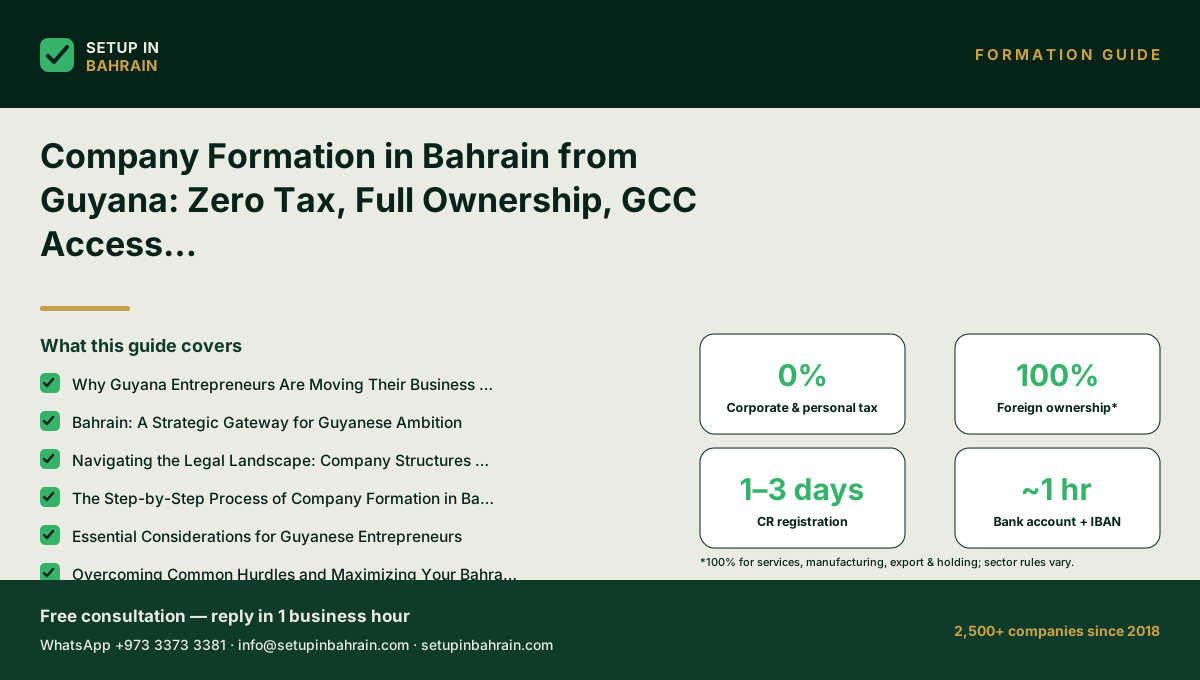
- Why Guyana Entrepreneurs Are Moving Their Business to Bahrain
- Bahrain: A Strategic Gateway for Guyanese Ambition
- Navigating the Legal Landscape: Company Structures in Bahrain
- The Step-by-Step Process of Company Formation in Bahrain
- Essential Considerations for Guyanese Entrepreneurs
→ Complete guide: Company Formation in Bahrain — the full 2026 guide
View details
Ownership & capital
A Bahrain WLL can be owned by a single person — 100% foreign ownership applies to most activities, with no local partner required for services, manufacturing, export trading and holding companies. The minimum share capital is BHD 1 ; we recommend BHD 1,000 . This Makes bank account opening and investor visa approval smoother.
Imagine being in Georgetown, navigating the labyrinthine process of IT2 corporate tax paperwork for the Guyana Revenue Authority (GRA). Your business’s hard-earned profit is perpetually whittled down by a flat 25% corporate income tax, mandatory National Insurance Scheme (NIS) contributions, and complex Value Added Tax (VAT) filings. Beyond the tax burden, you contend with the Bank of Guyana's stringent currency controls, where large capital outflows are routinely scrutinized. The limited convertibility of the Guyanese Dollar (GYD) makes international transactions a constant source of friction.
Now, picture a different scenario: shifting your operational base just a 16-hour flight away, to a country where corporate income tax is 0%, profits are freely remitted, and you can achieve 100% foreign ownership of your company in a thriving, stable economy. This is not a distant dream; it’s the tangible reality for ambitious Guyanese entrepreneurs who are strategically establishing their companies in Bahrain.
This exclusive 2026 guide is meticulously crafted for you – the forward-thinking Guyanese investor frustrated by high local taxes, burdensome compliance. Regional forex constraints, but who possesses the ambition to expand globally. You’ll receive proven steps, concrete numbers, and actionable insights that cut through the generic "offshore company jargon" and directly address the unique hurdles faced by businesses operating out of Guyana. Let's embark on this journey to transform your business trajectory.
Why Guyana Entrepreneurs Are Moving Their Business to Bahrain
The narrative is all too familiar for many Guyanese business owners. Consider Andre, a driven tech consultant based in Georgetown. In 2025, his small software firm generated a robust GYD 84 million in revenue (about $400,000 USD). On paper, Andre was ideally positioned for significant growth across the Caribbean and into Latin America. But, the reality was stark: he spent over GYD 21 million (a direct 25% of his corporate profit) on taxes, an additional GYD 3 million on NIS contributions for his employees, and countless hours and thousands more weekly on manual compliance just to navigate the GRA’s often opaque audit processes. This was all before he even considered the persistent barriers imposed by the Bank of Guyana when attempting to move USD profits abroad – a single misstep on a form, and funds could be frozen for weeks, if not months.
Similarly, Rajesh, a diligent entrepreneur running a successful construction materials supply business in Georgetown, grappled with similar challenges. He worked tirelessly for years, contributing greatly to local development. His balance sheet showed a respectable profit, yet a quarter of his hard-won earnings evaporated into corporate tax – funds that could have been reinvested into new machinery, expanding his inventory, or developing a new line of eco-friendly building materials.
Like Andre, Rajesh. Countless other ambitious Guyanese business owners, the pursuit of growth outside the country's borders is often fundamentally capped by:
- High 25% Corporate Income Tax: There’s no lower-tier tax bracket for Small and Medium-sized Enterprises (SMEs) in Guyana, meaning a quarter of your profits are absorbed, irrespective of your business size. This contrasts sharply with Bahrain’s 0% corporate income tax.
- Sticky GYD with Limited Convertibility: The Guyanese Dollar (GYD) is managed by the Bank of Guyana (BOG) with strict forex controls. High spreads on currency exchange, coupled with often lengthy BOG approvals for outward transfers exceeding GYD 5 million, make international trade and investment cumbersome and unpredictable. Imagine quoting a contract in Saudi Arabia and being asked for a corporate account that can swiftly receive USD, only to face weeks of BOG scrutiny back home.
- Burdensome GRA Compliance: The Guyana Revenue Authority (GRA) demands complex IT2 corporate income tax returns and intricate VAT reconciliations. The administrative load, even with professional help, is significant and diverts valuable time and resources away from core business activities.
- Mandatory NIS Contributions: While crucial for social security, the compulsory National Insurance Scheme (NIS) contributions add another layer of payroll expense and administrative overhead, impacting overall profitability and cash flow.
- Lack of Access to Diverse Funding and Markets: While Guyana’s economy is growing, its financial ecosystem and market access for global expansion remain limited compared to a regional financial hub like Bahrain, which offers direct access to a USD $2 trillion GCC market.
These are not abstract concerns; they are daily realities that stifle growth, limit reinvestment. Add significant stress to Guyanese entrepreneurs. The question then becomes: how do you break free from these constraints without abandoning your Guyanese roots? Bahrain offers a compelling, strategic answer.
Bahrain: A Strategic Gateway for Guyanese Ambition
Bahrain, an island nation in the heart of the Arabian Gulf, has meticulously cultivated an environment designed to attract foreign investment and foster business growth. It's a strategic move for Guyanese entrepreneurs looking to escape the limitations back home and tap into a much larger, more dynamic global economy.
Economic Stability and Vision 2030
Bahrain’s economy is remarkably stable, supported by a clear long-term vision. The government's "Economic Vision 2030" initiative aims to diversify the economy away from oil, focusing heavily on sectors like financial services, manufacturing, logistics, and technology. This proactive approach has made Bahrain a resilient and forward-looking nation.
The World Bank consistently ranks Bahrain highly for its ease of doing business, a testament to its streamlined regulatory environment. The Bahrain Economic Development Board (EDB) plays a pivotal role here, acting as a dedicated agency to attract and support foreign investors, making your entry into the market greatly smoother than navigating complex bureaucracy. This focus on economic diversification means your business can thrive in a modern, supportive ecosystem.
Tax-Free Business Environment
Perhaps the most compelling draw for Guyanese entrepreneurs is Bahrain's 0% corporate income tax and 0% personal income tax. This is not a temporary incentive; it is a fundamental pillar of the Bahraini economic model. Unlike Guyana’s flat 25% corporate tax, in Bahrain, every dollar your company earns after expenses remains with your business for reinvestment, expansion, or distribution.
Consider the impact:
- Increased Profitability: Retain 100% of your net profits, greatly boosting your bottom line.
- Enhanced Cash Flow: More capital available for operational needs, innovation, and strategic investments.
- Accelerated Growth: The compounding effect of zero tax means your retained earnings grow exponentially faster, allowing for quicker scaling and market penetration.
There are no withholding taxes on dividends, interest, or royalties for foreign entities, ensuring that your profits can be repatriated freely and without additional levies. This stands in stark contrast to the challenges faced with the Bank of Guyana's controls over capital outflows.
100% Foreign Ownership & Investor-Friendly Regulations
One of Bahrain's most progressive policies allows 100% foreign ownership of companies across most sectors, eliminating the need for a local partner or sponsor. This empowers you, the Guyanese entrepreneur, with complete control over your business operations, strategic direction, and profits.
For instance, a With Limited Liability (WLL) company, which is the most common and recommended structure for SMEs, can be 100% owned by a single individual (who can be a foreign national) with zero partners required. This is a critical distinction and a significant advantage, often overlooked in generic advice that might mistakenly mention a single-shareholder WLL – which, to be clear, does not exist in Bahrain. The Ministry of Industry, Commerce and Tourism (MOIC) oversees these regulations, ensuring clarity and ease of setup.
This level of autonomy removes potential complexities and conflicts that can arise with local partnership requirements, common in other jurisdictions.
Gateway to the USD $2 Trillion GCC Market
Bahrain's geographical location is a significant strategic asset. It serves as a natural bridge to the entire Gulf Cooperation Council (GCC) market – a colossal economic bloc comprising Saudi Arabia, UAE, Qatar, Kuwait, Oman, and Bahrain itself. This market represents over 50 million consumers with a combined GDP exceeding USD $2 trillion.
By establishing your company in Bahrain, you gain preferential access to this vast, affluent market through established free trade agreements and integrated logistics networks. Whether your target is the rapidly developing Saudi Arabian market, the commercial hub of the UAE, or the growing economies across the Gulf, Bahrain provides the ideal springboard. This direct access bypasses the fragmented market approach often necessitated by operating solely from Guyana, where regional trade agreements can be more complex to leverage.
Robust Banking and Financial Infrastructure
The Central Bank of Bahrain (CBB) regulates a highly sophisticated and stable financial sector. Bahrain is a recognized financial hub in the Middle East, home to numerous international banks, investment firms. A burgeoning FinTech ecosystem.
Opening a corporate bank account in Bahrain is a straightforward process, typically completed within a week or two once all required documents are submitted and KYC (Know Your Customer) procedures are cleared. This is a stark contrast to the often protracted and unpredictable experience of opening a corporate USD account in Guyana, where stringent regulations and limited options can create significant bottlenecks.
Bahraini banks offer multi-currency accounts, seamless SWIFT transfers, and access to modern banking technologies, facilitating effortless international transactions – a welcome relief from the GYD’s limited convertibility and the BOG's forex controls on large capital outflows.
Quality of Life and Connectivity
Beyond business, Bahrain offers an exceptional quality of life for expatriates. It boasts modern infrastructure, affordable living costs compared to other GCC nations, world-class healthcare and education. A vibrant multicultural community. The local population is welcoming, and English is widely spoken in business circles.
For Guyanese entrepreneurs, connectivity is crucial. While a 16-hour flight might seem long, direct and connecting flights make travel between Bahrain and Guyana (via Europe or North America) manageable. This ensures you can maintain ties with your home country while building your global empire.
Navigating the Legal Landscape: Company Structures in Bahrain
Understanding the right legal structure for your business is foundational. In Bahrain, the Ministry of Industry, Commerce and Tourism (MOIC) regulates company formations. For most Guyanese entrepreneurs, especially those starting an SME, the options narrow down to one clear front-runner.
The WLL (With Limited Liability) – Your Best Bet
The With Limited Liability (WLL) company is, without a doubt, the most suitable and popular choice for foreign investors in Bahrain. Here's why:
- 100% Foreign Ownership: As discussed, you can own 100% of your WLL company without needing a local Bahraini partner. This is a significant advantage, ensuring full control and profit retention.
- Single Shareholder Permitted: Crucially, a WLL company can be owned by a single person. You do not need multiple partners to form this entity. This is vital to remember, as it addresses a common misconception. There is no WLL (Single Person Company) classification in Bahrain; a WLL effectively serves this purpose.
- Limited Liability: Your personal assets are protected from the company's debts and obligations. This is a fundamental benefit of this structure, reducing personal financial risk.
- Minimum Share Capital: Legally, the minimum share capital for a WLL is only BHD 1 (one Bahraini Dinar). But, for practical purposes – specifically, for successful bank account approval and to help an investor visa – we strongly recommend a starting share capital of BHD 1,000. This practical advice is crucial, as many banks will decline to open an account for a company with only BHD 1 in capital, viewing it as insufficient for serious business operations. Similarly, the government requires proof of sufficient financial backing for investor visa applications.
- Flexibility: A WLL can engage in a wide range of commercial, industrial, and service activities.
Key Insight: While the legal minimum for WLL capital is BHD 1, always budget for and deposit BHD 1,000 as your initial paid-up capital. This greatly smooths the bank account opening and investor visa processes, preventing frustrating delays.
Other Structures (Briefly Mentioned for Context)
While a WLL is typically the best fit, it's worth knowing about other structures:
- Setup (Sole Proprietorship): Suitable for a single owner, but personal liability is unlimited. Not ideal for growth-oriented Guyanese entrepreneurs seeking asset protection.
- Public/Closed Shareholding Company (BSC/B.S.C. Closed): These are designed for larger enterprises requiring significant capital from multiple shareholders (public offering or private placement). They come with more stringent regulatory requirements and higher capital thresholds, making them generally unsuitable for SMEs from Guyana.
For the vast majority of Guyanese businesses looking to establish a presence in Bahrain, the WLL provides the perfect balance of control, liability protection, and administrative simplicity.
The Step-by-Step Process of Company Formation in Bahrain
Establishing your company in Bahrain is a structured process designed for efficiency. While specific timelines can vary based on the completeness of your documents and the nature of your business activity, here’s a general roadmap:
Phase 1: Planning and Pre-Approval (Weeks 1-2)
This initial phase focuses on preparation and securing preliminary approvals.
Develop Your Business Plan: Outline your company’s objectives, target market (including the GCC), services/products, operational model. Financial projections. While not always a mandatory submission for simple WLLs, having a clear plan is vital for your strategy and future bank interactions. Select a Company Name: Choose at least three preferred names in order of preference. The MOIC will check for availability and adherence to naming conventions (e.g., no offensive terms, not identical to existing companies). Initial Consultation & Activity Selection: Engage with a local expert consultant (legal firm or business setup agency) to clarify your business activities, ensuring they align with MOIC classifications and that 100% foreign ownership is permitted for your specific ventures. The consultant will guide you on the best structure (likely WLL). MOIC Initial Approval: Submit your application to the MOIC. This typically involves: * Application form. * Proposed company name. * Shareholders' details (passport copies, CVs, utility bills for address proof). * Proposed director(s) and manager details. * A brief summary of your business activities. * Any specific licenses or approvals required for regulated activities (e.g., financial services, healthcare).
Once submitted, the MOIC conducts background checks and grants initial approval, often within 3-5 business days if all documents are in order.
Phase 2: Registration and Capital Deposit (Weeks 3-5)
With initial approval in hand, you move towards formal registration and setting up your financial foundation.
Draft Memorandum and Articles of Association (MOA/AOA): These legal documents define your company's purpose, share capital, management structure. Operational rules. Your consultant will draft these in compliance with Bahraini law. For a WLL, these are straightforward. MOIC Final Registration & Commercial Registration (CR) Issuance: Once the MOA/AOA are signed (can often be done remotely with notarized documents), they are submitted to the MOIC for final approval and registration. Upon approval, your Commercial Registration (CR) certificate is issued. This CR is your company's official birth certificate, analogous to Guyana's Certificate of Incorporation. Includes your CR number, which acts as your unique business ID. Open a Corporate Bank Account: This is a crucial step. With your CR, MOA/AOA, and shareholder/director KYC documents, you can approach a CBB-regulated bank. * Practical Tip: As mentioned, while the legal minimum share capital for a WLL is BHD 1, deposit BHD 1,000 (or more, depending on your business) into the new corporate account. This shows serious intent and greatly increases your chances of swift bank approval. Banks are governed by strict anti-money laundering (AML) and KYC regulations and will scrutinize accounts with minimal capital for active businesses. * The bank will provide an "account opening letter," which you then provide to the MOIC as proof of capital deposit to finalize certain aspects of your registration. Get Necessary Licenses (If Applicable): Depending on your activity, you might need additional licenses from specific ministries (e.g., Ministry of Health for medical services, CBB for financial services). Your consultant will guide you on these.
Phase 3: Post-Registration Compliance (Ongoing)
Once registered, there are ongoing requirements to ensure your company remains compliant.
- Secure a Physical Address/Lease Agreement: All companies in Bahrain require a registered physical address. This can be a traditional office, a co-working space, or an office managed by a business center. A valid lease agreement is essential for visa applications and MOIC renewals.
- Visa Processing: With your CR and lease, you can apply for an investor visa for yourself and, then, dependent visas for your family members (spouse and children). The Bahrain Labour Market Regulatory Authority (LMRA) processes work permits and visas. This provides long-term residency and stability, a clear advantage over temporary business visas.
- MOIC Annual Renewal: Your CR needs to be renewed annually. This is a relatively simple process involving the submission of updated documents (if any changes) and payment of renewal fees.
- Financial Reporting & Audits: Depending on your company size and activity, you may need to file annual financial statements with the MOIC. Companies above a certain threshold (currently BHD 1 million in capital or BHD 10 million in revenue) may require an annual audit. Even if not mandatory, engaging a local accountant is highly recommended for maintaining accurate records.
The entire process, from initial consultation to receiving your CR and opening a bank account, can typically be completed within 4-6 weeks with proactive engagement and complete documents.
Essential Considerations for Guyanese Entrepreneurs
Moving your business to a new country involves more than just legal registration. Here are crucial practical considerations for Guyanese entrepreneurs.
Capital Requirements: The BHD 1,000 Sweet Spot
Let's re-emphasize the importance of the initial capital. While Bahraini law specifies a minimum of BHD 1 for a WLL, this is a legal technicality, not a practical reality. To avoid roadblocks:
- Bank Account Approval: Most reputable banks in Bahrain require a minimum opening balance greatly higher than BHD 1 (often BHD 1,000 or BHD 5,000) to open a corporate account. They need to see a viable business, not just a nominal entity.
- Investor Visa: For an investor visa, you need to show financial capability to sustain yourself and your business. A BHD 1 capital will likely be rejected by immigration authorities. A BHD 1,000 deposit, while still modest, provides a tangible demonstration of commitment.
- Repatriating Capital from Guyana: When planning your move, consider the Bank of Guyana’s forex controls on large capital outflows. Plan well in advance to ensure you can transfer your recommended BHD 1,000 (approx. USD 2,650) from Guyana. This might involve staggered transfers or specific BOG approvals, making early planning essential.
Our definitive recommendation remains: target BHD 1,000 as your initial paid-up capital.
Banking & Financial Transactions: Escaping GYD Limitations
This is where Bahrain truly shines for Guyanese businesses.
Multi-Currency Accounts: Bahraini banks offer corporate accounts in major currencies like USD, EUR, GBP. AED, alongside BHD. This eliminates the need for constant GYD conversions, saving on exchange rate spreads and currency risk. Seamless International Transfers: SWIFT transfers are efficient and reliable. You can send and receive international payments quickly, without the BOG's protracted approval processes or the limited convertibility issues associated with GYD. This drastically improves cash flow management for international trade. Advanced Banking Services: Access online banking, trade finance, credit facilities. Other sophisticated financial instruments that might be less accessible or more complex in Guyana. CBB's Robust Oversight: The Central Bank of Bahrain maintains a stable and transparent banking sector, providing confidence in your financial operations. This is a mature financial ecosystem designed for international business.
For a Guyanese entrepreneur, moving away from the "sticky GYD" and its associated BOG forex controls can be one of the most liberating aspects of operating from Bahrain.
Visa and Residency: Securing Your Future
An investor visa in Bahrain is more than just a permit; it's a pathway to long-term stability for you and your family.
- Long-Term Residency: The investor visa (typically granted for 2-3 years initially, renewable) allows you to reside in Bahrain and actively manage your business.
- Family Sponsorship: You can sponsor your spouse and children for dependent visas, enabling your entire family to relocate and enjoy Bahrain's high quality of life, excellent education, and healthcare.
- Path to Permanent Residency (Potential): While not automatic, a long history of successful business operations and residency can open doors to more permanent residency options over time.
This contrasts sharply with the challenges of conducting international business from Guyana, where prolonged stays in other countries often require juggling multiple short-term visas.
Corporate Governance & Compliance: Simpler Than GRA
While Bahrain has its own compliance requirements, they are generally perceived as more straightforward and less burdensome than the Guyana Revenue Authority's complex IT2 and VAT filings, and certainly less taxing than managing mandatory NIS contributions across multiple employees.
- MOIC Annual Renewal: A relatively simple process.
- Financial Record Keeping: Maintain accurate books. Depending on your size, an annual audit may be required, but for smaller WLLs, reporting requirements are proportionate.
- No Corporate Income Tax Filings: The absence of corporate income tax means you don't have the complexities of calculating and filing annual corporate tax returns, a significant relief compared to Guyana's 25% corporate tax and intricate IT2 forms.
This streamlined approach allows you to focus more on business development and less on administrative overhead.
Cultural Nuances and Business Etiquette
Bahrain is a progressive Gulf nation with a rich culture. While English is widely spoken in business, understanding and respecting local customs can foster stronger relationships.
- Professionalism: Punctuality, formal attire, and clear communication are valued.
- Networking: Building personal relationships (wasta, though not in a corrupt sense, but as personal trust) can be beneficial.
- Weekend: The official weekend in Bahrain is Friday and Saturday, with Sunday being a regular working day.
Embracing these nuances will help you integrate smoothly into the Bahraini business landscape.
Overcoming Common Hurdles and Maximizing Your Bahraini Venture
Even in an investor-friendly environment, thoughtful planning can help you maximize your success.
Choosing the Right Business Activity
The MOIC provides a detailed list of approved business activities. While most common commercial activities are permitted with 100% foreign ownership, some sectors (e.g., certain types of financial services, education, healthcare) might require additional licenses, specific capital, or in rare cases, a local partner (though this is highly limited for WLLs). Ensure your chosen activities are clearly defined and approved during your initial MOIC application. Your business setup consultant will be invaluable here.
Finding the Right Local Partner (When Necessary)
For the vast majority of WLLs (the recommended structure for Guyanese SMEs), a local partner is not required due to Bahrain’s 100% foreign ownership policy. But, for highly specialized or regulated activities that might fall outside the general permitted list, or if you specifically wish to leverage local expertise, a local partner could be beneficial. Always conduct thorough due diligence and have clear partnership agreements. This is the exception, not the rule, for WLLs.
Virtual vs. Physical Office
While it’s possible to register a company with a virtual office address, having a physical presence (even a serviced office) is often critical for:
- Bank Account Opening: Banks often prefer to see a tangible office or commitment to one.
- Visa Processing: The LMRA typically requires proof of a legitimate business operation, and a physical office reinforces this.
- Economic Substance Regulations (ESR): While Bahrain has ESR, the risk of non-compliance is lower than in typical offshore jurisdictions, especially if you have actual operations and management in Bahrain. A physical presence strengthens your compliance.
- Credibility: A physical office enhances your company’s credibility with clients and partners in the GCC.
Leveraging EDB Support
The Bahrain Economic Development Board (EDB) is your strategic ally. The EDB’s mandate is to attract and support foreign investment. They can provide invaluable assistance with:
Market Insights: Data and analysis on specific sectors within Bahrain and the GCC. Networking Opportunities: Connections to local businesses, government entities, and industry associations. Investment Facilitation: Guidance through the regulatory process, introductions to key stakeholders. Even potential support for large-scale investments. Don't hesitate to reach out to the EDB early in your planning process.
The Financial Advantage: A Deep Dive for Guyana-Based Businesses
Let’s quantify the true financial impact for Guyanese entrepreneurs. The move to Bahrain is not just about avoiding taxes; it’s about a fundamental shift in your financial landscape.
Unlocking Capital for Reinvestment and Growth
Consider a Guyanese company making GYD 100 million in profit. After 25% corporate tax, that’s GYD 25 million immediately gone. In Bahrain, that entire GYD 100 million (converted to BHD/USD) is retained.
This isn’t just a one-time saving; it's a compounding effect. If you reinvest that GYD 25 million annually into your business at a modest 10% return, over five years, the difference in accumulated capital is staggering. In Guyana, you’re constantly playing catch-up, whereas in Bahrain, your capital base grows greatly faster, fueling more aggressive expansion, R&D, and market capture. This is a game-changer for scaling your operations.
Seamless Profit Repatriation (No BOG Hurdles)
The frustration of dealing with the Bank of Guyana’s forex controls on large capital outflows, the limited convertibility of GYD. The opaque approval processes
Bahrain Business Guides for Guyana Citizens
Frequently Asked Questions
How long does it take to set up?
It takes 15 to 20 days. We file all forms for you. You do not need to wait long.
What does it cost?
Company formation: Standard BHD 1,340 with 3 months of office address; Gold BHD 1,700 with 6 months; Premium BHD 2,150 with 12 months and a cabin, officer table and chair, and two guest chairs. No formation package includes visas, including Premium. Investor/work visas are priced separately: BHD 755 for one year or BHD 953 for two years, in addition to the formation package. Ask for a written, itemized quotation confirming government fees and all inclusions before payment.
Do I need to visit Bahrain?
No. You can set up your firm from home. We do all the work online. Some banks may ask for one visit.
What tax will I pay?
You pay zero tax on your profits. Bahrain has no corporate income tax. This is a key benefit of the setup.
Can I own 100% of my firm?
Yes. Foreign owners can hold all shares. No local partner is needed. Full ownership is allowed.
What do I need to start?
You need a valid passport. You also need a trade name and a business address. We help you with all of these.
How do I open a bank account?
We guide you step by step. Most banks take 3 to 6 weeks. You will need your CR and firm papers.
Who issues the Commercial Registration (CR)?
The CR is issued by the MOICT. It is your legal right to trade in Bahrain. We file the CR for you.
Can I renew my CR each year?
Company renewal packages: BHD 530 with 3 months of office address; BHD 980 with 6 months; BHD 1,520 with 12 months. These are separate renewal packages, not visa fees.
How do I get started?
Fill in our form on this page. Our team will call you back. We map your best setup plan at no cost.
Steps to Form Your Company
- Pick your trade name. We check if it is free.
- Choose your business type. WLL is the most common.
- Sign the MOA. We draft and file all legal docs.
- Pay the state fees. About BHD 432 in total.
- Get your CR. Takes 15 to 20 days.
- Open your bank account. We guide each step.
- Start trading. You are ready to do business.
Key Facts
- Tax rate: 0%
- Foreign ownership: 100%
- Setup time: 15 to 20 days
- Company formation: Standard BHD 1,340 with 3 months of office address; Gold BHD 1,700 with 6 months; Premium BHD 2,150 with 12 months and a cabin, officer table and chair, and two guest chairs. No formation package includes visas, including Premium. Investor/work visas are priced separately: BHD 755 for one year or BHD 953 for two years, in addition to the formation package. Ask for a written, itemized quotation confirming government fees and all inclusions before payment.
- Company renewal packages: BHD 530 with 3 months of office address; BHD 980 with 6 months; BHD 1,520 with 12 months. These are separate renewal packages, not visa fees.
- Client rating: 4.8 stars
- Clients served: 2,500 and more
Quick Facts
- Tax rate: 0%
- Own all of your firm: Yes, 100%
- Time to set up: 15 to 20 days
- Company formation: Standard BHD 1,340 with 3 months of office address; Gold BHD 1,700 with 6 months; Premium BHD 2,150 with 12 months and a cabin, officer table and chair, and two guest chairs. No formation package includes visas, including Premium. Investor/work visas are priced separately: BHD 755 for one year or BHD 953 for two years, in addition to the formation package. Ask for a written, itemized quotation confirming government fees and all inclusions before payment.
- Company renewal packages: BHD 530 with 3 months of office address; BHD 980 with 6 months; BHD 1,520 with 12 months. These are separate renewal packages, not visa fees.
- Rating: 4.8 stars
- Clients: 2,500 and more
Why Bahrain?
Bahrain has no tax. You keep all your profits. This is rare in the Gulf.
You can own all of your firm. No local partner is needed. The law allows full foreign ownership.
Setup takes 15 to 20 days. We file all forms for you. You can do it all from home.
Bahrain has a free trade deal with the US. Your goods face low or no tariffs. This gives you access to big markets.
We have served 2,800+ clients from 44+ countries and maintain records to substantiate that total where needed. We have 113 Google reviews; reviews represent only some clients and are not the same as the total clients served.
Our Steps
- Tell us your plan. We advise you for free.
- We pick the right firm type for you.
- We file all your forms with MOICT.
- You get your CR in 15 to 20 days.
- We help you open a bank account.
- You are ready to trade. We stay with you.
Next Steps for Guyana Citizens
You can set up a firm in Bahrain from Guyana. You do not need to fly there first. We do all the work online.
Tell us your plan. We call you back the same day. We map the best route for you at no cost.
We file all your forms. We deal with MOICT and the state. You get your CR in 15 to 20 days.
After your CR, we help you get a bank account. We also help with your Investor Visa. One firm guides you at each step.
Why Our Clients from Guyana Choose Us
- We speak your language. We know your needs.
- We have helped clients from Guyana before.
- Our fee is clear. No surprise costs.
- We have a 4.8 star rating on Google.
- We have helped more than 2,500 clients set up in Bahrain.
Fill in the form on this page. We will be in touch soon. Let us help you start your Bahrain firm today.
Ready to set up in Bahrain from Guyana?
Tell us your business idea. We map the right entity, ownership and timeline — then handle the filing while you focus on what matters.