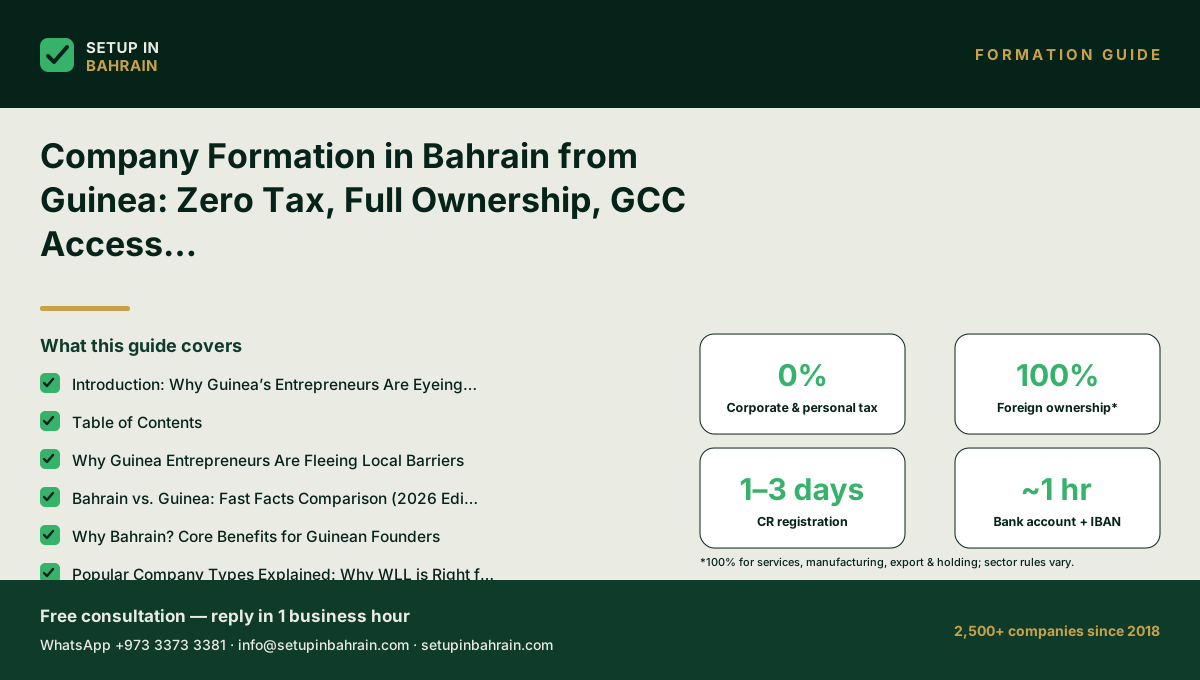
Complete guide for Guinea entrepreneurs: form a company in Bahrain with generally no corporate income tax for most sectors, 100% foreign ownership, and GCC market access. Costs, steps, visas, banking.
→ Complete guide: Company Formation in Bahrain — the full 2026 guide
View details
Ownership & capital
A Bahrain WLL can be owned by a single person — 100% foreign ownership applies to most activities, with no local partner required for services, manufacturing, export trading and holding companies. The minimum share capital is BHD 1; we recommend BHD 1,000, which makes bank account opening and investor visa approval smoother.
Introduction: Why Guinea’s Entrepreneurs Are Eyeing Bahrain
Picture yourself as a Guinean business owner in Conakry, analyzing your company’s annual books. You cleared GNF 2.5 billion (around USD 250,000) in profit last year, only to see 35% vanish due to Guinea’s corporate income tax. After accounting for social contributions, assorted municipal levies, and the cost of compliance, your working capital is whittled down to GNF 1.4 billion. Then the Guinean Franc (GNF) depreciates by another 17% against the US dollar, further shrinking your real value. You attempt to pay an international supplier, but run into the notorious limitations of BCRG's (Banque Centrale de la République de Guinée) international banking infrastructure—recurring delays, tight forex controls, and opaque compliance hurdles.
This is not a hypothetical scenario. This is the reality for thousands of Guinea’s most promising entrepreneurs in 2026—people who built wealth in construction, agriculture, bauxite trading, logistics, or consultancy, but are now watching that wealth wither away due to fundamental macroeconomic headwinds and regulatory uncertainty following the 2021 military coup.
Now, envisage the alternative: opening your own company in Bahrain—one of the fastest-growing, most entrepreneur-friendly business hubs in the Gulf. Here, you can enjoy:
- 0% corporate and personal income tax for most sectors
- 100% foreign ownership as a single shareholder, with zero need for a Bahraini partner or sponsor
- US dollar-pegged currency and world-class banking infrastructure
- Gateway to the entire GCC, with no local quota or discrimination against African passport holders
It's not just expats from India, Pakistan, or Europe making the move. Since 2022, a quiet but growing contingent of experienced Guinean entrepreneurs have set up companies in Bahrain, using local and international entities to safeguard profits, stabilize their cash reserves, and access both Middle Eastern and global markets with zero friction.
This comprehensive, consultant-written guide is tailored for Guinea's business owners, exporters, and ambitious founders. If you’re seeking escape from 35%+ tax, annual currency devaluation, and stifling bureaucracy at home, here’s your 2026 step-by-step roadmap to Bahrain company formation—packed with facts, real-world numbers, comparison tables, and actionable answers to your most pressing questions.
Table of Contents
- [Why Guinea Entrepreneurs Are Fleeing Local Barriers](#why-guinea-entrepreneurs-are-fleeing-local-barriers)
- [Bahrain vs. Guinea: Fast Facts Comparison](#bahrain-vs-guinea-fast-facts-comparison)
- [Why Bahrain? Core Benefits for Guinean Founders](#why-bahrain-core-benefits-for-guinean-founders)
- Popular Company Types Explained(#popular-company-types-explained)
- [Step-by-Step: How to Set Up a Bahrain WLL as a Guinean](#step-by-step-how-to-set-up-a-bahrain-wll-as-a-guinean)
- [Banking, Currency, and International Transfers](#banking-currency-and-international-transfers)
- Taxation: How Much Will You Really Pay?(#taxation-how-much-will-you-really-pay)
- Investor Visas and Living in Bahrain(#investor-visas-and-living-in-bahrain)
- [Building Credibility: Compliance and Substance in Bahrain](#building-credibility-compliance-and-substance-in-bahrain)
- [Avoiding Common Mistakes: Guinea–Bahrain Company Formation FAQ](#avoiding-common-mistakes-guinea-bahrain-company-formation-faq)
- Action Steps: How to Move Forward(#action-steps-how-to-move-forward)
- References & Further Reading(#references--further-reading)
Why Guinea Entrepreneurs Are Fleeing Local Barriers
Guinea, despite its natural resource wealth, presents a gauntlet of hurdles for entrepreneurs:
1. Punitive Corporate Taxation
- Guinea’s official corporate income tax: 35%—one of the highest in Sub-Saharan Africa (SSA average: 28% according to World Bank).
- Further levies: 4% social security, up to 5% municipal taxes, “exceptional contributions,” and frequent ad-hoc fees during audits.
2. Constant Currency Depreciation
- The Guinean Franc (GNF) regularly loses 15–20% of its value each year—a 50%+ reduction over four years.
- In 2023, official BCRG figures showed an 18% annual fall vs. the US dollar, cannibalizing hard-won export earnings and FX reserves.
- Payment delays and restrictions for international business due to BCRG’s currency controls.
3. Banking on a Tightrope
- Very limited international banking reach; most Guinea-based banks have minimal SWIFT/correspondent banking outside Africa.
- Global suppliers and clients increasingly refuse GNF payments.
- Moving profits out is fraught with paperwork, delays, and “informal facilitation costs.”
4. Political and Regulatory Instability
- Since the 2021 military coup, government by decree has created ongoing uncertainty for licensing, permits, customs, and taxation.
- Regulatory updates—such as business registration requirements and import/export restrictions—can change with no notice.
5. Low Ease of Doing Business
- According to the latest World Bank Enterprise Surveys and Doing Business reports, Guinea ranks 156th out of 190 for ease of business setup, legal protections, and contract enforcement.
- Licensing a new subsidiary or export agency can take 3–6 months in Conakry, often requiring multiple ministries’ approval.
6. Access to Capital and International Markets
- Guinea is not a member of the GCC (Gulf Cooperation Council), limiting access to Middle Eastern markets.
- Difficulty attracting foreign investment, syndication partners, and large contract opportunities.
These pain points have forced Guinea’s most globally minded entrepreneurs to look abroad—or risk being left behind.
Bahrain vs. Guinea: Fast Facts Comparison (2026 Edition)
| Factor | Guinea (2026) | Bahrain (2026) |
| Corporate Income Tax | 35% | 0% (except oil/gas sector) |
| Currency Stability | -17% to -20%/yr (depreciation, GNF) | Stable, BHD pegged to USD (rate: 2.65) |
| Business Setup Time | 3–6 months, 12+ government forms | 3–7 working days via MOIC e-services |
| Foreign Ownership | 49% max (most sectors), local partner needed | 100% (no local partner/sponsor required) |
| Minimum Share Capital | GNF 10,000,000 (~USD 1,000) | BHD 1 legal, BHD 1,000 practical for banks/visa |
| Banking Access | Domestic GNF only, limited SWIFT | Global banking, multi-currency, full SWIFT support |
| Investor Visa | No dedicated vehicle, slow & costly | Fast-track: own company can sponsor your residence |
| World Bank Doing Business Rank | 156/190 (2023) | 43/190 (2023) |
| Pro-Business Regulatory Bodies | Limited capacity (DNI, BCRG) | EDB, CBB, MOIC, BIPA: modern e-government |
| GCC Market Access | None | Full GCC (Saudi, UAE, Qatar, Kuwait, Oman, Bahrain) |
| Import/Export Licensing | Lengthy, discretionary | Straightforward, sector-standardized |
Why Bahrain? Core Benefits for Guinean Founders
1. Zero Corporate and Personal Tax for Most Activities
- Official CBB and MOIC documentation confirms NO corporate or personal income tax for trading, consulting, logistics, services, IT, and most sectors.
- Only exceptions: Oil and gas–related business is subject to sectoral taxes.
- No withholding tax on outbound dividends or profit repatriation.
2. Complete Foreign Ownership—Alone
- WLL (With Limited Liability) company can be owned 100% by a single person, with no local partner, no quotas, and no “silent” sponsors.
- No “Single Person Company” (WLL) regime needed—WLL covers both individuals and groups.
3. Hyper-Stable Banking and Currency
- Bahraini Dinar (BHD) is pegged to the US dollar at 2.65:1— unchanged for 35 years.
- Banking infrastructure is best-in-class (over 100 licensed banks according to CBB as of 2026), including full SWIFT, digital onboarding, and multi-currency options.
- Operate accounts in BHD, USD, AED, GBP, or EUR, with direct international wires and FX options.
4. Speed and Simplicity of Setup
- Standard WLL can be incorporated in 3 to 7 business days (per MOIC and BIPA).
- E-government systems handle everything from trade license to electronic ID and bank introduction.
5. Gateway to the GCC and Middle East
- Bahrain is a full GCC member with bilateral market access to Saudi Arabia, UAE, Qatar, Kuwait, and Oman.
- Businesses incorporated in Bahrain enjoy cross-border recognition—critical for Guinean exporters or importers.
6. Practical Investor Visa for Entrepreneurs
- No investment quota required; your WLL can directly sponsor you (and your family) for Bahraini residence status.
- Visa process is streamlined, with a legal presence and BHD 1,000+ minimum capital.
7. No Restrictive Quotas or Hidden Partner Requirements
- Unlike some GCC neighbors, Bahrain does not force African passport holders to use silent local partners or custodians.
- Ownership is fully transparent, legally protected, and internationally recognized.
8. Transparent, Pro-Business Regulation
- Regulatory authorities—MOIC (Ministry of Industry & Commerce), CBB (Central Bank of Bahrain), BIPA (Bahrain Investment Promotion Agency), and EDB (Economic Development Board)—are listed in the World Bank’s top quartile for efficiency and e-government innovation.
- All documents, contracts, and filings available in English and Arabic.
9. Broad Business Scope and Networking
- License activities include trading, advisory, logistics, technology, import/export, agriculture, and more.
- Easier connections to banks, regional distributors, and GCC buyers.
Popular Company Types Explained: Why WLL is Right for Guinea Entrepreneurs
What Is a WLL?
A WLL (With Limited Liability) company in Bahrain is the default choice for most foreign entrepreneurs. Key features:
- Minimum of one shareholder (can be a Guinean individual or company)
- Direct 100% foreign ownership
- Minimum legal share capital is BHD 1; banks and migration prefer BHD 1,000+ for practical onboarding and investor visa
- No restriction on citizenship
- Can carry out most business activities (trading, consultancy, logistics, IT, import/export, real estate, and more)
There is no “Single Person Company” regime in Bahrain—WLL accommodates single or multiple owners.
Other Entity Types (Not Usually Recommended for Africans)
- Branch of Foreign Company: Requires heavy reporting, more scrutiny from CBB; rarely needed for new ventures from Guinea.
- Closed Shareholding Company (BSC Closed): For larger groups, complex governance.
- Offshore Company: Mostly for tax structuring, not eligible for local trade license or investor visa.
For 97% of Guinean entrepreneurs, a WLL is the straightforward answer.
Step-by-Step: How to Set Up a Bahrain WLL as a Guinean
1. Strategy and Activity Selection
- Define your intended business (e.g., general trading, consulting, services, logistics, IT, trading).
- Choose business activities from MOIC’s official activity list.
2. Company Name Reservation
- Reserve an English and Arabic company name through the MOIC portal.
- Names must not infringe on trademarks or contain restricted words (quick online check available).
3. Document Preparation
- Personal documents (passport; proof of address; CV/resume; company profile for existing firms; board resolution if using a corporate shareholder).
- Proof of clean criminal record (police clearance not always required but recommended for future immigration or regulatory checks).
4. Submission to MOIC via BIPA
- Submit incorporation documents via eGovernment portal or through an authorized Bahrain corporate service provider.
5. Share Capital Deposit
- Legal minimum is BHD 1 but for best bank and visa success, deposit BHD 1,000 (~USD 2,650) into a newly opened pre-incorporation account.
- Must show proof of deposit before final incorporation.
6. MOIC Company Approval
- Incorporation certificate issued within 3–7 working days after completing approvals.
- Trade license and company registration number are provided.
7. Opening the Operational Bank Account
- Use your new trade license to open a full operational account (BHD, USD, EUR, AED, GBP).
- Choice of local or international banks: Al Baraka, ABC Bank, Bank of Bahrain & Kuwait (BBK), Citibank Bahrain, Standard Chartered.
8. Apply for Investor Visa
- Submit standard application for residency visa under your company.
- Requirements: Clean criminal record, valid insurance, proof of share capital.
- Residence granted in 2–4 weeks, allowing you to live and operate in Bahrain with full legal protection.
9. Activate Commercial Activities
- Register for necessary sector licenses (e.g., import/export, construction, logistics).
- Hire local or foreign staff as required.
- Access eGovernment systems for customs, VAT, municipality, and labor concerns.
Banking, Currency, and International Transfers
Bahrain’s Banking System: Region-Leading Access
- Over 100 licensed banks (CBB 2026 report), including all major GCC and global tier-one banks.
- Full digital onboarding: Open, fund, and operate accounts remotely in most cases.
- Multi-currency: Hold, send, and receive USD, EUR, GBP, AED, and BHD.
- No restrictive currency controls—profits and capital can be freely moved to and from international accounts.
Comparative Example: Transferring USD Profits
| Step | Guinea | Bahrain |
| $100,000 profit | GNF must be converted (avg. 17% lost yearly) | BHD holds stable against the USD (1 BHD ≈ $2.65 USD) |
| International SWIFT | Often delayed, $2,000+ in “facilitation” | 24-hour SWIFT, negligible friction or hidden charges |
| Correspondent Access | Limited to France, UAE, a few ex-Colonial | 100+ countries, global reach, no African premium |
| Capital Controls | Yes, central bank-use only, unpredictable | No—CBB policies guarantee FX remittance freedom |
Taxation: How Much Will You Really Pay?
Bahrain’s Tax Framework (Referenced: CBB, EDB, MOIC, KPMG 2026 Tax Card)
- Corporate Tax: 0% (exception: hydrocarbon sector only)
- Personal/Director Income Tax: 0%
- VAT: 10% (on local sales; does not apply to cross-border B2B exports for most services)
- Withholding Tax: 0%
- Dividends Repatriation: 0% tax
- Company renewal packages: BHD 530 with 3 months of office address; BHD 980 with 6 months; BHD 1,520 with 12 months. These are separate renewal packages, not visa fees.
Comparative Table: Guinea vs. Bahrain Tax Impact on $100k Profit
| Country | Corporate Tax | Net After Tax | Currency Devaluation (Yr 1) | Net Remaining | VAT on Exports | Dividends/Profit Transfer |
| Guinea | 35% | $65,000 | -17% ($10,910) | $54,090 | None | GNF controls, delays |
| Bahrain | 0% | $100,000 | 0% | $100,000 | None | No restriction |
Investor Visas and Living in Bahrain
Who Qualifies?
- Any 100%-owned WLL company with BHD 1,000+ share capital.
- No restriction on African nationals; no special quotas or work permit ceilings.
- Invest in your own company and gain full legal residence rights for the founder(s) and eligible dependents.
Typical Investor Visa Process
- Submit proof of company ownership and share capital
- Show valid health insurance and good conduct
- Submit biometrics and medical screening in Bahrain
- Residence issued for 1–2 years, renewable
Source: Bahrain EDB, MOIC investor visa 2026 guidelines
Living in Bahrain: Business and Lifestyle
- Cosmopolitan, safe, and family-friendly Gulf nation.
- English widely spoken; international schools and healthcare available.
- Excellent regional connectivity (one hour by road to Saudi Arabia; direct flights to Dubai and Qatar).
Building Credibility: Compliance and Substance in Bahrain
To ensure your Bahrain company is recognized by banks, regulators, and international partners:
- Maintain a registered office and commercial address in Bahrain.
- File annual renewals and company filings via MOIC e-services portal.
- Keep basic records of transactions, company resolutions, and employment contracts.
- For higher credibility: Open an actual office, hire local staff, and join the Bahrain Chamber of Commerce—a recognized business development body.
Tip: Bahrain’s regulatory regime is highly digital. All processes, from VAT filings to customs documentation, are managed online in English and Arabic.
Avoiding Common Mistakes: Guinea–Bahrain Company Formation FAQ
Q1: Is a local Bahraini sponsor necessary?
A: No. Any foreigner, including Guineans, can own 100% of a WLL company with zero Bahraini partners.Q2: Do I need a “Single Person Company” (WLL)?
A: No—there is no WLL regime in Bahrain. A WLL (With Limited Liability) can have one or multiple owners, including a single Guinean individual.Q3: What is the minimum share capital?
A: Only BHD 1 is legally required, but for practical reasons (banks and investor visas), you should deposit BHD 1,000 or more.Q4: Are there restrictions on African passport holders?
A: No. Bahrain does not discriminate by nationality for company ownership or investor visas.Q5: How fast can I set up and operate?
A: Company setup is typically complete in 3–7 working days after submission of paperwork. Bank account opening and investor visa follow within 10–21 days.Q6: Can I trade internationally using my Bahrain company?
A: Yes—your WLL can invoice and receive payments globally with zero GNF/FX friction.Q7: Are there ongoing reporting or auditing obligations?
A: Small WLLs face minimal annual filings; no mandatory audits unless you exceed certain turnover thresholds.Action Steps: How to Move Forward
- Define your business goals: Export, asset holding, international trading, or regional growth?
- Prepare your documentation: Passport, business profile, potential name options.
- Contact a Bahraini corporate service provider or use BIPA's official e-government portal to reserve your company name and start registration.
- Plan your capital deposit: Have at least BHD 1,000 ready for smoother bank and visa approval.
- Choose your banking partner: Consider whether local Bahraini or international banks better suit your needs.
- Submit for investor visa: Once the company is formed, immediately trigger the investor visa process.
- Maintain substance: Register a physical office or co-working address and begin operations for long-term credibility.
References & Further Reading
- Central Bank of Bahrain (CBB) Regulatory Guidelines: www.cbb.gov.bh(https://www.cbb.gov.bh)
- Ministry of Industry & Commerce (MOIC) eServices: www.moic.gov.bh(https://www.moic.gov.bh)
- Economic Development Board (EDB) Business Setup Portal: www.bahrainedb.com(https://www.bahrainedb.com)
- Bahrain Investors Center (BIPA): www.bipa.gov.bh(https://www.bipa.gov.bh)
- World Bank Doing Business Index 2023: www.doingbusiness.org(https://www.doingbusiness.org/en/data/exploreeconomies/bahrain)
- KPMG 2026 Bahrain Tax Card: www.kpmg.com/bh(https://www.kpmg.com/bh)
- Central Bank of the Republic of Guinea (BCRG) Official Reports: www.bcrg-guinee.org(https://www.bcrg-guinee.org)
In Conclusion
For Guinea’s globally minded entrepreneurs confronting aggressive taxes, a persistently falling local currency, and tight banking controls post-2021, the Bahrain option is more than a loophole—it’s a lifeline. In a matter of weeks, you can restructure your entire business future: global bank access, Generally no corporate income tax for most sectors, 100% ownership, and full GCC market privileges.
If you’ve outgrown the limitations of the Guinean system in 2026, now is the time to step boldly into a future where your ambitions are not boxed in by local constraints. Bahrain is not just an alternative—it is the region’s best-kept competitive edge for African entrepreneurs.
Ready to make the move? Start your Bahrain company formation journey today and turn relentless local risk into regional advantage.
Bahrain Business Guides for Guinea Citizens
Ready to set up in Bahrain from Guinea?
Tell us your business idea. We map the right entity, ownership and timeline — then handle the filing while you focus on what matters.