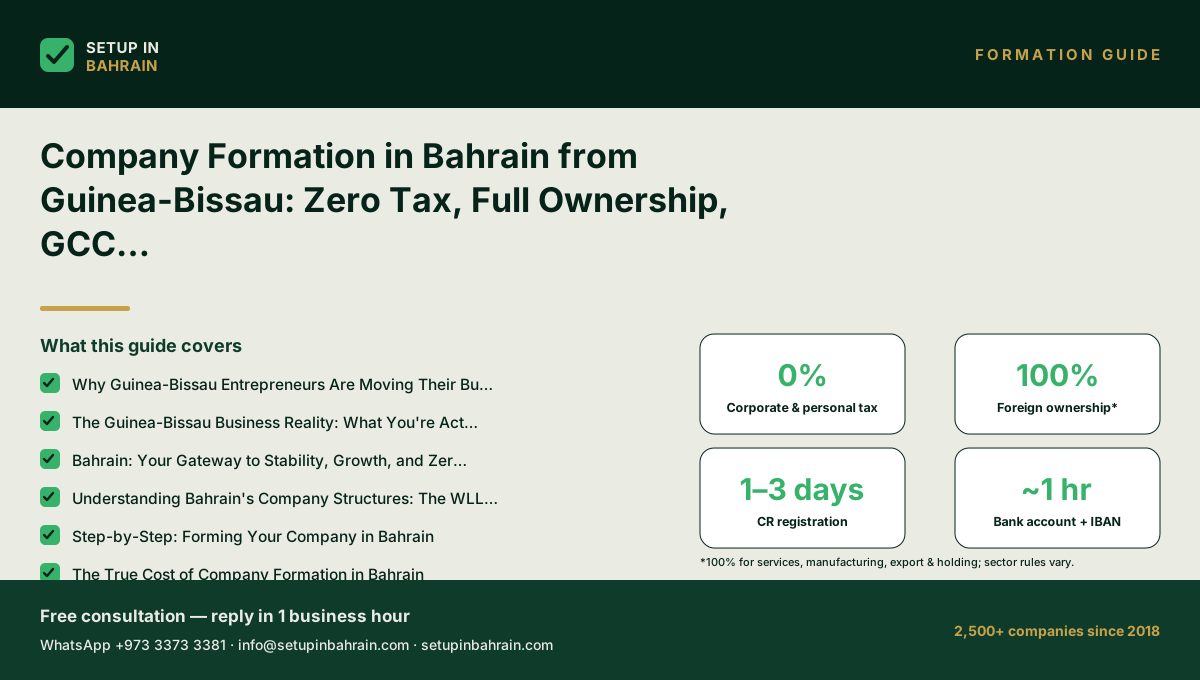
Complete guide for Guinea-Bissau entrepreneurs: form a company in Bahrain with generally no corporate income tax for most sectors, 100% foreign ownership, and GCC market access. Costs, steps, visas, banking.
→ Complete guide: Company Formation in Bahrain — the full 2026 guide
View details
Ownership & capital
A Bahrain WLL can be owned by a single person — 100% foreign ownership applies to most activities, with no local partner required for services, manufacturing, export trading and holding companies. The minimum share capital is BHD 1; we recommend BHD 1,000, which makes bank account opening and investor visa approval smoother.
For the entrepreneurial spirit thriving in Guinea-Bissau, the idea of truly expanding beyond familiar shores often comes with a heavy dose of realism. You've navigated the complexities of a cashew-driven monoeconomy, a tax system demanding 25% of your corporate profits, and a banking sector so concentrated it feels like doing business with just four branches in Bissau. The global market is calling, but the path from Bissau to international success can feel like an uphill battle against a strong current.
Imagine a business environment where the air is clear of corporate income tax. A place where you, a Guinea-Bissau national, can own 100% of your company without needing any local partners. Where your profits, earned in a stable USD-pegged currency, can be repatriated freely, with zero restrictions. This isn't a distant dream or a concept only for multinational giants. This is Bahrain, a dynamic island nation in the Arabian Gulf, and it’s increasingly becoming the strategic choice for entrepreneurs like you who are ready to unshackle their potential.
This comprehensive 2026 guide isn’t just another article on company formation. It’s written specifically for you, the Guinea-Bissau entrepreneur, addressing your unique pain points, understanding your economic context, and offering a clear, actionable roadmap to establish your presence in one of the world's most business-friendly economies. We’ll cut through the noise and provide the specific insights you need to transition your ambitions from Bissau to Bahrain.
Why Guinea-Bissau Entrepreneurs Are Moving Their Business to Bahrain
Picture this: Amadou, a seasoned cashew nut exporter from Bafatá, watches his annual profit erode: for every XOF 100 million in sales, he hands over XOF 25 million to the Guinea-Bissau tax authority (DGCI). The headache doesn’t end there — with just four banks in Bissau, he deals with week-long currency bottlenecks and waits months to clear a single incoming dollar wire. Political unrest brings constant regulatory whiplash—nine military coups (or attempts) since independence means he’s never sure which law or tax will hit next.
Last year, a Bissau-based cashew exporter with annual turnover of roughly 180 million XOF sat down with his accountant after the DGCI assessment arrived. The 25% corporate income tax bill came to 31 million XOF, on top of the 8% social security contributions and the unofficial facilitation payments that had become routine for clearing containers at the port. Two months later, a brief political flare-up closed the central bank for ten days, freezing his working capital exactly when he needed to pay seasonal pickers. He had heard about Bahrain through a contact in Dakar and began comparing the actual numbers. Within weeks, the contrast was stark.
Frustrated, Amadou sets out to diversify by expanding to the GCC. All roads, he finds, lead to Bahrain: generally no corporate income tax for most sectors, full foreign ownership without a local partner, no personal income taxes, and a streamlined company setup, often under a week. The kicker? Founders like Amadou keep every dinar they earn, in a country where BHD 1 is legally enough to launch a business (though BHD 1,000 will get him a bank account and investor visa far smoother).
If you’re a Guinea-Bissau entrepreneur tired of watching your earnings vanish to a 25% tax, or feeling trapped in a monoeconomy with limited banking under chronic instability, Bahrain opens the door to the GCC, the world’s most stable USD-pegged environment, and one of the simplest regulatory systems globally. This guide is your step-by-step playbook for finding that stability and growth.
The Guinea-Bissau Business Reality: What You're Actually Paying
The real cost isn’t just the tax rate—it’s the systemic friction, the uncertainty, and the lost opportunity. Many Guinea-Bissau business owners fixate on the 25% corporate income tax, but the true burden is so much larger and more unpredictable than any percentage number:
Corporate Income Tax: The 25% Siphon
The Directorate-General of Taxes and Contributions (DGCI) assesses corporate profits at a rate of 25%. On paper, this is a substantial chunk of your hard-earned revenue. But the reality is often more complex. Inconsistent enforcement and sometimes opaque administrative processes mean that smart operators often end up paying for "facilitation" to navigate bureaucratic hurdles and avoid arbitrary delays or assessments that can cripple cash flow. This unofficial "tax" is an unquantifiable drain on your resources and a constant source of stress.
Social Security Contributions: Another 8% Off the Top
Beyond corporate tax, businesses are also required to pay social security contributions, typically around 8% of employee salaries, in addition to employee contributions. This further adds to the operational costs, reducing your net profit and impacting your ability to invest back into your business or offer competitive wages.
The XOF Currency Trap: Instability and Bottlenecks
Operating in the West African CFA franc (XOF), while pegged to the Euro, presents its own set of challenges. Guinea-Bissau’s economy, heavily reliant on cashew exports, is susceptible to global commodity price fluctuations, which can impact the stability of the XOF within the local market. More critically for entrepreneurs like you, accessing hard currencies like USD for international trade is a constant struggle. With only four commercial banks operating effectively in Bissau, the banking infrastructure is severely limited.
- Currency Conversion Delays: Waiting weeks, or even months, to clear an incoming dollar wire or convert XOF to USD is not uncommon. This cripples your ability to make timely payments to international suppliers or receive funds efficiently from overseas clients.
- Limited Banking Capacity: The restricted number of financial institutions means less competition, higher fees, and often outdated digital services compared to international standards. This directly impacts your operational efficiency and global competitiveness.
Political Instability: The Unquantifiable Risk
Since its independence, Guinea-Bissau has endured at least nine successful or attempted coups. This chronic political instability translates directly into business risk:
- Sudden Policy Changes: New governments can introduce new taxes, change regulations, or even seize assets with little to no notice. This makes long-term business planning virtually impossible.
- Infrastructure Disruption: Political flare-ups often lead to shutdowns of essential services, including banks, ports, and even internet access, paralyzing your operations at critical junctures.
- Investor Hesitation: Both local and international investors are naturally wary of such an unstable environment, limiting access to capital for growth and expansion.
The DGCI: An Authority with Minimal Capacity
The DGCI, responsible for tax collection, often operates with limited resources and institutional capacity. This can lead to:
- Inconsistent Application of Laws: What might be permissible one day could be challenged the next, depending on the individual tax officer or prevailing political winds.
- Protracted Audits: Resolving tax disputes can be a lengthy and draining process, diverting valuable time and resources away from your core business.
- Unofficial Payments: The prevalence of "facilitation payments" at various levels of government administration, including customs and tax, adds an unpredictable and unethical layer of cost and risk to doing business.
The Monoeconomy Constraint: Limited Diversification
Guinea-Bissau's economy is overwhelmingly dominated by cashew nut exports, accounting for over 90% of total export revenues. While this provides a foundational industry, it also means:
- Lack of Economic Diversity: Limited opportunities for cross-sector growth or leveraging diverse supply chains within the country.
- Vulnerability to Market Shocks: A single bad harvest or a drop in global cashew prices can have catastrophic effects on the entire economy and individual businesses.
- Limited Local Market: The small domestic market, coupled with economic challenges, means scaling a business solely within Guinea-Bissau often hits a ceiling quickly.
Bahrain: Your Gateway to Stability, Growth, and Generally no corporate income tax for most sectors
In stark contrast to the challenges faced in Guinea-Bissau, Bahrain offers an oasis of stability, strategic advantages, and an incredibly pro-business environment. For an entrepreneur like you, it's not just a new location; it's a new paradigm for business success.
Zero Corporate Income Tax: Keep 100% of Your Profits
This is often the single most attractive feature for entrepreneurs looking to escape high-tax jurisdictions. In Bahrain, businesses operating in most sectors pay 0% corporate income tax. Imagine the impact on your bottom line: every dinar your company earns is yours to reinvest, expand, or repatriate. This isn't a temporary tax holiday; it's a foundational principle of Bahrain's economic strategy to attract foreign direct investment.
Full Foreign Ownership: No Local Partner Required
Unlike many jurisdictions in the region or globally, Bahrain allows 100% foreign ownership of companies in most sectors. This means you, as a Guinea-Bissau national, can establish your business without the need for a local sponsor or partner, retaining full control over your operations, strategy, and profits. This significantly reduces complexity, potential disputes, and ensures your vision remains uncompromised.
Strategic Access to the GCC Market
Bahrain is geographically positioned at the heart of the Gulf Cooperation Council (GCC) – a dynamic economic bloc with a combined GDP exceeding $1.6 trillion and a consumer market of over 50 million people. As a member of the GCC, Bahrain offers:
- Free Trade Agreements: Seamless access to markets like Saudi Arabia, UAE, Qatar, Kuwait, and Oman.
- Logistics Hub: Its modern Khalifa bin Salman Port and Bahrain International Airport serve as efficient gateways for goods and services across the region. The King Fahd Causeway, connecting Bahrain directly to Saudi Arabia, facilitates significant trade and transit.
- Growing Economy: The GCC continues to diversify away from oil, fostering growth in sectors like technology, logistics, tourism, and financial services.
Stable Economic and Political Environment
Bahrain has a well-established legal framework, a transparent regulatory system, and a stable political landscape. The Bahraini Dinar (BHD) is pegged to the US Dollar (1 BHD = 2.65 USD), providing incredible currency stability and predictability for international trade and financial planning. This eliminates the currency bottlenecks and political risks you face in Guinea-Bissau, allowing you to focus purely on business growth.
No Personal Income Tax
Complementing the Generally no corporate income tax for most sectors, Bahrain also imposes no personal income tax on salaries, wages, or capital gains. This means that as an entrepreneur, not only does your company benefit from tax efficiency, but your personal earnings are also maximized, making Bahrain an attractive place for you and your family to reside.
Repatriation of Profits
Bahrain has no restrictions on the repatriation of capital, profits, or dividends. You can freely move your earnings back to Guinea-Bissau or any other international account without bureaucratic hurdles or additional taxes, providing complete financial flexibility.
Highly Skilled Workforce & Business-Friendly Regulations
The Bahrain Economic Development Board (EDB) and the Ministry of Industry, Commerce and Tourism (MOIC) are highly proactive in attracting and supporting foreign investment. The country boasts:
- Streamlined Processes: Company formation, licensing, and regulatory compliance are designed to be efficient and digitally integrated.
- Skilled Talent Pool: A well-educated, multilingual local workforce, complemented by a diverse expatriate talent base, ensures you can find the human resources you need.
- Advanced Infrastructure: State-of-the-art telecommunications, logistics, and financial infrastructure support sophisticated business operations.
Understanding Bahrain's Company Structures: The WLL Advantage
When forming a company in Bahrain, choosing the right legal structure is crucial. For most Guinea-Bissau entrepreneurs, particularly those looking for full foreign ownership and flexibility, the With Limited Liability (WLL) company is the ideal choice.
The WLL (With Limited Liability) Company: Your Best Bet
The WLL structure is Bahrain's most common and versatile legal entity, offering significant advantages for foreign investors:
100% Foreign Ownership: This is a critical distinction. A WLL company in Bahrain can be owned 100% by a single foreign individual or corporate entity. You do not* need a local partner, sponsor, or even a second shareholder to incorporate a WLL. This provides unparalleled control and simplifies governance.
- Limited Liability: Your personal assets are protected from the company's debts and obligations. Your liability is limited to the amount of capital you have contributed to the company.
- Minimum Share Capital: The Legal vs. Practical Reality
- Broad Range of Activities: A WLL can undertake a wide variety of commercial activities, from trading and consulting to manufacturing and services, as long as they comply with MOIC regulations.
Other Company Types (Briefly Mentioned for Context)
While WLL is the primary focus, it’s useful to be aware of other structures:
- Bahrain Shareholding Company (BSC): For larger enterprises, often public companies, with more complex governance structures.
- Partnership Company: Less common for foreign investors seeking limited liability and full ownership.
- Branch of a Foreign Company: Suitable if you already have an established company in Guinea-Bissau and wish to simply open an operational extension without creating a separate legal entity. This doesn't create a new 'company' but an office of your existing one.
- Establishment (Sole Proprietorship): Permissible for certain activities, but comes with unlimited personal liability, making it less attractive for most entrepreneurs looking for asset protection.
- Free Zone Companies: While Bahrain does have free zones (e.g., Bahrain International Investment Park - BIIP), the entire country is essentially a free zone with its generally no corporate income tax for most sectors regime. This means many of the specific advantages of 'free zones' in other countries (like tax exemptions) are already available nationwide in Bahrain. So, for most Guinea-Bissau entrepreneurs, a mainland WLL is often the most straightforward and beneficial option.
CRITICAL NOTE: There is NO single-shareholder WLL structure in Bahrain. Do not get confused by structures in other jurisdictions. A WLL owned 100% by a single individual functions as what might be called a single-shareholder WLL elsewhere, but its legal designation is still a WLL.
Step-by-Step: Forming Your Company in Bahrain
The process of forming a company in Bahrain is notably efficient, largely thanks to the Ministry of Industry, Commerce and Tourism (MOIC) and its integrated Sijilat portal. Here’s a detailed breakdown:
Step 1: Business Activity Identification & Classification
Before anything else, you need to clearly define your business activities. The MOIC maintains a comprehensive list of commercial activities.
- Matching Activities: Ensure your proposed activities align with the classifications. Some specialized activities (e.g., financial services, healthcare) may require additional approvals from specific regulatory bodies (e.g., Central Bank of Bahrain - CBB, Ministry of Health).
- MOIC Review: Your activities will be reviewed to ensure they are permissible and correctly categorized.
Step 2: Name Reservation
Choose a unique and appropriate name for your company.
- Availability Check: Submit several preferred names in order of preference. The MOIC will check for availability and uniqueness.
- Brand Alignment: Select a name that reflects your business and is easy to remember.
Step 3: Preparing Documentation
This is where the bulk of the initial paperwork comes in. You will need:
- Application Form: Duly filled and signed.
- Passport Copy: For all shareholders and directors (if different from shareholders). For Guinea-Bissau nationals, ensure your passport is valid for at least six months.
- National ID (where applicable): If you already reside in Bahrain or have one from another GCC country.
- Proof of Address: For shareholders and directors (e.g., recent utility bill).
- Memorandum of Association (MoA): This is the foundational legal document outlining your company's purpose, share capital, structure, and operational rules. It will be drafted to comply with Bahraini law and your specific business needs. This document will explicitly state the share capital (e.g., BHD 1,000).
- Articles of Association (AoA): Often combined with the MoA, this document specifies the internal management structure and rules.
- Bank Reference Letter: For shareholders (sometimes required as part of enhanced due diligence for certain activities or nationalities).
- Business Plan (optional but recommended): For complex activities or higher capital companies, a concise business plan demonstrating viability can be beneficial during bank account opening or specific licensing.
Step 4: Submission to MOIC via Sijilat
All documentation is submitted digitally through the Sijilat portal, Bahrain’s comprehensive e-government platform for company registration.
- Online Application: Your corporate service provider will upload all prepared documents.
- Initial Review: MOIC will conduct an initial review for completeness and compliance.
- Fee Payment: Pay the government registration fees (commercial registration fee, trade name fee, etc.).
Step 5: Obtaining Initial Approvals
Depending on your business activity, you may need sector-specific approvals.
- Standard Activities: Many commercial activities receive automatic approval or only require MOIC sign-off.
- Regulated Activities: If your business falls into regulated sectors (e.g., financial services regulated by CBB, education regulated by Ministry of Education, healthcare by Ministry of Health), the MOIC will forward your application to the relevant authority for their no-objection certificate (NOC). This adds a bit of time to the process but is efficiently handled.
Step 6: Commercial Registration (CR) Issuance
Once all approvals are in place, the MOIC will issue your Commercial Registration (CR) certificate. This is your company's official birth certificate.
- Public Record: Your company will be listed in the commercial register.
- Legal Status: Your company now has legal personality and can enter into contracts.
Step 7: Post-Registration Formalities
After obtaining the CR, a few more steps are necessary:
- Capital Deposit (if applicable): If you initially stated a higher capital than BHD 1 (e.g., BHD 1,000), you will need to open a corporate bank account and deposit the subscribed share capital. Some service providers may offer temporary holding accounts until your bank account is fully established.
- Office Space (Virtual or Physical):
- Labor Market Regulatory Authority (LMRA) Registration: If you plan to hire employees (including yourself as an investor/director), your company must register with LMRA. This is crucial for obtaining work permits and investor visas.
Timeline: For straightforward WLL formations with no special approvals, the entire process can often be completed within 3-7 business days from the submission of complete documentation. Regulated activities may take 2-4 weeks longer due to inter-agency coordination.
The True Cost of Company Formation in Bahrain
Understanding the financial outlay is paramount. While Bahrain is highly cost-effective, particularly compared to its value proposition, it’s important to budget accurately. Here’s a breakdown of the typical expenses for a WLL company, providing a concrete comparison to the hidden costs of doing business in Guinea-Bissau.
1. Government Fees (Annual & One-Off)
These are standard, non-negotiable fees payable to the MOIC and other government bodies.
- Commercial Registration (CR) Fee: BHD 100 per year (approx. XOF 158,000). This is the primary annual license fee.
- Commercial Name Registration Fee: BHD 20 (approx. XOF 31,600) for a 1-year registration, renewable annually.
- Chamber of Commerce Fee: BHD 30 – BHD 200 annually (approx. XOF 47,400 – XOF 316,000), depending on the company's capital and activity. A typical WLL might pay BHD 50.
- LMRA Registration (one-off): Around BHD 100 (approx. XOF 158,000) for company registration.
- Virtual Office/Physical Address Registration: If you use a virtual office provider, they typically charge BHD 300 – BHD 600 per year (approx. XOF 474,000 – XOF 948,000). Physical office leases vary widely based on size and location.
Total Government-Related Annual Fees (Estimated, excl. office lease): BHD 200 - BHD 400 (approx. XOF 316,000 – XOF 632,000).
2. Professional Service Provider Fees (One-Off & Annual)
While you can navigate the process yourself, engaging a local corporate service provider or law firm is highly recommended for Guinea-Bissau entrepreneurs. They ensure compliance, streamline the process, and handle all local nuances.
- Company Formation Service Fee (One-Off): BHD 500 – BHD 1,500 (approx. XOF 790,000 – XOF 2,370,000). This covers drafting documents (MoA, AoA), liaising with MOIC, obtaining approvals, and initial setup.
- Registered Agent/Secretary Services (Annual): BHD 300 – BHD 800 (approx. XOF 474,000 – XOF 1,264,000). This covers ongoing compliance, regulatory updates, and acting as your official point of contact if required.
3. Share Capital Deposit
As discussed, while the legal minimum is BHD 1, the practical minimum to ensure bank account approval and facilitate investor visas is BHD 1,000 (approx. XOF 1,580,000). This capital must be deposited into your corporate bank account after the CR is issued. It is your company’s money, not a fee, and can be used for operational expenses.
4. Visa & Residency Costs (Per Person)
For yourself, your family, and any employees you hire.
- Investor Visa/Residency Permit: Approximately BHD 150 – BHD 300 per year (approx. XOF 237,000 – XOF 474,000), plus medical examination and fingerprinting fees (around BHD 80).
- Family Visas (Spouse & Children): Similar annual fees per individual.
- Work Permit for Employees: BHD 100 – BHD 300 annually per employee (plus LMRA monthly fees of BHD 50-100 per employee).
5. Other Potential Costs
- Attestation & Translation: Costs for notarizing and translating documents from Guinea-Bissau into Arabic or English (if not already in English) can range from BHD 50 – BHD 200.
- Accounting & Auditing: While generally no corporate income tax for most sectors, you still need to maintain proper books. Accounting services can range from BHD 50 – BHD 200 per month. Annual audit might be required for certain activities or above certain turnover thresholds.
- Marketing & Branding: Depending on your business, initial marketing efforts can be significant.
Cost Comparison: Guinea-Bissau vs. Bahrain (Estimated Annual Baseline)
| Item | Guinea-Bissau (XOF equivalent) | Bahrain (BHD & XOF equivalent) | Insight |
| :---------------------------------- | :-------------------------------------------------------------------- | :-------------------------------------------------------------------- | :------------------------------------------------------------------------------------------------------ |
| Corporate Income Tax | 25% of profits (highly variable, e.g., XOF 25M on XOF 100M profit) | 0% (BHD 0) | Immediate, massive savings and predictability. |
| Social Security (Employer) | 8% of payroll (e.g., XOF 800K on XOF 10M payroll) | Around BHD 14 (XOF 22K) per local employee for first 5 years (variable for expats). | Significantly lower, particularly for international staff. |
| Unofficial Payments/Facilitation | Highly unpredictable, often 5-15% of transaction value or profit. | BHD 0 (zero tolerance for corruption) | Eliminates a major, unquantifiable drain and ethical burden. |
| Banking Delays/Costs | Week-long currency bottlenecks, high transfer fees, lost opportunities. | Efficient, low-cost international transfers in USD-pegged currency. | Improves cash flow, reduces risk, and enhances global trade. |
| Company Registration Fees | Variable, often bureaucratic. | BHD 200-400 (XOF 316K-632K) annual government fees (transparent). | Predictable, transparent, and digitally managed. |
| Professional Services | Variable, often ad-hoc. | BHD 800-2,300 (XOF 1.2M-3.6M) one-off, BHD 300-800 (XOF 474K-1.2M) annual. | Expert support ensures compliance and efficiency. |
| Total Effective Cost | High & Unpredictable (taxes + unofficial + inefficiency) | Low & Predictable (fixed government/professional fees) | Bahrain offers tremendous long-term value, enabling reinvestment and growth. |
Opening a Corporate Bank Account in Bahrain: A Smooth Transition
For Guinea-Bissau entrepreneurs accustomed to the limited and
Bahrain Business Guides for Guinea-Bissau Citizens
Ready to set up in Bahrain from Guinea Bissau?
Tell us your business idea. We map the right entity, ownership and timeline — then handle the filing while you focus on what matters.